Buyer Resume Examples
Your summary should lead with a hard number, not a scope sentence. Name the annual open-to-buy you managed, the category sales you owned, or the sell-through rate you held. Merchandise managers and directors of buying…
Every resume example is written and reviewed by our team of Certified Professional Resume Writers to ensure top-quality content and formatting.
Most contract specialist roles fill based on one thing: proof you can run a full procurement cycle. Your resume needs to show solicitation work, cost analysis, and FAR compliance in concrete terms. Contracting officers and procurement directors look for awards managed, contract types handled, and dollar values administered.
List the clauses you negotiate and the acquisition methods you use. If you hold a CFCM, CCCM, or FAC-C, place it near the top. The examples below show how to present that experience on a resume built for this field. To compare layouts before you start, browse our resume templates.
Contracting officers reviewing contract specialist resumes filter first for FAR clause fluency and dollar thresholds on awarded contracts, because those two data points signal whether a candidate can manage procurement risk independently.
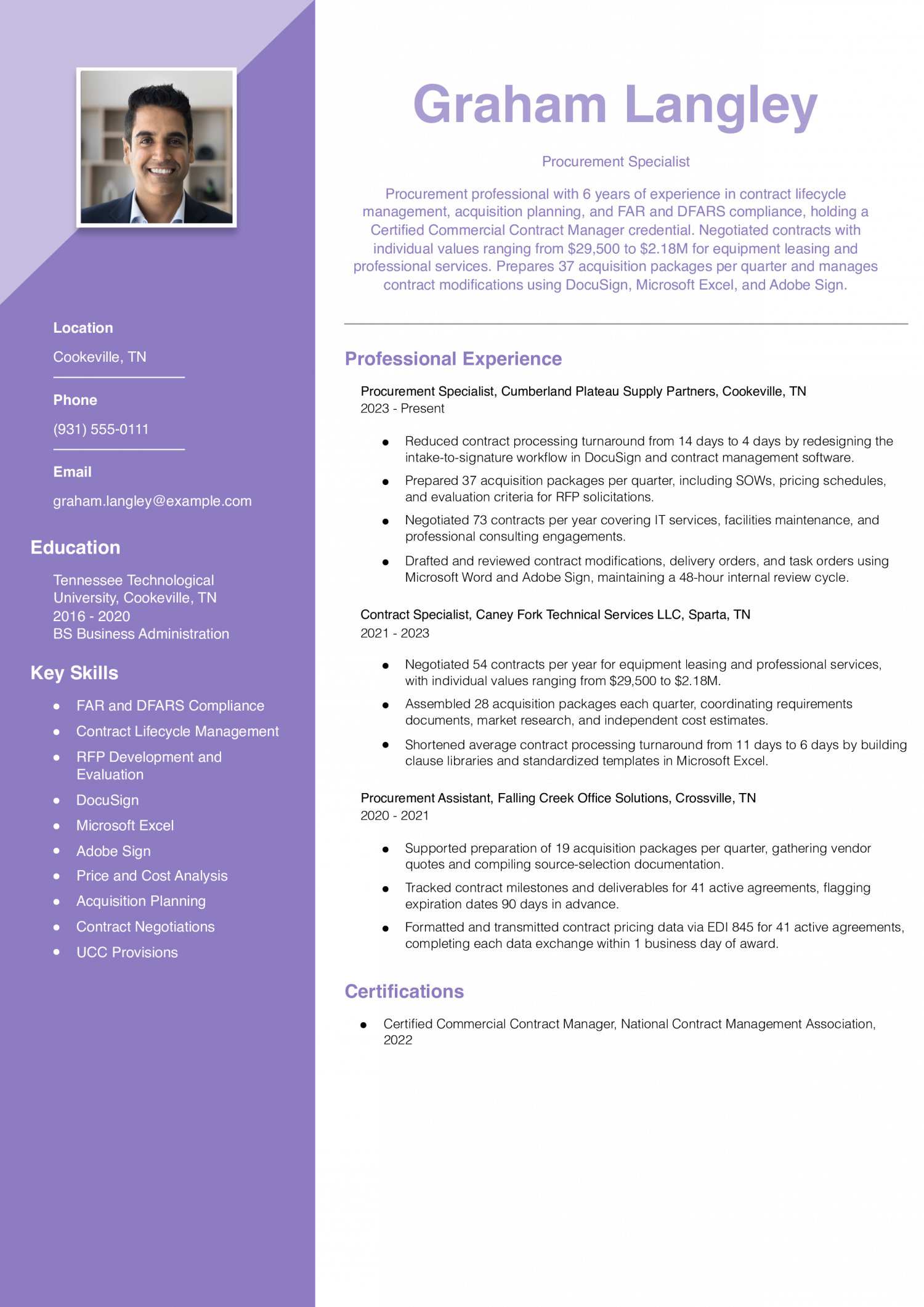
Pick this resume if you are a mid-level procurement specialist with growing contract negotiation responsibilities and a CCCM credential. Lead with the before-and-after turnaround reductions that appear across both specialist roles to show repeated process improvement.
Listing the dollar range of contracts handled, from smallest to largest, gives a reviewer a feel for the risk this specialist managed. A procurement director sees scope at a glance. Put your contract range beside the volume so the hiring team can judge both breadth and exposure.
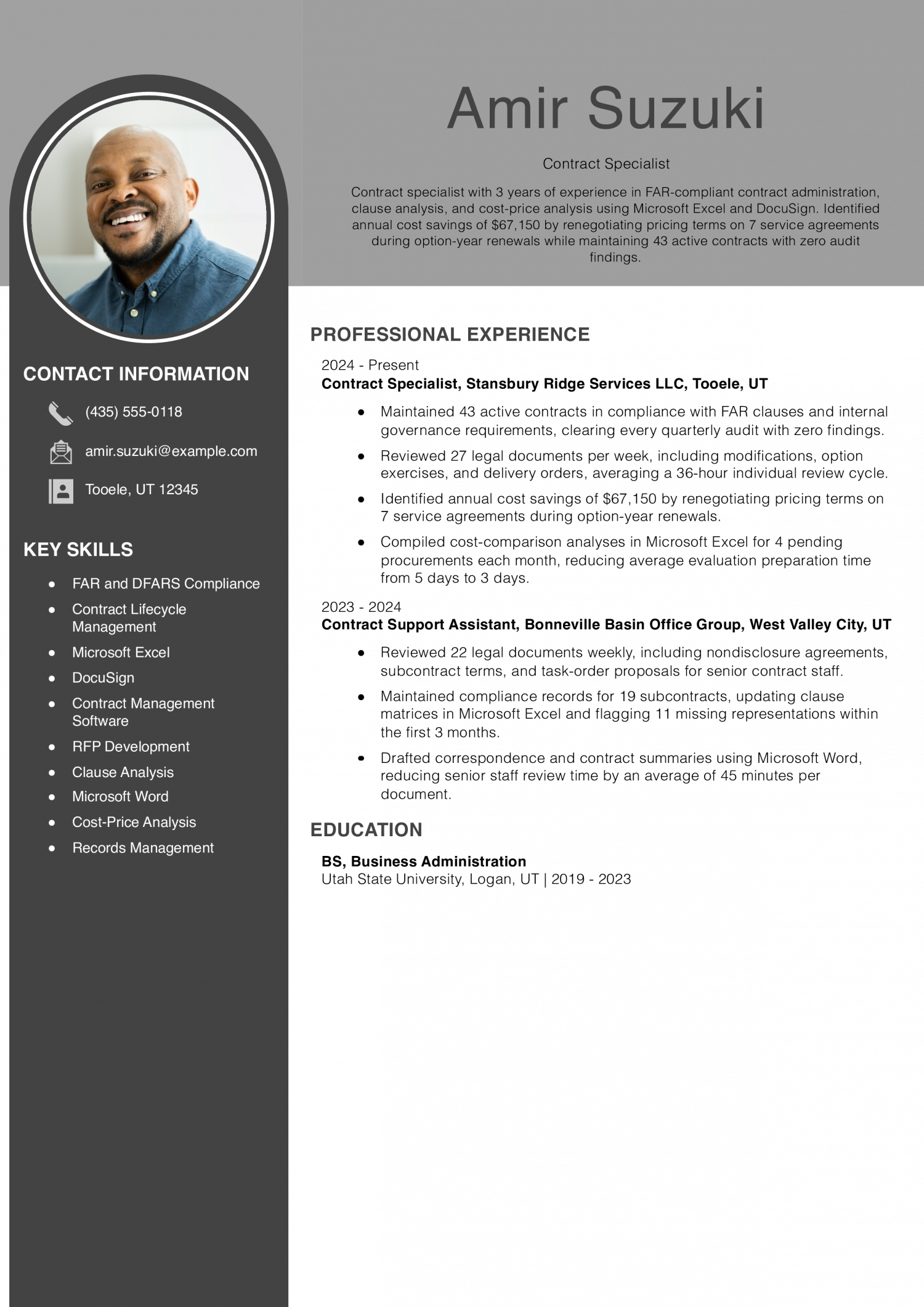
Start with this resume if you are an entry-level contract specialist building a federal acquisition career from a support role. Treat your compliance record as a headline number so reviewers see audit-ready discipline before they read anything else.
This resume attaches a review pace to the document workload, showing how long each contract took from start to finish. A contracting officer can tell this person kept up with volume without cutting corners. When you handle document review, pair the weekly count with your turnaround time.
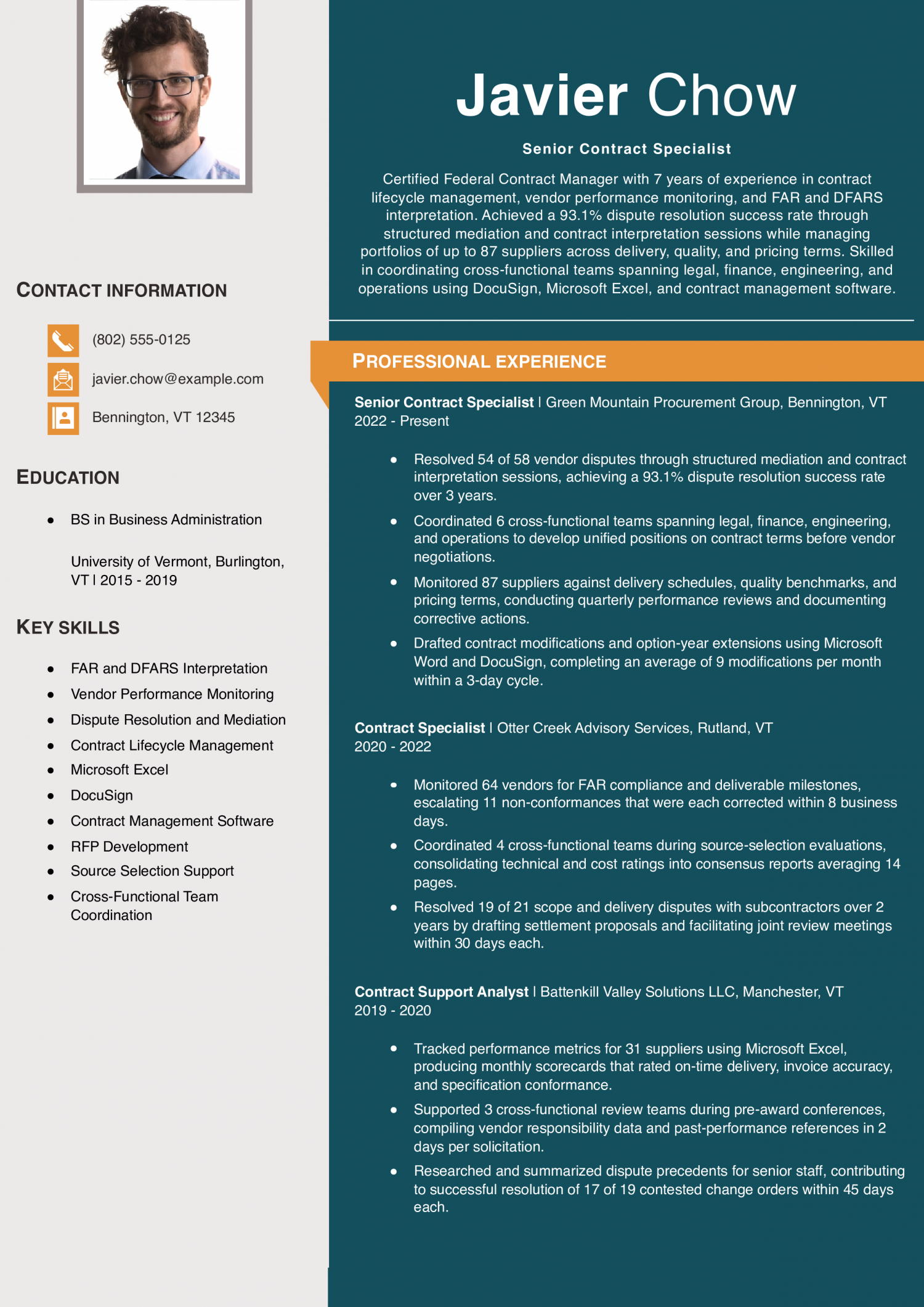
Try this resume if you are a mid-level contract specialist with federal acquisition credentials and growing vendor management responsibilities. Underline dispute resolution rates the way this resume does, tying each success percentage to the mediation method that produced it.
Naming the number of suppliers tracked and the standards each one was measured against gives this bullet real weight. A procurement manager can picture the oversight workload behind the numbers. For your own vendor management lines, say how many suppliers you monitored and which benchmarks you used.
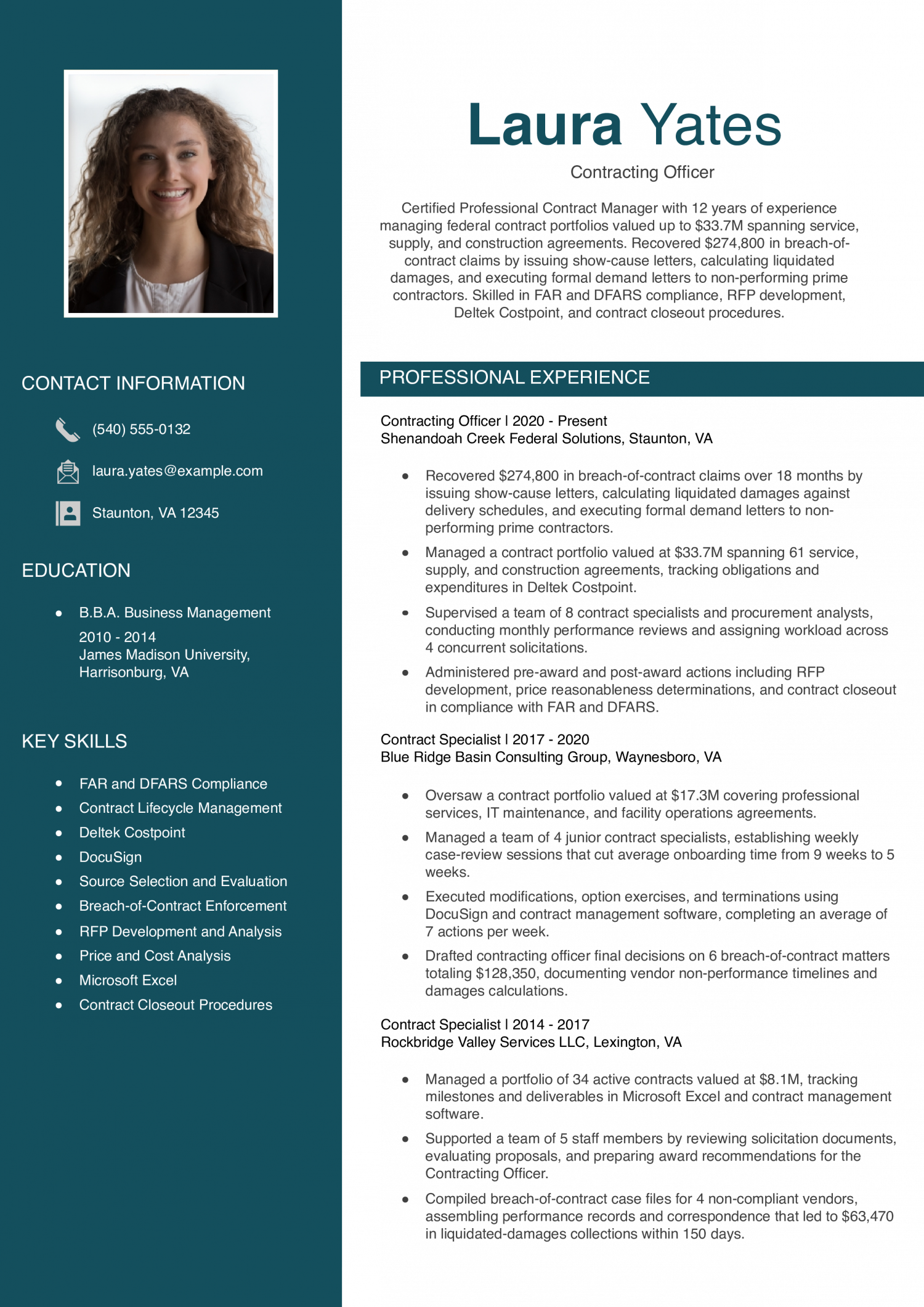
Rely on this resume if you are a senior contracting officer with over a decade of federal procurement and breach-of-contract enforcement experience. Write your claim recovery totals into each role so the dollar trail grows visibly across your career.
Weekly case reviews are the detail that makes this leadership bullet work. Connecting a recurring meeting to faster onboarding tells a supervisor the improvement came from a repeating habit, not a one-time fix. For your supervisory work, name the schedule of your reviews and the outcome they drove.
Experienced in FAR compliance, cost-price analysis, and RFP development across federal and commercial procurement settings over 6 years. Improved procurement workflow efficiency by 28.6% by consolidating approval queues and building automated status alerts in contract management software. Holds a Federal Acquisition Certification in Contracting and uses Deltek Costpoint, DocuSign, and Microsoft Excel to manage budgets, reconcile obligations, and evaluate pricing proposals.
Your summary should start with a number. State the dollar value of contracts you have managed in a 12-month period. Contracting officers and procurement directors use that figure to gauge your scope.
A line like “managed a $45M portfolio of 120 active contracts” sets the scale fast. Follow it with your acquisition method, such as sealed bidding or best-value tradeoffs. Then name the sector you know best, whether federal civilian or defense.
Skip vague phrases like “experienced professional.” A clear dollar figure and contract count tell the reader more in one line than a full paragraph of claims. Lead with the metric, then add context around it. This approach works for both federal and commercial roles.
Strong contract specialist resumes tie each bullet to a result. Name the dollar value of awards you processed. State the number of modifications you handled per quarter.
Most strong resumes also show cycle time, like days from solicitation to award. If you cut procurement lead time by 20%, say so. Savings percentages work well for cost negotiations.
Bullets without a number tend to read as duties, not results. You can also count task orders closed or protests avoided. Pair each action verb with a figure that proves the claim.
Even compliance work can be measured, such as the number of audits passed with zero findings. Two metrics per bullet is a solid target.
Break your experience into three to five areas that match contract lifecycle phases. Pre-award work includes market research and solicitation drafting. Award work covers evaluation, negotiation, and source selection.
Post-award work covers modifications and closeouts. You may also have a compliance category for FAR and DFARS adherence. A fifth group could cover small business coordination or subcontracting plan reviews.
Use these groups as subheadings or cluster your bullets under them. This structure helps contracting officers and procurement directors scan your resume in seconds. It also shows you understand the full acquisition cycle, from planning through closeout.
Keep each group to three or four bullets so no section feels heavy or hard to read.
List certifications in a dedicated block on page one, right below your summary. The CFCM and CCCM from NCMA signal mid-career competence. The CPCM, also from NCMA, signals senior-level mastery.
If you hold a FAC-C issued through the Federal Acquisition Institute process, place it first when applying to federal roles. Contracting officers and procurement directors often filter resumes by these credentials before reading bullets. Name the issuing body and the year you earned each one.
For contract management tools, add a short skills line that names your platforms. Put the platform version if it matters. Credentials and tools on page one save reviewers time and keep your resume in the stack.
If you are early in your career, expand your education section. List relevant coursework in procurement, business law, or supply chain. Include any Defense Acquisition University courses by title and level.
A capstone project tied to contract analysis belongs here too. If you have fewer than five years of experience, your degree details carry real weight. Add GPA only if it is 3.5 or higher.
For internships or co-ops in a contracting office, treat them as full experience entries with bullets and metrics. Place your education below your experience so your work comes first. End the resume with a short professional development line for any workshops you have finished.
ATS filters catch more Contract Specialist resumes than ever in 2026. Match the lists below against the posting you want. Procurement terms clear the first cut.
Soft signals like negotiation decide whether the resume moves forward. Contracting officers and procurement directors weigh hard skills first. They check for terms such as cost analysis and FAR compliance.
Soft skills then show how you handle vendors and deadlines. Both types must appear on the page. Scan each table against your target job posting.
Add every matching term to your skills section or bullet points. Turn soft skills into proof inside those bullets. A bullet that names a result tied to negotiation carries more weight than the word alone.
Drop any term from the table that does not appear in the posting.
| Soft Skills | AI-estimated % |
|---|---|
| Stakeholder communication | 77% |
| Detail orientation | 62% |
| Deadline management | 45% |
| Cross-functional collaboration | 39% |
| Ethical judgment | 33% |
And here are the top hard skills showing up most often.
| Hard Skills | AI-estimated % |
|---|---|
| Contract negotiation | 71% |
| Vendor sourcing | 66% |
| Purchase order management | 40% |
| Supplier performance evaluation | 38% |
| Cost-benefit analysis | 25% |
Skill names and rankings come from an AI model grounded in U.S. Department of Labor occupation data for contract specialists, not from a count of contract specialists’ resumes built on ResumeTemplates.com.
Before a contract specialist resume gets a closer read, hiring teams check for a short list of essentials.
Contracting officers and procurement directors scan for terms tied to real duties. Group your keywords by the work they cover. Federal acquisition terms show you know the FAR. Pre-award keywords prove you can build a solicitation. Post-award terms show you track costs and close out files. Pricing and cost analysis words flag your financial review skills. Certification terms confirm your professional standing. Each group below maps to a core contract function. Pick the rows that match your posted requirements. Add these terms near the duties they describe. Placing them in context helps automated filters read them correctly.
Contracting officers and procurement directors are split on AI right now. Some agencies want AI tools to speed up solicitation drafts. Others ban generative text in contract files entirely.
Name the tools you have used in real work. Describe what you did with them and what a human reviewed. Do not claim AI wrote your clauses if you only used it to summarize proposals.
The goal is honest positioning. Show the workflow, not a buzzword list. Let the contracting officer or director see where AI helped and where your judgment took over.
What AI is actually changing for this role
Market research: AI tools can scan pricing databases and past awards to build cost estimates in less time.
Solicitation drafting: Language models generate first drafts of sections L and M, but a specialist must verify FAR compliance.
Proposal evaluation: AI can flag non-responsive items across large proposal volumes, though evaluators still score each factor.
Contract data entry: Optical character recognition and extraction tools pull key terms from executed documents into tracking systems.
AI tools to name
How to phrase AI on your resume
Do
Skip
Contracting officers and procurement directors read this list as a map of where your career is heading. The items below tell them which contract type you know best. They also show whether you focus on federal work or commercial deals.
A strong list signals that you have put time into formal study. It sets you apart from peers who rely on experience alone. Some roles treat these as a preference, while others weight them heavily.
List each credential with the issuing body and the year you earned it.
About These Numbers
The Bureau of Labor Statistics does not publish a wage code for Contract Specialist specifically. The numbers below are a proxy: the closest published match is Buyers and Purchasing Agents (SOC 13-1020), so use them as an estimate for this role, not an exact figure.
The top-paying states for contract specialists cluster in smaller, low-supply markets rather than the coastal metros most people target first. BLS groups this role under Buyers and Purchasing Agents, a broader category. Even so, the wage spread is wide.
Earners at the 90th percentile take home roughly 66 percent more than the median. The 10th percentile sits about 38 percent below it. That gap signals real room to grow within the field.
If you are open to relocating, your resume should highlight that flexibility. List any remote contract administration experience and note your willingness to work across time zones. Contracting officers and procurement directors in underserved regions often value geographic reach over a long local tenure.
| # | State | Median Annual |
|---|---|---|
| 1 | District of Columbia | $124,090 |
| 2 | New Jersey | $93,250 |
| 3 | Maryland | $90,900 |
| 4 | Virginia | $89,210 |
| 5 | Rhode Island | $86,240 |
| 6 | Massachusetts | $85,970 |
| 7 | Washington | $85,130 |
| 8 | Colorado | $83,590 |
| 9 | Alaska | $83,460 |
| 10 | Connecticut | $83,030 |
| # | State | Workers | Median |
|---|---|---|---|
| 1 | California | 48,010 | $82,720 |
| 2 | Texas | 44,030 | $76,050 |
| 3 | New York | 31,240 | $79,460 |
| 4 | Florida | 30,270 | $72,850 |
| 5 | Virginia | 22,120 | $89,210 |
Resume Templates offers HR approved resume templates to help you create a professional resume in minutes. Choose from several template options and even pre-populate a resume from your profile.
Focus on terms that match the posting, such as FAR compliance and cost-price analysis. Pull exact phrases like source selection or contract closeout from the job listing. Weave those phrases into your bullet points so tracking systems can find them.
Give each contract assignment its own entry with the agency name and date range. Note the contract type and dollar ceiling so the reader sees your scope. If you held several short contracts at one agency, group them under a single heading.
Write each duty as a result, not a task. Instead of saying you managed contracts, state that you administered 40 firm-fixed-price contracts valued at $12M. Contracting officers and procurement directors want to see the contract type and the outcome you drove.
Yes, the Certified Commercial Contract Manager from NCMA signals that you understand commercial standards. Place the CCCM abbreviation next to your name at the top of the page. Private-sector procurement directors often look for it when screening mid-level candidates.
One page works well if you have fewer than ten years of contracting experience. A second page is reasonable when you need room for a long contract history. Keep every bullet focused on value so you do not fill space with filler.
Note any relevant activity during the gap, such as finishing federal acquisition courses or earning a CFCM. A short line under the gap period explaining what you studied gives useful context. Contracting officers and procurement directors care more about current FAR knowledge than a clean timeline.
Yes, highlight transferable skills such as vendor negotiation and purchase order management. Rewrite your bullets to mirror the language in contract specialist postings you are targeting. Adding a credential like the CFCM from NCMA can strengthen a career-change resume.
For a contract specialist, an ATS-friendly template is the safest pick, because it puts your certifications and experience where a hiring manager scans first. A basic template is a solid alternative. Whichever you choose, keep the formatting clean and easy to parse: clear section headings, a standard font, and no graphics a parser can choke on.
Contract Specialist Resume
4.5/5 stars with 200 reviews

Executive Resume Writer and Career Coach
Andrew Stoner is an executive career coach and resume writer with 17 years of experience as a hiring manager and operations leader at two Fortune 500 Financial Services companies, and as the career services director at two major university business schools.
© 2026 Resumetemplates.com All rights reserved.