Loan Officer Resume Examples
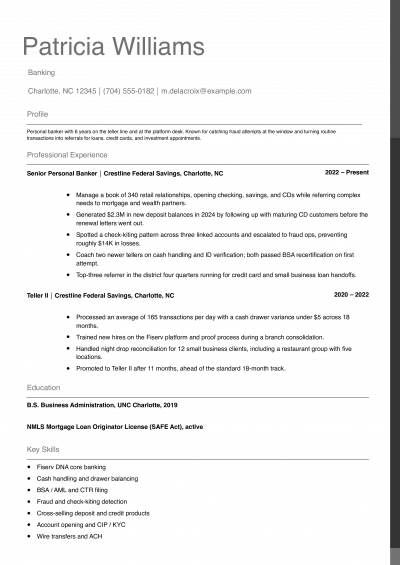
Your profile should state your years originating, the channel you work in, and your typical annual funded volume. Name the lender type: retail bank, credit union, independent mortgage bank, or broker shop. Then name the…
Every resume example is written and reviewed by our team of Certified Professional Resume Writers to ensure top-quality content and formatting.
Your loan processor resume has to prove you can move files from application to clear-to-close on time. Mortgage operations managers and branch managers want to see your pull-through rate, your volume per month, and your skill with Encompass or Calyx. A strong file shows you catch conditions early and keep pipelines moving.
List the loan types you have handled, such as FHA, VA, and conventional. Show how you cut turn times or reduced stip counts on your files. The examples below show you how to put these details on the page in a clear format. To compare layouts before you start, browse our resume templates.
Mortgage operations managers scan the first page for loan volume, turnaround times, and familiarity with specific loan origination systems, because those details signal whether a processor can keep a pipeline moving without bottlenecks.
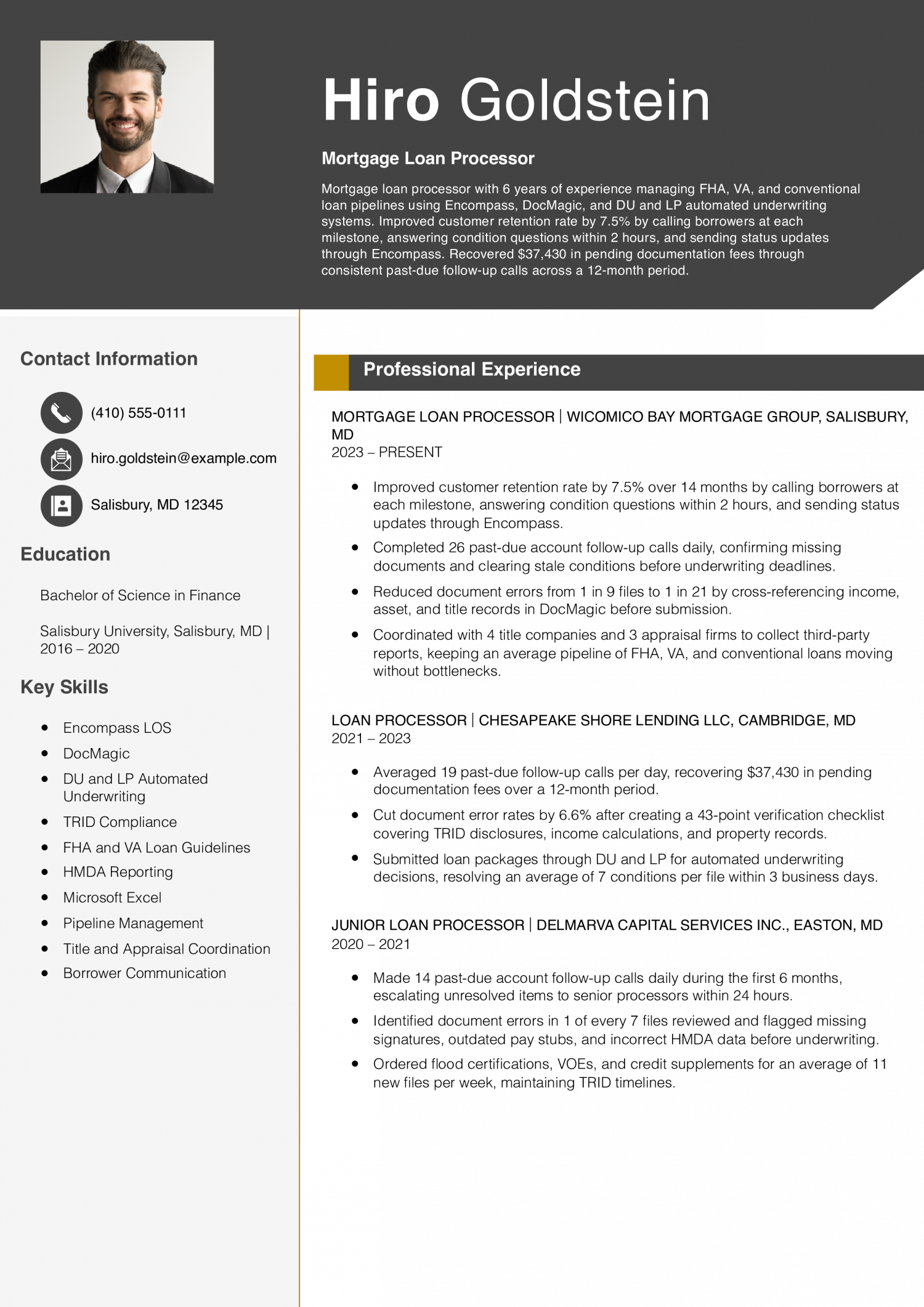
Pick this resume if you are a mid-level mortgage loan processor with about six years of experience seeking a lateral or upward move. Lead with error-rate reductions expressed as before-and-after ratios to show underwriting accuracy at a glance.
Document error rates before and after a new review step show whether the change worked. A compliance officer reading those two numbers can judge accuracy at a glance. Track your own error rate over a few months, then state both the old rate and the new one.
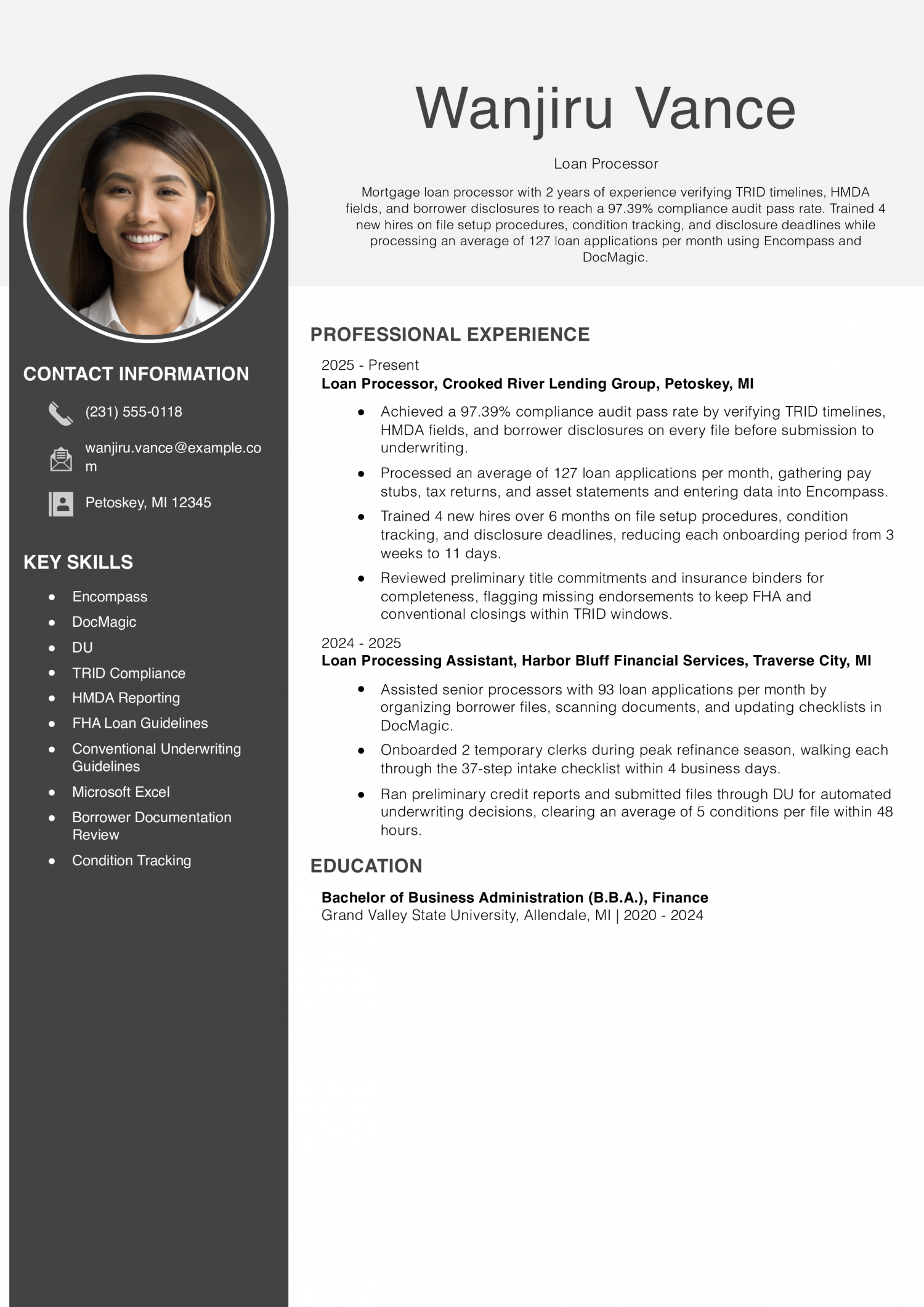
Start with this resume if you are an entry-level loan processor building a career in mortgage lending. Size each compliance result by its audit pass rate so reviewers can measure your accuracy on the spot.
Onboarding new processors is leadership work, and the shorter ramp-up time shows it paid off. A branch manager sees that the team could take on loans sooner. When you help train others, say how many new hires you guided and how the timeline compared to the old one.
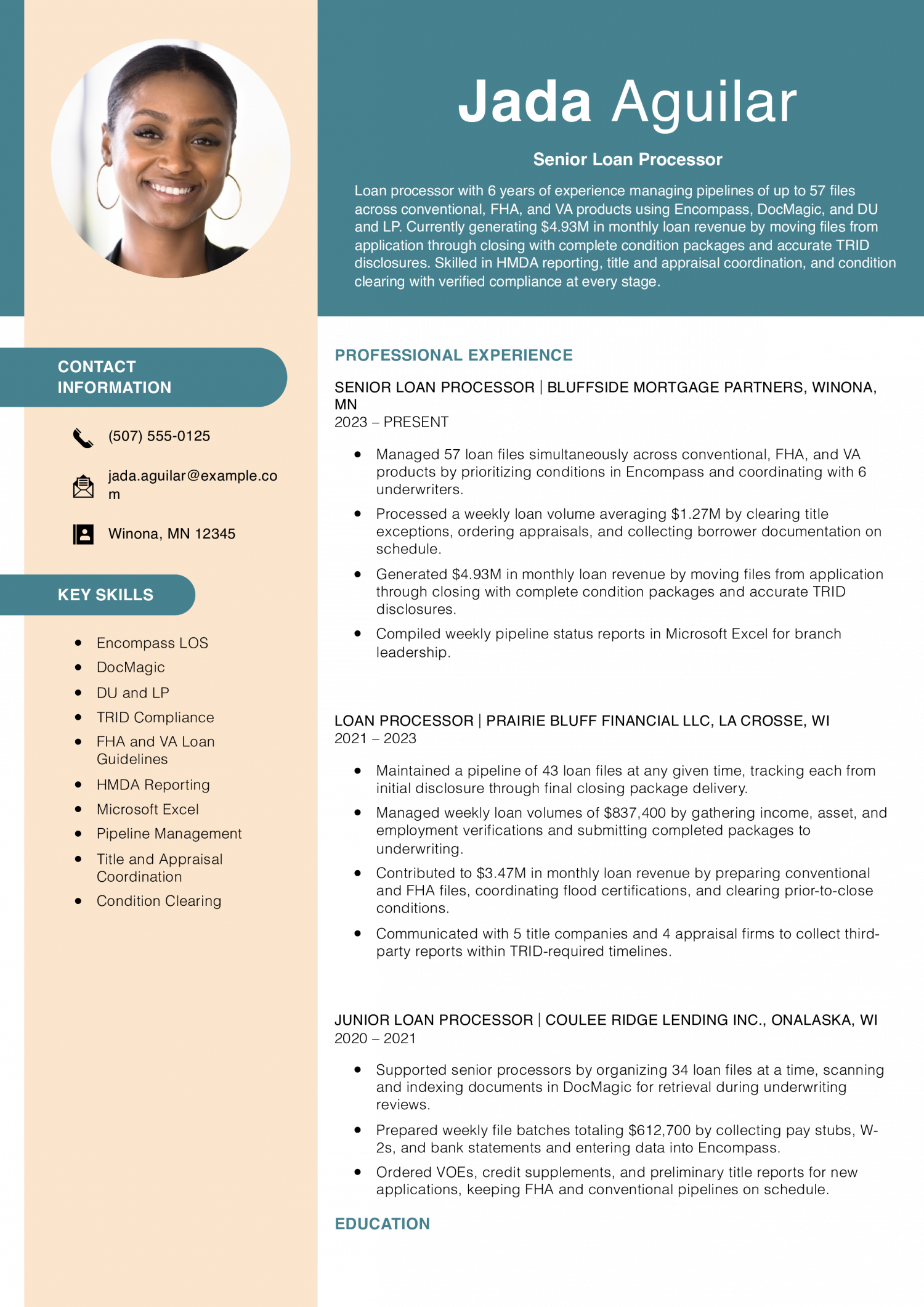
Try this resume if you are a mid-level senior loan processor ready to highlight growing pipeline responsibility and revenue output. End each bullet with the compliance framework or coordination step that made the result possible.
Encompass is named here alongside the number of underwriters coordinated. That tells a reviewer both the system and the team size behind the pipeline. For your loan work, name the software you used and count the parties you worked with on each file.
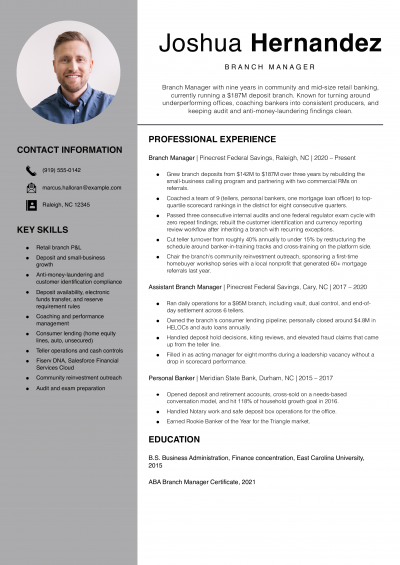
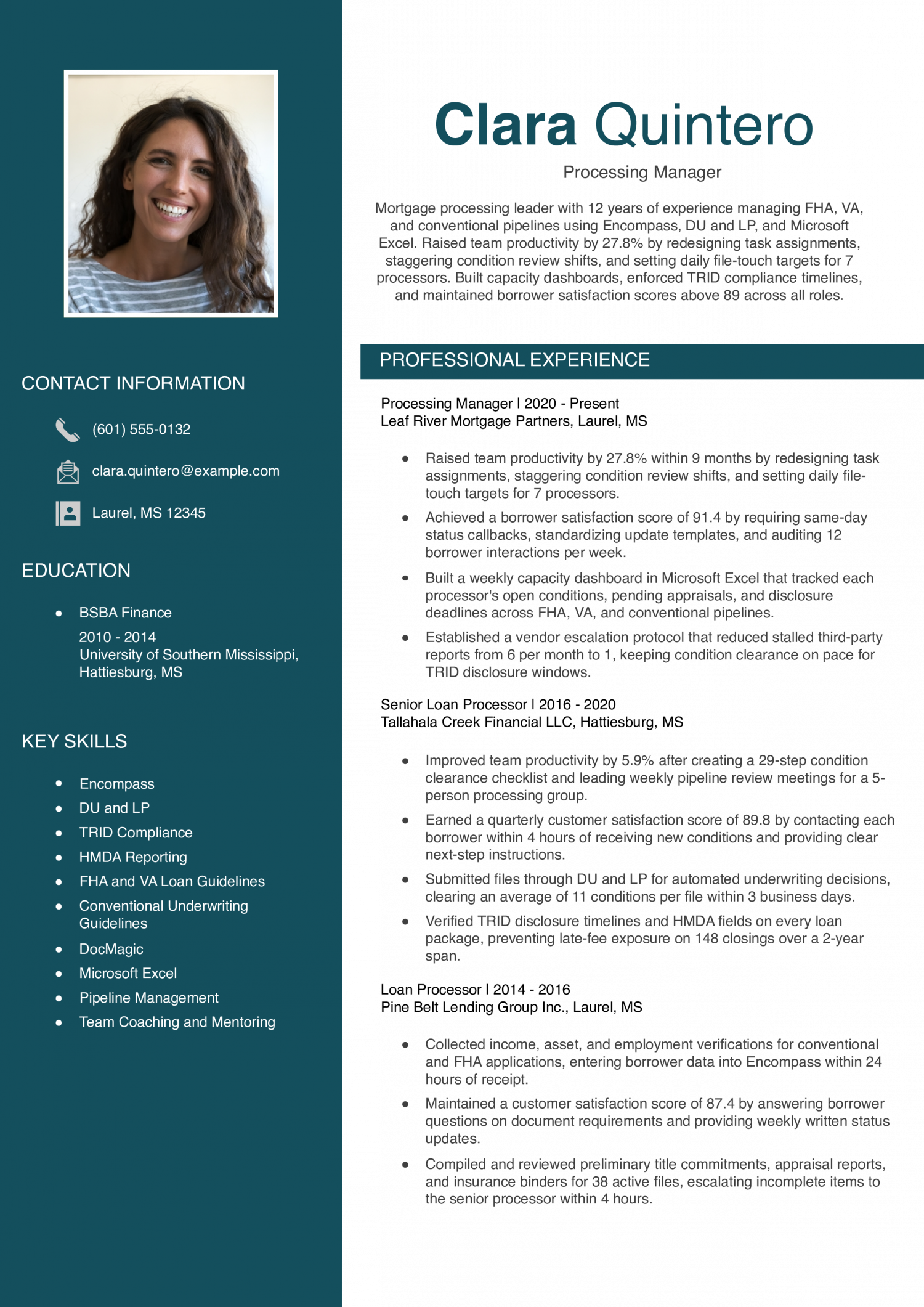
Lean on this resume if you are a senior processing manager with about a decade of mortgage operations experience and a record of leading processor teams. Size each management bullet around a before-and-after metric tied to a specific workflow change you introduced.
Stalled vendor reports dropped because the manager built a follow-up protocol, not because the vendors got faster. A director reading that sees a process fix, not luck. If you reduced delays from outside parties, say what you changed in your own workflow to get faster responses.
Experienced in processing FHA, VA, and conventional mortgage files across a 6-year career, with a record of reducing average application turnaround time from 11 days to 6 days through batched condition requests and accelerated borrower document confirmation. Skilled in Encompass, DocMagic, and electronic document management systems, with consistent success clearing an average of 8 conditions per loan within 48 hours while coordinating with underwriters, title companies, and appraisers.
Your summary should start with a number. State how many loan files you handle each month. Mortgage operations managers and branch managers look at that figure first.
It tells them if your pace fits their pipeline. A line like “Process 40 to 60 conventional and FHA files per month” sets your scope fast and establishes credibility. Follow it with your average closing rate.
Then name the loan types you touch most often. Skip vague phrases such as “experienced loan processor.” Replace them with a count and a product mix. Two concrete numbers in your opening line do more than a full paragraph of soft claims.
This approach lets hiring managers gauge your capacity in seconds. Keep the summary to three or four lines total so it stays focused and readable.
Most strong loan processor resumes pair every duty with a metric. Name your average pull-through rate or your turn time in days. Bullets without a number tend to look like duties, not results.
You might write “Cut file turn time from 22 days to 15 days.” You could also note the dollar volume you cleared each quarter. Error rates matter too. A bullet like “Maintained a 98% first-submission approval rate” shows quality.
Track conditions cleared per week or stips resolved per file. These figures help branch managers measure you against their current team. Pair each number with a plain verb like “cleared” or “reduced.” Avoid stacking more than two metrics in one bullet.
Break your experience into three or four skill areas. The first is file intake and setup. Cover how you order credit reports and verify income docs.
The second is underwriting support. Describe how you clear conditions, coordinate with underwriters, and track outstanding stips. The third area is compliance review.
Note your work with TRID disclosures and closing timelines. A fourth area could be borrower communication. Explain how you update borrowers on status and collect missing items.
Use these groups as subheadings or as clusters of bullets. This layout helps mortgage operations managers scan your resume. It also keeps your bullet points from blending into one long block of tasks.
Reviewers can then jump straight to the category that matters most for their open role.
List your loan origination system experience near the top of the resume. Name the platforms you know, such as Encompass or Calyx. Add a separate line for your AUS tools, like Desktop Underwriter.
Mortgage operations managers want to see these before they read your bullets. If you work as an independent contractor, you may need a State Mortgage Loan Originator License issued through NMLS. Requirements vary by state, so check your local regulator.
Place that license in a credentials block below your summary. Include your state and license status. Software and compliance tools belong in a skills section right after that block.
Keeping these items on page one saves reviewers from hunting through later pages.
Place your degree or diploma near the bottom of the resume. A college degree is common but not required for every posting. If you hold an associate or bachelor’s degree, list the school and field of study.
Skip your graduation date if it was more than ten years ago. Add any NMLS pre-licensing coursework you finished. Continuing education hours in federal and state lending law also belong here.
If you earned a certificate in mortgage lending, name the provider. Keep each entry to one or two lines. Close the section with relevant training, like fair lending or fraud detection courses.
This final block rounds out your resume without repeating what you already covered above.
Mortgage operations managers and branch managers scan dozens of loan processor resumes each week. They shortlist the ones that name clear skills and pair them with results. Hard skills tell them you can run files from intake to closing.
Soft skills tell them you can keep borrowers calm during long waits. Both types matter, but they serve different roles on your resume. Hard skills belong in a labeled section near the top.
Soft skills work best as proof inside your bullet points. For example, show “attention to detail” by citing an error rate you cut. Do not list soft skills without a story to back them up.
Cross-check each table below against the posting you are targeting. Add any match you can support with real work history. Drop any term you cannot tie to a specific task or outcome.
| Soft Skills | AI-estimated % |
|---|---|
| Attention to detail | 77% |
| Applicant communication | 70% |
| Deadline management | 42% |
| Cross-department collaboration | 40% |
| Discretion with confidentiality | 27% |
And here are the top hard skills showing up most often.
| Hard Skills | AI-estimated % |
|---|---|
| Loan application processing | 73% |
| Credit report review | 52% |
| Compliance documentation | 45% |
| Underwriting coordination | 39% |
| Income verification | 26% |
Skill names and rankings come from an AI model grounded in U.S. Department of Labor occupation data for loan processors, not from a count of loan processors’ resumes built on ResumeTemplates.com.
These are the must-haves hiring teams look for when scanning a loan processor resume.
Mortgage operations managers and branch managers scan for specific terms. Group your keywords by the type of processing you handle. The first row covers standard purchase and refinance files. The second row targets home equity work you may process. Compliance terms show you can verify borrower data correctly. Underwriting support keywords prove you prepare clean submissions. Closing and funding terms round out the full loan cycle. Each group maps to a real stage of file processing. Pick the rows that match your daily tasks. Swap out terms that do not fit your pipeline. Add them in your skills section or bullet points.
What mortgage operations managers expect on a loan processor resume has shifted. Listing only manual checklist steps now reads as incomplete. Naming the AI tools you use reads as current.
Show the human checks you run alongside each tool. Focus on tools tied to document review and data checks. Show that you verify every output before it moves to underwriting.
Mortgage compliance still requires a human sign-off on each file. Your resume should reflect that step clearly. Name the tool and describe your task.
Note who reviews the result before the file closes.
What AI is actually changing for this role
Document intake: AI reads pay stubs, W-2s, and bank statements, but you still confirm each data point against the 1003.
Condition tracking: Automated dashboards flag missing conditions faster, so you spend more time resolving them with borrowers.
Fraud detection: AI models score applications for red flags, and you review each alert before escalating to underwriting.
Compliance checks: Rule engines scan disclosures against state and federal guidelines, yet you validate every finding before the file ships.
AI tools to name
How to phrase AI on your resume
Do
Skip
A clean work history and strong file counts keep you in the mix. The credential below is what moves a loan processor resume from the qualified stack into a shortlist. Mortgage operations managers and branch managers scan for it to gauge your scope of work.
It tells them whether you can handle files on your own or only under a branch. List the state, the status, and the year you earned it. Add the NMLS ID on the same line so the reviewer can verify it fast.
Not every loan processor needs this credential. It depends on your work setup and your state rules. If you hold it, place it near the top of your resume.
That one detail can set you apart from other loan processors who lack it.
About These Numbers
The Bureau of Labor Statistics does not publish a wage code for Loan Processor specifically. The numbers below are a proxy: the closest published match is Loan Interviewers and Clerks (SOC 43-4131), so use them as an estimate for this role, not an exact figure.
BLS groups loan processors with all loan interviewers and clerks, so the median reflects a broad mix of roles and experience levels. That wider category has a moderate national headcount. The spread between the 10th percentile and the 90th is wide, with top earners outpacing the median by about 39 percent.
The bottom tenth sits roughly 25 percent below it. That range tells you the field rewards specific skills and tenure, not a flat pay band. Geographic pay gaps add another layer, with certain states clustering well above the national midpoint.
Lead your resume with the loan origination systems you use daily and the file volumes you close each month.
| # | State | Median Annual |
|---|---|---|
| 1 | District of Columbia | $77,080 |
| 2 | Maryland | $59,430 |
| 3 | Connecticut | $58,980 |
| 4 | Massachusetts | $58,940 |
| 5 | New Jersey | $58,760 |
| 6 | Washington | $58,740 |
| 7 | New York | $58,120 |
| 8 | North Carolina | $57,780 |
| 9 | Delaware | $57,760 |
| 10 | Oregon | $57,650 |
| # | State | Workers | Median |
|---|---|---|---|
| 1 | Texas | 17,090 | $49,980 |
| 2 | California | 14,680 | $57,300 |
| 3 | Florida | 10,690 | $50,510 |
| 4 | Michigan | 7,930 | $51,500 |
| 5 | Illinois | 6,850 | $50,000 |
Resume Templates offers HR approved resume templates to help you create a professional resume in minutes. Choose from several template options and even pre-populate a resume from your profile.
Lead with your pipeline volume, turnaround times, and the loan types you have handled. Name each loan origination system you have used, such as Encompass or Calyx Point. Include compliance knowledge and any state license you hold in good standing.
One page works well for most loan processors with fewer than ten years of experience. A second page is reasonable if you have held roles across multiple lenders or servicing shops. Keep every bullet tied to a measurable result so the extra space earns its place.
List each title in reverse order under the same company name to show a clear path upward. Highlight the point at which you moved from junior files to more complex loan products. Mortgage operations managers look for rising responsibility, so note when you began training newer staff.
Yes, a two-sentence summary at the top gives branch managers a fast read on your experience level. State your years in mortgage processing and the average monthly file count you have carried. This context frames the bullet points that follow it.
Pull from any role where you reviewed documents, verified data, or met regulatory deadlines. Bank teller work, title company support, and insurance claims roles all build transferable skills. Frame each bullet around accuracy rates or document turnaround times.
Start bullets with verbs that describe what you did to a file, such as verified, cleared, and ordered. Use coordinated or escalated when you worked with underwriters or title companies. Avoid vague verbs like assisted or helped, because they hide your role in the outcome.
Note the gap briefly in your work history with a one-line label such as family leave or professional development. If you kept up with regulation changes during the gap, say so in that line. Branch managers care more about current knowledge of TRID and disclosure rules than about a blank stretch of months.
For a loan processor, an ATS-friendly template is the safest pick, because it puts your certifications and experience where a hiring manager scans first. A basic template is a solid alternative. Whichever you choose, keep the formatting clean and easy to parse: clear section headings, a standard font, and no graphics a parser can choke on.
Loan Processor Resume
4.2/5 stars with 105 reviews

Executive Resume Writer and Career Coach
Andrew Stoner is an executive career coach and resume writer with 17 years of experience as a hiring manager and operations leader at two Fortune 500 Financial Services companies, and as the career services director at two major university business schools.
© 2026 Resumetemplates.com All rights reserved.