

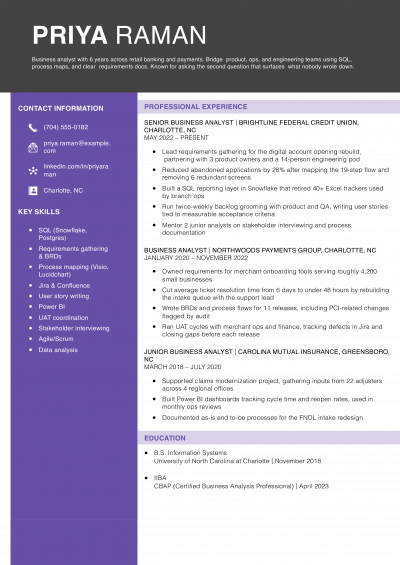
Business Analyst Resume Examples
Lead with the one signal another BA cannot copy from a LinkedIn search. That might be a domain (claims, payments, supply chain), a system (Salesforce, SAP S/4HANA, Workday), or a methodology depth like SAFe RTE…
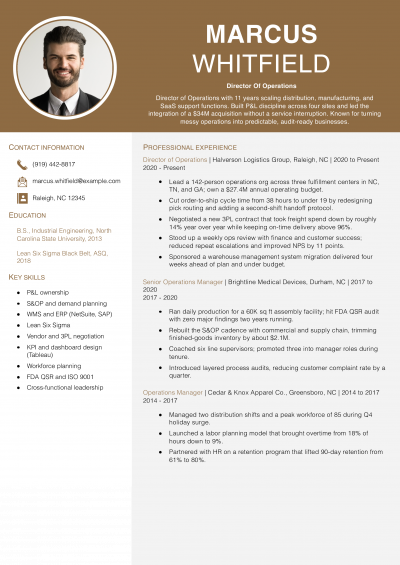
Every resume example is written and reviewed by our team of Certified Professional Resume Writers to ensure top-quality content and formatting.
Business administration roles get hired on proof you move work, money, and people through a system. Your resume should show the tools you run that system in: Excel models, ERP platforms like NetSuite or SAP, Salesforce, and reporting in Tableau.
Operations directors and business managers scan for scope: budget size, headcount supported, vendors managed, and the process you rebuilt. Pair each role with one clean output, a cost cut, a cycle time reduced, or an audit passed.
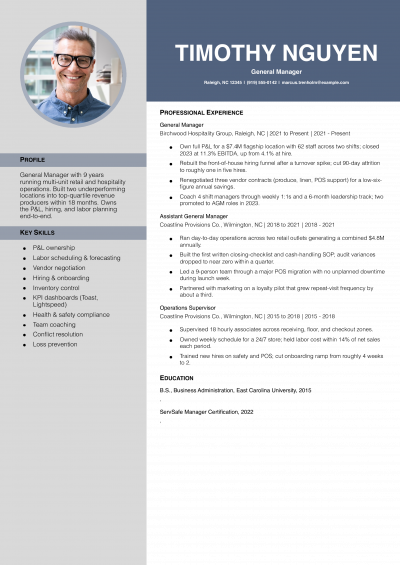
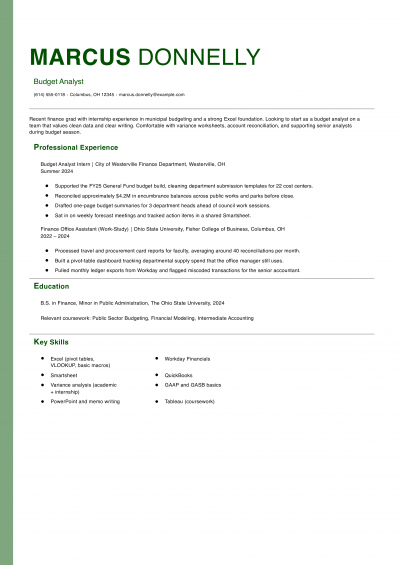
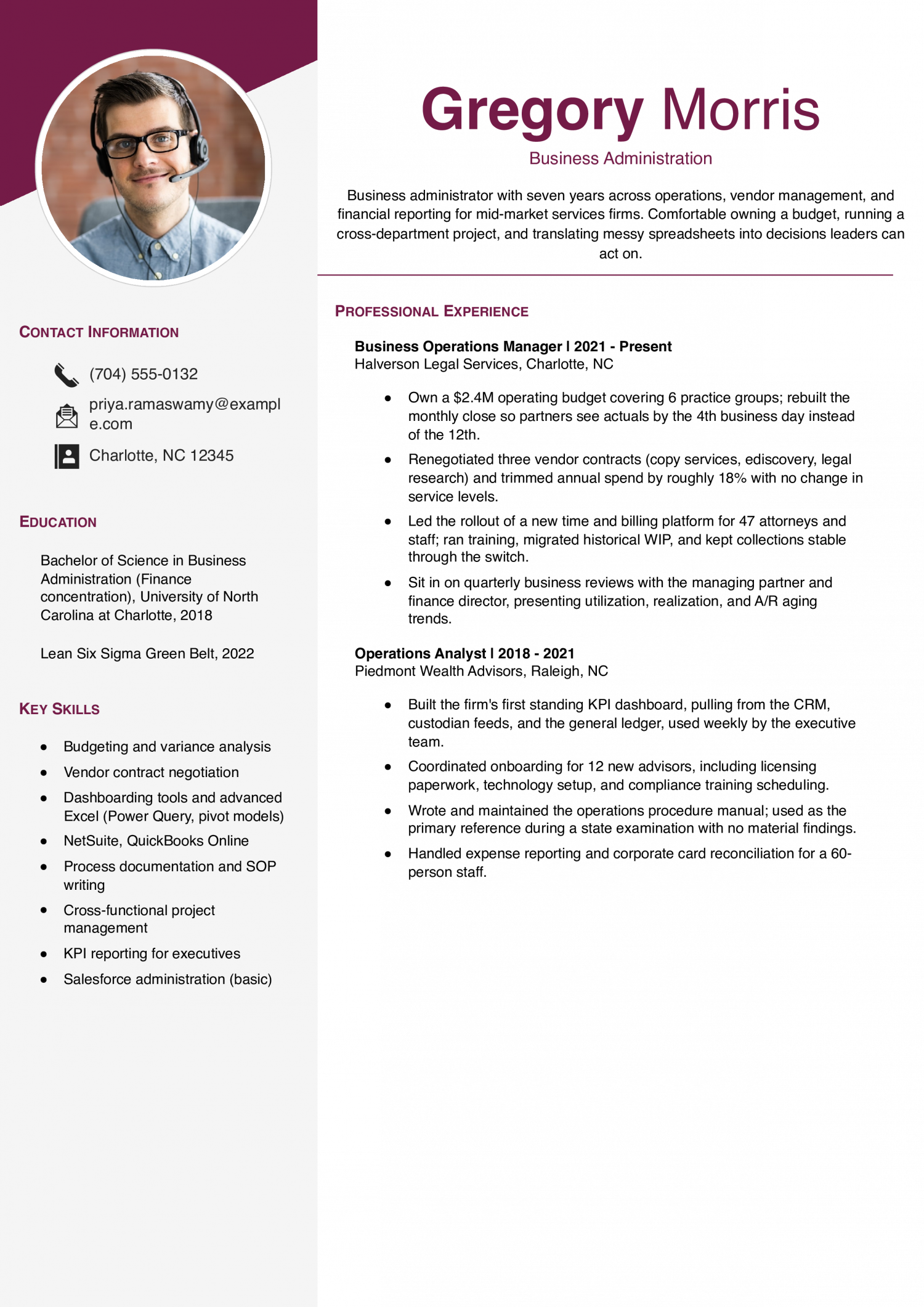
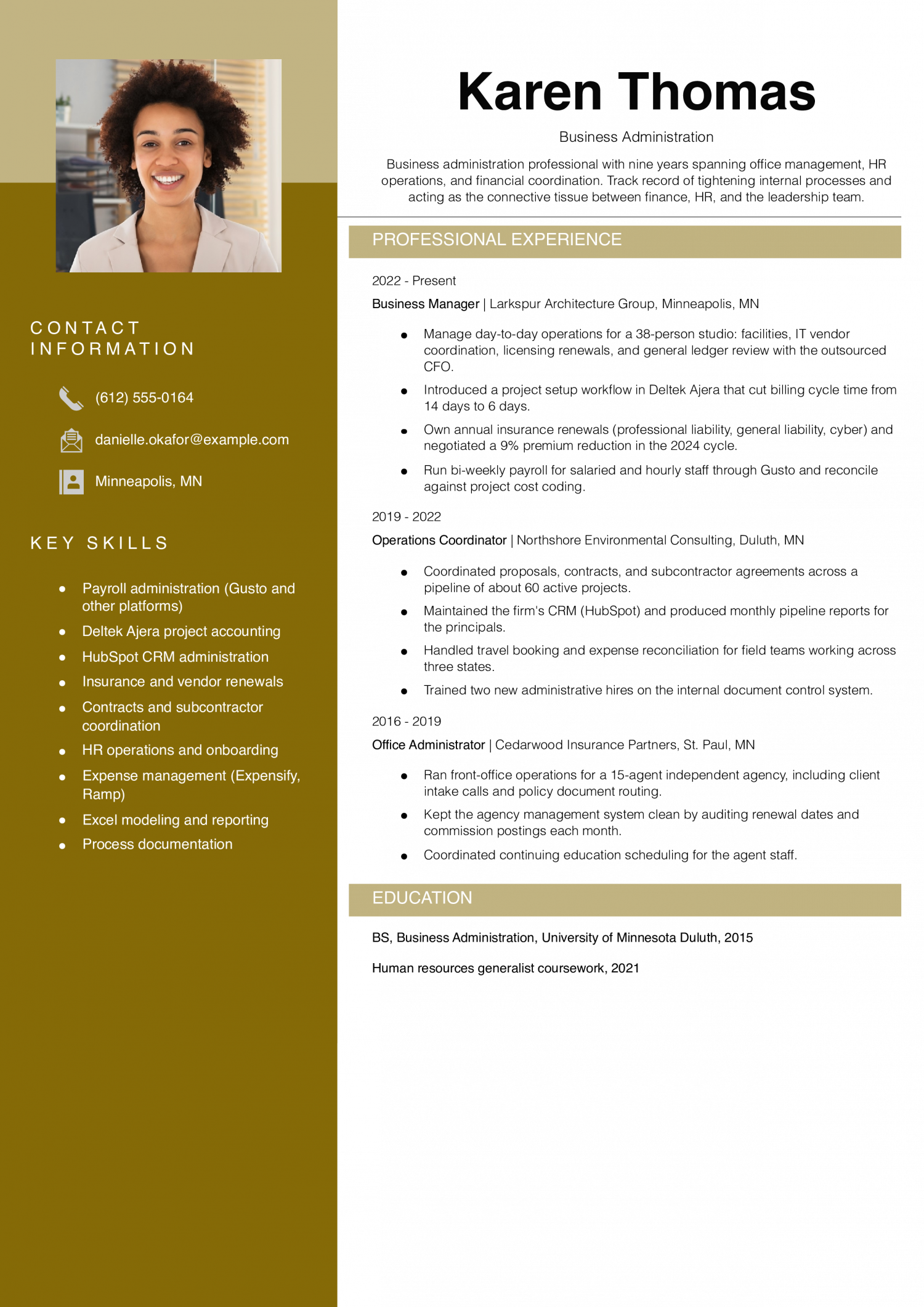
The examples below show how to frame that scope across coordinator, analyst, and manager levels without padding.
You are stepping out of a business program with internships or campus leadership rather than full-time roles. This resume has to prove you can support operations, handle data, and work across teams from day one.
You have four to nine years running projects, budgets, or teams inside a department. This resume has to show measured gains in process, cost, or throughput that operations directors can tie to real dollars.
You have led business operations across sites, functions, or a full P and L for a decade or more. This resume has to prove strategy, staff development, and margin results at a scale that shapes company direction.
Rebecca Halloway
Portland, OR | (503) 555-0147 | [email protected] | linkedin.com/in/rebeccahalloway
Business administration professional with 11 years across operations, finance coordination, and office leadership in professional services and nonprofit environments. Comfortable owning a budget, running a systems migration, and building the reporting cadence that keeps leadership out of the weeds. Known for turning ad-hoc processes into repeatable ones and for being the person a CFO or executive director trusts with an ambiguous problem.
Business Operations Manager
Willamette Public Health Alliance | Portland, OR | 2021-Present
Senior Operations Coordinator
Fircrest Litigation Support | Beaverton, OR | 2018-2021
Office Manager
Cascade Structural Engineers | Salem, OR | 2015-2018
Administrative Assistant
Rogue Valley Health Foundation | Medford, OR | 2013-2015
Your profile should sit at the top of page one. State your years of experience, the industry you work in, and the size of the operation you support. Say whether that means a five-person office, a 40-person department, or a multi-site business unit.
Name the functions you own, such as budgeting, vendor management, HR coordination, or executive support. Operations directors and business managers read this block first to place your scope. A profile that reads as generic office support gets passed over for one that names a $2M budget or a 12-state footprint.
Keep this to three or four lines, and let the specifics do the work of selling you.
Business administration bullets without a number tend to read as duties, not results. Recruiters scan for the size of what you managed before they read the verb. Name the budget you tracked, the headcount you supported, and the vendor spend you negotiated.
A strong bullet reads: reduced office supply spend 18 percent across four sites by consolidating three vendors. Another: onboarded 24 new hires in one quarter with zero I-9 errors. If your work is less numeric, pivot to volume and scope: number of contracts reviewed, meetings coordinated per week, or reports produced each month.
Two or three quantified bullets per role tend to advance further than a page of unmeasured tasks.
Cluster your bullets under the functions you actually own, so a reader can find them fast. Most business administration resumes group work into four buckets. Financial operations covers budgeting, expense tracking, invoice approval, and month-end close support.
People operations covers onboarding, benefits coordination, payroll input, and policy rollout. Vendor and facilities covers contracts, renewals, office moves, and equipment sourcing. Executive and project support covers calendaring, board prep, meeting minutes, and cross-team project tracking.
Pick the three or four buckets that match your actual week. Lead each role with the category that carries the most weight. This structure lets an operations director scan your resume in 20 seconds and see the shape of your work.
Put your degree, any relevant credentials, and your core systems in a short block near the top. Operations directors and business managers need to confirm tool fluency before they read your bullets. Name the ERP you use, such as NetSuite, SAP, or Oracle.
Name your accounting stack, such as QuickBooks or Sage Intacct. Name the people systems you use, such as Workday or BambooHR. Add Excel depth, meaning pivot tables, XLOOKUP, or macros.
If you hold a project management or process improvement credential, list it under your name or in a credentials line. This placement saves a reader from hunting on page two. It also gets you through keyword filters that screen for named platforms.
End the resume with an education block that supports the scope you opened with. List your degree, the institution, and the graduation year if it falls in the last 15 years. A business administration, finance, accounting, or management degree carries the most weight for these roles.
If your degree sits outside business, name the coursework that bridges the gap, such as managerial accounting, organizational behavior, or operations management. Add continuing education that maps to the job, such as a project management track or a state HR compliance course. Keep this block to four or five lines.
Honors belong here only if you graduated in the last three years.
Five years ago, a Business Administration resume read like a duty list under each job title. The mix has shifted toward budget ownership, process metrics, and named systems like ERP or CRM tools. Operations directors and business managers weigh hard skills first when scanning.
Tools, budgets, and reporting stacks give them a fast read on scope. Soft skills such as cross-functional coordination carry weight in the interview, not the scan. Pull the target posting and mark every term that names a tool or a method.
Match those against the hard skills table below and keep the wording the posting uses. Treat the soft skills table as a prompt list for your bullets, not a filler section. Each soft skill should back a bullet that shows the outcome you drove.
Vendor renewals, month-end close, and audit prep all read as concrete proof.
| Soft Skills | AI-estimated % |
|---|---|
| Communication | 77% |
| Time management | 59% |
| Organizational skills | 47% |
| Teamwork | 35% |
| Attention to detail | 30% |
And here are the top hard skills showing up most often.
| Hard Skills | AI-estimated % |
|---|---|
| Microsoft Office Suite | 66% |
| Project management | 62% |
| Budget management | 48% |
| Database management | 36% |
| Payroll management | 27% |
Skill names and rankings come from an AI model grounded in U.S. Department of Labor occupation data for business administrators, not from a count of business administrators’ resumes built on ResumeTemplates.com.
Before a business administration resume gets a closer read, hiring teams check for a short list of essentials.
Operations directors and business managers scan for the work you have done. They want proof you can run the daily engine of a business. Group your keywords by the function you owned, not by soft traits. One row can cover budgets and vendor spend. Another can cover staff scheduling and payroll input. A third can cover process work and SOP writing. A fourth can cover office systems and reporting tools. A fifth can cover records work and audit prep. Put the terms in each row the way your trade writes them. Keep the capitals on a system, a standard or a report. Match the words to what the job post asks for.
| Niche | Keywords ATS scans for |
|---|---|
| Budget and Spend | P&L tracking, expense reports, vendor contracts |
| Staff Operations | payroll input, PTO tracking, staff scheduling |
| Process and SOPs | SOP writing, workflow mapping, KPI reporting |
| Office Systems | QuickBooks, SAP, Microsoft 365 |
| Records and Audits | records retention, audit prep, policy binders |
Operations directors and business managers are split on AI at work. Some teams want faster reporting, drafting, and scheduling from AI tools. Others restrict AI use around vendor data, payroll files, or client records. Name the tools you actually use in a normal week. Describe the workflow honestly, including what a person still reviews. Do not claim you automate reporting if you paste numbers into a chatbot. Do not claim policy work if you only summarize meeting notes. State the task, the tool, and who signs off on the output. That framing reads as current without overstating your reach.
AI drafts first-pass status reports and KPI summaries that you fact-check against source systems before sending.
Transcription tools produce action items and owners, which you edit for tone and confidentiality before distribution.
AI flags renewal dates and unusual clauses in vendor agreements, though legal or finance still approves the terms.
Assistants sort inbound requests and propose meeting times, while you set the rules and confirm sensitive replies.
Microsoft Copilot: Draft status updates, summarize Teams meetings, and build first-pass Excel views that you verify.
ChatGPT: Reword policies, outline SOPs, and pressure-test project plans before you edit for accuracy and voice.
Resume Templates offers HR approved resume templates to help you create a professional resume in minutes. Choose from several template options and even pre-populate a resume from your profile.
Write it out on first mention as Bachelor of Business Administration, with your major in parentheses if you had one.
Put the degree, school, and graduation year on one line in the education section.
Use Master of Business Administration, the formal degree name, in the education section of your resume.
The plural apostrophe form belongs in casual writing, not on a resume. The short form MBA is fine in a summary line or after the degree is spelled out once.
Write Associate of Applied Science in Business Administration or Associate of Arts in Business Administration, whichever your college awarded.
Follow it with the school name, city, and graduation year on the same line. If the degree is in progress, add the expected month and year instead of a past date.
Lead with the operations work operations directors and business managers hire for: budget management, vendor coordination, and process improvement.
Add the software you use daily, such as Excel, QuickBooks, NetSuite, or Salesforce. Round it out with people skills you can prove in bullets, like cross-team coordination and staff training.
Open with a two-line summary that names your degree program, expected graduation, and one area of focus.
Use the experience section for coursework projects, campus roles, and part-time jobs where you handled numbers, schedules, or vendors. Add a skills row with the software you learned in class, such as Excel, QuickBooks, or Tableau.
Start each bullet with an action verb and end with a number that shows scope or result.
Name the budget you managed, the headcount you supported, or the process you shortened. Operations directors and business managers scan for those figures first, so put them near the front of the line.
Yes, list it in the education section under your degrees, with the certificate name, issuing school, and completion year.
Name the focus area in parentheses if it maps to the job, such as finance or supply chain. Skip it if the certificate is unrelated and your resume is already full.
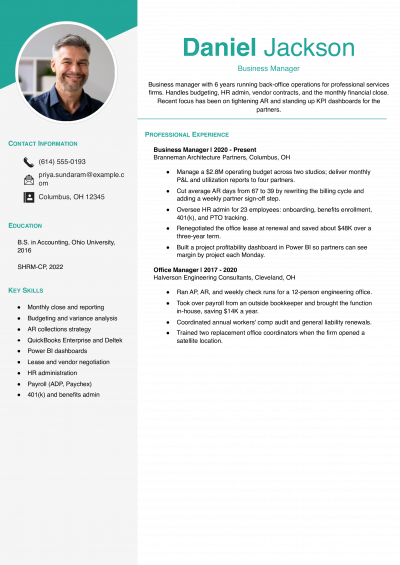
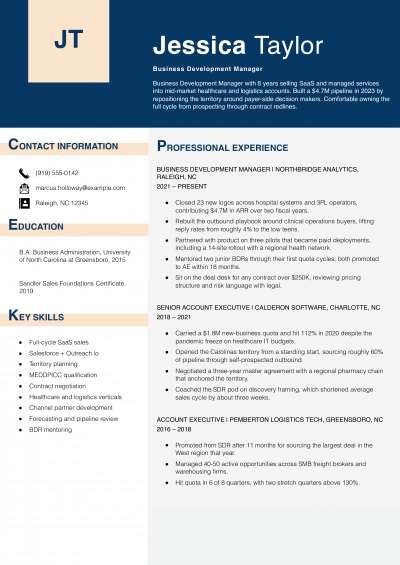
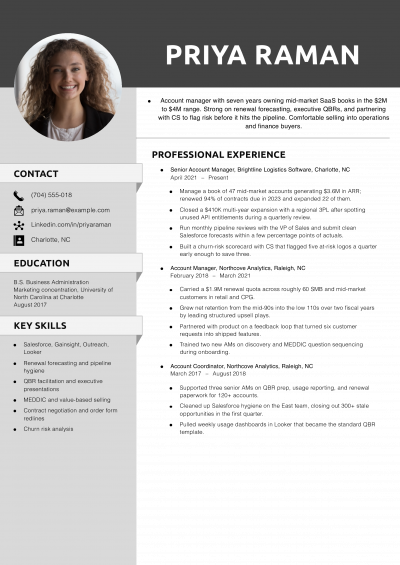
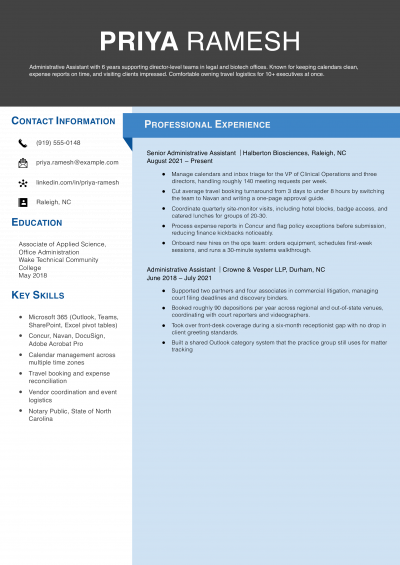
For a business administrator, a professional template is the safest pick, because it signals the polish hiring managers in this field expect. A clean ATS-friendly layout works well too. Whichever you choose, keep the formatting clean and easy to parse: clear section headings, a standard font, and no graphics a parser can choke on.
Business Administration Resume
4.8/5 stars with 211 reviews

Executive Resume Writer and Career Coach
Andrew Stoner is an executive career coach and resume writer with 17 years of experience as a hiring manager and operations leader at two Fortune 500 Financial Services companies, and as the career services director at two major university business schools.
© 2026 Resumetemplates.com All rights reserved.