
Tip !

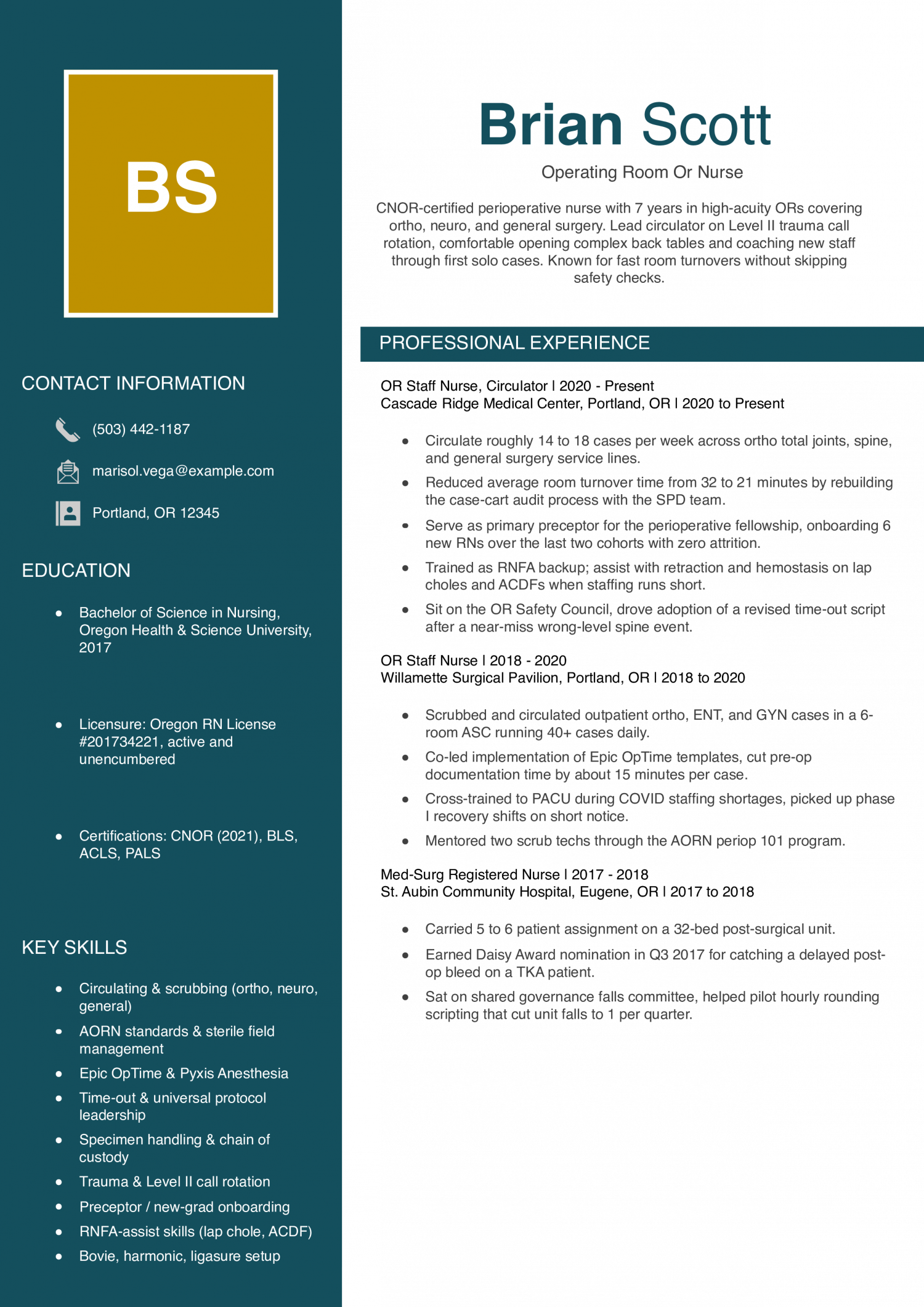
The OR nurse resumes that get callbacks share three things: a credentials block above experience showing RN, CNOR, and BLS or ACLS, specialty case counts in the first bullet, and AORN-aligned count and time-out language.

Andrew Stoner , Executive Resume Writer and Career Coach

Why this resume works

  • Specialty certification up top: Listing CNOR right next to the name tells OR managers this is a verified perioperative nurse, not a floor nurse pivoting in.
  • Real turnover time numbers: Going from 32 to 21 minutes on room turnover is the kind of metric OR directors care about every single day.
  • Shows growth from floor to OR: The med-surg to ASC to Level II progression reads like a real career path and explains how she picked up trauma-level skills.

New Grad RN Example

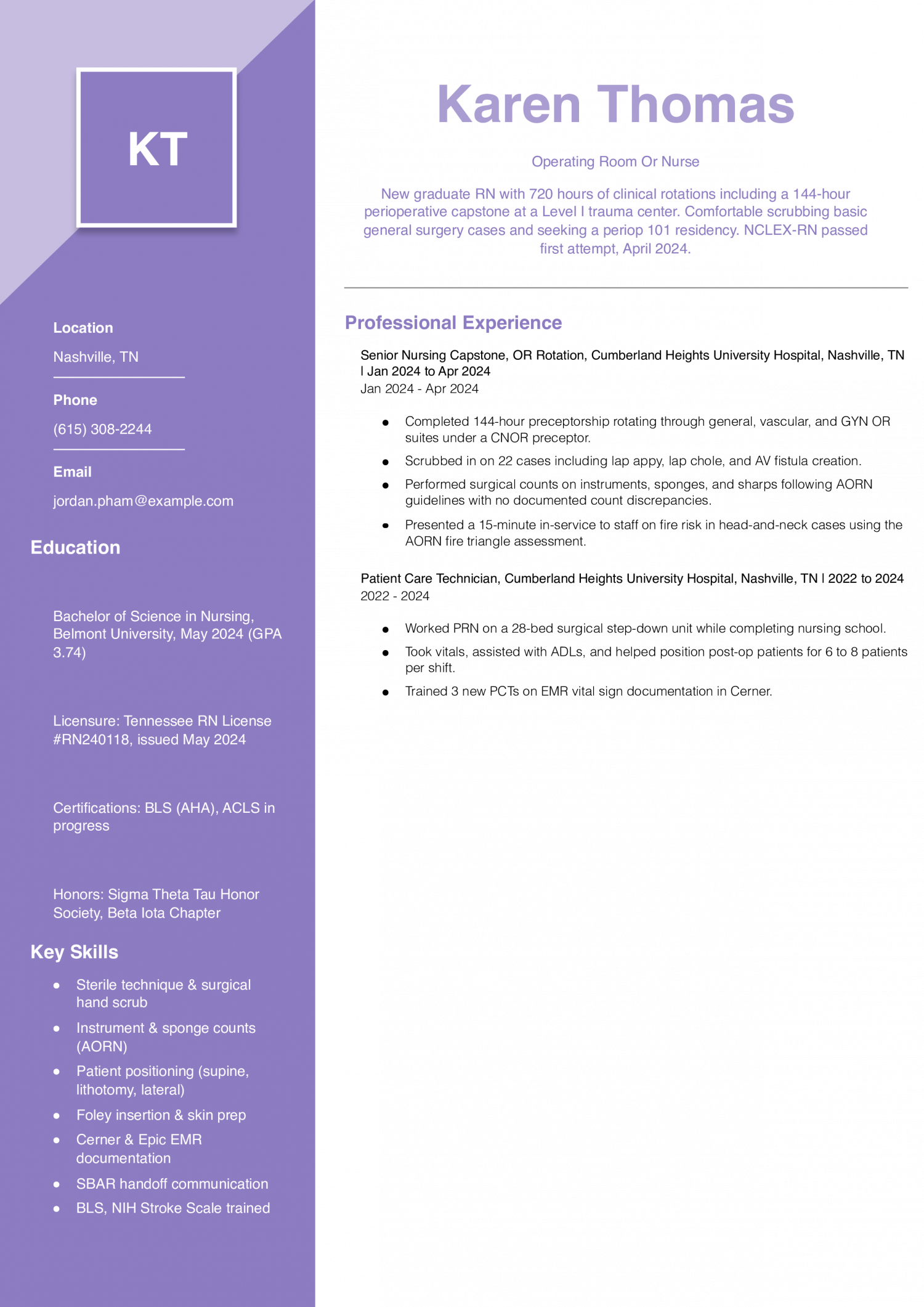
The new grad RN archetype is finishing a perioperative residency or OR-focused capstone. Your resume needs to prove sterile field competency, supervised case counts, and the specialty rotations you logged during training.

Why this resume works

  • Names the capstone hours: Saying 144 hours and listing actual cases scrubbed is much stronger than just writing ‘completed OR rotation’.
  • PCT job earns its place: The tech role shows hospital experience, EMR fluency, and trust from a manager, all of which a fresh BSN alone cannot prove.
  • Honest about what is in progress: Marking ACLS as in progress instead of leaving it off keeps the resume credible for nurse recruiters who verify certs.

Staff Nurse Example

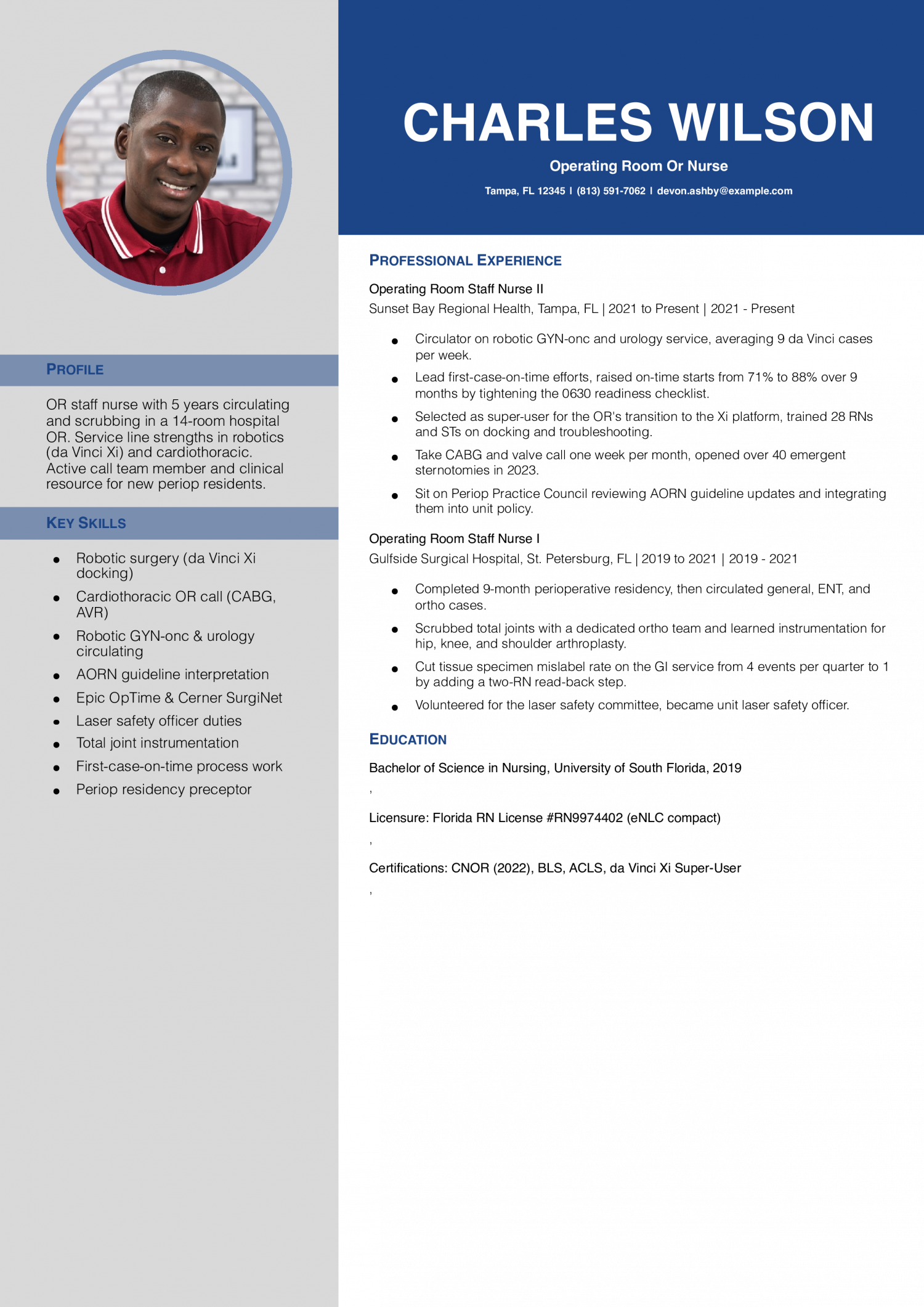
The staff nurse archetype circulates and scrubs independently across a defined service line. Your resume needs to prove case volume per specialty, AORN time-out and count compliance, and the surgeons or service lines you support.

Why this resume works

  • Service lines are clear: Calling out da Vinci Xi, CABG call, and total joints helps a hiring manager match this nurse to an open service.
  • On-time starts is a real OR metric: Moving first-case-on-time from 71% to 88% is the kind of number OR leadership reports up to the C-suite every month.
  • Specialty roles beyond the bedside: Laser safety officer and Xi super-user show this nurse takes on the unit jobs nobody else wants, which charge nurses notice.

Charge Nurse Example

The charge nurse archetype runs the board, assigns rooms, and owns turnover for a shift. Your resume needs to prove room count managed, on-time first-case starts, and the staff and trainees you direct.

Why this resume works

  • Real dollar impact on overtime: Saving $412,000 in OT in one fiscal year is the language nurse executives and CFOs share, not just unit-level praise.
  • Scope is sized in the summary: Naming 18 rooms, 220+ FTEs, and six service lines gives a reader an instant sense of how big this charge role actually is.
  • Shows survey and safety work: Joint Commission readiness chair plus the retained sponge RCA prove this is a charge nurse who owns regulatory and safety outcomes, not just the schedule.

How to Write an Operating Room Or Nurse Resume

01 Open with the metric an OR nurse manager would use to size you up

The first line of your summary should name your weekly case volume, your strongest service line, and the role you run.

OR nurse managers and surgical services directors read this as your readiness to take call and pick up rooms on day one.

A line like “Perioperative RN, 18 to 22 cases per week across ortho and general, circulator and scrub” beats a paragraph about your passion for patient care.

Anchor the rest of the summary to CNOR status, years in the OR, and the trauma level or ASC setting you trained in.

02 Quantify cases, turnover, and counts

Strong OR nurse bullets carry numbers. Name cases per shift, on-time first-case start rates, and room turnover times where you have them.

Tie metrics to the work that nurse managers track on the daily board.

Bullets without a number tend to read as a job description. “Circulated 12 to 15 cases per shift across ortho and neuro” lands harder than “circulated surgical cases.”

Most strong resumes name two or three quantified bullets per role plus AORN-aligned count and specimen-handling language.

03 Group bullets by the procedures you own

Sort your experience into three or four buckets reviewers scan for: circulating duties, scrub duties, specialty case mix, and patient safety compliance.

Under circulating, name positioning, prep, documentation in the EHR, and intraoperative advocacy.

Under scrub, name instrument setup, draping, and passing for specific procedures like total joints, laparoscopic colectomies, or CABG.

Under specialty case mix, list ortho, cardiac, neuro, robotic, trauma, or pediatric cases with rough volumes. Under compliance, name AORN counts, time-outs, and Joint Commission readiness.

04 Place credentials and EHR tools on page one

Build a credentials block under your summary with RN license state and status, CNOR, BLS, ACLS, and PALS where you hold them.

Add expiration months so the reviewer can verify currency at a glance. Do not publish your license number.

Next to credentials, list the EHRs and surgical systems you use: Epic OpTime, Cerner SurgiNet, Meditech, Pyxis, and any robotic platforms like da Vinci.

OR nurse managers and surgical services directors need these visible early because credential verification clears the first gate before the clinical read begins.

05 Cut duty lists and generic nursing filler

Trim bullets that any floor RN could claim: “provided patient care,” “followed hospital policy,” “worked as part of a team.”

Replace them with circulator-, scrub-, or PACU-specific actions tied to a case type.

Cut objective statements, high school entries, and certifications older than the current renewal cycle.

Keep education tight: nursing school, degree, and any perioperative residency or Periop 101 completion. The space you save goes to specialty case mix and AORN-aligned compliance language.

Perioperative hiring is tight in 2026. Surgical services teams are running leaner boards and the bar to clear a recruiter screen is higher. The skills below come from our user-built operating room nurse resumes.

OR nurse managers weigh hard skills like circulating, scrubbing, and CNOR first, then read soft skills as evidence behind your bullets, not standalone claims. Match the list against the specialty mix in the posting and use soft skills to back specific case examples.

Soft Skills % of resumes with this skill
Team communication 75%
Attention to detail 58%
Surgical team collaboration 50%
Critical thinking 39%
Composure under pressure 35%

And here are the top hard skills showing up most often.

Hard Skills % of resumes with this skill
Sterile technique 78%
Surgical instrument handling 50%
Patient positioning and safety 45%
Intraoperative patient monitoring 37%
BLS and ACLS certification 35%

Based on data from thousands of operating room nurses’ resumes built on ResumeTemplates.com, May 2026.


Must Have on an Operating Room Or Nurse Resume

The items below are what separate an operating room or nurse resume from one that gets put back in the pile.

Licensure Requirements

Credential verification clears the first gate before a clinical reviewer reads your bullets. Put licensure and core certifications in a page-one block reviewers can scan in seconds.

List your active RN license by state with “in good standing” and the expiration month. Do not publish the license number on the resume; provide it on the application form when asked.

If you hold a Nurse Licensure Compact multistate license, say so. Compact status signals you can start without waiting on an endorsement.

  • RN License, State of [X], in good standing, expires MM/YYYY
  • Nurse Licensure Compact (multistate) privilege, where applicable
  • BLS (American Heart Association), expires MM/YYYY
  • ACLS (American Heart Association), expires MM/YYYY
  • PALS, where required by service line, expires MM/YYYY
  • CNOR, expires MM/YYYY

Continuing Education That Belongs on the Resume

List CE that maps to the service lines in the posting. Reviewers read recent CE as evidence you stay current with technique and equipment changes.

Add a short “Continuing Education” block under certifications. Name the course, provider, and completion year. Keep entries from the last three years.

Track CE clock hours per your state board requirements and renew CNOR contact hours through CCI or AORN-approved providers.

  • AORN Periop 101 or Periop 202 modules
  • Robotic surgery training (da Vinci credentialing)
  • Total joints, spine, or cardiac specialty courses
  • Malignant hyperthermia and fire safety in the OR
  • Sterile processing and instrument reprocessing updates
  • Trauma nursing (TNCC) where the role supports trauma cases

EHR and Surgical Systems

OR nurse managers scan for the perioperative module by name, not just the EHR brand. List the specific surgical workflow you used.

  • Epic OpTime (intraoperative documentation, case tracking, preference cards)
  • Cerner SurgiNet (SurgiNet Anesthesia, PowerChart integration)
  • Meditech Surgical Services
  • Pyxis MedStation and Omnicell automated dispensing
  • Da Vinci robotic platform documentation
  • RFID and manual surgical count systems

HIPAA and OSHA Compliance

Keep Cases Generic, Keep Metrics Aggregated

Describe case types, volumes, and outcomes without naming patients, surgeons, or dates that could identify a case. “Circulated 14 total joint cases per week” is safe; a named patient story is not.

If you cite quality outcomes from a unit-level dashboard, note that the data is aggregated and de-identified.

  • Use case categories and volumes, not individual patient stories
  • Do not name surgeons in case examples without permission
  • Omit specific dates that could identify a single case
  • Cite unit-level or service-line metrics, not single-chart data
  • Keep portfolio artifacts off the public resume; reference availability on request

Perioperative Nursing Credentials That Get You the Job

Beyond your active RN license and BLS, the certifications below tell OR nurse managers and surgical services directors which rooms you can run and how prepared you are for emergent conversions. List the certifying body and current expiration month for each item.

  • CNOR (Certified Nurse Operating Room): The credential most OR job postings ask for by name; signals two-plus years of perioperative practice and tested knowledge of AORN standards.
  • ACLS (Advanced Cardiovascular Life Support): Required for most OR and PACU roles; reviewers expect it next to BLS in your credentials block with a current expiration.
  • CNAMB (Certified Ambulatory Perioperative Nurse): Signals fit for ASC and outpatient surgery roles where turnover, discharge teaching, and case throughput drive the day.
  • CRNFA (Certified Registered Nurse First Assistant): Distinguishes you for RNFA postings and higher-acuity service lines; pair with documented first-assist case counts in your bullets.

Latest BLS Statistics for Operating Room Nurses

The top-paying states for operating room nurses cluster in high cost-of-living West Coast and Northeast markets where union contracts and trauma center density set the floor, not the Sun Belt metros most travelers picture.

Employment, by contrast, concentrates in large hospital-system states with dense academic medical centers. If you are geographically flexible, the resume should foreground multi-state license compact status and the trauma level or ASC volume you trained in.

$93,600 National median annual
$98,430 National mean annual
$66,030 Entry-tier floor (10th percentile)
$135,320 Top-decile ceiling (90th percentile)
3,282,010 Operating Room Nurses in the U.S.
Where you stand

Entry tier

$66,030 to $93,600 At the entry tier, lead with your perioperative residency, Periop 101 completion, and supervised case counts by specialty from your capstone.

Mid band

$93,600 to $135,320 At the mid band, your resume needs to show CNOR, weekly case volume by specialty, and the Epic OpTime or Cerner SurgiNet workflows you own.

Top decile

$135,320+ At the top decile, lead with charge or RNFA scope, first-case on-time rates, room turnover times, and the service lines you have built.

Top-paying states

# State Avg. Annual
1 California $140,330
2 Hawaii $136,320
3 Oregon $123,990
4 Washington $112,180
5 Alaska $110,690
6 New York $105,600
7 District of Columbia $104,550
8 New Jersey $102,730
9 Nevada $101,990
10 Massachusetts $101,970

Highest-employment states

# State Workers Median
1 California 326,720 $140,330
2 Texas 261,050 $90,010
3 Florida 218,100 $82,850
4 New York 204,120 $105,600
5 Pennsylvania 146,840 $87,610
Source: U.S. Bureau of Labor Statistics, OEWS 2024 release (SOC 29-1141).
Written by professional resume writers and loved by hiring managers

Resume Templates offers HR approved resume templates to help you create a professional resume in minutes. Choose from several template options and even pre-populate a resume from your profile.

Frequently Asked Questions

How should I handle a multi-state move on my OR nurse resume?

Note your Nurse Licensure Compact (NLC) status next to your home-state RN license. Reviewers in compact states read that as ready to work without a license delay.

If you are moving to a non-compact state, add a short line under your contact block: "State X license application in progress, expected month and year."

Do not publish your license number. Provide it on the application form when the employer requests it.

I'm a PACU nurse moving into the OR. How do I frame that?

Lead your summary with the PACU acuity and post-op case mix you handled, then name the OR exposure you have. Reviewers will weigh both.

Under skills, list circulating exposure, sterile technique training, and any Periop 101 modules you have finished. Name the service lines you recovered most.

If you have shadowed in the OR, log those hours and case types under a short "Perioperative exposure" subhead.

Should travel OR contracts go on the resume the same way as staff roles?

Group travel contracts under one header with the agency, then list each assignment with facility type, trauma level, specialty mix, and dates.

This keeps the work history clean and shows breadth without 12 separate employer blocks.

Under each assignment, name the case volume per week and the EHRs you picked up. Surgical services directors read travel history as adaptability evidence.

How do I explain a clinical gap on an OR nurse resume?

Name the gap in one line under your most recent role. Reviewers prefer a clean explanation over a hidden date range.

If you took time for caregiving, military service, or recovery, say so. If you stayed current with CE, AORN membership, or per-diem shifts, list those under a "Currency" subhead.

For gaps over 18 months, plan to refresh BLS, ACLS, and any specialty modules before you apply, and note the refresh dates on the resume.

What's the best resume template for an operating room nurse?

For an operating room nurse, an ATS-friendly template is the safest pick, because it puts your certifications and experience where a hiring manager scans first. A basic template is a solid alternative. Whichever you choose, keep the formatting clean and easy to parse: clear section headings, a standard font, and no graphics a parser can choke on.

Rate this article

Operating Room (OR) Nurse Resume

Average Rating

4.5/5 stars with 167 reviews

You have given 0 Star(s)
4.5/5 stars with 167 reviews
Andrew Stoner

Executive Resume Writer and Career Coach

Andrew Stoner is an executive career coach and resume writer with 17 years of experience as a hiring manager and operations leader at two Fortune 500 Financial Services companies, and as the career services director at two major university business schools.