Tip !

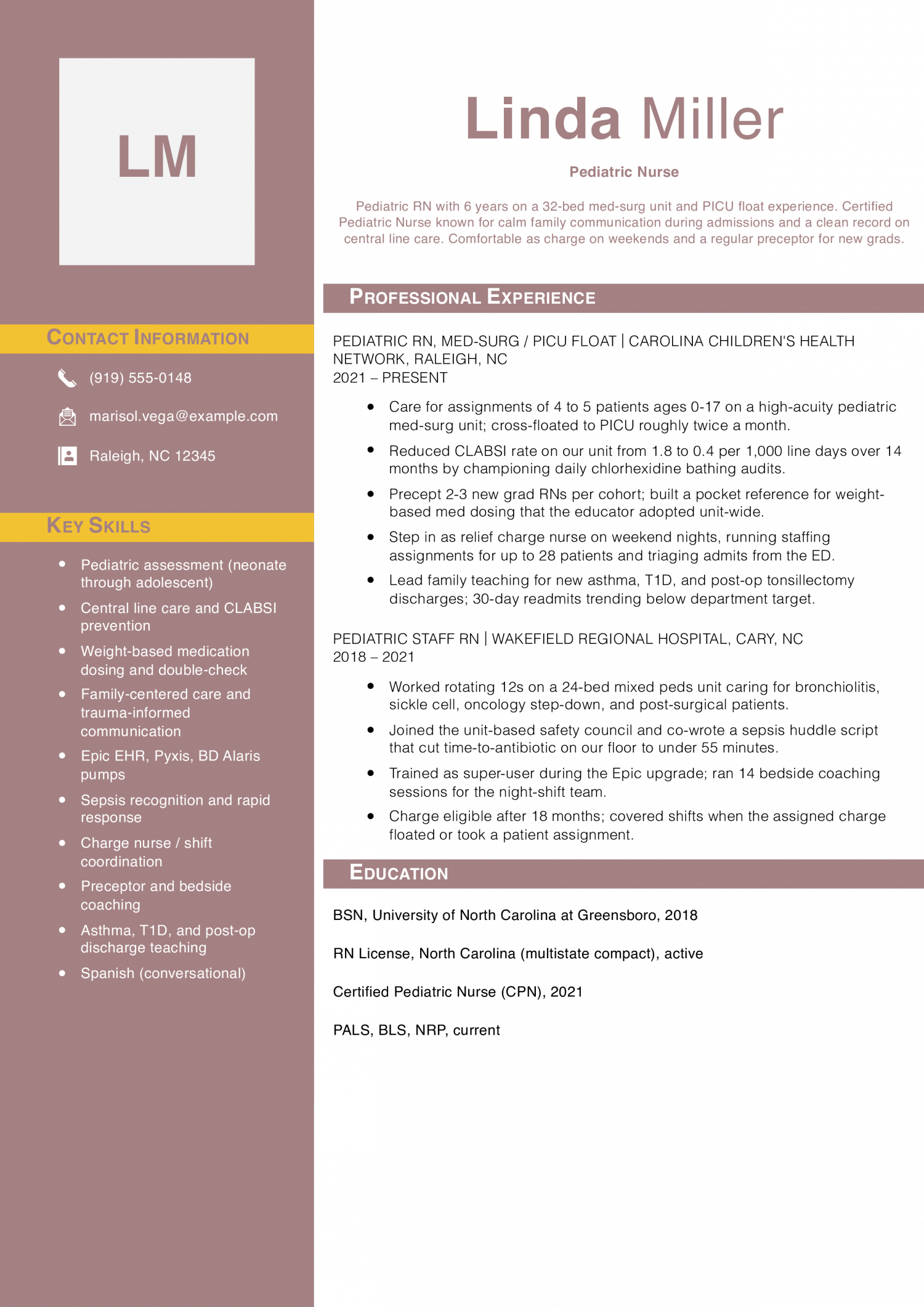
Hiring nurse managers scan the first half of page one for active RN licensure, PALS status, and the pediatric unit type, because that combination predicts whether a new hire can carry a full patient load by week six.

Andrew Stoner , Executive Resume Writer and Career Coach

Why this resume works

  • Specific patient ratios and unit size: Saying ‘4 to 5 patients’ on a ’32-bed med-surg unit’ tells a nurse manager exactly what kind of workload she has handled.
  • One real safety number: The CLABSI drop from 1.8 to 0.4 per 1,000 line days is the kind of metric a pediatric hiring panel actually checks against their own scorecard.
  • Shows she is ready to lead: Relief charge, preceptor, and Epic super-user lines build a clear bridge from staff nurse to charge nurse without overclaiming the title.

New Grad RN Example

You're finishing your BSN or wrapping a pediatric capstone, with clinical rotations but no staff RN hours yet. This resume needs to prove your pediatric clinical exposure, PALS or BLS status, and weight-based dosing familiarity.

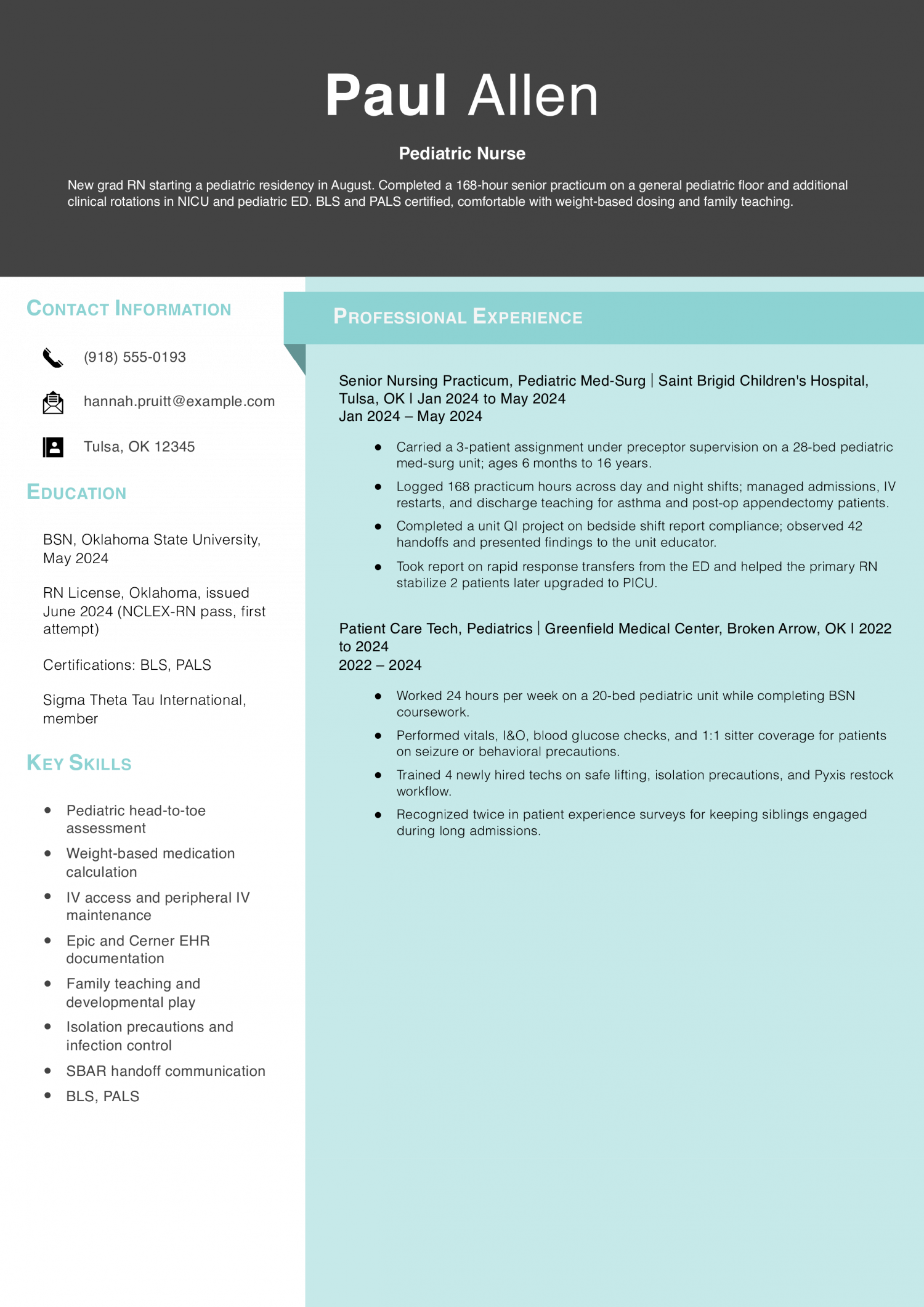
Why this resume works

  • Practicum hours are spelled out: 168 hours and a 3-patient assignment give a recruiter a real picture of her clinical exposure, not just ‘completed senior practicum.’
  • Tech job adds bedside hours: Two years as a peds PCT shows she already knows the unit rhythm, which residency directors weight heavily for new grads.
  • Honest scope, no overreach: She says ‘under preceptor supervision’ and ‘helped the primary RN’ instead of claiming sole responsibility, which builds trust with reviewers.

Staff Nurse Example

You hold one to five years on a pediatric unit and run a full patient load. This resume needs to prove your acuity range, charting volume in Epic or Cerner, and outcomes on infection control or HCAHPS scores.

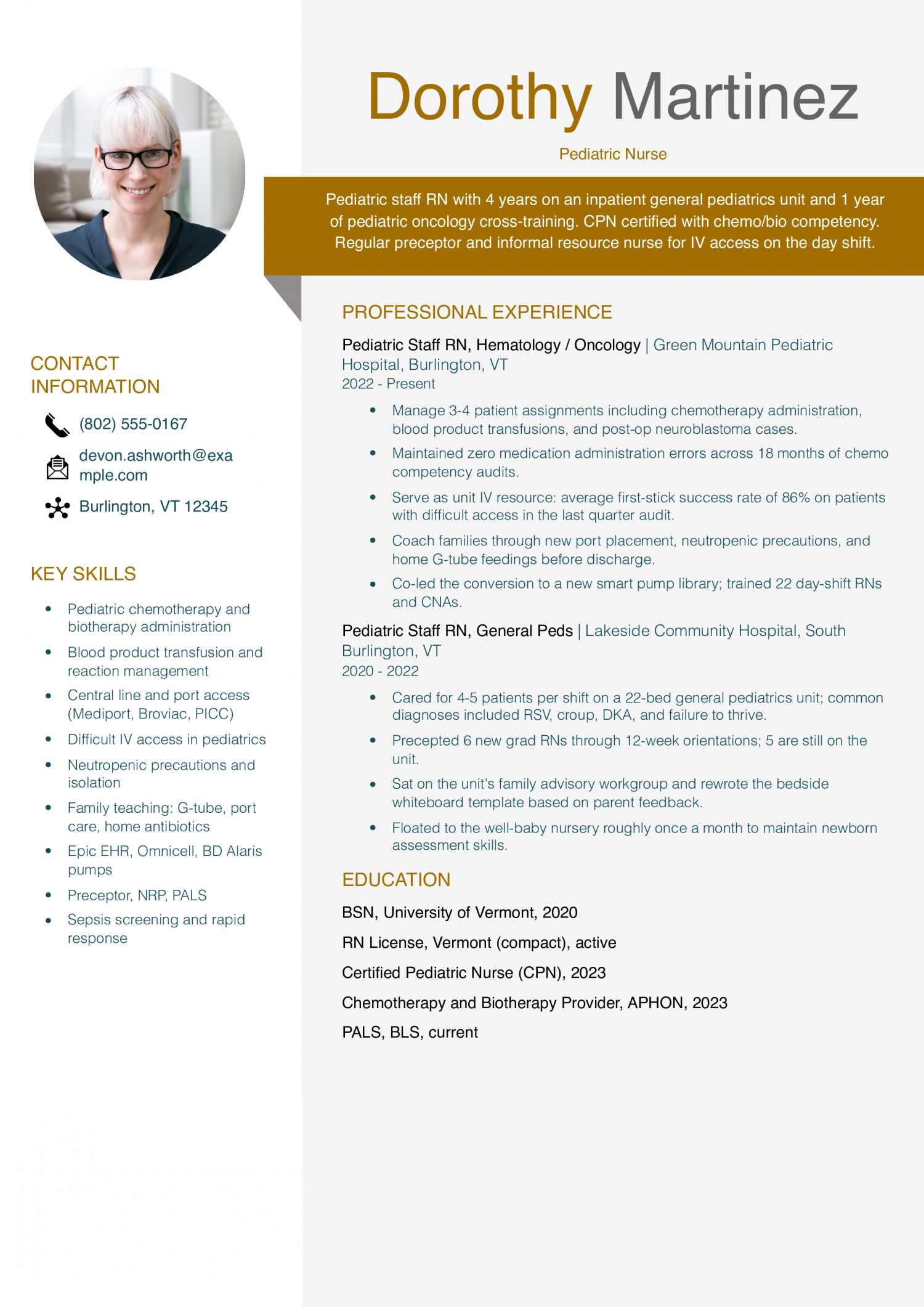
Why this resume works

  • Chemo competency is called out: Hiring managers screen for chemo/bio provider status on heme-onc roles, so putting it in both the summary and education saves them a search.
  • One concrete skill metric: An 86% first-stick rate on difficult IV access is the kind of number a charge nurse remembers when she needs a resource RN.
  • Preceptor retention told as a story: ‘5 of 6 are still on the unit’ shows the orientations actually worked, not just that he taught them.

Charge Nurse Example

You run shift assignments, precept new hires, and own escalations on a pediatric unit. This resume needs to prove staffing decisions you've made, codes you've led, and the unit metrics that moved while you held the desk.

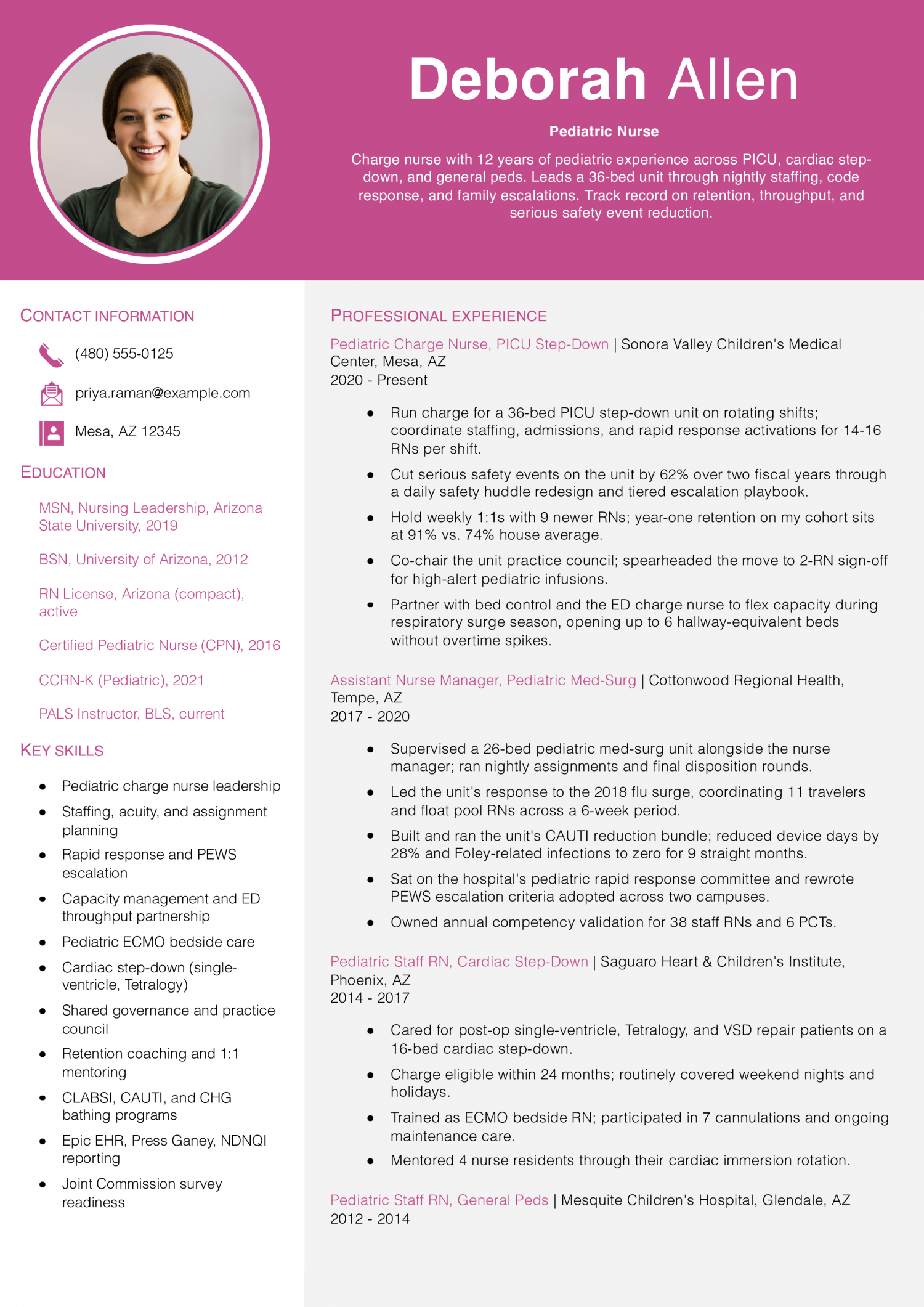
Why this resume works

  • Charge scope is concrete: A 36-bed unit, 14-16 RNs per shift, and a specific safety event reduction tell a nurse director exactly what scale of charge work she has owned.
  • Retention beats house average: Showing 91% vs. 74% retention turns mentoring from a soft skill into a number a CNO can defend in a budget meeting.
  • Career arc reads top-down: PICU step-down charge today, ANM before that, cardiac step-down and ECMO before that, the path makes the senior role believable instead of a stretch.

How to Write a Pediatric Nurse Resume

01 Open with what a license lookup misses

Add one line a nurse manager cannot pull from your license record. Name your pediatric unit type, your acuity range, and any sub-specialty you’ve worked.

PICU step-down, Level III NICU, pediatric hem-onc, or pediatric home health each signal something different. A nurse manager hiring for a Level IV NICU reads past anyone who only lists ‘pediatric experience’ without the unit type.

Add bilingual patient care, sedation experience, or central line competency if you have it. These differentiators move you above the stack of resumes that read identically on credentials alone.

02 Quantify patient load and outcomes

Pediatric bullets without numbers read as job duties. Name the patient load per shift, the acuity level, and the unit census you covered.

Three patterns work for pediatric RN bullets. Patient volume (four PICU patients per 12-hour shift), outcome metrics (CLABSI rate held at zero across 14 months), and throughput (charted 18 admissions per week in Epic).

If your unit tracks HCAHPS or family satisfaction, name the score and the trend. A bullet that reads ‘maintained 92% family communication score across two quarters’ beats ‘provided family-centered care’ every time.

03 Group clinical work into scannable categories

Split your bullets into three or four buckets so a nurse manager can read fit in 20 seconds. Direct patient care, family education, charting and handoff, and unit-level work each deserve their own grouping.

Under direct care, name weight-based medication dosing, IV starts on infants, ventilator monitoring, and code participation. Under family education, name discharge teaching, chronic condition coaching, and interpreter coordination.

Charting goes its own line: Epic or Cerner, SBAR handoffs, and any charting audit scores. Unit work covers precepting, charge shifts, and committee participation.

04 Put credentials where recruiters look first

Build a credentials block at the top of page one, under your name. Include your RN license with the state and ‘license in good standing,’ your BSN or ADN, and your active certifications.

Lead with PALS and BLS because nurse recruiters filter on those two before reading anything else. Add CPN, RNC-NIC, or CCRN-Pediatric on the next line if you hold them.

Pediatric nurse managers and hospital recruiters need these visible above the work history because credential verification clears the first screening gate. Bury them on page two and the resume gets cut before your bullets are read.

05 Close with education and clinical hours

End with your BSN or ADN program, graduation year, and any honors. New grads should add clinical rotation hours by unit type: 180 hours pediatric medical-surgical, 120 hours NICU, and so on.

Name the teaching hospitals where you trained if they carry weight in your region. A Texas Children’s or CHOP rotation reads differently than a generic clinical site.

Close with continuing education only if it’s pediatric-specific: PEARS, ENPC, or a Neonatal Resuscitation Program refresh. Generic CE hours belong on the license renewal form, not the resume.

The pediatric nurse resumes that get callbacks share a specific skill mix. The lists below come from our user-built pediatric nurse resumes. Pediatric nurse managers and hospital recruiters scan for these patterns first, not generic compassion language.

Hard skills clear the credential filter and the EHR check. Soft skills back up your bullets, so they need evidence on the resume, not adjective lists. Match the items below against your target posting and rewrite your bullets so each soft skill has a moment of proof.

Soft Skills % of resumes with this skill
Compassion and empathy 71%
Family communication 69%
Patience under pressure 46%
Teamwork 39%
Attention to detail 29%

And here are the top hard skills showing up most often.

Hard Skills % of resumes with this skill
Pediatric patient assessment 72%
Medication administration 58%
PALS and BLS certification 49%
IV insertion and therapy 40%
Electronic health records 35%

Based on data from thousands of pediatric nurses’ resumes built on ResumeTemplates.com, May 2026.

Must Have on a Pediatric Nurse Resume

The items below are what separate a pediatric nurse resume from one that gets put back in the pile.

Licensure Requirements

Pediatric nurse managers verify your license before they read your bullets. The credentials block belongs at the top of page one.

List your RN license by state, with the phrase ‘license in good standing.’ Do not include the license number on the resume itself.

If you hold a multi-state compact license (NLC), name it. Compact licensure matters for travel and per diem roles, and managers screen for it on float pool postings.

Add your BSN or ADN, your graduating school, and the year. Magnet-designated hospitals require BSN, so list it before any other education detail.

  • RN, California, license in good standing
  • Multi-state compact license (NLC) holder, if applicable
  • BSN, University Name, graduation year
  • Active BLS and PALS with expiration dates

Continuing Education Worth Listing

Generic CE hours belong on your license renewal, not your resume. Pediatric-specific CE earns space when it maps to the role you want.

List CE that signals specialty preparation: PEARS, ENPC, Neonatal Resuscitation Program (NRP), or Trauma Nursing Core Course (TNCC) with pediatric focus.

Name the issuing organization and the completion year. AACN, ENA, and AAP-issued courses carry more weight than vendor-run webinars.

If you’ve completed a pediatric chemotherapy and biotherapy provider course, list it. Pediatric hem-onc managers screen for it on every posting.

  • Neonatal Resuscitation Program (NRP), American Academy of Pediatrics
  • Pediatric Emergency Assessment, Recognition, and Stabilization (PEARS)
  • Emergency Nursing Pediatric Course (ENPC), Emergency Nurses Association
  • APHON Pediatric Chemotherapy and Biotherapy Provider course
  • S.T.A.B.L.E. Program for neonatal stabilization

EHR Systems Pediatric Nurses Should Name

EHR experience is one of the top three filters on pediatric nurse postings. Name the system by brand, not just ‘electronic health records.’

  • Epic (Rover, Stork, ASAP for ED workflows)
  • Cerner PowerChart and FirstNet
  • Meditech (smaller regional hospitals)
  • Allscripts and athenahealth (pediatric outpatient clinics)
  • Pyxis and Omnicell medication dispensing systems

HIPAA and OSHA Compliance

Pediatric nurse resumes get rejected when bullets cross HIPAA lines. Show outcomes without identifying patients or facilities in ways that breach privacy.

Quick HIPAA Check Before You Submit

Never include patient names, dates of admission, medical record numbers, or identifying conditions tied to a specific child.

Use aggregate language: ‘managed care for 4 PICU patients per shift,’ not ‘cared for an 8-year-old with leukemia in room 412.’

Naming your employer hospital is fine. Tying a specific patient case to that hospital is not.

Pediatric Nursing Credentials That Get You the Job

An active RN license, BLS, and PALS keep you eligible. The certifications below move a pediatric nurse resume from the qualified-but-typical stack into a nurse manager’s shortlist. List the issuing body and expiration date next to each credential on page one.

  • Certified Pediatric Nurse (CPN): Signals two years of pediatric bedside experience and bumps you ahead on competitive children's hospital postings.
  • RNC-NIC (Neonatal Intensive Care Nursing): Required vocabulary for Level III and Level IV NICU roles, and it tells managers you can handle high-acuity infants.
  • CCRN-Pediatric: Reads as PICU-ready and helps move you from staff RN into charge nurse and rapid response track applications.
  • Emergency Nursing Pediatric Course (ENPC): Pediatric ER and urgent care managers screen for this credential when filling roles with high pediatric trauma volume.

Latest BLS Statistics for Pediatric Nurses

For pediatric nurses, the 10th-percentile floor reflects entry-tier staff roles in lower-cost metros, and the top-decile ceiling reflects high-acuity unit work in major children’s hospitals. That spread tells you unit acuity, certifications like CPN or CCRN-Pediatric, and metro geography move pay more than years of experience alone. Magnet-designated children’s hospitals and Level IV NICUs cluster at the top of the band.

Lead your resume with the unit type, acuity level, and specialty certifications that map to where you want to land.

$93,600 National median annual
$98,430 National mean annual
$66,030 Entry-tier floor (10th percentile)
$135,320 Top-decile ceiling (90th percentile)
3,282,010 Pediatric Nurses in the U.S.
Where you stand

Entry tier

$66,030 to $93,600 At the entry tier, lead with your BSN, active RN license, PALS, and pediatric clinical rotation hours by unit type.

Mid band

$93,600 to $135,320 At the mid band, your resume needs to show patient load per shift, CPN or specialty certification, and Epic or Cerner charting volume.

Top decile

$135,320+ At the top decile, lead with PICU or NICU charge experience, code leadership, precepting hours, and unit metrics you moved.

Top-paying states

# State Avg. Annual
1 California $140,330
2 Hawaii $136,320
3 Oregon $123,990
4 Washington $112,180
5 Alaska $110,690
6 New York $105,600
7 District of Columbia $104,550
8 New Jersey $102,730
9 Nevada $101,990
10 Massachusetts $101,970

Highest-employment states

# State Workers Median
1 California 326,720 $140,330
2 Texas 261,050 $90,010
3 Florida 218,100 $82,850
4 New York 204,120 $105,600
5 Pennsylvania 146,840 $87,610
Source: U.S. Bureau of Labor Statistics, OEWS 2024 release (SOC 29-1141).
Written by professional resume writers and loved by hiring managers

Resume Templates offers HR approved resume templates to help you create a professional resume in minutes. Choose from several template options and even pre-populate a resume from your profile.

Frequently Asked Questions

What do pediatric hospitals look for on a nurse's resume?

Active RN license, BLS, and PALS on page one. Then the pediatric unit type you've worked, the acuity level, and your patient load per shift.

Children's hospitals also screen for Epic or Cerner experience and any pediatric-specific certifications like CPN or RNC-NIC. Magnet hospitals add a BSN requirement, so name your degree in the credentials block.

How do I list my nursing license without exposing the number?

List the state, the credential, and 'license in good standing.' For example: 'RN, California, license in good standing.'

Do not put the actual license number on your resume. Provide it on the formal employment application when the hospital requests it.

I'm transitioning from adult med-surg to peds. How do I reframe my resume?

Lead with any pediatric exposure you have: float pool shifts, family member coverage, school nurse moonlighting, or pediatric clinical rotations.

Then translate your med-surg bullets into pediatric-relevant skills like IV starts, weight-based dosing, family education, and acuity assessment.

Add PALS and ENPC before you apply. Those two certifications signal you've prepared for the specialty switch.

Should I include clinical rotation hours as a new grad pediatric nurse?

Yes. New grad pediatric nurse resumes should list clinical rotation hours by unit type.

Format it as: 'Pediatric medical-surgical: 180 hours, Texas Children's Hospital' and so on. Nurse managers reading new grad resumes use rotation hours and teaching hospital names as the closest proxy for staff experience.

What resume template should a pediatric nurse use?

For a pediatric nurse, an ATS-friendly template is the safest pick, because it puts your certifications and experience where a hiring manager scans first. A basic template is a solid alternative. Whichever you choose, keep the formatting clean and easy to parse: clear section headings, a standard font, and no graphics a parser can choke on.

Rate this article

Pediatric Nurse Resume

Average Rating

4.2/5 stars with 210 reviews

You have given 0 Star(s)
4.2/5 stars with 210 reviews
Andrew Stoner

Executive Resume Writer and Career Coach

Andrew Stoner is an executive career coach and resume writer with 17 years of experience as a hiring manager and operations leader at two Fortune 500 Financial Services companies, and as the career services director at two major university business schools.