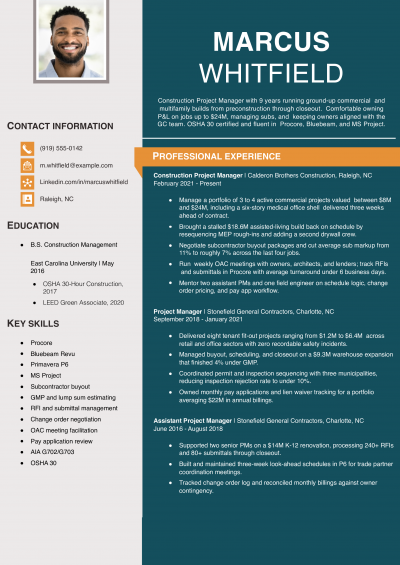
Construction Project Manager Resume Examples

Your profile belongs at the top of page one and should state years of experience, the delivery methods you have run (design-build, CM at risk, lump sum, IPD), and the sectors you have closed out…
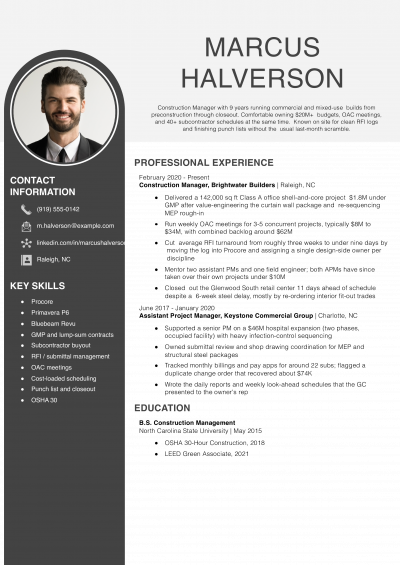
Every resume example is written and reviewed by our team of Certified Professional Resume Writers to ensure top-quality content and formatting.
Your project engineer resume has to prove you can keep scope, cost, and schedule in line. Project managers and construction project executives look for hard proof: RFI logs you managed, change orders you tracked, and budgets you held. A PE or EIT credential strengthens your case where the posting asks for one.
Show the tools you used on real jobs, such as Primavera P6 or Procore. Pair each one with a result, like days saved or dollars kept under budget. The examples below show you how strong project engineer resumes put these details to work. To compare layouts before you start, browse our resume templates.
Project managers and construction project executives decide whether to keep reading by the first few bullet points; if quantified scope, such as budget size or crew count, is not visible there, the resume moves to the reject pile.
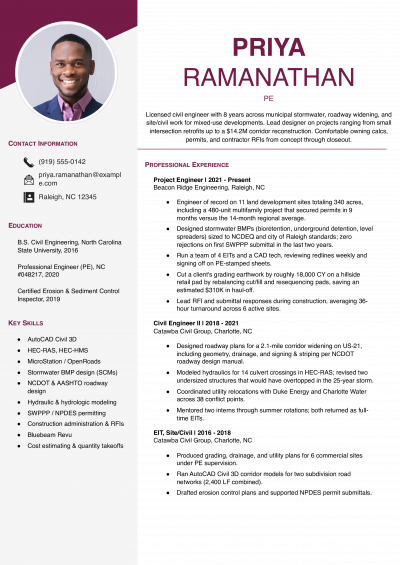
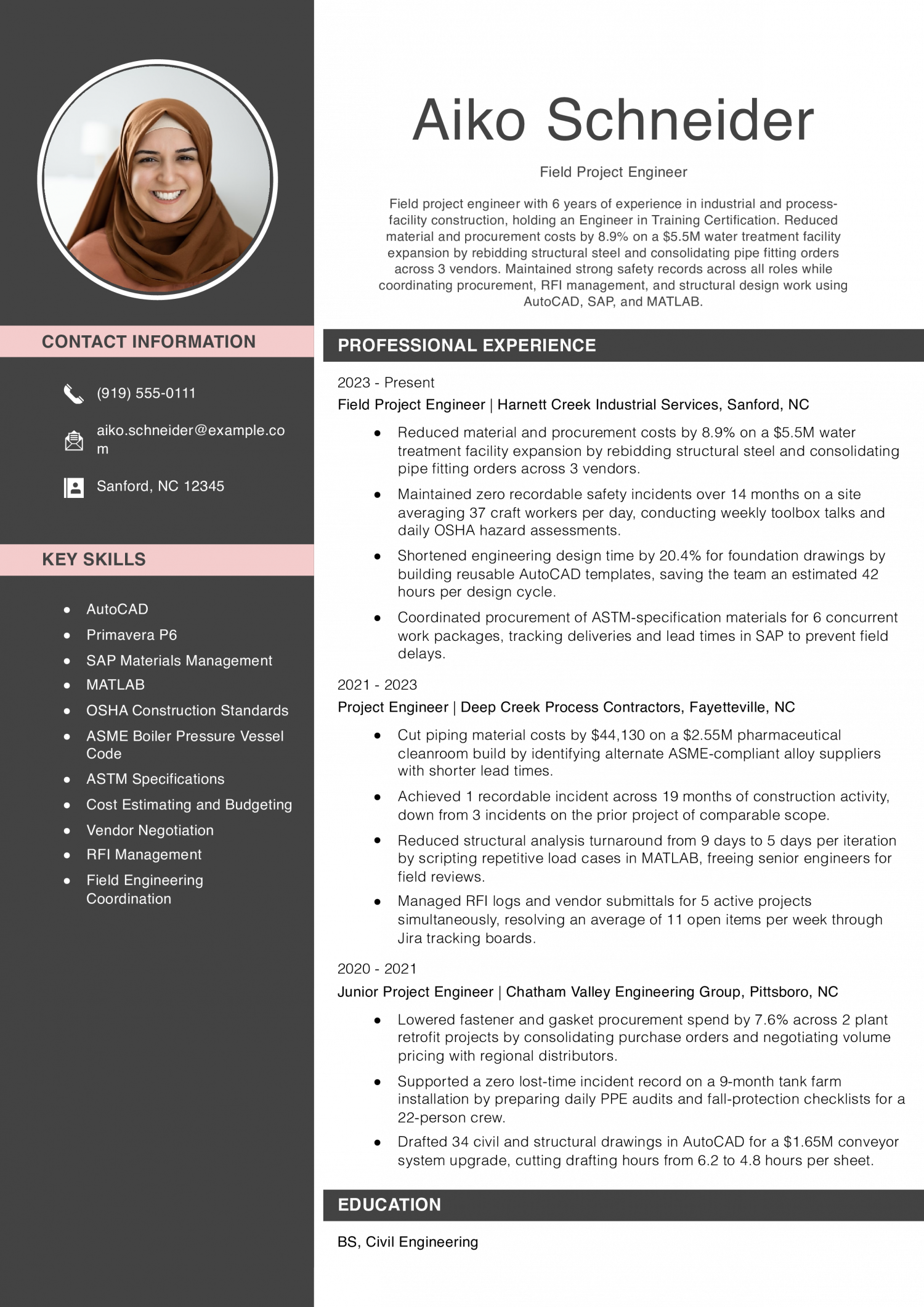
Consider this sample if you are a mid-level field project engineer with about six years of site-based industrial construction work. Lead with the procurement savings method and vendor count behind each cost reduction rather than listing general budget duties.
A common mistake on field project engineer resumes is listing safety responsibilities without proving sustained results over a defined timeframe. This resume writes “maintained zero recordable safety incidents over 14 months on a site averaging 37 craft workers per day” to anchor the claim in both duration and crew size. When you describe your own safety record, state the incident count, the number of months it covers, and the daily headcount so readers can weigh the scope of your oversight.
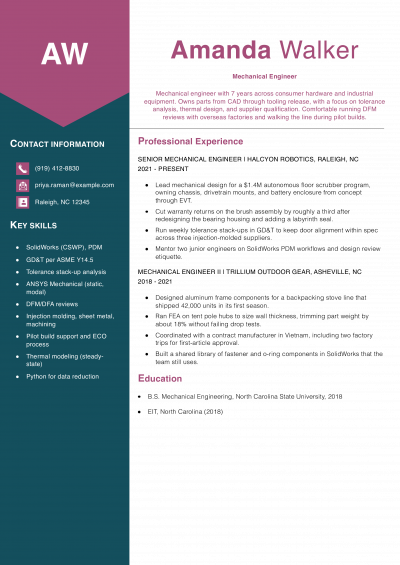
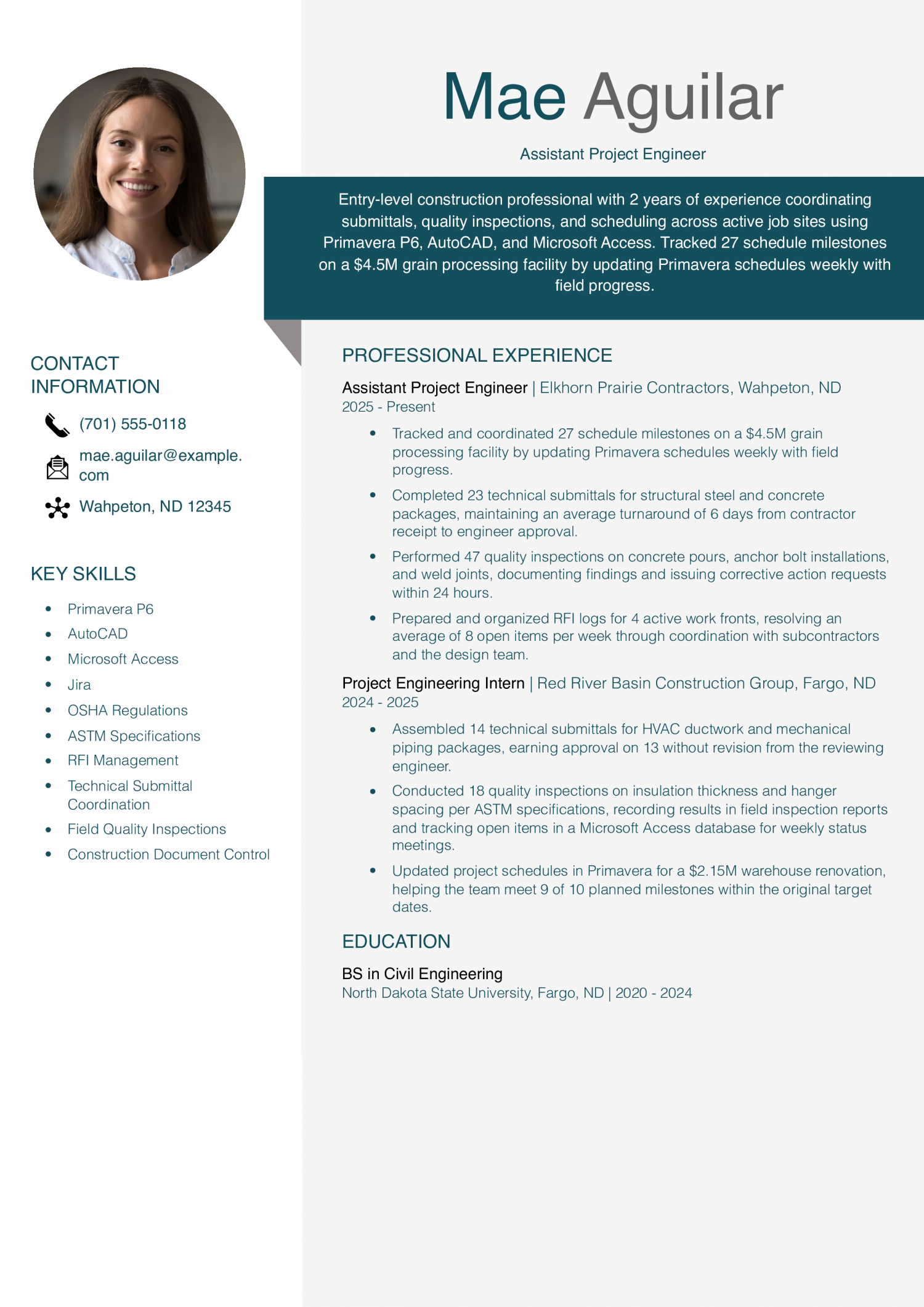
Use this sample if you are an entry-level assistant project engineer beginning your career after a civil engineering degree. Specify turnaround windows and inspection counts in every bullet so each responsibility carries a measurable scope.
Many entry-level project engineering resumes describe submittal duties without showing approval outcomes. This resume writes “earning approval on 13 without revision from the reviewing engineer” to prove the quality of work submitted, not only the volume. When you list submittal coordination on your own resume, state how many were approved without revision so reviewers can gauge your accuracy rate from a single line.
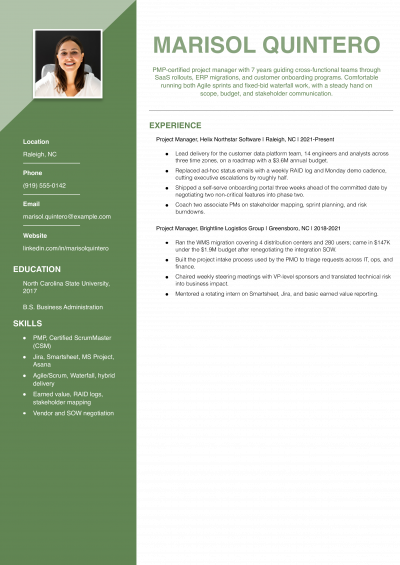
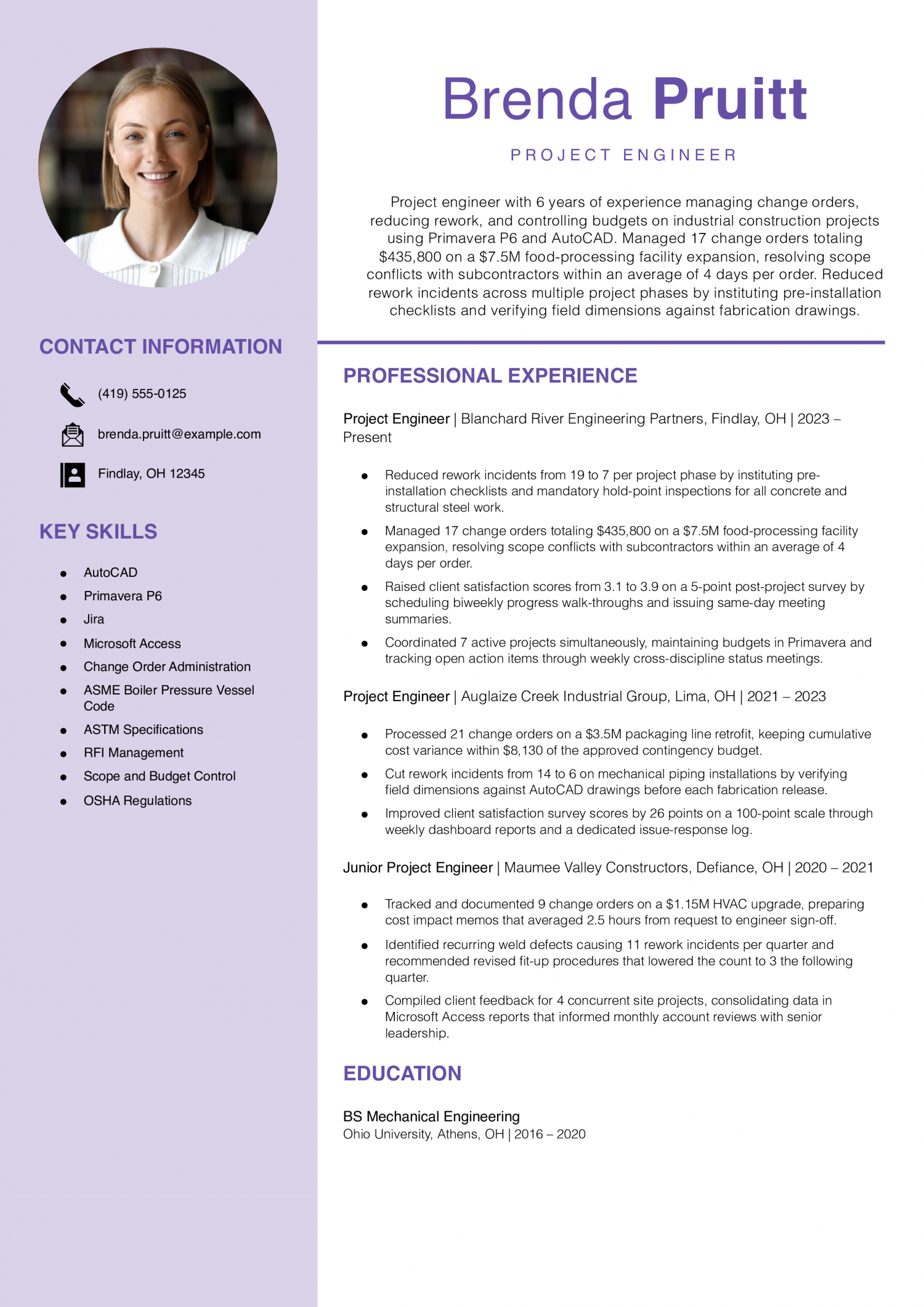
Try this sample if you are a mid-level project engineer with around six years in industrial or process-facility construction. Start each accomplishment with a before-and-after rework or variance figure tied to the specific inspection or tracking method you used.
Many project engineer resumes list change order responsibilities without showing cost control results. This resume writes “keeping cumulative cost variance within $8,130 of the approved contingency budget” to prove the dollar-level precision of that work. When you describe change order management on your own resume, state the final variance or savings figure alongside the project value so readers can gauge your budget discipline without guessing.
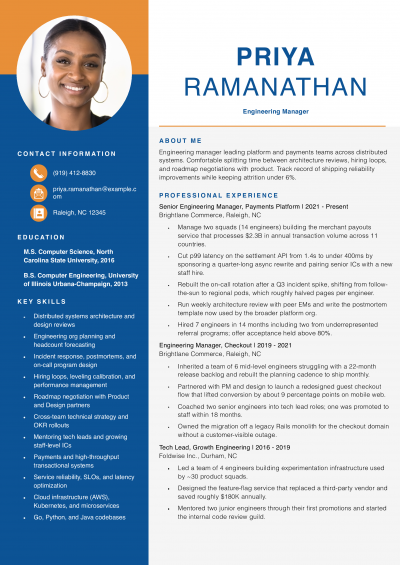
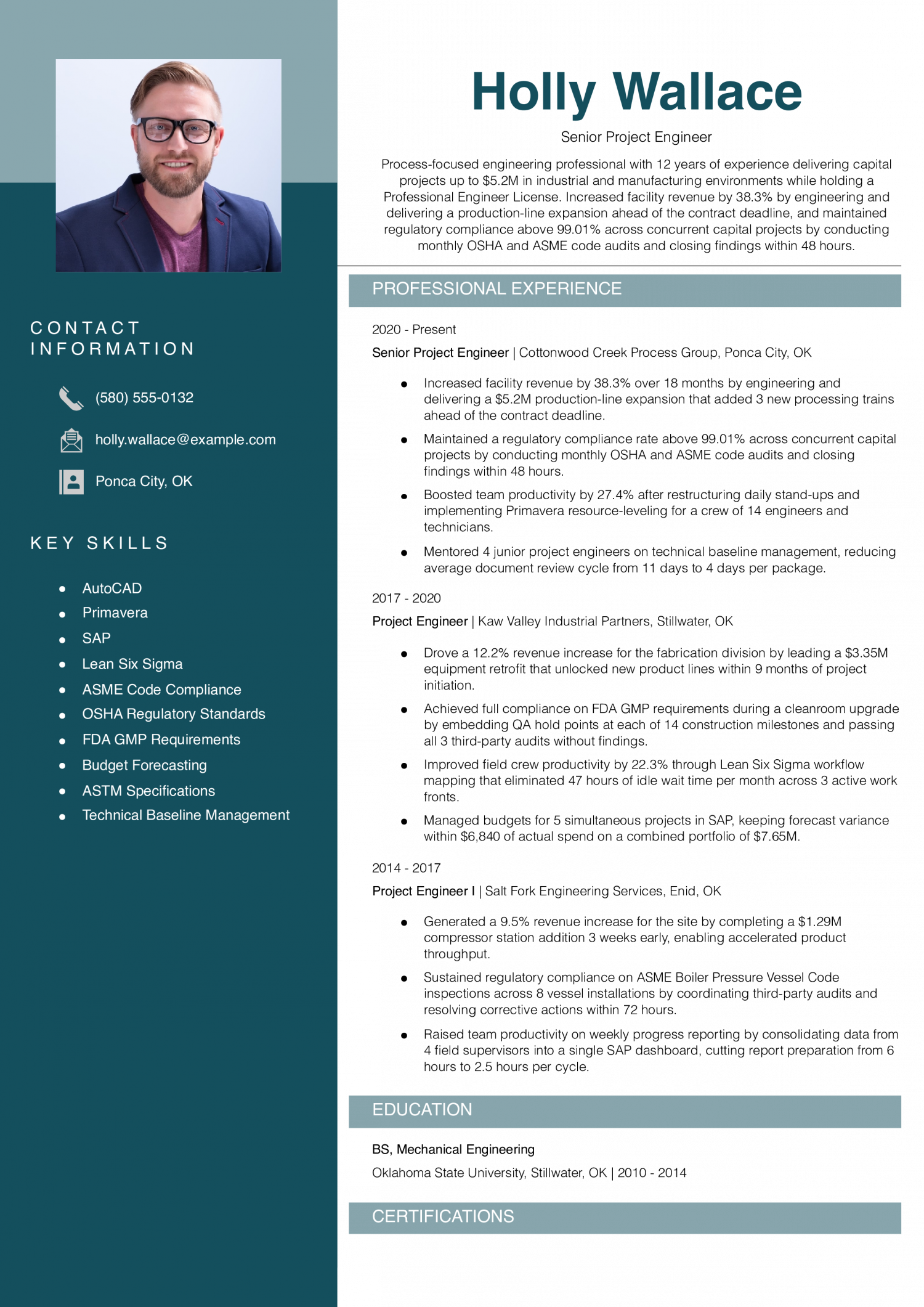
Lean on this sample if you are a senior project engineer with about twelve years of industrial capital project and process-facility experience. Supply each bullet with a named scheduling or tracking tool, such as Primavera or SAP, tied directly to the productivity or budget outcome it produced.
Many senior project engineer resumes describe budget oversight without proving how tightly costs were controlled. This resume writes “keeping forecast variance within $6,840 of actual spend on a combined portfolio of $7.65M,” which gives reviewers a concrete measure of financial precision rather than a vague claim of responsibility. When you describe your own budget management, state the dollar variance alongside the total portfolio value so readers can evaluate your discipline at a glance.
Construction project engineer with 7 years of experience managing capital builds across industrial and process facilities, including 6 capital projects simultaneously with a combined value of $4.4M. Skilled in design review acceleration, cost forecasting, and emissions monitoring using AutoCAD, Primavera, and Jira, with a record of raising project delivery efficiency by 24.5% through front-loaded procurement strategies.
Your PE or EIT status is easy to verify online, but what project managers and construction project executives cannot find there is your edge. Lead your summary with a detail that sets you apart, such as a niche software skill or a sector focus. Note your work in water treatment plants or data center builds.
Maybe you hold a PMP from PMI on top of your PE. A bilingual skill set also stands out in regions with diverse crews. Pick one trait that a comparable candidate is unlikely to share and place it in the first line of your summary.
Keep the summary to three or four lines. State your years of experience and your top credential. Then name the type of project you know best.
Most strong project engineer resumes tie each bullet to a metric. Bullets without a number tend to read as duty lists rather than accomplishment statements. Start with the project’s dollar value or square footage.
Name the schedule result, such as days saved against a baseline. You can also cite the number of RFIs you processed per month. Crew size is another useful figure.
A bullet like “coordinated 14 subcontractors across a $12M hospital expansion” communicates more than “managed subcontractors.” Percent cost savings work well for value engineering wins. Change order totals show your contract management scope. Pair each action verb with at least one hard figure.
Even early career roles have numbers worth citing. Count the submittals you reviewed or the inspections you logged each week.
Project managers and construction project executives scan for specific skill clusters. Organize your bullets under three to five categories so they find what matters fast. Schedule and budget control is one natural group, including tasks like tracking milestones and managing cost reports.
Design coordination is another, covering drawing reviews and clash detection. Quality and safety form a third group. List inspection routines and OSHA compliance checks there.
Procurement and contracts can stand alone if you handled bid packages or purchase orders. A fifth group, stakeholder communication, covers owner meetings and progress reports. You do not need literal subheadings for these groups.
Order your bullets so related tasks sit together within each job entry.
List your PE or EIT status right below your name. Include your state and note the license is in good standing. Do not print the license number on the resume.
If you hold a PMP from PMI, place it on the same line. Project managers and construction project executives often filter resumes by these credentials. Burying them in a subsequent section risks losing a reader early.
Create a short credentials block on page one for this purpose. Software tools belong in a separate skills section. Name programs like Primavera P6, Procore, or AutoCAD there.
Group them by type, such as scheduling, project controls, and design. This layout lets a reviewer confirm your qualifications in seconds.
If you have more than ten years of experience, cut detail from early roles. Keep the company name, your title, and the dates. Add one or two bullets at most for positions older than a decade.
Remove any technology that you no longer use or that has become obsolete. Merge short contract assignments under a single heading if they share a sector. This frees space for your recent, higher impact work.
Focus the top half of page one on your last two positions. Those carry the most weight with project managers reviewing your background. A two page resume is fine when every line earns its place.
Delete generic characterizations like “team player” or “strong communicator.” Replace them with a fact, a figure, or a specific project outcome.
Project managers and construction project executives scan dozens of project engineer resumes each week. The ones they shortlist name tools and measurable results. Hard skills prove you can run the technical side of a project.
Think scheduling software, cost tracking, and document control. Soft skills show how you work with field crews and owners. Leadership matters because you coordinate trades across shifting timelines.
Clear communication keeps stakeholders aligned on scope changes. Project managers and construction project executives weigh both skill types, but hard skills often filter first. Most applicant tracking systems score your resume on keyword matches.
Soft skills then back up your bullet points with proof of teamwork. Cross-check each table against the job posting you are targeting. Add the matching terms to your experience bullets and skills section.
| Soft Skills | AI-estimated % |
|---|---|
| Cross-functional coordination | 66% |
| Stakeholder communication | 61% |
| Problem-solving under pressure | 45% |
| Detail orientation | 38% |
| Field team leadership | 26% |
And here are the top hard skills showing up most often.
| Hard Skills | AI-estimated % |
|---|---|
| Project scope management | 69% |
| Engineering drawing review | 68% |
| Budget tracking | 43% |
| RFI and submittal processing | 39% |
| Schedule development | 33% |
Skill names and rankings come from an AI model grounded in U.S. Department of Labor occupation data for project engineers, not from a count of project engineers’ resumes built on ResumeTemplates.com.
These are the must-haves hiring teams look for when scanning a project engineer resume.
Safety training shows you can run a compliant job site. Project managers and construction project executives look for OSHA credentials. Adding them signals you understand federal safety rules.
Project managers and construction project executives are split on AI right now. Some firms want engineers who use AI to speed up scheduling. Others worry that AI outputs skip local code checks and site realities.
Name the tools you actually use on projects. Describe how you verify each output against specs or field data. Do not claim AI runs your estimates if you only use it to draft early models.
Honest framing matters more than a long tools list. State the task, the tool, and how you confirmed the result. Keep each claim tied to a real project outcome.
Show the human check behind every AI step.
AI tools now flag clashes in phased schedules before the critical path shifts on site.
Machine learning models pull historical bid data to produce quantity takeoffs in hours, not days.
Predictive models score weather, supply chain, and permit risks across the full project timeline.
AI can scan submittals and RFIs against contract specs to surface mismatches before review meetings.
Computer vision on job site photos detects rebar spacing or formwork errors for field engineers.
Project managers and construction project executives read this list as a map of where your work is heading. Each line tells them which track you have put time and money into. A PMP signals that you can run a full build.
A PE shows deep technical skill. These go past the base credentials covered in the must-have section. They mark your growth and focus.
List each one with the issuing body and the year you earned it. Put the most recent one first so it is easy to spot.
Resume Templates offers HR approved resume templates to help you create a professional resume in minutes. Choose from several template options and even pre-populate a resume from your profile.
Include scope values, schedule metrics, and budget figures for each project you managed. List your PE or EIT credential near the top of the page.
Name the software tools you used to track submittals and RFIs. Project managers and construction project executives look for proof you kept work on time and within cost.
Start each bullet with an action verb, then name the deliverable and attach a number. For example, write "Coordinated steel erection for a $12M warehouse, completing structural work two weeks ahead of schedule."
Specific dollar amounts and timelines tell reviewers more than a general summary of your duties.
Yes, list a current project with its start date and the word "Present" in place of an end date. State the percent complete or the milestone you reached most recently.
Mark projected completion dates clearly to separate them from confirmed results.
Place paid work experience above a separate projects section in most cases. If you are a recent graduate with fewer than two years of full-time work, a projects section right after your education can fill the gap.
Once you hold two or more professional roles, fold project details into each job's bullet points instead.
Yes, if you lack professional experience and the project shows relevant skills like cost tracking or field coordination. Label the section "Academic Projects" so reviewers know the context.
Drop school projects once you have two or more paid roles that cover the same skills.
One page works well when you have fewer than ten years of relevant experience. A two-page resume is reasonable if you have led multiple large-scope projects across different sectors.
Keep every bullet tied to a measurable outcome so the extra length earns its space.
Open with a summary that names your target role and the transferable skills you bring, such as scheduling or contract review. Rewrite each prior job's bullets to stress tasks that overlap with project engineering work.
Add your EIT credential or any relevant training to signal your commitment to the field.
For a project engineer, an ATS-friendly template is the safest pick, because it puts your certifications and experience where a hiring manager scans first. A basic template is a solid alternative. Whichever you choose, keep the formatting clean and easy to parse: clear section headings, a standard font, and no graphics a parser can choke on.
Project Engineer Resume
4.5/5 stars with 213 reviews

Executive Resume Writer and Career Coach
Andrew Stoner is an executive career coach and resume writer with 17 years of experience as a hiring manager and operations leader at two Fortune 500 Financial Services companies, and as the career services director at two major university business schools.
© 2026 Resumetemplates.com All rights reserved.