Tip !

Production supervisors and plant managers decide whether to keep reading by the top third of page one; if the specific assemblies, tools, and throughput numbers aren't visible by then, the resume drops out of the stack.

Andrew Stoner , Executive Resume Writer and Career Coach

Assembler Resume Examples

Why this resume works

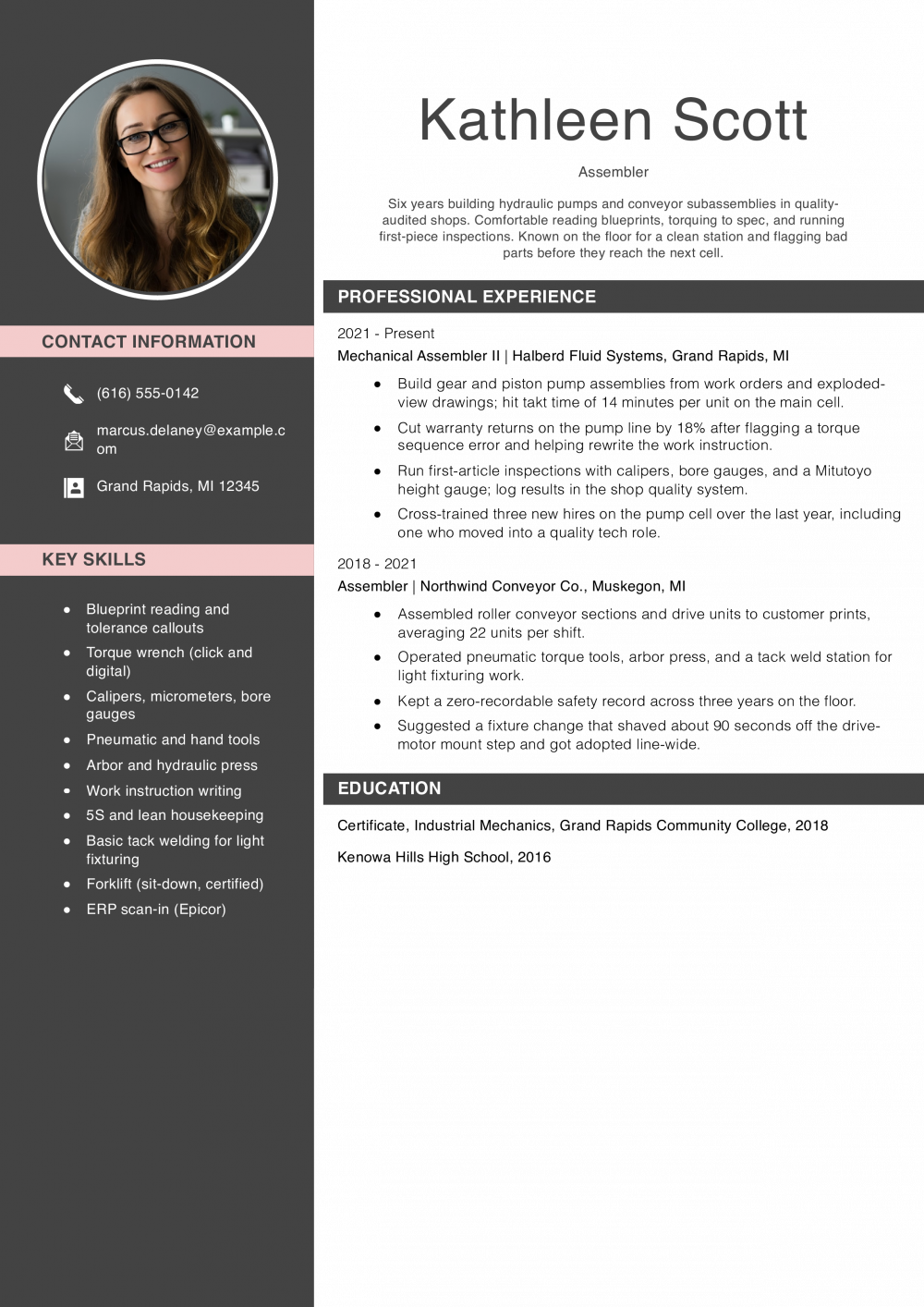
  • Real numbers on the floor: Takt time, warranty return drop, and per-shift output all give a hiring manager something concrete to compare against.
  • Protects downstream quality: First-article inspections and a caught torque-sequence error prove this assembler protects the next station, which is what leads pick for the harder cells.
  • Grew from basic assembly to trainer: Cross-training three new hires and having one promote out signals readiness for a lead role without having to say it.

Assembler Example

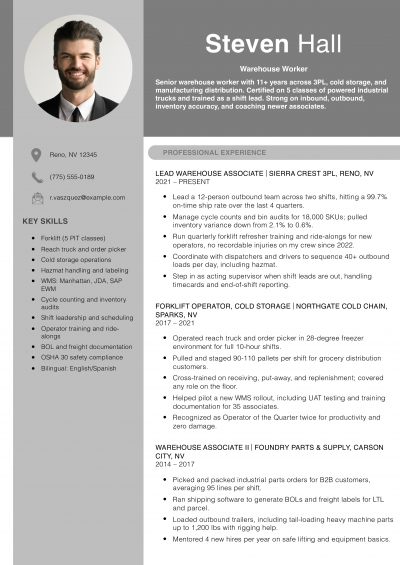
This resume is for an assembler who runs a station on the line and hits daily build targets. It has to prove clean quality checks, safe tool use, and steady output against a takt time.

Why this resume works

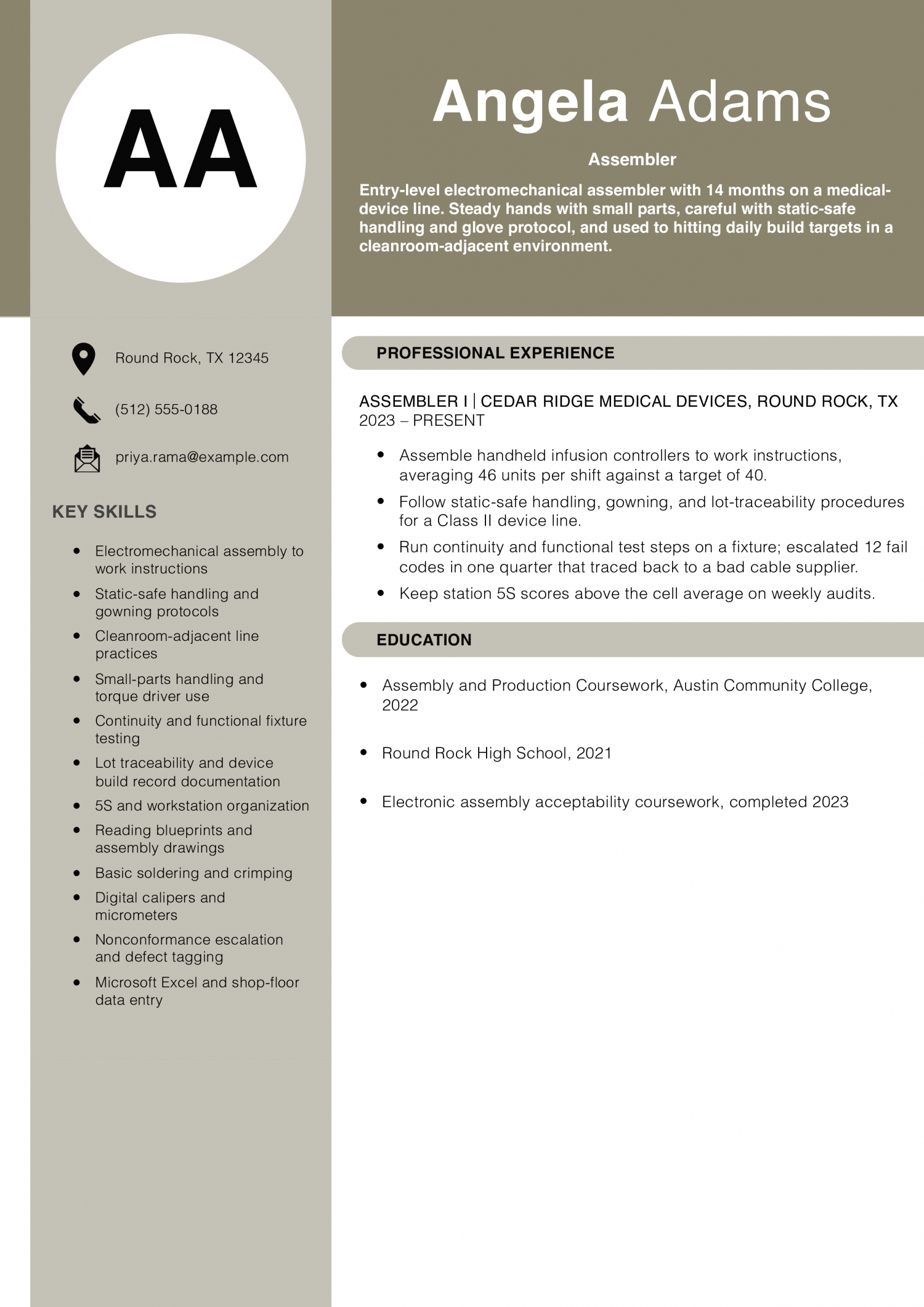
  • Hit and beat a build target: 46 against 40 is a specific, checkable number that says this assembler can hold pace on a real line.
  • Caught a supplier problem: Tracing 12 fail codes back to a bad cable vendor is exactly the kind of alertness that gets an entry-level worker moved onto harder builds.
  • Right habits for regulated work: Naming static-safe handling, gowning, and lot traceability shows the candidate understands why a medical device line runs the way it does.

Lead Assembler Example

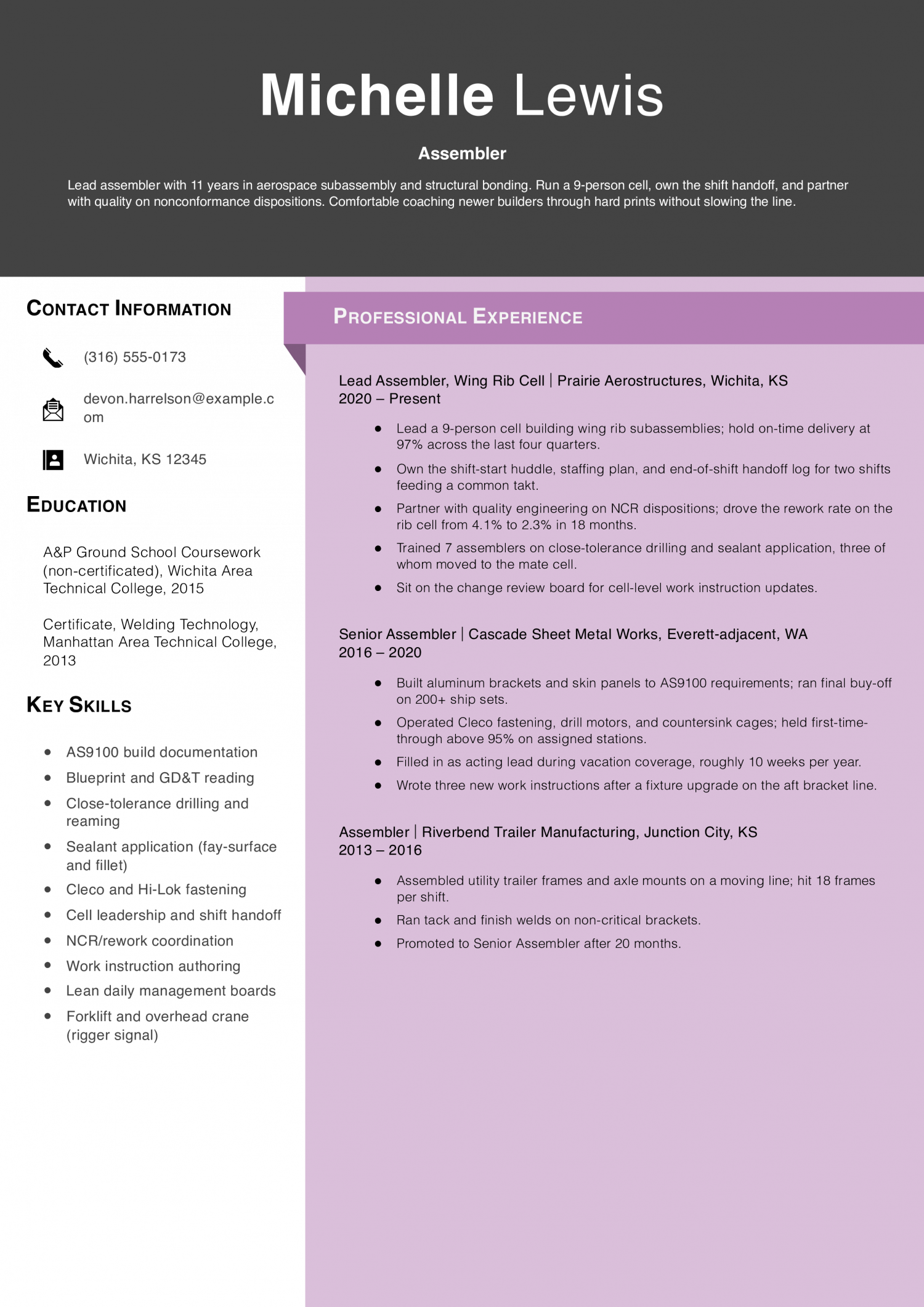
This resume is for a lead assembler who trains new hires and covers for the supervisor on the floor. It has to prove line balancing, first-pass yield gains, and clear handoffs between shifts on the same cell.

Why this resume works

  • Owns a real number the plant cares about: On-time delivery at 97% for a named cell tells a plant manager this lead can be trusted with a schedule.
  • Cut rework in half: Moving the rework rate from 4.1% to 2.3% is the kind of quality win that reads clearly to an aerospace hiring manager.
  • Coach, not just a fast builder: Training seven assemblers and having three move up shows the leadership piece that separates a lead from a senior assembler.

Production Supervisor Example

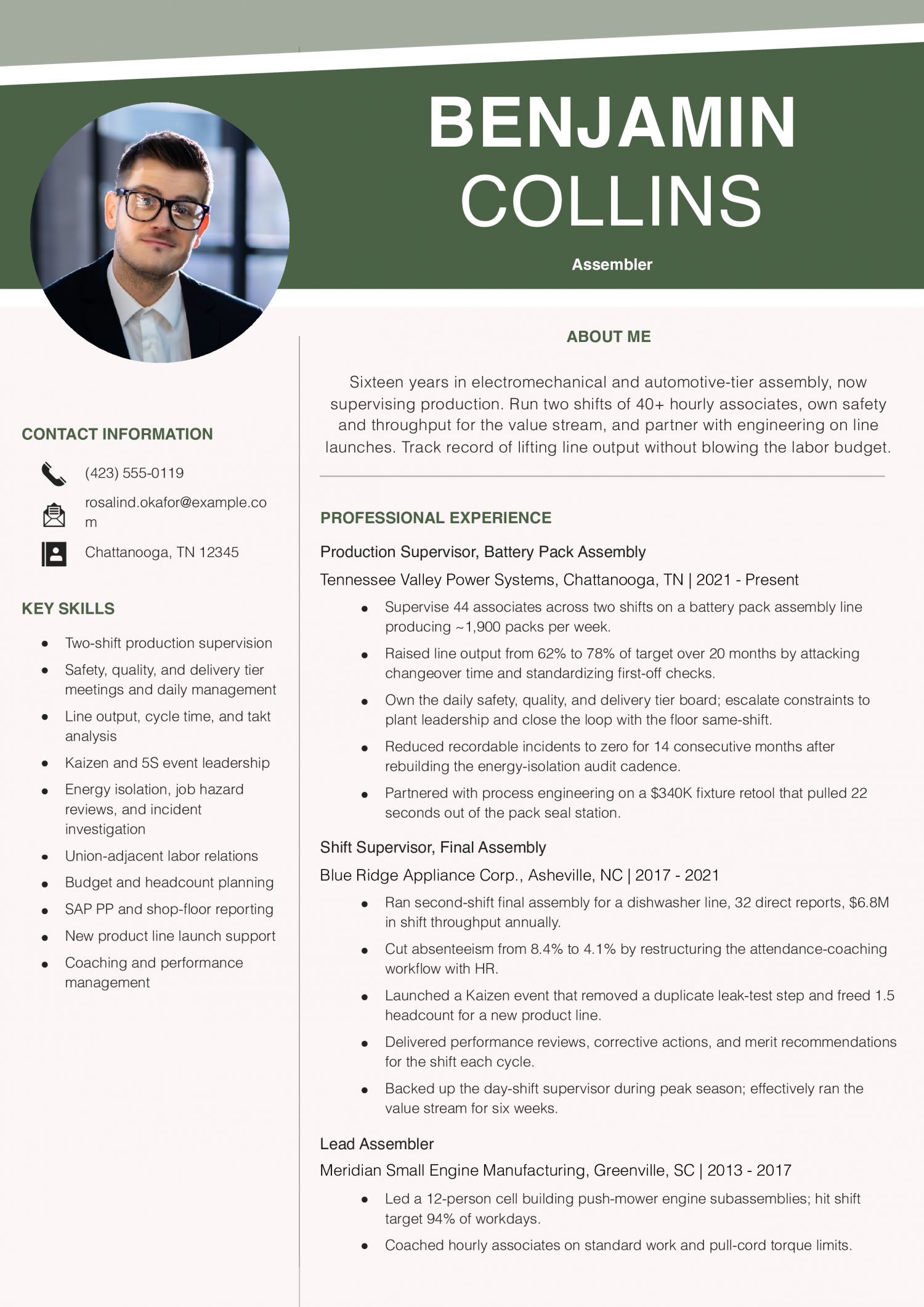
This resume is for a production supervisor who owns a shift, a crew, and the numbers posted at the end of it. It has to prove headcount planning, safety record, and output against schedule across cells.

Why this resume works

  • Big scope, plainly stated: 44 associates, two shifts, ~1,900 packs a week gives a plant director the size of the operation in one line.
  • Moved line output the right direction: 62% to 78% with the mechanism named (changeover time and first-off checks) reads as a real supervisor win, not a slogan.
  • Owns safety as a number: 14 months of zero recordables after fixing the energy-isolation audit cadence shows a supervisor who treats safety as an actual system.

How to Write an Assembler Resume

01 Open with what a supervisor cannot find elsewhere

Lead with one line that a shift lead cannot pull from a generic applicant search. Name the assembly type you run, not the label “assembler.” Options that read as specific: surface mount circuit board work to Class 3 standards. Torque-critical aerospace subassemblies built to blueprint and torque spec.

Medical device assembly in a clean room. Robotic weld cell tending on a Fanuc line. Cable and harness crimping with pull-test sign-off.

Wire your headline to the product, the standard and the setting. A production supervisor scans that line first to decide if your hands match the station open on the floor. Save the general “team player” language for lower on page one.

02 Put numbers on your output and quality

Assembly work reads best when bullets show throughput, yield and scrap. Strong resumes name two or three figures a plant manager already tracks. Units per shift or per hour at your station.

First-pass yield or defect rate in parts per million. Scrap or rework percentage before and after a change you made. Downtime minutes recovered on a line you supported.

If your shop does not publish those numbers, use volume and scope instead. Say you built 40 subassemblies a shift across three product lines. Say you ran a two-person cell feeding a 12-station line.

Leave the number off, and a bullet reads like a chore list instead of a track record. Recruiters scan for the figure first, then read the verb.

03 Group your work into clear task categories

Sort your bullets into three or four buckets a supervisor recognizes on sight. Build and assembly covers reading blueprints, following work instructions and hand-tool or power-tool use. Test and inspection covers functional testing, torque checks, continuity testing and visual quality checks.

Line support covers setup, changeover, material staging and minor troubleshooting. Documentation covers travelers, non-conformance reports and sign-off sheets. Under each bucket, lead with the product and the standard, then the tool.

“Assembled hydraulic manifolds to print using calibrated torque wrenches” reads cleaner than a jargon wall. Two to four bullets per role is enough. Save the deep tool list for the skills block so the work history stays scannable.

04 Place credentials and tools near the top

Production supervisors and plant managers screen for safety and standards before they read work history. Put a short credentials block on page one under your headline. List forklift certification, workplace safety training, soldering standards if you solder, and any lockout-tagout training.

Add your static-safe handling experience if you touch electronics. Put a skills block next to it that names the real tools. Torque wrenches, pneumatic drivers, calipers, micrometers, pick-and-place feeders, wave solder, and welding rigs.

Name the production system you clock into, such as SAP or Oracle. Supervisors want to see this early because it decides which line and which shift you can staff without extra training time.

05 Close with education and shift flexibility

Most assembler roles do not require a degree, so keep education short and honest. List a high school diploma or equivalent, then any technical school, apprenticeship or community college coursework in welding, machining, electronics or industrial maintenance. One or two lines is enough. If you are moving from assembly into machining, see our CNC machinist resume examples.

Below your education section, add a short availability line that plant managers look for. Note if you can work first, second or third shift, weekends, mandatory overtime or a 12-hour rotating schedule. Add attendance if it is strong, such as perfect attendance over a 12-month stretch.

Close with any language skills used on a bilingual floor. These small lines answer the staffing questions a supervisor has before scheduling a phone screen, and they tend to move a resume forward.

Assembler work sits on the factory floor, not at a desk. Skip the industry-shift frame here and focus on what the posting asks for. Production supervisors and plant managers screen resumes fast and want proof you can build.

They weigh hard skills like blueprint reading and torque specs above all else. Soft skills matter, but only when a bullet shows them at work. A line about hitting takt time proves teamwork better than the word itself.

List the tools you run and the standards you build to. Name the fixtures, hand tools, and torque wrenches from the job ad. Mirror the exact words the posting uses for quality checks.

Pull five or six hard skills from the table below that fit your bench. Add two or three soft skills that your bullets already back up. Then match the full list against the posting you want next.

Treat the tables as a menu, not a script to copy whole.

Soft Skills AI-estimated %
Team coordination 68%
Attention to detail 62%
Physical stamina 45%
Safety awareness 40%
Pace adaptability 34%

And here are the top hard skills showing up most often.

Hard Skills AI-estimated %
Parts assembly 76%
Blueprint reading 53%
Quality inspection 48%
Production line operation 36%
Torque tool operation 31%

Skill names and rankings come from an AI model grounded in U.S. Department of Labor occupation data for assemblers, not from a count of assemblers’ resumes built on ResumeTemplates.com.

Latest BLS Statistics for Assemblers

About These Numbers

BLS does not publish separate figures for SOC 51-2092 in this release. The numbers below are for the closest published match, SOC 51-2090, which BLS reports together with related occupations.

Assembler is one of the larger jobs tracked by BLS. The workforce runs in the hundreds of thousands. That scale means the median pulls in a long tail of entry-tier and general-line roles across many industries.

The spread from the low end to the high end is wide. The top of the range sits well above the middle. Pay also concentrates in a small set of states where aerospace, medical device, and heavy-equipment plants cluster. On your resume, name the product families you build, the fixtures you own, the torque specs you hold, and the inspection steps you run.

$44,650 National median annual
$46,660 National mean annual
$33,280 10th percentile
$64,880 90th percentile
1,405,030 Assemblers in the U.S.
Where you stand

Below median

$33,280 to $44,650 Lead with the products you build, hand-tool fluency, and any blueprint reading from a trade program.

Above median

$44,650 to $64,880 Show tight-tolerance work, torque and crimp certifications, and the first-pass yield you hold on your line.

Top 10%

$64,880+ Lead with cell lead scope, AS9100 or ISO audits you passed, and mentoring of newer assemblers.

Top-paying states

# State Median Annual
1 District of Columbia $50,330
2 Hawaii $49,630
3 Alaska $49,390
4 Nevada $49,050
5 Iowa $48,920
6 Washington $48,260
7 Kentucky $47,950
8 California $47,720
9 North Dakota $47,250
10 New Hampshire $46,940

Highest-employment states

# State Workers Median
1 Michigan 112,310 $44,690
2 California 98,390 $47,720
3 Texas 93,650 $38,320
4 Ohio 93,480 $45,720
5 Indiana 85,610 $45,550
1.1% projected growthJob outlook, 2025-2035

Source: U.S. Bureau of Labor Statistics, Employment Projections, 2025-2035. View on bls.gov
Source: U.S. Bureau of Labor Statistics, OEWS May 2025 release (SOC 51-2090). View on bls.gov
Written by professional resume writers and loved by hiring managers

Resume Templates offers HR approved resume templates to help you create a professional resume in minutes. Choose from several template options and even pre-populate a resume from your profile.

Frequently Asked Questions

How should you describe assembly line work on a resume?

Name the product, the station, and the cycle time you held on the line. Write the daily unit count and the quality rate the line was measured against.

Skip the phrase 'assembly line worker' and use the station title the plant printed on your badge.

How do you make assembly work sound strong without exaggerating it?

Put a number on every bullet: units per shift, scrap rate, takt time, or first-pass yield. Name the tool or fixture by model, and name the standard the work was inspected against.

Numbers a supervisor can check read as strong, and adjectives read as filler.

How do you list cable, mechanical, or electronic assembly work on the same resume?

Group the bullets under the product family, not under the employer. A supervisor scanning for cable harness experience wants to see it in one block, not spread across three jobs.

Use a subheader like 'Cable and harness assembly' above the bullets that fit it.

Should you list a General Assembly course on an assembler resume?

No. General Assembly is a coding bootcamp and has no bearing on production floor work.

List it only if you are moving out of assembly into a software role, and put it under education with the track name.

How do you list a large employer like Ford or Boeing without name-dropping?

Write the plant location and the vehicle or product program under the employer name. A supervisor knows Ford builds many things, and the program tells them which line and which build rate you ran.

Keep the bullets about your station, not about the company as a whole.

What do you write if you have a six-month gap between assembly jobs?

Put the gap on the resume in plain terms: layoff, plant closure, family care, or a short training program. A production supervisor sees plant closures every year and does not read a gap as a red flag on its own.

An unexplained gap raises more questions than a one-line reason does.

Should temp or agency assembly work go on the resume?

Yes. List the staffing agency as the employer on the left, and put the client plant and the product program on the next line.

Group short back-to-back placements under one agency entry so the resume does not look like job hopping.

What resume template should an assembler use?

For an assembler, an ATS-friendly template is the safest pick, because it puts your certifications and experience where a hiring manager scans first. A basic template is a solid alternative. Whichever you choose, keep the formatting clean and easy to parse: clear section headings, a standard font, and no graphics a parser can choke on.

Rate this article

Assembler Resume

Average Rating

4.8/5 stars with 211 reviews

You have given 0 Star(s)
4.8/5 stars with 211 reviews

Check Out Related Examples

Andrew Stoner

Executive Resume Writer and Career Coach

Andrew Stoner is an executive career coach and resume writer with 17 years of experience as a hiring manager and operations leader at two Fortune 500 Financial Services companies, and as the career services director at two major university business schools.