X-Ray Technician Resume Examples
A state license and ARRT registry tell radiology directors what you are cleared to do. They do not show what you actually run. Put that in your opening line. Name the modality mix you own…
Every resume example is written and reviewed by our team of Certified Professional Resume Writers to ensure top-quality content and formatting.
Your ARRT (R) credential opens the door, but your resume has to prove clinical output. Radiology managers and imaging recruiters look for patient volume, modality range, and dose optimization records. They want to see whether you can run CR, DR, and fluoroscopy cases with consistent image quality.
List the exams you perform most, such as portable chest and orthopedic series. Include your state license status and any CT or MRI post-primary credentials. The examples below show how to present that proof in a format that fits both hospital ATS platforms and direct review. To compare layouts before you start, browse our resume templates.
Radiology managers look for the ARRT registration and the state license first, so make both easy to find in the credentials block.
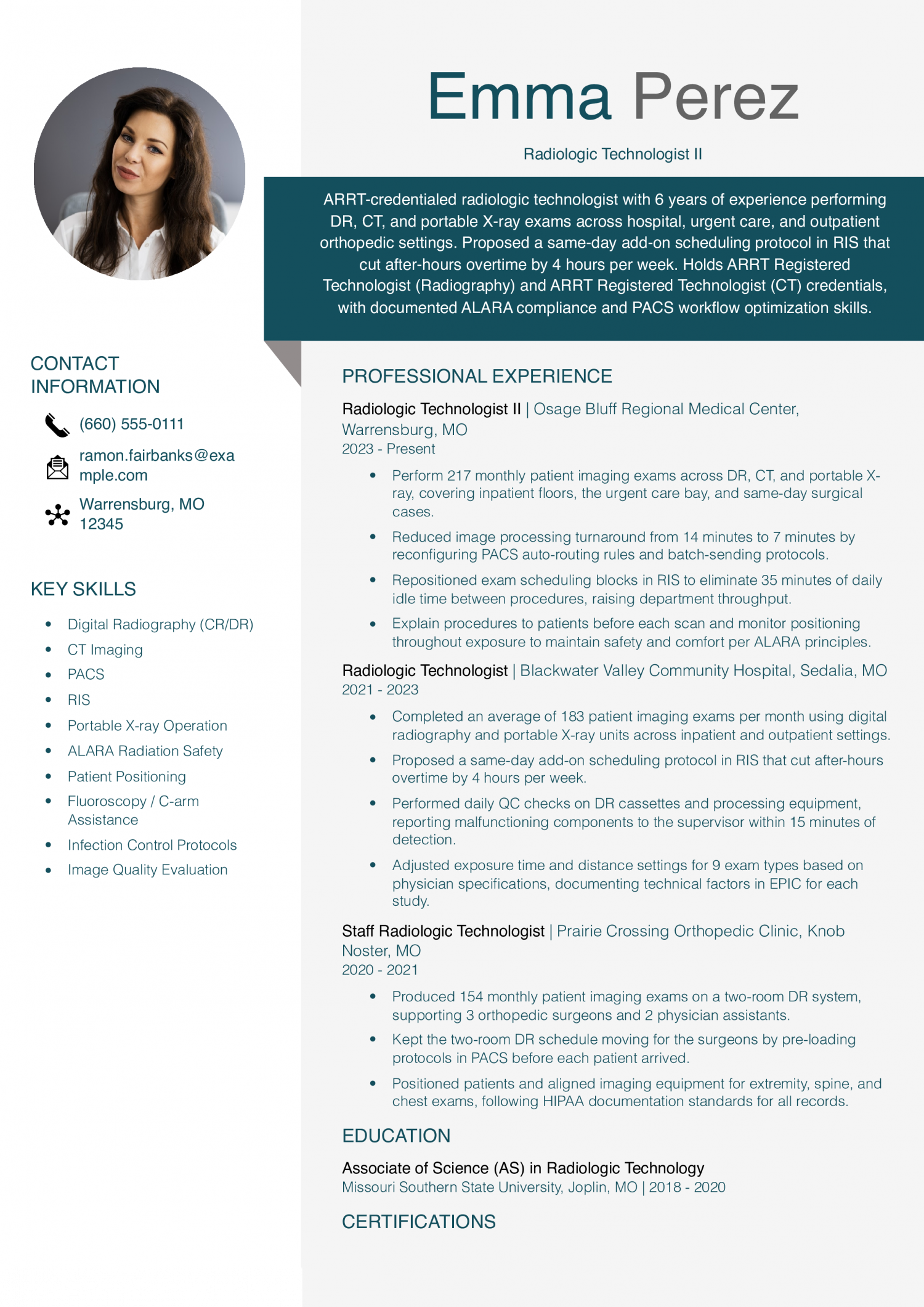
Pick this resume if you are a mid-level radiologic technologist advancing from a community hospital into a higher-volume imaging role. Lead with idle-time and turnaround reductions tied to specific PACS or RIS changes you implemented.
Radiology managers look for technologists who keep imaging moving without hurting quality. The PACS bullet names the setting that was changed and gives the turnaround time before and after. When you describe a workflow fix, name the system you changed and give the time before and after.
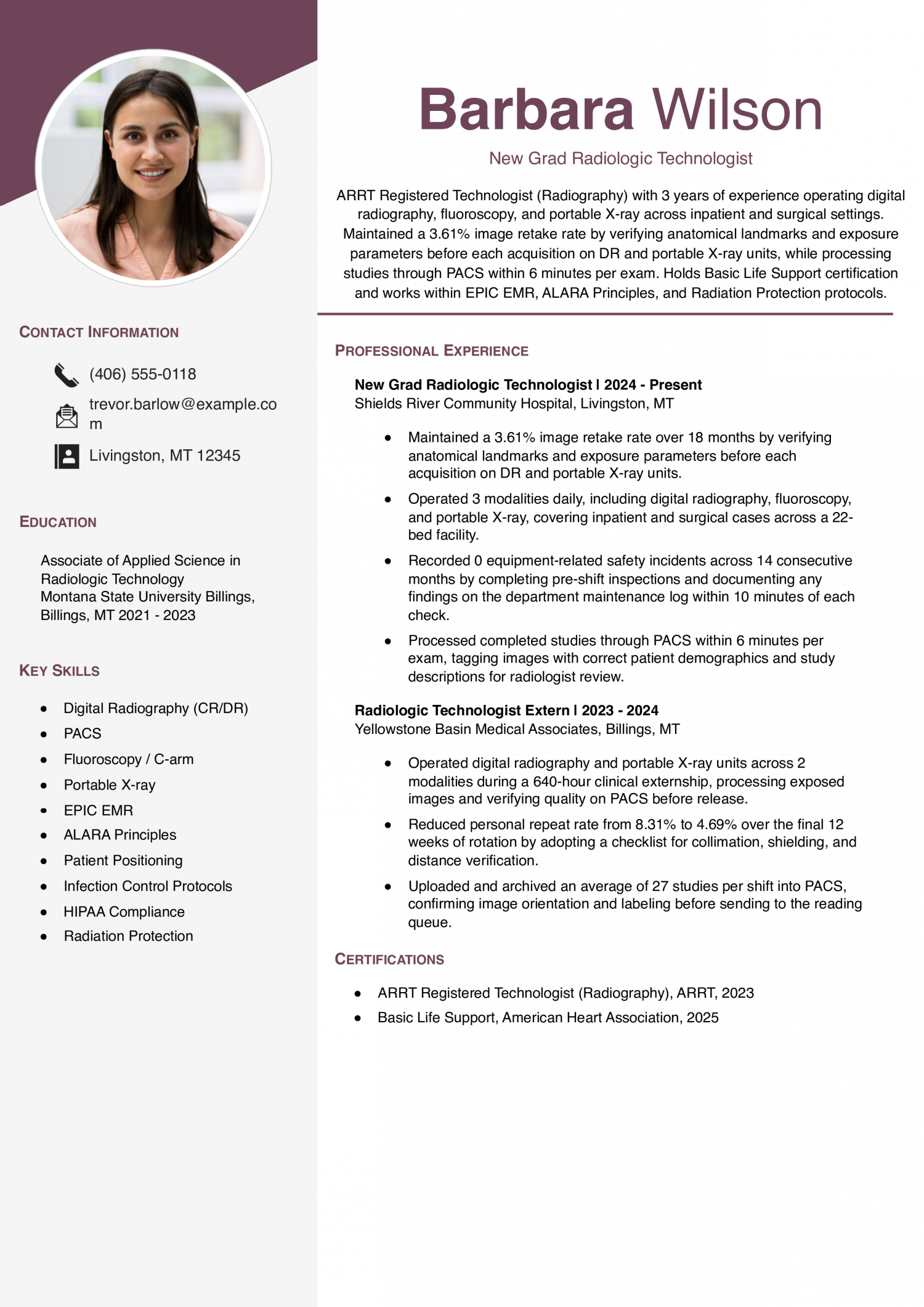
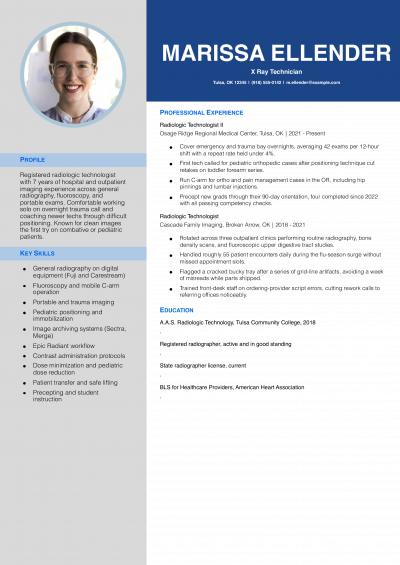
Start with this resume if you are a new graduate radiologic technologist entering your first full-time hospital position after a clinical externship. Lead with retake-rate percentages and safety-incident counts to prove clinical readiness from day one.
For a new graduate, hiring managers want to see clean images and safe habits. The externship bullet shows the repeat rate falling over the last weeks of rotation, and it names the checklist behind the drop. Track your own repeat rate at the start and end of training, and say what you changed.
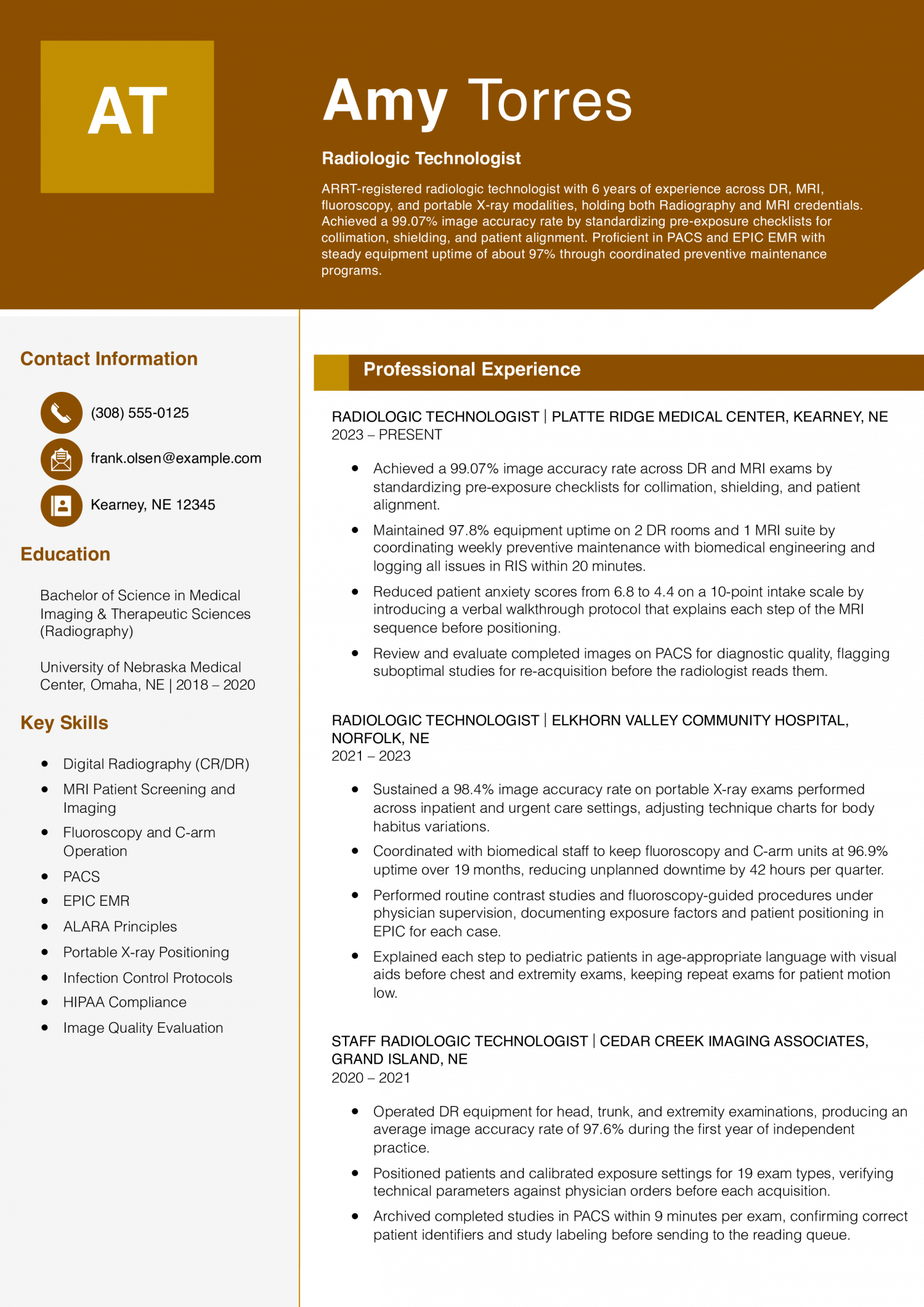
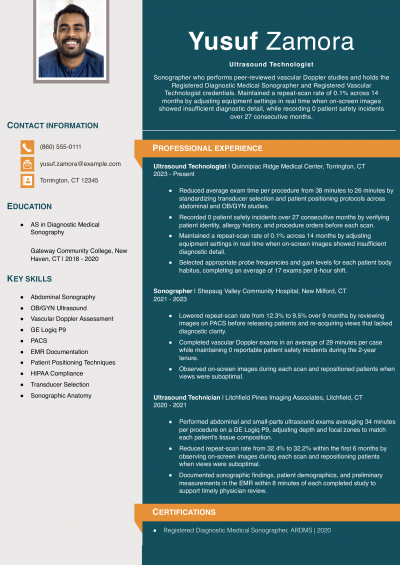
Try this resume if you are a mid-level radiologic technologist with multi-modality experience across hospital and outpatient settings. Lead with patient-experience improvements that pair anxiety-score reductions with the specific protocols behind them.
Imaging managers look for technologists who keep patients calm as well as take good images. The anxiety bullet gives a starting score, an ending score and the walkthrough that moved it, so the change is easy to believe. If you improved patient care, name the scale you used and the step you added.
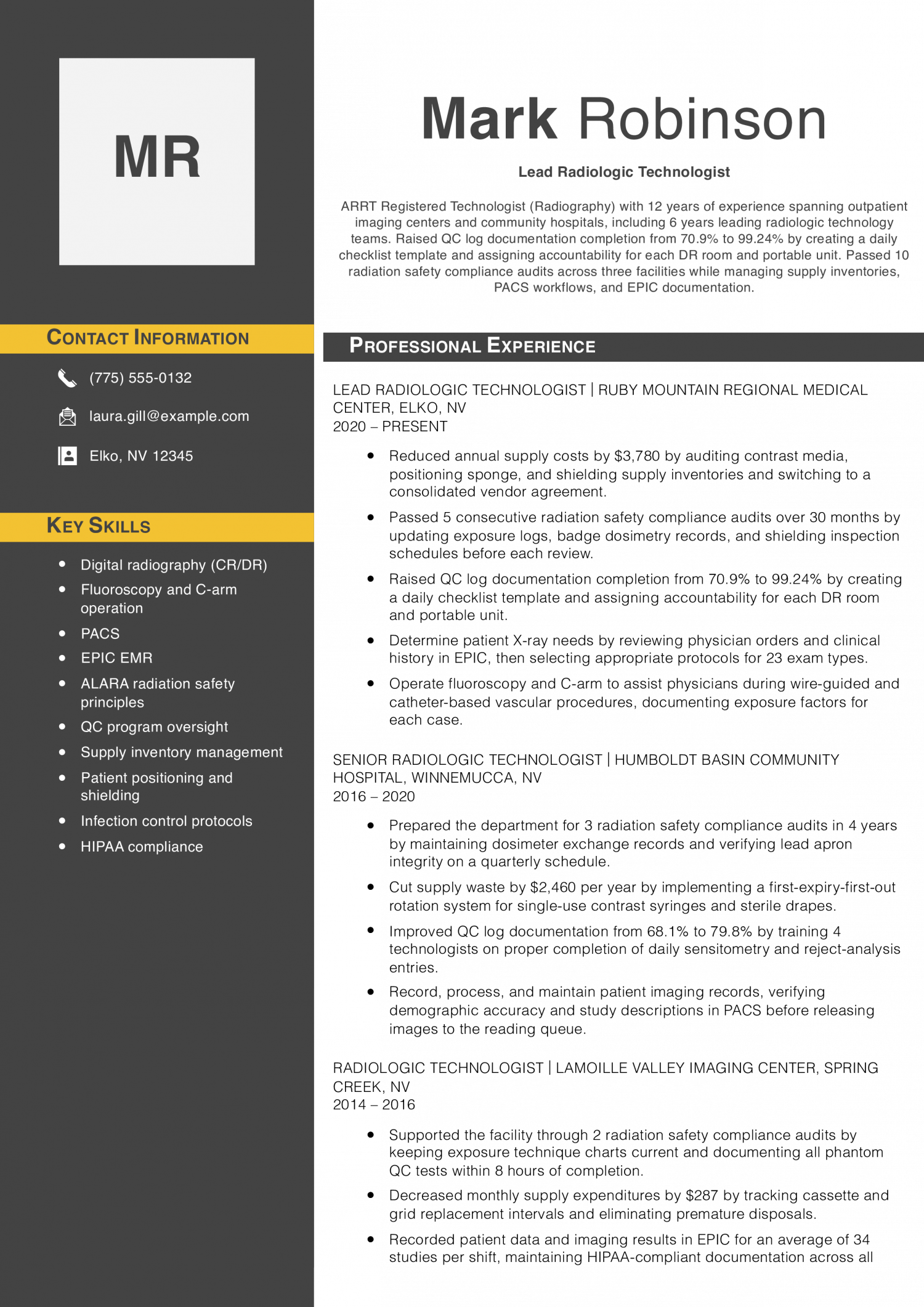
Lean on this resume if you are a senior radiologic technologist with lead experience across hospital and outpatient settings. Lead with consecutive audit pass counts to prove sustained compliance rather than one-time results.
Managers hiring a lead look for compliance that holds up year after year. The audit bullet counts how many reviews were passed in a row and over how many months, which shows the habits worked. When you describe audits or inspections, count the reviews you cleared in a row and give the months or years they cover.
Radiologic technologist with 7 years of experience in digital radiography, CT scanning, and fluoroscopy across hospital and community health settings, holding an ARRT Registered Technologist (Radiography) credential. Reduced average patient wait time from 26 minutes to 13 minutes by restructuring appointment scheduling in RIS. Trained 3 technologists on DR positioning, portable X-ray workflows, and ALARA shielding practices while documenting competencies across 17 exam types.
Radiology managers and imaging recruiters can verify your ARRT (R) status in seconds. They cannot see your CT or MRI cross-training from a registry search. Lead your profile with the modality, patient population, or language skill that sets you apart.
A line like “ARRT (R) and ARRT (CT) tech with four years of Level I trauma imaging” tells the reader more than a title alone.
Name the facility type you know best, such as outpatient imaging center or pediatric hospital. Then note any bilingual ability or vendor-specific scanner training. These details help a reviewer picture you inside their department before reading a single bullet.
Each bullet needs an action verb and a metric. Give the number of exams you complete each shift. Note your repeat rate or reject rate as a percentage.
A line like “Performed 35 diagnostic X-ray exams per shift with a 2% repeat rate” gives radiology managers a clear sense of your output and quality.
Track dose reduction results if your site runs a dose optimization program. Report patient throughput gains in minutes saved. You can also note the number of portable exams you handled per day in ER or ICU settings.
Even one number per bullet moves your resume past a generic task list.
Organize bullets under clear skill areas so reviewers can scan fast. Use groups like general radiography, fluoroscopy, and CT. Add a portable and surgical imaging group if you cover OR cases or do bedside exams in the ICU.
A fifth group for patient care covers positioning, contrast screening, and fall prevention. This format lets you show range without repeating the same task under every job title.
Keep the strongest metric in the first bullet of each group. This layout helps imaging recruiters match your scope to their open modality needs.
It also prevents long walls of text that blur your strongest results.
List your ARRT (R) on its own line with the issuing body and year earned. Follow it with any post-primary credential like ARRT (CT) or ARRT (MR).
Note your state radiologic technologist license and the state that issued it. Requirements vary by state, so match the license title your state uses.
Place Basic Life Support from the American Heart Association on the next line. Below your credentials, add a tools line naming the systems you use, such as your PACS platform and your EHR. Radiology managers scan this block before reading bullet points.
List your radiologic technology degree, school name, and graduation year. If you finished clinical rotations at a trauma center or specialty hospital, name the site. This gives imaging recruiters context about the volume and acuity you trained in.
New grads can add total clinical hours completed.
Include any continuing education courses tied to a modality you want to grow into. A line like “24 CE hours in MRI safety and protocols, 2024” signals your next career step. Keep the education section short so page one holds your credentials and experience.
Many rad tech skills blocks read like an equipment list of X-ray units and CR systems. Add dose tracking and image quality to show what you did with the equipment.
Radiology managers and imaging recruiters weigh hard skills first. They want to see modality terms that match the posting. Soft skills like patient positioning then confirm your clinical judgment.
Start by reading the job ad from top to bottom. Write down every skill term it names. Check each term against the two tables below. Add the ones that fit your real experience to your skills block.
Soft skills come next, in your work history bullets. Show each soft skill with a short result or number. A bullet about calming a pediatric patient proves patient care fast. A bullet about flagging an artifact proves attention to detail.
Do not list a skill you cannot discuss in an interview. Radiology managers and imaging recruiters often ask you to explain each one.
| Soft Skills | AI-estimated % |
|---|---|
| Patient reassurance | 75% |
| Physician communication | 67% |
| Attention to detail | 50% |
| Composure under pressure | 40% |
| Procedural adaptability | 35% |
And here are the top hard skills showing up most often.
| Hard Skills | AI-estimated % |
|---|---|
| Image quality review | 77% |
| Radiation safety compliance | 70% |
| Patient positioning techniques | 46% |
| Contrast media preparation | 37% |
| Radiographic exposure calibration | 33% |
Skill names and rankings come from an AI model grounded in U.S. Department of Labor occupation data for radiologic technologists, not from a count of radiologic technologists’ resumes built on ResumeTemplates.com.
For a radiologic technologist resume, radiology managers and imaging recruiters look at image quality review and radiation safety compliance first, so the items below back those up with detail.
ARRT requires continuing education every two years. Radiology managers check whether you stay current. A short credits section proves that at a glance.
Skip courses older than four years unless they are rare.
Name every PACS and RIS platform you have used. Imaging recruiters often filter resumes by system name. Spelling the exact product name helps you clear that filter.
Patient data flows through every imaging exam. Radiology managers expect you to protect patient privacy. Your resume should reflect that awareness.
Mention HIPAA training in your education or credentials section. Note any role where you audited image-sharing workflows. Even a brief line signals that you take privacy rules seriously.
Radiology managers and imaging recruiters scan for modality terms first. They also look for safety protocols and vendor systems. The first row lists general radiography tasks you do daily. The second row covers CT-specific terms and protocols. MRI work uses its own safety and coil terms. Patient care terms show your bedside and prep skills. Quality and compliance terms prove you follow ALARA standards. Use the exact phrasing your department or job posting uses. Each group helps a different part of your resume stand out. Match these terms to your actual hands-on experience.
| Niche | Keywords ATS scans for |
|---|---|
| General Radiography | X-ray positioning, fluoroscopy, portable radiography |
| CT Imaging | ARRT (CT), contrast injection, helical scanning |
| MRI Operations | ARRT (MR), MRI safety screening, surface coil selection |
| Patient Care | venipuncture, patient transfer, Basic Life Support |
| Quality Compliance | ALARA principles, dose optimization, image QA |
Beyond your state license, the credentials below tell radiology managers and imaging recruiters which modalities you can staff. They help a reviewer sort you by skill tier in seconds. A posting may call for one or several of these credentials. Show the year you earned each one so the reviewer knows your status at a glance. If you hold more than one ARRT post-primary credential, list them in the order the posting names them. That small detail shows you read the ad and matched your resume to it. Keep each entry on its own line for clean scanning.
Your ARRT (R) credential is the baseline. Most states also require a state license.
In BLS data, this occupation is moderate in size. The median sits well below the top earners, with the 90th percentile roughly 48 percent higher. At the bottom, the 10th percentile falls about 30 percent under the midpoint.
That spread tells you the field rewards specific credentials and modality range. Where you land in that range depends partly on geography and partly on what your resume proves you can do.
Lead with your registered modalities, patient volume, and the imaging systems you operate every shift.
| # | State | Median Annual |
|---|---|---|
| 1 | California | $121,260 |
| 2 | Massachusetts | $103,620 |
| 3 | District of Columbia | $102,770 |
| 4 | Oregon | $102,290 |
| 5 | Washington | $102,090 |
| 6 | Hawaii | $101,700 |
| 7 | Alaska | $98,920 |
| 8 | New York | $98,470 |
| 9 | New Jersey | $95,000 |
| 10 | Vermont | $94,540 |
| # | State | Workers | Median |
|---|---|---|---|
| 1 | California | 20,900 | $121,260 |
| 2 | Texas | 20,250 | $78,630 |
| 3 | Florida | 16,470 | $76,750 |
| 4 | New York | 13,450 | $98,470 |
| 5 | Ohio | 9,570 | $78,320 |
Resume Templates offers HR approved resume templates to help you create a professional resume in minutes. Choose from several template options and even pre-populate a resume from your profile.
List ARRT (R) right after your name in the header of the resume. Then create a credentials section below your contact details for the full title.
Spell out "ARRT Registered Technologist (Radiography)" along with the issuing body and year earned.
Leave your license number off the resume unless the posting asks for it. Note your state radiologic technologist license in good standing and name the state.
An employer can verify the number through the state agency.
Focus on clinical skills such as patient positioning and radiation safety protocols. Add the names of imaging equipment you have operated, like specific CT or X-ray units.
Soft skills such as patient communication and team coordination belong in this section too.
Yes, but only if you are a new graduate or changing careers into imaging. A strong objective names the modality you trained in and your ARRT credential.
Experienced technologists benefit more from a summary that highlights patient volume and imaging specialties.
Place your Basic Life Support certification in the same credentials section as your ARRT and state license. Include the American Heart Association as the issuer and your current expiration date.
Update this entry whenever you renew your certification.
Note any continuing education or volunteer imaging work you completed during the gap. If you kept your ARRT credentials current, state that clearly in your credentials section.
Showing that you maintained your skills during time away reassures reviewers about your readiness.
Yes, if you hold multiple ARRT post-primary credentials and have more than eight years of experience. A second page works well for advanced modalities or clinical preceptor roles.
Keep one page if your career is shorter than five years.
Try an ATS-friendly template to begin with. It keeps your radiologic technologist resume simple for hiring software. A basic template gives you the same simple layout. Avoid graphics, pick a standard font, and name sections plainly.
Radiologic Technologist Resume
4.4/5 stars with 216 reviews

Executive Resume Writer and Career Coach
Andrew Stoner is an executive career coach and resume writer with 17 years of experience as a hiring manager and operations leader at two Fortune 500 Financial Services companies, and as the career services director at two major university business schools.
© 2026 Resumetemplates.com All rights reserved.