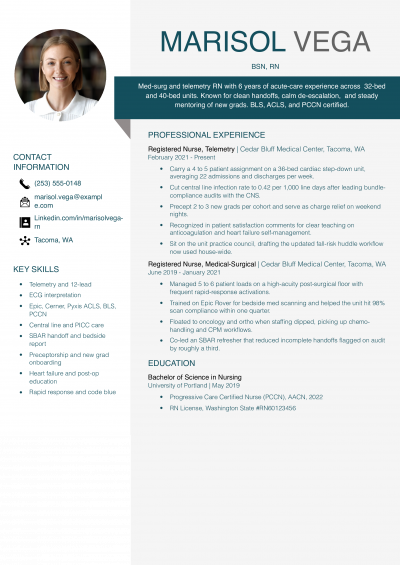
Registered Nurse Resume Examples
A state board lookup confirms you hold an active RN license. It does not show acuity, specialty, or the unit you actually staff. Lead the summary with the one signal that separates you from the…
Every resume example is written and reviewed by our team of Certified Professional Resume Writers to ensure top-quality content and formatting.
Most respiratory therapist roles fill based on two things: your credential level and your clinical volume. A CRT or RRT from the NBRC sets your baseline. Respiratory care managers and hospital recruiters then look for proof you can manage ventilators, run ABG analysis, and handle acute airway cases.
Your resume should show patient load numbers and the care settings you have covered. List ICU or neonatal rotations with the protocols you used. The examples below show how to organize these details so your experience reads clearly at every career stage. To compare layouts before you start, browse our resume templates.
Respiratory care managers decide whether to keep reading by the credentials block at the top of page one; if the RRT or CRT and state license aren't visible there, the resume moves to the rejection pile.
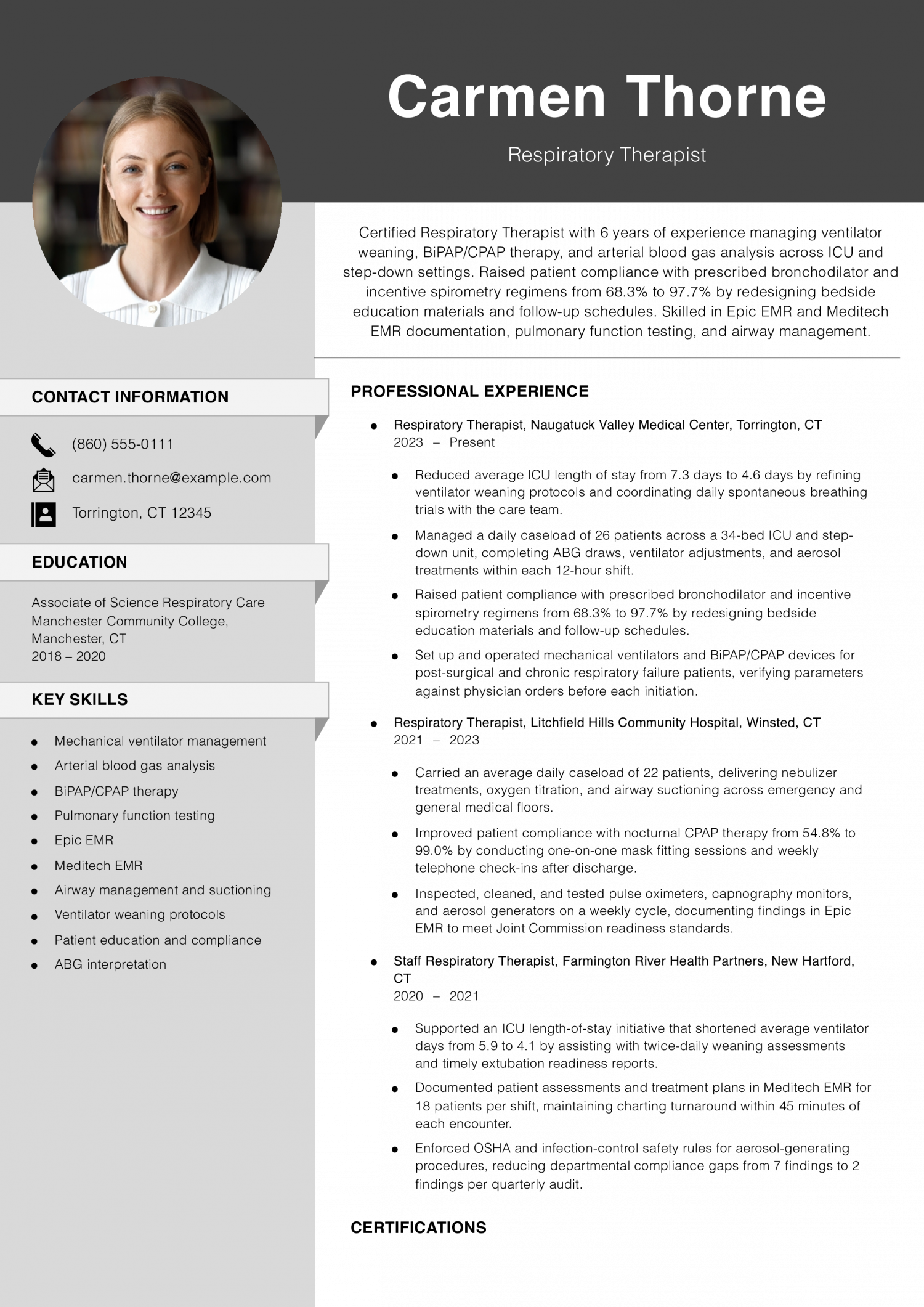
Pick this resume if you are a mid-level respiratory therapist with a CRT credential and about six years of bedside experience. Borrow its approach of pairing a compliance percentage gain with the specific patient education method that drove it.
ICU length of stay dropped because the weaning protocols were changed, and both the old and new stay durations are on the page. A clinical director can see the patient-care impact in one line. Show your own protocol work with both the before and after outcomes it produced.
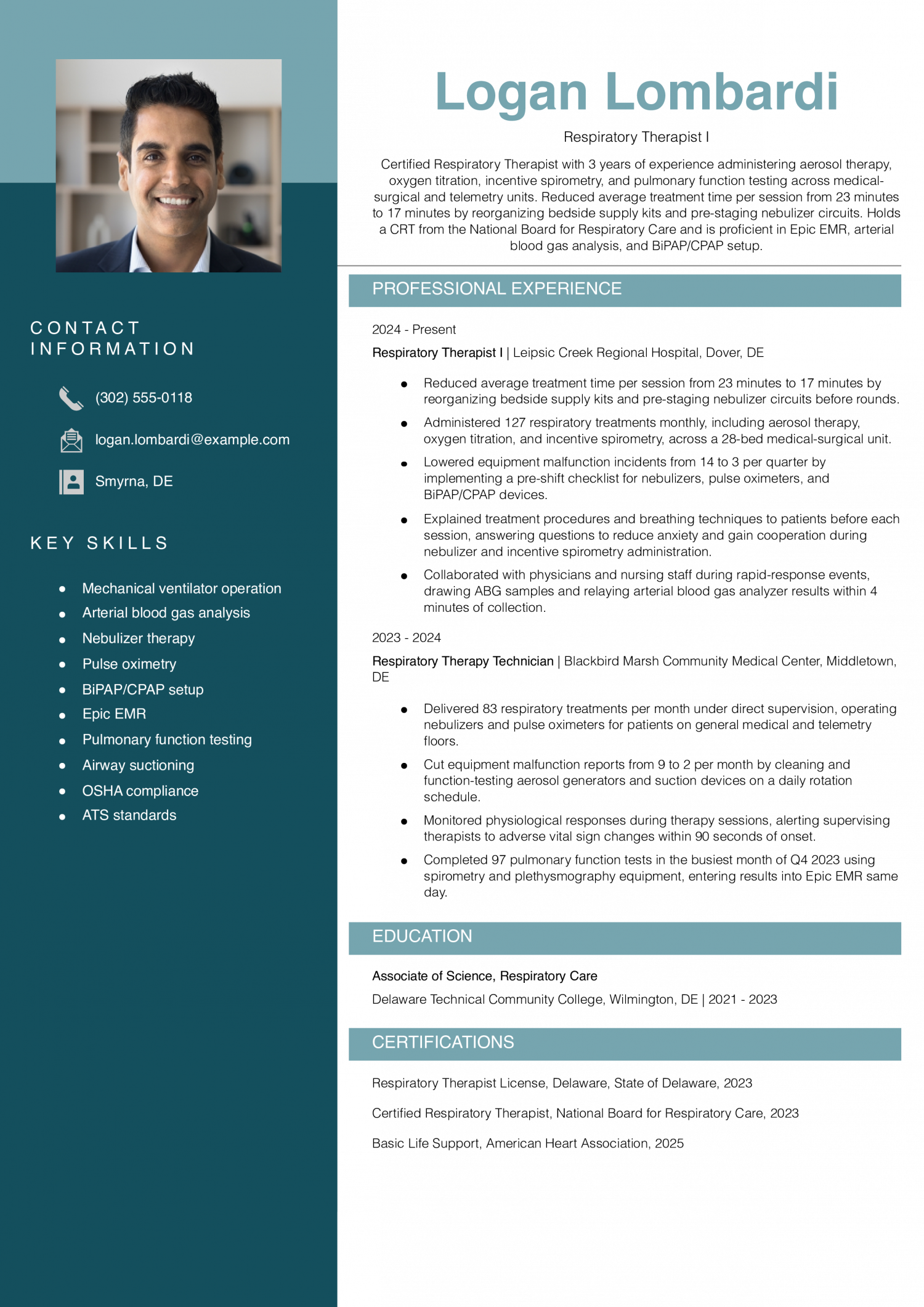
Start with this resume if you are an entry-level respiratory therapist building your first full-time clinical record after earning a CRT. Post your equipment malfunction reductions as before-and-after counts tied to the checklist or schedule that caused the drop.
Reorganizing bedside supply kits and staging nebulizer circuits before rounds is the method behind the shorter treatment times. A charge nurse can see exactly which prep steps saved the minutes. Name your own workflow changes and the time they freed per session.
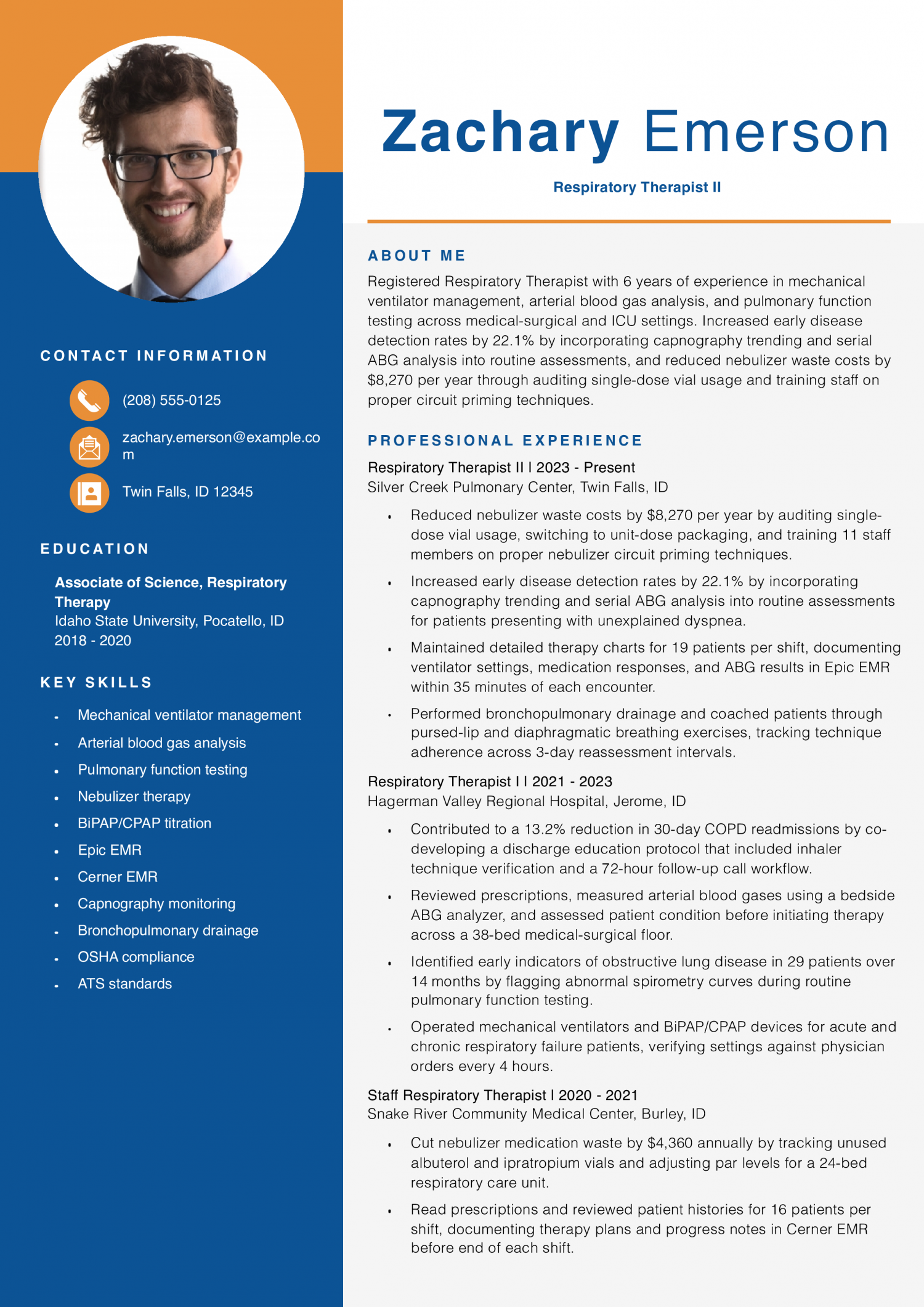
Try this resume if you are a mid-level respiratory therapist with about six years spanning RT-I and RT-II roles. Rank your cost savings by naming the exact supply change and dollar amount behind each reduction.
A discharge protocol that includes inhaler technique checks and follow-up calls within a set time window explains how readmissions fell. A department head reading those steps knows the program would work at another hospital. Describe the steps you built into any protocol that changed an outcome.
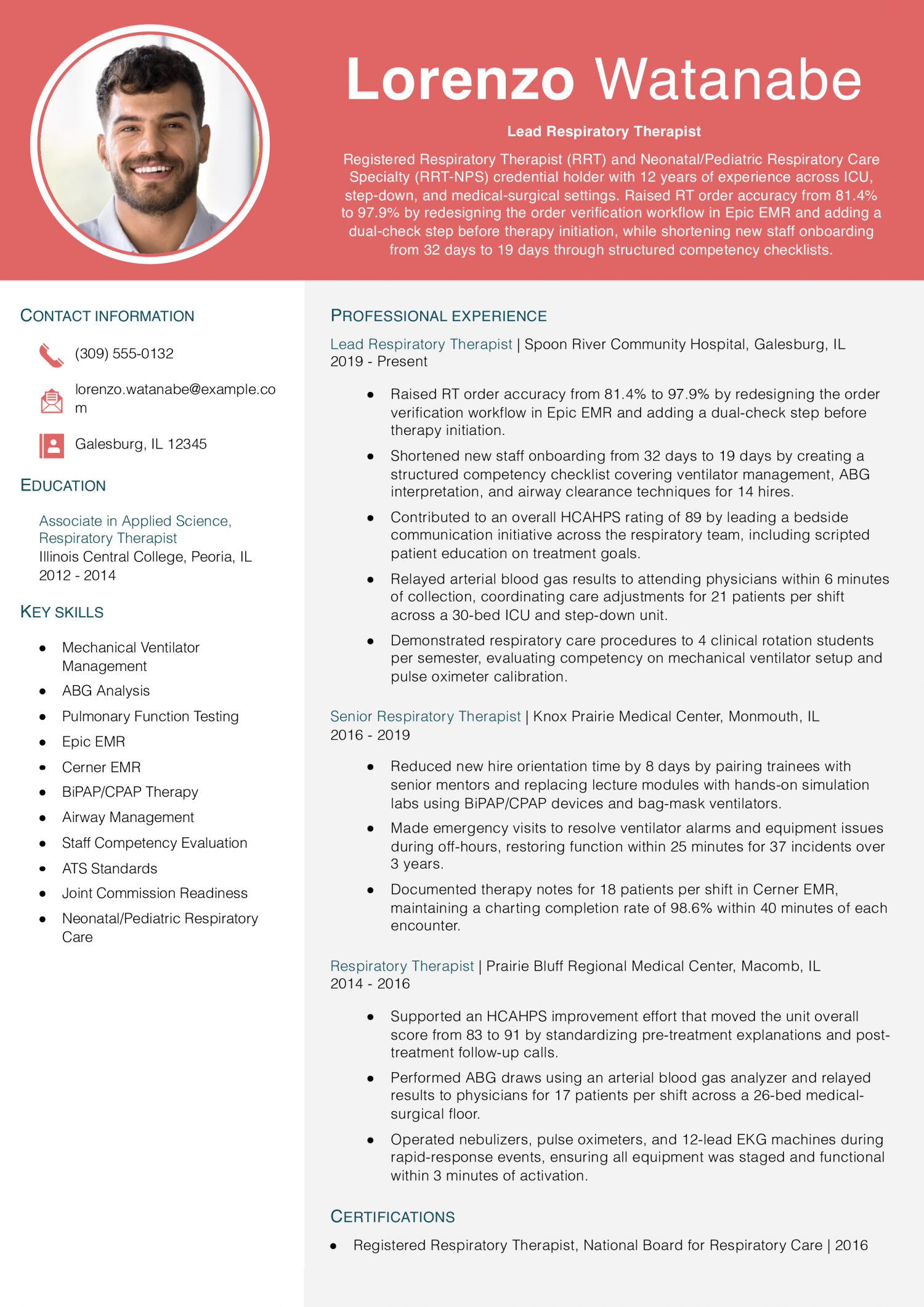
Lean on this resume if you are a senior lead respiratory therapist with over a decade of clinical and supervisory experience in hospital respiratory departments. Reach for its technique of anchoring each onboarding improvement to the exact competency checklist and hire count behind it.
Order accuracy climbed because the verification workflow in the EMR was redesigned and a dual-check step was added before therapy began. A hiring manager can see the fix is structural, not a personal push. Show the system change you made and where accuracy started versus where it ended.
Dedicated to reducing procedural errors across pulmonary units, having cut them by 26.6% through standardized ventilator setup checklists and pre-treatment verification steps for ABG draws and aerosol delivery. Bringing 6 years of respiratory care experience with a Certified Respiratory Therapist credential, proficiency in Epic EMR, and consistent equipment uptime above 99.3% through scheduled preventive inspections and rapid fault-alert calibrations.
Your state license and CRT prove you can practice. Every other applicant has those same lines. Lead your summary with the one detail respiratory care managers cannot find in a board database.
That could be a ventilator weaning protocol you refined. It could be a neonatal unit where you spent two years. A bilingual skill set counts here too.
Name one clinical focus, one patient population, or one piece of equipment that sets you apart. Keep this opener to two or three lines. It should read like a sharp elevator pitch, not a list of traits.
The rest of your resume fills in the proof.
Strong respiratory therapist resumes pair each duty with a measurable result. Without a number, a bullet tends to read as a task list. State how many ventilator patients you managed per shift.
Note the percentage drop in reintubation rates your protocol helped achieve.
Volume counts too: list bed counts or daily treatment loads. If you trained new hires, note how many you oriented each quarter. Respiratory care managers scan for these figures first because they signal workload capacity.
Round numbers are fine when exact data is unavailable. Pair one metric with one outcome per bullet for the clearest read.
Organize your experience bullets into clear categories so hospital recruiters can scan them fast. Critical care covers vent management and emergency airway response. Diagnostics covers pulmonary function tests and arterial blood gas draws.
Patient education is its own group, such as inhaler coaching and smoking cessation counseling. Neonatal care forms a strong category if you have hours in that specialty. Keep each category to three or four bullets.
This structure shows breadth without forcing the reader to hunt across a long list. Match your groupings to the job posting when possible.
List your license and CRT or RRT near the top of page one. List your state respiratory therapist license with the state name. Add your CRT or RRT credential from the NBRC on the next line.
If you hold the RRT-NPS from the NBRC, place it right after your RRT.
Include ACLS and Basic Life Support from the American Heart Association below those. Respiratory care managers often verify these before reading your work history. If a posting asks for a specific credential, bold it or move it to the first line.
Note your license state but never print the license number itself.
Close your resume with your degree in respiratory care or a related field. Name the school, the degree level, and your graduation year. If you hold an associate degree and are finishing a bachelor’s program, list both with expected dates.
Clinical rotations belong here too, especially in a specialty unit. Add any continuing education hours that match the posted role. Respiratory care managers in teaching hospitals may value conference presentations or preceptor roles.
List those under a short heading like “Professional Development.” Keep this section brief, four to six lines at most.
Respiratory care managers and hospital recruiters scan for both clinical and personal skills on your resume.
Hard skills like ventilator management show you can handle bedside care. Soft skills like critical thinking prove you can act under pressure. Recruiters weigh both types, but hard skills clear the ATS filter first.
Soft skills then shape the interview shortlist. Cross-check each table against your target job posting. Add any missing terms that appear in the ad.
Treat soft skills as proof points that back your bullet statements. Spell each term the same way the posting spells it. ATS tools score exact matches higher than close variants.
Use both tables as a checklist before you submit your file.
| Soft Skills | AI-estimated % |
|---|---|
| Patient reassurance | 65% |
| Clinical decision-making | 59% |
| Interdisciplinary collaboration | 43% |
| Composure under pressure | 35% |
| Clear patient education | 34% |
And here are the top hard skills showing up most often.
| Hard Skills | AI-estimated % |
|---|---|
| Mechanical ventilator management | 66% |
| Arterial blood gas analysis | 52% |
| Pulmonary function testing | 41% |
| Airway management | 39% |
| Bronchodilator therapy | 35% |
Skill names and rankings come from an AI model grounded in U.S. Department of Labor occupation data for respiratory therapists, not from a count of respiratory therapists’ resumes built on ResumeTemplates.com.
Start with your state license, then show how you keep learning, which record systems you use, and the safety training you hold.
A State Respiratory Therapist License is required in most states. Alaska is the current exception. Check your state board for exact rules.
List your state license with its status and state name. Do not print the license number on your resume. Write “active” or “in good standing” instead.
If you hold licenses in more than one state, list each one. Respiratory care managers value multistate readiness. Each state board issues its own license, so check the rules in each state where you plan to work.
Respiratory care managers look for ongoing learning. A short section shows you stay current. Focus on courses tied to your target role.
List the course title, provider, and completion year. Group entries under a clear heading. Keep the list to your most recent or relevant hours.
Ventilator management and airway courses stand out in critical care. Pulmonary rehab training matters in outpatient settings. Pick what fits the posted job.
Hospitals screen for EMR experience early in review. Name the exact systems you have used. This saves time for hospital recruiters.
HIPAA training is standard in clinical hiring. Mention it, but keep it brief. One line is enough for this topic.
Note your most recent HIPAA training year. Respiratory care managers expect compliance, not paragraphs about it. A single bullet or skills-line works well.
If you handled audits or trained staff on privacy rules, say so. That shows leadership beyond the baseline requirement.
A state respiratory therapist license is required in every state except Alaska, so list yours with its expiration date. The Certified Respiratory Therapist from the NBRC is the entry credential that qualifies you for initial licensure in many states. Beyond those two baseline items, the credentials below tell respiratory care managers and hospital recruiters what patient populations you can cover.
They also show which units you can staff on your first shift. Include the issuing body and the date each credential expires. Credentials tied to a specific care setting carry the most weight when they match the unit in the posting.
Order them by relevance to the role you want.
Credentials signal your clinical scope to reviewers. For each credential, note who issued it and the year you earned or renewed it.
Respiratory therapist is a moderate-sized occupation in BLS data. The workforce is large enough that the median reflects a wide mix of settings and credential levels. Pay at the 90th percentile runs roughly 43 percent above the median.
The 10th percentile sits about 23 percent below it. That spread tells you the field rewards specifics, not tenure alone. Geographic concentration also shapes the range, with some states paying well above the national figure.
On your resume, lead with your credential tier and the clinical protocols you manage daily. Name the patient populations and ventilator systems you work with most.
| # | State | Median Annual |
|---|---|---|
| 1 | District of Columbia | $111,950 |
| 2 | New York | $107,810 |
| 3 | California | $104,820 |
| 4 | Massachusetts | $102,170 |
| 5 | Washington | $101,130 |
| 6 | New Jersey | $100,810 |
| 7 | Oregon | $100,560 |
| 8 | Minnesota | $98,710 |
| 9 | Alaska | $97,950 |
| 10 | New Hampshire | $95,940 |
| # | State | Workers | Median |
|---|---|---|---|
| 1 | California | 18,650 | $104,820 |
| 2 | Texas | 12,130 | $79,540 |
| 3 | Florida | 8,820 | $81,160 |
| 4 | New York | 7,010 | $107,810 |
| 5 | Ohio | 6,640 | $79,920 |
Resume Templates offers HR approved resume templates to help you create a professional resume in minutes. Choose from several template options and even pre-populate a resume from your profile.
List your state license status, your CRT or RRT credential, and clinical skills tied to each role. Include patient volume or ventilator weaning rates as measurable outcomes in your bullet points. Name the EMR platforms and equipment brands you have used in practice.
One page works for therapists with fewer than 10 years of experience. A second page is reasonable when you hold specialty credentials or have worked across several clinical settings. Keep every line relevant to the posting so the extra length earns its space.
Yes, a cover letter lets you explain context that bullet points cannot carry. Use it to describe why you want that specific unit or facility. Mention a patient population or protocol you have managed that matches the posting.
Lead with your clinical rotations and list them the way you would list paid positions. Include the facility name, the unit, dates, and tasks you performed during each rotation. Add your CRT credential and Basic Life Support certification near the top of the page.
A summary works better than an objective because it tells the reader what you have done. Write two to three lines that name your credential, your strongest clinical setting, and a key outcome. Respiratory care managers often scan this section first to decide whether to read further.
Note the gap briefly in your summary or in a short line between roles. If you completed continuing education or kept your license current during that time, say so. Respiratory care managers care more about an active license and recent clinical skill than about the gap itself.
Group your travel assignments under the staffing agency name, then list each facility as a separate entry beneath it. Include the unit type, patient volume, and length of each assignment. This format shows variety without making the resume look scattered across too many employers.
Pick an ATS-friendly template so your license and clinical credentials have their own section. A basic template is a solid choice too.
Respiratory Therapist Resume
4.7/5 stars with 131 reviews

Executive Resume Writer and Career Coach
Andrew Stoner is an executive career coach and resume writer with 17 years of experience as a hiring manager and operations leader at two Fortune 500 Financial Services companies, and as the career services director at two major university business schools.
© 2026 Resumetemplates.com All rights reserved.