Dental Hygienist Resume Examples
Add a line a practice owner cannot read off your state license. That might be a laser certification, a pediatric residency rotation, or fluency in Spanish with a bilingual patient panel. Lead the summary with…

Radiology directors decide whether to keep reading by the credentials line near the top; if state license, registration status, and modality experience aren't visible there, the resume gets set aside before the work history is read.
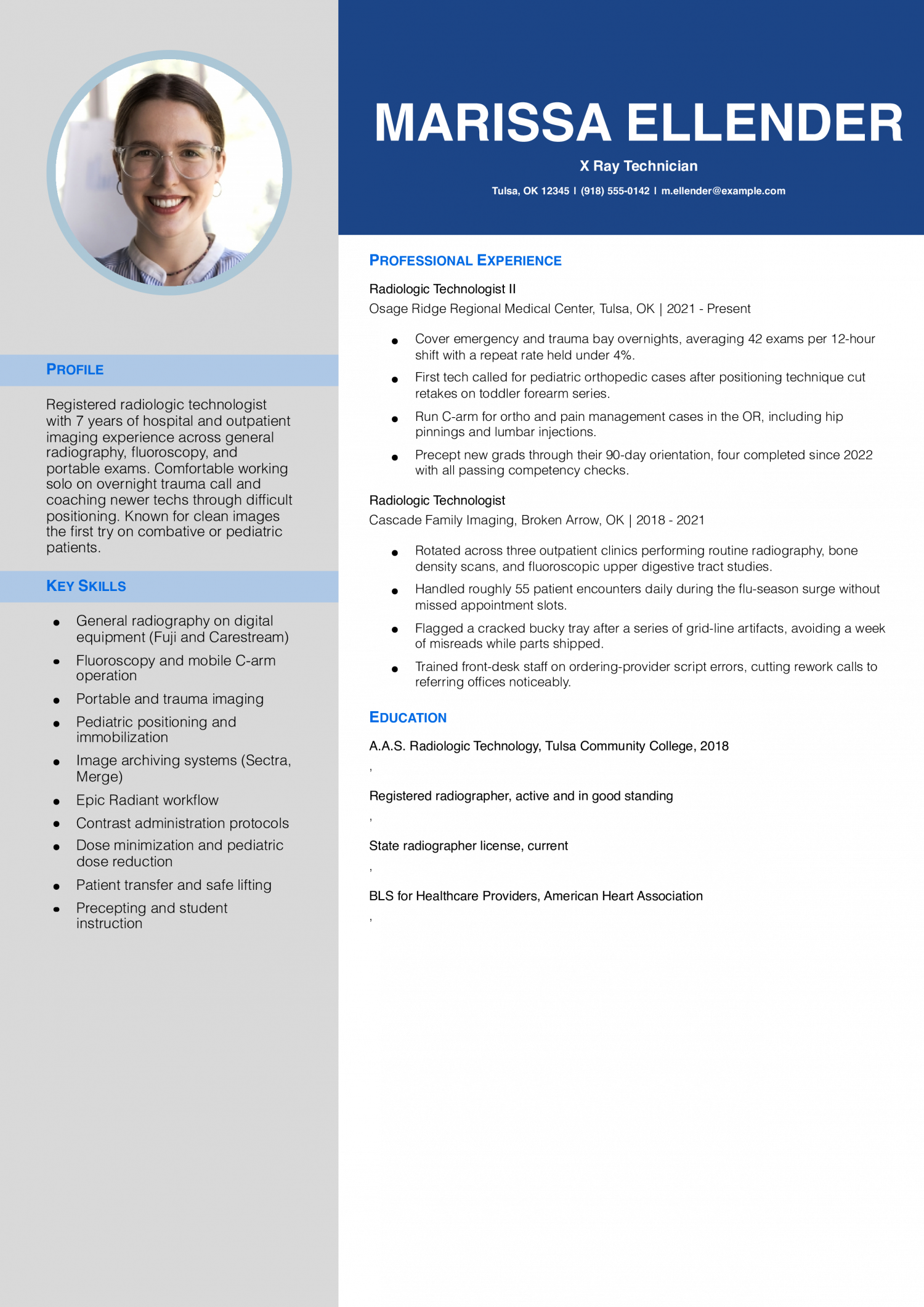
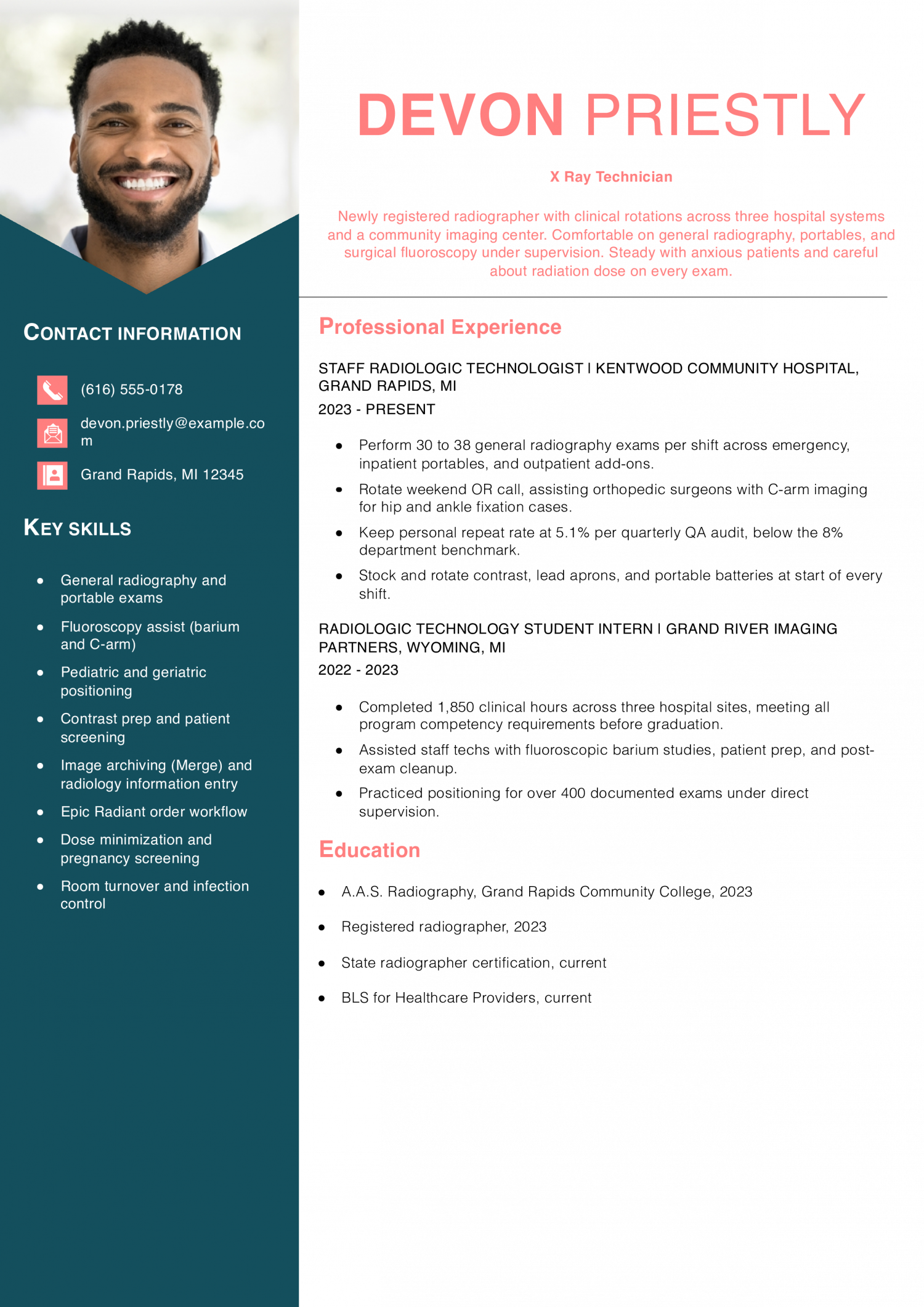
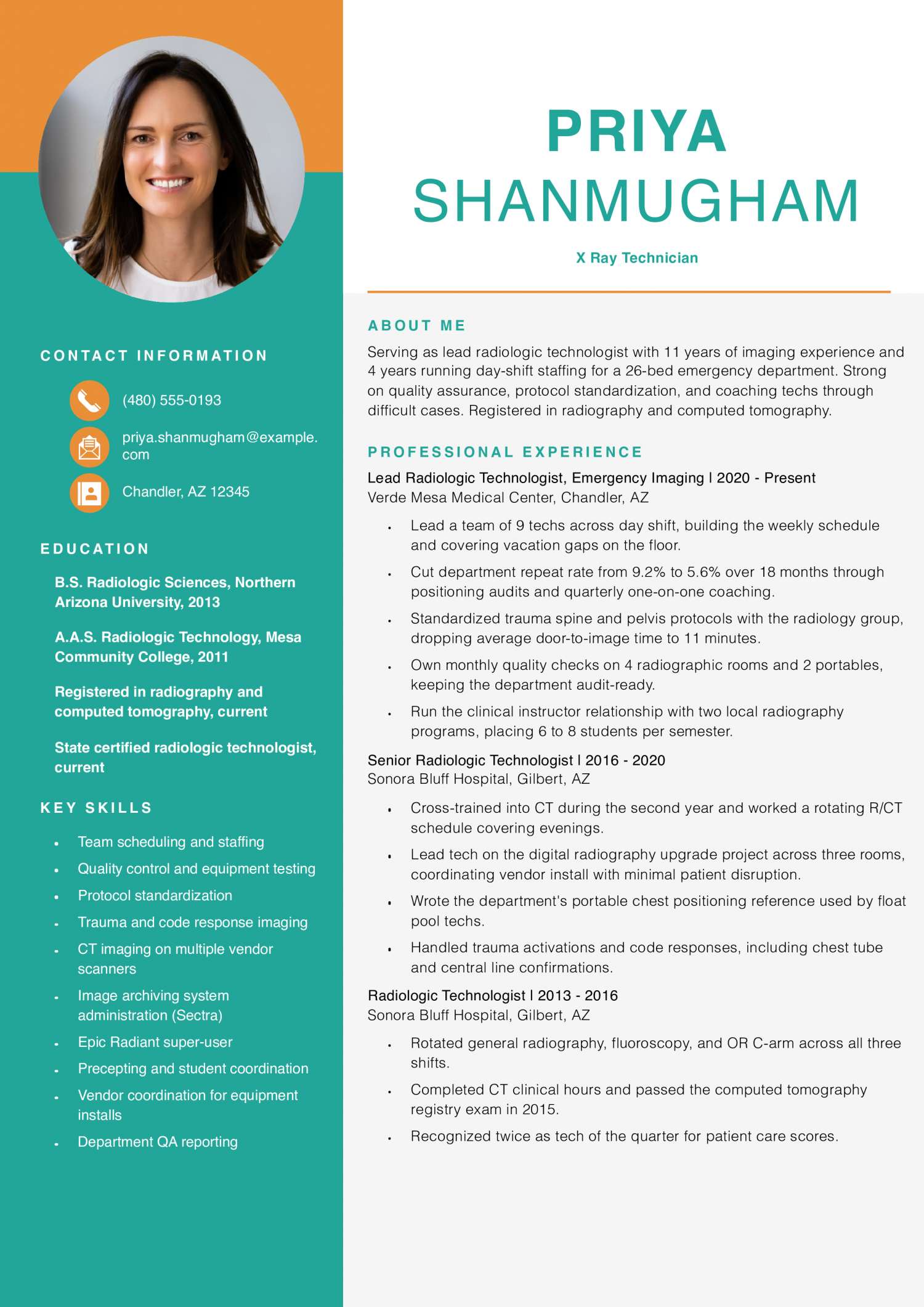
A staff rad tech runs routine exams in the ER, on the floors and in the clinic. This resume has to show clean image quality, safe patient positioning and steady exam volume across common studies.
A lead tech runs the daily schedule, coaches new staff and owns quality checks for a shift. This resume has to prove you can hold volume, coach peers and answer to rad directors.
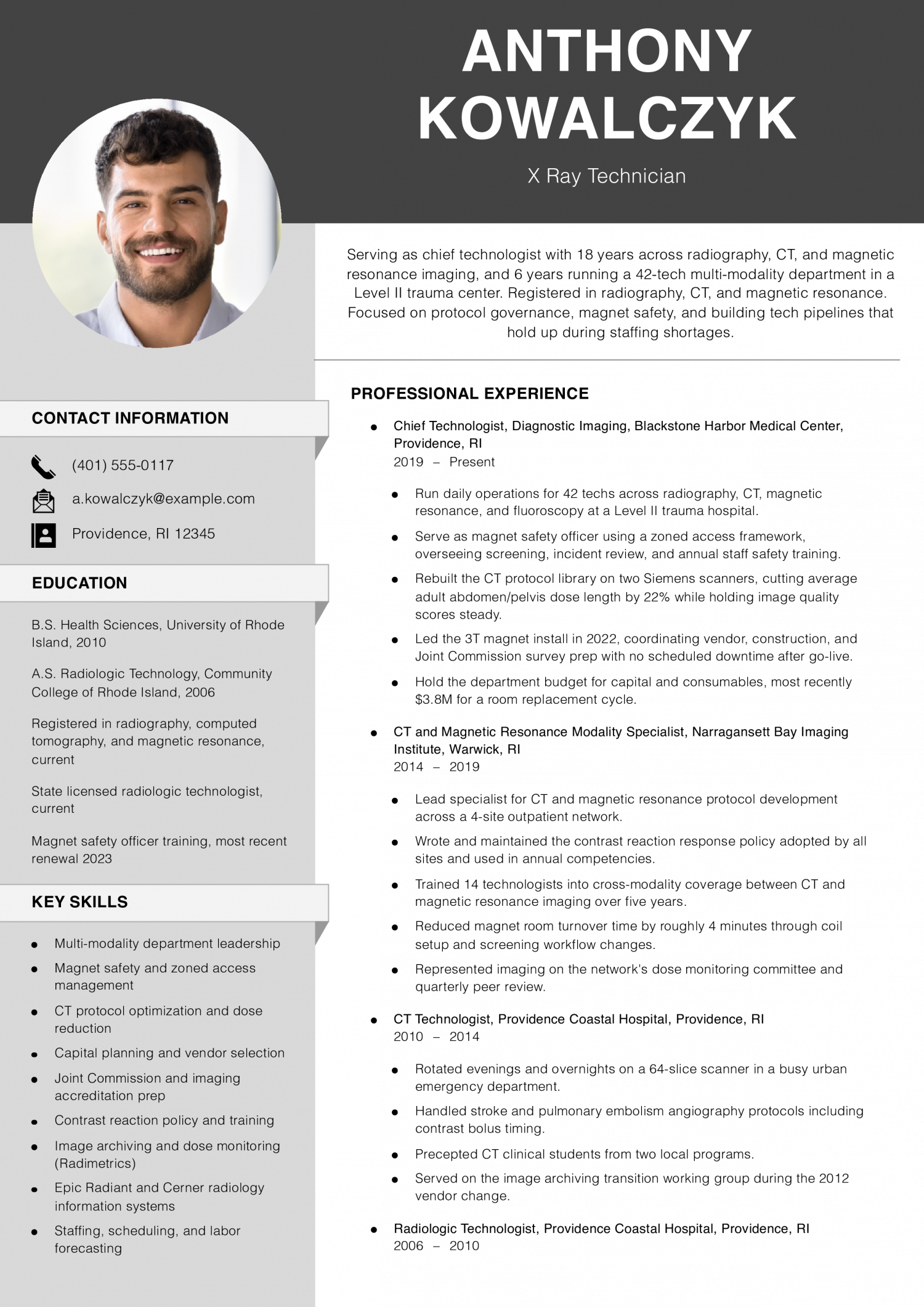
A modality lead or chief tech owns CT, MRI or the full imaging unit, with protocols and uptime. This resume has to show deep modality skill, protocol ownership and clear gains in exam volume.
Rachel Ondremba
Louisville, KY | (502) 555-0164 | [email protected] | linkedin.com/in/rachel-ondremba
Radiologic technologist with 9 years of hospital and outpatient experience across general radiography, fluoroscopy, and CT. Registered in radiography and computed tomography with active Kentucky license. Comfortable running solo overnight emergency coverage, precepting students, and standing in as charge tech during weekend shifts. Known for clean images on difficult trauma and bariatric cases and for steady communication with radiologists and referring providers.
Senior Radiologic Technologist, Emergency and CT
Riverbend Baptist Hospital | Louisville, KY | 2020-Present
Radiologic Technologist / CT Cross-Trained
Bluegrass Valley Regional Hospital | Elizabethtown, KY | 2017-2020
Radiologic Technologist
Ohio Valley Urgent Care Network | Jeffersonville, IN | 2015-2017
Radiologic Technology Student Intern
Louisville Metro Health System | Louisville, KY | 2014-2015
A state license and ARRT registry tell radiology directors what you are cleared to do. They do not show what you actually run. Put that in your opening line.
Name the modality mix you own beyond plain film. That might be a portable C-arm in the OR, fluoroscopy support, or CT cross-training. Add the shift patterns you cover, such as trauma call, third shift, or weekend rotation.
If you read pediatric, geriatric, or orthopedic volume all day, say so, and note a bilingual patient base too. One clear line at the top sets you apart from every other tech in the stack, and points to the work you do each shift.
Bullets without a number read as duties. Radiology directors scan for load first. Name your daily or weekly exam volume, the modality split, and your repeat rate if you track it.
A strong bullet might read: 45 to 60 exams per shift across chest, extremity, and portable studies, with a repeat rate under 4 percent. If you cover trauma or OR call, note cases per month. If your department does not publish repeat rates, use dose metrics, patient throughput, or wait-time improvements you contributed to.
Where hard numbers are not available, use scope: level one trauma center, 400-bed hospital, or three-site outpatient network. Hard figures move a resume past a screen.
Radiology directors read faster when the work is sorted. A wall of tasks slows them down. Use three to five buckets under each role.
Patient care and positioning covers intake, screening for pregnancy and metal, and handling non-ambulatory or pediatric patients. Imaging production covers routine radiography, portable studies, fluoroscopy assistance, and any CT, MRI, or mammography cross-training. Safety and ALARA covers shielding, technique factors, and dose tracking.
Equipment and PACS covers QC checks, calibration, and image transfer to the reading room. Team and workflow covers OR coverage, ER turnaround, and handoffs to radiologists. Categories let a reader see your range in one pass.
They will not have to mine a 12-bullet block.
Radiology directors check credentials before they read a bullet, so put a short block near the top of page one. List ARRT registration by category, such as R, CT, or M, with state licensure in good standing. Add BLS, and ACLS or PALS if your setting expects them, and note your fluoroscopy permit where the state requires one.
Below that, name the gear you have run: GE, Siemens, Philips, or Canon units, plus PACS platforms like Epic Radiant, Merge, or Sectra. Specifics matter because departments hire against a known fleet. Rules vary by state and employer, so mirror the posting where your credentials match.
Your closing section should confirm the training path a radiology team expects. List your JRCERT-accredited program, the degree earned, and the graduation year. If you completed a hospital-based clinical rotation, name the site and hours logged.
Add continuing education that maps to modalities you want to grow into: CT registry prep, mammography clinicals, or MRI safety coursework. New graduates should include clinical competencies completed and exam counts by modality, since that stands in for job volume. Experienced techs can keep this section short and use the space saved for a stronger metrics line up top.
Awards, in-service teaching, and student precepting belong here too, in one short line each.
Radiology directors and hospital recruiters scan hundreds of X Ray Technician resumes a week for open shifts. The skills below show up most often on the ones they move forward. Hard skills prove you can run the equipment on day one.
Soft skills like patient positioning finesse and clear communication back up the bullets that describe your shifts. Match the table against the exact wording in the job posting. Then mirror those terms in your summary and bullets.
Put the hard skills in a dedicated skills block near the top of the resume. Weave the soft skills into your bullet points where you can tie them to a shift or a case. Use the plain form of each term the posting uses, since the scan reads strings, not meaning.
Swap in the modality names the department runs, like CT or MRI, if the posting lists them. Keep the block short and clean so a human reader can skim it in five seconds. Do not pad the list with skills the posting never asked for.
| Soft Skills | AI-estimated % |
|---|---|
| Patient reassurance | 69% |
| Physician communication | 51% |
| Attention to detail | 44% |
| Composure under pressure | 36% |
| Procedural adaptability | 33% |
And here are the top hard skills showing up most often.
| Hard Skills | AI-estimated % |
|---|---|
| Radiographic image acquisition | 77% |
| Radiation safety compliance | 61% |
| Patient positioning techniques | 46% |
| Image quality evaluation | 37% |
| Contrast media preparation | 27% |
Skill names and rankings come from an AI model grounded in U.S. Department of Labor occupation data for x-ray technicians, not from a count of x-ray technicians’ resumes built on ResumeTemplates.com.
These are the must-haves hiring teams look for when scanning an x-ray technician resume.
Radiology directors and hospital recruiters scan for the modality you run. They also scan for the patient setting where you ran it. The rows below cover the main slices of X ray work. Trauma and emergency imaging is one slice, with portable and stat exams. Surgical suite work is another, with C-arm and fluoro cases. Orthopedic clinics lean on long bone and joint views. Outpatient imaging centers mix chest, abdomen and extremity studies. Put your state license and BLS on the page. Name the imaging systems you used by product. Match the words to the postings you want to answer.
| Niche | Keywords ATS scans for |
|---|---|
| Trauma and ER | portable radiography, stat exams, trauma imaging |
| Surgical Imaging | C-arm operation, fluoroscopy, OR sterile technique |
| Orthopedic Radiography | long bone views, joint imaging, weight bearing studies |
| Outpatient Imaging | chest X ray, abdominal series, extremity radiography |
| Safety and Compliance | radiation safety, patient shielding, dose reduction |
The top-paying states for X Ray Technicians cluster in smaller, low-supply markets and high cost-of-living regions, not the big metros most readers picture. Pay concentration follows facility density and shift coverage gaps, so states with fewer trained techs push wages up to hold staff. The spread from bottom to top is wide for a mid-sized allied health field.
That means the same title can carry very different pay depending on where you sit and what you scan. Radiology directors and hospital recruiters read location as a proxy for procedure volume and call burden. If you can relocate, name every state where you hold licensure and the modalities you are cleared to run in each one.
| # | State | Avg. Annual |
|---|---|---|
| 1 | California | $121,260 |
| 2 | Massachusetts | $103,620 |
| 3 | District of Columbia | $102,770 |
| 4 | Oregon | $102,290 |
| 5 | Washington | $102,090 |
| 6 | Hawaii | $101,700 |
| 7 | Alaska | $98,920 |
| 8 | New York | $98,470 |
| 9 | New Jersey | $95,000 |
| 10 | Vermont | $94,540 |
| # | State | Workers | Median |
|---|---|---|---|
| 1 | California | 20,900 | $121,260 |
| 2 | Texas | 20,250 | $78,630 |
| 3 | Florida | 16,470 | $76,750 |
| 4 | New York | 13,450 | $98,470 |
| 5 | Ohio | 9,570 | $78,320 |
Resume Templates offers HR approved resume templates to help you create a professional resume in minutes. Choose from several template options and even pre-populate a resume from your profile.
Yes, the field has steady demand across hospitals, urgent care clinics, and orthopedic offices.
Show that stability by listing your exam volume, modalities, and the patient populations you have covered. Radiology directors and hospital recruiters read those numbers as proof you can carry a real shift.
Use a resume for clinical staff positions in the United States, since a CV is expected mainly for academic or research roles.
Keep it to one or two pages and lead with your credentials, modalities, and exam volume. Save the longer CV format for teaching hospitals or published research work.
Put both at the top of the resume, under your name or in a short credentials block near the summary.
Name the registration, the state that issued the license, and the expiration month and year. Do not print the full registration number, since a hiring office will verify it through the issuing directory.
Lead with your clinical rotations, listing each site, the modalities you used, and the exam count you logged.
Add your program, graduation date, and any competencies signed off by your clinical instructor. That gives radiology directors and hospital recruiters the same picture a first job would.
Group them under the agency name as the employer, then list each assignment as a sub-entry with the facility, city, and dates.
Note the shift type, the modalities you covered, and the exam volume at each site. That keeps a two-year run of short contracts from looking like job hopping.
Yes, list cross-training under a separate line and label it as clinical hours or observation, not as a registration.
Name the modality, the site, and the number of hours or exams you assisted with. Radiology directors and hospital recruiters use this to plan which advanced registry you could add next.
An ATS-friendly template suits an x-ray technician resume best, since it keeps your registration and modality experience where a radiology director looks first. A basic template is a solid alternative. Whichever you choose, keep the formatting clean and easy to parse: clear section headings, a standard font, and no graphics a parser can choke on.