Recruiter Resume Examples
Add a line a TA director cannot pull from your LinkedIn: a niche function you staff (clinical RN, embedded SWE, GTM sales), the average req load you carry, or a sourcing specialty like passive executive…
Every resume example is written and reviewed by our team of Certified Professional Resume Writers to ensure top-quality content and formatting.
Most recruiting coordinator hires come down to one thing: proof you keep a hiring pipeline moving. Recruiting managers and talent acquisition directors scan for ATS fluency, interview scheduling volume, and candidate experience scores. Your resume needs to show those outputs in clear numbers.
Lead with metrics like time-to-schedule, requisitions managed per week, and offer acceptance rates. Pair them with the tools you used, such as Greenhouse, Lever, or Workday. The examples below show how to frame that experience so it reads well at every stage of review. To compare layouts before you start, browse our resume templates.
Recruiting managers scan a coordinator resume for ATS fluency and scheduling volume first, because those two details signal whether someone can keep a high-requisition pipeline moving without bottlenecks.
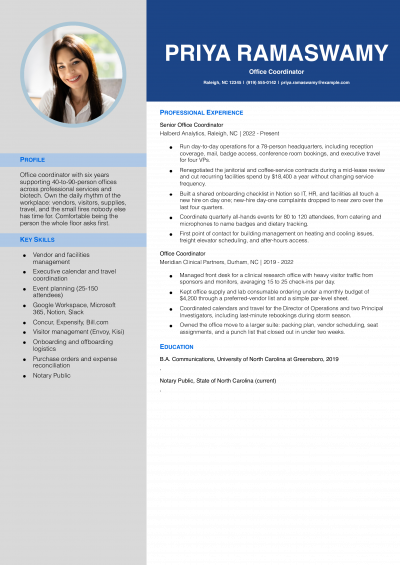
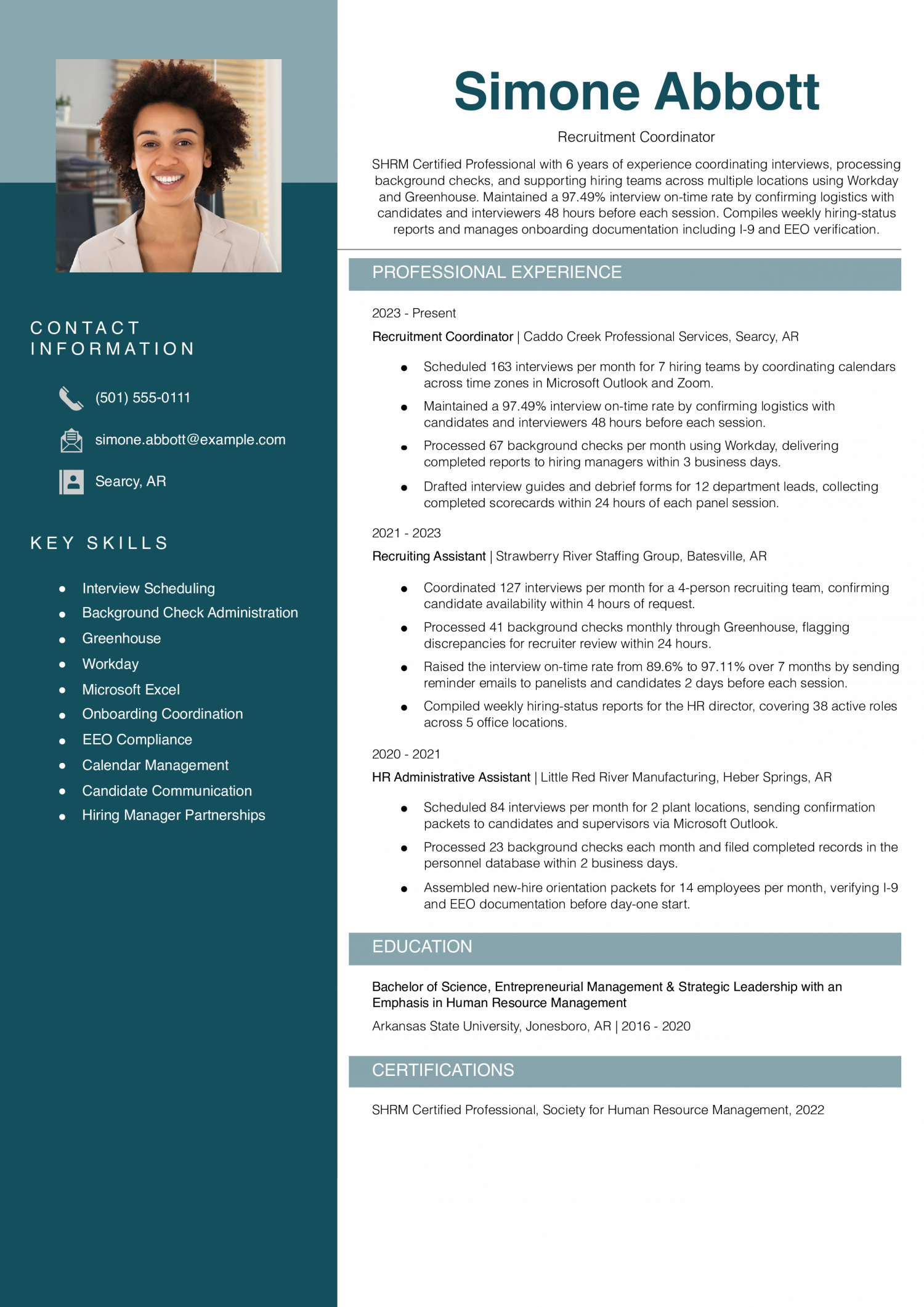
Pick this resume if you are a mid-level recruitment coordinator with scheduling and background check experience across staffing and corporate settings. Lead with on-time rate metrics and turnaround windows that prove your reliability to hiring teams.
A turnaround promise for background checks, measured in business days, shows how fast the coordinator delivers. A hiring manager can plan their offer timeline around that pace. State your own turnaround window for any recurring deliverable so the team knows what to expect.
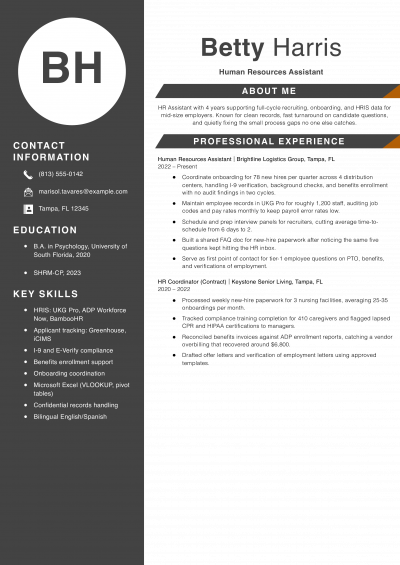
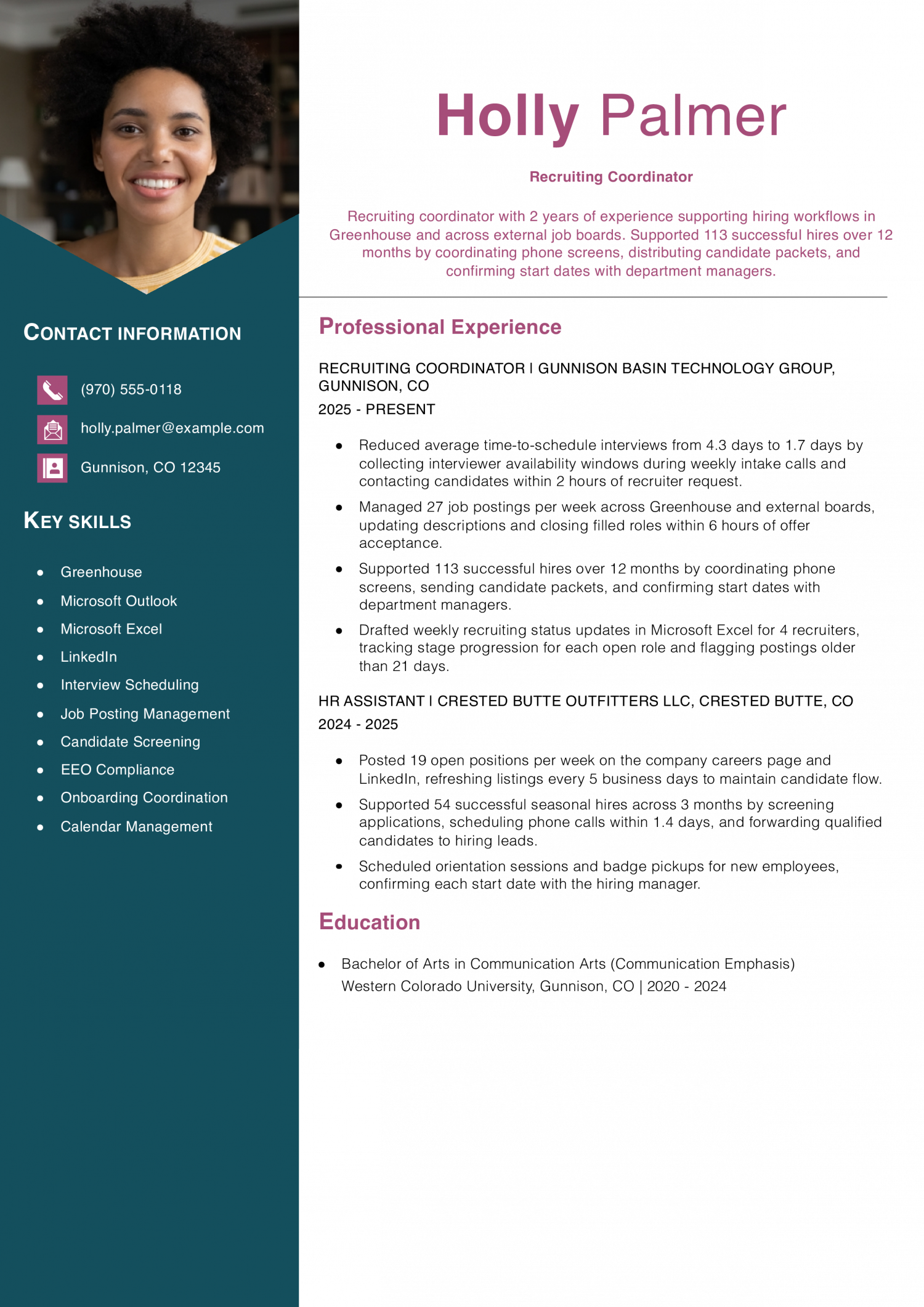
Use this resume if you are an entry-level recruiting coordinator moving from an HR assistant role into a dedicated recruiting position. Lead with turnaround-time reductions that show speed gains tied to a specific scheduling process change.
Scheduling speed improved because of a specific process change, not harder work. A talent director spots the method behind the faster interviews. When you cut a cycle time, name what you changed in the workflow so the improvement looks repeatable.
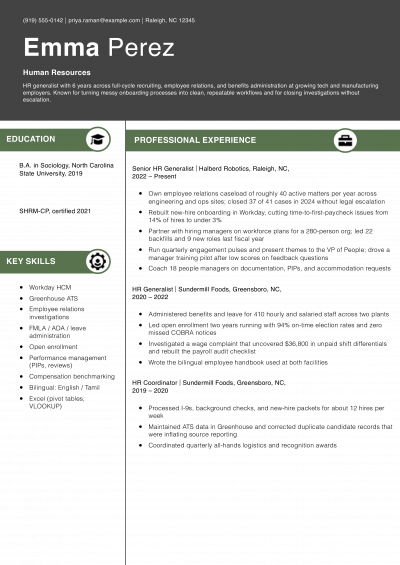
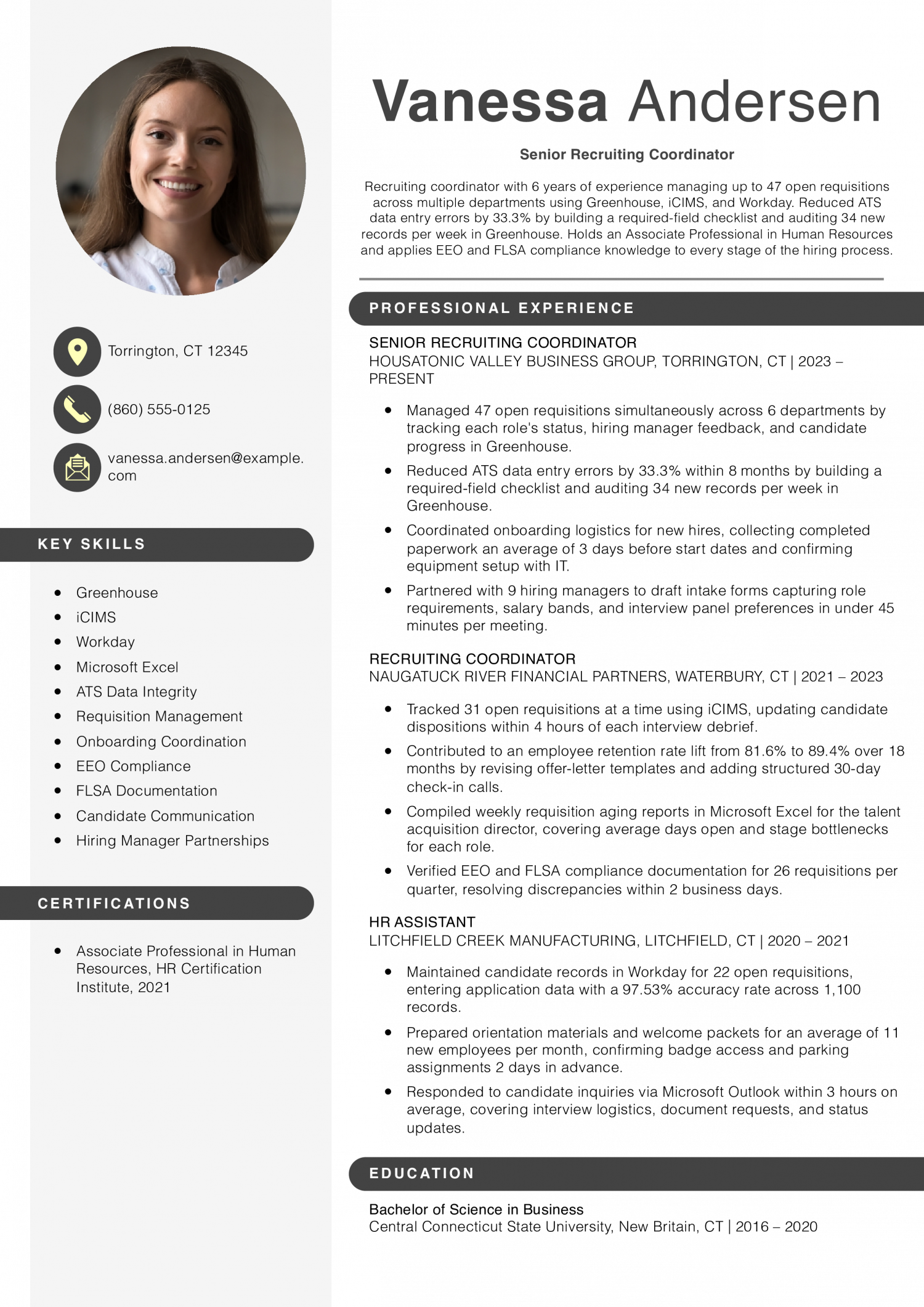
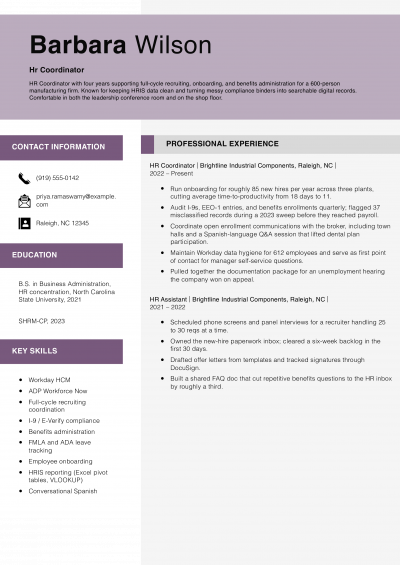
Try this resume if you are a mid-level senior recruiting coordinator with about six years of experience spanning HR assistance, requisition tracking, and onboarding logistics. Lead with compliance verification counts and error-reduction percentages rather than restating generic coordinator duties.
Two concrete changes are credited for the retention gain: revised offer letters and structured check-in calls after the start date. A VP of talent sees the strategy, not the outcome alone. Name the specific steps you took and pair them with the result they produced.
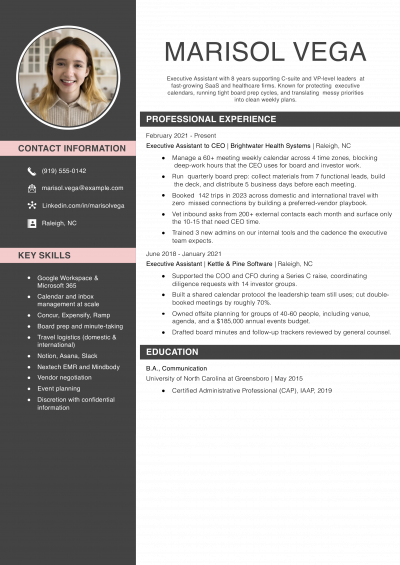
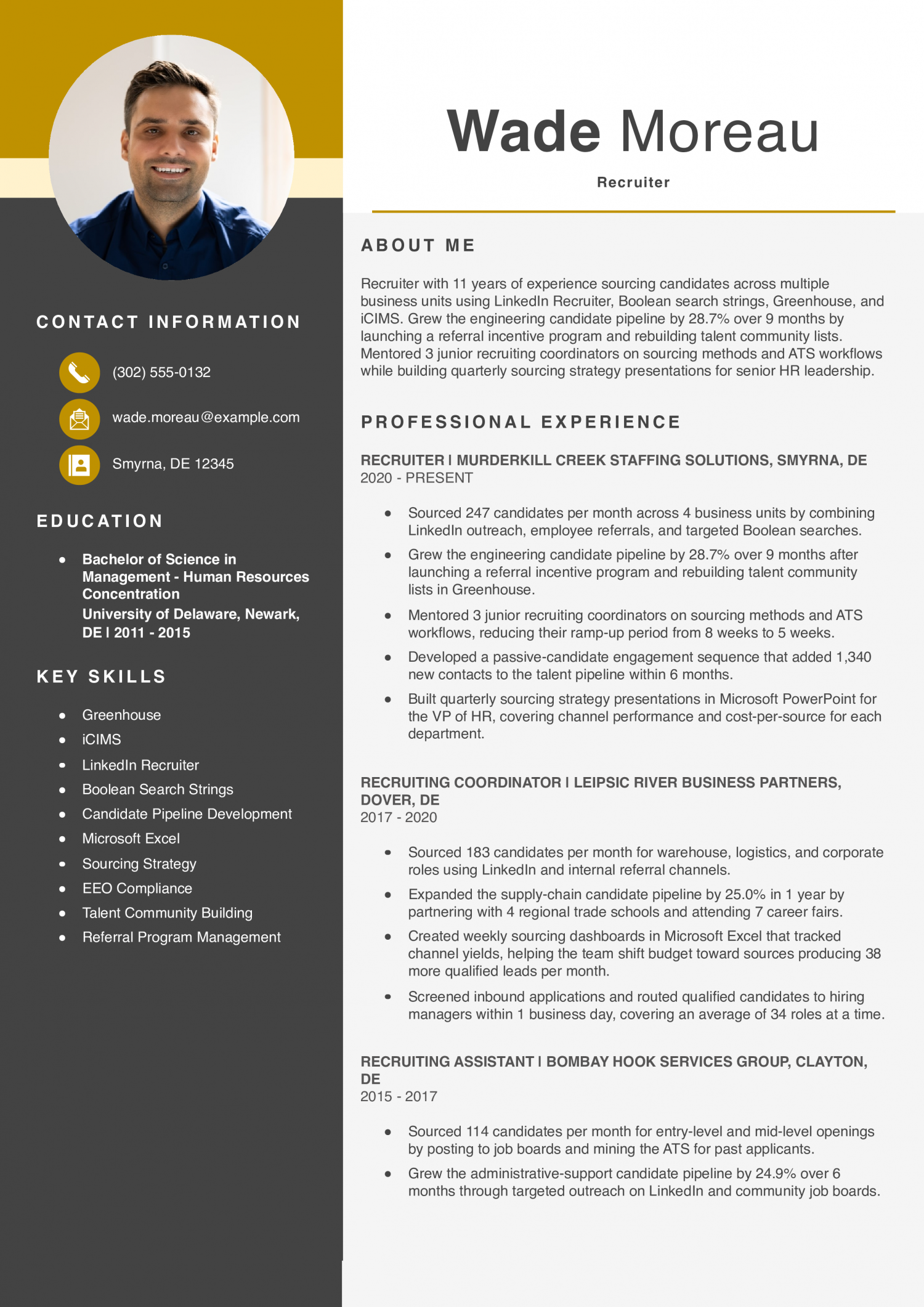
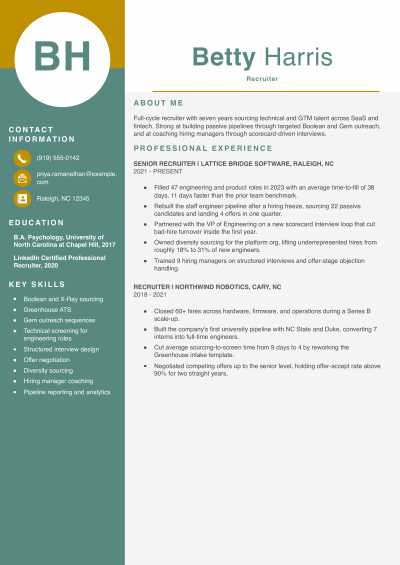
Lean on this resume if you are a senior recruiter with about a decade of experience progressing from recruiting assistant through coordinator to full recruiter. Lead with pipeline growth percentages that credit the specific sourcing program or channel change behind each gain.
Ramp-up time for new recruiters dropped after a coaching program started, shown as a before-and-after comparison. A recruiting director can measure the value of that mentoring in weeks saved. When you describe coaching, show the onboarding timeline before and after your program began.
Coordinating full-cycle hiring workflows for 6 years, with a focus on refining evaluation criteria and interview processes that raise conversion rates. Partnered with 8 hiring managers to refine role scorecards and align candidate evaluation criteria, lifting the interview-to-hire conversion rate from 17.7% to 28.5%. Experienced with Greenhouse and Microsoft Excel for tracking stage durations, maintaining data integrity across active requisitions, and delivering weekly hiring progress reports.
Open with your years in recruiting support and the hiring volume you handle. Name the type of roles you coordinate, such as technical or hourly.
Add the industries you have worked in. A profile that reads “Recruiting coordinator with three years supporting high-volume warehouse hiring” tells more than a vague objective line. State whether you support one recruiter or an entire talent acquisition team.
Mention if you run campus events or contract staffing. Recruiting managers and TA directors scan this section in about six seconds. A clear scope line helps them see a fit right away.
Keep it to three or four lines at most.
Most strong resumes in this role lean on volume and speed. State how many interviews you scheduled per week. Note the number of open requisitions you tracked at one time.
Show volume and speed together when you can. A line like “Scheduled 45 phone screens per week across 12 requisitions” is clear. You can also cite time-to-fill improvements or offer acceptance rates.
Attendance at hiring events is another good metric. If you cut scheduling lag by two days, say so. Recruiting managers and TA directors want to see throughput, not task lists.
Even a modest improvement in pipeline velocity is worth documenting on your resume. Pair each number with the action you took to reach it.
Sort your bullet points under the category of work they describe. Interview logistics is one group. Include scheduling panels, booking rooms, and sending confirmations.
Candidate communications is another. Cover offer letters, status updates, and rejection notices. A third group is ATS and data work, such as posting jobs and updating candidate records.
You can also create a section for event support. Career fairs and campus visits fit there. A final group covers onboarding tasks like background checks and new-hire paperwork.
Grouping your bullets this way helps readers find what matters to them, and it also demonstrates you understand the full recruiting lifecycle from initial sourcing through day-one intake. This organizational approach signals that you can manage complexity and prioritize competing coordination tasks across multiple hiring pipelines at once.
List your ATS experience in a visible skills block on page one. Name the platforms you have used, such as Greenhouse or Workday. Add any HRIS systems you know well.
If you hold the Associate Professional in Human Resources (aPHR) from HRCI, place it right below your name. The SHRM Certified Professional (SHRM-CP) from SHRM belongs there too. Recruiting managers look for these credentials early because they signal foundational human resources knowledge.
Include tools for scheduling, such as Calendly or GoodTime. Note any experience with background check vendors. Keep this block to one or two lines so it reads fast.
Bold the credential abbreviations so they stand out on a quick scan.
Your education section can be brief but should not be missing. Include your degree, the school, and your graduation year. A bachelor’s in human resources or business is common, but other fields work too.
If you are still finishing a degree, note your expected date. Add any relevant coursework in employment law or HR management. This is also a good spot for training like HRIS boot camps.
Volunteer recruiting work counts here as well. If you served on a campus hiring committee, say so. Recruiting managers value signs that you chose this career path with intentionality and professional commitment.
Keep your resume to one page unless you have more than seven years of direct TA support experience.
Five years ago, a recruiting coordinator resume read like a calendar. The mix has shifted toward ATS platform skills and data tracking. Pipeline metrics now sit beside scheduling on strong resumes.
Recruiting managers and TA directors weigh hard skills like applicant tracking first. They use those terms to filter resumes before a human reads them. Soft skills such as organization then back up your bullet results.
Read both tables and pull the terms that match your target posting. Drop any term you cannot tie to real work you did. Add a term only when you can pair it with a task or outcome.
Treat soft skills as proof inside your experience bullets. Show teamwork by noting how many hiring managers you partnered with. Show organization by citing the number of interviews you coordinated per week.
Swap one skill for a closer synonym when the posting uses different phrasing. Keep every skill term short so the ATS reads it cleanly.
| Soft Skills | AI-estimated % |
|---|---|
| Candidate rapport building | 65% |
| Hiring manager collaboration | 56% |
| Attention to detail | 44% |
| Multitasking under deadlines | 40% |
| Discretion with sensitive information | 28% |
And here are the top hard skills showing up most often.
| Hard Skills | AI-estimated % |
|---|---|
| Candidate sourcing | 79% |
| Interview scheduling | 62% |
| Applicant tracking systems | 47% |
| Job posting creation | 35% |
| Onboarding coordination | 33% |
Skill names and rankings come from an AI model grounded in U.S. Department of Labor occupation data for recruiting coordinators, not from a count of recruiting coordinators’ resumes built on ResumeTemplates.com.
The section below starts with how to list AI tools you use in scheduling and screening.
Recruiting managers and hiring directors are split on AI in hiring workflows. Some want coordinators who automate screening and scheduling at scale. Others worry about bias in AI-scored candidate pools.
Name the tools you use and describe the workflow honestly. Do not claim you built an AI sourcing pipeline if you only edit its output. List the step where you apply the tool.
Then note who reviews the result. That clarity matters more than a long tools list. Frame each skill around a task you own today.
Show the human check you run after each AI step. Keep it specific to your daily coordination work.
What AI is actually changing for this role
Interview scheduling: AI scheduling assistants parse interviewer calendars and propose slots, but coordinators still confirm and resolve conflicts.
Candidate screening: Resume-parsing tools rank applicants by keyword fit, though coordinators verify accuracy before passing names forward.
Email outreach: Generative AI drafts candidate follow-up emails, and coordinators edit tone and details before sending.
Data entry: ATS auto-fill features pull candidate data from uploaded resumes, reducing manual entry time per requisition.
Reporting: AI dashboards surface pipeline metrics like time to fill, but coordinators still audit the data for errors.
AI tools to name
How to phrase AI on your resume
Do
Skip
Most recruiting coordinator roles do not require certification. Still, the right credential signals HR fundamentals. For the aPHR or SHRM-CP named above, keep these points in mind:
Recruiting managers and directors read this list as a map of where your career is heading. The items below tell them which area of talent work you have chosen to grow in. A credential here sets you apart from peers who rely on job experience alone.
It shows you study hiring trends on your own time. It also hints at your next step, whether that is a sourcing role or an HR partner seat. Show who issued it and the year you passed.
About These Numbers
The Bureau of Labor Statistics does not publish a wage code for Recruiting Coordinator specifically. The numbers below are a proxy: the closest published match is Human Resources Assistants, Except Payroll and Timekeeping (SOC 43-4161), so use them as an estimate for this role, not an exact figure.
BLS groups recruiting coordinators with other human resources assistants, so the figures below cover a broader set of roles. Keep that in mind as you read them. The 90th percentile out-earns the median by about 35 percent, which tells you the market pays more for specialized recruiting skills than for general HR support tenure.
The 10th percentile sits roughly 26 percent below the median, so the gap between the top and bottom is large. Geographic location and employer type shape where you land in that range. On your resume, lead with the applicant tracking systems you run and the requisition volume you coordinate.
| # | State | Median Annual |
|---|---|---|
| 1 | District of Columbia | $59,050 |
| 2 | California | $57,590 |
| 3 | Washington | $57,390 |
| 4 | Maryland | $56,880 |
| 5 | Alaska | $56,510 |
| 6 | Rhode Island | $56,370 |
| 7 | Massachusetts | $55,840 |
| 8 | Colorado | $54,880 |
| 9 | Minnesota | $54,520 |
| 10 | New Jersey | $54,410 |
| # | State | Workers | Median |
|---|---|---|---|
| 1 | California | 11,490 | $57,590 |
| 2 | New York | 8,800 | $52,920 |
| 3 | Texas | 5,890 | $47,540 |
| 4 | Illinois | 4,140 | $48,310 |
| 5 | New Jersey | 4,000 | $54,410 |
Resume Templates offers HR approved resume templates to help you create a professional resume in minutes. Choose from several template options and even pre-populate a resume from your profile.
Start with a brief profile that names the industries and hiring volumes you have supported. Follow it with bullet points showing results you can measure, like time-to-fill reductions. List your ATS platforms and scheduling tools in a dedicated skills section.
Use the title your employer gave you, because recruiting managers verify titles during background checks. If your official title was staffing coordinator but you did full-cycle recruiting, add a short note in parentheses. Something like "Staffing Coordinator (full-cycle recruiting)" clarifies your scope without misrepresenting the role.
Yes, include one when the job posting requests it or the application portal provides an upload field. A short cover letter lets you explain a career change or gap that your resume alone cannot address. Keep it to one page and mirror the keywords from the posting.
Name each applicant tracking system you have used in your skills section and in the bullets where you used it. Write the product name, such as Greenhouse or Lever, rather than a generic phrase like "ATS proficiency." Recruiting managers look for the specific platform their own team runs.
List the gap period honestly and note any relevant activity during that time, such as earning the aPHR. A one-line explanation in your experience section is enough for most gaps. Recruiting managers care more about your current skills than a break of a few months.
Yes, send a brief thank-you email within 24 hours of the interview. Reference one specific topic you discussed so the message feels personal. If you have not heard back after the timeline they gave you, one polite follow-up email is appropriate.
One page works best when you have fewer than 10 years of recruiting experience. A second page is reasonable if you have held multiple coordinator or recruiter roles with measurable results. Recruiting managers typically spend under 30 seconds on a first review, so put your strongest content on page one.
An ATS-friendly template keeps your HR credentials and scheduling results organized under clear headings. A basic template fits recruiting coordinators too.
Recruiting Coordinator Resume
4.5/5 stars with 142 reviews

Executive Resume Writer and Career Coach
Andrew Stoner is an executive career coach and resume writer with 17 years of experience as a hiring manager and operations leader at two Fortune 500 Financial Services companies, and as the career services director at two major university business schools.
© 2026 Resumetemplates.com All rights reserved.