Corporate Trainer Resume Examples
State your years in corporate training and name the audience you train, such as frontline staff or senior leaders. Mention the delivery format you use most, such as live classroom or virtual sessions. Note the…
Every resume example is written and reviewed by our team of Certified Professional Resume Writers to ensure top-quality content and formatting.
Employers filling trainer roles look for proof you can build a program and measure its impact. Training managers and HR business partners look for concrete outcomes like completion rates, post-training skill gains, and time-to-competency reductions. A credential such as the APTD or CPTD from ATD CI strengthens your profile further.
Your resume should name the learning platforms you have used and the learner populations you have served. To compare layouts before you start, browse our resume templates.
Show how you designed curricula, ran needs assessments, and tracked results so reviewers can connect your decisions to learner behavior change.
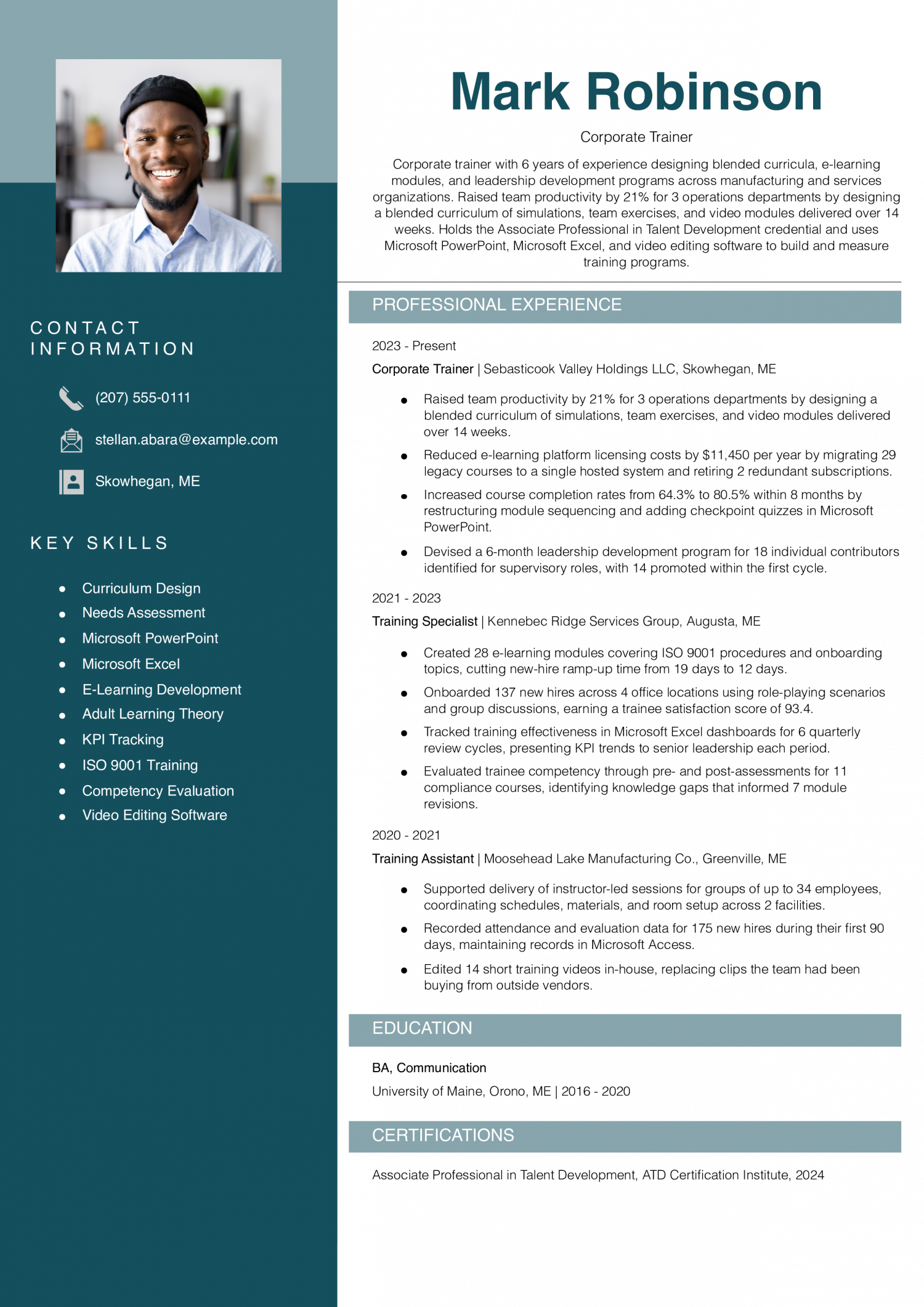
Consider this resume if you are a mid-level corporate trainer with about six years of experience progressing from assistant to program owner. Lead with completion-rate or ramp-time shifts so reviewers see instructional impact before reading delivery details.
Training managers look for trainers who show that learners finished and used what they were taught. This resume pairs a completion rate before and after with the change that caused it, adding checkpoint quizzes and reordering the modules. When you describe a course on your own resume, give the rates before and after and the change you made.
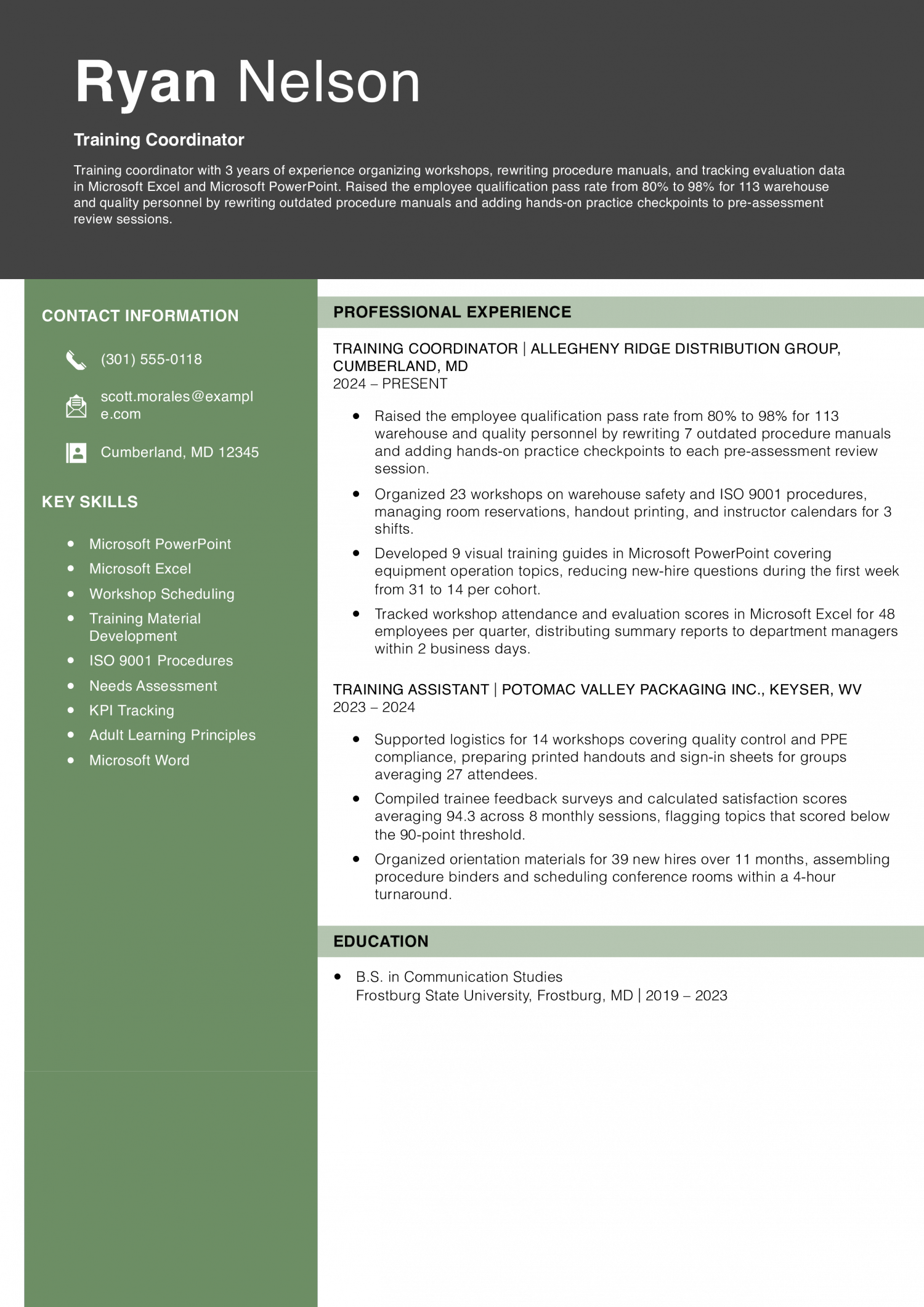
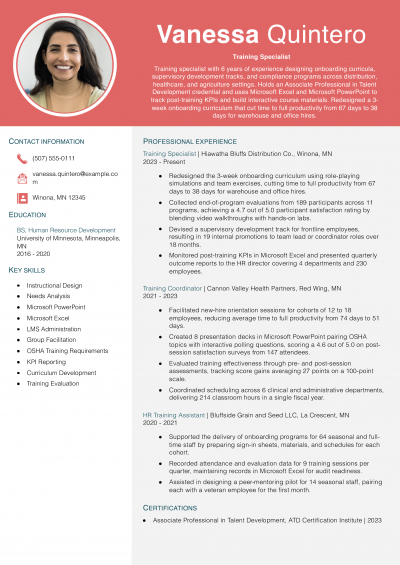
Start with this resume if you are an entry-level training coordinator building a record across assistant and coordinator roles. Open with the pass rates before and after you rewrote the materials.
Hiring teams for entry-level training jobs look for coordinators who can show that people learn from their materials. This resume ties a drop in new-hire questions during the first week to a set of visual guides. When you describe a guide you wrote, count something before and after, such as questions asked or errors logged.
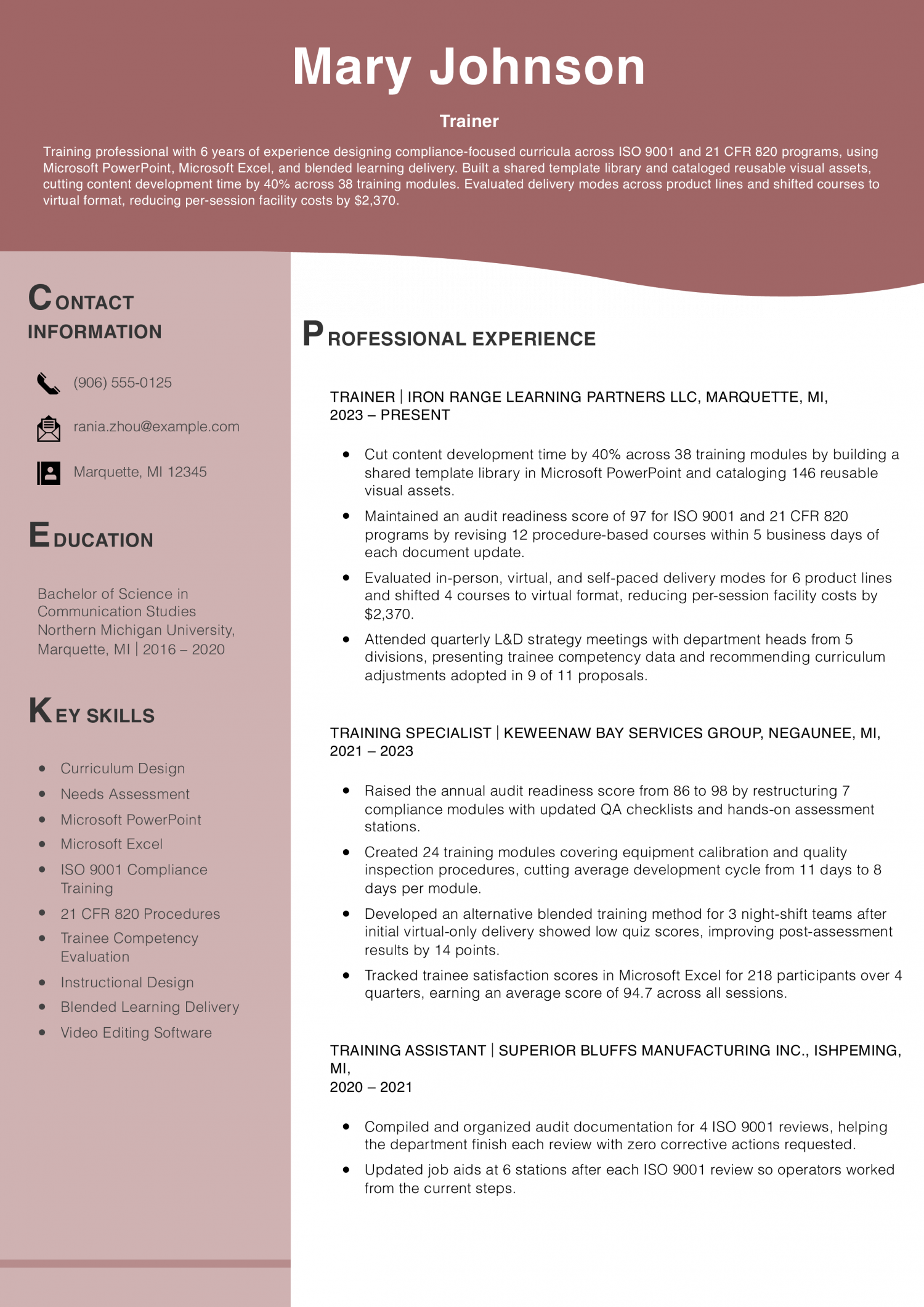
Try this resume if you are a mid-level trainer with about six years of experience moving from training assistant to specialist to trainer. Open with audit readiness scores and delivery-mode cost comparisons that tie curriculum choices to compliance and budget results.
HR partners screening trainers for regulated plants look for gains that were measured, along with the courses that were built. This resume shows a post-assessment gain after a night shift course was rebuilt. On your own resume, follow each course you revised with the score change it produced.
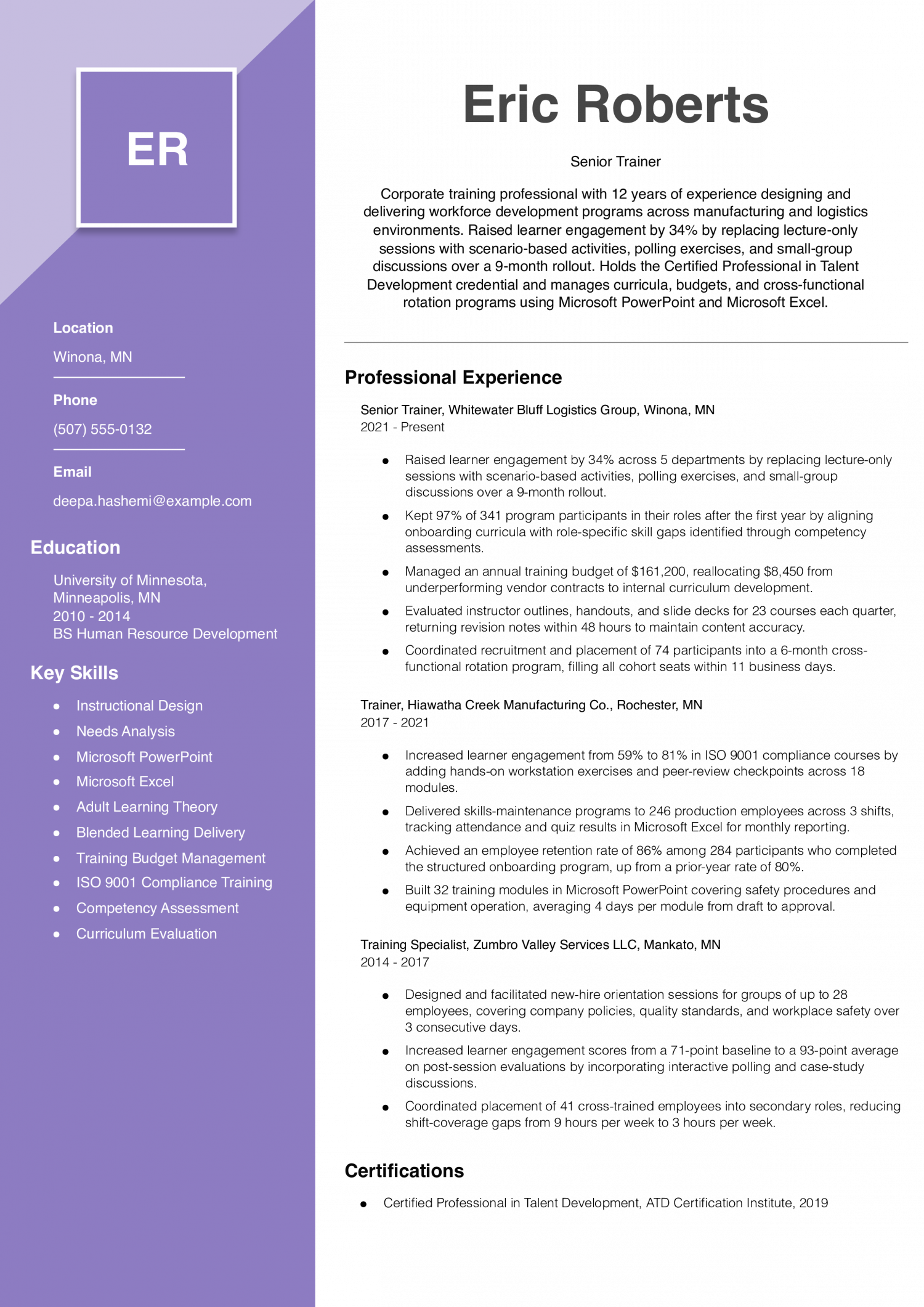
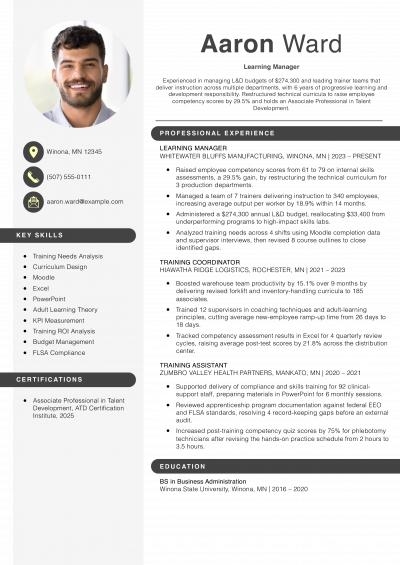
Turn to this resume if you are a senior trainer with over a decade of experience spanning specialist through senior-level program ownership roles. Lead with engagement and retention percentages tied to the specific instructional methods you chose.
Senior training roles call for sound judgment about money, so reviewers look at how you spent a budget. This resume names the underperforming vendor contracts and the dollars moved into building courses in house. When you describe budget work on your own resume, give the amount you moved and why you moved it.
Curriculum design and instructional delivery specialist with 6 years of experience spanning training assistant, specialist, and trainer roles. Improved learner retention from 61.7% to 80.1% on 90-day post-training assessments by restructuring 14 modules with spaced-repetition exercises and scenario-based practice. Skilled in needs assessment, training budget management, Microsoft PowerPoint, Microsoft Excel, and ISO 9001 compliance instruction.
Your top line should name one thing training managers cannot find on a job board search. That might be a niche subject area, such as compliance onboarding for regulated industries. It could be fluency in a second language your learners speak.
A specific LMS platform you have built courses in also works. Pick the detail that sets you apart from other trainers with the same job title. State it in a two-line profile above your work history.
Keep the language plain and free of buzzwords. This single detail tells the reader why your file is worth a closer look. Save the full scope of your background for the bullets below it.
Training managers and HR business partners scan for proof that your sessions changed behavior. Name the class size and the frequency you delivered it. Report a pass rate or a post-training assessment score.
Tie your work to a business outcome such as a drop in safety incidents or a rise in first-call resolution. Even a percentage of learners who completed a course on time counts. Pair each bullet with one metric so the scope is clear at a glance.
A bullet that only lists a duty, like “facilitated new hire training,” gives no sense of scale or impact. Swap it for “trained 40 new hires per quarter with a 95% completion rate” instead.
Sort your bullet points under three to five clusters that reflect what you actually do. Curriculum design covers needs analysis, course outlines, and learning objectives. Delivery includes live workshops, virtual instructor-led sessions, and one-on-one coaching.
Assessment work covers pre-tests, post-tests, and feedback surveys. A fourth group could hold stakeholder coordination, such as partnering with department heads on skill gaps. A fifth could cover content tools like video editing or e-learning authoring.
Label each cluster with a short heading inside your work history so the layout mirrors the way training managers actually read resumes. This structure helps readers find the skill they care about in seconds rather than scanning every bullet from top to bottom.
If you hold the Certified Professional in Talent Development from ATD CI, list it by name near the top of page one. The Associate Professional in Talent Development from ATD CI fits the same spot.
Under the credentials, name the platforms you use daily, such as your LMS, authoring tool, and video platform.
Training managers and HR business partners often skim the top third of page one before they read any bullets at all. When you place credentials and tools high on the page, reviewers can confirm your qualifications in that first pass without scrolling further down.
End with your degree, school name, and graduation year. A bachelor’s degree in education, HR, or a related field is common for trainer roles. If you hold a master’s degree, list it first.
Add relevant coursework only if you have fewer than three years of experience. Skip your GPA unless it is above 3.5 and you finished school in the last two years. If you earned professional development hours through ATD or a similar organization, note them here as well.
This section should take up no more than four lines. Keep the format consistent with your other sections so the page looks balanced from top to bottom.
Curriculum design, platform setup, and learner assessment are the skill groups trainers need. Check the tools below against your target posting. Training managers and HR business partners scan for these patterns first.
Hard skills prove you can build and run a program. Soft skills show how well you hold a room. Both types carry weight in different places on the page.
Compare both tables below with the posting you want. Keep soft skills inside the bullets of your work history. A claim like “collaboration” reads stronger when tied to a team result.
| Soft Skills | AI-estimated % |
|---|---|
| Learner engagement | 68% |
| Adaptive communication | 62% |
| Motivating adult learners | 48% |
| Cross-functional collaboration | 35% |
| Constructive feedback delivery | 33% |
And here are the top hard skills showing up most often.
| Hard Skills | AI-estimated % |
|---|---|
| Instructional design | 66% |
| Curriculum development | 54% |
| Training needs assessment | 43% |
| Learning management systems | 37% |
| Workshop facilitation | 28% |
Skill names and rankings come from an AI model grounded in U.S. Department of Labor occupation data for trainers, not from a count of trainers’ resumes built on ResumeTemplates.com.
Training managers and HR business partners check for instructional design and curriculum development before they read a trainer resume closely, and the items below show how to prove them.
What training managers and HR business partners expect on a trainer resume has shifted. Listing only classroom hours now reads as incomplete. Naming your AI content tools shows you are current. You should also note how you review AI output for accuracy. A clear workflow line tells reviewers you build courses faster. It also tells them you still check every fact yourself. Below are the AI tools trainers name and the phrases to avoid. Each item ties to a task trainers handle every week.
AI drafts lesson outlines and learning objectives, but trainers still align each module to skill gaps.
Generative tools produce question banks in minutes, so trainers spend more time validating answer accuracy.
AI summarizes post-session survey comments, and trainers interpret themes to adjust delivery and pacing.
AI flags outdated slides by comparing them to current policy documents, cutting manual review time.
AI tools pull completion rates and score trends into dashboards that trainers present to stakeholders weekly.
ChatGPT: Draft lesson plans and discussion prompts, then review each output for subject accuracy.
Synthesia: Create short AI-generated video modules for asynchronous onboarding courses.
Training managers and HR business partners scan for credentials first. The right certification signals you can design programs. It also shows you follow evidence-based learning methods.
A degree and some teaching skill keep you in the pool. The credentials below can help your resume make the shortlist. Training managers and HR business partners scan your credentials block to gauge your depth.
They want proof that you understand adult learning theory. A credential from a known body tells them you do. It also tells them you chose to invest your own time.
That choice signals you take training seriously. Add the issuing body and the year you earned it, plus the expiry month if it renews.
BLS groups trainers under Training and Development Specialists, a broader category that includes many related roles. The spread between the top and bottom of this field is wide. Top earners far out-pace the median, while entry-level pay sits well below it.
That shape tells you the market rewards deep subject expertise over general experience. National employment in this category is large, so you face competition at every level. Standing out means proving you can build programs that change learner behavior.
On your resume, name the specific courses you built and the measurable outcomes those courses produced. Lead with the topic area where your expertise runs deepest.
| # | State | Median Annual |
|---|---|---|
| 1 | Delaware | $88,570 |
| 2 | New Hampshire | $86,050 |
| 3 | Alaska | $81,860 |
| 4 | Washington | $81,860 |
| 5 | District of Columbia | $80,980 |
| 6 | Massachusetts | $80,270 |
| 7 | Connecticut | $78,080 |
| 8 | Vermont | $77,800 |
| 9 | Virginia | $77,690 |
| 10 | New Jersey | $77,020 |
| # | State | Workers | Median |
|---|---|---|---|
| 1 | Texas | 46,630 | $62,860 |
| 2 | California | 46,530 | $75,790 |
| 3 | Florida | 34,130 | $71,990 |
| 4 | New York | 27,460 | $76,080 |
| 5 | North Carolina | 20,220 | $65,250 |
Resume Templates offers HR approved resume templates to help you create a professional resume in minutes. Choose from several template options and even pre-populate a resume from your profile.
List the title as Crew Trainer under your experience section with dates included. Below that title, add bullets showing what you taught and how many people you trained. Include results like reduced onboarding time or higher order accuracy scores.
Common alternatives include Learning Specialist, Training Coordinator, and Facilitator. Pick the title that matches the wording in the job posting you are targeting. Training managers scan for the same terms they wrote in the listing.
Focus on what you built, who you taught, and what changed afterward. Name the program or curriculum, the audience size, and a clear outcome. A metric like a percentage gain in assessment pass rates gives the description weight.
Yes, name each platform in your skills section or inside the bullet where you used it. Training managers often filter applications by platform name. Listing the specific tool helps your resume pass that early screen.
Add a bullet under the role where you did the training and lead with the action. For example, write "Designed and led a four-week onboarding program for 30 new hires." That tells an HR business partner you performed the work even when your title did not reflect it.
A trainer with under ten years of relevant experience can stop at one page. A second page can be justified if you have led programs across several business units. Every line on that second page should still support the role you are targeting.
A summary helps when you are changing careers or have over a decade of training work to frame. Keep it to three lines naming your specialty area and a standout result. Skip it if your experience bullets already make those points clear on their own.
If you are unsure, an ATS-friendly template is a good default for a trainer resume, and a basic template is a good second choice. Simple headings, one standard font, and graphics kept out keep either one readable.
Trainer Resume
4.8/5 stars with 227 reviews

Executive Resume Writer and Career Coach
Andrew Stoner is an executive career coach and resume writer with 17 years of experience as a hiring manager and operations leader at two Fortune 500 Financial Services companies, and as the career services director at two major university business schools.
© 2026 Resumetemplates.com All rights reserved.