Stay At Home Mom Resume Examples
Lead with the concrete skill or project you kept sharp during your time at home. A returnship coordinator sees dozens of resumes that all say the same career gap phrase. Give them something specific in…
Documented service hours with named organizations, specific roles held rather than generic helper labels, and outcomes tied to the mission are what separate the volunteer resumes that advance past coordinator screens from the rest.
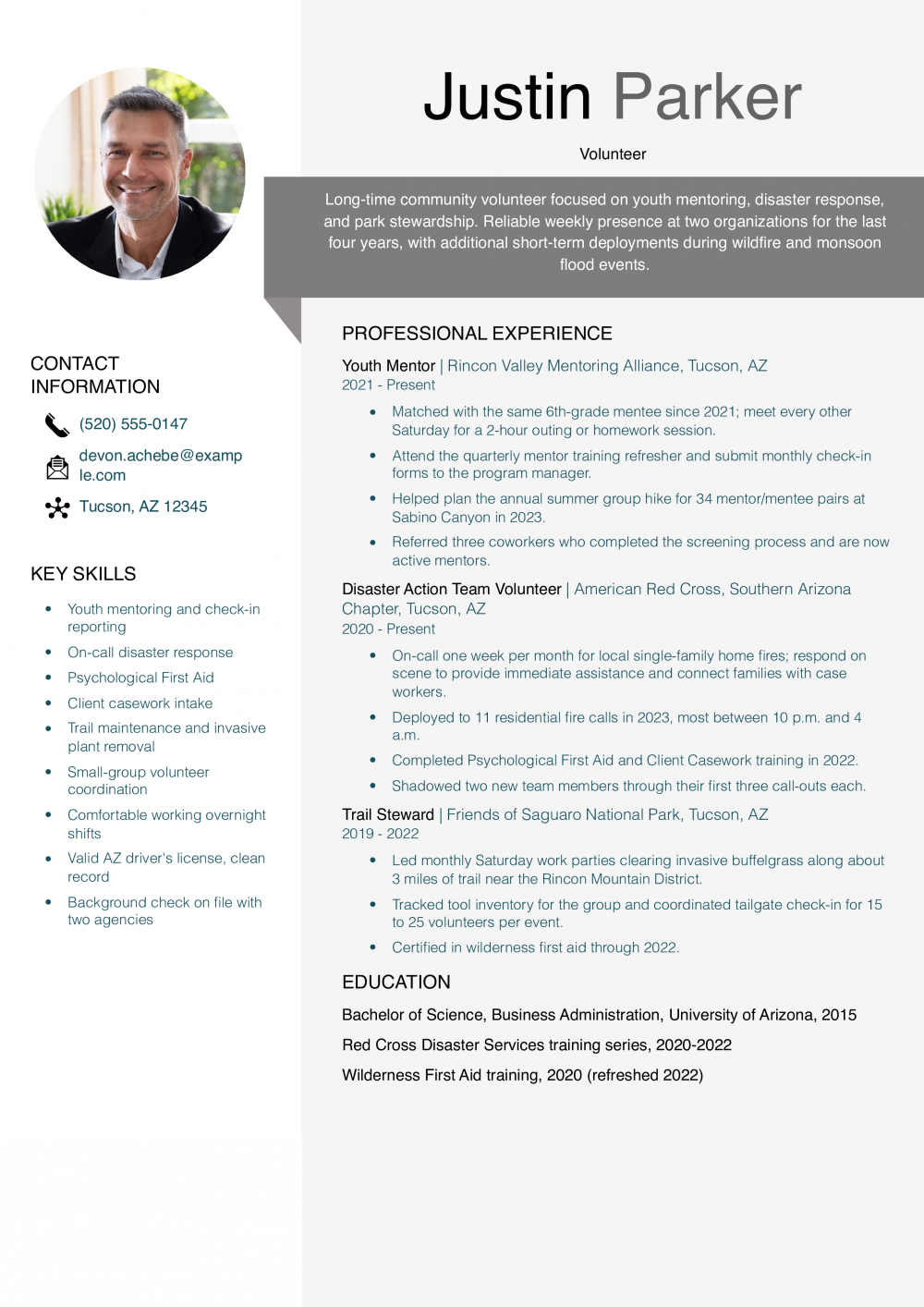
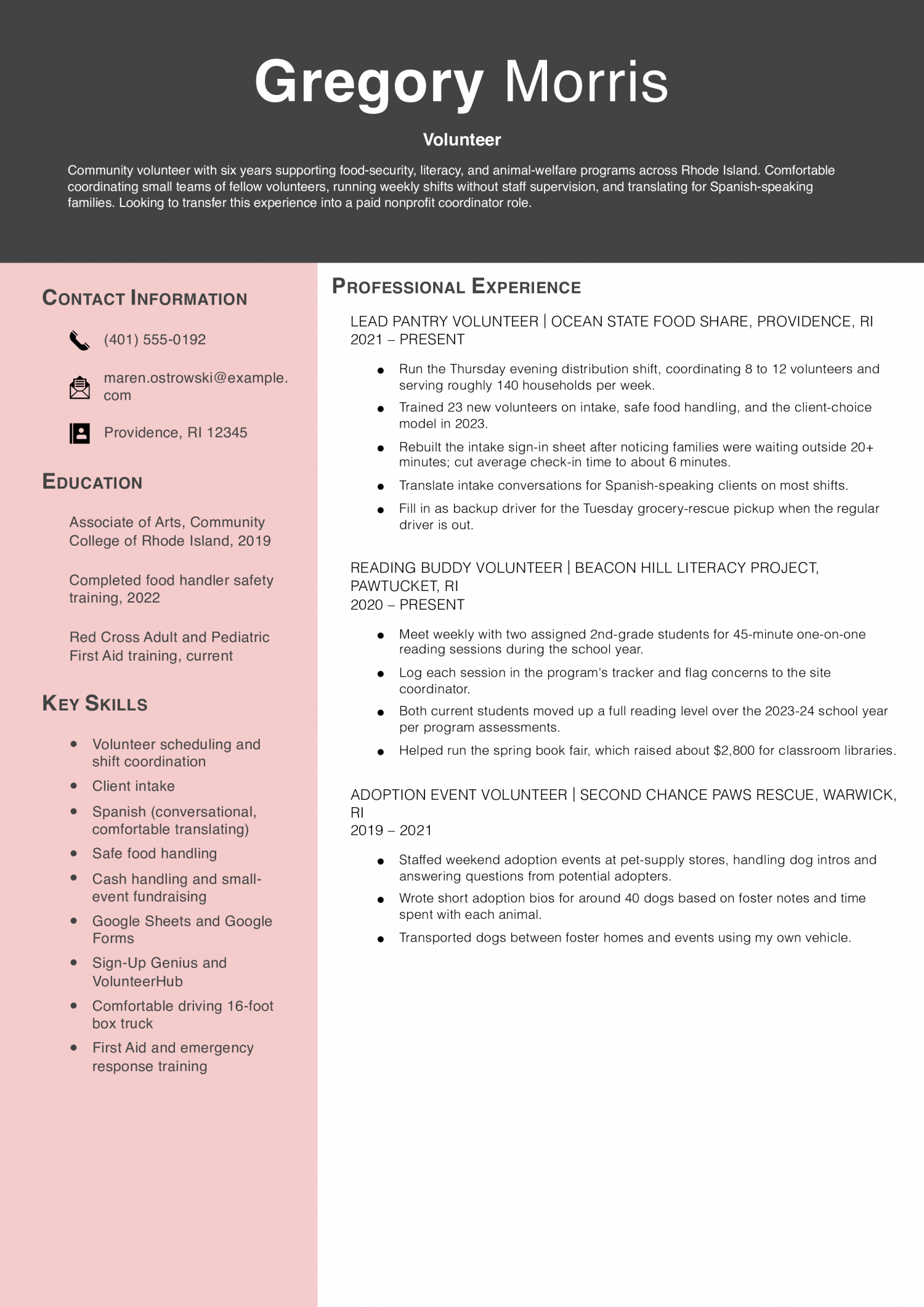
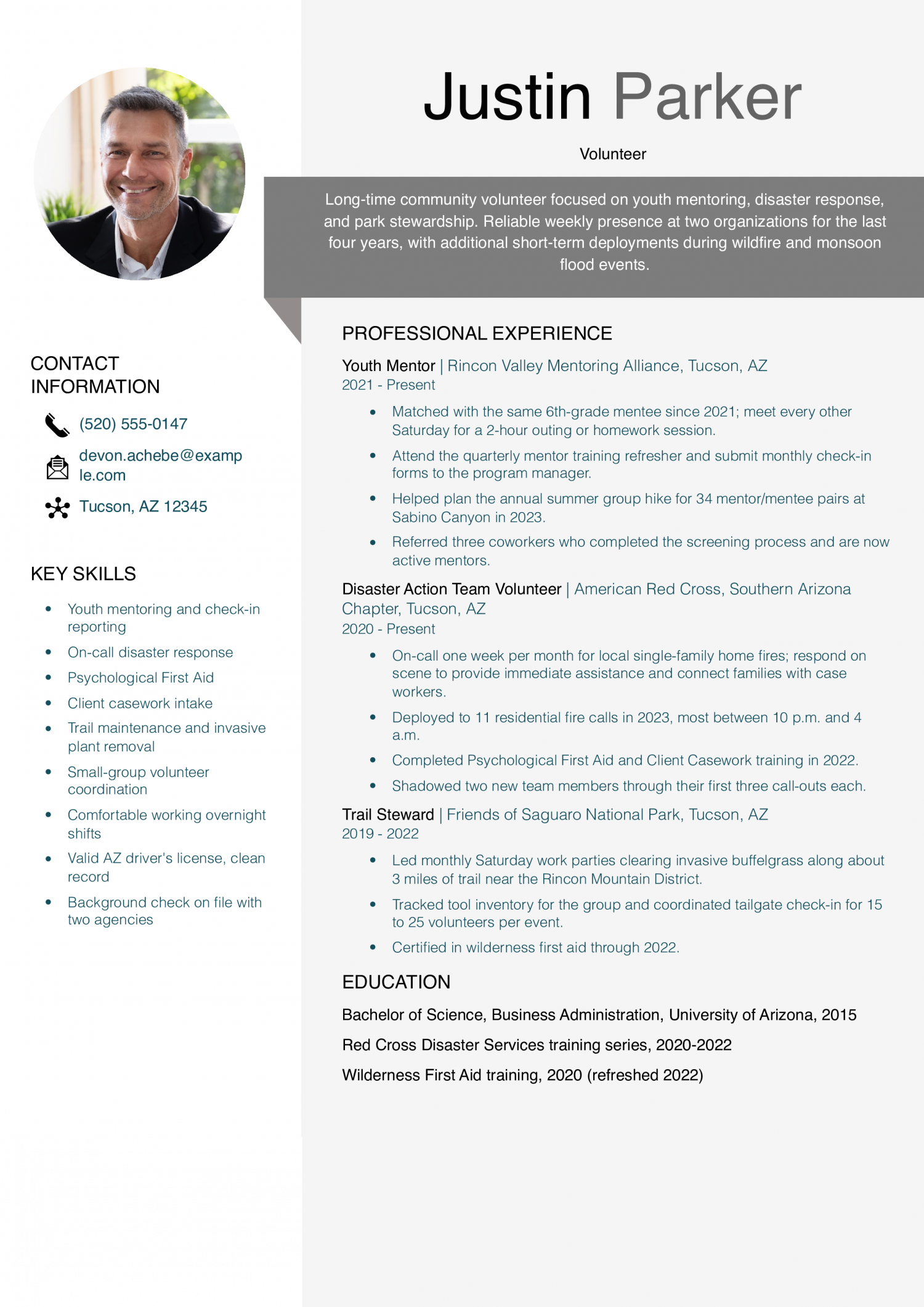
A volunteer resume works when it reads like paid experience with the pay stripped out. Show volunteer coordinators and nonprofit program managers the hours you gave, the people you served, and the outcomes you can point to.
Volunteer with seven years of experience across hospice companionship, adult English tutoring, community garden coordination, and event support for two annual fundraisers. Comfortable working directly with clients, keeping simple records, and stepping into short-notice coverage. Seeking a part-time paid role in volunteer coordination or program support.
The first line of your summary should name the hours you have logged, the people you have served, or the funds you have raised. Volunteer coordinators and nonprofit program managers scan the top of the page for reach before they read anything else. A line like “Logged 400 service hours across two food-bank sites in 2023” tells them your commitment level in one glance.
Save the mission statement and the values language for later in the document. Lead with what you did and at what scale, in one sentence. If you have served with a name a coordinator will recognize, put that name in the opener too.
Save adjectives for the cover letter, not the summary.
Volunteer work reads as duties when the bullets carry no scope. A strong bullet names how many people you served, how many hours you gave, or how much you raised. “Sorted donations weekly” is a duty.
“Sorted 200 pounds of donations across 12 weekly shifts, serving 60 families” is a contribution. Where a hard count is not honest, use volume and reach words instead: caseload size, event attendance, or the square footage of the site you covered. Bullets without a number tend to read as filler, even when the work behind them was real.
Recruiters scan for scale first, then for the verb, then for the outcome. Give them all three in that order.
A wall of one-off shifts reads as scattered, even when the total hours are strong. Sort your service into three to five buckets a coordinator will recognize on sight. Common ones include direct client service, event support, fundraising and donor relations, tutoring or mentorship, and facilities or logistics.
Under each bucket, list the organizations you served and what you actually did on shift. Keep the verbs concrete: served, tutored, sorted, canvassed, staffed, drove. Skip mission language and skip the internal titles nobody outside that nonprofit will know.
If one bucket holds most of your hours, put it first and give it the most bullets. The shape of the section should match the shape of your service.
Any training that unlocks a role should sit in a short credentials block near the top of page one. That covers food-handler cards, background-check clearance, driver records for transport shifts, and any child- or vulnerable-adult protection training. Volunteer coordinators and nonprofit program managers need to see these before they read your bullets, because the clearances decide which shifts they can even schedule you for.
List the credential, the issuing body, and the year, and note that a license or clearance is in good standing. Requirements vary by state, agency, and the population you serve, so match what the posting asks for. Skip numbers such as license IDs on the resume itself.
Close the resume with a short education block and a references line a coordinator can act on. List your degree or current program, the institution, and the year, in that order. If you are still in school, name your expected graduation and any service-learning coursework tied to the role.
Add languages you can use on shift, since bilingual volunteers are staffed onto client-facing work first. End with two references from past service placements, with the organization name, the coordinator’s title, and a work email. Skip personal references and skip “available on request,” which wastes a line.
A reader who has made it this far wants a way to confirm your hours, not another paragraph about your values.
Nonprofit hiring stayed tight through 2026. Volunteer coordinators and nonprofit program managers run leaner rosters and the bar to clear a screen is higher. Cross-check these two tables with the nonprofit’s actual posting rather than a generic volunteer listing.
Hard skills like event logistics or donor outreach tell the scanner you can carry real work. Soft skills like empathy back up the bullets where you show the outcome. Use the tables as a checklist against each posting you apply to.
Mirror the exact phrasing the posting uses when the skill is truly yours. Do not pad the list with terms you cannot defend in an interview. Put hard skills in a dedicated section near the top of page one.
Weave the soft skills into your bullets as proof, not as a bare label. Update the list for every new posting, since program needs shift by cause area.
| Soft Skills | AI-estimated % |
|---|---|
| Communication | 68% |
| Teamwork | 61% |
| Empathy | 48% |
| Time management | 37% |
| Problem solving | 30% |
And here are the top hard skills showing up most often.
| Hard Skills | AI-estimated % |
|---|---|
| Event planning | 80% |
| Fundraising | 63% |
| Data entry | 50% |
| First aid certification | 36% |
| Community outreach | 28% |
Skill names and rankings come from an AI model grounded in U.S. Department of Labor occupation data for volunteers, not from a count of volunteers’ resumes built on ResumeTemplates.com.
Resume Templates offers HR approved resume templates to help you create a professional resume in minutes. Choose from several template options and even pre-populate a resume from your profile.
Yes, put volunteer work on your resume when it shows skills, hours, or leadership a paid job would prove.
Volunteer coordinators and nonprofit program managers read it as real work if you write it that way. Leave off a single one-day event unless it fills a gap or matches the posting.
Put volunteer work in its own section titled Volunteer Experience, placed right under paid work when the hours are steady.
Move it above paid work when the service is the closest match to the posting. Slide it into a Community Involvement block near the bottom when the role is brief or unrelated.
List each role the way you would list a job: organization name, city and state, your title, and dates served.
Under that, write three to five bullets that start with a verb and end in a number. Write "Food Pantry Volunteer" or "Youth Mentor," not "Helper," so a coordinator can picture the shift.
Write each bullet the way you would a paid one: verb, task, and the number that sizes the task.
"Served 120 meals per Saturday shift" tells a coordinator more than "helped in the kitchen." Track hours per week or month next to the dates so the reader sees the load without asking.
Yes, and it is one of the cleanest ways to close a gap without hiding it.
Put the volunteer role directly in your work history with its own dates, hours per week, and bullets. A coordinator reading the page sees continuous activity, not a blank stretch between paid jobs.
Keep volunteer roles from the last 10 years if they show skills a reader still cares about today.
Older service belongs on the page when it names a well-known organization or a leadership title. Drop high school service once you have any college or work history to replace it.
Group short events under one heading like "Community Service, 2022 to 2024" and list each with the organization and your role.
Skip a full bullet block for a three-hour event unless it ties straight to the posting. Save the fuller write-up for roles with recurring shifts a coordinator can verify.
A volunteer resume holds up best in an ATS-friendly template, since it keeps your clearances and logged hours where a coordinator looks first. A basic template is a solid alternative. Whichever you choose, keep the formatting clean and easy to parse: clear section headings, a standard font, and no graphics a parser can choke on.