Project Manager Resume Examples and Templates for 2026



Hiring case manager supervisors look for caseload size, population served, and named documentation systems on the first page, because that combination shows whether someone can hold a real panel without orientation hand-holding.
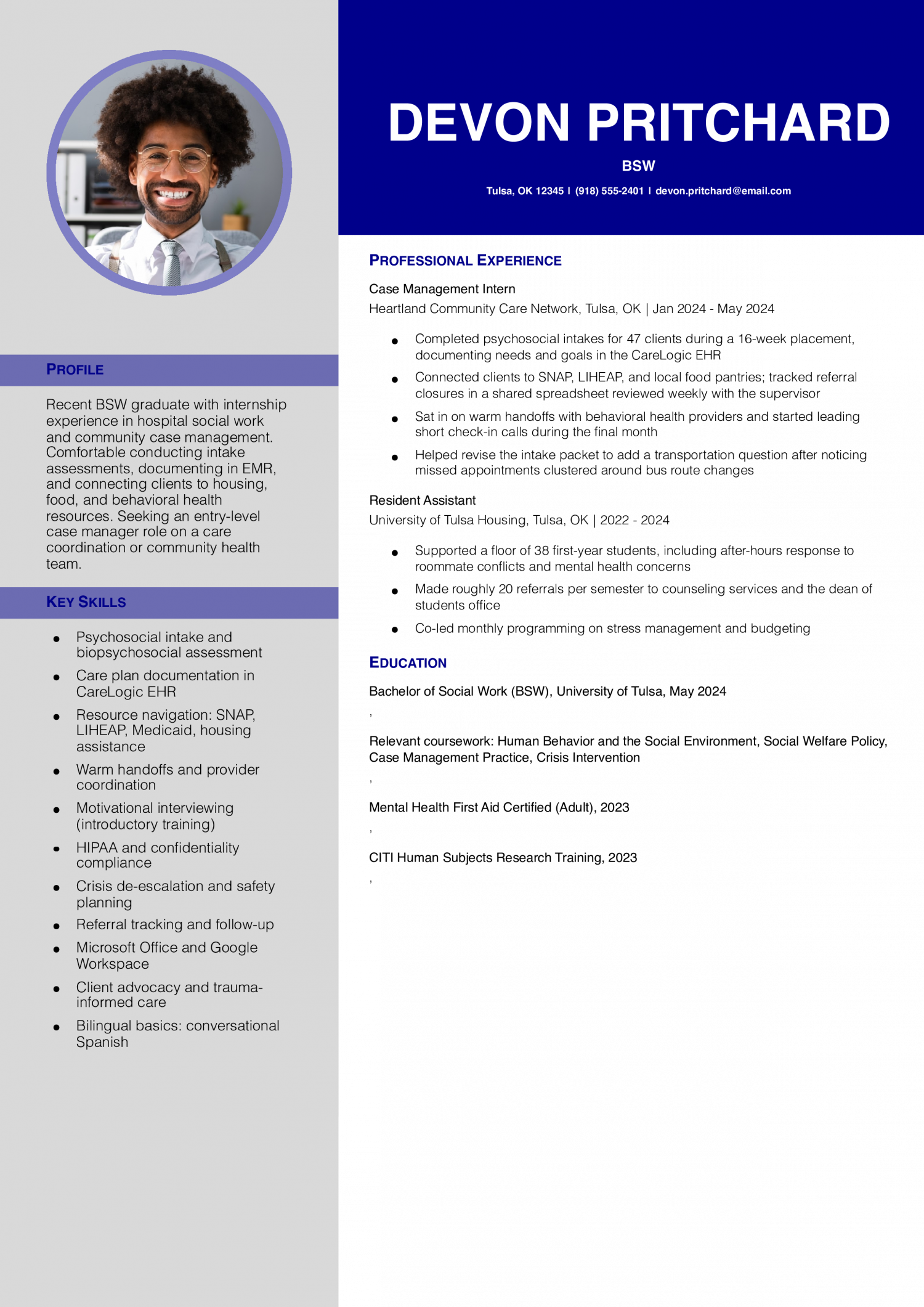
Entry-level case managers are often new social work or nursing grads, recent BSW holders, or intake workers stepping into a first caseload. This resume needs to prove field placements, the populations you served, and any assessment tools you used.
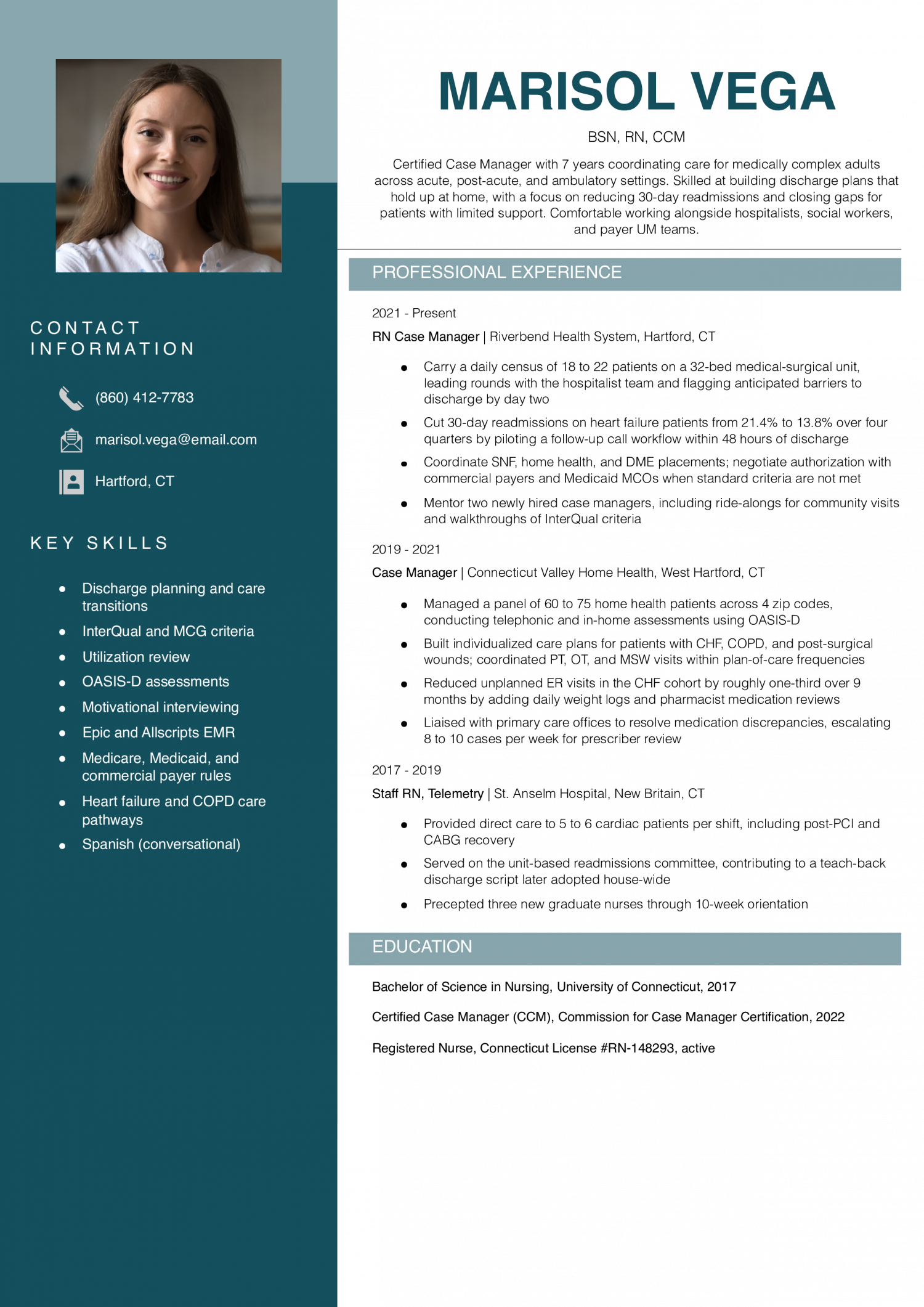
Mid-career case managers carry a steady caseload, run independent assessments, and own care plan revisions across 30 to 60 clients. This resume needs to show measurable outcomes, the EHR you document in, and any utilization review or discharge planning scope.
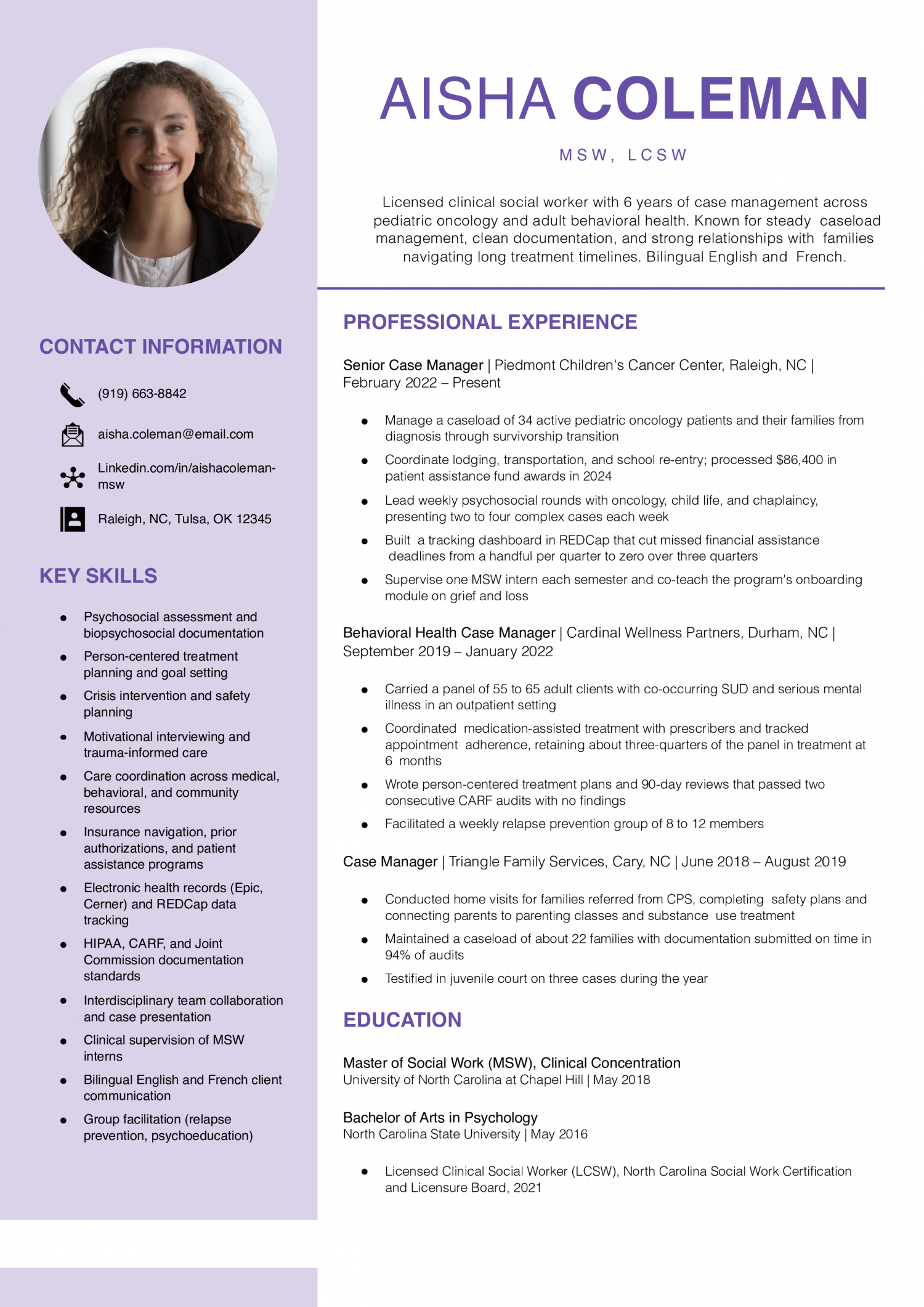
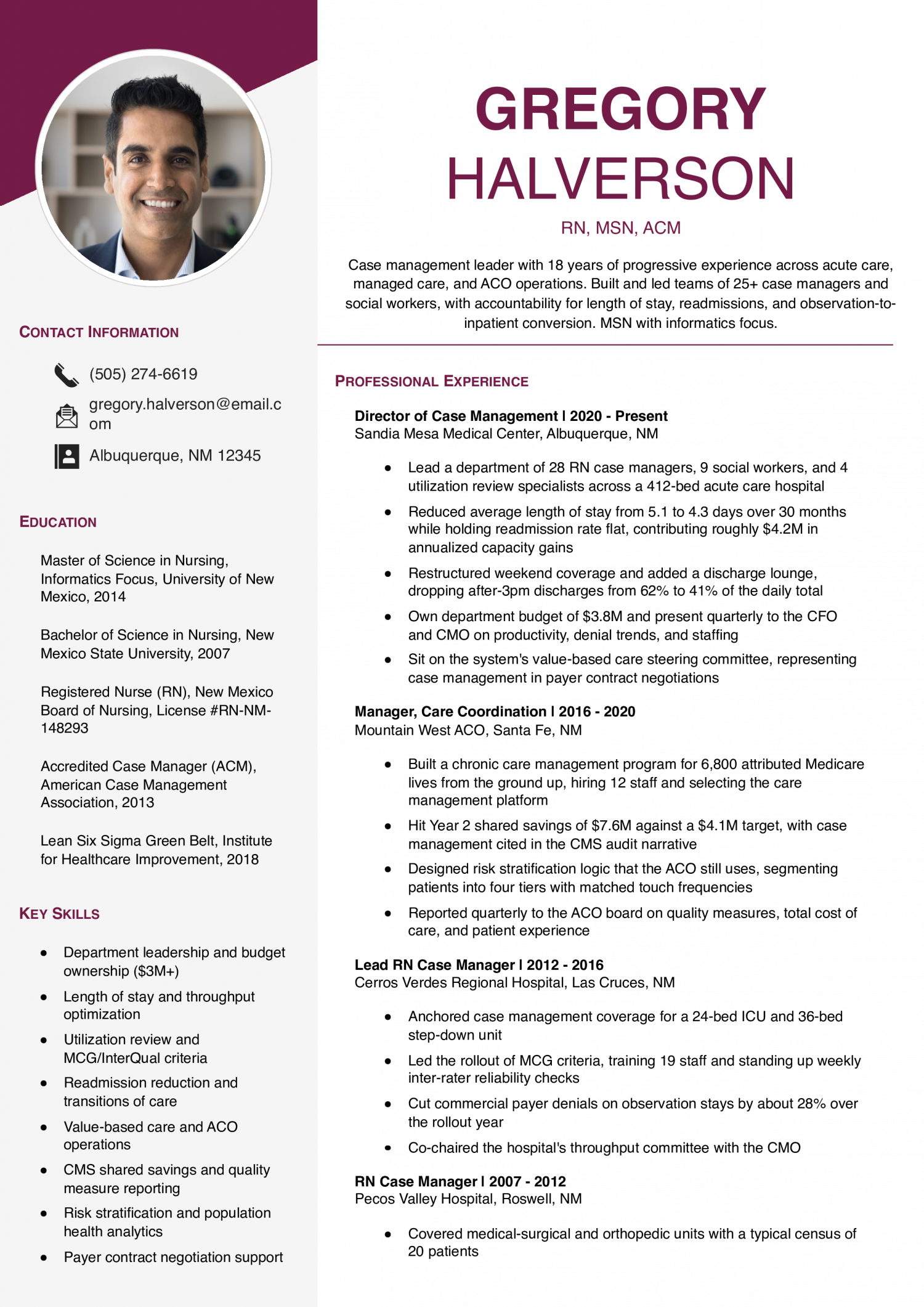
Senior case managers lead complex caseloads, mentor junior staff, and often hold a CCM or ACM. This resume needs to prove population-level outcomes, program design, payer or accreditation experience, and the supervisory scope you carry.
Marisol Vega, BSN, RN, CCM
Hartford, CT | (860) 412-7783 | [email protected] | linkedin.com/in/marisolvega-ccm
Certified Case Manager with 7 years coordinating care for medically complex adults across acute, post-acute, and ambulatory settings. Track record of reducing 30-day readmissions, closing post-discharge follow-up gaps, and partnering with payer UM teams to keep authorizations moving. Comfortable in fast-paced medical-surgical environments and equally at home on community home visits. Bilingual English and conversational Spanish.
RN Case Manager
Riverbend Health System | Hartford, CT | 2021-Present
Case Manager
Connecticut Valley Home Health | West Hartford, CT | 2019-2021
Staff RN, Telemetry
St. Anselm Hospital | New Britain, CT | 2017-2019
Nurse Extern
St. Anselm Hospital | New Britain, CT | Summer 2016
The first line of your summary should name your average caseload, the population you serve, and your setting. Social services directors and clinical supervisors read that triplet as proof you can hold a real panel.
Skip the soft opener about being compassionate or detail-oriented. Lead with something like 40 high-risk adults across a managed Medicaid panel, or 55 post-discharge patients in a hospital-to-home program. Add the assessment tool you use most, such as a PHQ-9, ACE screen, or LACE index.
That single sentence tells a reviewer your scope, your acuity level, and the documentation rhythm you already know.
Bullets without a number tend to read as duties, not impact. Reviewers scan for caseload size, client outcomes, and timeliness against contract or accreditation standards.
Aim for two or three real metrics per role. Strong patterns include caseload count (45 active clients), reassessment cadence (30-day reviews completed on time at 94 percent), and outcome shifts (reduced 30-day readmissions by a measurable amount in the program you supported). If your agency tracks HEDIS, NCQA, or URAC measures, name the one you moved.
Volume language works when exact numbers are restricted: phrases like a high-acuity caseload of complex behavioral health clients still beat vague claims about strong organizational skills.
Reviewers expect to see four buckets of work. Group your bullets so a supervisor can scan them in seconds rather than hunting through prose.
The buckets are assessment and care planning, coordination across providers and community resources, documentation and compliance, and advocacy or crisis response. Under assessment, name the screens you administer. Under coordination, name the referrals you make (SNF placement, MAT programs, housing vouchers, DME).
Under documentation, name the EHR or case management platform. Under advocacy, name the systems you navigate, such as Medicaid waivers, SNAP, or housing court. Each bucket should carry two to four bullets so the page reads like an organized panel review.
Page-one real estate matters. Build a short credentials block under your summary that lists your degree (BSW, MSW, BSN, RN), your state licensure status, and any case management certifications such as CCM or ACM.
List the state and license status, not the license number. The same rule applies to nursing licensure: name the state and good-standing status, then provide numbers on the application form. Add a tools line directly under credentials naming your EHR (Epic, Cerner), case management platform (HMIS, ICM, TruCare), and any assessment libraries you use.
Social services directors and clinical supervisors need those visible before they reach your work history, because they screen for population fit and platform fluency in the first scan.
Senior case managers tend to over-list. Cut the generic soft skills line, the objective statement, and any duty bullets that could apply to a customer service role.
Drop role descriptions that repeat your title back to the reader. Cut references available on request and any address detail beyond city and state. Trim early-career roles older than 12 years to one line unless they carry direct case management work.
Replace anything generic with a metric, a population, or a system name. Keep the resume to two pages even at the supervisor level. The reviewer is looking for caseload weight, accreditation literacy, and supervisory scope, not a complete career biography.
Five years ago, a case manager resume read like a duty list copied from a job description. The skills below come from the resumes our users built in 2026. The mix has shifted toward named EHR systems, specific assessment tools, and outcome metrics like 30-day readmission reduction.
Social services directors weigh hard skills as gatekeepers and soft skills as evidence behind your bullets. Epic, HMIS, and motivational interviewing get you past the parse; the soft skills earn the interview. Match the hard skills below against your target posting word for word, then anchor each soft skill to a bullet that proves it.
| Soft Skills | % of resumes with this skill |
|---|---|
| Communication | 80% |
| Active listening | 64% |
| Client advocacy | 45% |
| Organization | 38% |
| Problem-solving | 30% |
And here are the top hard skills showing up most often.
| Hard Skills | % of resumes with this skill |
|---|---|
| Skin analysis and consultation | 67% |
| Client needs assessment | 53% |
| Care plan development | 48% |
| Resource coordination | 38% |
| HIPAA compliance | 33% |
Based on data from thousands of case managers’ resumes built on ResumeTemplates.com, May 2026.
Before a case manager resume gets a closer read, hiring teams check for a short list of essentials.
Reviewers look for named platforms, not generic phrases. Spell out each system so the parser indexes it and a supervisor sees platform fit before reading bullets.
Never put client names, dates of birth, MRNs, or identifying case detail on your resume. Aggregate metrics and population descriptions are safe; specifics are not.
Write outcomes at the panel level. A bullet like reduced 30-day readmissions across a 50-client cardiac panel is HIPAA-safe; quoting a single client’s outcome is not.
Do the same for documentation samples. If a recruiter asks for a writing sample, send a redacted template or a de-identified case summary, never a real chart note.
Social services directors and clinical supervisors expect to see population-specific and platform-specific terms grouped together. The clusters below mirror how postings are written and how parsers index the role.
| Niche | Keywords ATS scans for |
|---|---|
| Hospital and acute care | discharge planning, transitions of care, utilization review, LACE index |
| Behavioral health | biopsychosocial assessment, motivational interviewing, co-occurring disorders, crisis intervention |
| Community and housing | HMIS, housing first, Medicaid waiver navigation, SNAP enrollment |
| Managed care and payer | HEDIS, NCQA, prior authorization, care plan documentation |
| Documentation systems | Epic, Cerner, TruCare, ICM platform |
A state license in good standing and HIPAA training keep you eligible. The certifications below are what move a case manager resume from the qualified-but-typical stack into the shortlist. List the issuing body, the credential acronym, and the expiration month and year on one line.
Case manager is one of the larger occupations tracked by BLS, which means the median pulls in a long tail of entry-tier intake workers and partial-caseload variants. The spread between the 10th and 90th percentile widens further when you separate hospital-based acute case managers from community nonprofit roles.
To position above the median, lead the resume with the caseload size you carry, the population acuity, and the named EHR or case management platform you document in.
| # | State | Avg. Annual |
|---|---|---|
| 1 | District of Columbia | $57,210 |
| 2 | California | $51,780 |
| 3 | Washington | $49,940 |
| 4 | New Jersey | $49,000 |
| 5 | Minnesota | $48,860 |
| 6 | Oregon | $48,660 |
| 7 | Rhode Island | $47,620 |
| 8 | Massachusetts | $47,280 |
| 9 | North Dakota | $47,010 |
| 10 | Colorado | $46,730 |
| # | State | Workers | Median |
|---|---|---|---|
| 1 | California | 58,830 | $51,780 |
| 2 | New York | 40,700 | $46,210 |
| 3 | Pennsylvania | 23,590 | $43,340 |
| 4 | Texas | 21,890 | $44,030 |
| 5 | Florida | 21,820 | $42,790 |
Resume Templates offers HR approved resume templates to help you create a professional resume in minutes. Choose from several template options and even pre-populate a resume from your profile.
Lead with your field placement or internship caseload and the populations you served. Name the assessment tools, the EHR you charted in, and the supervision model you worked under.
Pull case management language out of related work too. Intake coordinator, patient navigator, peer support, and youth mentor roles all carry transferable bullets if you frame them around assessment, coordination, and follow-up.
List the four functions a supervisor screens for: assessment, care planning, coordination, and documentation. Under each, name the specific tool or method.
Examples include biopsychosocial assessment, motivational interviewing, care plan revision, warm handoffs to community providers, and HIPAA-compliant Epic documentation. Generic terms like organized or detail-oriented add no ATS value.
No. List the state and good-standing status of your license, not the number. Provide the number on the employer's application form when asked.
Format it as RN, Texas, license in good standing, or LSW, Ohio, active. The same rule applies to CCM and ACM credential numbers. Resumes circulate widely, and embedding identifiers creates risk with no hiring upside.
Name the active caseload count, the population, and the acuity level. A bullet like managed a panel of 45 high-risk adults with co-occurring SUD and chronic medical conditions reads more credibly than carried a large caseload.
If exact numbers are restricted by your employer, use a band. Phrases like a caseload in the 40 to 60 range or a high-acuity panel still pass review and beat vague volume claims.
For a case manager, a professional template is the safest pick, because it signals the polish hiring managers in this field expect. An ATS-friendly template is a solid alternative. Whichever you choose, keep the formatting clean and easy to parse: clear section headings, a standard font, and no graphics a parser can choke on. For a case manager, a professional template is the safest pick, because it signals the polish hiring managers in this field expect. An ATS-friendly template is a solid alternative. Whichever you choose, keep the formatting clean and easy to parse: clear section headings, a standard font, and no graphics a parser can choke on.
Executive Resume Writer and Career Coach
Andrew Stoner is an executive career coach and resume writer with 17 years of experience as a hiring manager and operations leader at two Fortune 500 Financial Services companies, and as the career services director at two major university business schools.