Sales Director Resume Examples
The first line of your summary should name your last full-year quota attainment as a percentage, the team size you managed, and the revenue band you owned. VPs of sales and CROs read this as…
Every resume example is written and reviewed by our team of Certified Professional Resume Writers to ensure top-quality content and formatting.
Revenue growth is the metric that opens doors at the VP level. CEOs and boards of directors want proof you have built and scaled a sales org. They look for quota attainment trends, pipeline velocity, and team size across your career arc.
Your resume should lead with hard numbers tied to ARR growth or market expansion. Show how you structured territories, hired reps, and shortened deal cycles. The examples below show how strong VP of sales resumes present that record on one page. To compare layouts before you start, browse our resume templates.
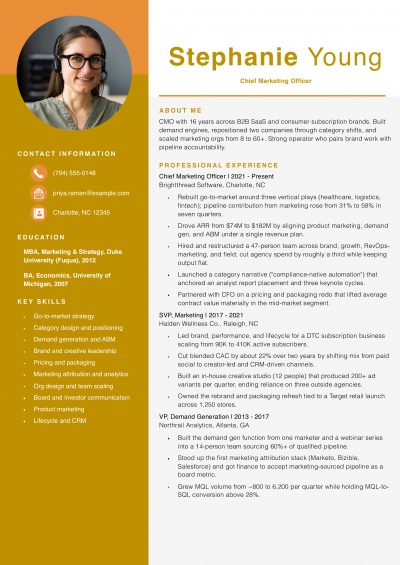
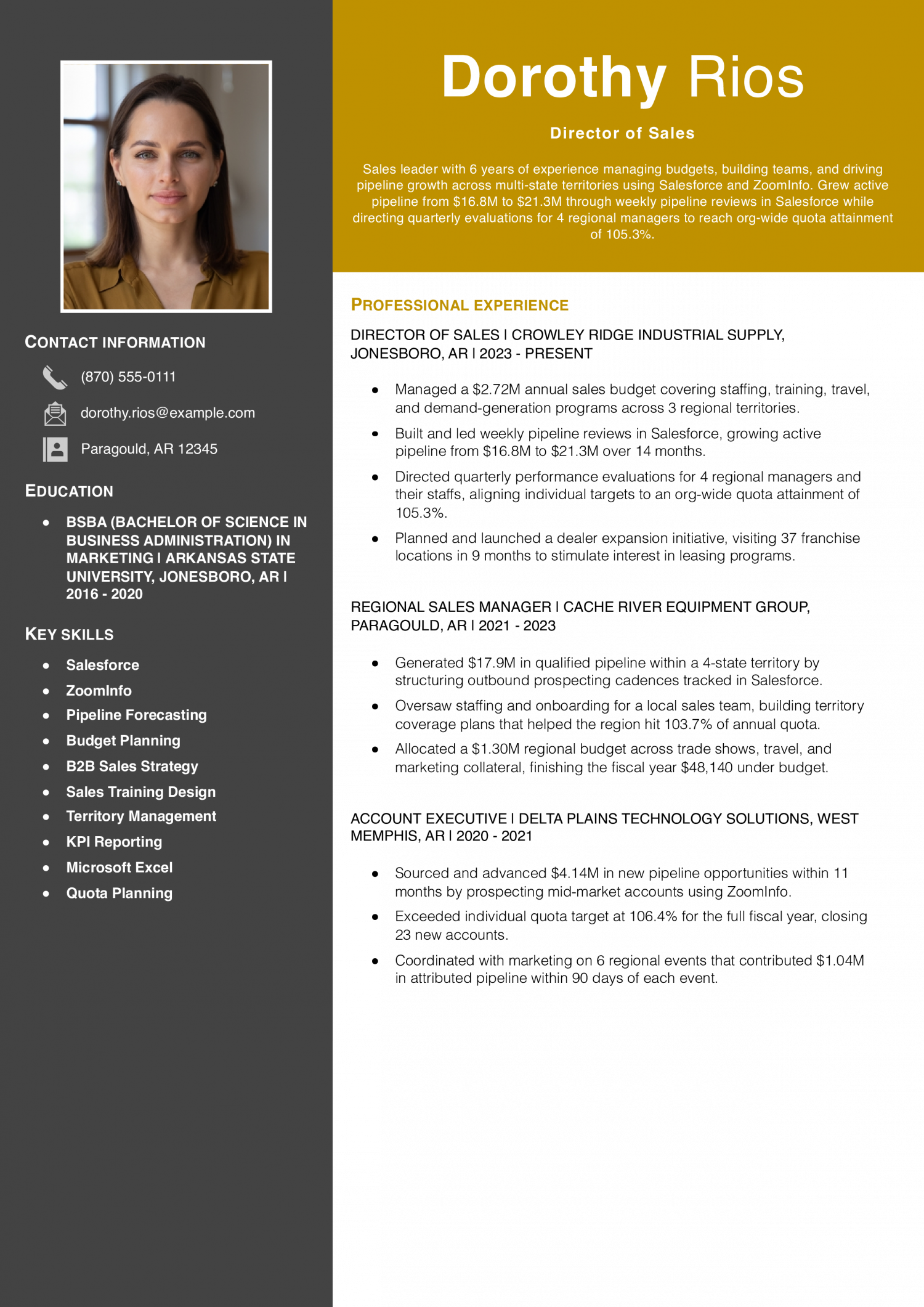
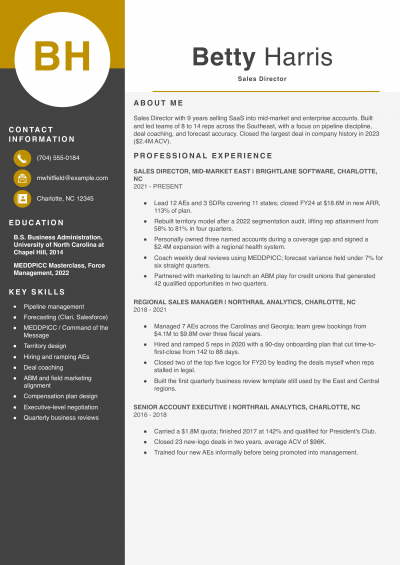
Pick this resume if you are a mid-level sales professional with a few years of management under your belt aiming for a director seat. Lead with budget ownership figures alongside pipeline numbers to prove you can run the business side of sales.
Pipeline growth means more when you show where it started and where it ended over a set time. A sales board can judge the pace without asking follow-up questions. State the opening value, the closing value, and the months between them.
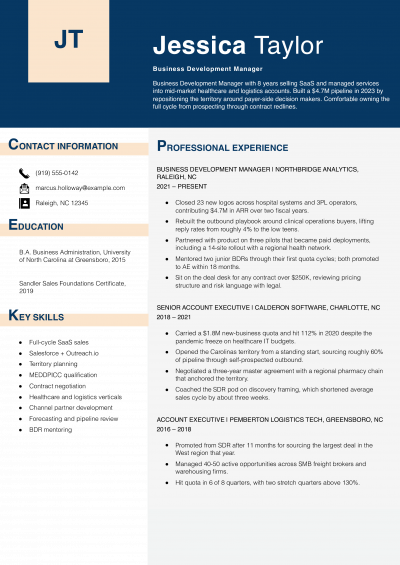
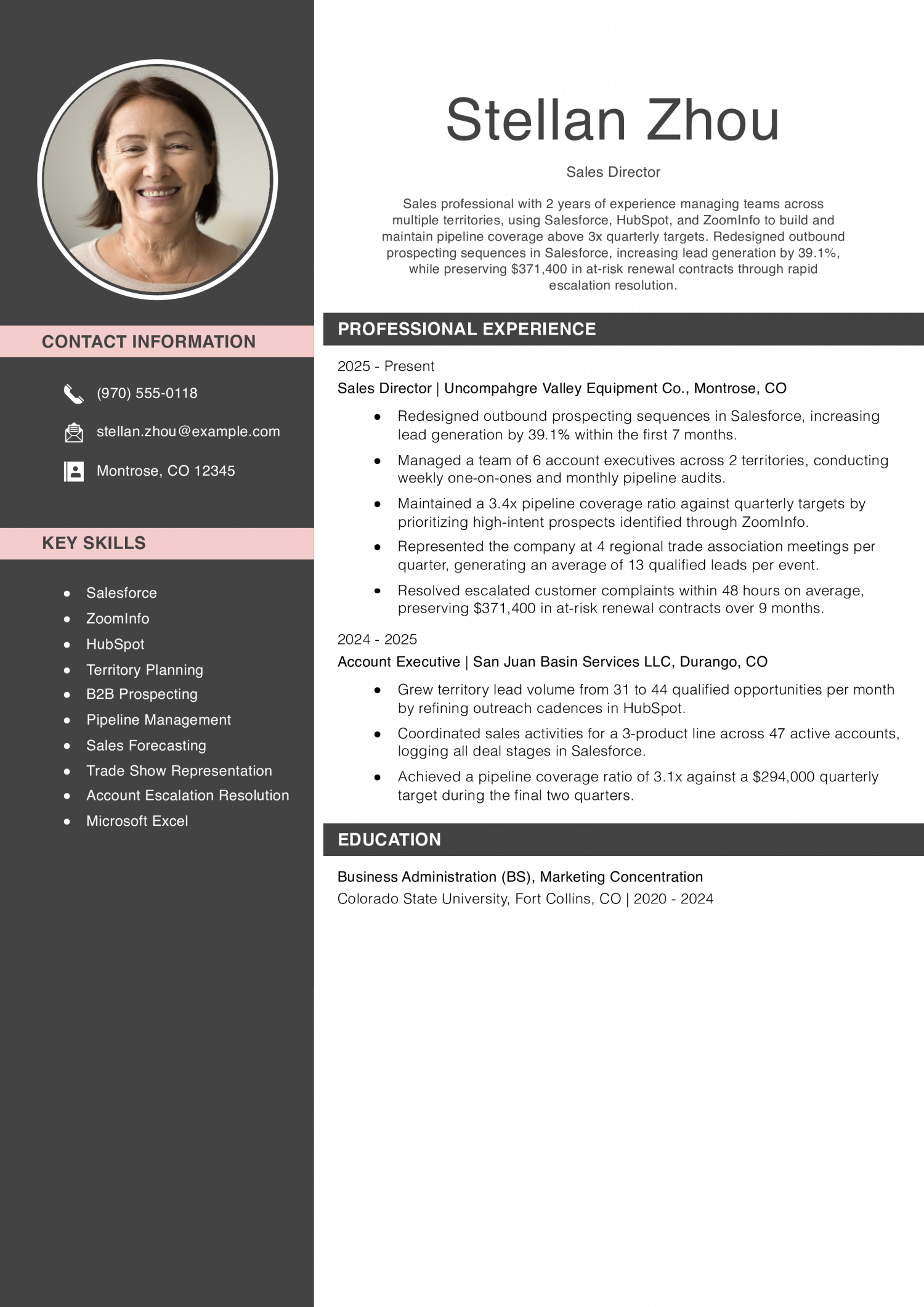
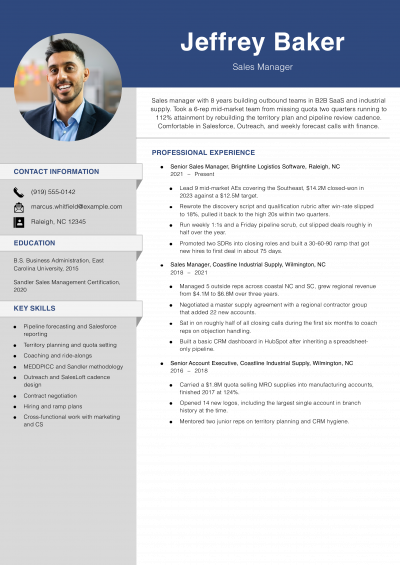
Start with this resume if you are an early-career sales professional stepping into your first director role after excelling as an account executive. Lead with pipeline coverage ratios repeated across both positions to show consistency in forecasting discipline.
Weekly one-on-ones and monthly pipeline reviews show a structured rhythm, not a vague team-lead claim. A VP hiring for this role can picture the routine right away. When you describe team management, say which meetings you held and how often.
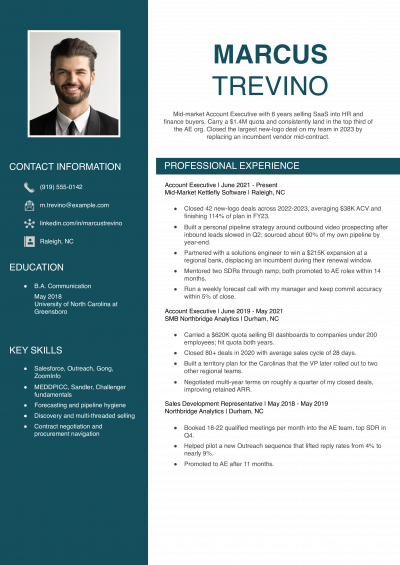
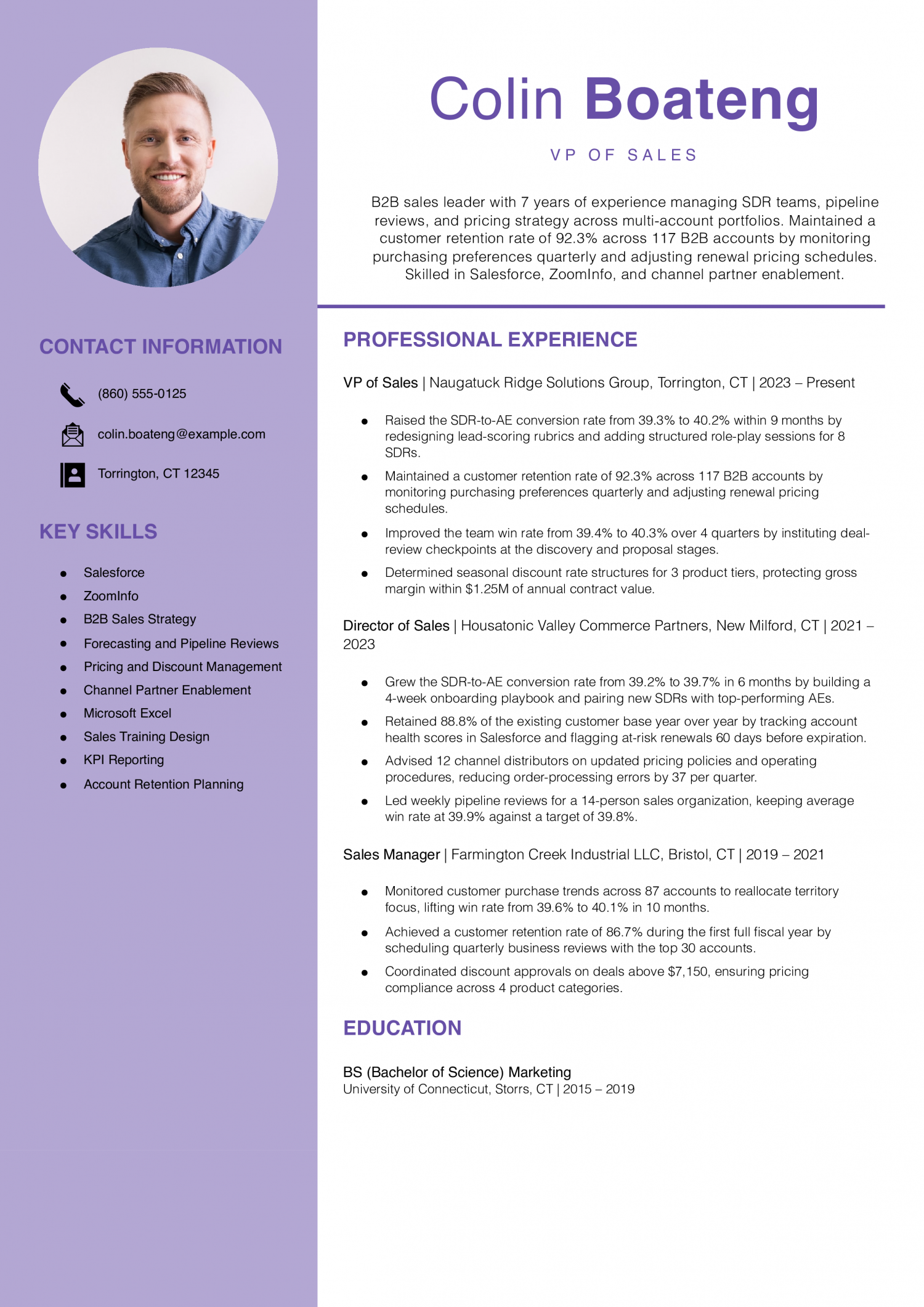
Try this resume if you are a mid-level sales leader with director experience moving into a VP of Sales role. Lead with retention and win-rate figures repeated across every position to show consistent performance management.
Lead scoring redesigns and role-play sessions for the full SDR team show the investment reached the whole group. A CRO reading that can see how the reps were trained and what the program looked like. Say what you built, how you delivered it, and how many people went through it.
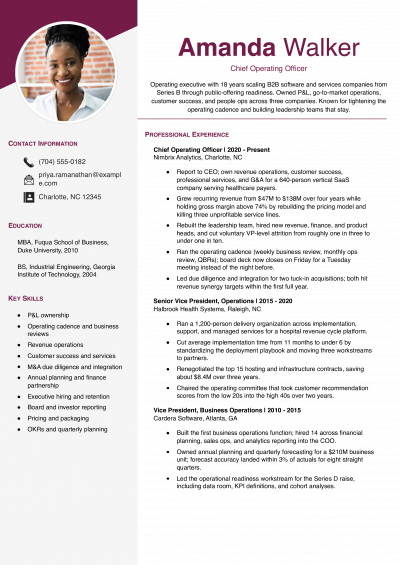
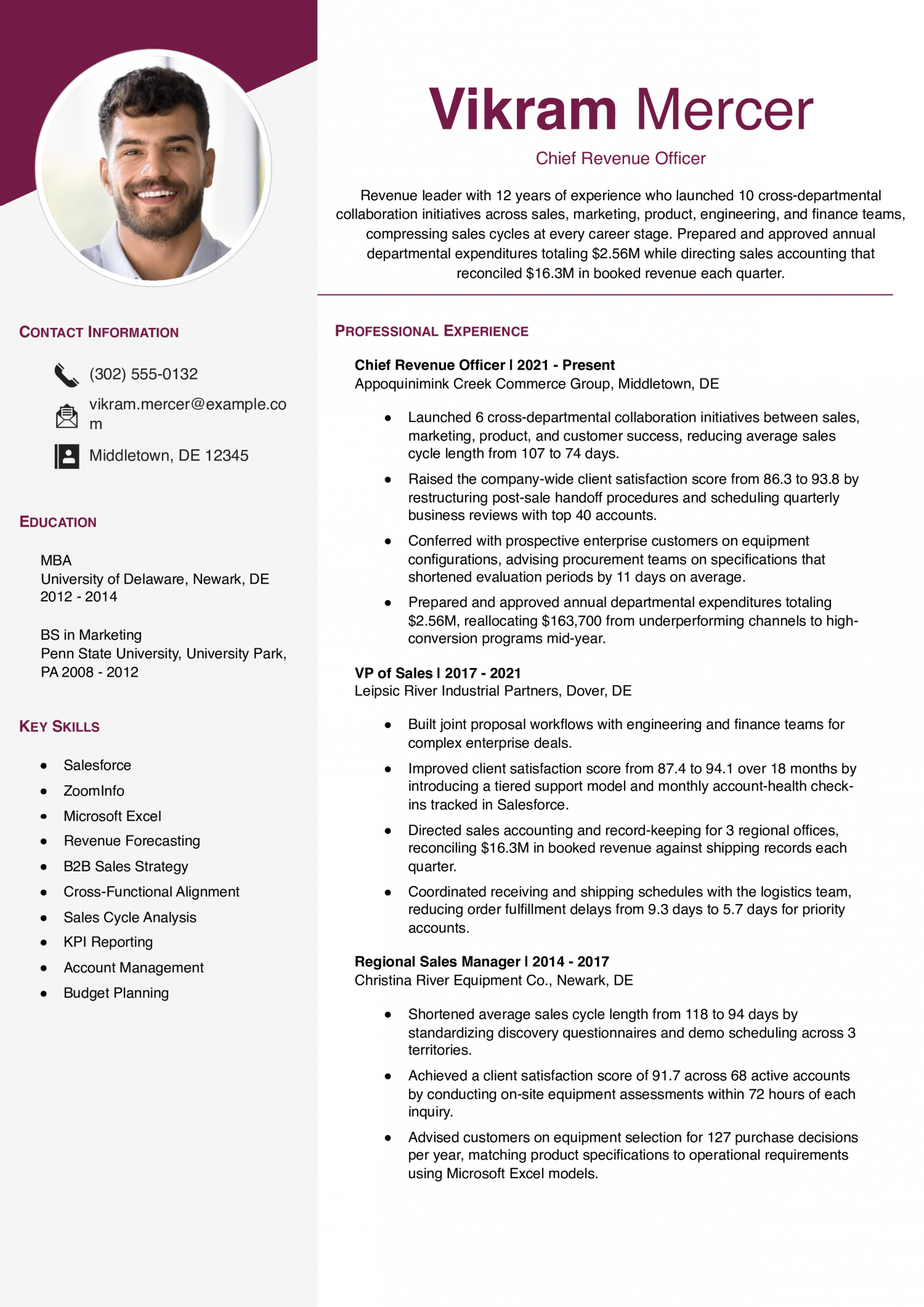
Turn to this resume if you are a senior sales executive ready to step into a Chief Revenue Officer role. Lead with sales cycle compression figures tracked across multiple positions to prove you deliver repeatable acceleration.
Reallocating budget mid-year from underperforming channels to higher-return programs is the decision behind the revenue gain. A board member sees active financial management, not a year-end report. If you moved money between programs, say where it came from, where it went, and why.
Experienced in revenue forecasting, territory planning, and sales onboarding design across 6 years spanning analyst, manager, and director roles. Grew annual recurring revenue from $11.7M to $17.1M by restructuring territory assignments and tightening forecasting cadences in Salesforce. Skilled in KPI reporting, commission structure analysis, and B2B account management using Salesforce, Microsoft Excel, and ZoomInfo.
Name the annual revenue you managed in your last role. CEOs and boards of directors read that figure before anything else.
It tells them your scale and your ceiling. A line like “VP of Sales who grew a $48M book to $71M in two years” sets your range fast. Follow that with your team size and your market type.
If you led 30 reps in mid-market SaaS, say so. If you ran enterprise field sales, say that instead. Skip broad claims about being a “strategic leader.” Those phrases carry no weight without a dollar figure next to them.
One strong number in the first sentence frames everything below it.
Most strong VP of Sales resumes tie each bullet to a result. Revenue growth rate is the first metric to include. Quota attainment is the second.
Win rate, deal size, and pipeline velocity each deserve their own bullet. “Led the sales team” tells a board nothing.
“Grew new-logo revenue 34% year over year across a 22-rep org” tells them plenty. Where exact figures are protected, use percentages or ranges. State the before and after so the reader sees the change.
Pair each metric with the action you took to move it. Hired, restructured, launched, and cut are verbs that show your lever. Keep every bullet under two lines on the page.
Break your experience into the areas a board evaluates. Revenue generation is one. Cover quota planning, territory design, and forecast accuracy there.
Team leadership is another. Show how you hired reps and built onboarding programs. Go-to-market strategy deserves its own section.
Describe how you entered new segments or launched products. Sales operations belongs here too. Call out your CRM governance and pipeline reporting.
Finally, add a cross-functional block. Note how you partnered with marketing on demand generation. Note how you worked with finance on pricing.
Grouping your work this way helps CEOs scan for gaps. It also keeps your resume from reading like a flat list of tasks.
List your CRM platform near the top of the resume. Salesforce and HubSpot are the most recognized names. Add your forecasting and reporting tools right after.
CEOs and boards of directors want to see these early. They signal that you manage by data, not instinct. Put them in a short skills or tools block below your summary.
Include sales engagement platforms you have used. Include conversation intelligence tools if they shaped your coaching model. Do not bury these items on page two.
A board member scanning 15 resumes may never reach the second page. Keep the block to one or two lines so it stays tight. Name only the tools you can speak to in an interview.
Your resume should run two pages at most. Remove individual contributor roles from early in your career. A board does not need to see your first account executive job.
Summarize anything older than 15 years in a single line. Drop bullet points from regional manager roles unless they show a milestone. A record-breaking turnaround is worth keeping.
Routine territory management is not. Strip out objective statements and references lines. They take space without adding proof.
Cut skills that are assumed at this level, like cold calling or CRM data entry. Your resume should read as a record of decisions and outcomes. Every line that stays should answer one question: what did you build, fix, or grow?
Keyword filters screen more VP of Sales resumes now than in past years. Revenue forecasting clears the first cut.
Cross-functional leadership decides whether the resume advances. CEOs and boards of directors weigh hard skills to confirm you can run a pipeline. They then look for soft skills like negotiation.
Those traits signal you can lead a team, not only a spreadsheet. Scan each table against your target job posting. Add missing terms from the ad into your skills section.
Drop any skill you cannot support with a bullet point. Place hard skills near the top of your resume so the parser reads them first. Treat soft skills as proof points that back your bullet results.
Pair each one with a metric or outcome in your work history. A skill without a story behind it carries less weight with reviewers.
| Soft Skills | AI-estimated % |
|---|---|
| Executive-level communication | 75% |
| Cross-functional leadership | 55% |
| Strategic negotiation | 46% |
| Coaching and mentoring | 39% |
| Adaptability under pressure | 35% |
And here are the top hard skills showing up most often.
| Hard Skills | AI-estimated % |
|---|---|
| Sales pipeline management | 77% |
| Revenue forecasting | 61% |
| Quota setting | 40% |
| Sales team development | 36% |
| Customer acquisition strategy | 30% |
Skill names and rankings come from an AI model grounded in U.S. Department of Labor occupation data for VPs of sales, not from a count of VPs of sales’ resumes built on ResumeTemplates.com.
AI use is the first topic below, and it needs to be specific.
Sales leaders write about AI on their resumes in one of three ways. You can lead with vague claims like “AI-driven sales leader.” You can leave AI off and address it in the interview. Or you can describe the actual workflow you run.
The third option is what CEOs and boards of directors can validate. Name the tool, the task, and the outcome it produced. A board member may ask how you used it in pipeline reviews.
Keep the detail specific enough that the answer holds up. If you have not used a tool yourself, leave it off. Honest framing matters more than a long list of platforms.
What AI is actually changing for this role
Pipeline forecasting: AI models flag at-risk deals earlier, so VPs can adjust coverage before the quarter closes.
Rep coaching: Call-analysis tools surface talk patterns and objection handling gaps across the full sales team.
Territory planning: Scoring models rank accounts by fit and intent signals, replacing spreadsheet-based segmentation.
Proposal generation: Generative tools draft pricing summaries and business cases, cutting days from the deal cycle.
Revenue reporting: Automated dashboards pull CRM and finance data into board-ready slides with less manual work.
AI tools to name
How to phrase AI on your resume
Do
Skip
Your methodology choices reveal how you build teams. CEOs want to see a system, not a style. Name the frameworks you trained reps to follow.
List board presentations, investor updates, or M&A contributions. Each one signals you operate above a director level. Keep entries brief and tied to outcomes.
Name the governing body or committee you reported to. State the revenue scope you oversaw. These details separate a VP from a senior manager.
The 90th-percentile sales manager out-earns the median by roughly 96 percent. That gap tells you the market pays a steep premium at the top of the range.
The 10th percentile sits about 51 percent below the median. National employment is large, so the role exists across many industries and company sizes. Geographic and sector differences shape where you fall in that range.
Your resume needs to reflect quota scale and revenue you owned, not years in sales leadership. Lead with the annual contract value or deal size you closed, stated in dollars.
| # | State | Median Annual |
|---|---|---|
| 1 | New York | $217,640 |
| 2 | Massachusetts | $191,200 |
| 3 | Virginia | $191,130 |
| 4 | Colorado | $180,850 |
| 5 | Washington | $174,000 |
| 6 | New Jersey | $173,020 |
| 7 | Connecticut | $162,110 |
| 8 | Kansas | $159,990 |
| 9 | Georgia | $159,890 |
| 10 | Maine | $158,660 |
| # | State | Workers | Median |
|---|---|---|---|
| 1 | California | 112,440 | $134,910 |
| 2 | Texas | 76,010 | $136,020 |
| 3 | Florida | 46,480 | $131,900 |
| 4 | New York | 38,510 | $217,640 |
| 5 | Illinois | 32,240 | $155,280 |
Resume Templates offers HR approved resume templates to help you create a professional resume in minutes. Choose from several template options and even pre-populate a resume from your profile.
A VP of sales resume leads with a brief summary of your revenue scope and team size. The experience section lists director-level and above roles with metrics in every bullet.
Keep it to two pages, and place your skills and tools near the top. CEOs and boards scan for those details first.
Start by studying the company's annual revenue, market segment, and sales org structure. Prepare two or three stories that show how you grew pipeline or restructured a team.
Tie each story to a specific dollar figure or percentage. That framing lets the interviewer measure your impact against their own targets.
Ask about the current quota attainment rate across the sales team. Then ask what the board expects in revenue growth over the next four quarters.
You can also ask how marketing and sales share pipeline ownership. These questions show you think at the executive level.
Yes, but you need to reframe the content around org-wide results. Swap individual quota numbers for total revenue you influenced and team headcount you managed.
Add cross-functional projects you led across departments. CEOs and boards want to see that you operated above a single region.
Group your skills into categories such as revenue operations and team leadership. Name the specific platforms you have used, like your CRM or forecasting tool.
Avoid generic phrases like "strong communicator" and replace them with outcomes. A skill paired with a result carries more weight than a label on its own.
Yes, if the role you are targeting sits in that vertical. Name the market segment, the buyer persona, and any regulatory context you navigated.
Industry depth signals that you can ramp faster. It also tells CEOs you already understand the typical sales cycle length in their space.
List any advisory, board, or consulting work you did during the gap period. If you had no paid work, note relevant activity like a nonprofit leadership role.
Keep the entry brief and move the reader's eye to the revenue results above and below it. A short honest line draws less attention than a missing date range.
An ATS-friendly template lines up your quota results and team history under their own headings. A basic template fits a VP of sales resume well.
VP of Sales Resume
4.1/5 stars with 111 reviews

Executive Resume Writer and Career Coach
Andrew Stoner is an executive career coach and resume writer with 17 years of experience as a hiring manager and operations leader at two Fortune 500 Financial Services companies, and as the career services director at two major university business schools.
© 2026 Resumetemplates.com All rights reserved.