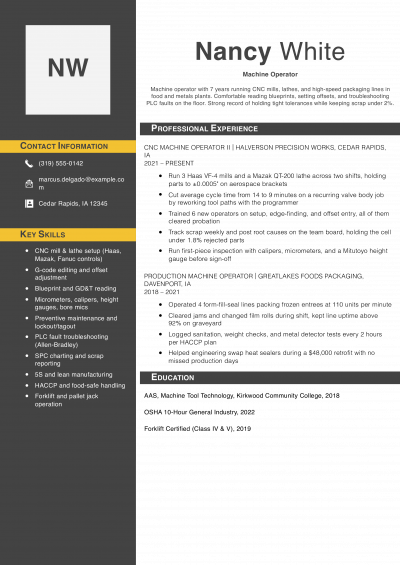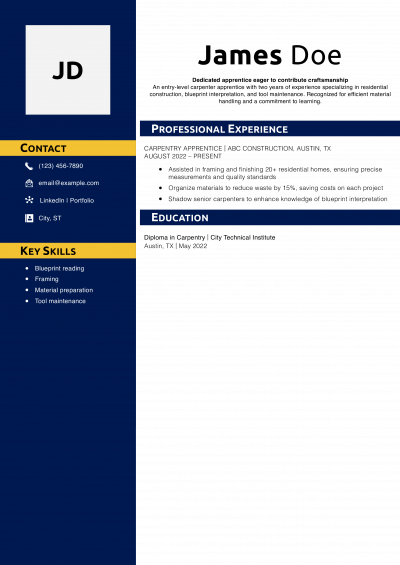
Carpenter Resume Examples and Templates



A current OSHA card and equipment ticket list is what gets general laborer resumes past the foreman's 30-second scan; named project types and crew size are what make them readable enough to advance.
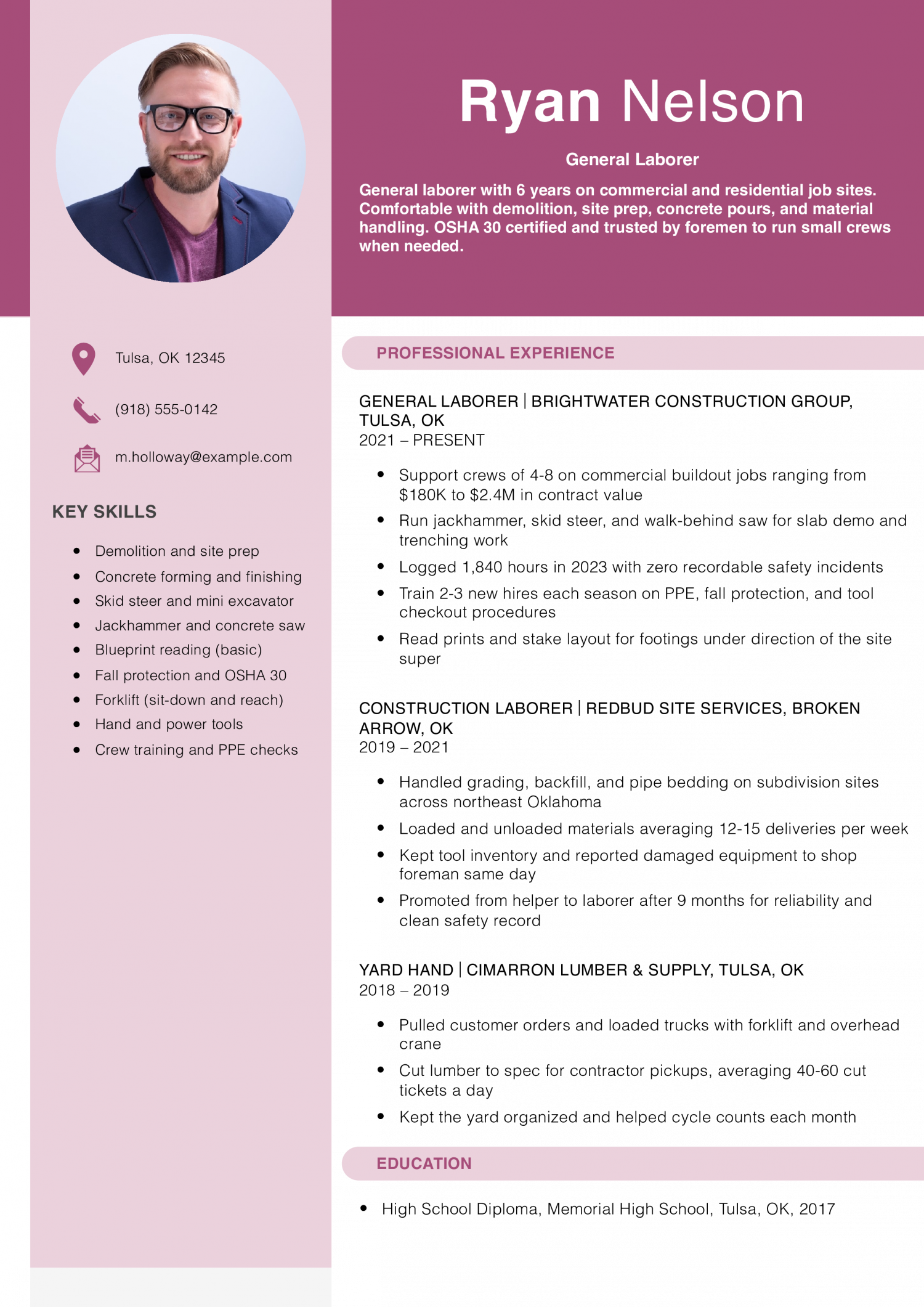
Entry-level general laborers are first-year crew members with an OSHA 10 card and limited site time. The resume needs to prove reliability, willingness on physical work, and any equipment or tool exposure from school, military, or short-term gigs.

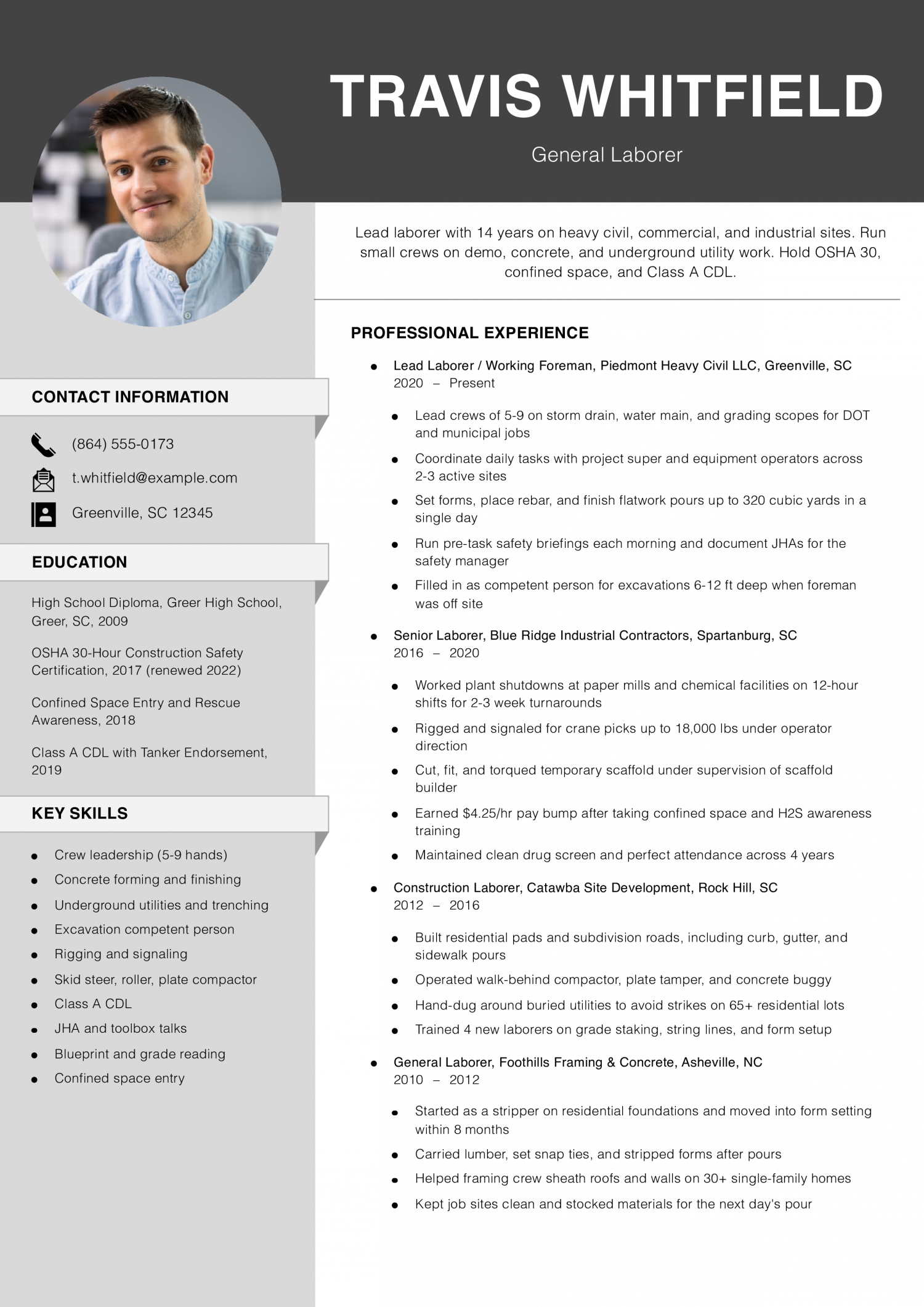
Experienced general laborers have three or more years on commercial, residential, or warehouse sites with current OSHA 30 and equipment tickets. The resume needs to prove project scale, crew size led or worked within, and the specific materials and tools handled day to day.
Andre Coleman
Akron, OH | (330) 555-0166 | [email protected] | linkedin.com/in/andrecoleman
General laborer with 9 years on commercial buildouts, road work, and residential framing crews. Comfortable with concrete, demo, and underground utilities. Hold OSHA 30, flagger certification, and a clean Class B CDL. Known on crews for showing up early, handling tools the right way, and helping newer hands without being asked.
Senior Laborer
Cuyahoga Commercial Builders | Akron, OH | 2022-Present
Road Crew Laborer / Flagger
Maple Valley Paving | Canton, OH | 2019-2022
Construction Laborer
Summit Residential Group | Stow, OH | 2017-2019
Demolition Helper
Northcoast Demo & Salvage | Cleveland, OH | 2016-2017
Yard and Delivery Helper
Buckeye Ready-Mix Supply | Akron, OH | 2015-2016
Your profile should state years on the tools, the site types you’ve worked, and the tickets you carry. Site foremen want that in the first two lines, not in a buried skills block.
Name commercial, residential, warehouse, demolition, or roadwork by name. Add OSHA 10 or 30 status, forklift or aerial-lift certification, and the materials you handle most. Skip soft-skill adjectives in the profile; foremen read past them.
A profile that reads “OSHA 30-certified general laborer with four years on commercial interior fit-outs, forklift and scissor-lift certified” beats any “hardworking team player” line.
General labor work translates well into volume language: loads moved, square footage cleared, crew size, and project duration. Most strong bullets carry at least one number.
Write “Cleared 12,000 sq ft of demo debris across a six-week tenant build-out” rather than “Helped with demolition.” Name the crew size you worked within, the lift capacity you ran, and the project length in weeks. Bullets without scope read as duties and tend to lose to bullets that show volume. If you’re new to the trade, lean on hours logged, shift length, or training site hours instead of inventing a metric.
Foremen scan bullets for the work they actually need filled. Group your tasks into three or four buckets so the match is obvious.
The common buckets are material handling and staging, demolition and site cleanup, equipment operation, and assist work for skilled trades (carpentry, concrete, drywall, MEP rough-in). Under each bucket, name the tools and materials: jackhammer, reciprocating saw, sledge, mortar mixer, rebar, sheetrock, structural steel. If you’ve done flagging, traffic control, or signal work, give it its own line.
Avoid mashing six trades into one bullet; a super reading fast wants to see which trades you can step into without re-training.
Tickets and OSHA cards belong in a page-one credentials block, not at the bottom under “Additional.” Site foremen and project superintendents check those before they read your job history.
List OSHA 10 or 30 with the issue year, forklift certification with class (Class IV, Class VII), aerial-lift or scissor-lift, first aid and CPR, HAZWOPER if you have it, and any union book or apprenticeship hours. If you have a CDL or a powered-tool certification, those belong here too. Do not list license or certification numbers on the resume itself; “OSHA 30, current” is the standard line.
Numbers go on the employment application when asked.
Education for general laborers is short: high school diploma or GED, trade school coursework, or apprenticeship hours. Put it after experience, one or two lines.
Use the closing third to signal reliability and physical readiness without slop adjectives. A short “Work Authorization” line (driver’s license class, transportation reliable, available for overtime and weekend work) helps. So does a one-line attendance note if you have one (“Zero missed shifts across 18 months at previous GC”).
If you’ve done military service, name the MOS and any operator licenses earned. Skip hobbies and references; the page-one credentials block is doing the heavy lifting.
Five years ago, a general laborer resume read like a clipboard of duties: lifted materials, swept site, assisted crew. The skills below come from the resumes our users built in 2026. The mix has shifted toward named equipment tickets, OSHA tier, and trade-specific assist work.
Site foremen and project superintendents weight hard skills first (OSHA 30, forklift class, jackhammer hours), then read soft skills as evidence backing your bullets, not as standalone claims. Match the items below against your target posting and treat soft skills as the behavior your project bullets should prove out.
| Soft Skills | % of resumes with this skill |
|---|---|
| Teamwork | 74% |
| Reliability | 63% |
| Time management | 47% |
| Attention to detail | 36% |
| Adaptability | 33% |
| Hard Skills | % of resumes with this skill |
|---|---|
| Material handling | 67% |
| Equipment operation | 62% |
| Safety compliance | 40% |
| Heavy lifting | 39% |
| Measurement and basic math | 29% |
Based on data from thousands of general laborers’ resumes built on ResumeTemplates.com, May 2026.
Before a general laborer resume gets a closer read, hiring teams check for a short list of essentials.
Site foremen and project superintendents look for your OSHA tier before they read your job history. Put your card status in the top third of page one, named by tier and current year.
Name the tools and equipment you’ve run on real sites. Generic phrases like “power tools” do not match posting language; specific tool names do.
LIUNA (Laborers’ International Union of North America) is the most common book for general laborers, with locals across the U.S. and Canada. Membership signals completed safety training, jurisdictional knowledge, and access to union site work that pays above non-union scale in most metros.
If you’re in apprenticeship, list the program name, your year (first-year, second-year), and hours logged toward journeyman. Non-union laborers should not invent affiliation; instead, list any pre-apprenticeship coursework, OSHA tier, and the GCs you’ve worked for.
Beyond OSHA 10, the certifications below tell site foremen which equipment you can run on day one and which trades you can assist without retraining. List each one with the certifying body and the year you earned or renewed it, no card numbers on the resume.
The spread between the 10th and 90th percentile for general laborers is wide, and the lever that moves you up the band is equipment tickets and trade specialization, not years swinging a shovel. Union book, OSHA 30, and forklift or aerial-lift certifications separate the top decile from generalist labor. Geographic concentration matters too: metro areas with active commercial pipelines pay well above rural residential markets.
Lead the resume with the tickets and site types the high-percentile band gets hired for, not raw time in the trade.
| # | State | Avg. Annual |
|---|---|---|
| 1 | Hawaii | $66,100 |
| 2 | Illinois | $64,890 |
| 3 | New Jersey | $63,190 |
| 4 | Massachusetts | $62,430 |
| 5 | California | $60,540 |
| 6 | Minnesota | $58,720 |
| 7 | Rhode Island | $58,290 |
| 8 | Alaska | $57,970 |
| 9 | New York | $57,680 |
| 10 | Washington | $57,240 |
| # | State | Workers | Median |
|---|---|---|---|
| 1 | Texas | 117,580 | $38,180 |
| 2 | California | 85,370 | $60,540 |
| 3 | Florida | 75,770 | $40,820 |
| 4 | New York | 49,890 | $57,680 |
| 5 | North Carolina | 38,530 | $42,250 |
Resume Templates offers HR approved resume templates to help you create a professional resume in minutes. Choose from several template options and even pre-populate a resume from your profile.
Skip the objective unless you have under a year of work history. A profile summary works harder on the same line count.
If you do use one, keep it to one sentence that names the site type and your tickets. Example: "OSHA 10-certified laborer seeking entry crew work on commercial interior projects, forklift Class IV certified and available for overtime."
Lead each bullet with the trade or task, then add scope. Name the materials, tools, and crew size you worked within.
Replace "Assisted with demolition" with "Ran jackhammer and sledge on 12,000 sq ft tenant demo across a six-week schedule with a four-person crew." Foremen read for volume and tools, not generic verbs.
Yes. Lead with OSHA 10, your driver's license, and any physical-work history you have.
Warehouse, landscaping, moving, farm, restaurant back-of-house, and military service all transfer. Name the shift length, the loads or volume you handled, and any tools or equipment you ran. A short "Available immediately, reliable transportation, weekend shifts welcome" line at the bottom helps with crew-level hiring.
No. List the certification and year, not the card number. Write "OSHA 30-Hour Construction, current" or "OSHA 30, renewed 2025."
The card number goes on the employment application or the GC's onboarding paperwork when they ask. The same rule applies to forklift, HAZWOPER, and CDL numbers. Names and currency dates on the resume; numbers on the form.
For a general laborer, an ATS-friendly template is the safest pick, because it puts your certifications and experience where a hiring manager scans first. A basic template is a solid alternative. Whichever you choose, keep the formatting clean and easy to parse: clear section headings, a standard font, and no graphics a parser can choke on.
Executive Resume Writer and Career Coach
Andrew Stoner is an executive career coach and resume writer with 17 years of experience as a hiring manager and operations leader at two Fortune 500 Financial Services companies, and as the career services director at two major university business schools.

Customize this template in our builder in under 10 minutes.