Theater Resume Examples and Templates for 2026



Casting directors decide whether to keep reading by the top third of the credits column; if union status, recent project names, and the role size aren't visible by then, the resume goes in the no pile.
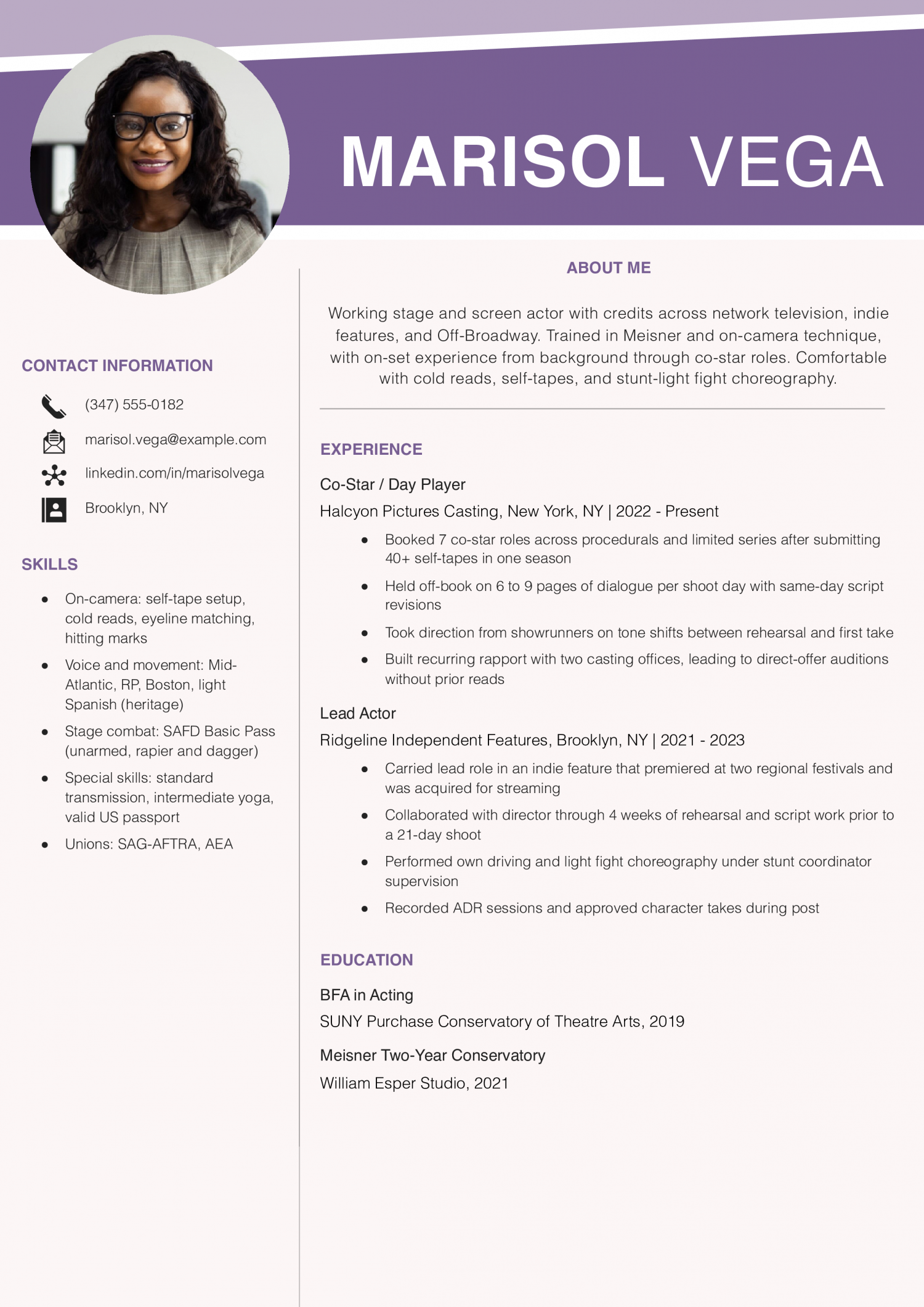
Casting directors reading a background or beginner acting resume are answering one question: does this actor have enough training and on-set discipline to take direction without slowing the shoot day?
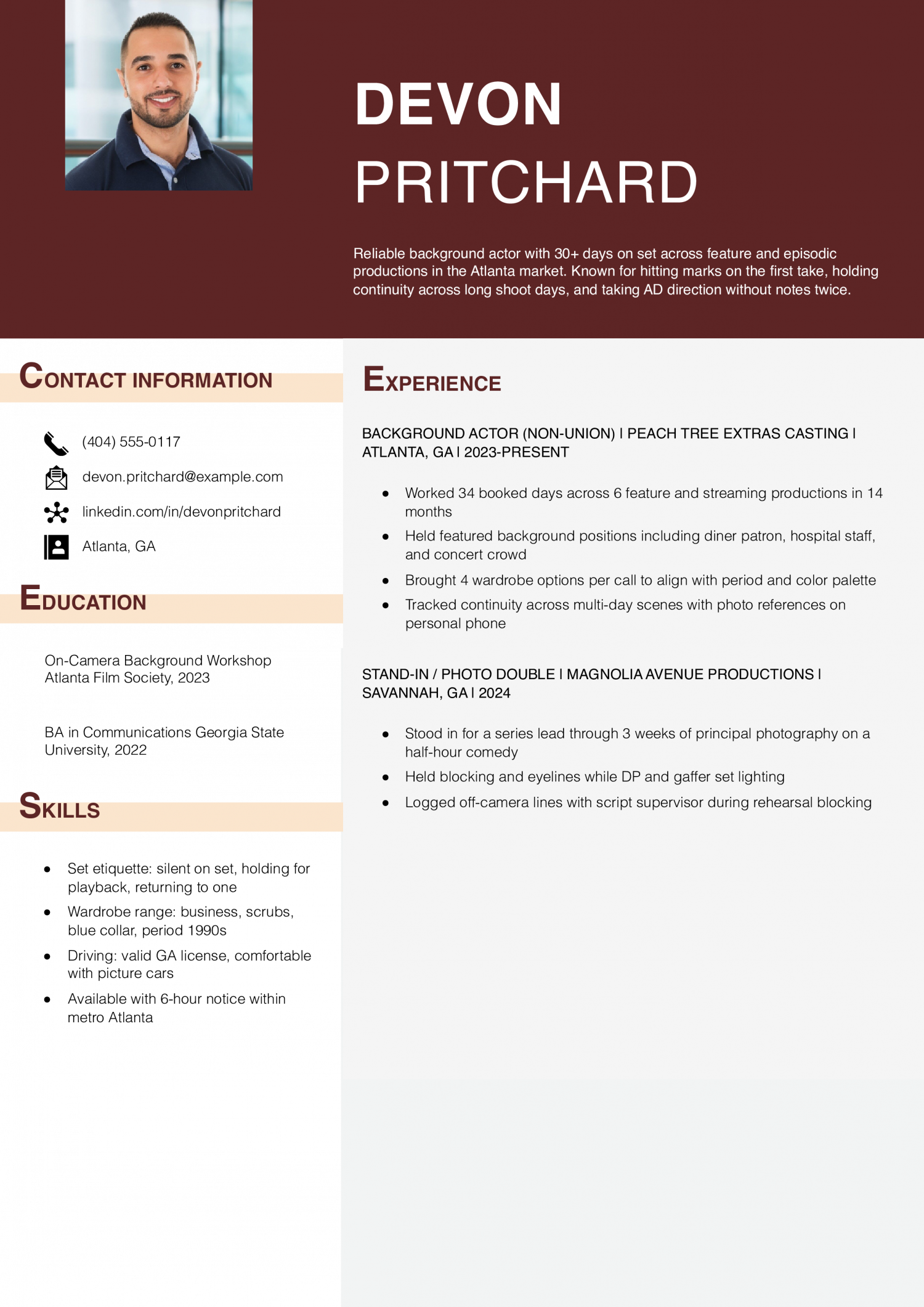
Casting directors reading a day-player resume are answering one question: has this actor booked enough co-star and guest spots to handle coverage, marks, and quick rewrites between takes?
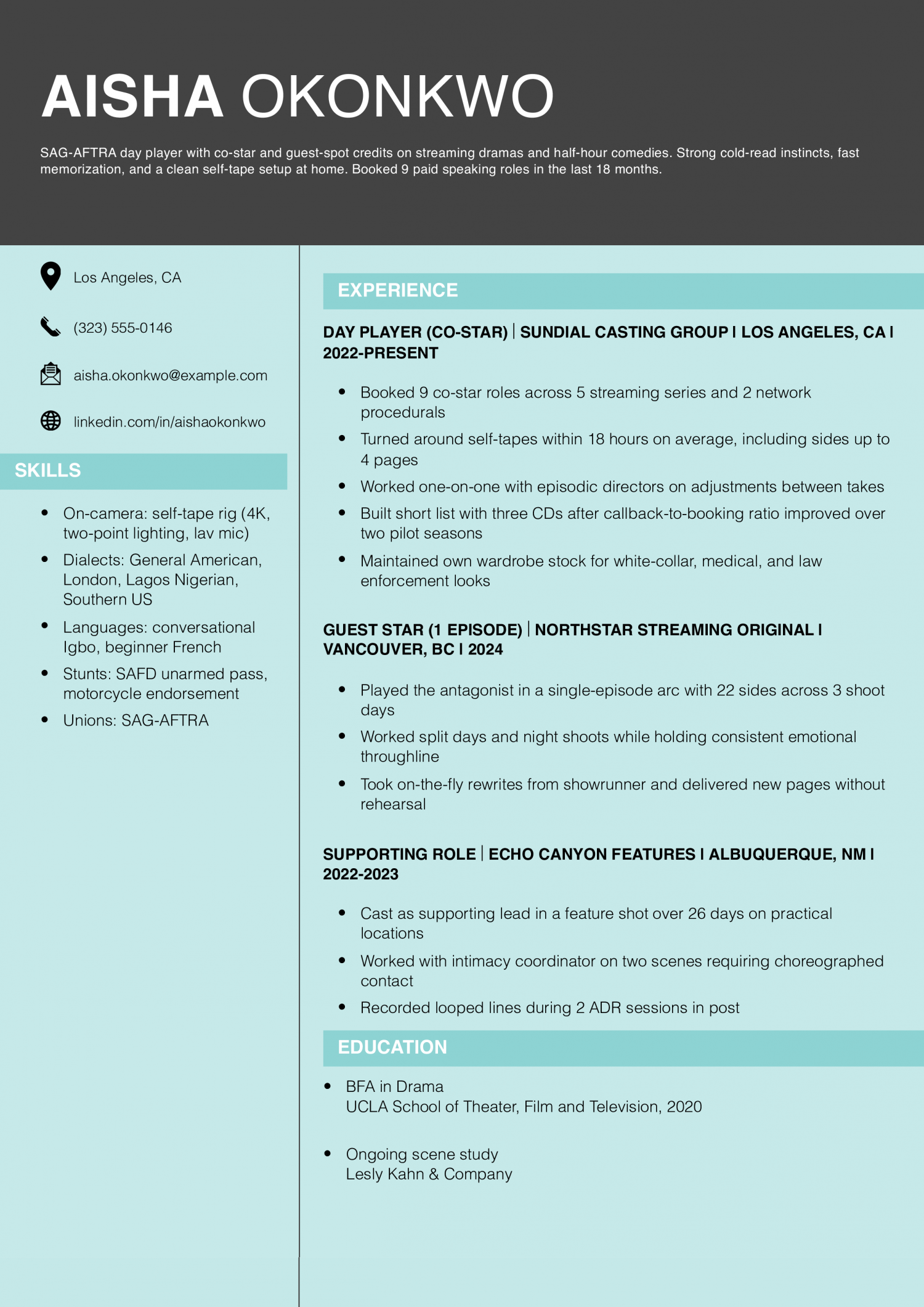
What changes between a day player and a series regular is the credit weight, recognizable showrunner names and a recurring arc replace the scattered one-episode bookings below.
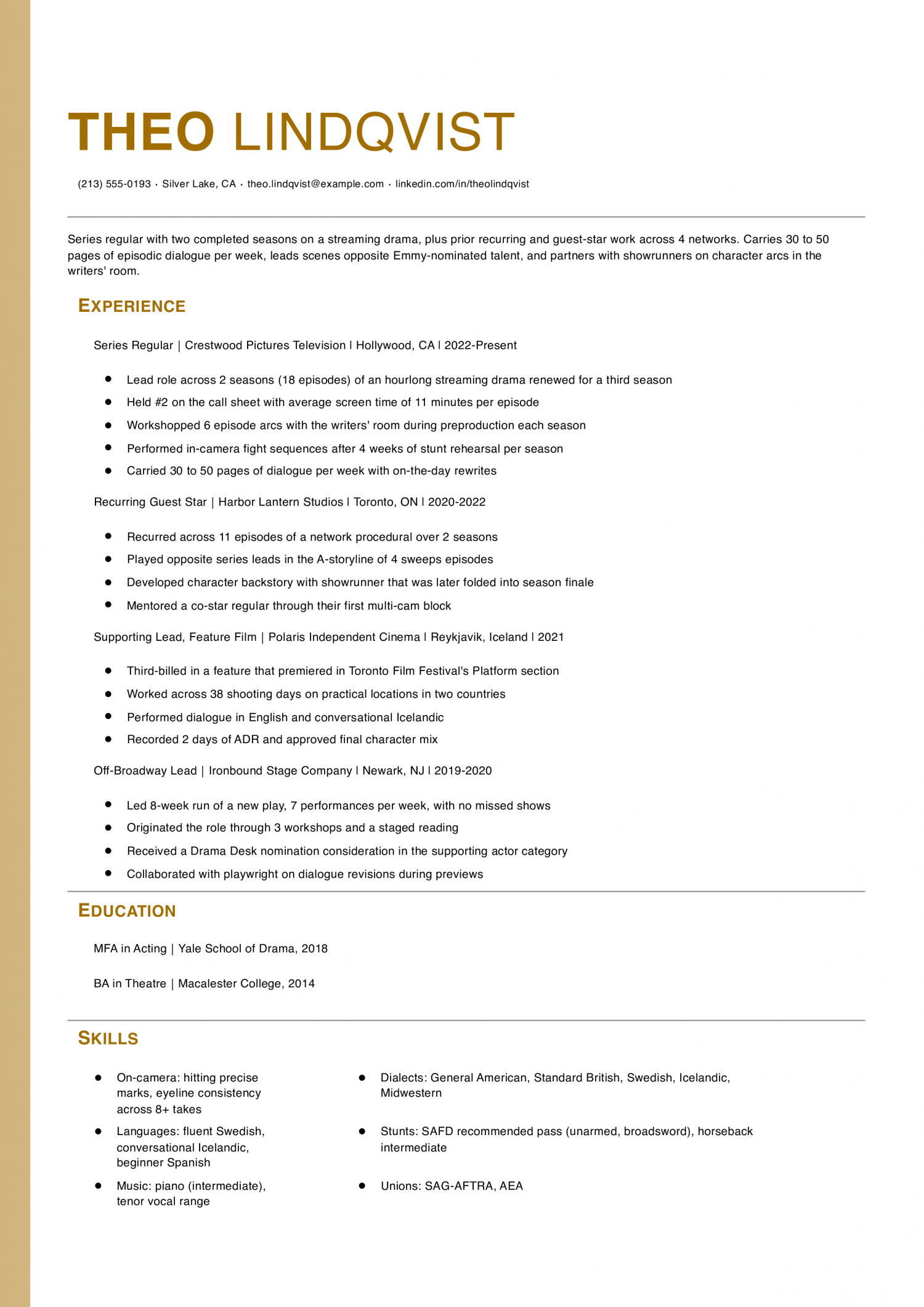
Renata Halvorsen
Minneapolis, MN | (612) 555-0164 | [email protected] | linkedin.com/in/renatahalvorsen
SAG-AFTRA actor with 12 years of credits across regional theatre, indie film, national commercials, and episodic television. Comfortable as a co-star, recurring guest, or supporting lead. Trained in Meisner and Linklater technique, with stage combat and motion capture experience.
Recurring Co-Star
Birchwood Television Group | Minneapolis, MN | 2023-Present
National Commercial Principal
Pinewood Spot Casting | Chicago, IL | 2022-2024
Lead, Independent Feature
Driftless Films Collective | Madison, WI | 2022
Voice and Motion Capture Performer
Northgate Interactive Studios | Seattle, WA | 2021-2023
Resident Acting Company
Lakeshore Repertory Theatre | Duluth, MN | 2018-2021
Add one line at the top a casting director cannot pull from your Actors Access or Casting Networks profile. That might be a verifiable accent, a fight choreography certification, a fluency in Mandarin, or stunt driving on a closed course.
Place this under your name, height, vocal range, and union status. The header block sits above the credits grid, so the eye lands there during the first scan. Keep it factual and provable on a callback.
Skip vague claims like versatile range or strong stage presence. Casting directors and producers treat those as filler and move on to the credits.
Acting credits do not carry dollar figures or percentages, so lead with scope: role size, project tier, and the name attached. Write Co-Star opposite a series lead, Lead in a SAG signatory short, or Recurring across six episodes.
Name the director, showrunner, or theater company in the third column. A bullet that reads Hamlet, Lead, Steppenwolf Theatre, dir. Anna Shapiro reads stronger than Played Hamlet to critical acclaim.
Most strong resumes show role size, project name, and credible name in three clean columns, which is the format Breakdown Services and casting offices expect.
Split your credits into four standard buckets in this order: Film, Television, Theater, and Commercials or New Media. Within each bucket, lead with the strongest credit, not the most recent.
A guest star on a network procedural outranks a co-star on a streaming pilot, even if the pilot shot last month. Commercials get a conflicts-available note instead of brand names if you are non-union or working out the conflict window. Voiceover, motion capture, and industrials sit in their own section below if you have enough credits to justify the space.
Union status (SAG-AFTRA, AEA, or non-union) sits in the header next to your contact agent, not buried at the bottom. Training goes below the credits grid, organized by discipline: scene study, on-camera, voice, movement, and dialect.
Name the teacher and studio for each line, since casting directors recognize coaches like Anthony Meindl, Margie Haber, or Stella Adler Studio faster than they recognize school names. Include hours or duration only when relevant, such as 200 hours Meisner with William Esper Studio. Special skills go at the bottom, and every entry must be callback-ready.
Pull every skill you cannot demonstrate cold in a room. Conversational French gets cut if a French-speaking reader could expose you in 30 seconds. Same with horseback riding, stage combat without a certification, and dialects you learned for one role five years ago.
Drop your home address, your full birthdate, and any union number. Trim student film credits once you have professional work to replace them. Keep the resume to one page formatted in landscape grid style, since that is the page shape casting directors print and staple to the back of your headshot.
Casting submission portals like Casting Networks and Actors Access filter more acting profiles than ever in 2026. The skills below come from our user-built acting resumes. Recognizable credits and union status clear the first cut, and demonstrable special skills like stage combat, dialects, and singing range decide whether the resume advances.
Match your special skills line by line against the breakdown for each project, and treat soft skills as evidence behind your credit choices rather than standalone bullets.
| Soft Skills | % of resumes with this skill |
|---|---|
| Emotional vulnerability | 65% |
| Director collaboration | 58% |
| Resilience under rejection | 48% |
| Audience awareness | 29% |
| Adaptability on set | 25% |
And here are the top hard skills showing up most often.
| Hard Skills | % of resumes with this skill |
|---|---|
| Script memorization | 52% |
| Character development | 28% |
| Cold reading | 26% |
| Stage combat | 24% |
| Voice modulation | 23% |
Based on data from thousands of actors’ resumes built on ResumeTemplates.com, May 2026.
Before an acting resume gets a closer read, hiring teams verify a short list of licenses, tools, and compliance signals.
Match your resume language to the niche you submit for. Casting portals search for literal phrasing, so use the terms below as written when they fit your real credits.
| Niche | Keywords ATS scans for |
|---|---|
| Film and television credits | co-star, guest star, series regular, lead role |
| Theater credits | regional theater, off-broadway, LORT, equity showcase |
| Commercial and voiceover | national commercial, regional spot, voiceover demo, on-camera principal |
| Training and technique | meisner training, on-camera scene study, improv, conservatory MFA |
| Special skills and certifications | SAFD certified, stage combat, dialects, stunt driving |
Your acting portfolio runs across three surfaces: a headshot, a reel, and a casting profile that hosts both. Casting directors expect to find you on at least two of the platforms below.
Primary submission portal for film and television projects in Los Angeles and New York.
Dominant for commercial breakdowns, voiceover, and regional theater submissions.
Verified union profile that confirms eligibility status to casting and producers.
Host your reel at a stable URL with no ads and direct embed for self-tape submissions.
Single-page site with headshot, reel, resume PDF, and representation contact in one URL.
Keep one headshot per look. Commercial smiling, theatrical neutral, and a character look cover most submissions. Update every two years or after a significant appearance change.
Keep your reel under two minutes. Lead with your strongest 20 seconds, since casting often stops watching at the first weak cut. Update the reel each time a credit airs.
Casting submissions move as a three-piece package: headshot, reel, and resume. Each piece reinforces the others, and a mismatch between them ends the submission fast.
Awards and festival selections sit in their own block when the credit alone does not communicate the prestige. A short-film lead reads differently when the short played Sundance.
Beyond union eligibility and basic training, the certifications below tell casting directors which physical and technical demands you can meet without a stunt double or coach on set. List the certifying body and the year earned for each item.
For actors, the industry on the call sheet matters more than the years on the page. Background and student-film work clusters near the floor, regional theater and commercial bookings cluster near the median, and series-regular and studio-feature contracts sit above the 90th percentile.
Lead the resume with the project tier and the recognizable name attached (showrunner, director, or theater company), not the chronology of every gig you have taken since drama school.
| # | State | Workers | Median |
|---|---|---|---|
| 1 | California | 6,640 | N/A |
| 2 | New York | 6,460 | N/A |
| 3 | Florida | 6,420 | N/A |
| 4 | Illinois | 3,200 | N/A |
| 5 | Georgia | 1,910 | N/A |
Resume Templates offers HR approved resume templates to help you create a professional resume in minutes. Choose from several template options and even pre-populate a resume from your profile.
List training first when you have no professional credits yet. Name the studio, the teacher, and the discipline for each line.
Add student films, staged readings, and school productions under a Theater or Student Film heading. Casting directors expect a lighter resume from a beginner and read for trainable instincts, not padding.
Round out the page with a strong special skills section covering verifiable abilities like dialects, instruments, sports, and certifications.
Use a one-page layout with a three-column credits grid: role, project, and director or company. Put your name, union status, height, and vocal range in the header block.
Group credits under Film, Television, Theater, and Commercials in that order. The resume gets printed and stapled to the back of your headshot, so size it to 8x10 inches.
The biggest mistakes are listing commercial brand names you have a conflict on, padding special skills with abilities you cannot demonstrate cold, and writing a paragraph-style bio instead of a credits grid.
Avoid listing your home address, full birthdate, social security number, or union member number on the resume itself. Provide those on official paperwork once a booking moves forward.
Group special skills by category: dialects, combat, dance, sports, languages, instruments, and certifications. Note proficiency where it matters, such as fluent versus conversational for languages.
Only list what you can perform cold in a callback room. Casting directors regularly test special skills on the spot, and an exposed skill ends the audition fast.
Executive Resume Writer and Career Coach
Andrew Stoner is an executive career coach and resume writer with 17 years of experience as a hiring manager and operations leader at two Fortune 500 Financial Services companies, and as the career services director at two major university business schools.
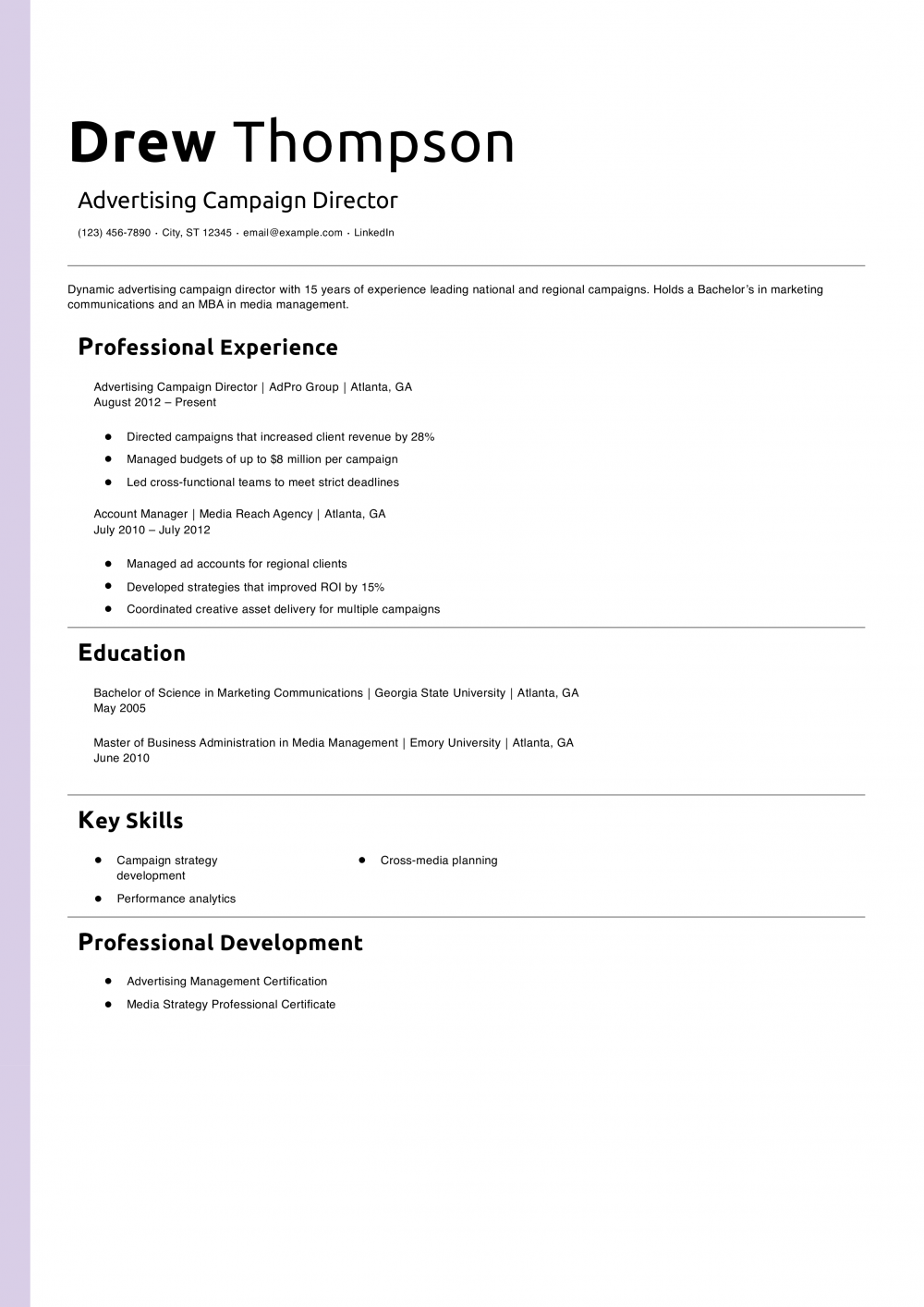
Customize this template in our builder in under 10 minutes.