Labor and Delivery Resume Examples and Templates for 2026



The RN resumes that get scheduled for interviews share three things: a credentials block above experience with license state and BLS/ACLS dates, patient ratios attached to every unit, and a specialty cert tied to the posted opening.
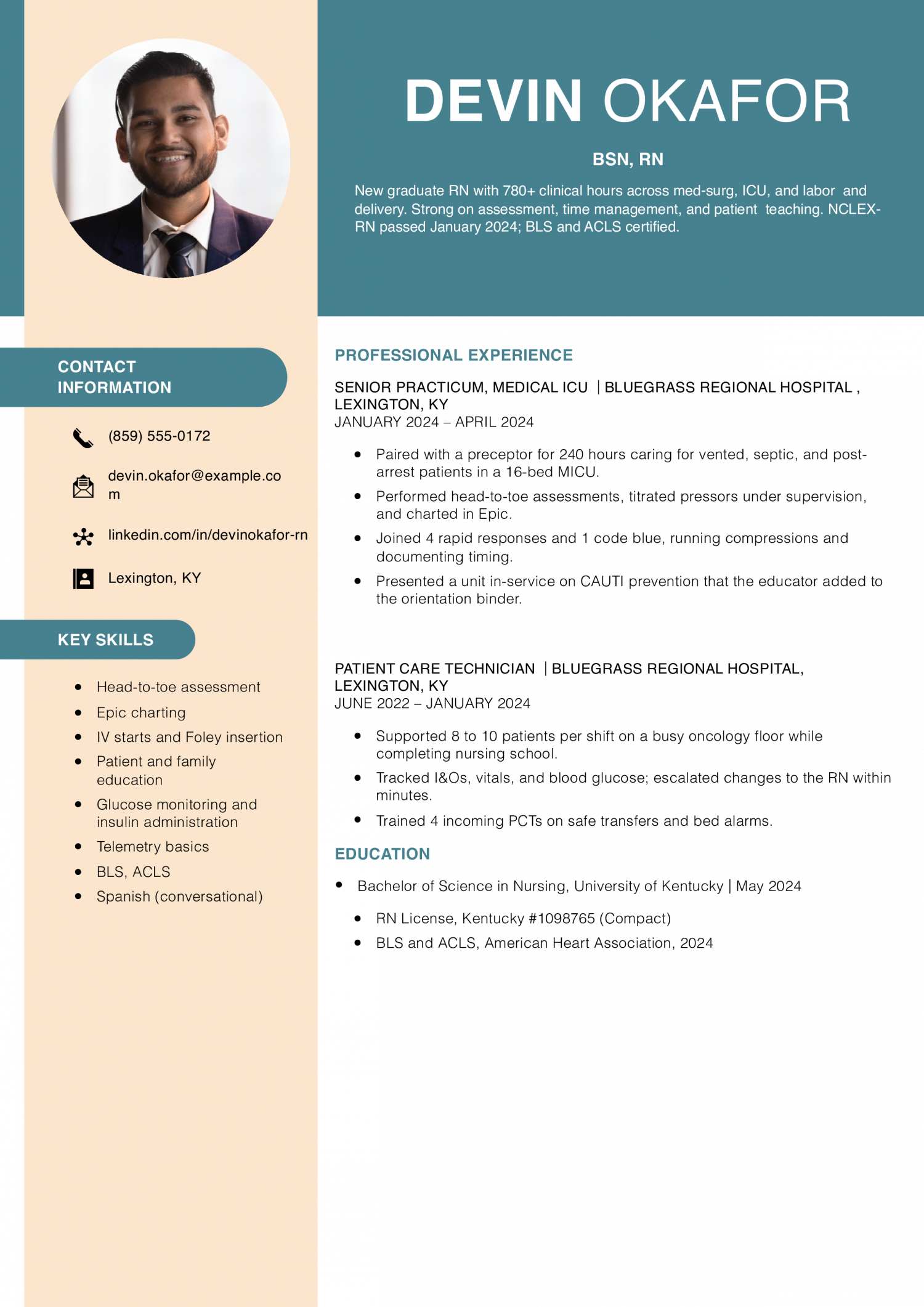
The new grad RN has passed NCLEX-RN within the last 12 months and is targeting a first hospital role or residency. This resume needs to prove clinical rotation hours, acuity exposure, and BLS readiness for the unit.
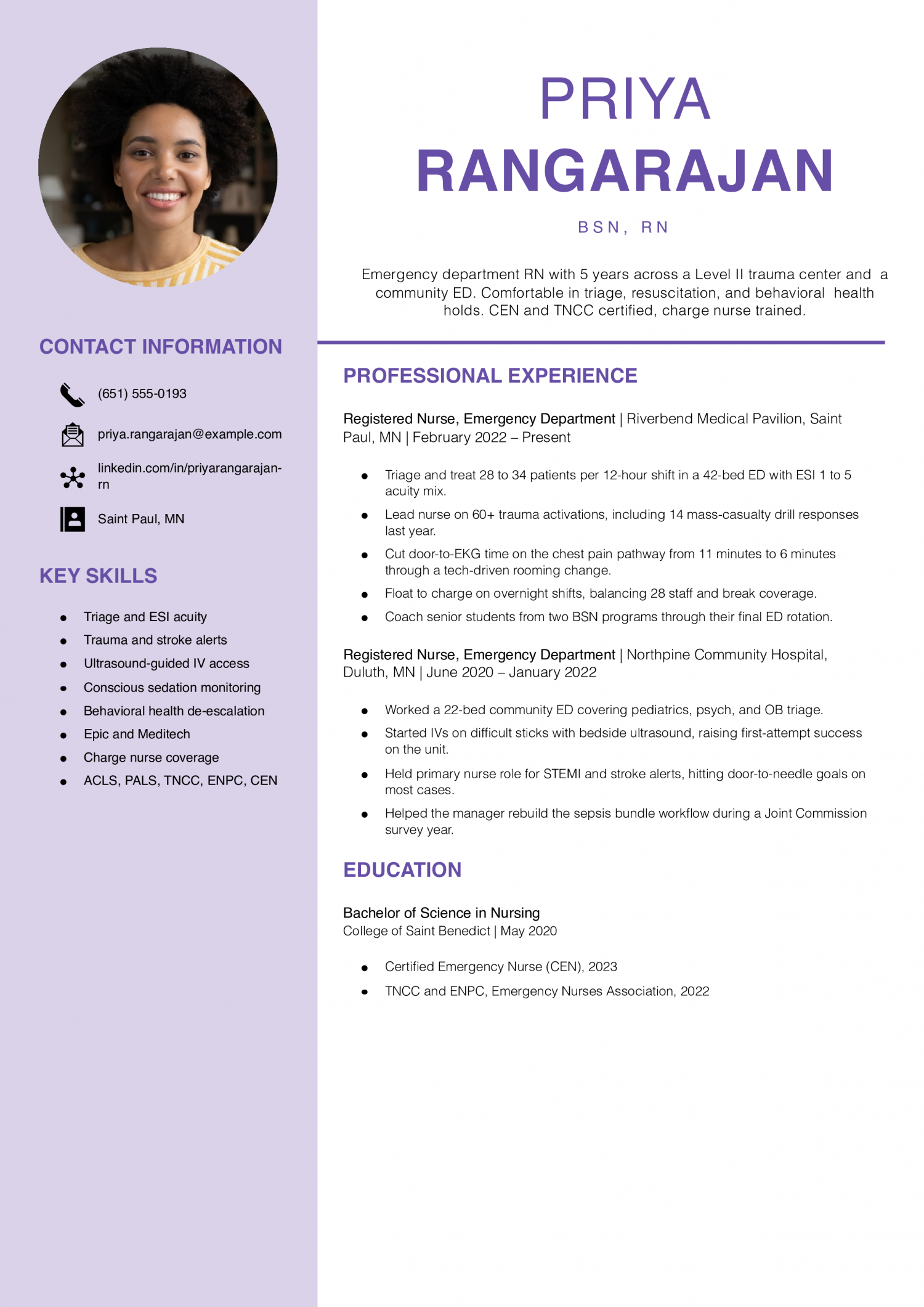
The staff nurse has 2 to 6 years on a unit and a steady patient assignment in med-surg, tele, or a specialty floor. This resume needs to prove patient load, charting accuracy, and a specialty certification or progress toward one.
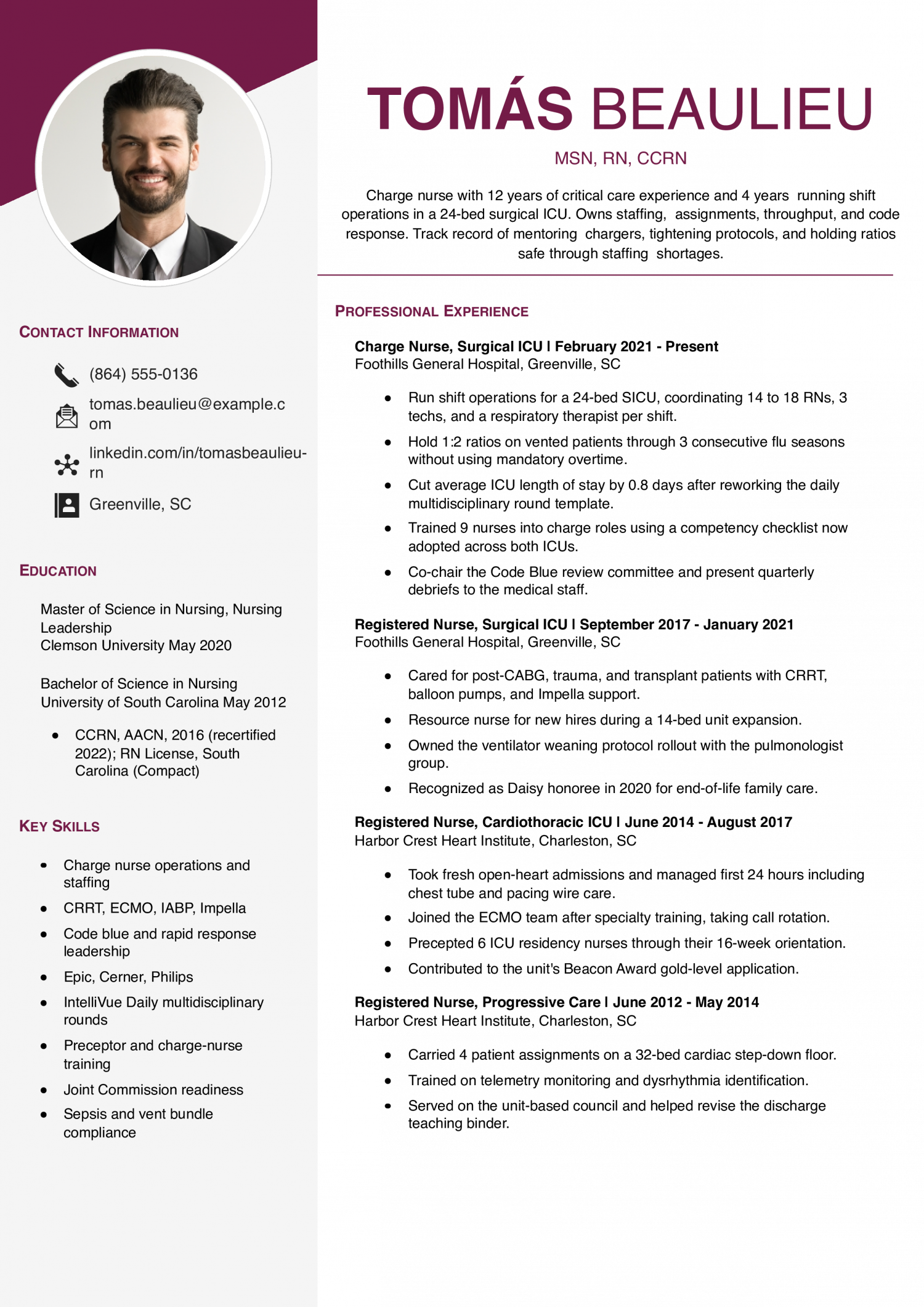
The charge nurse runs shift assignments, mentors newer RNs, and serves as the clinical resource on the floor. This resume needs to prove staffing decisions, throughput metrics, and the leadership artifacts a nurse manager looks for.
Aisha Hollander, BSN, RN, CMSRN
Albuquerque, NM | (505) 555-0167 | [email protected] | linkedin.com/in/aishahollander-rn
Medical-surgical RN with 8 years of acute-care experience spanning ortho-trauma, oncology, and float pool assignments. Strong preceptor and informal charge nurse. CMSRN and ONS chemo/bio certified, with a record of cutting falls, pressure injuries, and readmissions through bedside leadership.
Registered Nurse, Ortho-Trauma
Mesa Verde Medical Center | Albuquerque, NM | 2022-Present
Registered Nurse, Float Pool
Mesa Verde Medical Center | Albuquerque, NM | 2020-2022
Registered Nurse, Medical Oncology
Sandia Health Partners | Rio Rancho, NM | 2018-2020
Registered Nurse, Medical-Surgical
Pinon Crest Hospital | Santa Fe, NM | 2016-2018
A state board lookup confirms you hold an active RN license. It does not show acuity, specialty, or the unit you actually staff.
Lead the summary with the one signal that separates you from the next RN in the stack. Name your specialty, your typical patient ratio, and a cert like CCRN, OCN, or CEN if you hold one.
For new grads, lead with your clinical rotation specialty, the acuity of the host unit, and any tech, externship, or PCT hours you logged before NCLEX-RN.
Nurse managers read bullets for ratios, acuity, and volume. A bullet without a number reads as a duty, not a contribution.
Most strong RN resumes name three metrics: patient ratio per shift, unit acuity or census, and a throughput or quality figure such as fall rate, CAUTI rate, or discharge time.
For oncology nurse resume examples, swap CAUTI for chemo administrations per shift and port access volume. Tie the number to the unit, not to your whole career.
Recruiters scan for clinical scope first, leadership second. Cluster your bullets so both jump out on a single page.
Use four buckets: direct patient care (assessments, med administration, IV starts), specialty procedures (chemo, vent management, telemetry), documentation (Epic or Cerner charting, care plans), and patient and family education.
For charge or senior roles, add a fifth bucket for staffing and mentorship: shift assignments, preceptor hours, and committee work like shared governance or unit practice council.
Nurse managers and hospital recruiters need to see license, BLS, ACLS, and specialty certs before they read a single bullet. A page-one credentials block does that work.
List your RN license by state and status (active, in good standing) without the number. List BLS and ACLS with expiration month and year, then specialty certs like CCRN, OCN, CEN, or RNC.
Name your EMR systems (Epic, Cerner, Meditech) in the same block. These are the keywords automated screens look for, and the credential check happens before the keyword scan.
Education sits at the bottom for experienced RNs and just below the summary for new grads. List ADN or BSN, school, and graduation month and year.
If you are an ADN-RN pursuing an RN-to-BSN bridge, name the program and expected completion date. Magnet hospitals weight BSN progress in screening.
For new grads, add a clinical rotations subsection: host unit, hours, and a one-line scope note (for example, 180 hours med-surg, average 5 patients per shift).
Five years ago, an RN resume read like a list of nursing duties pulled from a job description. The skills below come from the resumes our users built in 2026. The mix has shifted toward specialty certifications, EMR fluency, and named acuity metrics.
Nurse managers weight hard skills first because licensure and EMR experience gate the unit assignment. Soft skills back up bullets about handoffs, family education, and rapid response. Match the list below to the unit and acuity in the posting, and treat each soft skill as a claim you can back with one bullet.
| Soft Skills | % of resumes with this skill |
|---|---|
| Therapeutic communication | 76% |
| Critical thinking | 67% |
| Compassionate patient care | 40% |
| Team collaboration | 39% |
| Attention to detail | 34% |
And here are the top hard skills showing up most often.
| Hard Skills | % of resumes with this skill |
|---|---|
| Patient assessment | 80% |
| Medication administration | 61% |
| IV therapy | 49% |
| EHR documentation | 39% |
| Care plan coordination | 33% |
Based on data from thousands of registered nurses’ resumes built on ResumeTemplates.com, May 2026.
The items below are what separates a registered nurse resume that clears credentialing from one that gets put back in the pile.
State boards of nursing and most health systems warn against publishing your RN license number on a public document. The resume should name the state, the credential, and the status, then leave the number for the application form.
Place licensure in a credentials block on page one, above the experience section. Recruiters verify the license against the state board before forwarding the resume to a nurse manager.
If you hold a compact multistate license under the eNLC, note Multistate (eNLC) after your state of residence. That signals you can practice in 40-plus compact states without a new application.
Most state boards require continuing education contact hours each renewal cycle, and many specialty certs require their own CE total for renewal. Show recent CE on your resume to signal active practice.
List CE hours completed in the last two years and tie them to the specialty you are targeting. A med-surg RN applying to oncology should show ONS chemo and biotherapy hours.
Group CE under a Professional Development heading below certifications. Name the provider (ANA, AACN, ONS, ENA), the topic, and the contact hours.
Nurse managers and recruiters search for EMR systems by name, not by the term EMR. Name each system you have charted in and the modules you have used.
Resume bullets should describe scope and outcomes without identifying patients or breaching protected health information. A bullet that names a specific patient case, date, or condition can violate HIPAA.
Write bullets in aggregate. Use patient ratios, unit census, and procedure volumes instead of single-case narratives. Replace I cared for a 67-year-old post-op patient with managed 5 to 6 post-op patients per shift.
Do not attach work samples, case studies, or screenshots of EMR charts to a digital resume. Even de-identified screenshots can carry metadata that points back to a patient.
Beyond your state RN license and BLS, the certifications below tell nurse managers which unit you are ready for and which acuity you have already carried. List the certifying body and the current expiration month and year for each.
For registered nurses, the 10th-percentile floor reflects new grad and rural staff RN roles, and the top-decile ceiling reflects specialty, charge, and high cost-of-living markets. That spread tells you specialty certification, acuity, and geography move you from floor to ceiling faster than years alone. The top-paying states cluster on the West Coast and Northeast, while employment volume concentrates in large hospital states.
Lead your resume with the specialty, EMR, and acuity that map to the ceiling you are targeting.
| # | State | Avg. Annual |
|---|---|---|
| 1 | California | $140,330 |
| 2 | Hawaii | $136,320 |
| 3 | Oregon | $123,990 |
| 4 | Washington | $112,180 |
| 5 | Alaska | $110,690 |
| 6 | New York | $105,600 |
| 7 | District of Columbia | $104,550 |
| 8 | New Jersey | $102,730 |
| 9 | Nevada | $101,990 |
| 10 | Massachusetts | $101,970 |
| # | State | Workers | Median |
|---|---|---|---|
| 1 | California | 326,720 | $140,330 |
| 2 | Texas | 261,050 | $90,010 |
| 3 | Florida | 218,100 | $82,850 |
| 4 | New York | 204,120 | $105,600 |
| 5 | Pennsylvania | 146,840 | $87,610 |
Resume Templates offers HR approved resume templates to help you create a professional resume in minutes. Choose from several template options and even pre-populate a resume from your profile.
List your RN license by state and status without the number. The standard format is: Registered Nurse, State of California, active and in good standing.
Most state boards warn against publishing the license number on a public document. Provide it on the application form when the employer asks.
If you hold a compact license, write Multistate (eNLC) after the state of residence. That tells the recruiter you can work across compact states without delay.
A new grad resume leads with clinical rotations, NCLEX-RN pass date, and BLS. A staff nurse resume leads with the unit, patient ratio, and a specialty cert.
For new grads, the rotations subsection carries the weight that work history will carry later. Name the host unit, the hours, and the typical patient load.
Staff nurses should drop the rotations block by year two and replace it with acuity, throughput, and EMR metrics from real shifts.
Yes. Magnet hospitals weight BSN progress during screening, and naming an in-progress RN-to-BSN program signals you meet that preference.
List the program in the education section with expected completion month and year. Add the school name and degree (BSN) so the keyword scan picks it up.
If you have not yet enrolled but plan to, leave it off the resume. Mention it in the cover letter or interview instead.
Lead with the acuity overlap. Med-surg RNs already manage complex meds, central lines, and patient education, which map to oncology floors.
Add the ONS Chemotherapy and Biotherapy Certificate before applying. It is a 30-hour course that signals readiness to administer chemo under supervision.
In bullets, call out any oncology patient share on your med-surg unit, port access volume, and end-of-life or hospice handoffs you have managed.
For a registered nurse, an ATS-friendly template is the safest pick, because it puts your certifications and experience where a hiring manager scans first. A basic template is a solid alternative. Whichever you choose, keep the formatting clean and easy to parse: clear section headings, a standard font, and no graphics a parser can choke on.
Executive Resume Writer and Career Coach
Andrew Stoner is an executive career coach and resume writer with 17 years of experience as a hiring manager and operations leader at two Fortune 500 Financial Services companies, and as the career services director at two major university business schools.
Customize this template in our builder in under 10 minutes.