
Tip !

A tight instrumentation and techniques block is what gets chemist resumes past the lab manager's first cut; specific assay throughput, yield improvements, and method validations are what make them readable enough to advance.

Andrew Stoner , Executive Resume Writer and Career Coach

Chemist Resume Examples

Why this resume works
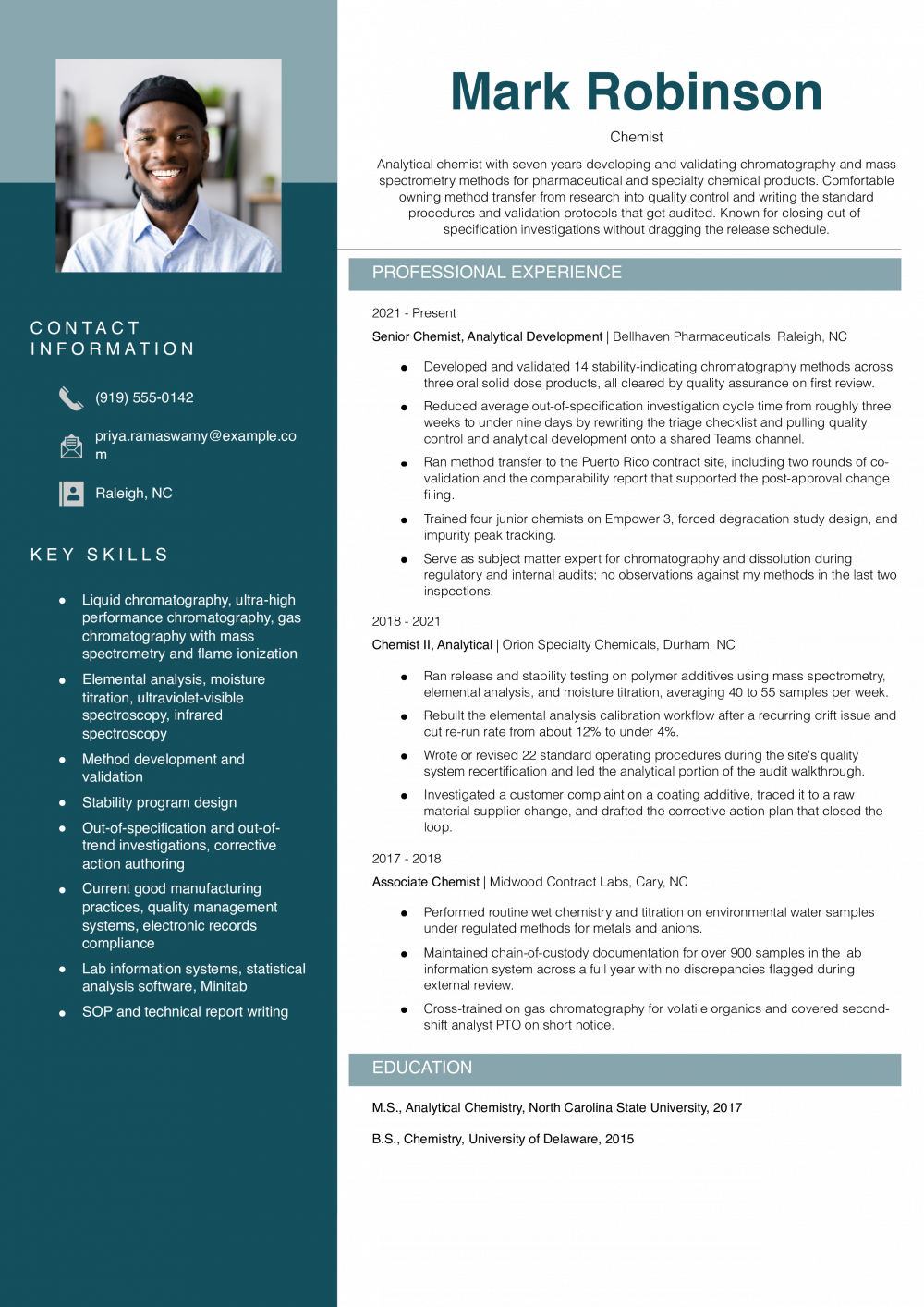
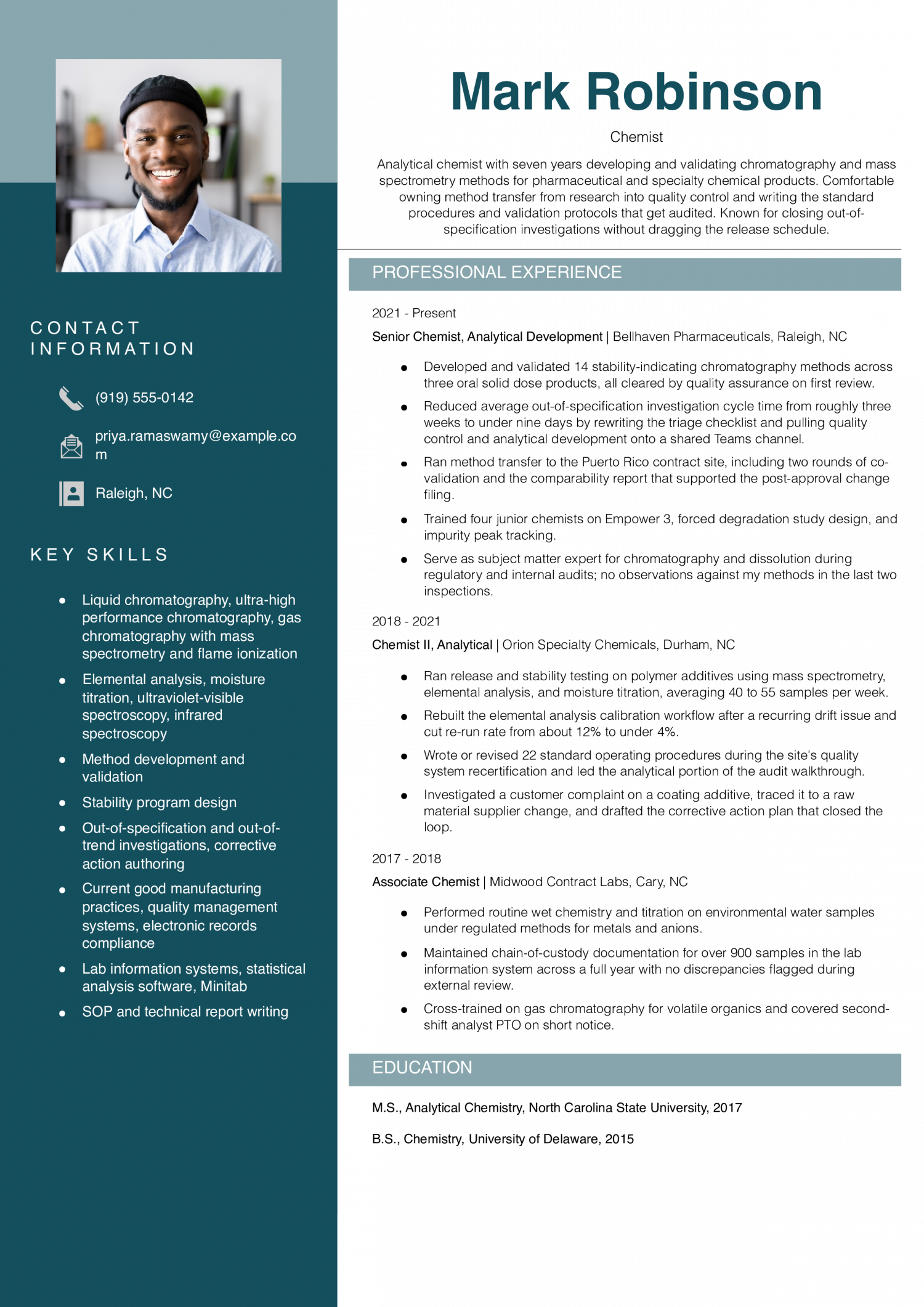
  • Numbers tied to lab throughput: The OOS cycle time and ICP re-run rate metrics give a hiring manager something concrete to compare against their own lab’s pain points.
  • Regulatory work is grounded, not just named: citing cGMP, the post-approval change filing, and zero inspection observations shows she has actually shipped work that gets audited, not just run instruments.
  • Career progression is easy to read: Associate Chemist to Chemist II to Senior Chemist over seven years, each step with more scope, tells the story without needing a headline.

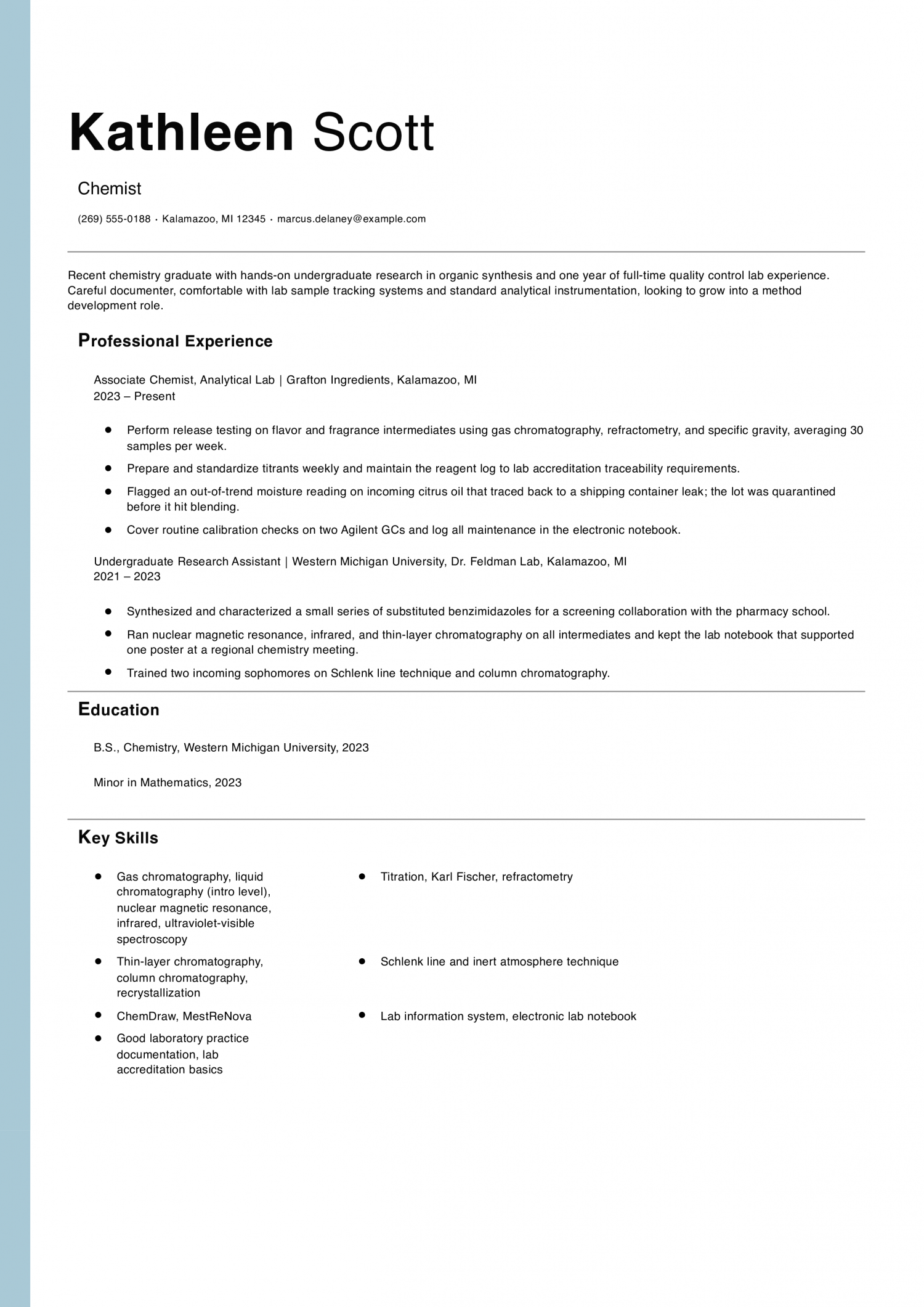
Associate Chemist / Chemist I Example

This resume is for an Associate Chemist or Chemist I who runs bench work with help. Show clean lab skills, sharp data notes, and steady work on set methods that lab chiefs can trust.

Why this resume works
  • Caught a real quality issue: The flagged citrus oil moisture reading is the kind of story a hiring manager remembers because it shows judgment, not just following the SOP.
  • Undergraduate research shows depth: Naming the instrumentation, the compound class, and the conference poster proves he can actually run a synthesis, not just recite one.
  • Transparent skill-level disclosure: Liquid chromatography listed as intro level, one year in industry, no inflated titles. That reads as trustworthy for an entry-level role.

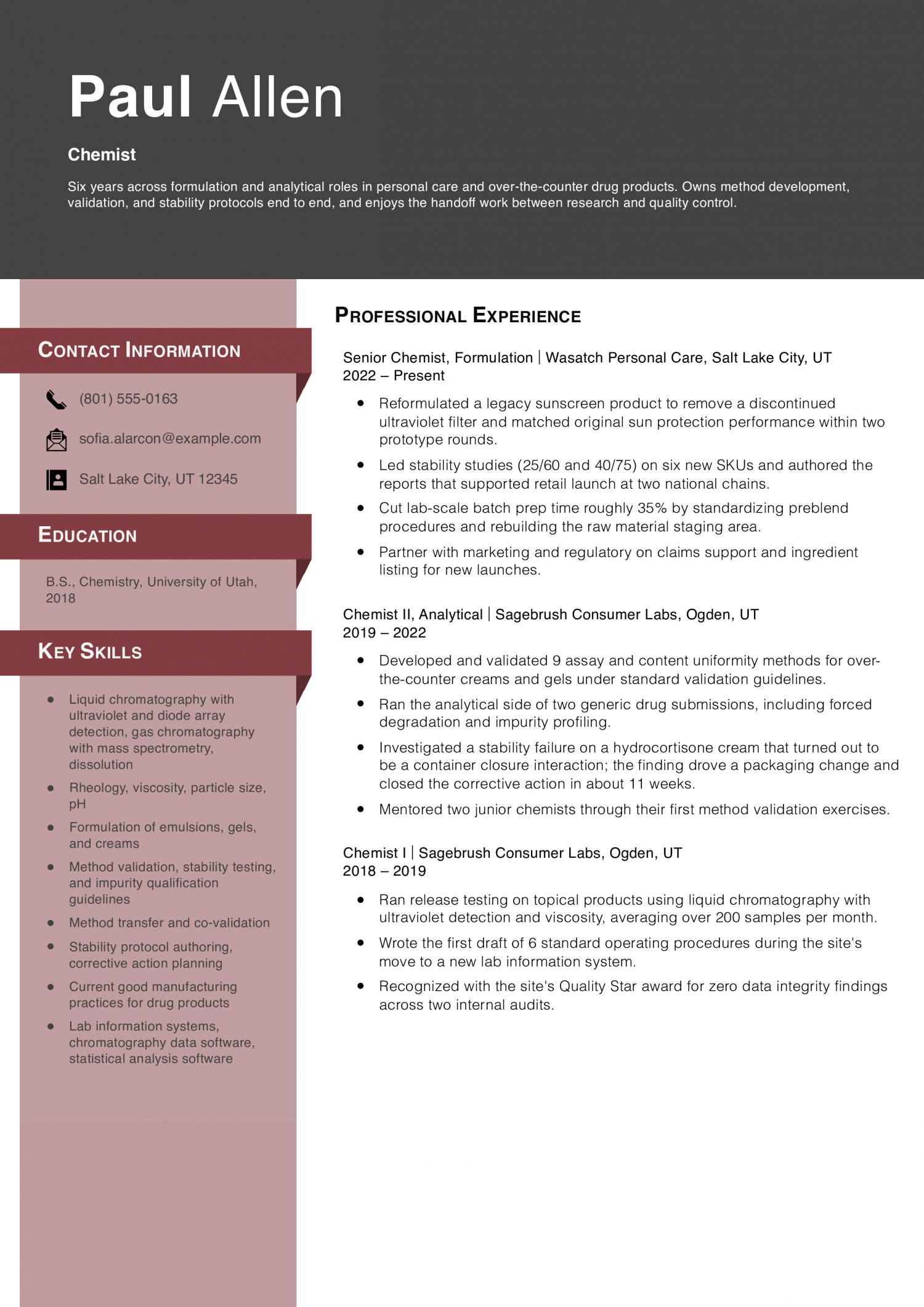
Chemist II / Senior Chemist Example

This resume is for a Chemist II or Senior Chemist who owns method work and guides new staff. Show your own problem solving, team project work, and results that lab chiefs can tie to product calls.

Why this resume works
  • Story on the stability failure: Naming the root cause and the CAPA timeline shows investigation skill, not just that a problem happened.
  • Both formulation and analytical: The two roles side by side signal she can handle the R&D to QC handoff, which is the exact gap most Senior Chemist openings are trying to fill.
  • Regulations named at the right altitude: cGMP for drug products and the specific submission work, forced degradation and impurity profiling, read like she has actually sat in a regulatory review, not just studied for one.

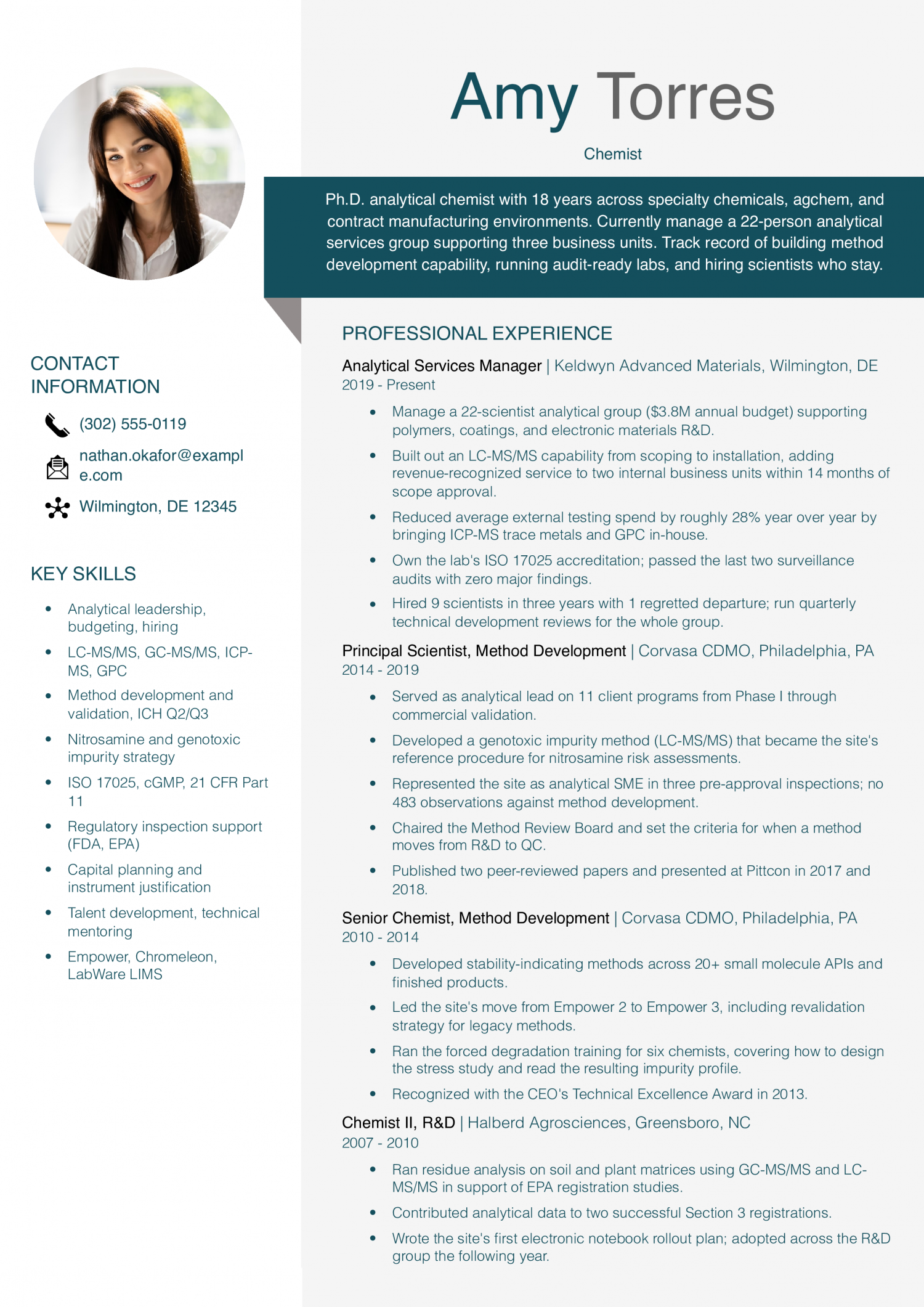
Principal Scientist / Lab Manager Example

This resume is for a Principal Scientist or Lab Manager who sets the path and runs people, budget, and safety. Show pipeline work, staff growth, and results that lab chiefs weigh when planning research.

Why this resume works
  • Scope is stated in one line: 22 scientists and a $3.8M budget lets a recruiter place him at the right level without hunting for it.
  • Inspection history is concrete: Naming the ISO surveillance audits and the pre-approval inspections with zero observations is the strongest possible proof of an audit-ready lab.
  • Hiring and retention numbers: 9 hires with 1 regretted departure is a specific people-leadership signal that most senior scientist resumes leave off entirely.

How to Write a Chemist Resume

01 Open with a profile that names your technical scope

Your profile should state your years of bench experience and the branch of chemistry you work in. Name the setting too: pharma R&D, contract lab, specialty materials, food and beverage, or academic core facility. Add the sample types and instruments you run every week.

A polymer chemist reads differently than an analytical chemist in a quality lab. Lab managers and R&D directors want that scope on page one, not buried in bullets. Two or three sentences do the work.

Name your degree level, your discipline, your setting, and the technique stack you own. Save method development, publications, and cross-functional projects for the bullets below. The profile is a scope statement, not a highlight reel.

02 Turn bench work into numbers

Bullets without a number tend to read as duties, not results. Most strong chemist resumes carry two or three metrics in the top role. Sample throughput is the easiest one: assays run per week, batches released per month, or method validations closed per quarter.

Cycle time is the next: turnaround from sample receipt to reported result. Yield, purity, and recovery numbers land well for synthesis and process work. Cost and instrument uptime matter for quality and manufacturing support.

Lab managers and R&D directors scan for volume and accuracy first. If your work is early-stage discovery, use scope language: compounds screened, targets covered, or projects supported. Pair each number with the technique or method that produced it.

03 Group your bench work into clear categories

Sort your bullets into three or four buckets so the reader can find your strengths fast. Instrumentation is the first: name the chromatography, spectrometry, and spectroscopy platforms you run daily. Method work is the second: development, validation, transfer, and troubleshooting under the frameworks your lab follows.

Sample and study work is the third: stability studies, impurity profiling, formulation support, or raw material release. Documentation and cross-functional work is the fourth: SOPs authored, deviations investigated, CAPAs closed, and partnering with quality, process engineering, or formulation. Keep each bullet tied to one category.

A wall of technique names with no context reads as a parts list. Name the instrument, the matrix, and what the work delivered.

04 Place credentials and software up top

Put your degree, discipline, and any regulated-lab experience in a short block near your name. Add the lab information system you use and your chromatography data system by name. List your statistical and modeling tools next: Minitab, Design of Experiments, or Python for data work.

Lab managers and R&D directors screen for regulated-environment experience early, so buried credentials tend to get missed. State your work authorization if you are applying across borders. If you hold a specific safety qualification the posting names, put it in that block.

Save conference posters, publications, and patents for a short section at the bottom of page one or top of page two.

05 Close with education, publications, and what to cut

Education sits at the bottom for experienced chemists and near the top for recent graduates. List your degree, institution, year, and thesis or capstone title if it maps to the role. Add a short publications and patents section if you have two or more.

One line each: authors, title, journal, year. Cut coursework once you have two years of bench experience. Cut high school entries and unrelated undergrad jobs.

Trim technique lists to what you have run in the last five years. Drop soft-skill bullets like team player or detail oriented, since Lab managers and R&D directors read those as filler. Keep the resume to one page through five years of work, two pages beyond that.

Five years ago, a chemist resume read like a bench protocol list. The mix has shifted toward method development, instrument ownership, and data pipeline fluency. Titration and wet chemistry still matter, but they no longer carry the page.

Lab managers and R&D directors read hard skills as proof you can run the assay on day one. They read soft skills as proof you can hand off cleanly and defend a result. The instrument name on your keyword line answers the first question.

Cross-functional work in a bullet answers the second, and both need to be present. Match the two tables against the target posting before you write. Mirror the phrasing the job uses, so GC-MS stays GC-MS and does not drift to gas chromatography.

Treat the soft skills as headers for bullets that show the behavior in context. A bullet naming a project, a method, and a measured outcome beats a bare adjective every time.

Soft Skills AI-estimated %
Attention to detail 71%
Cross-functional collaboration 51%
Problem-solving under constraints 49%
Technical communication 38%
Methodical work ethic 33%

And here are the top hard skills showing up most often.

Hard Skills AI-estimated %
Laboratory experimentation 71%
Chemical synthesis 52%
Analytical testing 42%
Research documentation 36%
Safety protocol compliance 25%

Skill names and rankings come from an AI model grounded in U.S. Department of Labor occupation data for chemists, not from a count of chemists’ resumes built on ResumeTemplates.com.

Must Have on a Chemist Resume

The items below are what separate a chemist resume from one that gets put back in the pile.

Niche Keywords for ATS Checkers

Lab managers and R&D directors scan for the tools you ran. They also scan for the methods you owned end to end. A generic skills list will not clear their filter. Name the instrument, the technique, and the standard by trade name. Keep the capitals on the acronyms your bench work uses. Spell out cGMP the way audits spell it. Group the terms by the bench work each one covers. Analytical work reads differently from synthesis work on a resume. Formulation and quality control each carry their own vocabulary. Pick the rows that match the job you want. Drop the rest so the page stays honest.

Niche Keywords ATS scans for
Analytical chemistry chromatography, mass spectrometry, spectroscopy
Synthetic chemistry organic synthesis, structure elucidation, route scouting
Quality control compendial methods, method validation, stability testing
Regulated manufacturing cGMP, batch records, deviation reports
Formulation development excipient screening, dissolution testing, DoE

AI Skills to Add

What lab managers and R&D directors expect on a chemist resume has shifted. A blanket claim of hand-run analysis now reads as thin on modern labs. A short note on which models you use, and where a human confirms the result, reads as current. The shift is toward describing the workflow. Name the tool. Name the step it speeds up. Name who reviews the output before it enters a report or a batch record. That framing shows method literacy without overclaiming. The list below names what to add, and what to leave off when the work was still bench-driven.

What AI is actually changing for this role
Literature review

Language models summarize prior art and reaction conditions, but you still confirm citations against the primary source.

Spectral interpretation

Assisted peak assignment on mass spectra speeds first-pass reads, and you sign off on the final structure.

Reaction planning

Retrosynthesis tools suggest routes and reagents, and you screen them against yield, cost, and lab safety.

Data cleanup

Scripts and copilots parse instrument exports into tidy tables, which shortens the path from raw run to plotted result.

AI tools to name

  • ChatGPT or Claude: Drafting method summaries and parsing supplier COAs, with your review before results leave the lab.

  • Reaxys or SciFinder AI search: Finding prior routes and physical property data, which you verify against the cited paper.

How to phrase AI on your resume
Do
  • Name the tool and the review step
  • Tie AI use to a specific assay or method
Skip
  • AI-powered chemist
  • Leveraged AI to revolutionize synthesis

Latest BLS Statistics for Chemists

For chemists, the 10th-percentile floor sits well below the median, and the top-decile ceiling runs sharply above it. That wide spread points to a field where a bench role and a senior specialist role sit under one job title. The gap between the floor and the ceiling is larger than the gap between the floor and the middle.

National employment is moderate, and the top-paying states are not the same as the states with the most jobs. Read the two tables together before you set a target number. Position your resume for the tier you want next, and lead with the specialty, the industry, and the scope of work that maps to that tier.

$91,240 National median annual
$100,450 National mean annual
$58,460 10th percentile
$160,830 90th percentile
82,770 Chemists in the U.S.
Where you stand

Below median

$58,460 to $91,240 Lead with your degree, the instruments you run, and the assays you have validated.

Above median

$91,240 to $160,830 Show the methods you own end to end and the projects you have led.

Top 10%

$160,830+ Lead with patents, published methods, and the teams or labs you have built.

Top-paying states

# State Avg. Annual
1 District of Columbia $149,860
2 Maryland $140,670
3 Delaware $129,860
4 New Mexico $126,960
5 Massachusetts $125,000
6 Alaska $106,010
7 Oregon $104,590
8 Louisiana $103,890
9 Wyoming $102,000
10 Colorado $101,980

Highest-employment states

# State Workers Median
1 California 9,820 $97,860
2 Pennsylvania 6,800 $77,090
3 New Jersey 5,280 $84,450
4 Texas 5,130 $99,640
5 North Carolina 4,530 $82,620

6.4% projected growth
Job outlook, 2025-2035

Source: U.S. Bureau of Labor Statistics, Employment Projections, 2025-2035. View on bls.gov

Source: U.S. Bureau of Labor Statistics, OEWS May 2025 release (SOC 19-2031). View on bls.gov

Written by professional resume writers and loved by hiring managers

Resume Templates offers HR approved resume templates to help you create a professional resume in minutes. Choose from several template options and even pre-populate a resume from your profile.

Frequently Asked Questions

Should I use chemist or scientist in my resume title?

Use chemist when the posting says chemist, and match the exact title the employer used.

Scientist reads as broader and can push your resume into biology or physics queues by mistake. If the role blends both, write the posted title first and note your chemistry focus in the profile.

How do I write an entry-level chemist resume with only coursework?

Turn lab courses into a projects section with the technique, the sample type, and the result you measured. Add teaching assistant or research assistant work as real jobs with bullet points.

What belongs on a cosmetic chemist resume that a general chemist resume skips?

Name the product forms you have formulated, such as emulsions, surfactant systems, or anhydrous sticks.

List regulatory frameworks you have worked under, and call out stability testing, preservative efficacy, and claims support. Lab managers and R&D directors in personal care read for those exact terms before they read anything else.

How should organic chemistry skills appear in the skills section?

Group them by what you actually did, not by what the textbook called them.

Write multi-step synthesis, air-free technique, and column chromatography as separate lines a reader can scan. Pair each skill with the scale you ran it at, since milligram and kilogram work read as different jobs.

Do I need a CV or a resume for a chemist role?

Industry roles at bench and senior bench level want a two-page resume, not an academic CV.

Save the full CV for faculty postings, national lab principal investigator roles, and some senior R&D director searches. When a posting says CV but the employer is a company, send a two-page resume with a publications section.

How many publications and posters should I list?

List every peer-reviewed publication where you are a named author, in a short section near the end.

For posters and talks, keep the three or four that match the role you are applying to and cut the rest. A long conference list on an industry resume reads as academic and pushes your bench work off page one.

How do I handle a gap between a chemistry degree and my first lab job?

Name the gap in one line at the top of the experience section, and move on.

If you kept your hands in chemistry through tutoring, contract sample prep, or a personal synthesis project, list it as work. Lab managers and R&D directors care that your technique is current, not that every month was a paid role.

What resume template should a chemist use?

For a chemist, an ATS-friendly template is the safest pick, because it puts your certifications and experience where a hiring manager scans first. A basic template is a solid alternative. Whichever you choose, keep the formatting clean and easy to parse: clear section headings, a standard font, and no graphics a parser can choke on.

Rate this article

Chemist Resume

Average Rating

4.8/5 stars with 211 reviews

You have given 0 Star(s)
4.8/5 stars with 211 reviews
Andrew Stoner

Executive Resume Writer and Career Coach

Andrew Stoner is an executive career coach and resume writer with 17 years of experience as a hiring manager and operations leader at two Fortune 500 Financial Services companies, and as the career services director at two major university business schools.