Cook Resume Examples
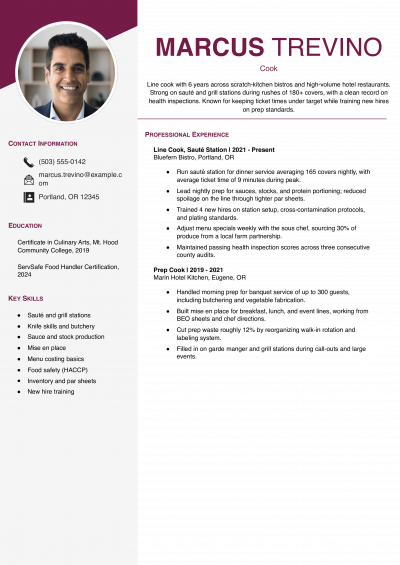
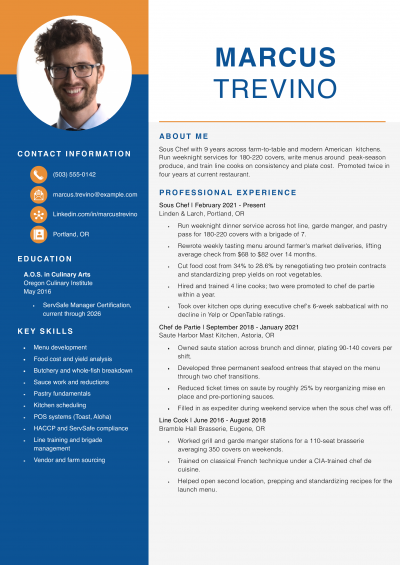
Start with the stations and cuisines an executive chef cannot pull from a job title alone. A line cook role at one restaurant means wood-fired pizza; at another it means hot apps and pasta. Put…
Every resume example is written and reviewed by our team of Certified Professional Resume Writers to ensure top-quality content and formatting.
Most baker roles fill through a working interview or a bench test. Your resume still has to clear the first screen. Bakery managers and executive pastry chefs scan for proof you can hold formula ratios, scale batch sizes, and keep waste low.
List the breads or pastries you produce daily and the volume you handle. Note food safety training such as ServSafe Food Handler or a Certified Journey Baker credential from the RBA. The baker resume examples below show how to frame that production detail on the page. To compare layouts before you start, browse our resume templates.
Batch output numbers, a clear ServSafe or RBA credential line, and recipe-scaling examples are what make baker resumes stand out to bakery managers.
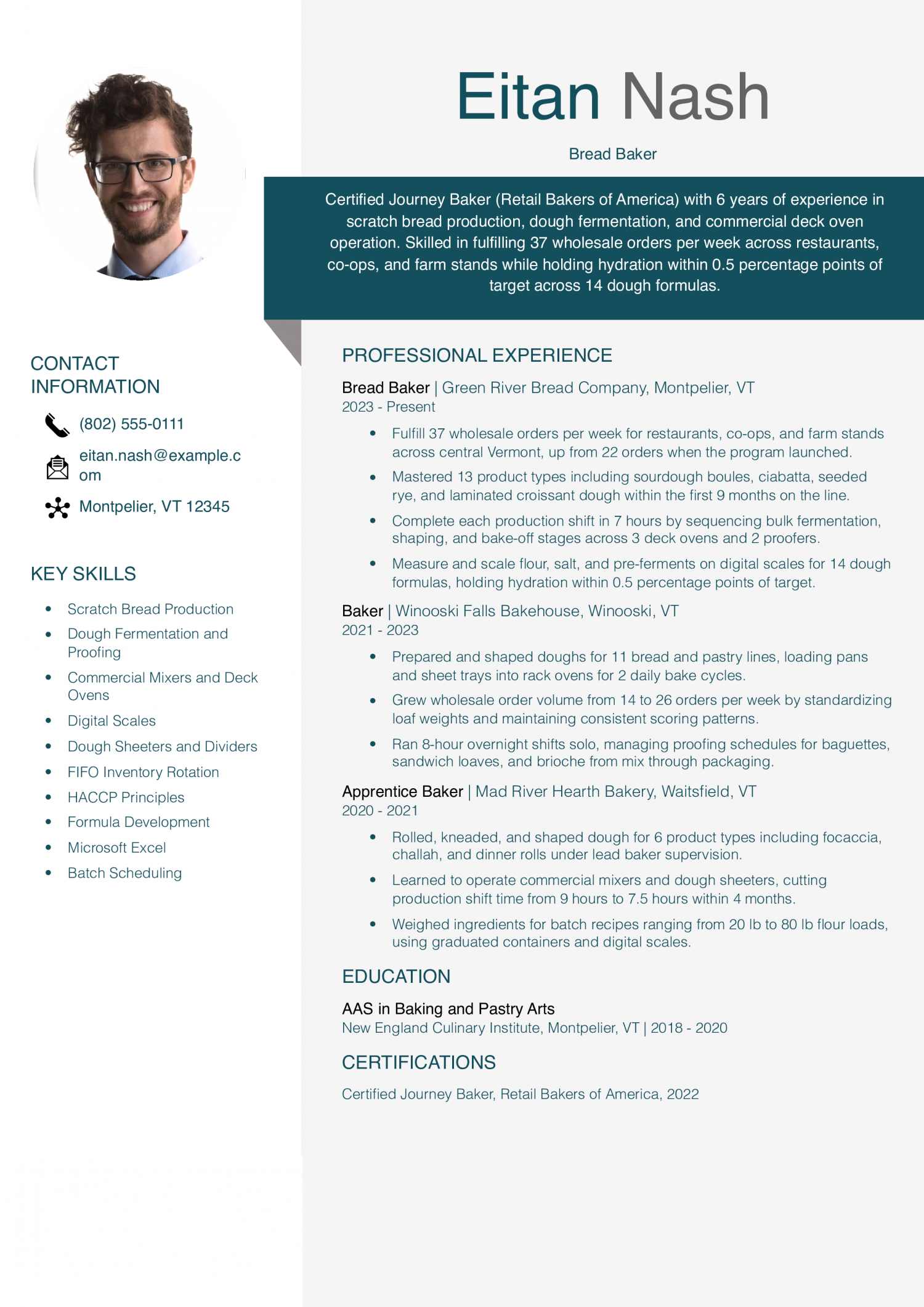
Pick this resume if you are a mid-level bread baker with around six years moving from apprentice roles into full production responsibility. Add a before-and-after wholesale order count to each position so your growth in output is visible at a glance.
Many baker resumes list order counts at one job but give no baseline for comparison. This resume repeats the same wholesale metric across two roles, noting “from 14 to 26 orders per week” at one bakery and then tracking continued growth at the next. If you have held more than one baking position, carry the same measure through each entry so a hiring manager can follow your output as it scaled over time.
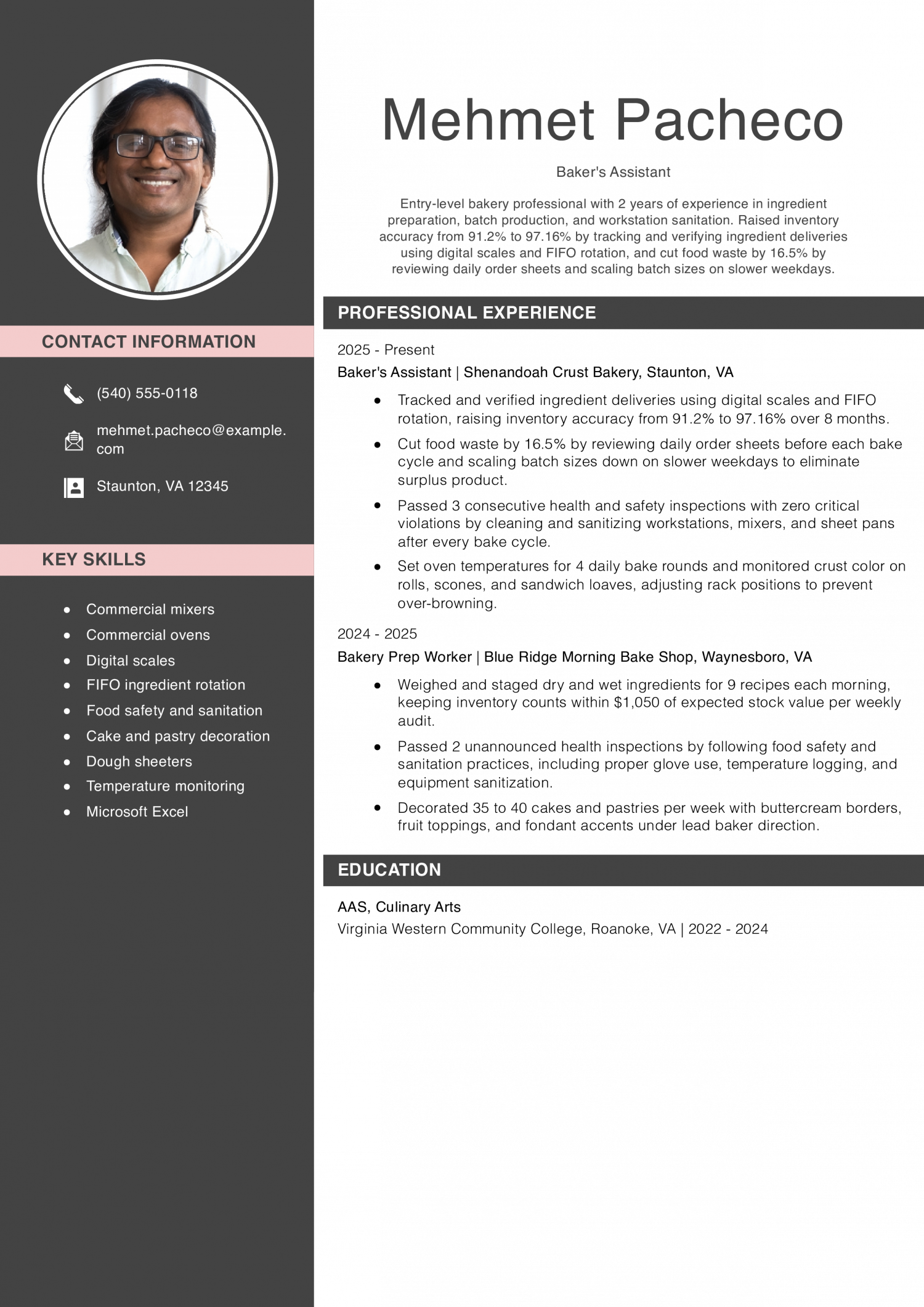
Use this resume if you are an entry-level baker's assistant beginning your career in a retail or scratch bakery setting. Cut waste and inventory language into separate bullets so each improvement has its own before-and-after measure.
Many baker resumes mention reducing waste without showing how the reduction was achieved. This resume connects the method directly to the result with “reviewing daily order sheets before each bake cycle and scaling batch sizes down on slower weekdays to eliminate surplus product.” If you cut waste or costs in your role, name the specific habit or process change that drove the number so a hiring manager can see the thinking behind your result.
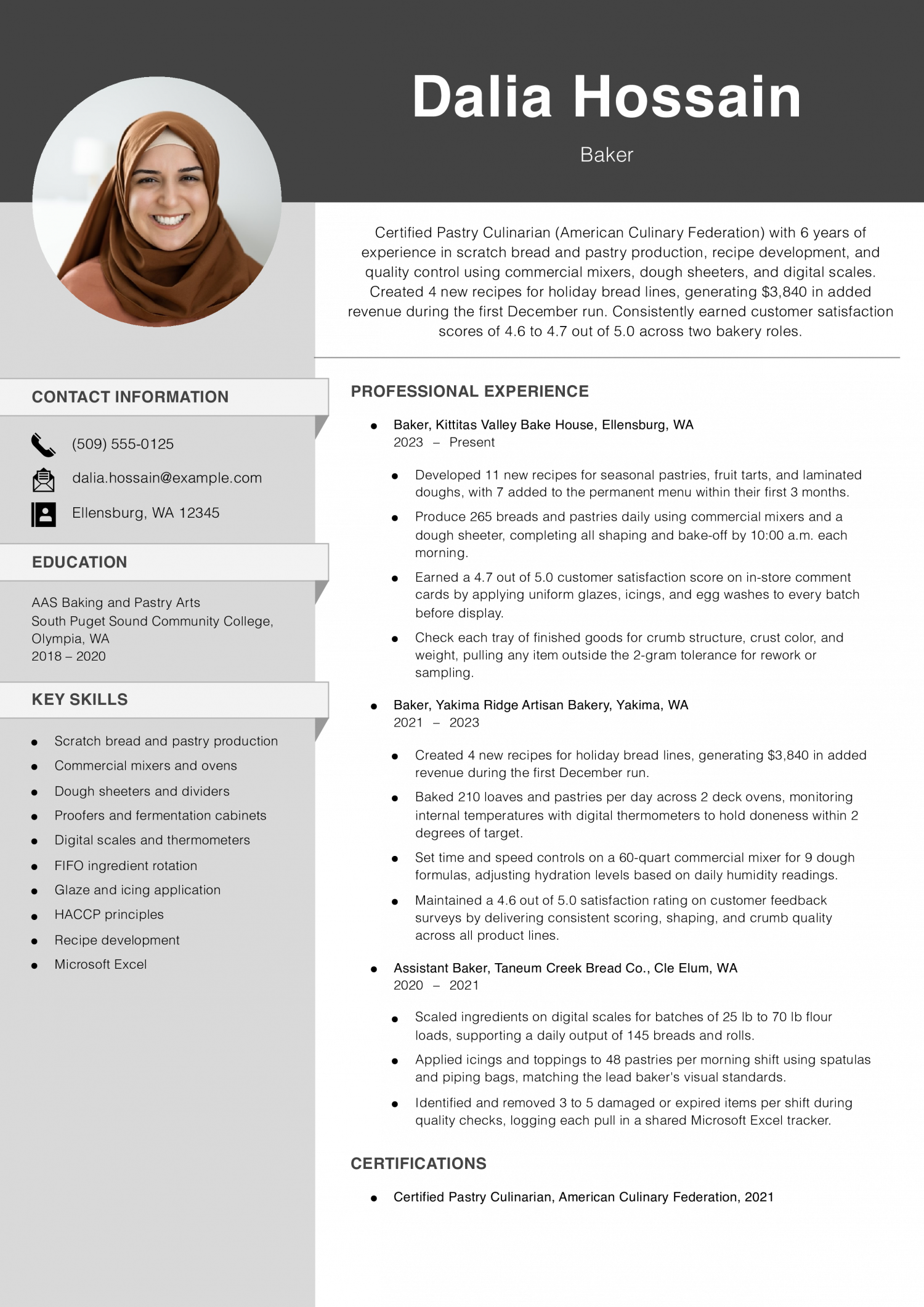
Try this layout if you are a mid-level baker with around six years producing breads and pastries in a scratch-production environment. Emulate the way it ties a tight weight tolerance to the specific quality check that enforces it.
Many baker resumes mention new recipes without showing whether those creations actually sold. This resume ties a specific dollar figure to a limited run with “4 new recipes for holiday bread lines, generating $3,840 in added revenue during the first December run.” If you develop new products in your role, attach the revenue or sales volume from a defined period so a hiring manager can measure the commercial payoff of your creativity, not only the recipe count.
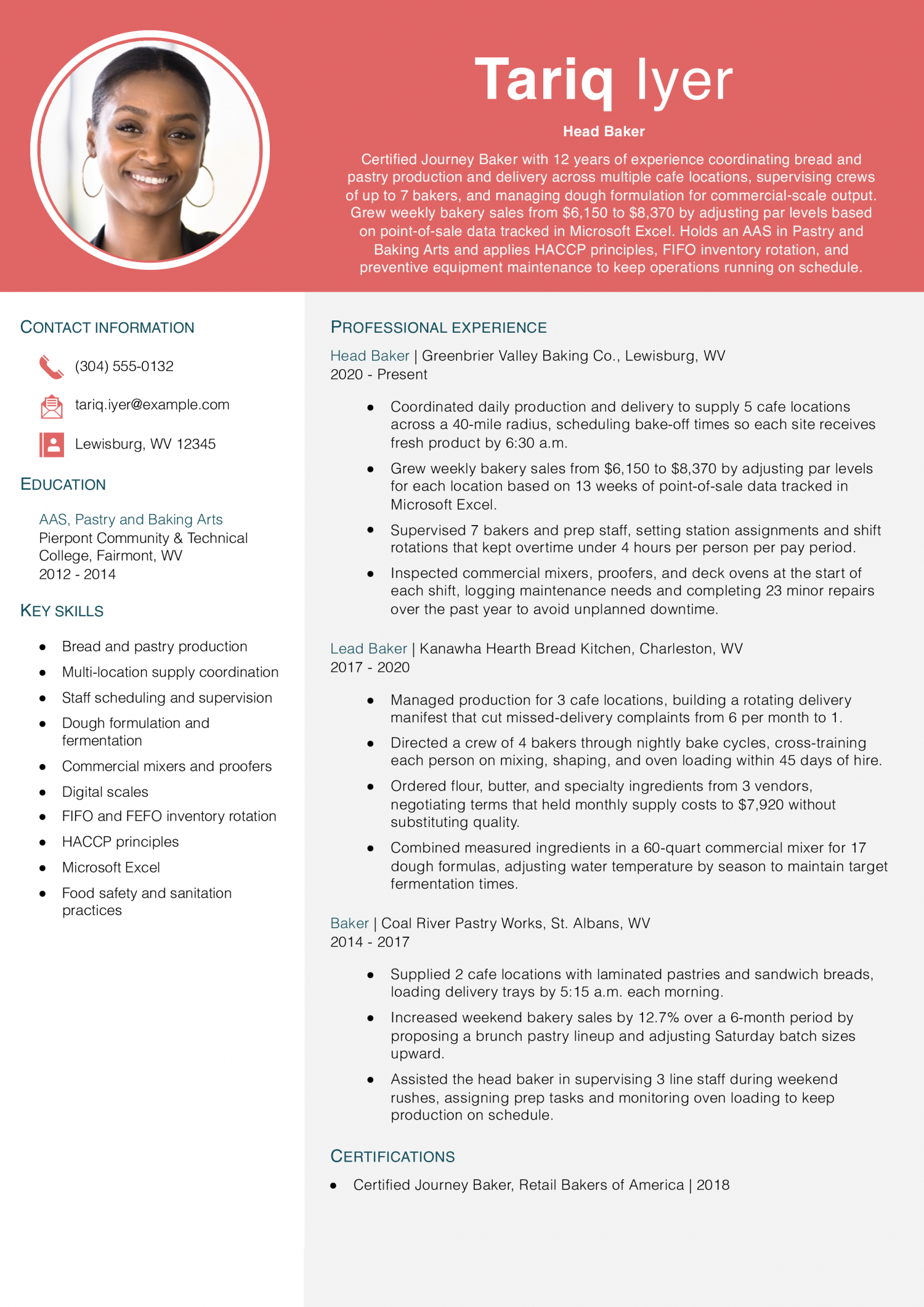
Lean on this resume if you are a senior head baker overseeing multi-location production and a full baking crew. Record a specific delivery radius alongside the number of sites you supply so readers grasp your logistics scope.
Many baker resumes claim they grew sales but leave out the data source behind the decision. This resume explains the method by noting it grew results “by adjusting par levels for each location based on 13 weeks of point-of-sale data tracked in Microsoft Excel.” If you made changes that lifted revenue, name the specific tool and the volume of data you used so a hiring manager can see your decisions were informed by evidence, not guesswork.
Skilled in scratch cake production, HACCP compliance, and buttercream and ganache preparation across 6 years of professional baking experience. Trained 11 team members on mixing, layering, decorating, and equipment operation while holding monthly food costs within $4,470 of budget by adapting ingredient quantities across 6 cake formulas each week. Holds an AAS in Baking and Pastry Management and a ServSafe Food Handler certification.
Start your resume with one line that sets you apart. A bakery manager can verify your food handler card in seconds. What that card does not reveal is your real edge.
Maybe you specialize in laminated doughs or sourdough fermentation. Maybe you decorate wedding cakes or bake gluten-free breads. Maybe you speak two languages in a diverse kitchen.
Pick the single skill or specialty most relevant to the posting. Place it in a headline or summary directly below your name. This line should answer one question: why choose you over a baker with the same basic training?
That answer is what makes a manager pause and keep reading your resume.
Baking is physical, repetitive, and measurable by volume. Strong resumes name the scale of daily production. State how many loaves, rolls, or pastries you produced per shift.
Mention the size of the team you worked alongside. Note waste percentages you helped lower or kept below a target. A bullet like “Produced 300 artisan rolls per shift with under 2% waste” reads better than “Responsible for baking bread.” You can also note revenue tied to a specialty item you introduced.
Most bakery managers scan for proof that you can handle their volume. Bullets without a number tend to read as duties, not results. Even a rough figure is stronger than no figure at all.
Organize your core tasks so they are easy to scan. Use three to five clear groups. Bread production covers mixing, proofing, scoring, and oven management.
Pastry work covers lamination, fillings, and plated desserts. Cake decorating covers fondant, buttercream, and custom designs. Sanitation covers cleaning schedules, allergen controls, and temperature logs.
Inventory covers ordering, rotating stock, and tracking waste. List each group as a short cluster of two or three bullets. Label every group with a bold heading so the reader can skip to what matters.
This structure helps bakery managers find the skills their shop needs most. It also keeps your resume from looking like one long block of text that is hard to read at a glance.
Add a credentials block near the top of page one. Bakery managers and executive pastry chefs look for food safety proof early. List your ServSafe Food Handler card on its own line.
If you hold a Certified Journey Baker or Certified Baker from the Retail Bakers of America, place it next. A Certified Pastry Culinarian from the American Culinary Federation fits here too. Include the credential name and the year you earned it.
Do not list ID numbers or personal data. Putting credentials above your work history signals that compliance is handled. Equipment skills like spiral mixers, deck ovens, and sheeters belong in a tools section right below.
This layout lets a manager confirm your qualifications in seconds.
Close your resume with an education section. List any culinary school diploma or baking and pastry arts degree. Include the school name, location, and graduation year.
If you trained through an apprenticeship, name the bakery and the duration. Community college courses in food science or nutrition fit here too. You can add a short line for volunteer work, such as baking for a local food bank.
Bakery managers and executive pastry chefs value hands-on training, so highlight practical hours over classroom theory. If you are new to the trade, this section carries more weight. Keep it brief for experienced bakers.
Two to four lines are enough to round out the page.
Five years ago, a baker resume read like a recipe list. Bread types and oven names filled most of the page. The mix has shifted toward batch yield data and food safety know-how.
Bakery managers and executive pastry chefs look for hard skills first. They want proof you can scale recipes and hold safe temps. Soft skills like time management then show you can run a full bake schedule.
Read each table below before you open the job posting. Check which terms the posting repeats. Add those terms to your bullet points word for word.
Turn soft skills into short proof statements inside each bullet. A claim of teamwork means more when tied to a crew size. Link it to a shift goal or a daily output number.
Swap in new terms from the posting each time you apply. One generic list will not clear every ATS filter. Tailor the mix so your resume reads like the ad wrote it.
| Soft Skills | AI-estimated % |
|---|---|
| Attention to detail | 65% |
| Time management | 58% |
| Physical stamina | 49% |
| Team coordination | 40% |
| Customer service | 32% |
And here are the top hard skills showing up most often.
| Hard Skills | AI-estimated % |
|---|---|
| Dough preparation | 71% |
| Recipe scaling | 56% |
| Bread and pastry shaping | 47% |
| Proofing and fermentation | 36% |
| Food safety compliance | 34% |
Skill names and rankings come from an AI model grounded in U.S. Department of Labor occupation data for bakers, not from a count of bakers’ resumes built on ResumeTemplates.com.
The items below are what separate a baker resume from one that gets put back in the pile.
Most bakeries require a food safety credential before your first shift. A ServSafe Food Handler card is the most common ask. List it near the top of your resume.
Bakery work starts well before most people wake up. Early shifts often begin at 3 or 4 a.m. Stating your availability removes doubt right away.
Tip: State Your Shift Availability Early
Bakery managers and executive pastry chefs fill overnight and weekend slots first. A short line near your contact info can help. Name the days and hours you can work.
Keep the callout to one line on the page. Plain text works better than a graphic or icon.
Bakery managers and executive pastry chefs read this list as a map of where your work is heading. The items below tell them which baking track you have put time into. They also show how far you have moved past entry level.
These are not the basic food safety cards most shops require. They are the extras that signal skill and drive. List each one with the issuing body and the year you earned it.
Put the most recent item first.
For bakers, the 10th-percentile floor and the top-decile ceiling sit about 56 percentage points apart. That gap is wider than many food-production roles. Where you land in that range varies a lot.
The floor clusters around entry roles in grocery and retail settings. The ceiling reflects pastry work in hotels, resorts, and high-volume production facilities. Your resume should map your skills to the tier you want.
List batch sizes, product lines, and any credential from the Retail Bakers of America or the ACF. Show the setting and scale of each role so bakery managers and executive pastry chefs can place you in the right band.
| # | State | Median Annual |
|---|---|---|
| 1 | Hawaii | $46,710 |
| 2 | Washington | $46,140 |
| 3 | District of Columbia | $44,040 |
| 4 | California | $43,120 |
| 5 | Colorado | $40,650 |
| 6 | Minnesota | $40,210 |
| 7 | Wyoming | $40,000 |
| 8 | Vermont | $39,980 |
| 9 | Alaska | $39,710 |
| 10 | Nevada | $39,540 |
| # | State | Workers | Median |
|---|---|---|---|
| 1 | California | 30,020 | $43,120 |
| 2 | Texas | 16,710 | $33,790 |
| 3 | New York | 15,130 | $38,660 |
| 4 | Illinois | 12,420 | $37,030 |
| 5 | Florida | 12,320 | $35,870 |
Resume Templates offers HR approved resume templates to help you create a professional resume in minutes. Choose from several template options and even pre-populate a resume from your profile.
List the products you made at home and the volumes you produced each week. Treat your home baking as self-employment under a work experience heading.
Include food safety practices you followed, such as temperature logging and allergen labeling. This shows bakery managers you can meet a commercial kitchen's standards.
Name the types of bread, pastry, or cake you have produced and your daily batch counts. List the ovens and mixers you have operated, such as deck ovens or spiral mixers.
Add any relevant credentials, like the Certified Journey Baker from the Retail Bakers of America. Bakery managers look for proof you can step into production on your first shift.
Start each bullet with an action verb and pair it with a measurable result. For example, write "Scaled and mixed 200 pounds of dough per shift for artisan bread production."
Keep each bullet to one task and one outcome so the reader can scan it in seconds. Executive pastry chefs spend very little time on each resume, so clear numbers stand out.
No, many bakery positions do not require a culinary degree. On-the-job training and apprenticeships carry strong weight with bakery managers.
If you trained informally, list the months of hands-on experience you completed. Name the product lines you learned to produce, from laminated doughs to decorated cakes.
One page is the standard length for most baker roles. If you have more than ten years of production experience across several bakeries, a second page works.
Keep only the positions and details that relate to the job you are targeting. Removing unrelated work frees space for the batch sizes and products that matter most.
Yes, allergen awareness is a valuable detail for bakery managers reviewing your resume. Note any experience with nut-free or gluten-free production lines.
Mention cross-contamination protocols you followed in the kitchen. This shows you understand food safety at a practical, day-to-day level.
List any baking you did during that period, such as freelance cake orders or recipe development. Place a brief note next to the dates so the gap does not look unexplained.
Bakery managers care more about your current skill level than a stretch of time away. A short summary line under the gap keeps the focus on what you can produce today.
For a baker, an ATS-friendly template is the safest pick, because it puts your certifications and experience where a hiring manager scans first. A basic template is a solid alternative. Whichever you choose, keep the formatting clean and easy to parse: clear section headings, a standard font, and no graphics a parser can choke on.
Baker Resume
4.1/5 stars with 201 reviews

Executive Resume Writer and Career Coach
Andrew Stoner is an executive career coach and resume writer with 17 years of experience as a hiring manager and operations leader at two Fortune 500 Financial Services companies, and as the career services director at two major university business schools.
© 2026 Resumetemplates.com All rights reserved.