

Tip !

Revenue cycle managers decide whether to keep reading by the certifications block; if a CPC, CCA, or equivalent credential is not visible there, the resume moves to the rejection pile.

Andrew Stoner , Executive Resume Writer and Career Coach

Medical Billing and Coding Resume Examples

Featured Example

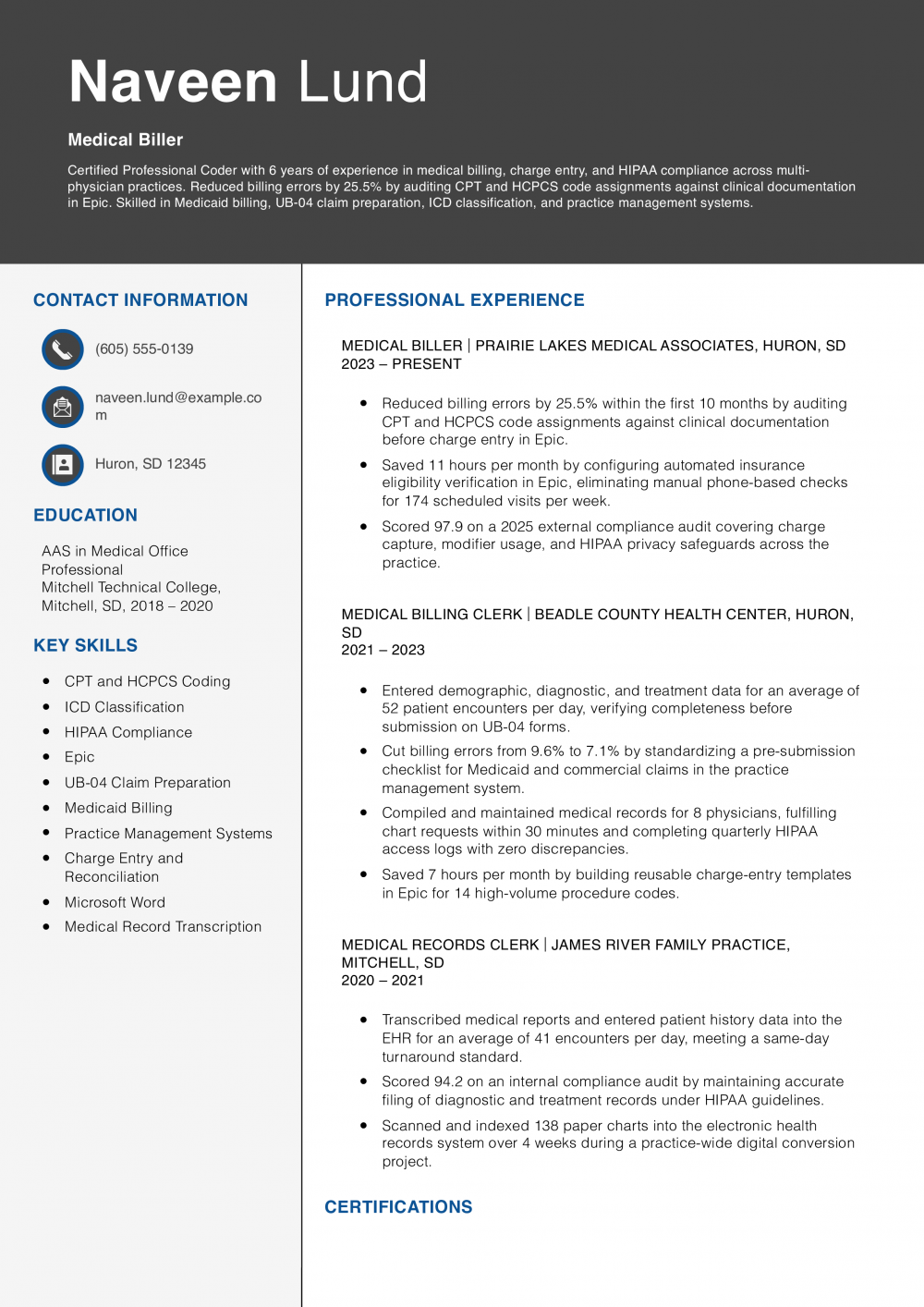
Pick this resume if you are a mid-level medical billing specialist with about six years of experience and a Certified Coding Specialist credential. Add a before-and-after denial rate in each role to show continuous improvement across positions.

What to take from this resume example

Many medical billing and coding resumes list appeals work without attaching any dollar amount, so the reader has no way to measure the impact. This resume pairs the appeal count with the total value of the denied claims: “resolving 43 denied claims valued at $29,150 in a single quarter.” If you know how much was recovered, state that separately from the total claim value.

Billing and Coding Specialist Example

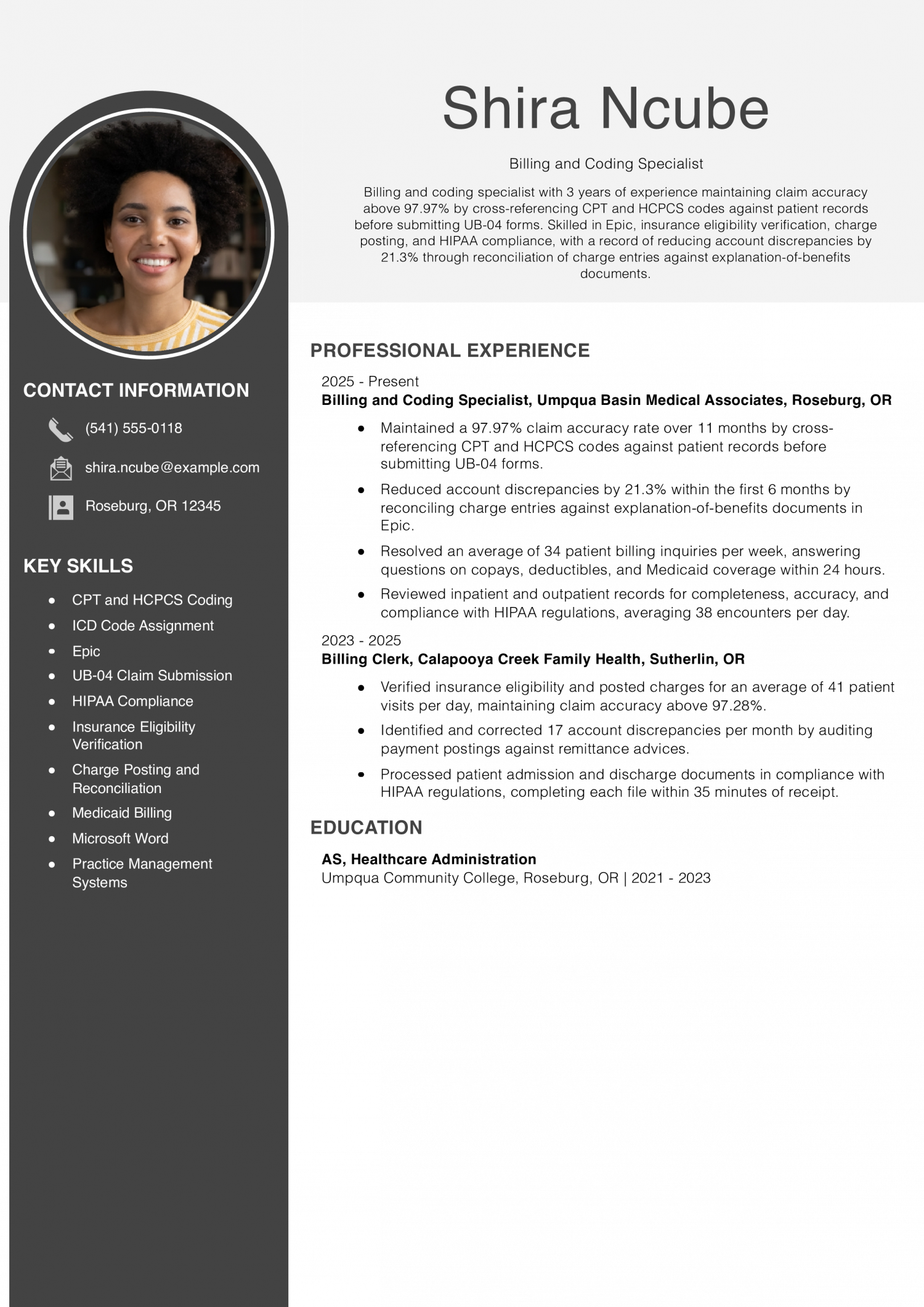
Use this resume if you are an entry-level billing and coding specialist building a career in health information technology. Lead with a claim accuracy rate stated as a precise percentage to anchor your credibility in each role.

What to take from this resume example

Many medical billing and coding resumes mention handling patient questions but leave out how many or how fast, so the reader cannot tell if you can keep up with a busy office. This resume writes “34 patient billing inquiries per week, answering questions on copays, deductibles, and Medicaid coverage within 24 hours,” pairing a weekly volume with a specific response window. On your own resume, count the inquiries you handle each week and add the turnaround time you held so a hiring manager can measure both your workload and your speed.

Senior Coding Specialist Example

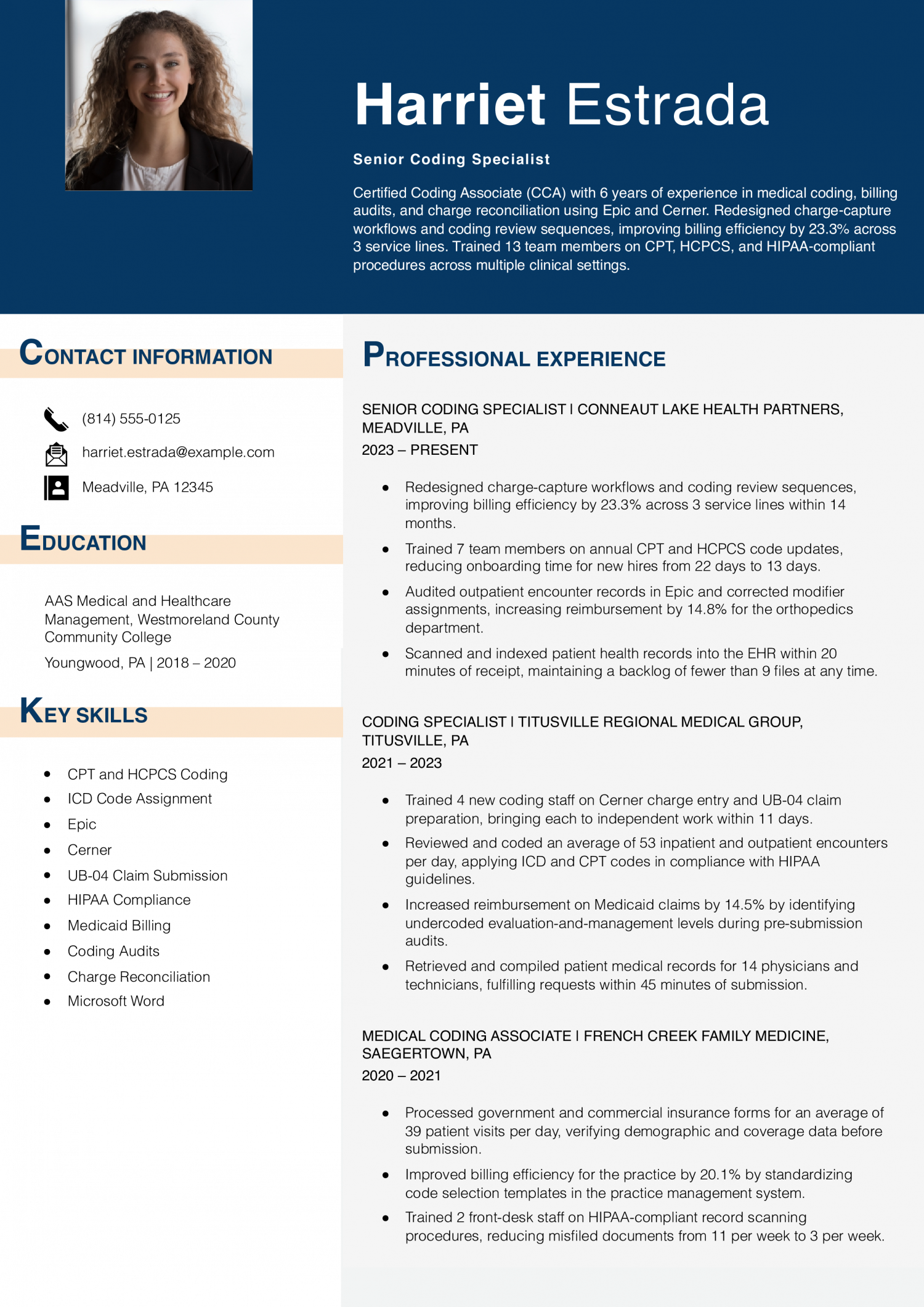
Try this resume if you are a mid-level coding specialist with about six years of experience and a CCA credential. Quote the specific department or service line each reimbursement gain applies to, the way this resume does for orthopedics.

What to take from this resume example

Many medical billing and coding resumes claim they improved efficiency without explaining what they changed, so the reader cannot tell if the gain came from real process work or normal fluctuation. This resume writes “improving billing efficiency by 23.3% across 3 service lines within 14 months,” tying a specific percentage to both the scope of departments affected and the time it took. On your own resume, pair your efficiency gain with the number of service lines or departments involved and the timeline so a hiring manager can see the scale behind the number.

Revenue Cycle Supervisor Example

Rely on this resume if you are a senior revenue cycle supervisor with over a decade of billing, coding, and appeals experience. Report each recovered dollar amount beside the specific appeal or workflow change that produced it.

What to take from this resume example

Many medical billing and coding resumes mention revenue gains but never explain the operational change behind them, so the reader cannot tell what actually moved the number. This resume writes “restructuring claim prioritization queues and shortening average days in accounts receivable from 41 to 29 days,” naming the specific process change and pairing it with a before-and-after metric. On your own resume, identify the workflow you redesigned and attach the starting and ending figures so a hiring manager can connect your action to the financial result.

How to Write a Medical Billing and Coding Resume

01 Open with the metric that sizes you up

Revenue cycle managers and practice managers want a number in your first line. Lead your summary with your coding volume per day or your clean claim rate. A line like “CPC coder averaging 85 charts per day at a 97% first-pass rate” tells a reader your speed and accuracy in one breath.

Skip broad phrases like “detail-oriented professional” or “years of experience in healthcare.” Those lines waste the spot where a metric could go. Name the code set you work in most, such as ICD-10 or CPT. Then add the setting, like a multispecialty group or a hospital system.

This gives the reader your scope in plain terms. A strong opener pairs one output number with one quality number.

02 Add numbers that prove your accuracy

Most strong medical billing and coding resumes carry two or three clear metrics per role. Start each bullet with a result, not a task. Claim denial rates show how clean your work is.

First-pass resolution rates show it from another angle. Accounts receivable days tell a reader how your coding affects cash flow. Name the dollar value of claims you process each month.

If you reduced denials, state the percentage drop and the time frame. A bullet without a number tends to read as a duty, not a result. Even a volume count, like “coded 70 charts daily across four specialties,” gives a reader something to measure.

Revenue cycle managers scan for these figures early in a review.

03 Group your work by core functions

Organize your bullets into clear categories so readers can scan fast. Coding work covers chart review, code assignment, and modifier selection. Billing work covers claim submission and payment posting.

Denial management is its own group, covering appeals and root-cause tracking. Compliance tasks cover audit preparation and documentation reviews. A fifth group could cover patient-facing work like balance inquiries.

Keep each group to two or three bullets. This layout shows range without creating a wall of text. Practice managers look for depth in the area they need most.

Tagging your bullets by function lets them find it in seconds. Use the terms from the job posting when they match your real work.

04 Place credentials where reviewers look first

List your certification right after your name at the top of page one. The CPC and CPB from AAPC are common at the entry level. The CCA from AHIMA also signals entry-level readiness.

The CCS from AHIMA signals a mid-level skill set. Revenue cycle managers and practice managers often filter resumes by credential, so a buried cert may cost you a screen. Below the header, add a short tools section.

Name the EHR and billing platforms you have used, such as Epic or AdvancedMD. Add the code sets you work with, like ICD-10-CM and CPT. Keep this block tight, four to six items at most.

A clean tools line saves a reviewer from hunting through your bullets.

05 Strengthen your closing section with training

Your education section should list your certificate or degree program in health information. If you earned a CPC or CCA, name the program where you prepared for the exam. Add any practicum hours and the setting where you completed them.

Relevant coursework in anatomy, medical terms, or pharmacology can fill gaps when your work history is short. Place this section near the bottom of the page. If you hold more than one AAPC or AHIMA credential, group them in a separate credentials block above education.

Close with any continuing education units that show you stay current. Revenue cycle managers and practice managers value proof that you track code updates each year. One or two recent courses are enough to round out the page.

ATS filters catch more Medical Billing and Coding resumes than ever in 2026. Match the lists below against the posting you want. Code set names clear the first cut.

Payer workflow terms decide whether the resume moves forward. Revenue cycle managers and practice managers screen hard skills first. They look for CPT and ICD-10 terms tied to real claim volumes.

Soft skills like attention to detail then show you can keep denial rates low. Both types need to appear in your bullets. Compare each table to the job posting you are targeting.

Where a skill appears in both, add it to your resume. Turn each soft skill into a short result in your work history.

Soft Skills AI-estimated %
Attention to detail 75%
Payer communication 55%
Deadline management 43%
Cross-department coordination 40%
Discretion with PHI 33%

And here are the top hard skills showing up most often.

Hard Skills AI-estimated %
Medical coding 75%
Claims submission 51%
Insurance verification 45%
Accounts receivable follow-up 37%
Compliance auditing 25%

Skill names and rankings come from an AI model grounded in U.S. Department of Labor occupation data for medical billing and coding specialists, not from a count of medical billing and coding specialists’ resumes built on ResumeTemplates.com.

Must Have on a Medical Billing and Coding Resume

Before a medical billing and coding resume gets a closer read, hiring teams check for a short list of essentials.

EMR and Practice Management Systems to Feature on Your Resume

Practice managers scan for software names fast. Name every system you have used in a skills section. Group them so the list is easy to read.

  • Epic, Cerner, or Athenahealth EMR platforms
  • Kareo or AdvancedMD billing software
  • Encoder tools like 3M or TruCode
  • Clearinghouse portals you have used

HIPAA and OSHA Compliance

HIPAA rules touch every task in billing and coding. Revenue cycle managers expect you to know them well. A short line on your resume can confirm that knowledge.

Mention HIPAA training you have finished and the year. Note any audits you supported or compliance reports you filed. Concrete details work better than vague statements.

  • Annual HIPAA training with completion year
  • Internal or external audit support
  • PHI breach prevention procedures followed
  • Compliance documentation you maintained

AI Skills to Add

What revenue cycle managers and practice managers expect has shifted. Listing only manual ICD-10 lookup now reads as incomplete. Naming an AI-assisted coding workflow reads as current and credible.

The list below names what to add. Focus on tools you have used in real claim cycles. Describe the human review step you apply after each suggestion.

Revenue cycle managers want to see that you catch errors. Show how you verified output against payer rules. Accuracy still falls on you, not on the software.

Name the tool, then name your check.

What AI is actually changing for this role

Code suggestion: AI tools propose ICD-10 and CPT codes from clinical notes, but coders still verify each one against documentation.

Denial management: Predictive models flag claims likely to be denied so billers can correct errors before submission.

Charge capture: Automated charge capture scans encounter records and highlights missed billable services for human review.

Audit prep: AI audit tools compare coded claims against payer rules and surface patterns that may trigger an external audit.

AI tools to name

  • Solventum CodeAssist (formerly 3M CodeAssist): Suggests diagnosis and procedure codes from clinical documentation for coder review.
  • Denial predictor platforms: Flag high-risk claims before submission so billers can fix common errors.

How to phrase AI on your resume

Do

  • Name the AI tool and your verification step
  • State denial rate reduction with a number

Skip

  • AI-powered coding expert
  • Leveraged AI to revolutionize billing

Medical Billing And Coding Credentials Worth Listing

Revenue cycle managers and practice managers read this list as a map of where your work is heading. It tells them which coding track or billing scope you have invested in. These credentials go beyond the basic entry bar.

They signal that you chose to deepen your skills in a focused area. List the issuing body, the credential name, and the year you earned it. Put the most recent one first.

Some employers treat a credential as a firm requirement, while others weigh it alongside hands-on experience. Posting language varies by setting, so check each job ad before you apply. A current credential paired with strong claim volume numbers gives your resume a clear edge in the review stack.

Earning more than one shows range across both coding and billing workflows.

  • Certified Professional Coder: AAPC issues this credential, and many outpatient practices ask for it when hiring coding staff.
  • Certified Professional Biller: AAPC issues this credential, and billing teams in larger practices often prefer it for claims roles.
  • Certified Coding Specialist: AHIMA issues this through CCHIIM, and hospital systems often request it for inpatient coding roles.

Certifications That Strengthen a Medical Billing and Coding Resume

Credentials tell revenue cycle managers you can code accurately. They also signal you stay current on payer rules. List each credential with its issuing body and year earned.

  • CPC or CPB from AAPC
  • CCA from AHIMA for entry roles
  • CCS from AHIMA for mid-level coders
  • Year earned and current status for each

Latest BLS Statistics for Medical Billing And Coding Specialists

About These Numbers

The Bureau of Labor Statistics does not publish a wage code for Medical Billing and Coding specifically. The numbers below are a proxy: the closest published match is Medical Records Specialists (SOC 29-2072), so use them as an estimate for this role, not an exact figure.

BLS wage data covers all Medical Records Specialists, a broader group that includes medical billing and coding roles. The gap between the entry-tier floor and the top-decile ceiling is wide. Workers at the 90th percentile earn roughly 59 percent more than the median.

Workers at the 10th percentile sit about 28 percent below it. Credential level, facility type, and region all shape where you fall in that range. Your resume should name the coding systems you use, the credential you hold, and the setting where you work.

Place those details near the top so revenue cycle managers and practice managers can spot your tier at a glance.

$51,140 National median annual, all medical records specialists
$56,790 National mean annual, all medical records specialists
$37,000 10th percentile, all medical records specialists
$81,150 90th percentile, all medical records specialists
194,720 Medical Records Specialists in the U.S. (the BLS group that includes medical billing and coding specialists)
Where you stand

Below median

$37,000 to $51,140 At this level, your resume needs to show your CPC or CCA credential and primary code set.

Above median

$51,140 to $81,150 At this level, lead with the EHR platform you use and your claim denial rate.

Top 10%

$81,150+ At this level, show your CCS credential and the specialty departments you have coded for.

Top-paying states

# State Median Annual
1 District of Columbia $72,040
2 Rhode Island $63,960
3 Hawaii $63,180
4 Washington $62,270
5 California $61,810
6 New York $61,720
7 Minnesota $61,530
8 Alaska $61,090
9 Connecticut $60,940
10 Massachusetts $60,350

Highest-employment states

# State Workers Median
1 Florida 21,490 $45,760
2 California 18,700 $61,810
3 Texas 17,210 $48,860
4 New York 9,080 $61,720
5 Ohio 7,440 $50,990
7.8% projected growth (Much faster than average)Job outlook, 2025-2035

Source: U.S. Bureau of Labor Statistics, Employment Projections, 2025-2035. View on bls.gov
Source: U.S. Bureau of Labor Statistics, OEWS May 2025 release (SOC 29-2072). View on bls.gov
Written by professional resume writers and loved by hiring managers

Resume Templates offers HR approved resume templates to help you create a professional resume in minutes. Choose from several template options and even pre-populate a resume from your profile.

Frequently Asked Questions

Is medical billing and coding a good career?

Yes. Demand stays strong because every healthcare provider needs accurate claims processing and revenue cycle support. The career offers clear advancement from entry-level coder to billing supervisor or revenue cycle analyst.

Earning a CPC or CCA credential early can accelerate that path.

How do I write a medical billing and coding resume with no experience?

Lead with your certification, relevant coursework, and any practicum or externship hours you completed. List the code sets you trained on, such as ICD-10-CM and CPT, in your skills section. Even a short clinical rotation gives you claim volume and accuracy figures worth adding.

Where should I list my CPC or other coding credential?

Place the credential abbreviation after your name in the header, such as "Jane Smith, CPC." Then list the full credential name, the issuing body, and the year earned in a dedicated certifications section. Revenue cycle managers and practice managers scan the header first, so that placement matters.

How is a medical billing resume different from a medical coding resume?

A billing resume stresses claims submission, payment posting, and accounts receivable follow-up. A coding resume highlights code assignment accuracy, chart review volume, and audit results. Many employers combine both duties, so tailor bullet points to match the posting you apply for.

Should I include my denial management experience on a billing and coding resume?

Yes. Denial management shows you can protect revenue after the initial claim is filed. State the percentage by which you reduced denials or the dollar amount you recovered through appeals.

Revenue cycle managers and practice managers value that proof of financial impact.

How do I write a medical billing and coding resume if I am changing careers?

Open with a summary that names your new certification and any transferable skills from your prior field. Customer service, data entry speed, and insurance knowledge all transfer well. Move your education and credentials above your work history so reviewers see them first.

How far back should my work history go on a medical billing and coding resume?

Ten years is a strong guideline for most applicants in this field. Older roles rarely reflect current code sets or payer rules. If a position beyond that window shows relevant leadership or specialty experience, include it in a brief "Earlier Experience" line without full dates.

What's the best resume template for a medical billing and coding specialist?

For a medical billing and coding specialist, an ATS-friendly template is the safest pick, because it puts your certifications and experience where a hiring manager scans first. A basic template is a solid alternative. Whichever you choose, keep the formatting clean and easy to parse: clear section headings, a standard font, and no graphics a parser can choke on.

Rate this article

Medical Billing and Coding Resume

Average Rating

4.6/5 stars with 123 reviews

You have given 0 Star(s)
4.6/5 stars with 123 reviews
Andrew Stoner

Executive Resume Writer and Career Coach

Andrew Stoner is an executive career coach and resume writer with 17 years of experience as a hiring manager and operations leader at two Fortune 500 Financial Services companies, and as the career services director at two major university business schools.