Tip !

Vendor negotiations with dollar outcomes, category margin and sell-through figures tied to specific seasons, and open-to-buy management at a stated budget level are what separate the Buyer resumes that advance past merchandise managers from the rest.

Andrew Stoner , Executive Resume Writer and Career Coach

Buyer Resume Examples

Why this resume works
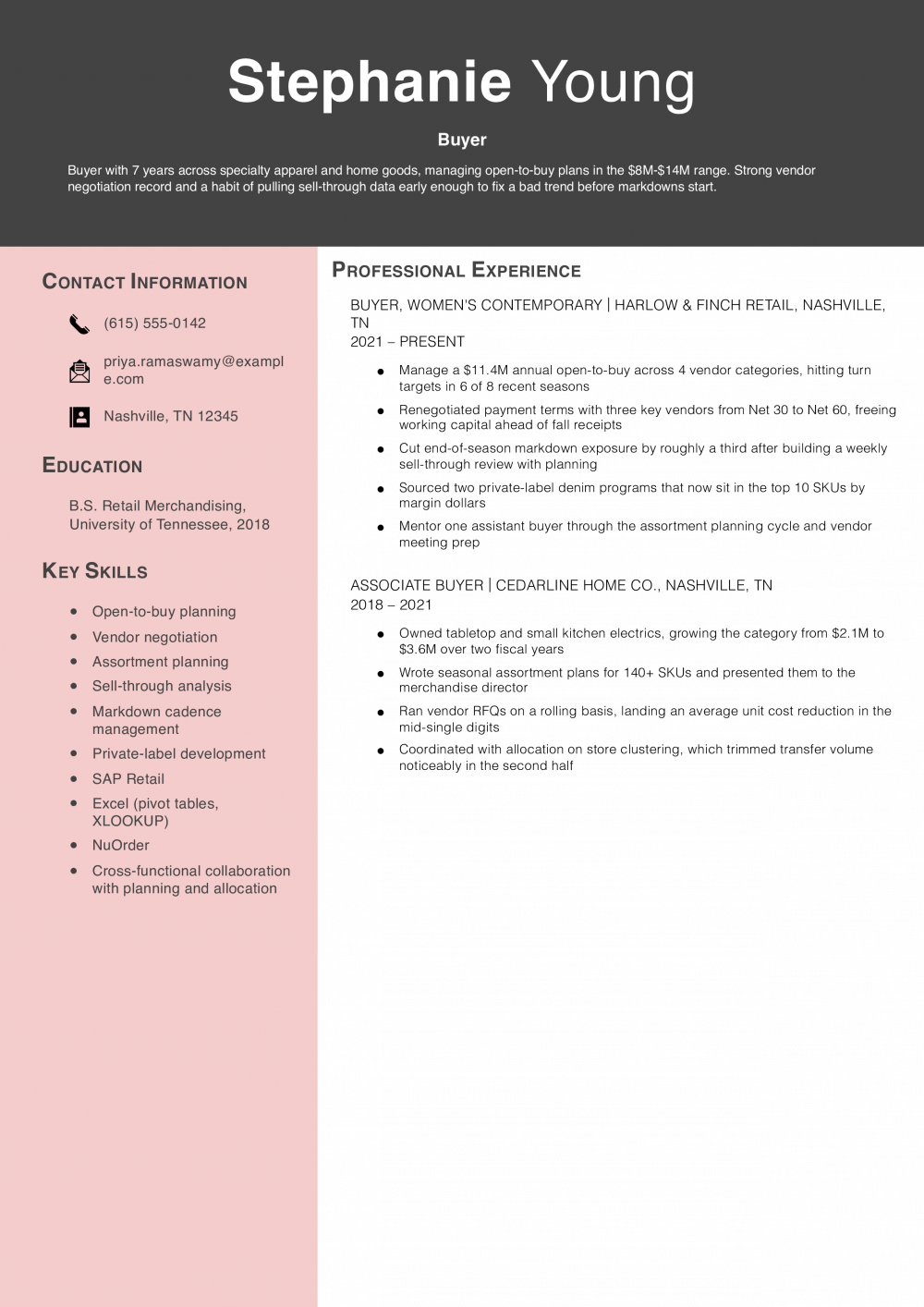
  • Numbers tied to real dollars: Open-to-buy size, category growth from $2.1M to $3.6M, and turn hit rate give a hiring manager a clear picture of scale.
  • Shows negotiation, not just ordering: The payment-terms renegotiation and quoted cost reduction show the candidate actually moves vendor terms, which is what buyers get promoted for.
  • Grew into more responsibility: Associate Buyer to Buyer with a bigger open-to-buy and a direct report reads as a natural progression instead of a title change.

Assistant Buyer Example

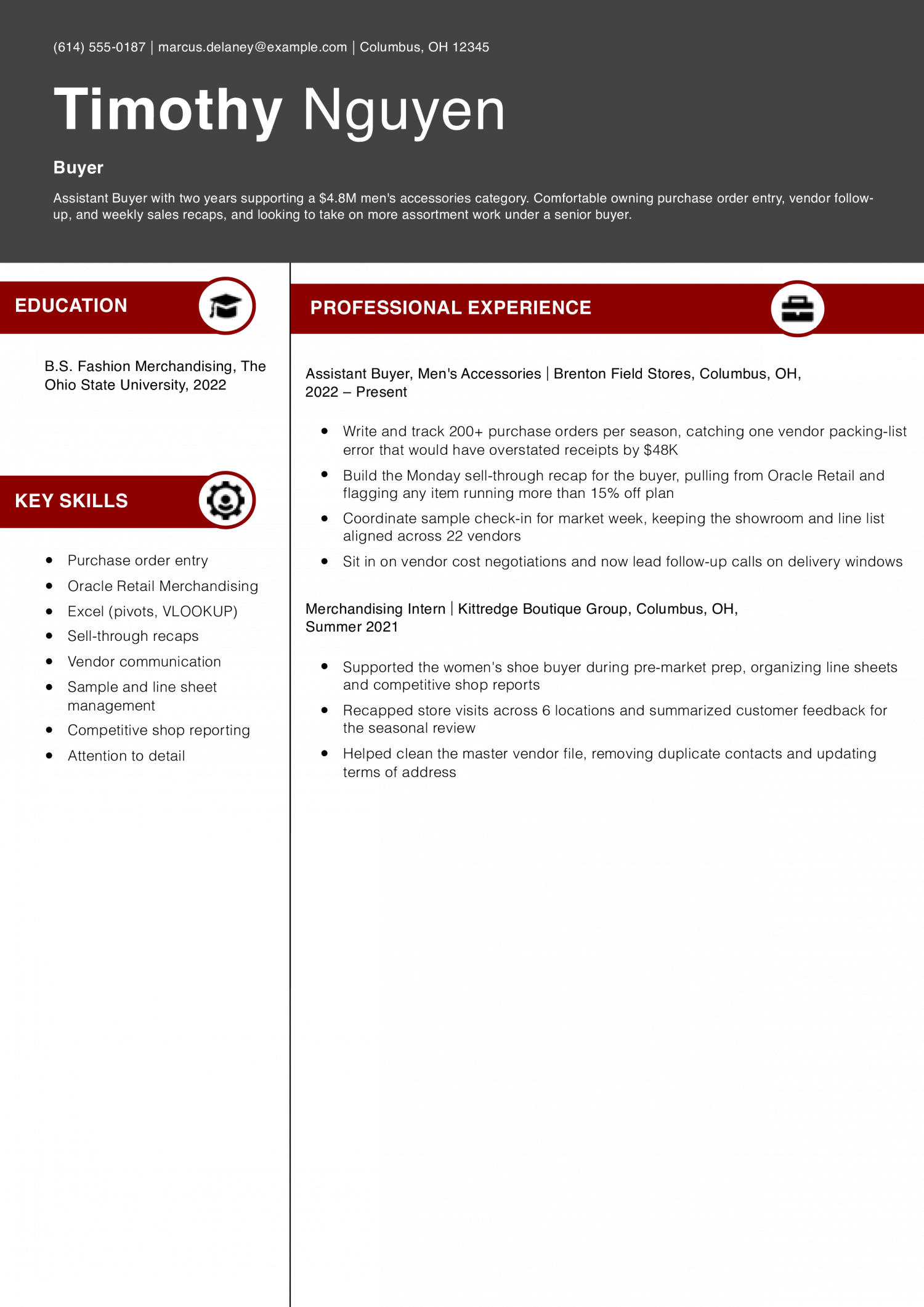
This resume is for an assistant buyer helping a category owner with purchase orders, vendor setup, and markdowns. It has to show you can run the daily work well and read a sell-through report on your own.

Why this resume works
  • Caught a costly data error: The $48K packing-list catch is the kind of concrete save that separates a real assistant buyer resume from a generic one.
  • Right scope for the level: Purchase order entry, sell-through recaps, and vendor follow-up are exactly what an assistant buyer owns, no inflated titles.
  • Shows movement toward buyer: Leading delivery-window follow-up calls signals the candidate is picking up work a buyer would normally do.

Buyer Example

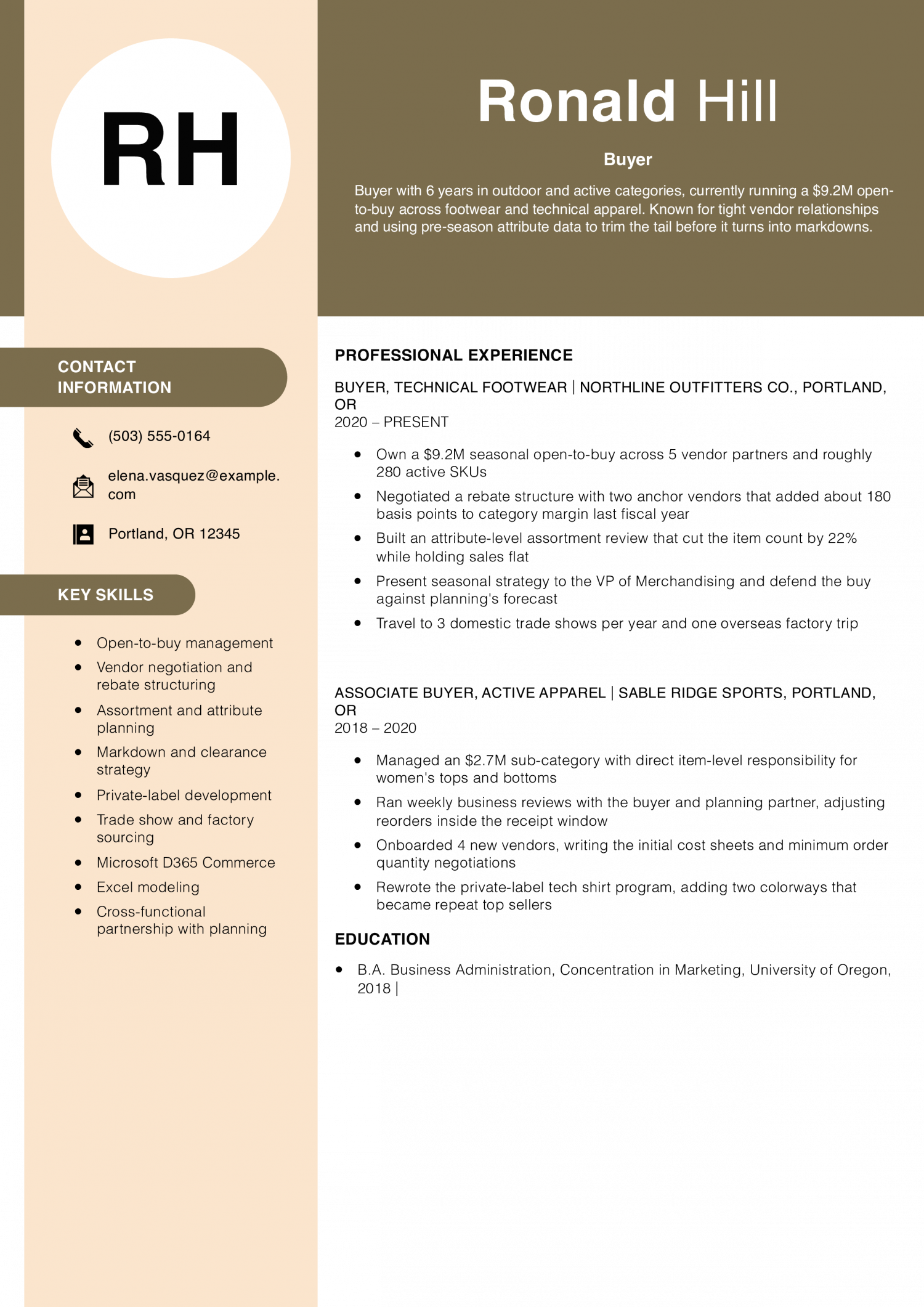
This resume is for a buyer who owns a category, sets the assortment, and carries the open-to-buy. It has to show margin gains, vendor wins, and sound calls on depth and reorder timing across a season.

Why this resume works
  • One anchored number per job: The $9.2M open-to-buy and 22% assortment reduction each sit in one bullet, so the resume reads specific without feeling padded.
  • Real vendor terms language: Rebate structure, MOQs, and cost sheets are the actual mechanics of a buyer’s day, not generic ‘sourcing’ filler.
  • Category ownership is clear: Dollar size and SKU count on both roles tell a hiring manager exactly what scope the candidate has handled.

Senior Buyer / Merchandise Manager Example

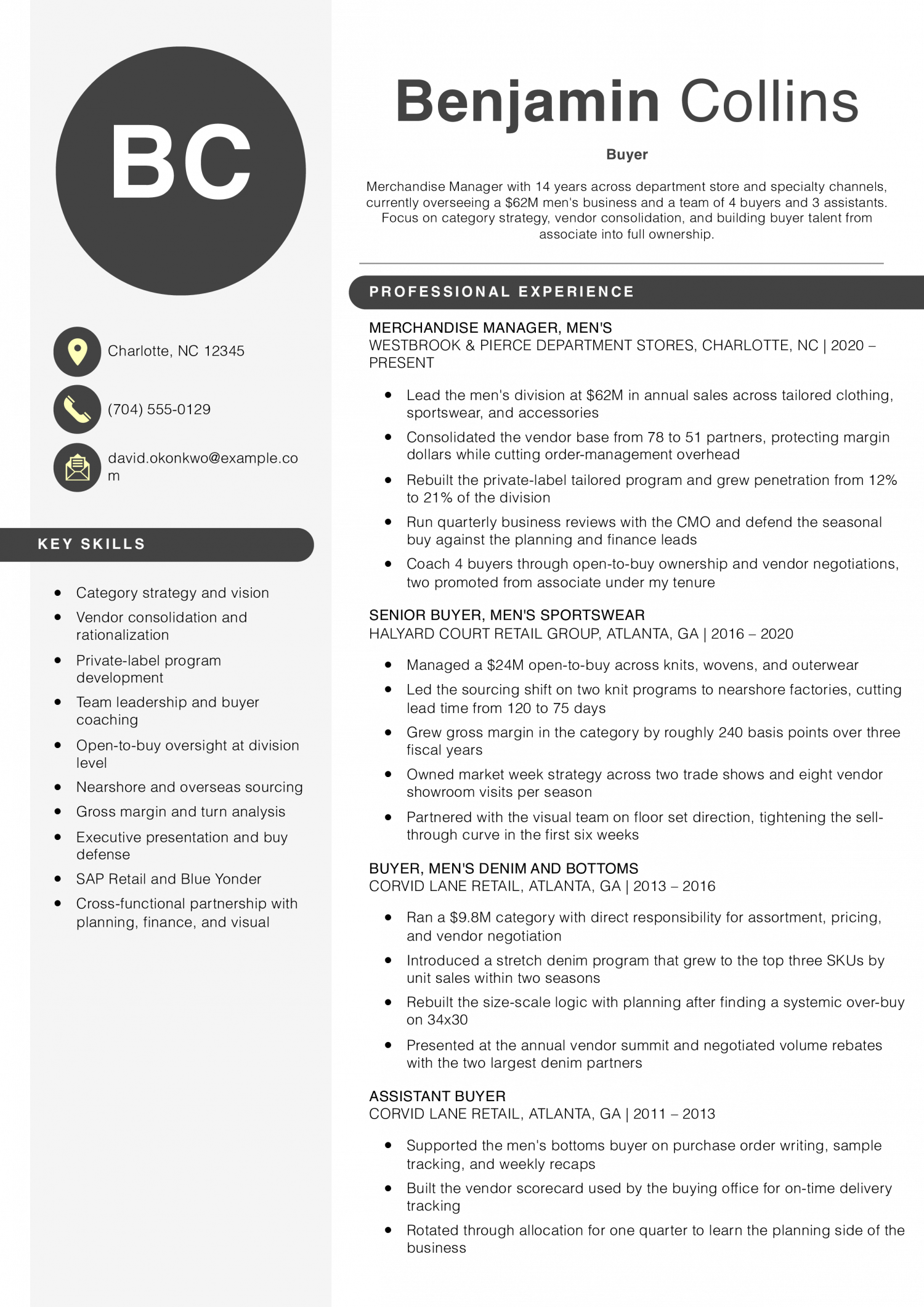
This resume is for a senior buyer or merchandise manager leading a category team and shaping strategy with planning and marketing peers. It has to show people leadership, multi-million dollar budget ownership, and a record of growing gross margin each year.

Why this resume works
  • Dollar size and team count signal manager seniority: The $62M men’s business and team of 7 tell a hiring manager immediately that this is manager, not senior buyer, seniority.
  • Built other buyers: Two associates promoted to buyer under the candidate’s coaching is the kind of leadership signal that separates managers from senior individual contributors.
  • Full career arc: Assistant through Merchandise Manager on one page shows how the candidate learned each layer of the buying office instead of skipping steps.

How to Write a Buyer Resume

01 Open with the metric a merchandise manager would use to size you up

Your summary should lead with a hard number, not a scope sentence. Name the annual open-to-buy you managed, the category sales you owned, or the sell-through rate you held. Merchandise managers and directors of buying read that first line as a signal of whether you can run a budget.

A line like ‘Buyer managing a $14M open-to-buy across 60 SKUs with 78 percent sell-through’ does more work than a paragraph of adjectives. Pair the dollar figure with the category, the channel and the store count. If you cannot share exact dollars, name the unit volume or the vendor count instead.

Save the softer detail about your buying philosophy for the body of the resume.

02 Put numbers on every buying bullet

A bullet with no figure in it reads as a task, not a win. Most strong buyer resumes carry two or three metrics per role: open-to-buy size, sell-through percent, gross margin, markdown rate, turn, or year-over-year category growth. Recruiters scan for those figures first, then read the verb.

Write ‘Grew handbag category 22 percent year over year on a $6M open-to-buy’ rather than ‘Responsible for handbag buying.’ If a number is confidential, use a range or an index. Note the store count, channel mix and vendor count so the scale is clear. Buyers who show margin lift and inventory turn tend to advance further than those who only list assortments planned or vendors met.

03 Group your work into buying categories

Break the body of each role into three or four buckets so the reader can scan. Useful groupings are assortment planning, vendor negotiation, inventory and markdown management, and cross-functional work with planning and stores. Under assortment, name the category, the price tiers and the number of SKUs.

Under vendor work, note contract terms, cost negotiations and new-vendor onboarding. Under inventory, name your turn, weeks of supply and markdown cadence. Under cross-functional, name the partners: planners, allocators, visual merchandising and ecommerce.

Grouping this way keeps the bullets tight and lets merchandise managers match your work to their open role. Avoid piling every task into one long list of duties.

04 Place credentials, systems and tools near the top

Directors of buying want to see your systems fluency before they read every bullet. Put a short credentials block on page one, under the summary or beside it. List the retail systems you use: your ERP or merchandising platform, your planning tool, and your reporting stack.

Name the Excel work honestly, including pivot tables and lookups. If you hold a degree in merchandising, business or a related field, list it here too. Merchandise managers use this block to filter for people who can step into their tech stack without a long ramp.

Keep it to short labels, not sentences. Move deeper detail about how you use each tool into the bullets themselves.

05 Close with education and category context

End the resume with a short education section and a line of category context. List your degree, the school and the year if it is recent. If you took coursework in retail math, merchandising or supply chain, name one or two courses.

Below education, add a one-line note on the categories and price points you have bought: for example, ‘Categories: women’s apparel, accessories, footwear. Price points: opening to better.’ That line helps directors of buying match you to open categories fast. Keep any awards or vendor recognitions in a two-line block, not a paragraph.

Skip hobbies unless they connect to the category you buy. A tight close signals that you know what belongs on a buyer resume.

ATS filters catch more buyer resumes than ever in 2026. Category and vendor terms clear the first cut. Margin language decides whether the resume advances to a human reader.

Merchandise managers and directors of buying scan hard skills first to confirm you have run the work. They then read soft skills to judge how you handle vendors and cross-functional partners. A term like open-to-buy signals you own the plan, not just the order.

Negotiation shows you can protect margin when a vendor pushes cost up. Match the two lists below against the posting you want. Mirror the exact phrasing the job uses for systems, tools and category names.

Treat soft skills as claims your bullets must back with numbers or outcomes. Drop any skill you cannot defend in a first-round interview. Keep the section tight so the reader finds the proof fast.

Soft Skills AI-estimated %
Trend awareness 76%
Supplier relationship building 63%
Cross-functional collaboration 50%
Data-driven decision-making 39%
Deadline management 28%


And here are the top hard skills showing up most often.

Hard Skills AI-estimated %
Purchase order management 79%
Vendor negotiation 59%
Inventory forecasting 45%
Merchandise assortment planning 38%
Supplier contract review 33%

Skill names and rankings come from an AI model grounded in U.S. Department of Labor occupation data for buyers, not from a count of buyers’ resumes built on ResumeTemplates.com.

Must Have on a Buyer Resume

The items below are what separate a buyer resume from one that gets put back in the pile.

Niche Keywords for ATS Checkers

Merchandise managers and directors of buying scan for niche terms. They want proof you know the work, not soft skills. Group your keywords by the buying specialty you own. Assortment planning covers what you range and how you brief it. Vendor work covers price files, terms, and joint plans. Open-to-buy work covers budgets, markdowns, and receipt flow. Private label work covers spec sheets, tech packs, and sample rounds. Compliance work covers safety testing, customs codes, and duty rates. Put the terms in the phrasing your trade uses. Match the words on the job post when you can. Cut any term you cannot back up in an interview.

Niche Keywords ATS scans for
Assortment planning range architecture, style rationalization, line review
Vendor management quote process, cost negotiation, minimum order terms
Open-to-buy budget planning, markdown cadence, receipt flow
Private label tech pack, spec sheet, sample rounds
Import compliance customs classification, product safety testing, Incoterms 2020

AI Skills to Add

Retailers are split on AI in buying work. Some chains push forecasting and assortment tools hard. Others still trust vendor meetings and a buyer’s read on the floor. Name the tools you actually use in your open-to-buy or assortment planning. Describe the workflow in plain terms, from data pull to human sign-off. Do not claim you run AI-driven forecasting if you only review model output that a planner built. Merchandise managers and directors of buying want to see how you check the numbers, not that a system produced them.

What AI is actually changing for this role
Demand forecasting

Planning tools now suggest reorder quantities and season depth that you review before signing off.

Markdown timing

Price optimization tools flag slow sellers earlier than a weekly report, so you decide markdown cadence sooner.

Assortment planning

Models cluster stores and rank SKUs, and you edit the output against vendor terms and floor space.

Vendor and sample review

Image search and trend tools surface comparable items faster, which shortens your line review prep.

AI tools to name

  • Microsoft Copilot in Excel: Summarize sell-through, flag outliers in size curves, and draft vendor recap notes.

  • ChatGPT: Draft buy sheet comments, order cover notes, and internal recaps you edit before sending.

How to phrase AI on your resume
Do
  • Name the tool and the buying task
  • Say who signs off on the output
Skip
  • AI-powered assortment strategist
  • Leveraged AI to revolutionize buying

Latest BLS Statistics for Buyers

About These Numbers
BLS does not publish separate figures for SOC 13-1022 in this release. The numbers below are for the closest published match, SOC 13-1020, which BLS reports together with related occupations.

For Buyers, the floor sits well below the middle, and the ceiling clears it by close to two-thirds. That spread is wider than a typical office role. The work runs from assistant desks stocking one category to leads who own a full private-label program.

Postings stay steady, but the top tier is narrow and tied to category ownership and vendor scope. Read the spread before you write. Place yourself against the floor and the ceiling.

Then lead the resume with the category scope, the vendor count, and the open-to-buy dollars that map to where you want to sit.

$77,710 National median annual
$83,770 National mean annual
$48,380 10th percentile
$128,870 90th percentile
491,430 Buyers in the U.S.
Where you stand

Below median

$48,380 to $77,710 Show the category you supported and the SKU count you managed on each line.

Above median

$77,710 to $128,870 Feature the open-to-buy dollars you own and your sell-through rate by season on the page.

Top 10%

$128,870+ Feature private-label programs launched and the total category revenue you own at the top.

Top-paying states

# State Median Annual
1 District of Columbia $124,090
2 New Jersey $93,250
3 Maryland $90,900
4 Virginia $89,210
5 Rhode Island $86,240
6 Massachusetts $85,970
7 Washington $85,130
8 Colorado $83,590
9 Alaska $83,460
10 Connecticut $83,030

Highest-employment states

# State Workers Median
1 California 48,010 $82,720
2 Texas 44,030 $76,050
3 New York 31,240 $79,460
4 Florida 30,270 $72,850
5 Virginia 22,120 $89,210

6% projected growth
Job outlook, 2025-2035

Source: U.S. Bureau of Labor Statistics, Employment Projections, 2025-2035. View on bls.gov

Source: U.S. Bureau of Labor Statistics, OEWS May 2025 release (SOC 13-1020). View on bls.gov

Written by professional resume writers and loved by hiring managers

Resume Templates offers HR approved resume templates to help you create a professional resume in minutes. Choose from several template options and even pre-populate a resume from your profile.

Frequently Asked Questions

What keywords should a buyer resume include for applicant tracking systems?

Load the top third with terms merchandise managers scan for first: open-to-buy, assortment planning, vendor negotiation, markdown management, and sell-through.

Add the systems you have used, such as SAP, Oracle Retail, or NuORDER, spelled the way the posting spells them. Mirror the exact phrasing from the job description when your history supports it.

What skills belong on a buyer resume?

Show a mix of financial, analytical, and relational skills, because directors of buying hire for all three.

List open-to-buy planning, margin analysis, vendor negotiation, trend forecasting, and assortment building. Add the tools you run those skills through, like Excel pivot tables, SAP, or retail planning software.

How should a retail buyer resume differ from a wholesale or purchasing buyer resume?

A retail buyer resume leads with sell-through, gross margin, and markdown control on consumer assortments.

A purchasing buyer resume leads with cost savings, supplier lead time, and contract terms on materials or indirect spend. Name the channel in your summary so the reader places you in the right lane on the first line.

How do you write a fashion buyer resume when trend judgment is hard to quantify?

Attach a number to every trend call you made, because merchandise managers read judgment through results.

Write the trend, the buy quantity, and the sell-through the season landed at. Add market weeks attended, vendors onboarded, and any private-label programs you built from sketch to floor.

What words work well on a wine or specialty buyer resume?

Use the trade vocabulary a beverage director uses on the floor: allocation, by-the-glass program, distributor relations, and cellar depth.

Add regions and producers you have built relationships with, since those signal category depth faster than a general skill line. Pair each with a sales lift, margin gain, or waste reduction number.

How do you walk a merchandise manager through your resume in an interview?

Move category by category, not job by job, since that is how the buying org actually thinks.

For each category, name the size of the book, the growth you drove, and one vendor decision you are proud of. Close on the systems you use daily so the reader knows you can plug into their planning stack.

How do you move from assistant buyer to buyer on paper when your title has not changed yet?

Rewrite your bullets around decisions you owned, not tasks you supported, because that is the line between the two roles.

Show the open-to-buy dollars you managed, the vendors you negotiated with directly, and the categories you signed off on. Ask your manager to confirm those scope points before you send the resume out.

Which resume template works best for a buyer?

For a buyer, an ATS-friendly template is the safest pick, because it puts your certifications and experience where a hiring manager scans first. A basic template is a solid alternative. Whichever you choose, keep the formatting clean and easy to parse: clear section headings, a standard font, and no graphics a parser can choke on.

Rate this article

Buyer Resume

Average Rating

4.8/5 stars with 211 reviews

You have given 0 Star(s)
4.8/5 stars with 211 reviews
Andrew Stoner

Executive Resume Writer and Career Coach

Andrew Stoner is an executive career coach and resume writer with 17 years of experience as a hiring manager and operations leader at two Fortune 500 Financial Services companies, and as the career services director at two major university business schools.