Business Owner Resume Examples
Your profile should state the years you have owned the business, the revenue band you operate in, the industry, and the headcount you manage. A reader needs to know within two lines whether you ran…
Every resume example is written and reviewed by our team of Certified Professional Resume Writers to ensure top-quality content and formatting.
Most founders can pitch a product in seconds but struggle to pitch themselves on paper. Your resume needs to show that you built something real. Revenue growth, team size, and capital raised are the proof points that matter most.
Hiring managers and startup investors look for a track record of turning ideas into measurable outcomes. Lead with the ventures you launched and the results they produced. The examples below show you how to frame founder experience for your next role. To compare layouts before you start, browse our resume templates.
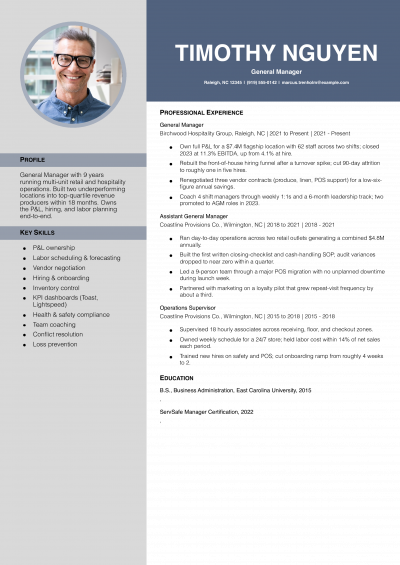
Quantified revenue or growth metrics are what get entrepreneur resumes past the initial credibility screen with investors and hiring managers; a clear narrative of scaled outcomes is what makes them readable enough to advance.
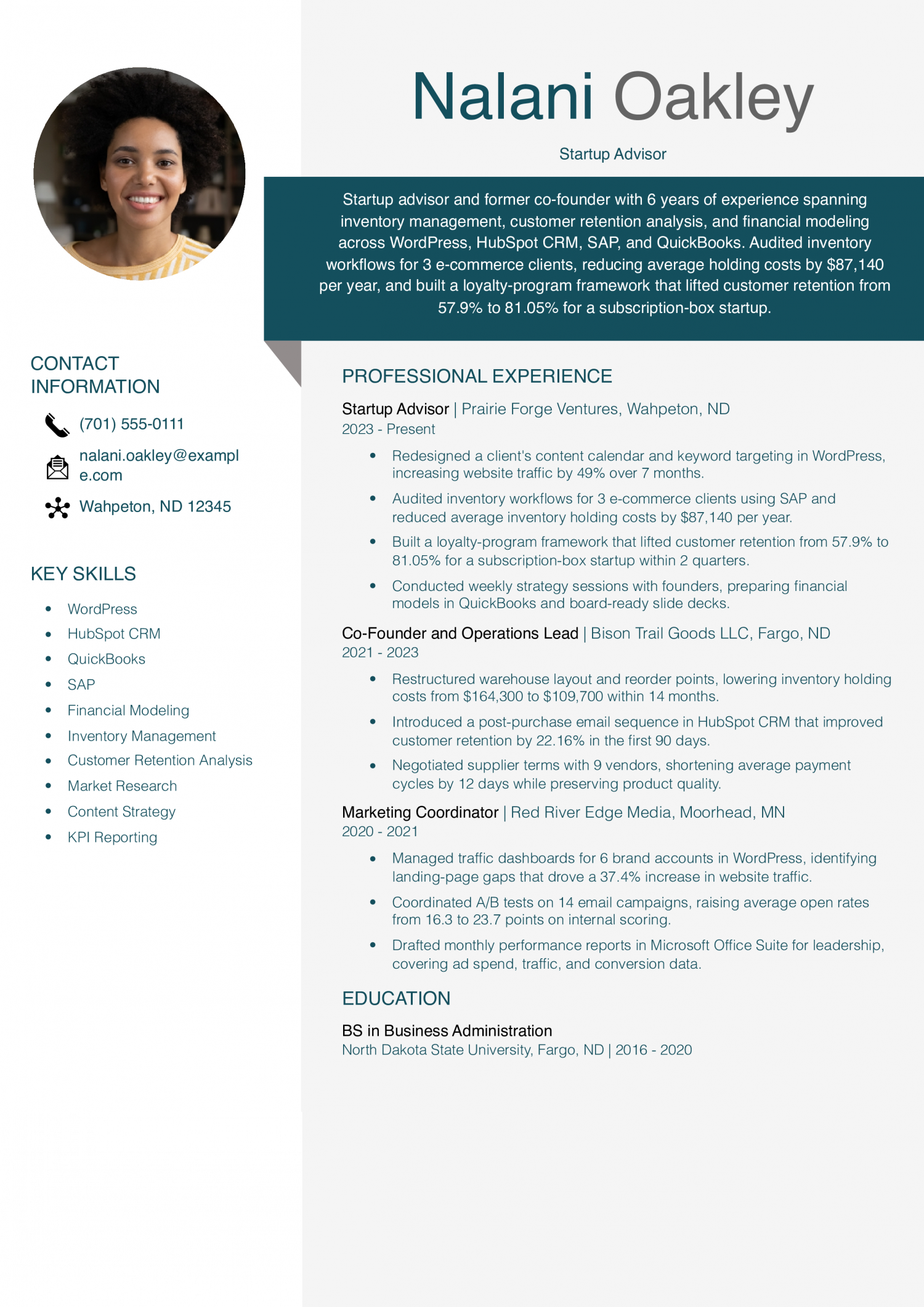
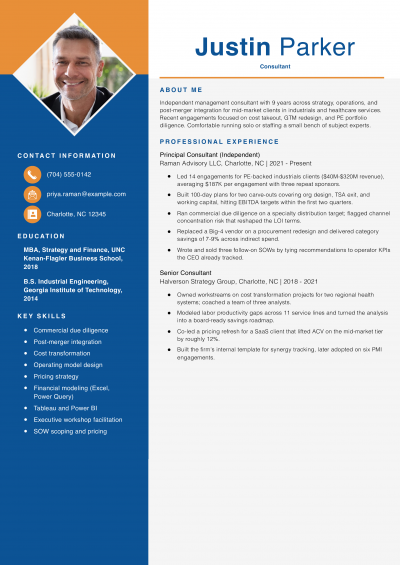
Pick this resume if you are a mid-level startup advisor who pairs hands-on founding experience with client-facing consulting work. Lead each bullet with the specific client type and measurable cost or retention shift your advisory produced.
Naming the system where the inventory audit happened helps a client see how the work was done. A client considering this consultant knows the tools in play before the first call. When you describe consulting results, say which system you worked in and what changed there.
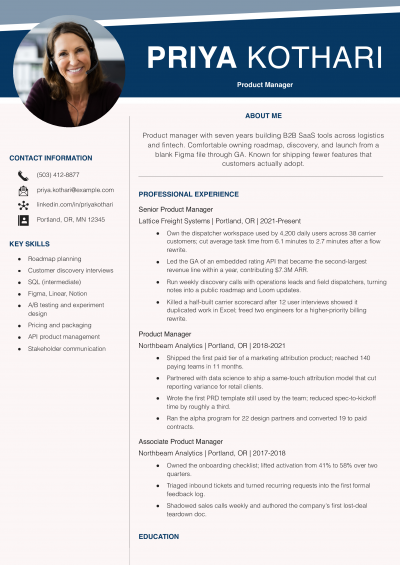
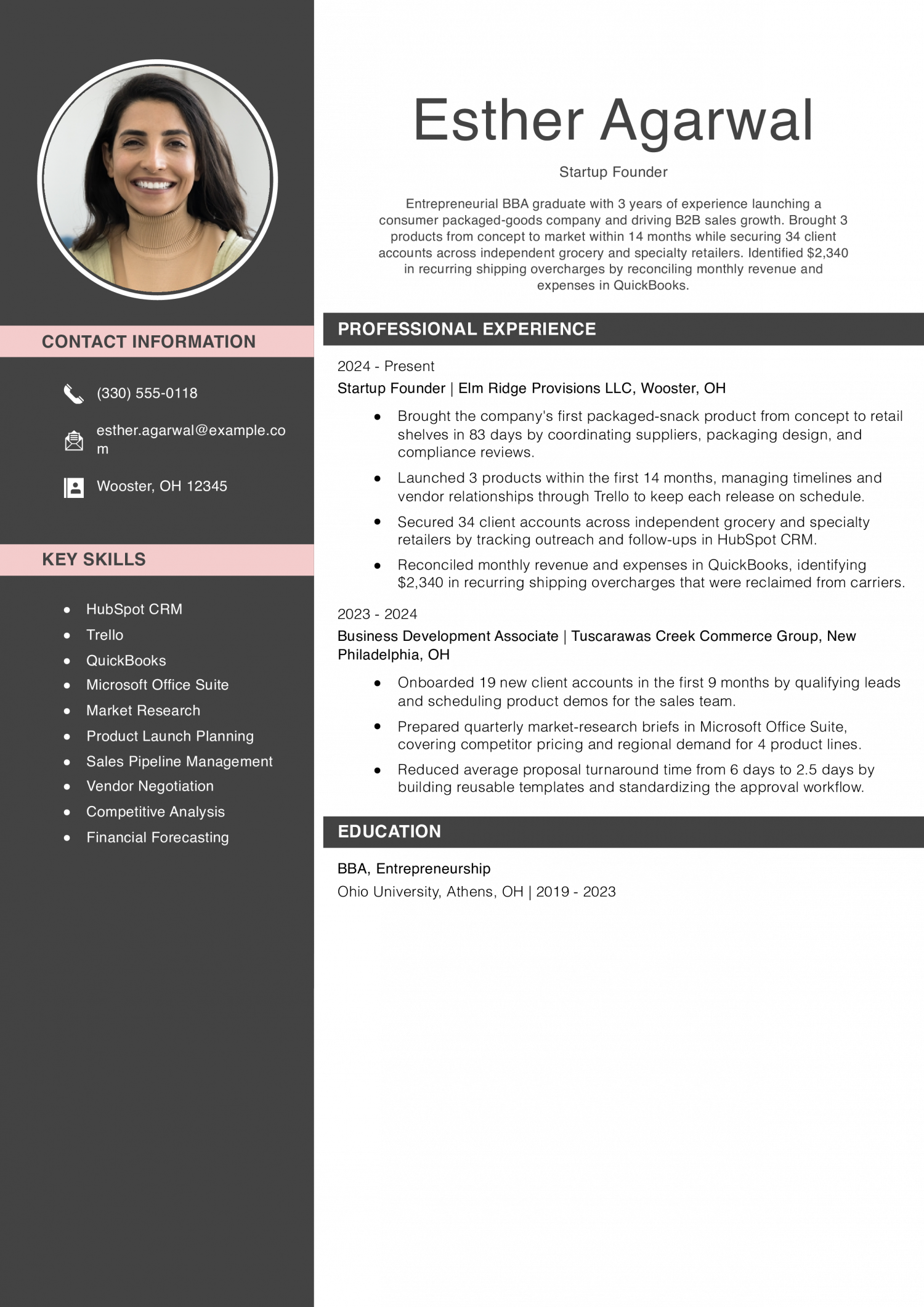
Use this resume if you are an entry-level founder who has launched a real product company while building early business development experience. Spell out the timeline from idea to shelf so readers can measure your speed.
Speed matters for a founder resume. Putting the number of days from idea to retail shelf next to the product name tells a reader how fast the company moved. If you launched something, say how long it took from first step to first sale.
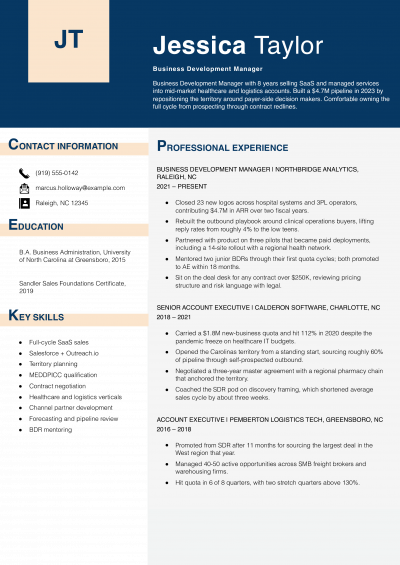
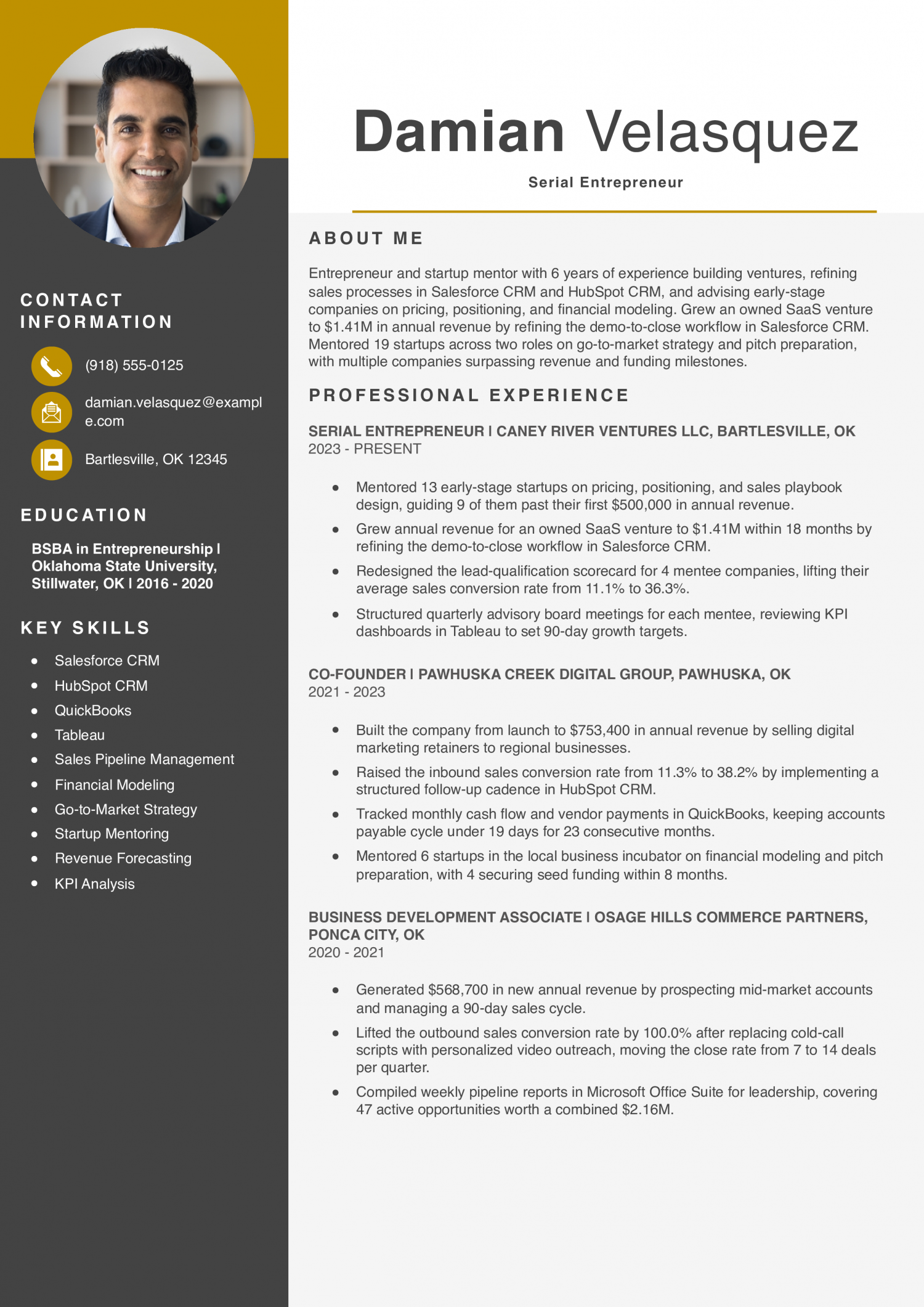
Try this resume if you are a mid-level founder who has both launched ventures and coached other startups through early revenue milestones. Spot how each bullet names the specific CRM tool or reporting platform behind every conversion and revenue gain.
A conversion rate before mentoring and a conversion rate after it show a reader whether the advice did anything. Without both numbers, mentoring is an empty claim. When you write about advising or coaching a business, include where the number started and where it ended.
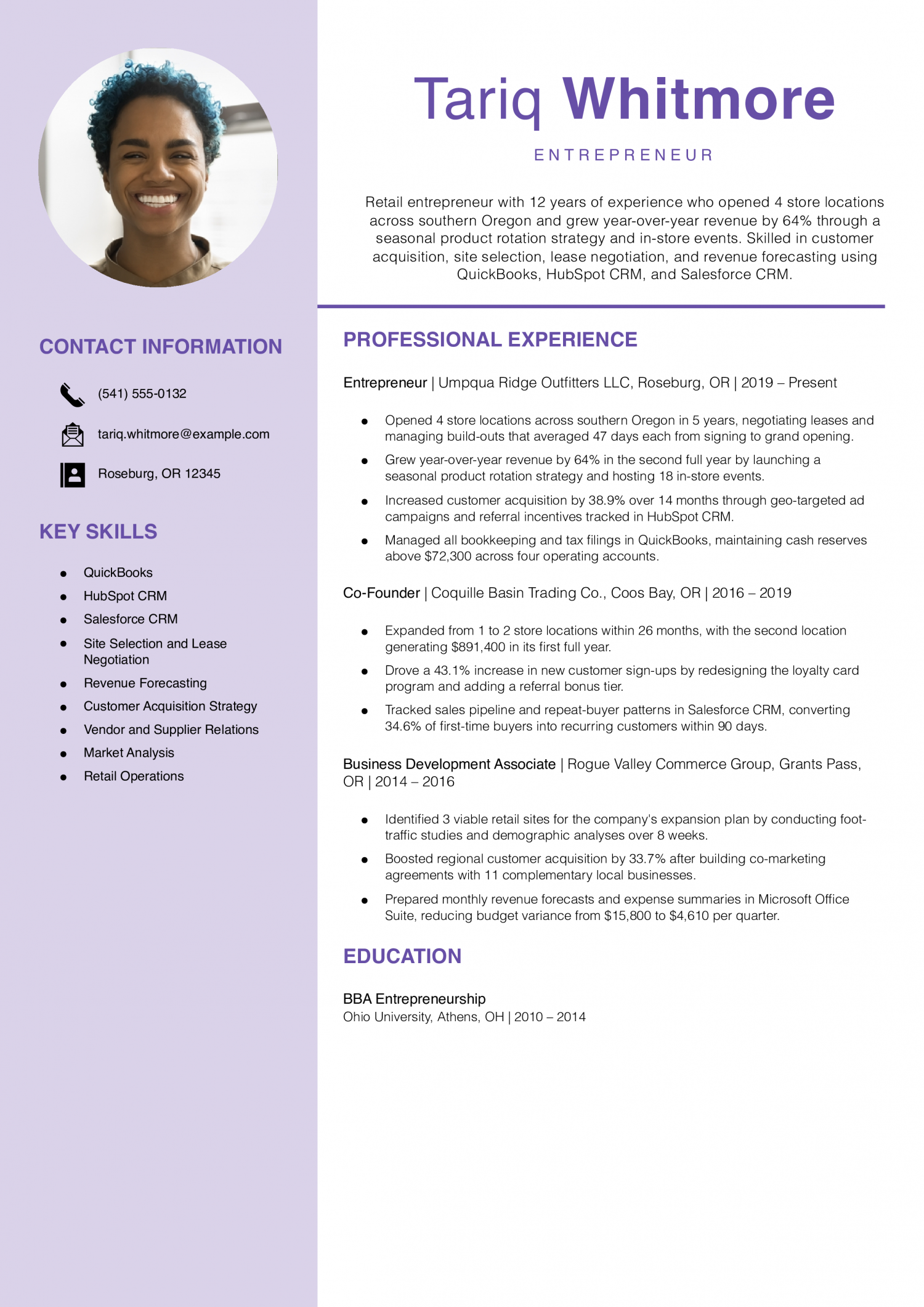
Lean on this resume if you are a senior entrepreneur with a decade-plus record of founding and scaling brick-and-mortar retail businesses. Lead with build-out timelines and lease negotiation details that prove you can repeat a location launch process.
Repeat buyers tell an investor or partner that the product keeps people coming back. This resume ties a retention rate to a time window so a reader can judge the pace. State your own repeat-buyer rate and say over how many days or months you measured it.
Combining financial modeling, vendor negotiation, and workforce planning across 7 years of experience in operations and advisory roles. Restructured pricing tiers and vendor contracts for a consumer-products client, improving their profit margin from 8.6% to 36.9%. Skilled in QuickBooks, Trello, and Microsoft Office Suite, with a record of leading cross-functional teams and delivering retention-focused programs across multiple concurrent accounts.
State how many ventures you have founded or co-founded. Name the industry you built in, such as SaaS or e-commerce.
Then note the stage you reached, whether seed, Series A, or profitable exit. Hiring managers and startup investors scan this block first. They want to know your scale.
A profile that reads “founded two B2B SaaS companies” is stronger than one that says “experienced leader” because it is concrete and specific. Add your revenue band or team size in this same block. Keep it to three or four lines.
Every word should prove you ran a real business, not a side project.
Strong entrepreneur resumes lead with numbers. Start each bullet with a metric. State the revenue you generated or the funding you raised.
Name the growth rate you drove over a clear time frame. For example, write “grew monthly recurring revenue from $12K to $210K in 18 months.” Team size matters too. Note how many people you hired and managed.
Bullets without a number read as job descriptions. Include customer counts or retention rates when you have them. Cost savings also work well.
If you cut burn rate by 30%, say so. Hiring managers and startup investors compare founders by the outcomes they can prove on paper.
Entrepreneur roles touch many areas at once. Organize your bullets into three to five groups so readers can scan them fast. Product development is one strong category, and it covers roadmap planning and feature launches.
Business development is another group. It covers sales pipelines and partnership deals. Operations is a third, and it includes vendor contracts and supply chain work.
You can also add a fundraising category for pitch decks and investor relations. A final group could cover hiring and culture building. Use bold subheadings or separate entries for each category so the layout stays clear.
This structure keeps your resume from looking like a wall of text. It also helps hiring managers find the skills that matter most to their open role.
Create a short credentials block on page one, right below your profile, and list the tools you used to run your ventures. CRM platforms like HubSpot or Salesforce belong here. Analytics tools such as Google Analytics or Mixpanel do too.
Add project management software like Asana or Jira. If you hold a relevant degree, name it in this block. Hiring managers want to spot technical fluency early, so put these details where they are hard to miss.
Financial modeling skills in Excel or Google Sheets are worth naming. Include any payment or e-commerce platforms you configured. Keep each entry to two or three words.
A clean block signals that you built with real systems, not theoretical ones.
Your resume should center on your ventures. Early career roles that came before your first company add length without value. Remove them, or compress each into one line.
An internship from ten years ago does not help your case. Board seats or advisory roles deserve their own short section. Keep those to one bullet each.
If your venture history spans more than 15 years, trim older entries to a company name and date range. Drop any bullet that repeats a skill you already proved elsewhere on the page. Hiring managers and startup investors spend about seven seconds on a first scan.
Every line must earn that time or it works against you.
Five years ago, an entrepreneur resume read like a pitch deck summary. The mix has shifted toward financial modeling and growth metrics. Hiring managers and startup investors now scan for proof you can build and scale.
Soft skills appear in the first table below. Hard skills appear in the second table. These are the terms that ATS filters check before a human sees your file. Soft skills show how you lead teams and handle setbacks.
Read the target job posting before you touch your resume. Pull skill phrases from that posting word for word. Place each matching term in your skills section near the top. Then weave those same terms into your bullet points.
Hiring managers and startup investors weigh revenue forecasting and financial modeling first. They then look for soft skills such as leadership. Treat soft skills as evidence that backs each result you list. One strong example per skill is enough to hold attention.
| Soft Skills | AI-estimated % |
|---|---|
| Risk tolerance | 79% |
| Visionary thinking | 65% |
| Resilience under pressure | 42% |
| Stakeholder persuasion | 38% |
| Decisive leadership | 27% |
And here are the top hard skills showing up most often.
| Hard Skills | AI-estimated % |
|---|---|
| Business plan development | 80% |
| Revenue model design | 55% |
| Startup fundraising | 43% |
| Financial forecasting | 39% |
| Market opportunity analysis | 27% |
Skill names and rankings come from an AI model grounded in U.S. Department of Labor occupation data for entrepreneurs, not from a count of entrepreneurs’ resumes built on ResumeTemplates.com.
The section below covers which AI tools to name and which to skip.
What hiring managers and startup investors expect on an entrepreneur resume has shifted. Listing every tool you touched once now reads as padding. Naming one or two tools with clear output checks reads as credible.
Investors want to see how you used AI to cut costs. They also want proof a human reviewed every result. Your resume should show the workflow, not the brand name.
State what you built, what the tool handled, and what you verified. Keep each claim tied to a metric you can defend in a pitch meeting. The section that follows spells out what belongs and what to leave off.
What AI is actually changing for this role
Market research: Founders use AI to scan competitor data and spot gaps, then validate findings with customer interviews.
Financial modeling: AI tools draft revenue projections faster, but investors still expect you to stress-test every assumption.
Content and outreach: Entrepreneurs draft pitch decks and cold emails with AI, then edit for tone and accuracy.
Product prototyping: AI code assistants help solo founders ship MVPs sooner, cutting early development costs by weeks.
Hiring and ops: AI screens applicant pools and drafts job posts, though founders review each shortlist before interviews.
AI tools to name
How to phrase AI on your resume
Do
Skip
Hiring managers and startup investors want to see that your ventures followed a clear pattern, not a random scatter of side projects. Group your client and customer work by industry vertical, revenue stage, or business model so reviewers can spot your focus areas at a glance. This structure also helps you show repeat expertise rather than one-off experiments.
Choose the grouping method that highlights your strongest results. If you built three SaaS products for small retailers, cluster them under one heading with combined revenue or user counts. If you served clients across industries but always handled the same function, group by service type instead.
Keep each cluster to three or four entries at most. A long, undivided list suggests a lack of direction, while tight clusters signal strategic thinking and domain knowledge.
Resume Templates offers HR approved resume templates to help you create a professional resume in minutes. Choose from several template options and even pre-populate a resume from your profile.
Yes, you can list entrepreneur as a job title on your resume. Use it under the company name, then follow with bullets that describe measurable results. Hiring managers and startup investors look for proof of what you built, not the title alone.
Choose the title that matches the role you are targeting. Business owner signals operational management of an established company. Entrepreneur signals that you identified a market gap and built something new, which fits venture-backed or startup roles better.
Yes, a resume is useful even if you plan to stay self-employed. Investors, accelerator programs, and strategic partners often request one before a meeting. A clear resume also helps when you apply for advisory boards or speaking engagements.
Start each bullet with an action verb and attach a number to the outcome. For example, write "Grew monthly recurring revenue from $8K to $62K in 14 months." Focus on results you drove rather than duties you held.
It follows a standard reverse-chronological format with your venture listed as a job. The top third holds a profile summary, key metrics, and a short skills list. Below that, each venture gets its own entry with the company name, your title, and dated bullet points.
List the venture and focus on transferable skills you gained from it. A failed business still shows you managed budgets, led a team, or acquired customers. State what you accomplished during that period rather than why the business closed.
Fill the gap with consulting, freelance projects, or relevant coursework you completed. Even short advisory roles count as professional activity worth listing. If no paid work took place, note the research or planning phase for your next venture.
An ATS-friendly template helps you show your business results and leadership history in clear sections. A basic template is a strong pick too.
Entrepreneur Resume
4.8/5 stars with 201 reviews

Executive Resume Writer and Career Coach
Andrew Stoner is an executive career coach and resume writer with 17 years of experience as a hiring manager and operations leader at two Fortune 500 Financial Services companies, and as the career services director at two major university business schools.
© 2026 Resumetemplates.com All rights reserved.