Designer Resume Examples and Templates for 2026



The fashion designer resumes that advance share three things: a portfolio link in the header that loads on first click, sell-through or margin numbers tied to specific collections, and category scope a brand merchandiser can read in under 30 seconds.
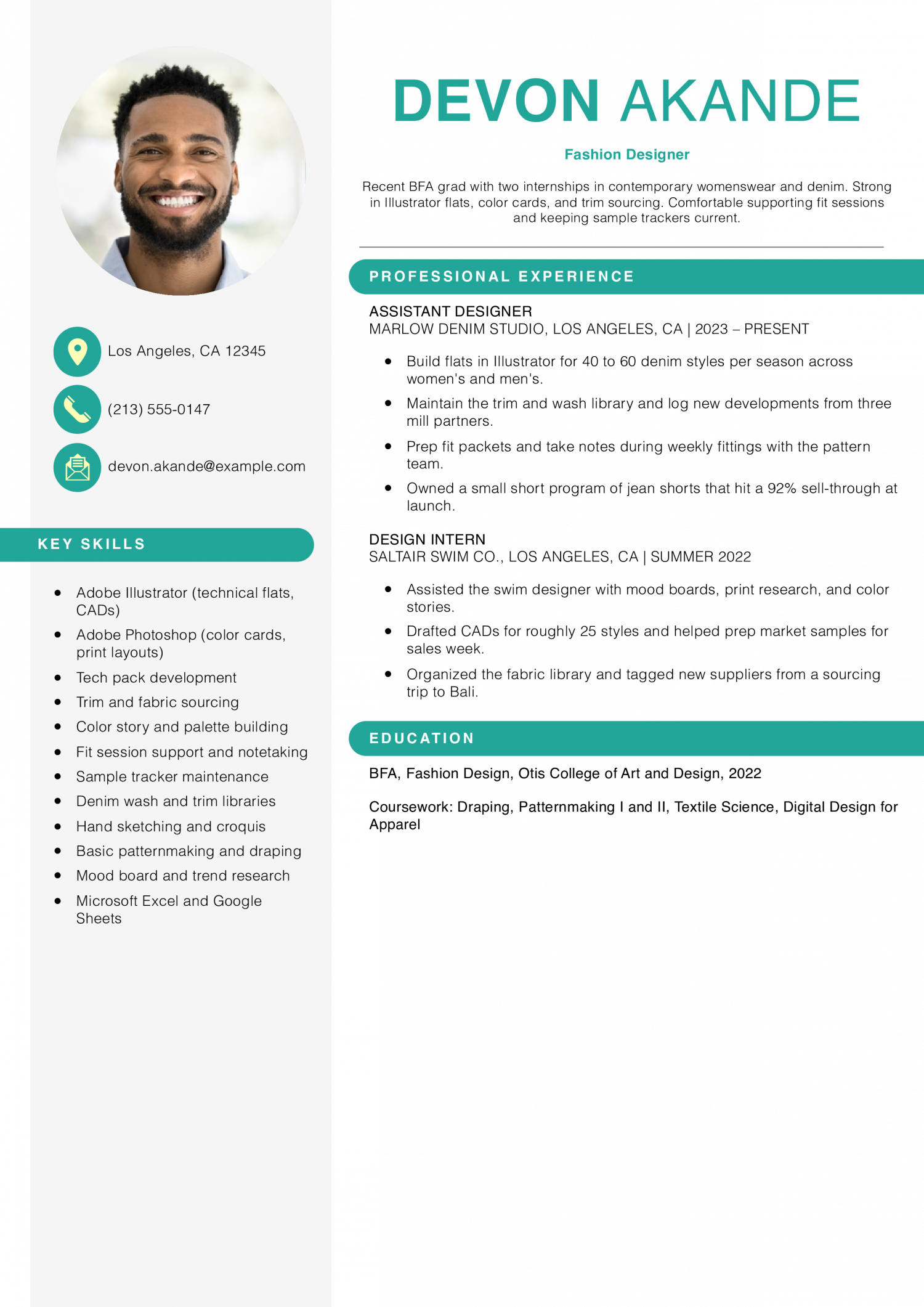
Assistant designers are one to three years in, supporting a senior or lead designer on trims, sourcing, and tech pack edits. This resume needs to prove fluency in Illustrator flats, fabric handling, and how you moved styles from sketch to fit sample.
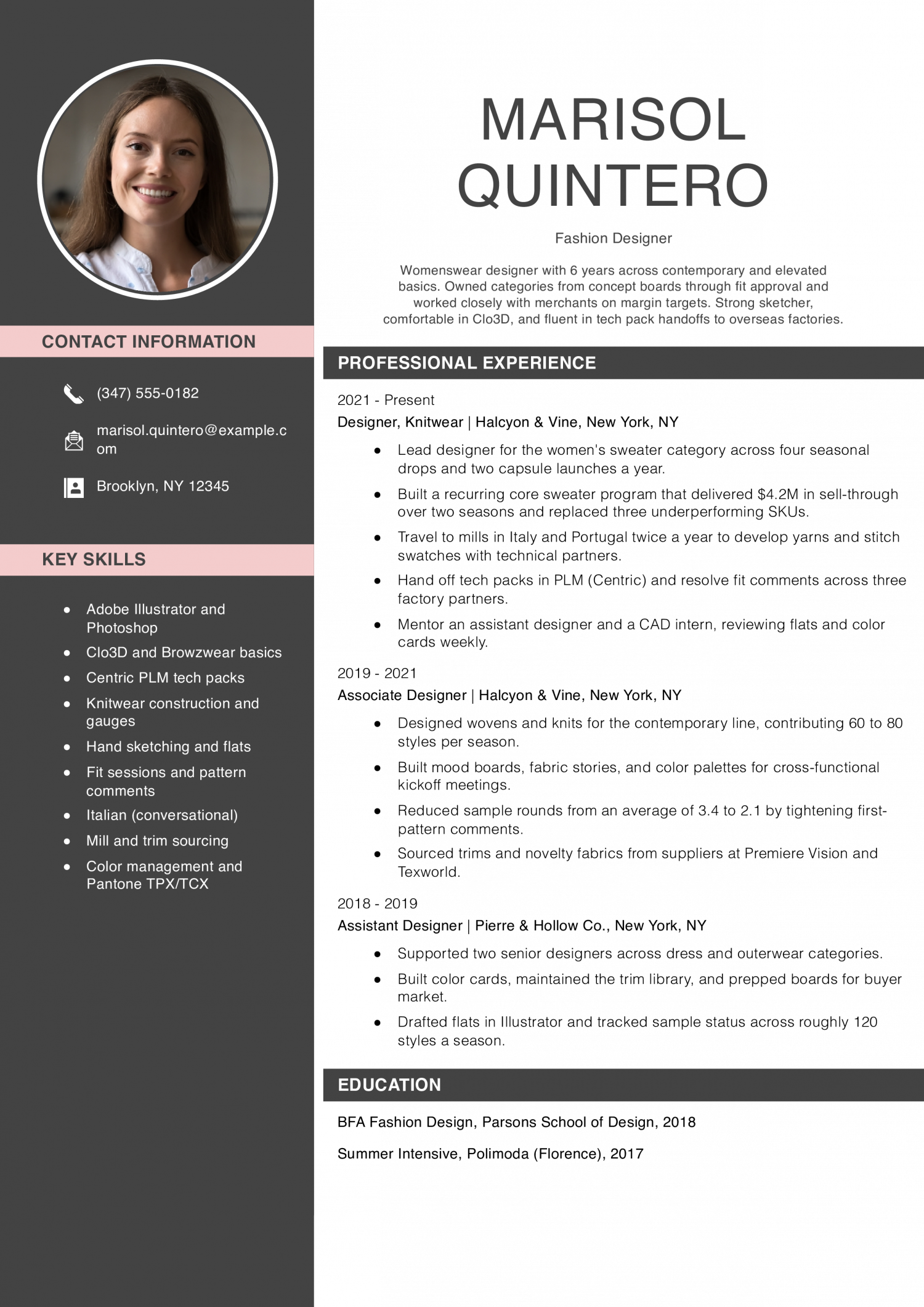
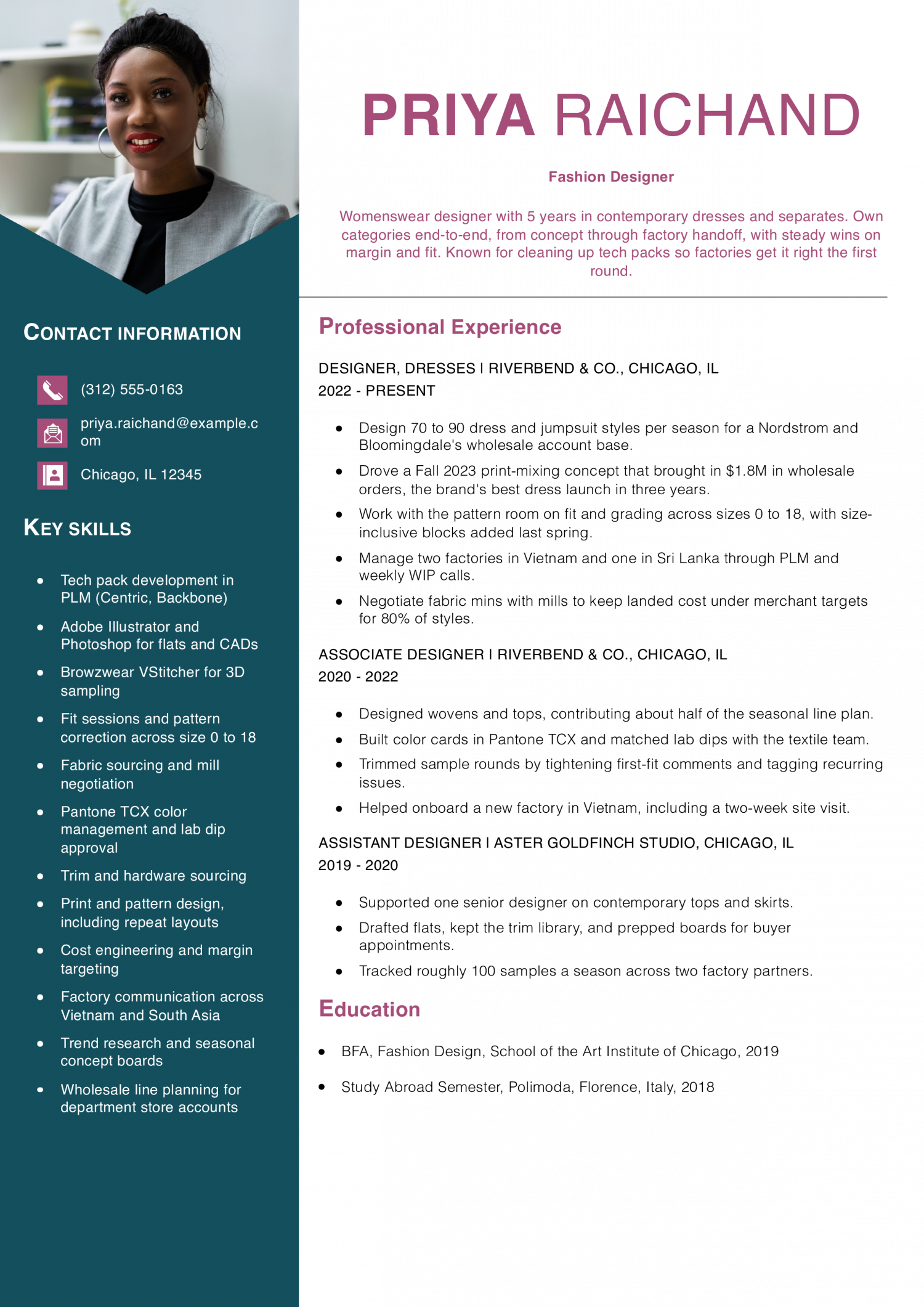
Designers own categories or capsule collections from research through handoff to production. This resume needs to prove sell-through or margin results, the tech pack volume you ship per season, and the vendors you brief directly.
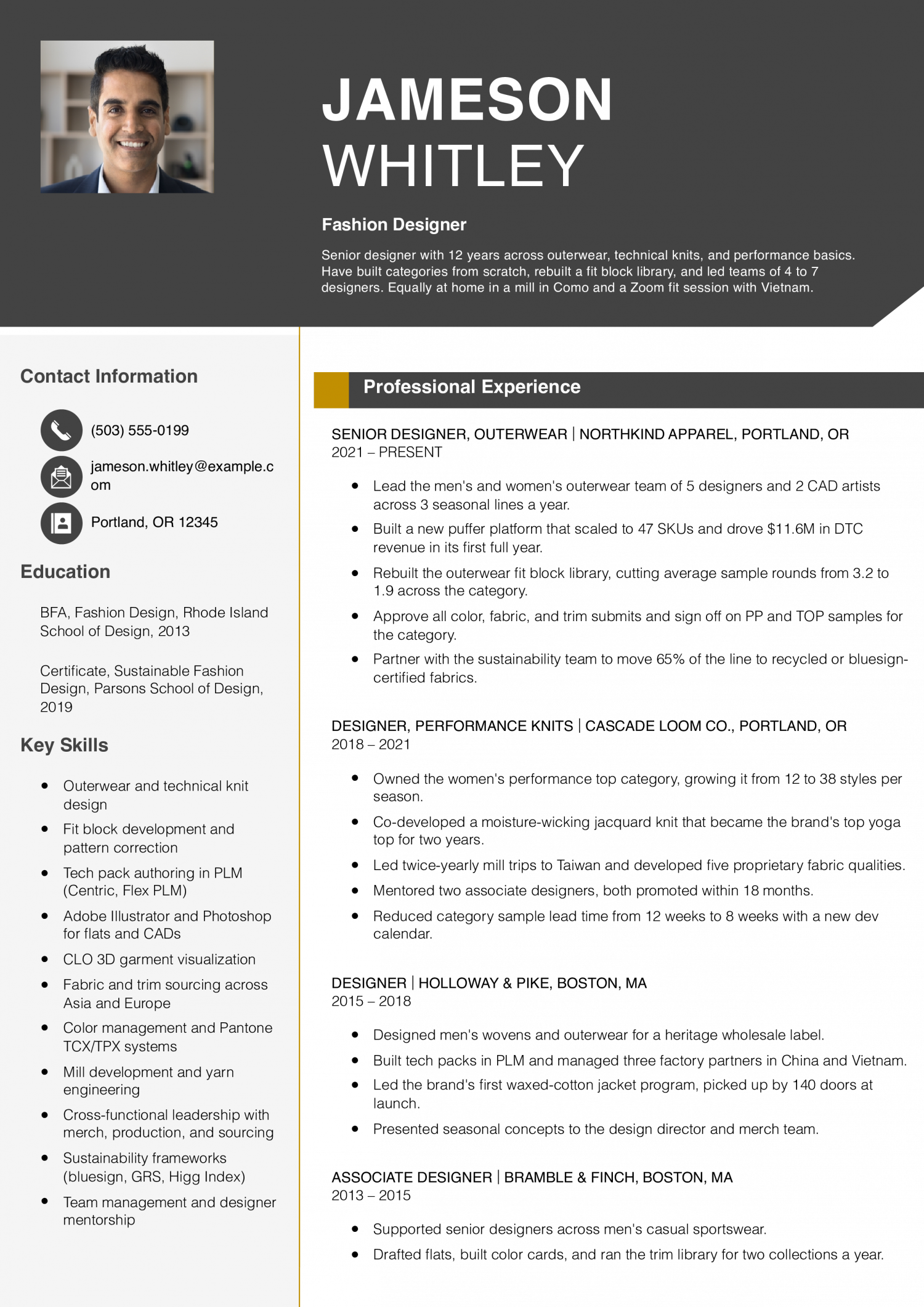
Senior designers lead a category, manage assistants, and sit in the room on line plans and costing. This resume needs to prove team scope, the seasonal revenue your collections drove, and the brand voice you set against a merchandising calendar.
Elena Ochoa-Reyes
Austin, TX | (512) 555-0124 | [email protected] | linkedin.com/in/elenaochoareyes
Womenswear designer with 8 years across contemporary tops, dresses, and elevated basics. Have owned categories from concept through factory handoff, led small teams, and pushed steady margin and fit gains. Strong technical foundation paired with a clean, salable aesthetic for wholesale and DTC.
Senior Designer, Tops and Knits
Greyfield Studio | Austin, TX | 2022-Present
Designer, Knit Tops
Sable Harbor Co. | Dallas, TX | 2020-2022
Associate Designer
Linden Row Apparel | Houston, TX | 2018-2020
Assistant Designer
Magnolia Pine Studio | Houston, TX | 2016-2018
Design Intern
Acadia Blue Swim | Miami, FL | Summer 2015
Your profile should state your years in design, the categories you own (womenswear contemporary, menswear tailoring, kids activewear, intimates), and the price tier you have shipped at (mass, contemporary, bridge, luxury).
Name the brand types in your track record: heritage label, DTC startup, private-label supplier, or licensee. Add the seasonal cadence you run (four drops a year, two main collections, monthly capsules) so design directors can map your rhythm to theirs before reading further.
Most strong fashion designer bullets carry a number tied to commercial outcome. Lead with sell-through percentage, gross margin lift, reorder rate, or seasonal revenue for the styles you owned.
If your studio does not share margin data, pivot to volume and scope: SKUs shipped per season, tech packs written, vendors briefed, or styles carried into a second season. A bullet without any number reads as a duty, not a contribution.
Cluster your work so brand merchandisers can scan it. Useful buckets are research and concept (mood boards, trend reports, color stories), design development (sketches, flats, CAD, print and embroidery direction), technical (tech packs, BOMs, fit comments, grading notes), and vendor and production (sourcing, costing reviews, lab dip approvals).
Carry the bucket structure across roles so your progression is legible. Same headings, deeper scope each step up.
Adobe Illustrator, Photoshop, and one CAD or 3D tool (CLO 3D, Browzwear, Optitex) belong in a tools line directly under your profile. Add PLM systems you have used (Centric, Bamboo Rose, FlexPLM) since brands filter on these.
Put your portfolio URL in the header next to your email. Design directors will click before they read; a broken link or a slow site kills the screen before your experience section gets a look.
Cut school projects once you have two seasons of professional work shipped. Cut software you have only touched in a class, and cut soft-skill lists like creative and detail-oriented without a bullet behind them.
Trim early roles to two or three bullets each so the most recent collection work carries the page. If your portfolio shows the aesthetic, the resume should carry the scope, the numbers, and the categories.
Fashion hiring is tight in 2026. Design teams are running leaner across DTC and contemporary brands, and the screen-clearing bar is higher. Design directors weigh hard skills like Illustrator, CLO 3D, and tech pack authorship as gating, then read soft skills as evidence behind your bullets.
Match the list below against the posting, and use the soft skills to frame how you ran a season, not as standalone claims. The hard skills come from our user-built fashion designer resumes.
| Soft Skills | % of resumes with this skill |
|---|---|
| Creativity | 65% |
| Attention to detail | 51% |
| Communication | 47% |
| Team collaboration | 40% |
| Time management | 25% |
And here are the top hard skills showing up most often.
| Hard Skills | % of resumes with this skill |
|---|---|
| Fashion sketching | 71% |
| CAD design software | 56% |
| Pattern making | 50% |
| Garment construction | 39% |
| Textile knowledge | 27% |
Based on data from thousands of fashion designers’ resumes built on ResumeTemplates.com, May 2026.
The items below are what separate a fashion designer resume from one that gets put back in the pile.
Design directors and brand merchandisers expect a niche keyword footprint that matches the category and price tier on the posting. Use the rows below to mirror the language used in the listing.
| Niche | Keywords ATS scans for |
|---|---|
| Apparel design and development | apparel designer, fashion designer, garment construction, sketch to production |
| Technical design | tech packs, BOM management, fit comments, grading notes |
| Fashion technology and 3D | CLO 3D, Browzwear, 3D garment sampling, digital prototyping |
| PLM and production | Centric PLM, FlexPLM, lab dip approval, vendor sourcing |
| Trend and concept | trend research, mood board development, color story, seasonal concept |
AI use on a fashion designer resume can go three ways: lead with AI-powered designer (which design directors screen out), leave it off entirely (which reads as evasive in 2026), or describe where the tools sit in your process and what you decide after. The third is what brand merchandisers can validate.
Midjourney and Firefly compress the first pass on direction; the judgment shifts to which thread is commercially viable.
Generative fill in Photoshop produces dozens of variants per hour; designers now edit and curate rather than originate every option.
PLM-integrated assistants pre-fill measurement tables and care labels, leaving you to verify and adjust against fit history.
Trend platforms now summarize runway and retail data; the value is choosing which signals your brand actually acts on.
Your portfolio is the gate. Design directors look at the work before they read a single bullet, so the link in your header has to load fast and lead with the strongest collection for the brand you are targeting.
Clean grid layouts, fast loads, and you keep the URL across job changes.
Included with Creative Cloud and pulls cleanly from Behance for designers already in the Adobe stack.
Good for discovery and visibility; weaker as a primary link because layouts and ads dilute the work.
File-size limits and inconsistent rendering kill the first impression; use only as a leave-behind after interviews.
Lead with one collection, not ten. Show one cohesive concept-to-runway or concept-to-retail story up top: research, mood, flats, fabric, and final looks or product photography. Recruiters bounce when they see six projects on the landing page with no hierarchy.
Match the portfolio to the brand. If you are applying to a contemporary womenswear label, lead with your contemporary womenswear work. Reorder the landing page per application. Hide bridal capsule projects when you are targeting activewear.
Caption the commercial story. Under each project, note the season, the role you played (sole designer, supporting designer, freelance), and the result if you have it (sell-through, reorders, press). Pretty boards without context read as student work.
Brands filter on specific tools, not on Adobe Creative Suite as a blanket phrase. Name the applications and versions you actually use in production work.
Awards and press carry weight when they are tied to a specific collection or season. List them in a dedicated section under experience so brand merchandisers can map the recognition to the work.
A design degree or strong portfolio keeps you eligible. The certifications below are what move a fashion designer resume from the qualified-but-typical stack into a brand merchandiser’s shortlist. List each with the issuing body and year completed.
For fashion designers, the spread between the entry-tier floor and the top-decile ceiling is wide, and most of the movement comes from category scope, price tier, and which city you are willing to work in. Brand size matters less than whether your collections drive sell-through that buyers and merchants can name.
Lead your resume with the categories you own, the price tier you ship at, and the commercial results that map to where you want to land on that spread.
| # | State | Avg. Annual |
|---|---|---|
| 1 | Tennessee | $142,500 |
| 2 | Oregon | $125,310 |
| 3 | Massachusetts | $99,340 |
| 4 | New York | $96,420 |
| 5 | New Hampshire | $88,230 |
| 6 | Virginia | $85,870 |
| 7 | Colorado | $85,680 |
| 8 | New Jersey | $84,020 |
| 9 | Missouri | $81,700 |
| 10 | Pennsylvania | $78,950 |
| # | State | Workers | Median |
|---|---|---|---|
| 1 | New York | 6,600 | $96,420 |
| 2 | California | 5,610 | N/A |
| 3 | Texas | 1,800 | N/A |
| 4 | Oregon | 1,140 | $125,310 |
| 5 | Florida | 840 | $43,920 |
Resume Templates offers HR approved resume templates to help you create a professional resume in minutes. Choose from several template options and even pre-populate a resume from your profile.
Yes. Put the URL in the header next to your email, not buried at the bottom.
Design directors click before they read the experience section. A missing or broken link ends the screen.
Host on a custom domain or a clean Squarespace, Cargo, or Adobe Portfolio site. Avoid PDF-only portfolios over 10 MB.
Use a single-column reverse-chronological format in a clean serif or sans-serif.
Skip heavy graphics, icons, and skill bars. ATS parsers drop them, and design directors read the aesthetic in your portfolio.
Pivot to scope. Name SKUs shipped per season, tech packs authored, vendors briefed, and styles carried into a second season.
You can also cite published press, retailer pickups, or buyer reorders by name. Volume and continuation read as commercial signal when percentages are confidential.
Name the tool inside a bullet that shows the workflow, not in a buzzword line.
Say where it sat in your process (mood boards, print exploration, colorway iteration) and what judgment you applied after.
Design directors have started screening out resumes that lead with AI-powered designer or generative fashion innovator.
For a fashion designer, a modern template is the safest pick, because it shows visual polish while keeping your work the focus. A creative template is a solid alternative. Whichever you choose, keep the formatting clean and easy to parse: clear section headings, a standard font, and no graphics a parser can choke on.
Executive Resume Writer and Career Coach
Andrew Stoner is an executive career coach and resume writer with 17 years of experience as a hiring manager and operations leader at two Fortune 500 Financial Services companies, and as the career services director at two major university business schools.