Animator Resume Examples and Templates for 2026



Art directors decide whether to open a resume by what they see in the portfolio's first three thumbnails; if a consistent style and a named client aren't visible there, the resume rarely gets clicked.
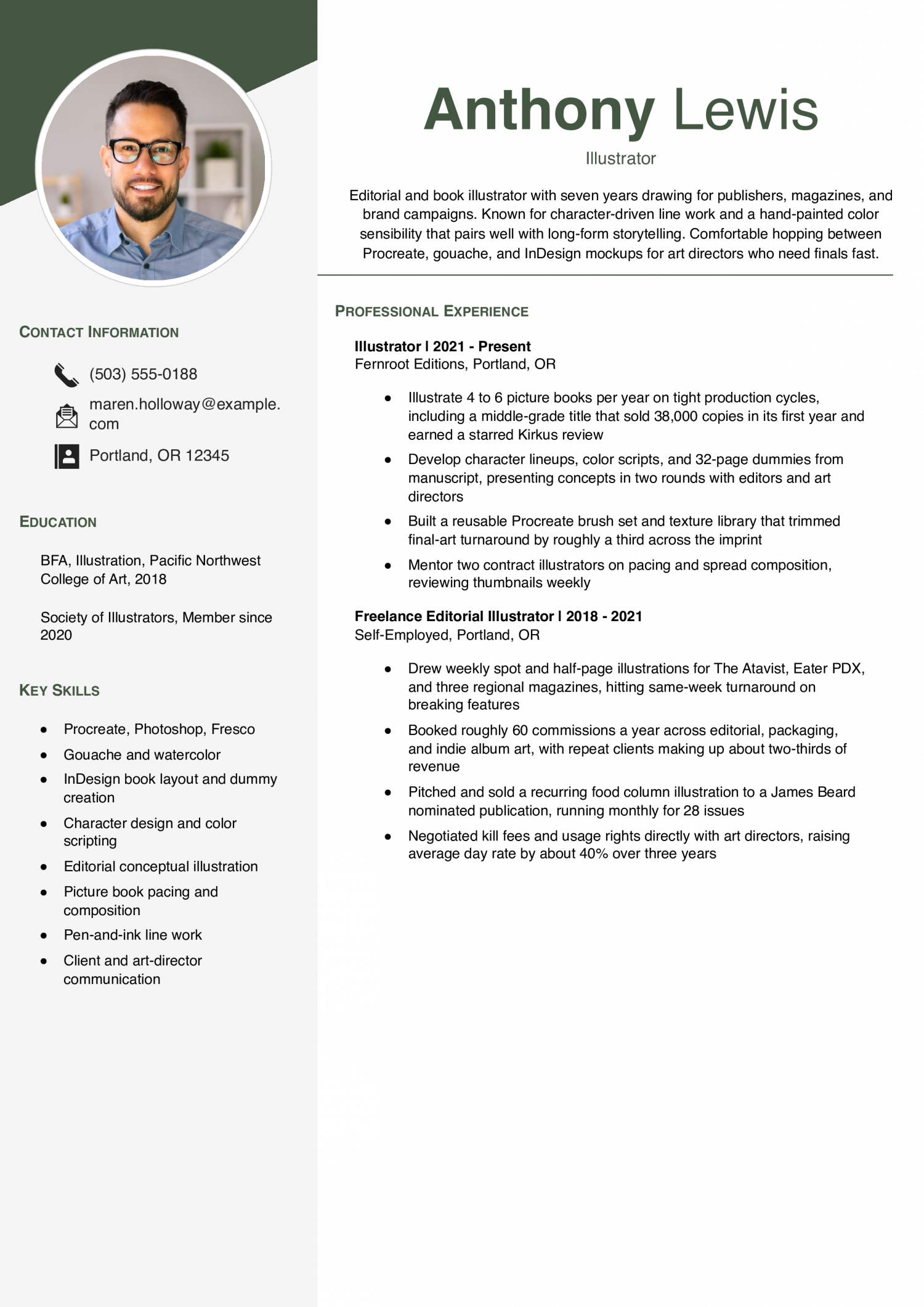
The junior illustrator resume covers the first two or three years out of program or self-taught practice. It needs to prove a working style, finished pieces under a real brief, and basic command of Procreate, Photoshop, and Illustrator.
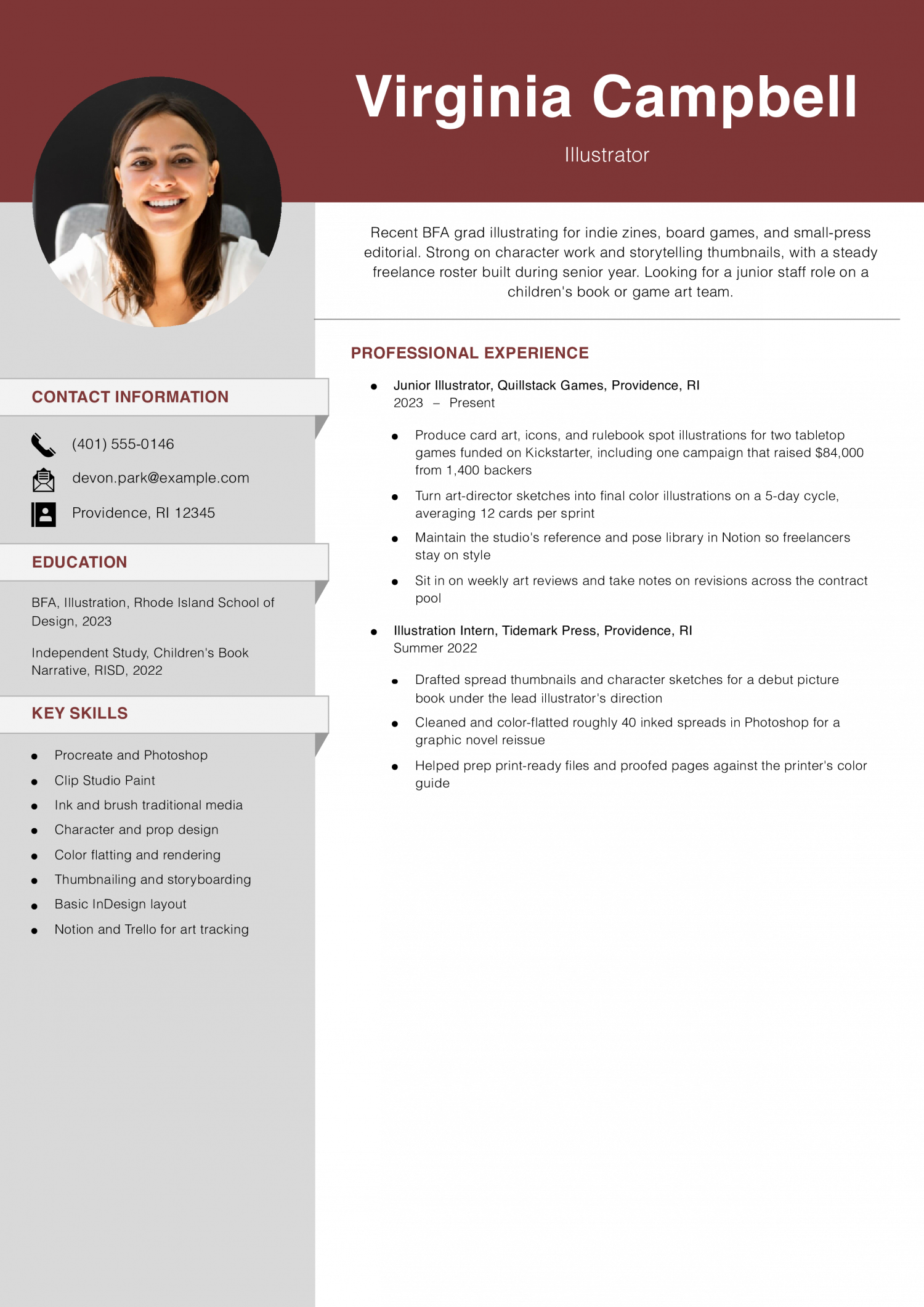
The senior illustrator resume covers six-plus years with a named client roster and repeat work. It needs to prove deadline reliability across mediums, art direction collaboration, and published or licensed credits a reader can verify.
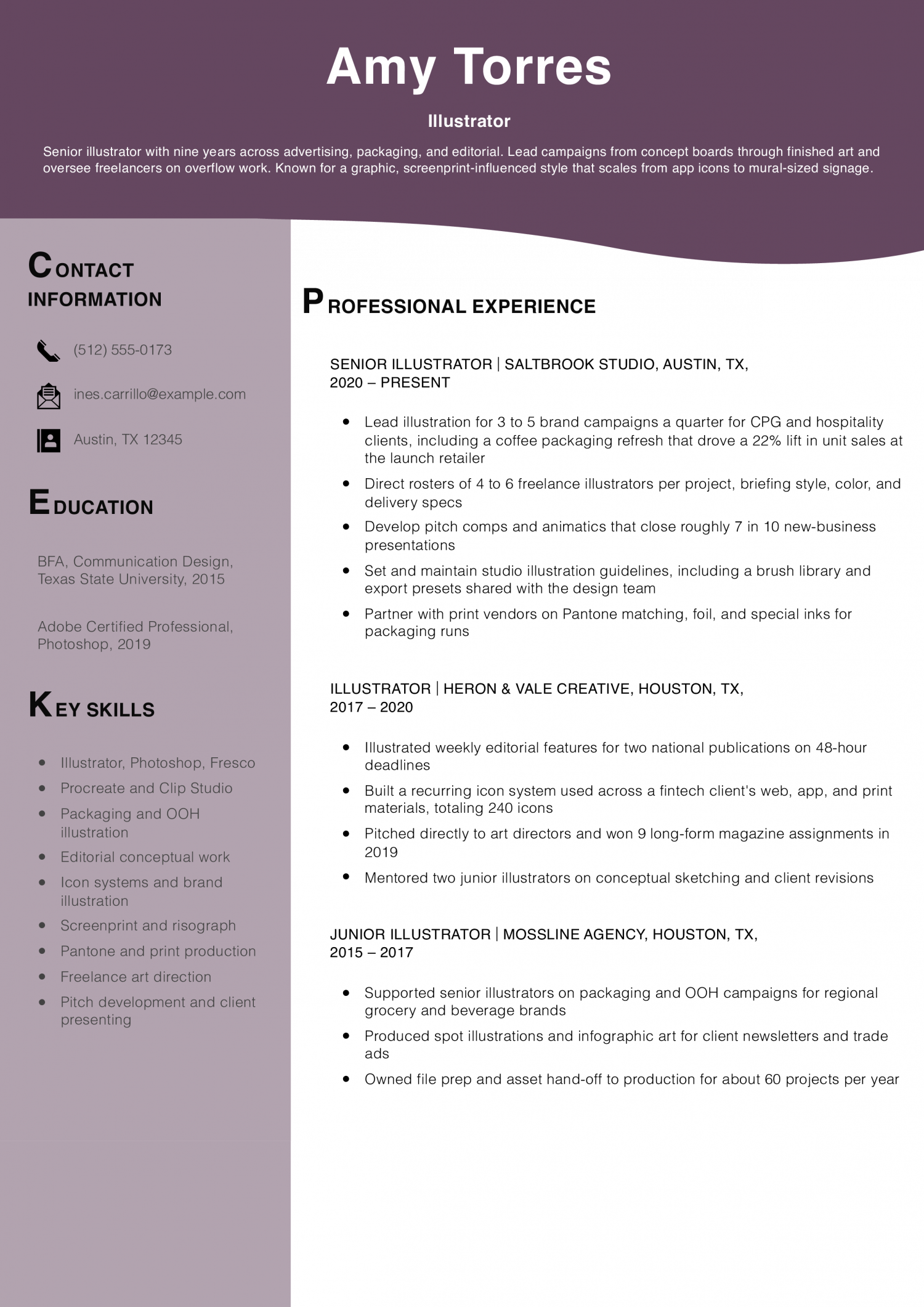
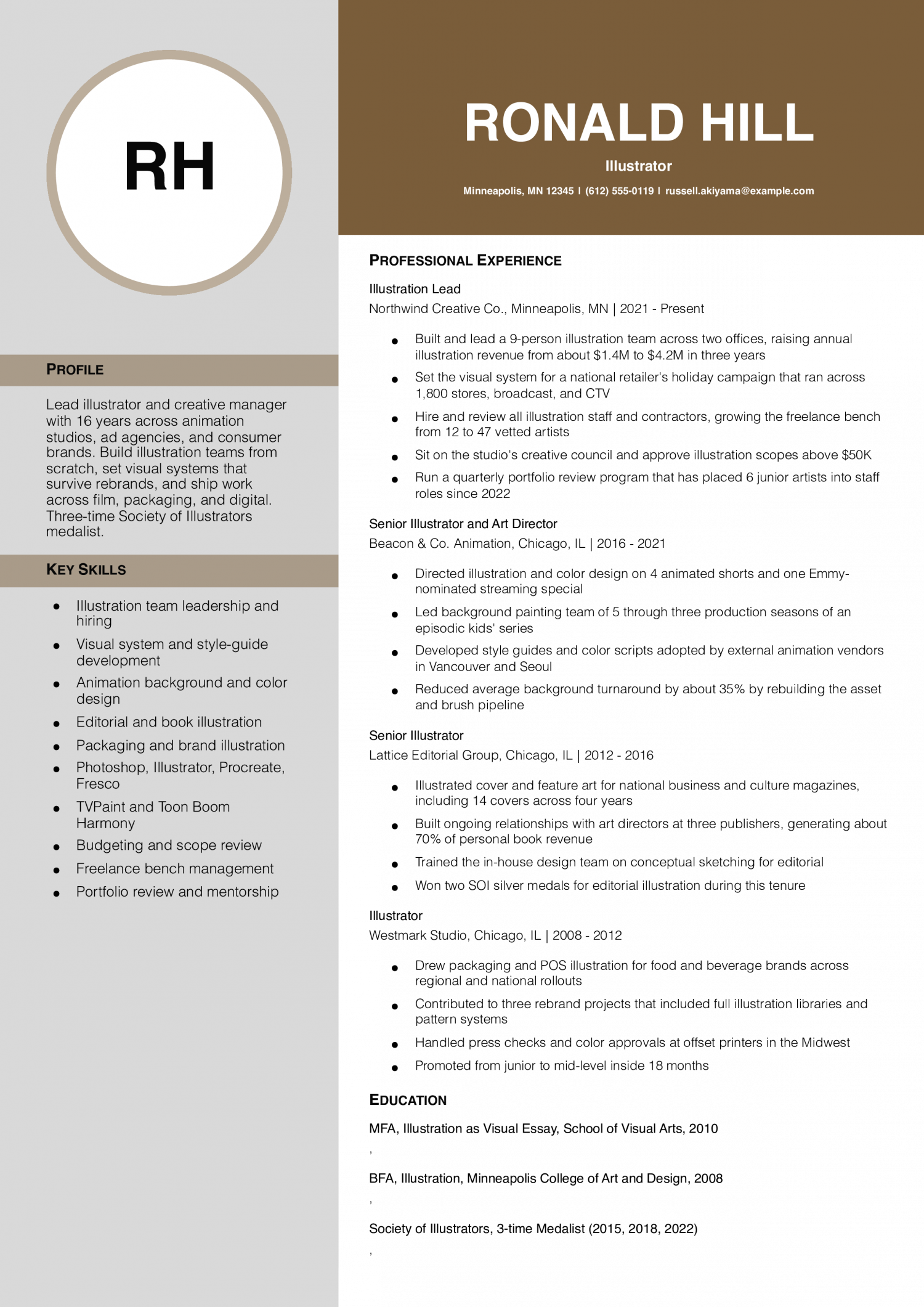
The lead illustrator resume covers studio leads, art direction, and franchise or IP work. It needs to prove you set visual direction for a team, hand off style guides, and ship across formats from editorial to packaging to motion.
Illustrator with 11 years across editorial, children’s publishing, and brand campaigns. Mix of digital and traditional media, with a portfolio that spans New York Times op-eds, three published picture books, and apparel collaborations. Comfortable owning a project from concept sketches through final delivery and press approval.
Your profile belongs at the top of page one. State your years working as an illustrator, the mediums you ship in (editorial, children’s book, concept, packaging, surface, motion frames), and the brief types you turn around weekly.
Name the style range in plain words. A reader should know in two lines whether you do flat vector editorial, painterly digital cover work, or board-ready concept art. Close the profile with the portfolio URL on its own line so it survives a paste into any applicant tracking system.
Most strong illustrator bullets carry a number. Recruiters scan for three patterns first: pieces shipped per year, turnaround time on a typical brief, and the reach of the final placement.
Write bullets like “Delivered 42 editorial spots for a national news weekly on 48-hour turnarounds” or “Illustrated a picture book that sold 60,000 copies in its first printing.” Bullets without a number tend to read as duties, not credits, and credits are what move an illustrator resume up the stack.
Cluster your work so a scanner reads scope in one pass. Useful categories include editorial illustration, book and cover work, brand and packaging, concept and visual development, and licensed or merchandised art.
Under each category, name two or three signature pieces with the client, the publication, or the product line. Add medium next to each: gouache, digital Procreate, vector, 3D blockout. This is how art directors confirm you can hold a style across a campaign, not just on one hero image.
Put a credentials block on page one, right under the profile. List your core stack (Procreate, Adobe Photoshop, Adobe Illustrator, Adobe Fresco, Blender or Cinema 4D if relevant) and your file delivery range (CMYK print, RGB web, layered PSD, vector EPS).
Add a short “selected clients” line in the same block: three to six recognizable names. Art directors and creative leads use that line to gauge tier before they read a single bullet, so put it above the experience section, not buried at the bottom. If you work in 3D, see our 3D artist resume examples for ways to present your software.
If you’re coming from graphic design, animation, fine art, or a staff art role, translate the bridge work in your most recent two jobs. Pull out the illustration-only deliverables (spot art, character sketches, editorial features) and list those bullets first under each role.
Move purely production or admin bullets to the bottom or cut them. A career-change illustrator resume reads stronger when the experience section visibly tilts toward illustration credits, even if the job title still says designer or production artist.
The illustrator resumes that get callbacks share a specific skill mix. The lists below come from our user-built illustrator resumes. Art directors and creative leads scan for these patterns first, not generic creative-passion language.
Hard skills carry the screen; soft skills only count when a bullet shows them in action. Match the lists against your target posting, and treat each soft skill as a claim a bullet has to back with a named client or deadline.
| Soft Skills | % of resumes with this skill |
|---|---|
| Creativity | 68% |
| Attention to detail | 58% |
| Visual communication | 49% |
| Collaboration | 35% |
| Adaptability | 26% |
And here are the top hard skills showing up most often.
| Soft Skills | % of resumes with this skill |
|---|---|
| Adobe Illustrator | 65% |
| Digital illustration | 54% |
| Drawing fundamentals | 41% |
| Color theory | 39% |
| Typography | 29% |
Based on data from thousands of illustrators’ resumes built on ResumeTemplates.com, May 2026.
Before an illustrator resume gets a closer read, hiring teams check for a short list of essentials.
Art directors and creative leads expect the niche section to mirror the language of the brief. Group keywords by the specialty you’re targeting, and lift exact phrases from the posting where you can.
| Niche | Keywords ATS scans for |
|---|---|
| Editorial illustration | editorial illustration, op-ed illustration, magazine illustration, spot illustration |
| Children’s book illustration | picture book illustration, children’s book illustrator, character design, story spread layout |
| Concept and visual development | visual development, concept art, character sheet, environment design |
| Brand and packaging illustration | packaging illustration, brand illustration, surface design, label artwork |
| Licensing and merchandise | licensed illustration, merchandise art, apparel graphics, art licensing |
What art directors expect on an illustrator resume has shifted: a silent stance on AI now reads as evasive on most editorial and brand briefs; an honest workflow naming the tools and the human-finished steps reads as professional. The list below names what to add.
Generative tools now shorten the rough-thumbnail stage, so resumes show idea range with finished pieces, not sketch volume.
Art directors test whether you can hold a style across a series, the one thing diffusion models still struggle to repeat cleanly.
Brands and publishers now ask up front which steps used AI, so resumes that name the workflow get fewer second-round questions.
Licensing deals increasingly require human-authored work, so listing "hand-drawn final art" or "painted in Procreate" on credits matters.
Adobe Firefly: Used for generative fill on backgrounds and texture passes, with all final character and line work hand-drawn.
Midjourney: Used for mood frames and color exploration during the brief stage, not for any delivered final artwork.
The portfolio is the gate. Curate it to 12 to 20 pieces that point at the niche you want to be hired for, not a career retrospective. Lead with finished, published, or licensed work; sketches and process belong on a secondary page.
A single-purpose site at yourname.com signals seriousness and gives you full control of the first three thumbnails.
Clean templates that don't fight the artwork; popular with editorial and book illustrators.
Where entertainment art directors search; required if you target studios, games, or animation.
Strong discovery channel; link it from the resume, but don't substitute it for a curated portfolio site.
Order matters more than count. The first three pieces a viewer sees set the read on your style. Put your strongest niche-matched work in slots one, two, and three.
Caption every piece. Each entry should name the client or publication, the brief, the medium, and the year. Art directors use captions to verify you can ship to a real assignment.
Keep a separate stream for personal work. Hide it behind a second link or page so the main reel reads as commissioned and published, not mixed with sketchbook pages.
List your stack as a credentials block on page one, grouped by use. Spell out each Adobe app by name so applicant tracking systems match the string, and name the tools you actually deliver in, not every app you’ve opened.
Drawing and painting: Procreate, Adobe Photoshop, Adobe Fresco, Clip Studio Paint
Vector and layout: Adobe Illustrator, Adobe InDesign, Affinity Designer
3D and motion (if relevant): Blender, Cinema 4D, After Effects
Delivery formats: Layered PSD, vector EPS, print-ready CMYK PDF, web-optimized PNG
An awards and credits section is what separates a working illustrator from a hobbyist on paper. List juried recognitions, named publication credits, and licensed releases with enough detail to verify.
Society of Illustrators 65, Editorial category, selected for ""
3x3 International Illustration Show No. 21, Children's Book honorable mention
American Illustration 43, Chosen for the annual
Communication Arts Illustration Annual, Shortlist
Published cover, , month and year
An illustrator job rarely requires a license, so a degree or self-taught portfolio keeps you eligible. The credentials below are what move an illustrator resume from the qualified-but-typical stack into an art director’s shortlist. List each with the issuing body and year completed.
Adobe Certified Professional in Visual Design: Signals fluency in the Adobe stack to studios that vet for production-ready hires, especially packaging and brand shops.
Society of Illustrators Annual Selection: A juried credit, not a certification, but listing the year and category carries more weight than most courses on this list.
Schoolism or SVA Continuing Ed Track Completion: Naming the instructor (Bobby Chiu, Nathan Fowkes, etc.) signals where your visual development training came from.
3x3 International Illustration Show Honoree: Recognized credit for editorial and children's book illustrators; include the show number and category for the citation to land.
The 90th-percentile illustrator out-earns the median by a wide margin, which tells you the market rewards a defined niche and a named client roster more than years on the job. Editorial generalists tend to cluster near the middle of the band, while illustrators with licensing, IP, or franchise credits push into the top decile.
Lead the resume with the work the high band charges for: the niche, the recognizable clients, and the formats you ship to.
| # | State | Avg. Annual |
|---|---|---|
| 1 | California | $140,080 |
| 2 | Massachusetts | $83,530 |
| 3 | Indiana | $79,280 |
| 4 | New York | $78,690 |
| 5 | Washington | $78,370 |
| 6 | Colorado | $74,010 |
| 7 | South Carolina | $72,990 |
| 8 | Connecticut | $72,860 |
| 9 | Maryland | $72,750 |
| 10 | Minnesota | $63,730 |
| # | State | Workers | Median |
|---|---|---|---|
| 1 | California | 1,760 | $140,080 |
| 2 | Texas | 1,140 | $34,600 |
| 3 | New York | 960 | $78,690 |
| 4 | Washington | 840 | $78,370 |
| 5 | Florida | 820 | $48,490 |
Resume Templates offers HR approved resume templates to help you create a professional resume in minutes. Choose from several template options and even pre-populate a resume from your profile.
You can, and many illustrators do, because the type controls beat Word.
Export the final file as a PDF and a parallel .docx version so applicant tracking systems can read the text. Keep the layout to one column with live text, not outlined paths, or the parser will drop your bullets.
Yes. The portfolio is the real gate, and a resume without a URL gets passed over.
Put the link on its own line under your name in plain text. Point it at a curated 12 to 20 piece site, not a full archive, and lead with the niche you want to be hired for.
Treat freelance as a single role with a clear title, dated range, and a client list. Use "Freelance Illustrator" as the position and your studio name or your own name as the employer.
Under it, list three to six recognizable clients with a one-line credit each, then group bullets by category (editorial, packaging, books).
Yes, and you should list each Adobe tool by name.
Parsers match on the exact string, so "Adobe Illustrator," "Adobe Photoshop," and "Adobe Fresco" should appear as separate items, not under a single "Adobe Creative Suite" line. Add Procreate, Blender, or Cinema 4D as their own entries if you ship work in them.
For an illustrator, a modern template is the safest pick, because it shows visual polish while keeping your work the focus. A creative template is a solid alternative. Whichever you choose, keep the formatting clean and easy to parse: clear section headings, a standard font, and no graphics a parser can choke on.
Executive Resume Writer and Career Coach
Andrew Stoner is an executive career coach and resume writer with 17 years of experience as a hiring manager and operations leader at two Fortune 500 Financial Services companies, and as the career services director at two major university business schools.