Financial Analyst Resume Examples
The first line of your summary should name your forecast accuracy, the P&L size you supported, or the budget you owned. FP&A managers read that opener as a proxy for whether your work survived an…
Every resume example is written and reviewed by our team of Certified Professional Resume Writers to ensure top-quality content and formatting.
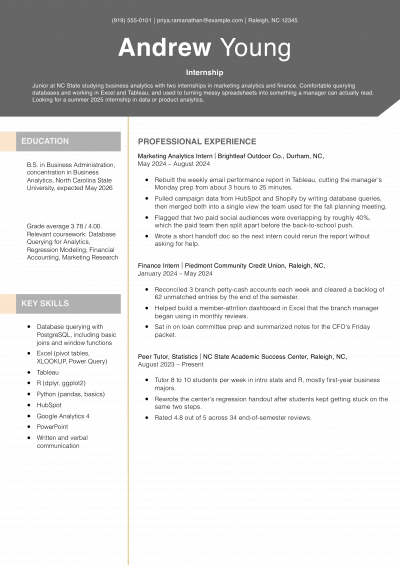
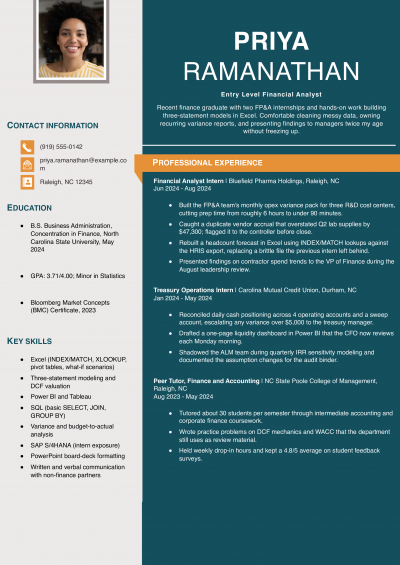
Most finance intern spots go to students who can prove they already work with real data. A strong resume shows Excel models, cash flow analysis, or coursework tied to valuation. Finance managers and campus recruiters look for that proof before they read your GPA.
Your resume should name the tools you used, such as Excel or Bloomberg Terminal. Show a project where you built a forecast or cleaned a data set. The finance intern resume examples below show you how to frame that work on the page. To compare layouts before you start, browse our resume templates.
On the page, lead with credentials and tools in a block below your contact information, then place quantified project outcomes in the experience bullets that follow.
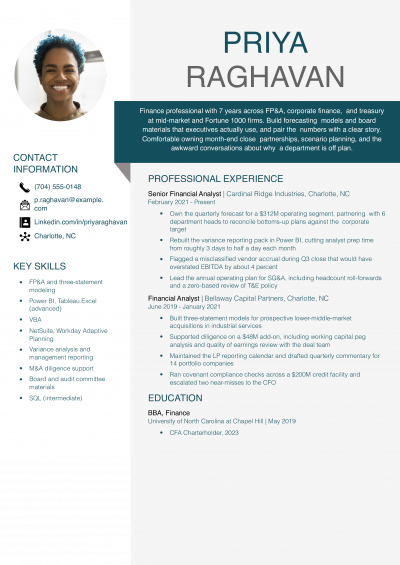
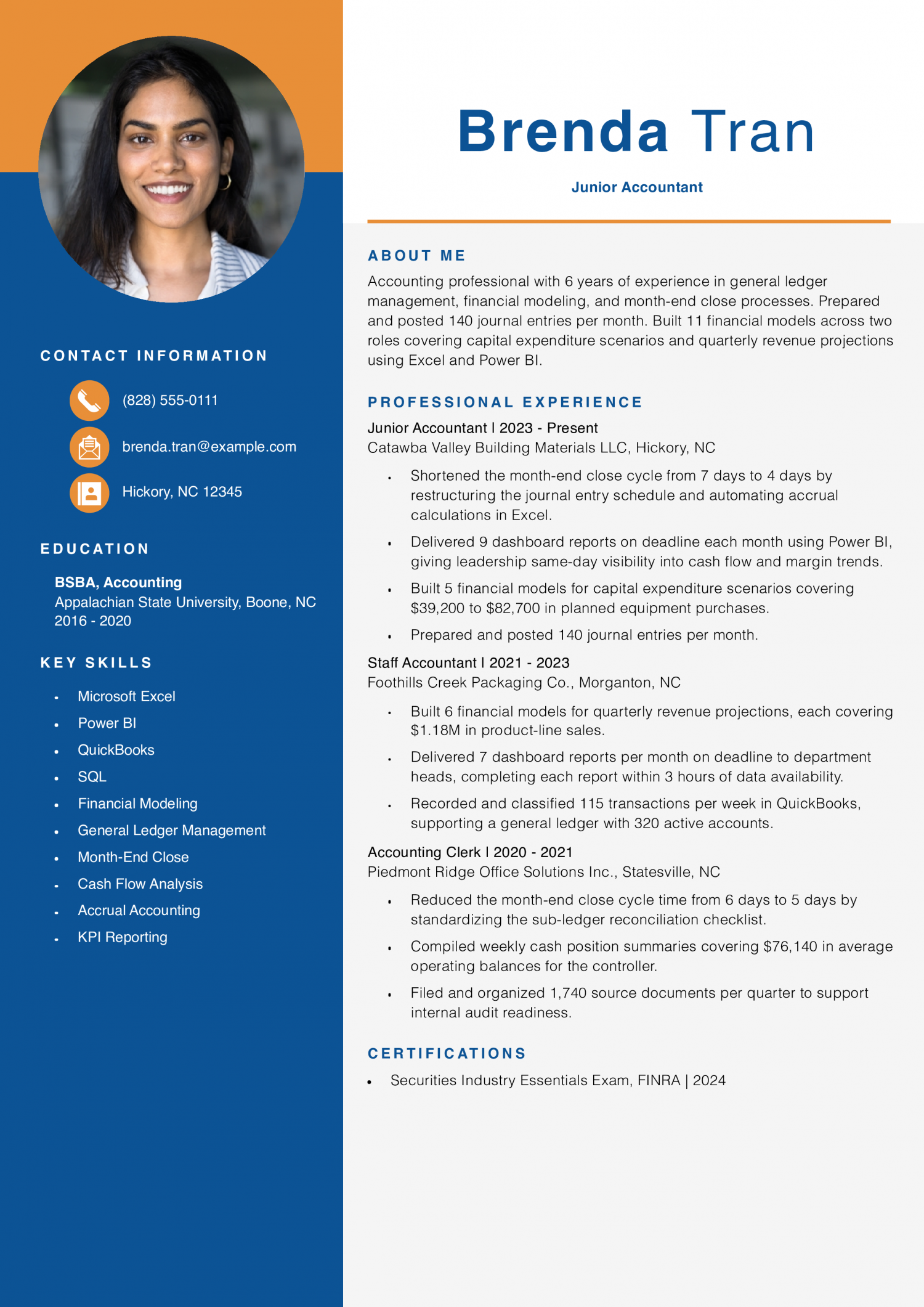
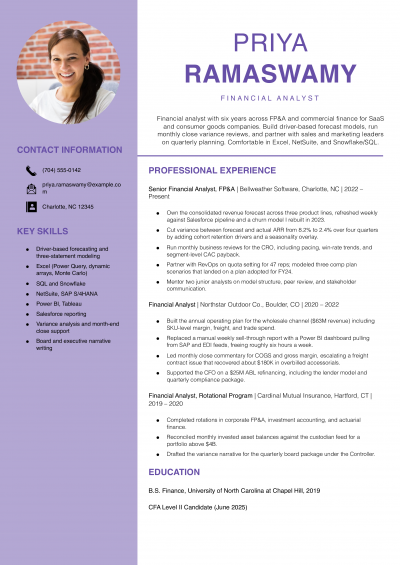
Pick this resume if you are a mid-level junior accountant progressing from clerk work into financial modeling and reporting responsibilities. Lead with close-cycle compression and accuracy metrics the way each role here does.
The month-end close got shorter because the journal entry schedule was rebuilt. A controller can see that the scheduling change drove the improvement. If you compressed a close cycle, name the scheduling change you made and show the old timeline next to the new one.
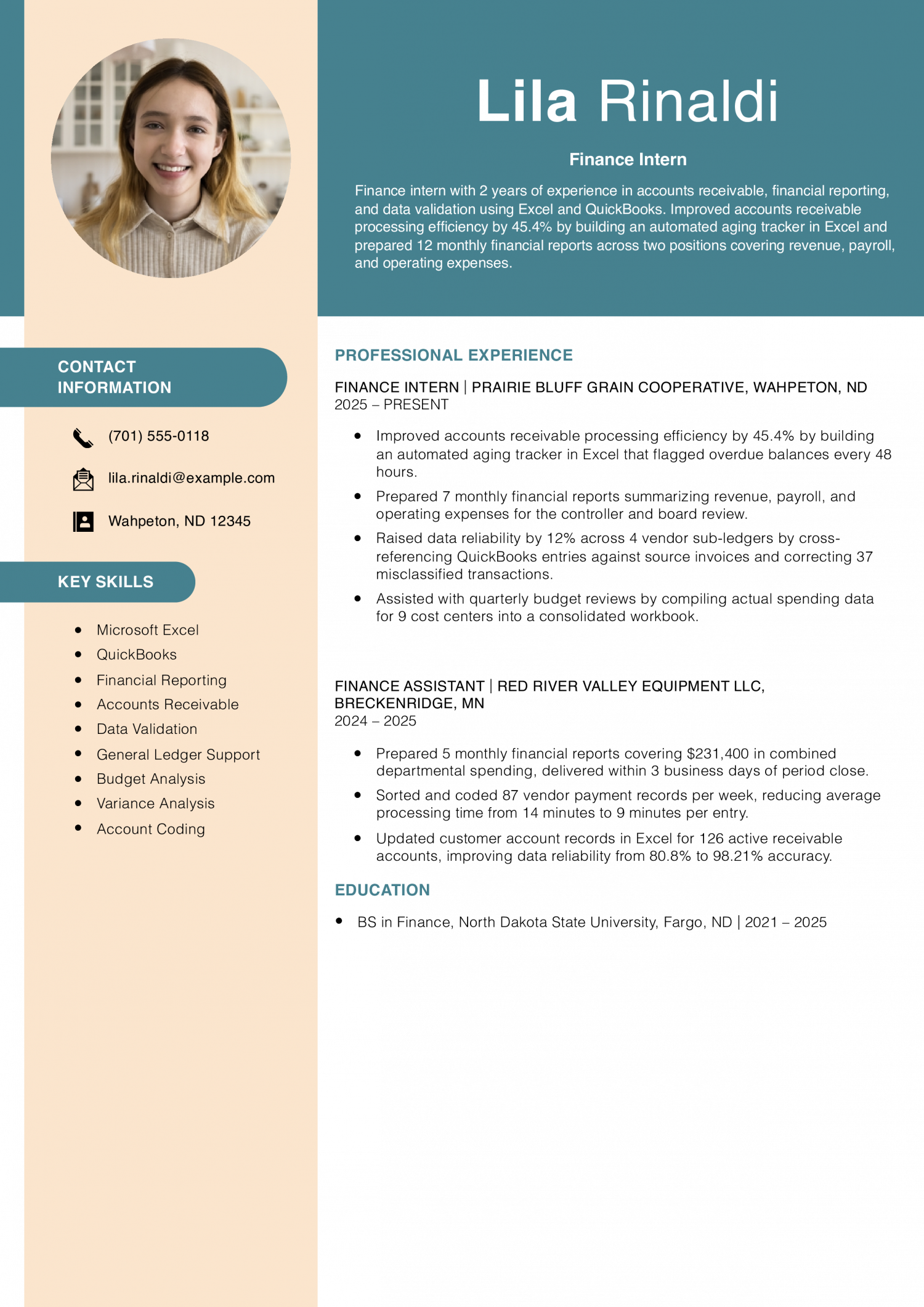
Use this resume if you are an entry-level finance intern building early career experience across receivables, reporting, and ledger work. Lead with the specific tool or method behind each efficiency gain rather than listing duties alone.
QuickBooks entries checked against source invoices are the detail that separates this bullet from a vague cleanup claim. A senior accountant reading it sees the tool and the verification source. Name the system you audited, what you compared it to, and how many errors you corrected.
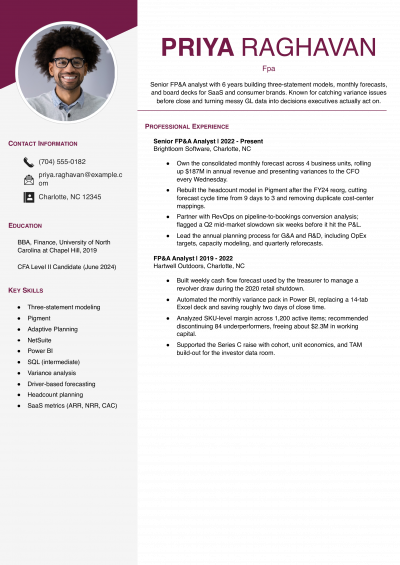
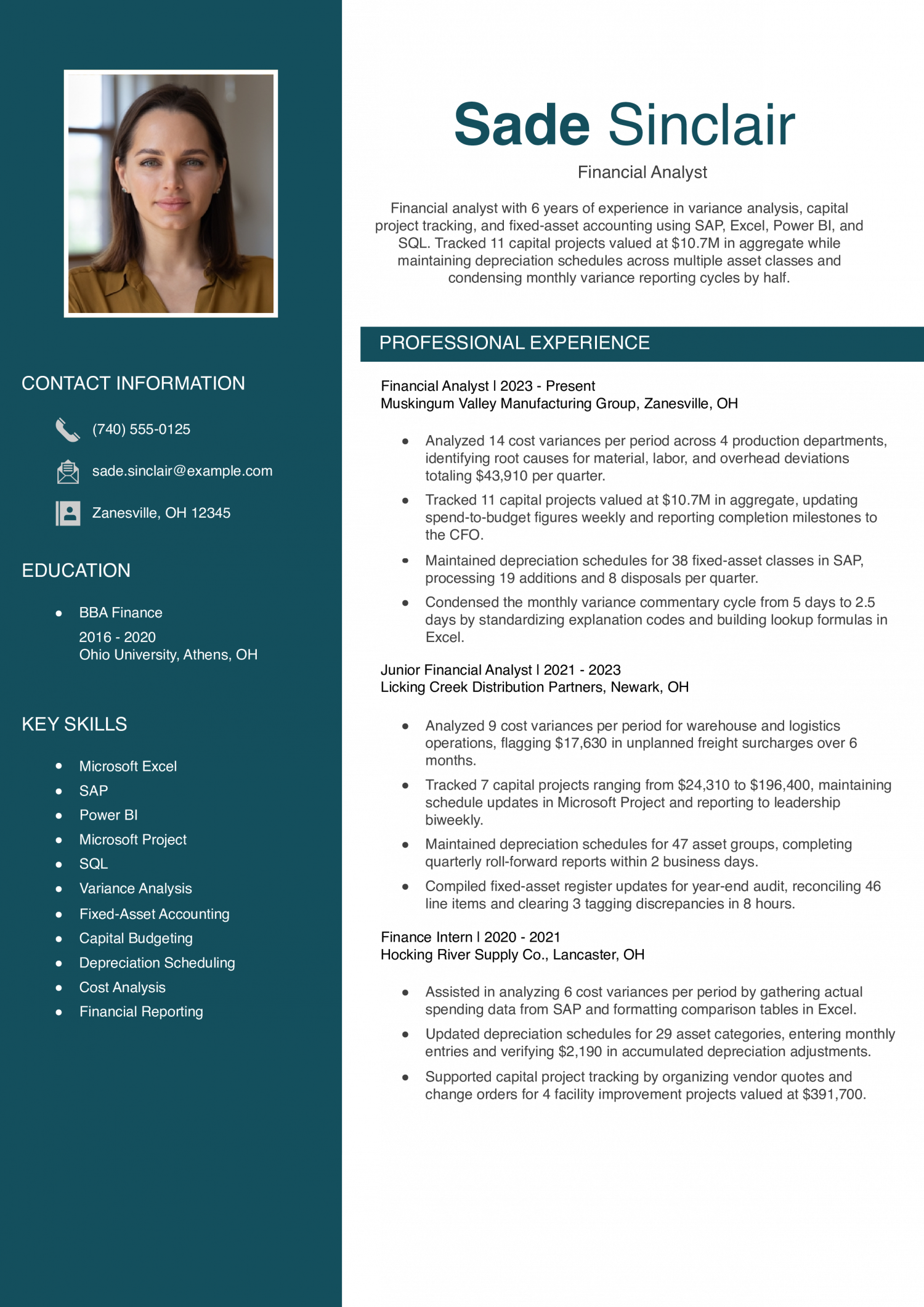
Try this resume if you are a mid-level financial analyst moving from junior roles into full ownership of cost variance and capital project reporting. Lead with the specific dollar totals your variance work uncovered rather than describing analysis as a general responsibility.
Variance commentary that took several days and now takes half that time shows real progress. A finance director can see how much faster the team gets its monthly analysis. State the old reporting cycle, the new one, and the method that closed the gap.
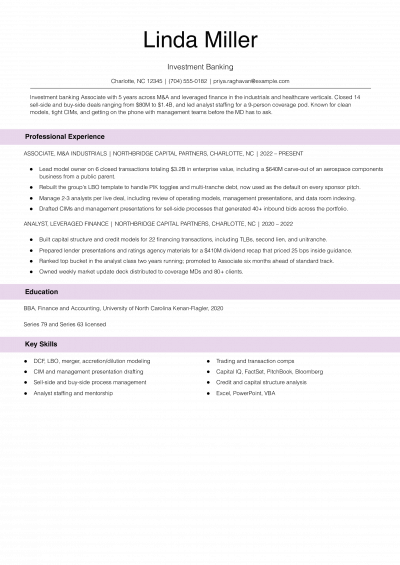
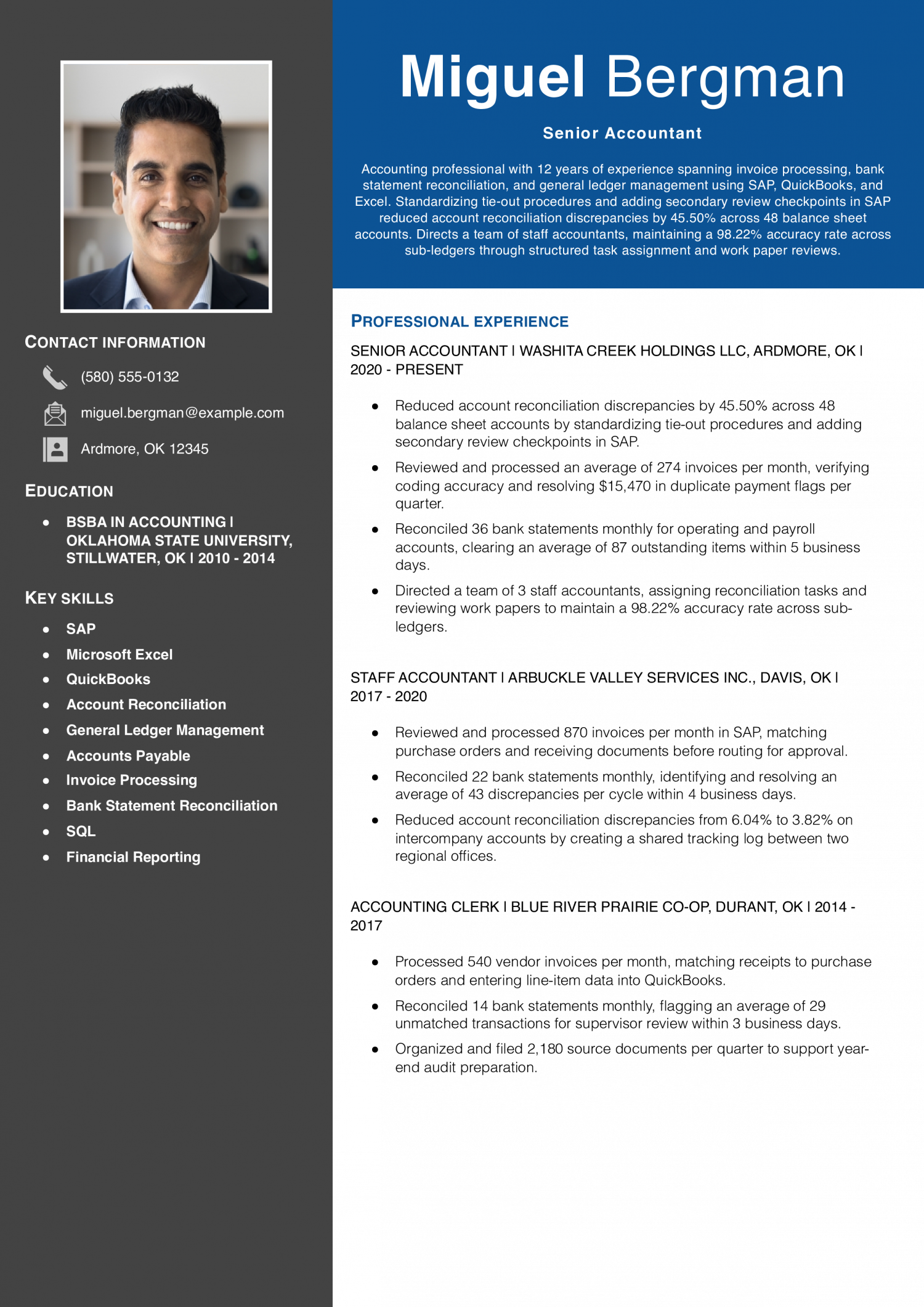
Lean on this resume if you are a senior-level accountant with over a decade of reconciliation and team oversight experience. Lead with discrepancy reduction percentages tied to the specific procedural changes that produced them.
Assigning reconciliation tasks and reviewing work papers across sub-ledgers shows both the teaching and the quality check. A CFO reading that sees how the accuracy rate held under shared responsibility. If you oversee others’ work, count the analysts you checked and say what accuracy level the team maintained.
Analytical finance professional with 6 years of experience spanning budget variance analysis, market research, and financial forecasting across corporate finance and investment banking roles. Identified $67,740 in budget-to-actual variances by comparing monthly actuals against approved line items in Excel and tracing root causes to timing and classification errors. Skilled in Bloomberg Terminal, SAP, SQL, and Excel, with a track record of completing 17 market research analyses per quarter covering regional M&A activity.
Your GPA and coursework appear on every intern resume that hiring committees review. Lead with a line that sets you apart. That could be a passed SIE exam from FINRA.
It could be fluency in Python or SQL for data pulls. A campus role where you managed a real budget also works. Finance managers and campus recruiters scan dozens of similar profiles each cycle.
They stop on a detail that demonstrates you performed the work, not that you attended the lecture. Position this line at the top of your professional summary or in a header skills row. Make it the first thing a reader sees.
One concrete edge beats a list of soft traits every time.
Most strong intern resumes incorporate at least one quantifiable number per bullet. You may not have years of deal flow to cite. You can still count what you touched.
State the size of a portfolio you modeled in class. Note how many records you cleaned in a data set. If you helped a student org raise funds, name the dollar total.
Bullets without a quantifiable number tend to read as generic duty descriptions. A line like “built a three-statement model for a $2M case study” says more than “assisted with financial modeling.” Scope counts too. Mention the team size or the timeline.
Even small figures provide campus recruiters with a meaningful sense of your overall productivity and output.
Sort your experience bullets so each cluster demonstrates a particular type of work. Financial analysis is one group, and you should include valuation models, forecasting exercises, and ratio work there. Data handling is another group.
Cover spreadsheet builds, pivot table work, and database queries in that section. A third group can hold reporting and presentations. Think slide decks and memos you drafted.
If you did client-facing tasks, give those a fourth cluster. Campus recruiters read fast, so labeled groups help them locate the relevant qualifications they need. Mixing all tasks into one undifferentiated block forces them to hunt through your entire document.
Two to four bullets per group is the right range. Keep the strongest number in the first bullet of each cluster.
Create a short credentials block on page one, positioned right below your contact information. If you passed the SIE exam from FINRA, list it here. Finance managers want to identify it before they proceed to read your experience bullets.
Below that block, add a tools row. Name the software you have used, such as Excel and Bloomberg Terminal. List any coding tools like Python or R.
Keep each entry to the tool name and your skill level. Do not bury these items in a bullet positioned halfway down the page. Campus recruiters often search resumes by keyword.
A clear tools row makes sure your file surfaces in that search. Order the row by relevance to the posting.
As an intern, your degree is still in progress. List your school, expected graduation date, and major. Add your GPA if it is 3.0 or above.
Name two or three courses that match the role, such as corporate finance, financial accounting, and econometrics. Place relevant honors or dean’s list terms on the same line. If you hold a minor in economics or data science, include it here.
Finance managers and campus recruiters expect this section near the bottom for interns. End with any finance clubs or case competitions you joined. A competition win or leadership post adds weight.
Keep the whole section to four or five lines so it remains clean and professional.
Hard skills like financial modeling prove you can do the work. They show you are ready to contribute on day one. Soft skills like attention to detail show you will catch errors early.
They prove you can work well inside a team. Finance managers and campus recruiters weigh both categories. Hard skills set the first filter in most ATS tools.
Soft skills then shape the interview shortlist. Compare each table to your target posting. Add the matching terms to your bullet points as proof.
Do not paste them into a standalone list at the top of your resume.
| Soft Skills | AI-estimated % |
|---|---|
| Attention to detail | 75% |
| Analytical curiosity | 53% |
| Deadline management | 42% |
| Team collaboration | 39% |
| Professional communication | 27% |
And here are the top hard skills showing up most often.
| Hard Skills | AI-estimated % |
|---|---|
| Financial statement analysis | 78% |
| Equity research support | 61% |
| Financial modeling | 47% |
| Market data gathering | 39% |
| Investment memo drafting | 30% |
Skill names and rankings come from an AI model grounded in U.S. Department of Labor occupation data for finance interns, not from a count of finance interns’ resumes built on ResumeTemplates.com.
The AI section is first.
You claim to be an AI finance analyst. Finance managers will doubt that.
You leave it off and answer questions later. Or you describe how you used the tool in coursework or projects. That last option is what finance managers and campus recruiters can validate.
Name the tool you used. State the task it helped you complete. Then note what you checked by hand before submitting.
That framing shows you understand output risk. It also shows you can explain your own process clearly.
What AI is actually changing for this role
Data cleanup: Interns now use AI to flag formatting errors in spreadsheets before a senior analyst reviews the output.
Draft modeling: AI can generate a rough valuation template, but interns still verify each assumption against source documents.
Report summaries: AI tools help interns draft earnings call summaries that a finance manager then edits for accuracy.
Research triage: Interns use AI to scan public filings for key terms, then read the flagged sections in full.
AI tools to name
How to phrase AI on your resume
Do
Skip
Most finance interns have not yet earned major licenses. You can still show progress toward key credentials. Finance managers and campus recruiters notice early steps in this area.
Finance managers and campus recruiters read this list as a map of where your work is heading. The entry below tells them which area of finance you have started to invest in. Most interns will not hold many credentials yet, and that is fine.
Even one exam signals that you are moving toward a clear goal. It shows you took steps on your own time to learn the field. That effort stands out on a short resume.
List the issuing body and the year you passed each exam. Put any exam still in progress on a separate line with the expected date.
About These Numbers
The Bureau of Labor Statistics does not publish a wage code for Finance Intern specifically. The numbers below are a proxy: the closest published match is Financial and Investment Analysts (SOC 13-2051), so use them as an estimate for this role, not an exact figure.
Financial and investment analyst is one of the larger occupations tracked by BLS, so the median reflects a wide mix of experience levels. These BLS figures cover the full analyst category, not interns alone. The 90th percentile out-earns the median by about 76 percent. The 10th percentile sits roughly 38 percent below it. That range tells you the field rewards specific skills and credentials over general interest.
On your resume, lead with the financial models or tools you have used in coursework or prior internships. Name the software and the output, not the class title.
| # | State | Median Annual |
|---|---|---|
| 1 | Wyoming | $187,090 |
| 2 | New York | $127,930 |
| 3 | Oregon | $120,590 |
| 4 | Massachusetts | $111,040 |
| 5 | Connecticut | $109,500 |
| 6 | California | $109,110 |
| 7 | New Jersey | $108,610 |
| 8 | Washington | $107,210 |
| 9 | District of Columbia | $105,780 |
| 10 | Virginia | $105,490 |
| # | State | Workers | Median |
|---|---|---|---|
| 1 | New York | 52,380 | $127,930 |
| 2 | California | 45,380 | $109,110 |
| 3 | Texas | 28,820 | $99,150 |
| 4 | Florida | 23,900 | $94,490 |
| 5 | Illinois | 20,520 | $101,180 |
Resume Templates offers HR approved resume templates to help you create a professional resume in minutes. Choose from several template options and even pre-populate a resume from your profile.
Lead with coursework in accounting, corporate finance, or economics that matches the posting. Follow with any project work where you built models or ran valuations. Add proficiency in Excel, Python, or Bloomberg if you have used them.
Highlight tasks like reconciling daily cash receipts or verifying loan documents. Dealership finance work is operations-heavy, so name the dollar volumes you touched. Campus recruiters at banks or funds still value that detail because it shows real exposure.
A reverse-chronological format works for most finance intern roles because it puts your latest experience first. Use a single-column layout with clear headings so tracking systems can parse every line. If you have no paid finance experience yet, place your education section above experience.
Mirror the language in the job posting by swapping general terms for the exact phrases the employer uses. If the posting says "variance analysis," write that instead of "budget review." Then tailor your bullet points to the industry the company operates in.
Keep it to one page. Finance managers and campus recruiters review intern resumes, and one page signals you can prioritize information. Cut high school activities once you have enough college coursework and projects to fill the space.
Pull keywords straight from the posting, such as "discounted cash flow" or "financial modeling." Pair each keyword with a result so it reads as experience rather than a label. Tracking systems and campus recruiters both scan for these terms during the first review.
Yes, a short objective can work when you have limited experience. State the role you are targeting and the skill you bring in two lines or fewer. Replace it with a summary once you have completed at least one internship rotation.
An ATS-friendly template keeps your coursework and internship results under clear headings. A basic template can work for an intern role too.
Finance Intern Resume
4.7/5 stars with 211 reviews

Executive Resume Writer and Career Coach
Andrew Stoner is an executive career coach and resume writer with 17 years of experience as a hiring manager and operations leader at two Fortune 500 Financial Services companies, and as the career services director at two major university business schools.
© 2026 Resumetemplates.com All rights reserved.