Tip !

Hiring EMS supervisors look for active NREMT status, state license, and BLS on the first page, because that block decides whether the resume gets a credential check or a recycle bin.

Andrew Stoner , Executive Resume Writer and Career Coach

Why this resume works

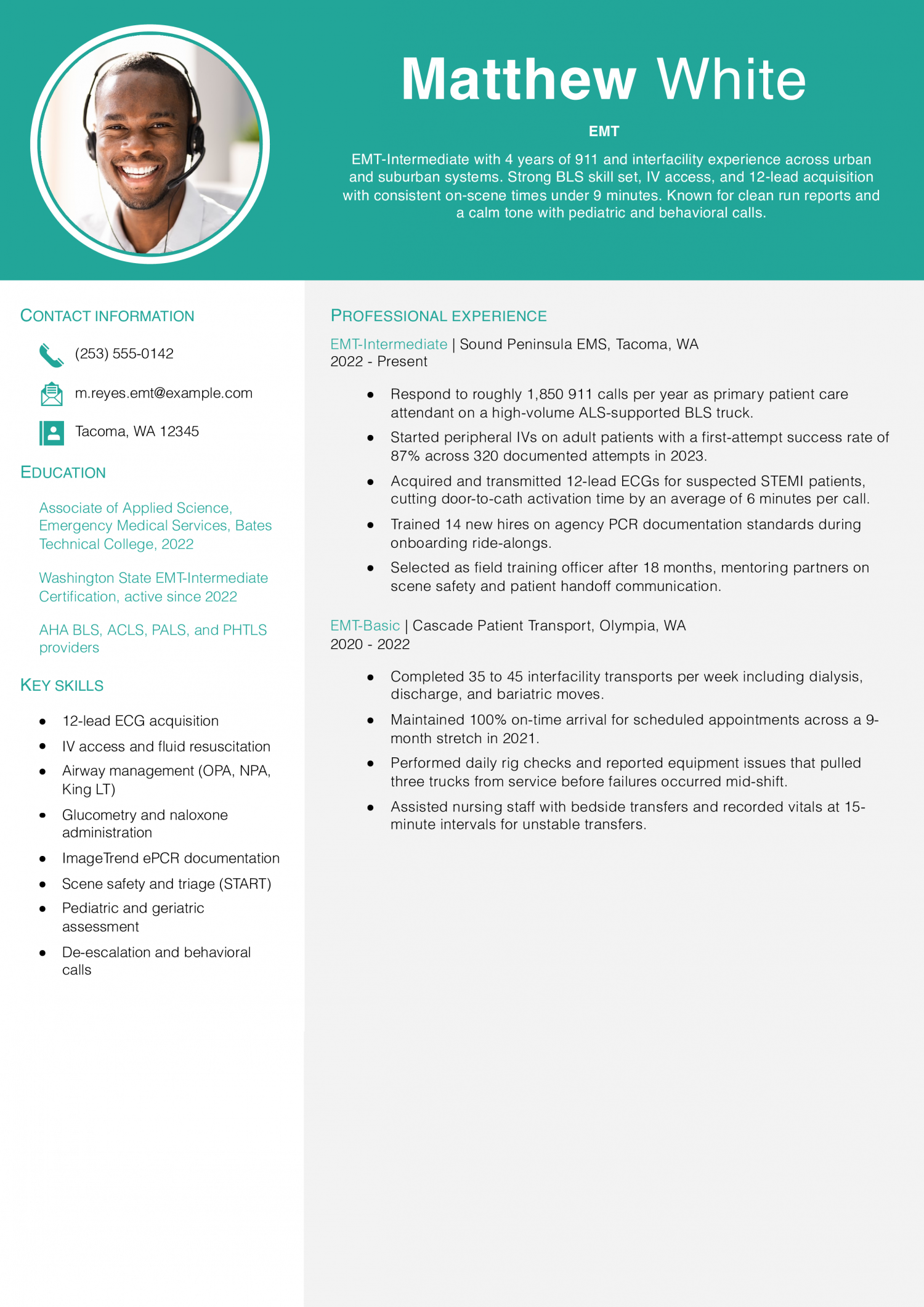
  • Numbers tied to real call volume: Call counts and IV success rate give hiring captains a clear picture of skill frequency, not vague claims.
  • Shows growth from Basic to Intermediate: Two-job timeline makes the certification jump and added responsibility obvious at a glance.
  • Names the systems they actually use: ImageTrend, King LT, and START tell EMS leaders this candidate can step onto a truck without weeks of catch-up.

EMT-Basic Example

The EMT-Basic resume is for newer providers a year or two out of an accredited program. It should prove active NREMT-B status, state licensure, BLS, and any clinical or ride-along hours that show field readiness.

Why this resume works

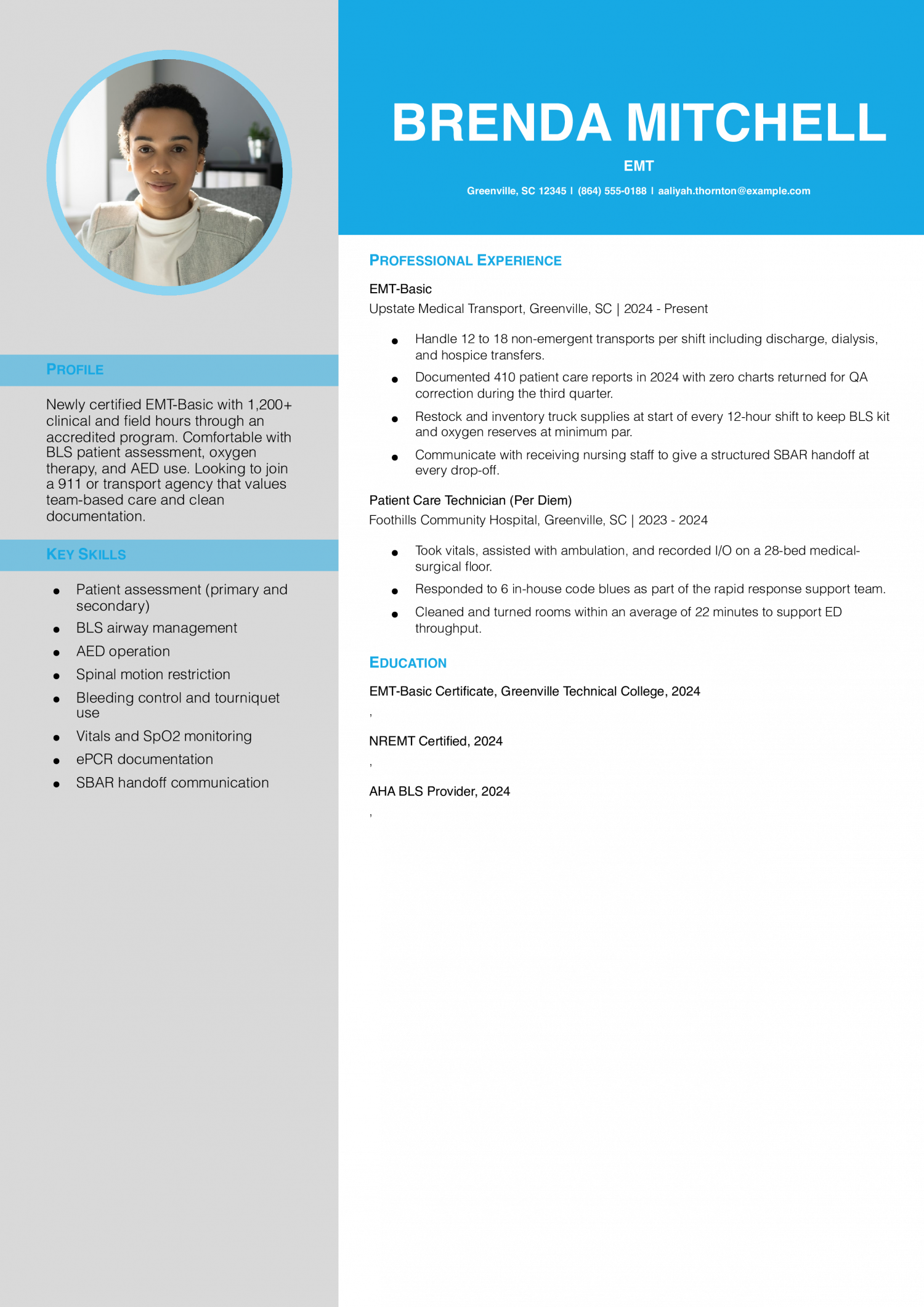
  • Clinical hours speak louder than a fresh license: Listing 1,200+ training hours plus PCT shifts shows real bedside time, not just classroom passes.
  • QA stat proves clean charting: Zero returned PCRs in a quarter is the kind of detail field supervisors care about for new hires.
  • Hospital experience adds context: Med-surg and code blue exposure show comfort with sick patients beyond what a basic transport role usually offers.

EMT-Intermediate Example

The EMT-Intermediate or AEMT resume is for providers who run IVs, advanced airways, and select medications. It should prove your AEMT scope, call volume at that level, and the protocols you operate under.

Why this resume works

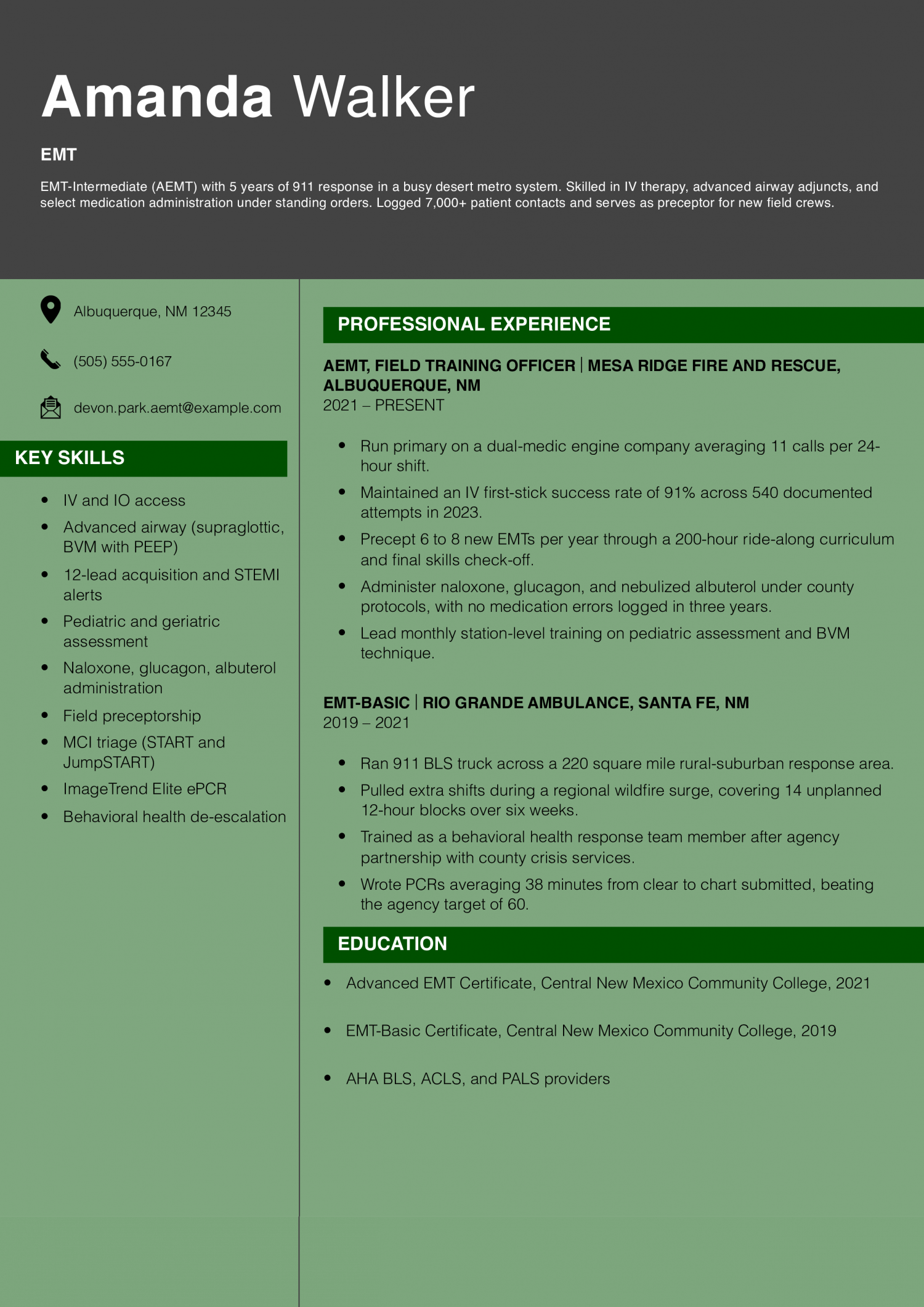
  • Preceptor role shows trust from leadership: Training 6 to 8 EMTs per year is concrete proof this candidate is the go-to for onboarding.
  • Medication record matters for AEMT roles: Three years with zero med errors is exactly what an EMS medical director wants to see on paper.
  • Rural-to-metro path adds range: Santa Fe wildfires plus Albuquerque metro shows comfort across very different call profiles and resource levels.

Paramedic Example

The Paramedic resume is for ALS providers running cardiac, trauma, and pediatric calls. It should prove NRP status, ACLS, PALS, and the acuity mix you handle on a typical shift.

Why this resume works

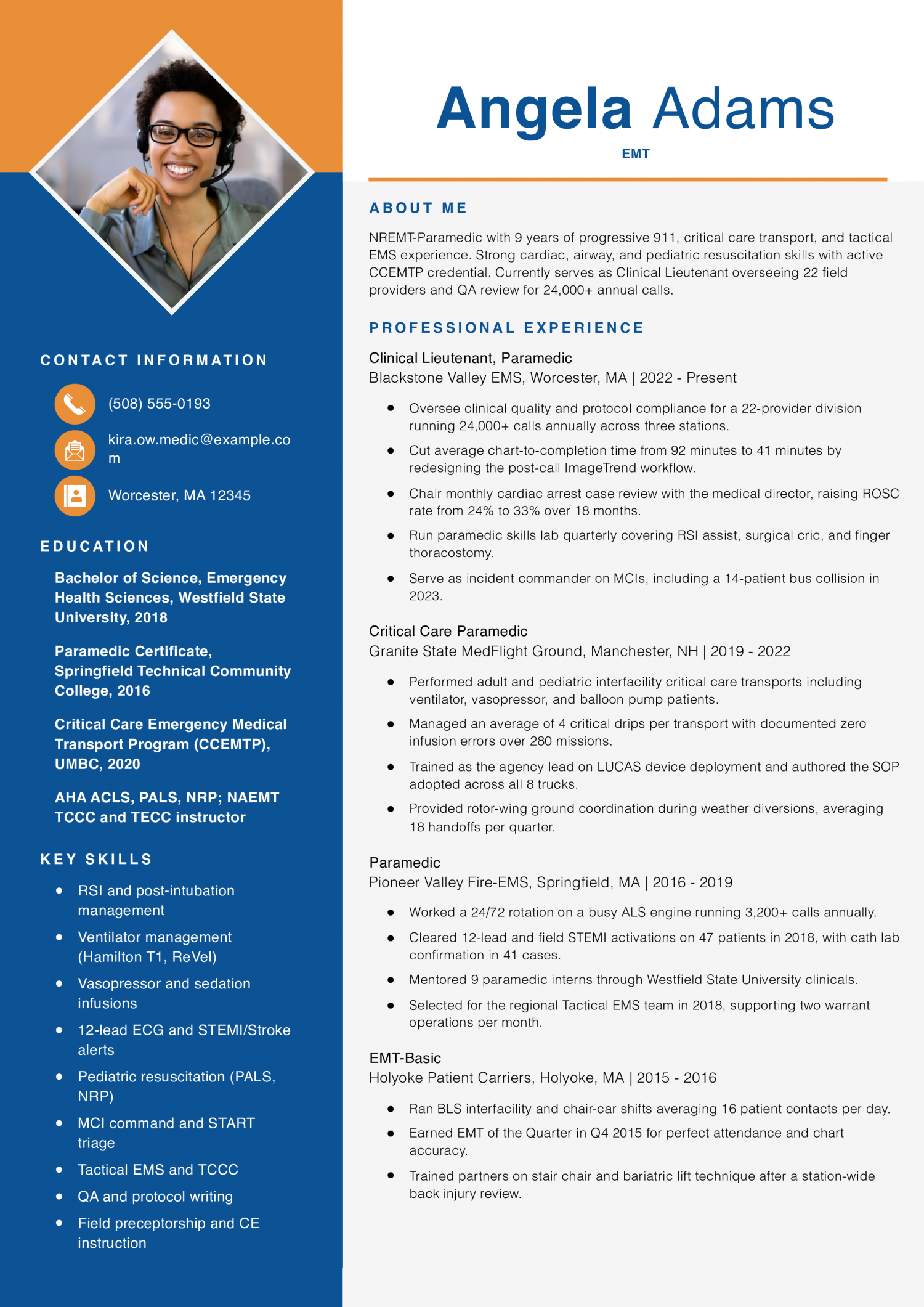
  • Clinical outcomes are quantified: ROSC rate moving from 24% to 33% is the kind of measurable result EMS leadership roles ask about in interview.
  • Career arc tells a clear story: BLS to Paramedic to Critical Care to Clinical Lieutenant maps a real progression without gaps.
  • Specialty credentials match the senior tier: CCEMTP, TCCC instructor, and tactical EMS show this is a paramedic ready for medical officer or supervisor roles.

How to Write an EMT Resume

01 Open with a profile that names your field scope

Your profile should state your years on a rig, your certification level (EMT-B, AEMT, or paramedic), and the service type you’ve worked.

Name 911 response, interfacility transport, fire-based EMS, event medical, or industrial standby. Add typical call volume per shift and the acuity range you cover.

02 Quantify run volume and clinical outcomes

EMS supervisors and ambulance service directors read for numbers. Bullets without a metric read as duties, not impact.

Name three: average calls per 24-hour shift, response times against the agency standard, and the percentage of ALS assists or successful IV starts on first attempt.

03 Group bullets by call type and skill

Sort your work into four buckets: patient assessment and triage, airway and BLS interventions, trauma and cardiac response, and documentation.

Under each, name the protocols, equipment, and ePCR system you used. Spell out LUCAS, King airway, CPAP, and your medical director’s standing orders where they apply.

04 Place credentials in a page-one block

Put NREMT level, state EMT license (state plus ‘in good standing’), BLS, and driving credentials in a credentials block under your name.

EMS supervisors verify these before reading bullets. Add ACLS, PALS, PHTLS, or EVOC as separate lines. Do not list license numbers on the resume.

05 Close with your EMS education and CE

List the accredited EMT or paramedic program, the school, and your completion year. Add clinical hours and field internship sites if you graduated within the last two years.

Below that, name recent CE hours by topic. Pediatric, geriatric, and cardiac CE signal you keep current with NCCP requirements.

ATS filters catch more EMT resumes than ever in 2026. The skills below come from our user-built EMT resumes. Certification names and procedural skills clear the first cut.

Patient-care language and crew communication decide whether the resume advances to the EMS coordinator. Match this list against the posting, then back each soft skill with a bullet that shows it on a real call.

Soft Skills % of resumes with this skill
Communication 70%
Composure under pressure 55%
Teamwork 42%
Empathy 35%
Quick decision-making 29%

And here are the top hard skills showing up most often.

Hard Skills % of resumes with this skill
Patient assessment 72%
CPR and basic life support 52%
Vital signs monitoring 50%
Emergency vehicle operation 37%
Trauma care 30%

Based on data from thousands of EMTs’ resumes built on ResumeTemplates.com, May 2026.

Public Safety Credentials to Verify Before You Apply

Public safety employers verify credentials before the resume reaches a supervisor. List each item with the issuing body and expiration month, and confirm everything is current the week you apply.

  • Active NREMT certification at your level (EMT, AEMT, or paramedic)
  • State EMT license in good standing (list the state, not the number)
  • BLS for Healthcare Providers through AHA or equivalent
  • Valid driver's license and clean motor vehicle record
  • EVOC or CEVO ambulance driving certification where required
  • Current immunizations and annual TB screening

Must Have on an EMT Resume

These are the must-haves hiring teams look for when scanning an emt resume.

Continuing Education That Belongs on Your Resume

NREMT recertification runs on the National Continued Competency Program. Listing recent CE shows EMS supervisors you keep current between two-year cycles.

Group CE by topic and list total hours per category. Name the provider when it carries weight, such as AHA, NAEMT, or your medical director’s grand rounds.

  • National Component CE: airway, cardiac, trauma, medical, and operations hours
  • Local and state CE hours tied to your protocols
  • Pediatric CE through PEPP or EPC
  • Geriatric CE through GEMS
  • Annual airway, IV, and medication competencies

HIPAA and OSHA Compliance

HIPAA applies to anything you write about prior patients or runs. Keep call examples de-identified and quantitative.

HIPAA-Safe Bullet Writing

Reference call types, acuity, and outcomes in aggregate. Do not include patient names, dates of service, addresses, or any detail that could identify a specific person.

Name agencies you’ve worked for and the medical director’s protocols in general terms. Save case-specific stories for the interview, framed without identifiers.

  • Use aggregate numbers (calls per shift, ALS assists per month), not single-patient stories
  • Reference protocols by name, not by patient
  • Skip dates, locations, or demographics that could identify a specific run

Emergency Medical Services Credentials That Get You the Job

EMS supervisors and ambulance service directors read this list as a map of where your EMS career is heading. The certifications below tell them which track, ALS, tactical, critical care, or pediatric, you’ve invested in. List the issuing body and the year completed, no certificate numbers.

  • Advanced Cardiac Life Support (ACLS): Required for paramedics and a strong add for EMT-Bs targeting transport or ALS-assist roles.
  • Pediatric Advanced Life Support (PALS): Signals you can run pediatric codes and respiratory calls, common ask for 911 and pediatric transport teams.
  • Prehospital Trauma Life Support (PHTLS): Maps to trauma response scope and is often required by fire-based EMS and flight programs.
  • Emergency Vehicle Operator Course (EVOC): Shows you can drive code three safely; many private ambulance services require it before hire.

Allied Health Certifications That Add Range

These credentials sit alongside your EMS license and open doors into transport, clinic, or hospital-based roles. Add them when they match the posting.

  • Certified Phlebotomy Technician (CPT) for ED tech and clinical roles
  • Patient Care Technician (PCT) for hospital cross-training
  • Tactical Combat Casualty Care (TCCC) for law enforcement or tactical EMS
  • Wilderness EMT (WEMT) for SAR and remote medicine
  • Critical Care Paramedic (CCP-C or FP-C) for transport and flight programs

Latest BLS Statistics for EMTs

Top-paying states for EMTs cluster in regions with high call volumes and tight EMS labor supply, not the biggest metros most applicants chase. Urban systems pay competitively, but rural and frontier services often lift wages to recruit certified providers.

If you’re geographically flexible, the resume should foreground multi-state NREMT portability, the protocols you’ve operated under, and any wildland, tactical, or critical care transport experience that travels across regions.

$41,340 National median annual
$44,790 National mean annual
$31,410 Entry-tier floor (10th percentile)
$60,780 Top-decile ceiling (90th percentile)
177,980 EMTs in the U.S.
Where you stand

Entry tier

$31,410 to $41,340 At the entry tier, lead with your NREMT-B, state license, BLS, and any clinical or ride-along hours from your accredited program.

Mid band

$41,340 to $60,780 At the mid band, your resume needs to show calls per shift, ALS assists, ePCR fluency, and ACLS or AEMT scope.

Top decile

$60,780+ At the top decile, lead with paramedic credential, critical care or flight endorsements, FTO experience, and acuity mix on a typical shift.

Top-paying states

# State Avg. Annual
1 Hawaii $61,310
2 Alaska $56,900
3 New Jersey $49,500
4 Rhode Island $49,500
5 Washington $48,850
6 Oregon $48,070
7 Connecticut $47,550
8 Maryland $47,390
9 Virgin Islands $47,040
10 New York $46,000

Highest-employment states

# State Workers Median
1 California 19,020 $45,680
2 New York 14,350 $46,000
3 Texas 13,550 $37,000
4 Pennsylvania 9,810 $38,580
5 Illinois 8,480 $40,780
Source: U.S. Bureau of Labor Statistics, OEWS 2024 release (SOC 29-2042).
Written by professional resume writers and loved by hiring managers

Resume Templates offers HR approved resume templates to help you create a professional resume in minutes. Choose from several template options and even pre-populate a resume from your profile.

Frequently Asked Questions

How should you list your NREMT certification on an EMT resume?

Put NREMT in a credentials block directly under your name and contact line. List the level (EMT, AEMT, or paramedic), the issuing body, and your expiration month and year.

Do not print your registry number on the resume. Share it on the application form when the employer asks for verification.

Do EMTs need a hobby section on a resume?

Not by default. EMS supervisors and ambulance service directors weigh credentials, run volume, and call types first.

Add hobbies only when they signal field-relevant traits. Wilderness rescue, SAR volunteer time, or lifeguarding can earn a short line.

How do you write an EMT resume with no paid field experience?

Lead with your NREMT, state license, and BLS in a page-one credentials block.

Then list your accredited EMT program, clinical and ride-along hours, patient contacts during your internship, and any volunteer first-response time.

What should you cut from an EMT resume that's running long?

Cut unrelated jobs older than five years once you have EMS experience. Drop generic soft-skill bullets and replace them with a call-based example.

Remove high school once you've completed your EMT program. Keep the resume to one page through the mid band.

What's the best resume template for an EMT?

For an EMT, an ATS-friendly template is the safest pick, because it puts your certifications and experience where a hiring manager scans first. A basic template is a solid alternative. Whichever you choose, keep the formatting clean and easy to parse: clear section headings, a standard font, and no graphics a parser can choke on.

Rate this article

EMT Resume

Average Rating

4.6/5 stars with 128 reviews

You have given 0 Star(s)
4.6/5 stars with 128 reviews
Andrew Stoner

Executive Resume Writer and Career Coach

Andrew Stoner is an executive career coach and resume writer with 17 years of experience as a hiring manager and operations leader at two Fortune 500 Financial Services companies, and as the career services director at two major university business schools.