Maintenance Resume Examples
Your profile should state your years on the tools, the building type or plant you worked in, and the systems you service weekly. Name the trades you cover: electrical up to a stated voltage, plumbing,…
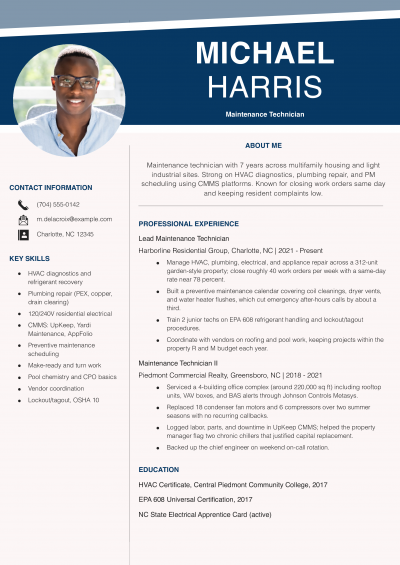
A clear list of trade credentials and safety training is what gets handyman resumes past the property maintenance manager's first cut; quantified repair volumes and completion rates are what make them readable enough to advance.
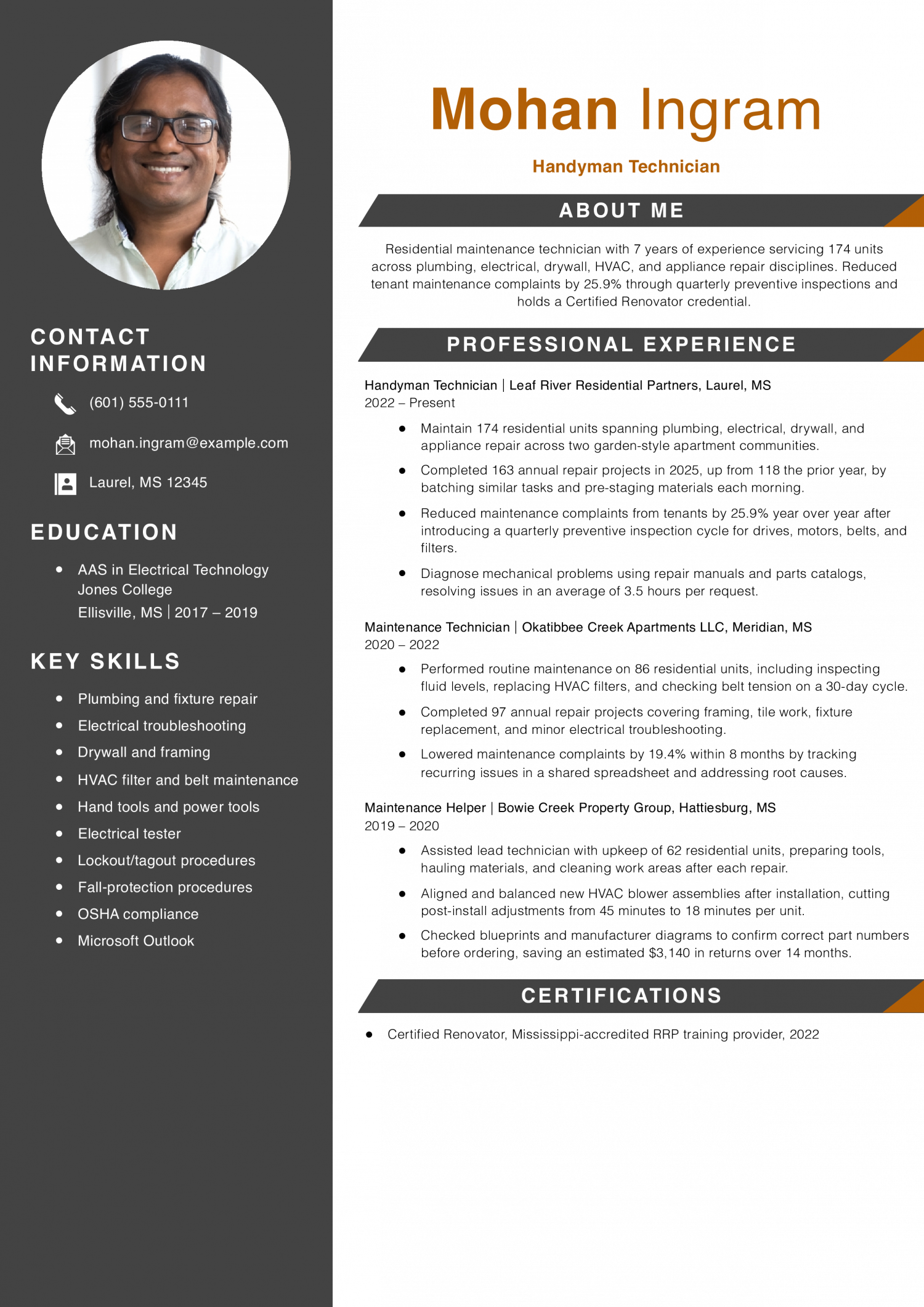
Pick this resume if you are a mid-level handyman technician with residential multi-unit experience looking to move up. Lead with a complaint-reduction percentage tied to the preventive cycle that caused it.
Most handyman resumes list a higher number of completed jobs without explaining what changed to make that possible. This resume adds the method right after the count: “by batching similar tasks and pre-staging materials each morning.” That detail tells a property manager not only that output went up but exactly how it happened. If you improved your workflow through a specific habit or process change, name it on the same line as the result so the reader can picture you repeating that approach at their property.
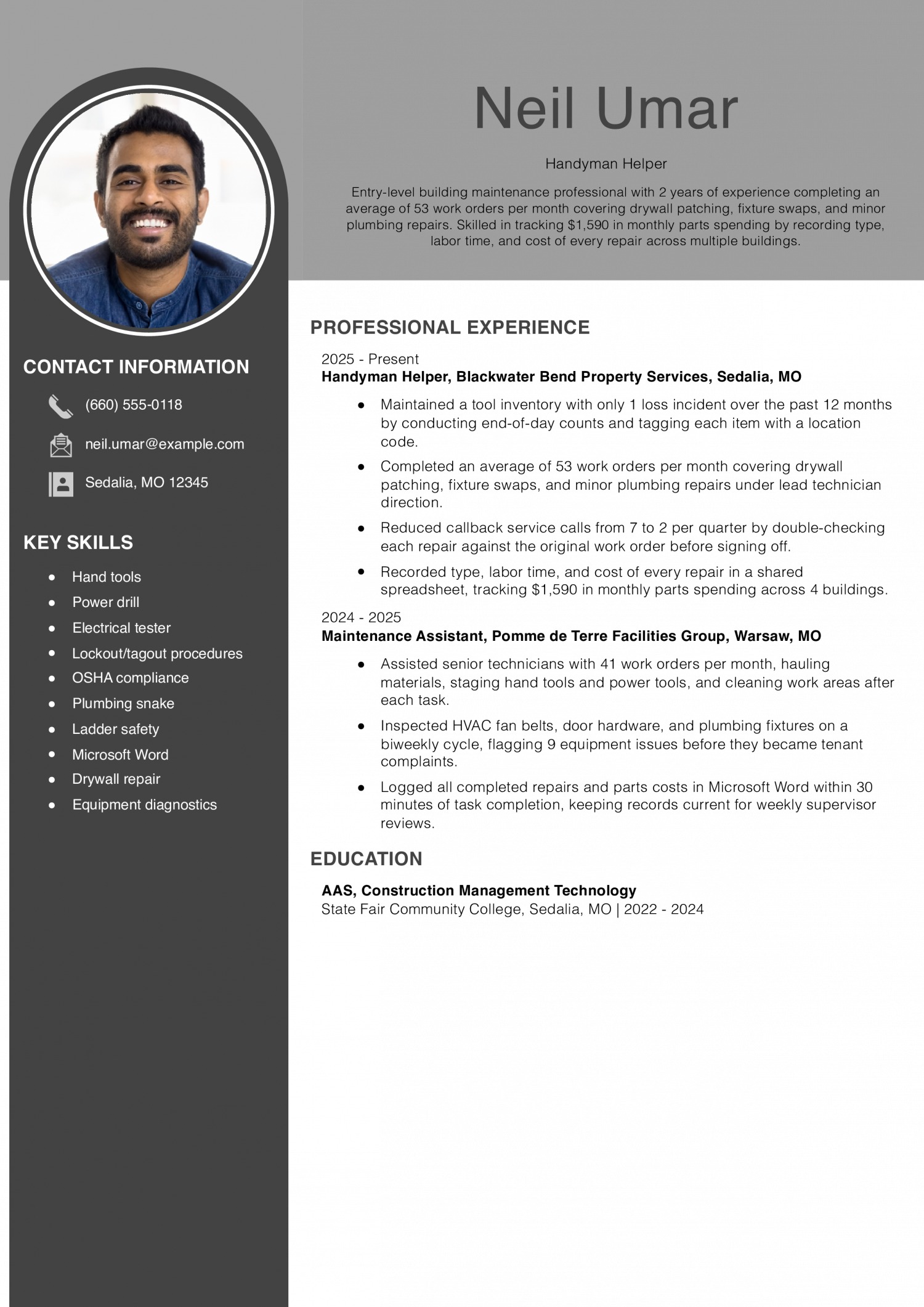
Start with this resume if you are an entry-level handyman helper moving from an assistant role into hands-on property maintenance work. Nest your callback reduction inside a quality-check method so hiring managers see the habit behind the number.
Most handyman resumes mention tool accountability without showing how they kept track. This resume ties a specific habit to a measurable outcome: “only 1 loss incident over the past 12 months by conducting end-of-day counts and tagging each item with a location code.” That line tells a property manager you had a repeatable system, not a lucky streak. If you maintained tools, supplies, or equipment with a daily or weekly routine, pair the routine with the loss or damage count so the reader sees the discipline behind the number.
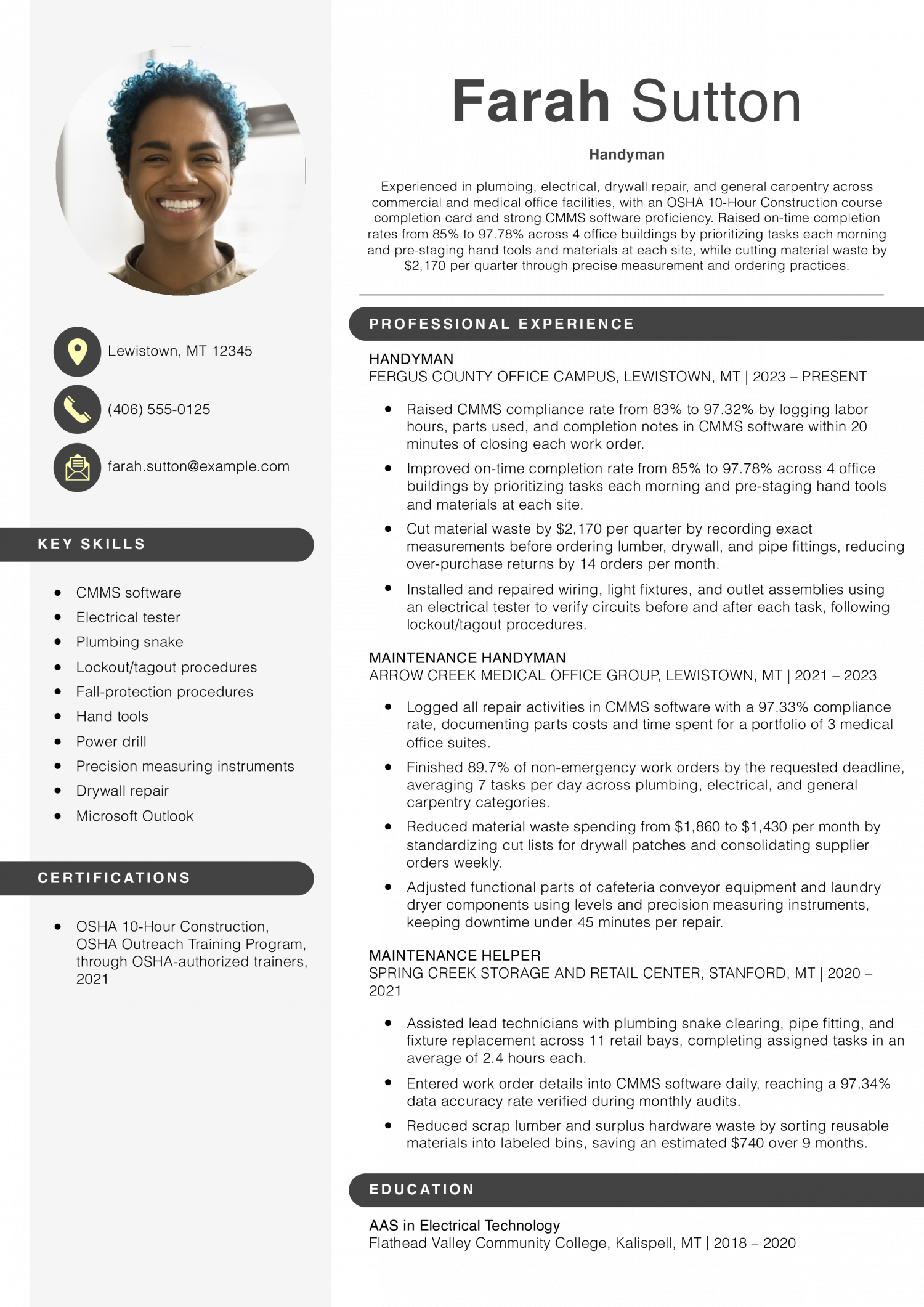
Try this resume if you are a mid-level handyman with about six years of multi-building commercial maintenance experience. Plant a material-waste dollar figure next to the ordering habit that produced it so readers connect your process to the savings.
Most handyman resumes list a dollar amount saved on materials without explaining the ripple effect on daily operations. This resume connects the savings to a specific downstream change: “reducing over-purchase returns by 14 orders per month.” That detail tells a facilities manager you did not only spend less but also cut the time and hassle of sending back unneeded stock. When you write a cost-saving bullet on your own resume, add the secondary metric that shows how the saving played out in your routine.
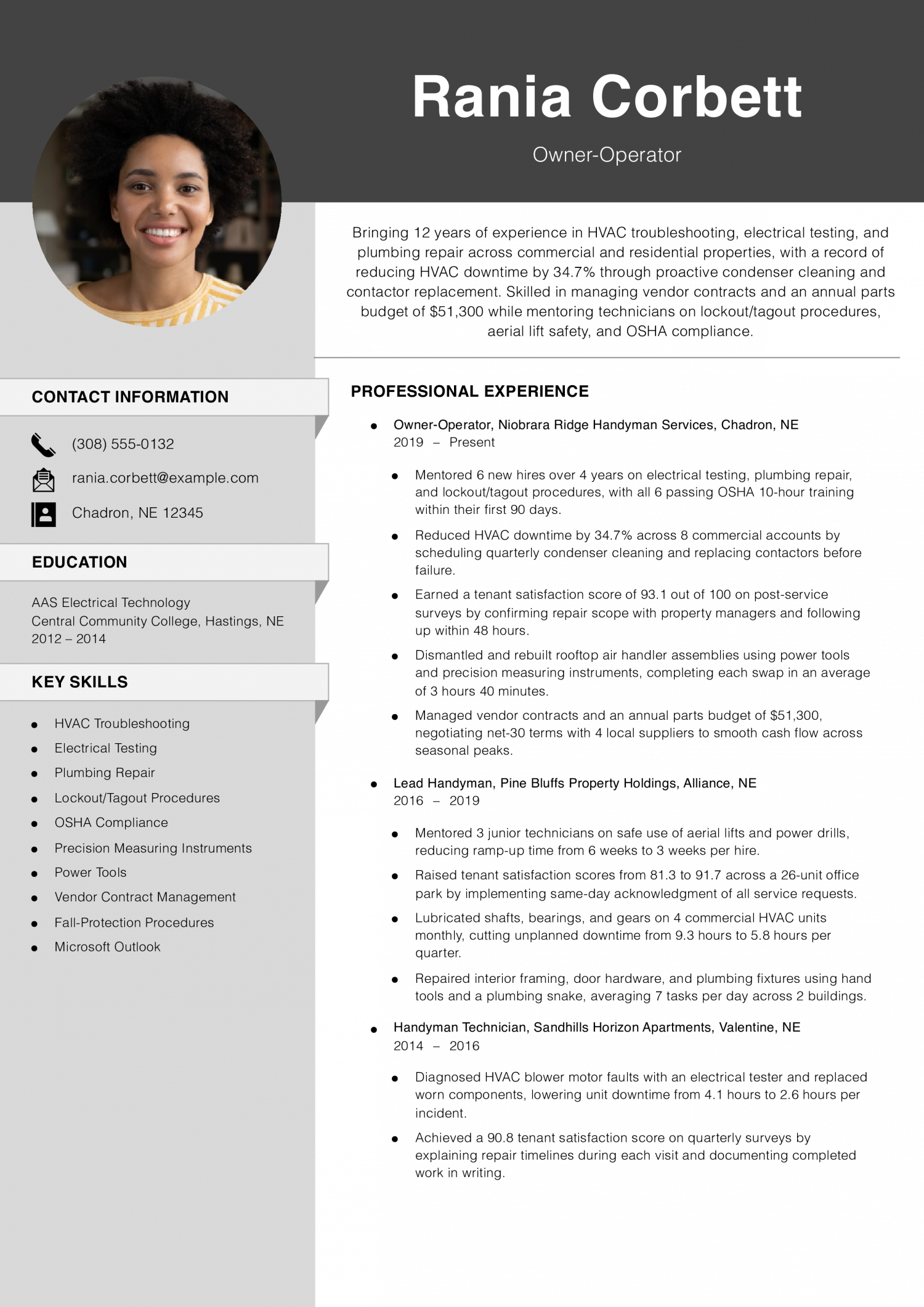
Lean on this resume if you are a senior owner-operator with a decade-plus record running a multi-trade handyman business. Prove how preventive maintenance schedules and vendor negotiations translate into measurable cost and downtime savings.
Most handyman resumes claim they reduced equipment downtime without naming the maintenance habit that caused the drop. This resume ties the improvement directly to a routine: “scheduling quarterly condenser cleaning and replacing contactors before failure.” That line tells a property manager you prevented breakdowns on a set calendar rather than reacting after something broke. If you follow a preventive maintenance cycle on any system, name the interval and the specific task next to your downtime reduction so the reader sees the cause behind the result.
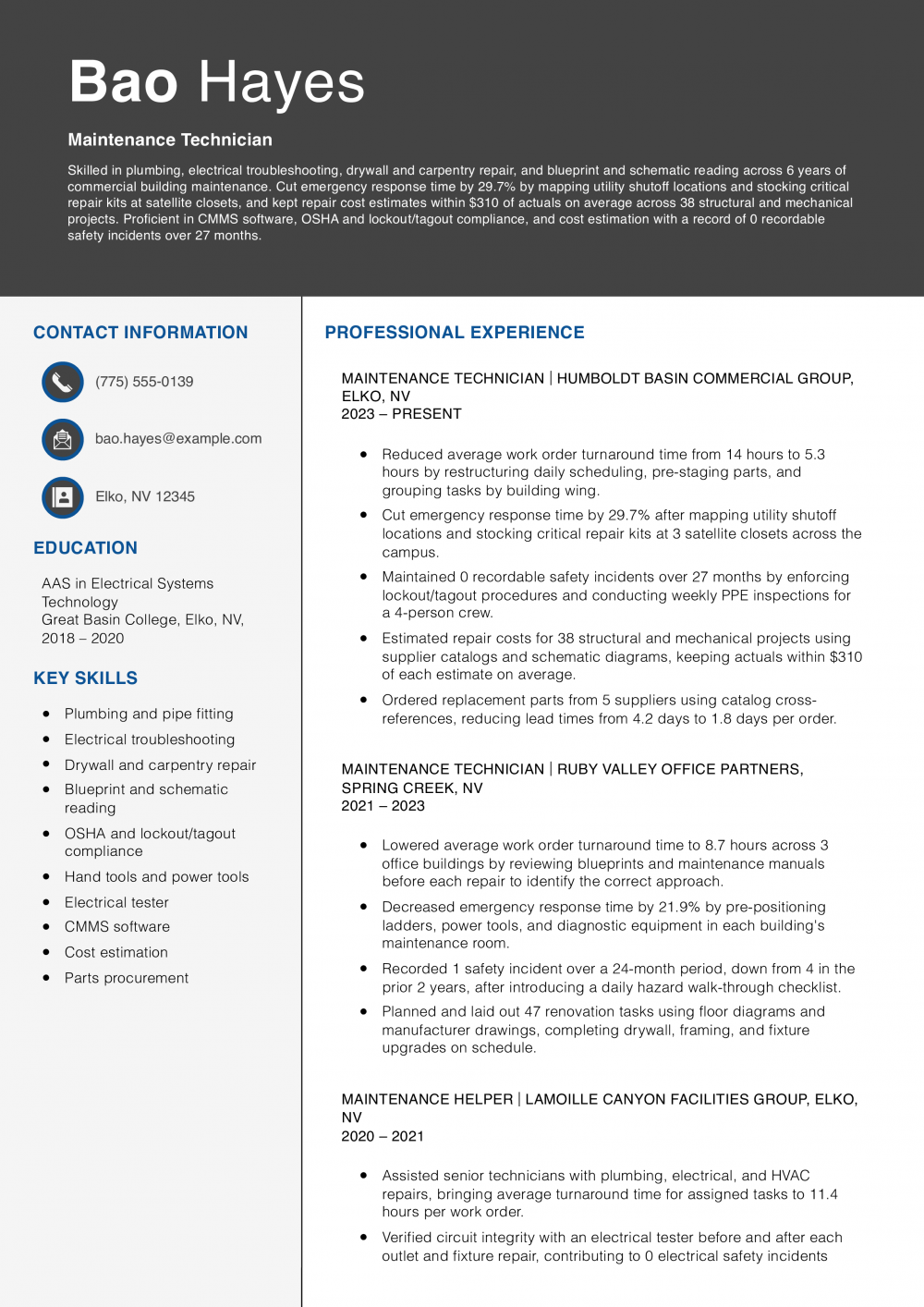
Skilled in plumbing, electrical troubleshooting, drywall and carpentry repair, and blueprint and schematic reading across 6 years of commercial building maintenance. Cut emergency response time by 29.7% by mapping utility shutoff locations and stocking critical repair kits at satellite closets, and kept repair cost estimates within $310 of actuals on average across 38 structural and mechanical projects. Proficient in CMMS software, OSHA and lockout/tagout compliance, and cost estimation with a record of 0 recordable safety incidents over 27 months.
Your profile sits at the top of page one. It should state your years of hands-on experience. Name the setting you work in, such as residential or commercial.
List the core trades you cover most often. Electrical, plumbing, carpentry, drywall, and painting all count, but pick the two or three you perform weekly and lead with those. A property maintenance manager scanning your resume wants to see your range fast.
Mention the property types you know best, like apartment complexes or retail spaces. If you hold a state or local trade license, name it here too. This profile acts as a scope statement for the rest of the page.
Handyman work is physical and varied, so frame your output around volume and scope. State how many units or properties you maintained each week. Note the square footage you covered on a given site.
Most strong resumes include a turnaround time for common repairs, like patching drywall in under two hours. You can also cite the number of work orders you closed per month. Cost savings matter too.
If you sourced materials under budget, name the dollar amount you saved. Bullets without a number tend to read as a duty list. Even a rough count, like 15 service calls per week, gives property maintenance managers a concrete picture of your pace and reliability.
Break your experience into clear trade groups so the page reads fast. Electrical work can include outlet replacement, light switch wiring, and fixture install. Plumbing covers faucet repair and drain clearing.
Carpentry and finish work include door hanging, trim installation, and deck repair. Surface work means painting, caulking, and tile setting. General building maintenance covers HVAC filter changes, appliance hookups, and lock replacement.
Use these groups as subheadings or as clusters within your bullet points. This structure helps property maintenance managers and homeowners match your skills to their open needs. It also keeps you from listing 30 random tasks in a single block of text, which can look messy and hard to scan.
Create a credentials block on page one, right below your profile. List your OSHA 10-Hour Construction card first if you hold one. It signals that you follow jobsite safety rules.
Add your Certified Renovator status under the EPA Renovation, Repair and Painting Rule if you have it. This credential matters for pre-1978 housing work. If your state or locality requires a trade license for electrical or plumbing tasks, note the license type and the issuing board.
Property maintenance managers and homeowners look for these items before they read your work history. Burying them on page two risks losing their attention. Keep each entry to one line with the credential name and the issuer.
List your highest level of education near the bottom. A high school diploma or a vocational program both fit here. If you completed a trade school course in electrical or plumbing, name the school and the year.
Apprenticeships count as formal training, so include them with the supervising contractor or company name. Add any manufacturer training you finished, like a certification for a specific brand of HVAC unit. Keep each entry to one or two lines.
Property maintenance managers often scan this section to confirm you have baseline training. You do not need a college degree for most handyman roles, so focus on the credentials that show applied trade knowledge.
The handyman resumes that get callbacks share a specific skill mix. Match the lists below against the posting you want. Property maintenance managers and homeowners scan for these patterns first, not vague “jack of all trades” labels.
Hard skills prove you can finish a repair on your own. Soft skills show how you handle the people side of each job. Both carry weight, but in different ways.
Drywall repair or plumbing basics answer whether you can do the work. Time management and clear communication answer whether you can keep a schedule. Compare each table to your target posting.
Add the matching terms to your bullets. Treat soft skills as proof points inside those same lines. If the posting names a skill you have, put it on your resume.
| Soft Skills | AI-estimated % |
|---|---|
| Reliable self-management | 78% |
| Tenant communication | 62% |
| Problem-solving under pressure | 45% |
| Physical task endurance | 40% |
| Multi-trade adaptability | 27% |
And here are the top hard skills showing up most often.
| Hard Skills | AI-estimated % |
|---|---|
| Preventive maintenance inspections | 67% |
| Electrical component repair | 60% |
| Plumbing system repairs | 47% |
| Mechanical troubleshooting | 36% |
| Carpentry and drywall work | 29% |
Skill names and rankings come from an AI model grounded in U.S. Department of Labor occupation data for handymen, not from a count of handymen’s resumes built on ResumeTemplates.com.
These are the must-haves hiring teams look for when scanning a handyman resume.
Property maintenance managers scan for specific tools and gear. Listing them shows you can start work on day one. Group power tools, hand tools, and diagnostic items separately.
Property maintenance managers and homeowners look for proof that you can work safely and follow federal rules. Credentials on your resume back up the hands-on skills you list in your experience section. They also set you apart from workers who rely on word of mouth alone.
A Certified Renovator card shows you know lead-safe practices in older homes. An OSHA 10 card proves you finished a recognized safety course. A state or local trade license confirms you meet the legal bar for specialty tasks like electrical or plumbing work.
List the training provider and your completion date for each credential. Add the expiration date if the credential renews on a cycle. Place each entry on its own line so the reader can scan it fast.
About These Numbers
The Bureau of Labor Statistics does not publish a wage code for Handyman specifically. The numbers below are a proxy: the closest published match is Maintenance and Repair Workers, General (SOC 49-9071), so use them as an estimate for this role, not an exact figure.
The top-paying states for maintenance and repair workers tend to cluster in higher cost-of-living regions, not in the Sun Belt markets with the largest crews. BLS figures cover all Maintenance and Repair Workers, General, a broader group that includes handymen. The spread between the lowest and highest earners is wide.
Workers near the 90th percentile out-earn those at the median by roughly 56 percent. The 10th percentile sits about 29 percent below that midpoint. Geographic flexibility matters on a resume.
If you can serve markets where skilled labor is scarce, list the regions you cover and the trade work you handle without subcontractors.
| # | State | Median Annual |
|---|---|---|
| 1 | District of Columbia | $60,310 |
| 2 | Alaska | $60,270 |
| 3 | Minnesota | $59,200 |
| 4 | Washington | $59,160 |
| 5 | Massachusetts | $58,320 |
| 6 | Hawaii | $57,960 |
| 7 | New York | $57,790 |
| 8 | Connecticut | $57,620 |
| 9 | California | $57,000 |
| 10 | Illinois | $56,720 |
| # | State | Workers | Median |
|---|---|---|---|
| 1 | California | 143,060 | $57,000 |
| 2 | Texas | 140,580 | $46,670 |
| 3 | New York | 119,650 | $57,790 |
| 4 | Florida | 111,530 | $46,060 |
| 5 | Illinois | 66,600 | $56,720 |
Resume Templates offers HR approved resume templates to help you create a professional resume in minutes. Choose from several template options and even pre-populate a resume from your profile.
List each position with the company or client name, dates, and bullets that start with action verbs. Each bullet should name the repair type and include a number, such as square footage completed.
Property maintenance managers scan for measurable output, not vague task lists.
Use a title that matches the job posting, such as Maintenance Technician or Facilities Maintenance Worker. Handyman is fine when the posting uses that word itself.
Matching the posted title helps your resume clear applicant tracking systems that filter by keywords.
Create a work entry with your business name or your own name followed by "Self-Employed" and dates. Write bullets that describe recurring client work, such as the number of properties serviced each month.
Include any contracts with property managers to show steady, verifiable work history.
Focus on trade-specific skills that property managers look for, such as drywall repair and fixture installation. Add tool skills like power saws and diagnostic meters on a separate line.
Soft skills like time management and client communication also belong, but limit them to two or three entries.
Start each bullet with a strong verb like repaired, installed, or replaced, then name the system or material. Add a result the reader can picture, such as reducing tenant work orders by a percentage.
Keep each bullet to one line so the section stays easy to scan.
Treat each major project or ongoing client as its own bullet under one self-employed heading. Note the project scope with numbers, such as total budget managed or rooms renovated.
If you held subcontracts with general contractors, name the contractor to give the work a reference point.
One page is enough for most handyman roles, especially with fewer than ten years of experience. A second page is reasonable if you hold multiple trade licenses across states and need room for them.
Cut older roles to two bullets each before adding a page, because property maintenance managers prefer a focused document.
For a handyman, an ATS-friendly template is the safest pick, because it puts your certifications and experience where a hiring manager scans first. A basic template is a solid alternative. Whichever you choose, keep the formatting clean and easy to parse: clear section headings, a standard font, and no graphics a parser can choke on.