Writer Resume Examples
Lead with the signal another writer is unlikely to have. That might be a beat with built-in source access, like municipal courts or vertical SaaS. It might be a format mix a generalist cannot fake,…
Every resume example is written and reviewed by our team of Certified Professional Resume Writers to ensure top-quality content and formatting.
Your clips prove you can report, but your resume proves you can produce on deadline. Managing editors and news directors look for beat coverage, source development, and measurable audience growth. The strongest journalist resumes lead with published work and concrete output, like stories filed per week or page views.
Show the tools you use daily, such as AP style, public records research, or audio editing software. Pair each skill with a result, like a series that drove subscription sign-ups. The examples below show how working journalists at every career stage structure these details on the page. To compare layouts before you start, browse our resume templates.
Managing editors read beat history and source counts before they read anything else; make those two elements prominent in every role you list.
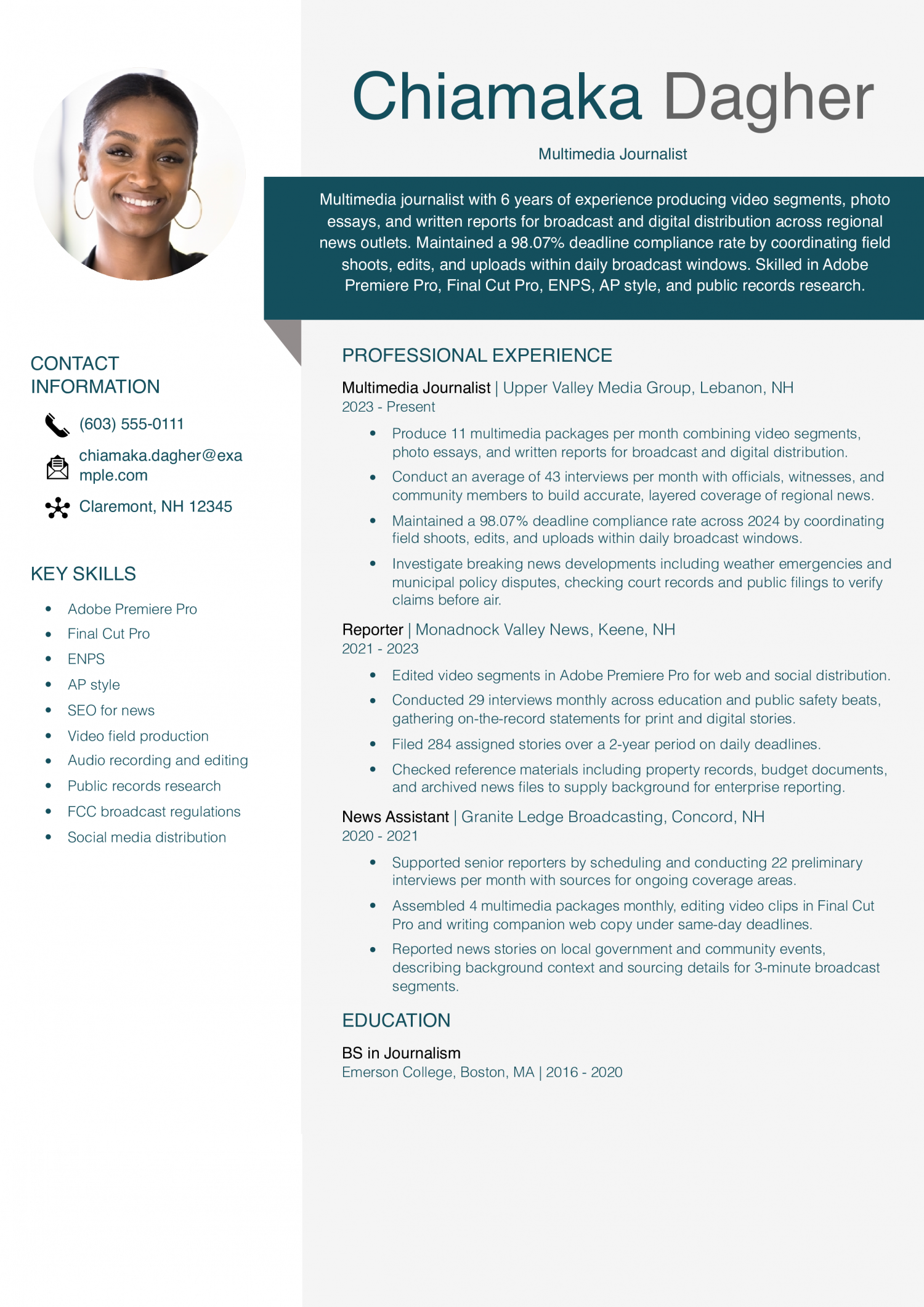
Pick this resume if you are a mid-level multimedia journalist with about six years at regional outlets producing packages across broadcast and digital channels. Adopt its method of placing a precise deadline compliance percentage in each role to prove reliability under daily pressure.
Many journalist resumes claim they conduct thorough reporting but never quantify the sourcing work behind each story. This resume backs up that claim with a specific count: “an average of 43 interviews per month with officials, witnesses, and community members.” That number tells a news director the coverage is built on verified, on-the-record information, not recycled quotes or press releases. If you track how many sources you contact each week or month, add that figure to your resume so hiring managers can measure your reporting depth in real terms.
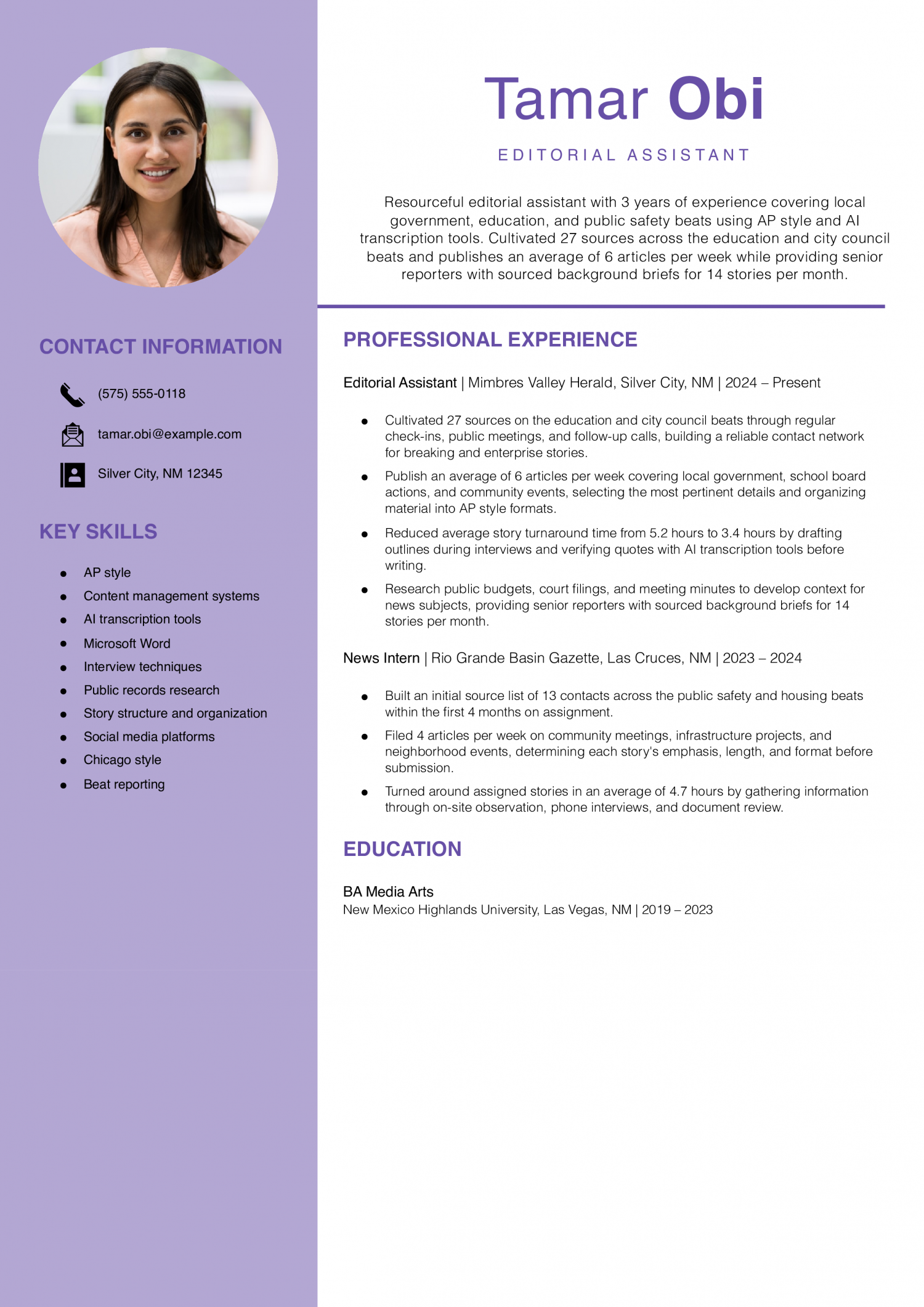
Start with this resume if you are beginning your editorial career and have internship or early newsroom experience. Check how it credits speed gains to a specific workflow change rather than listing general writing ability.
Many journalist resumes list a weekly article count but leave out the behind-the-scenes work that supports other reporters on the team. This resume includes that contribution: “providing senior reporters with sourced background briefs for 14 stories per month.” That line tells an editor you do more than file your own pieces and that your research directly feeds the newsroom’s broader output. If you regularly prepare notes, fact checks, or background materials for colleagues, add a monthly count to your resume so editors can see the full scope of your contribution.
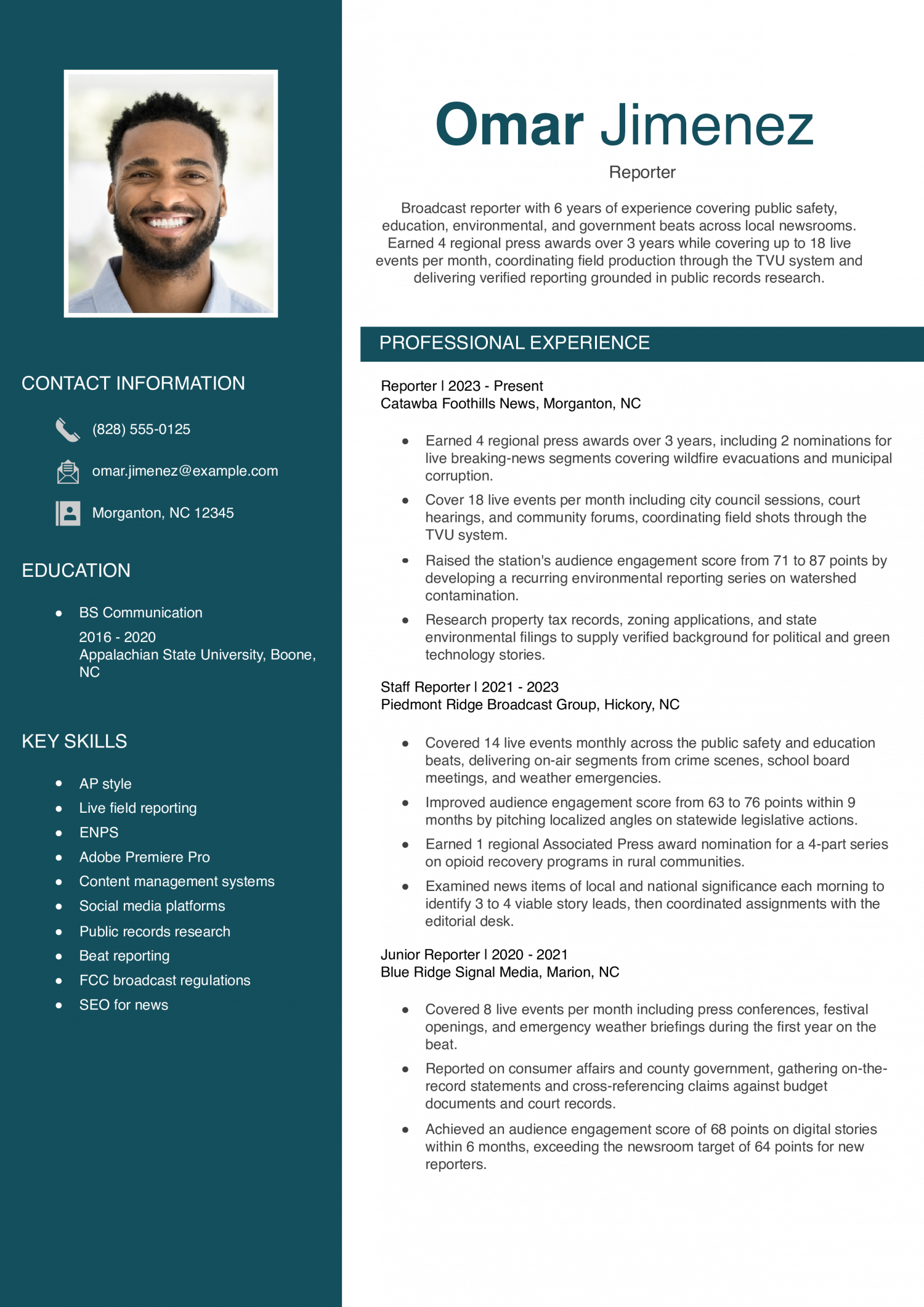
Try this layout if you are a mid-level reporter with around six years of beat experience seeking your next newsroom role. Close in on how it attaches a rising audience engagement score to the specific content series that moved it.
Many journalist resumes list story counts but never explain how they turned raw news into workable assignments each day. This resume spells out that editorial process: “identify 3 to 4 viable story leads, then coordinated assignments with the editorial desk.” That line shows a news director you can scan a full morning feed, judge what matters locally, and organize coverage with the team. If you follow a similar routine, describe the number of leads you flag and how you hand them off so editors can picture your newsroom workflow.
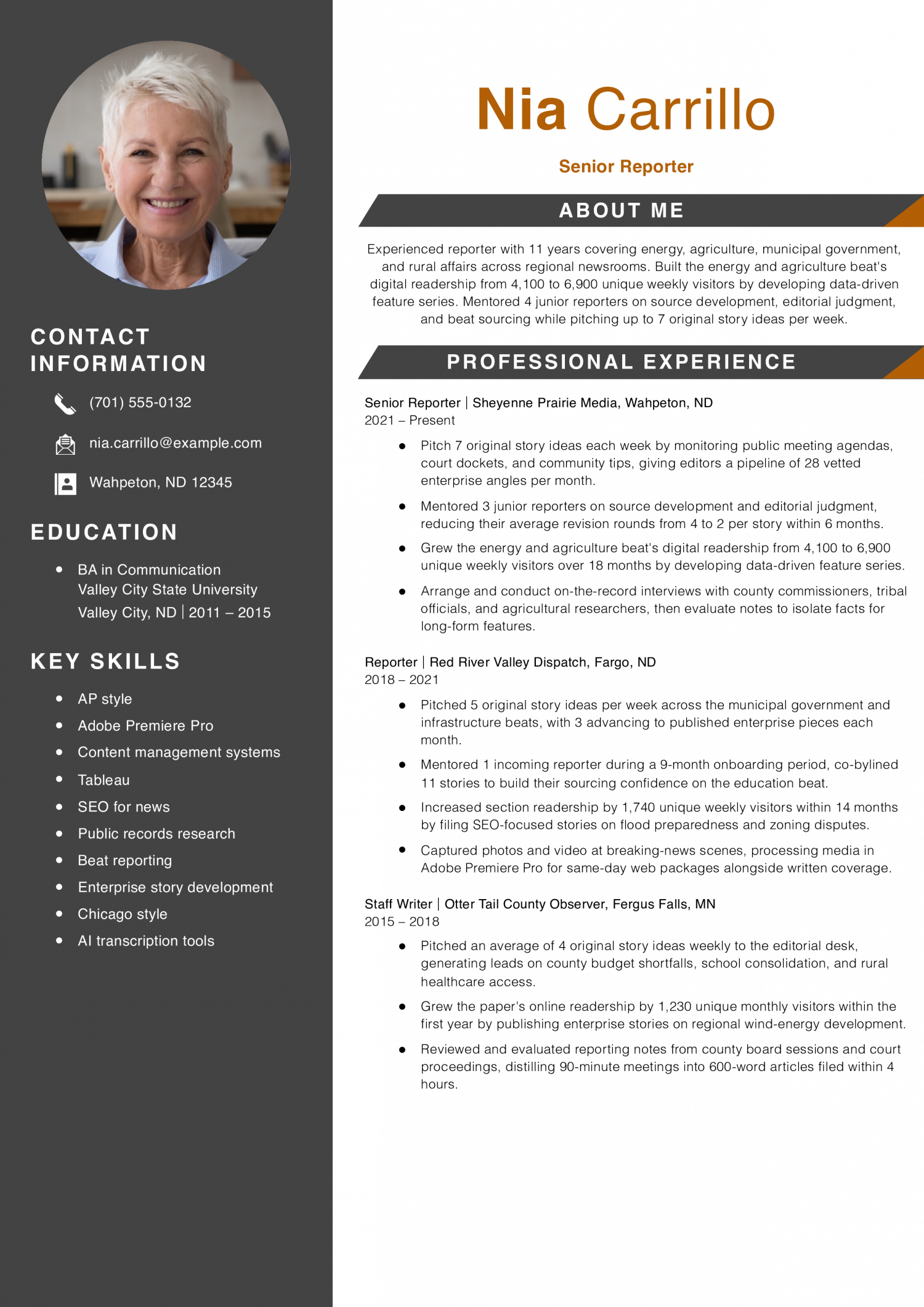
Lean on this resume if you are a senior reporter with roughly a decade of regional newsroom experience and a record of growing beat readership. Detail how it shows audience growth in each role, with weekly or monthly visitor figures.
Many journalist resumes mention growing an audience but leave out the baseline number, so the gain has no context. This resume includes both ends of the change: “Grew the energy and agriculture beat’s digital readership from 4,100 to 6,900 unique weekly visitors over 18 months by developing data-driven feature series.” That line lets an editor see the starting point, the result, and the method in one sentence. When you claim readership growth on your own resume, pair the before and after figures with a timeframe so the increase is verifiable.
Dedicated to accountability journalism, with 6 years of experience producing investigative pieces on public health, criminal justice, and municipal governance while maintaining a 98.37% fact-check accuracy rate by cross-referencing court filings, budget documents, and on-the-record statements before broadcast. Contributed to a 16.6% viewer ratings increase by developing a recurring criminal justice series examining pretrial detention data, and built a network of 34 credible sources across law enforcement, city planning, and school administration.
Your summary should start with a number. Name how many stories you filed per week or month. Managing editors and news directors will read that figure first.
It tells them your speed under deadline pressure. Follow it with your beat and the outlet’s reach. A daily paper with 200,000 readers signals a different pace than a niche trade site.
State the format you work in, such as print or broadcast. Add your audience size or monthly page views. These concrete details replace vague claims about passion for storytelling.
Mention any awards or recognition your coverage has earned at the outlet. Two lines built this way give a news director enough context and credibility to keep reading your resume.
Most strong journalist resumes pair each individual story type with a measurable result. Name the average word count and the turnaround time. Cite page views, social shares, or syndication pickups on your top pieces.
If you boosted a section’s traffic, state the percentage gain. Bullets without a number tend to read as duties, not proof. You can also count sources per story to show depth.
For broadcast roles, note your average package length in minutes. Managing editors scan for output volume and audience reach first. Pair those two figures in a single bullet when you can.
Even a rough monthly average is stronger than no figure at all. Track your clips so you always have fresh data to add.
Organize your bullets under the types of journalism you practice. Breaking news, including spot coverage and developing stories, is one clear group. Investigative or long-form work is a second category.
Feature writing and human-interest coverage can form a third. If you produce multimedia content, give it its own cluster. This layout helps news directors spot the beats you can fill.
It also prevents your experience section from looking like one long list. Use two or three categories per job entry. Label each with a short header or lead it with the format, such as print, broadcast, or digital.
Keep every bullet to one line when possible. That white space makes a busy editor more likely to read each point.
List your content management systems right after your summary, because hiring managers look for platform familiarity early on the page. Name your CMS platforms, such as WordPress or Arc Publishing. Add analytics tools like Google Analytics or Chartbeat.
Social media scheduling tools also belong in this block. Managing editors want to see these skills before they reach your job history. If you hold a press credential from a state or federal body, note it here as well.
Audio and video editing software matters for multimedia roles. Name the specific program, not a broad category. A dedicated skills block on page one keeps this information visible and organized.
It saves a news director from hunting through your individual bullet points for technical proficiencies.
Place your degree near the bottom of the page. Name the school, the major, and your graduation year. A journalism or communications degree is common, but not universal.
Many working journalists hold degrees in political science or English. If you studied a specialized subject, name it as a beat qualifier. Below your education, add a line linking to your online portfolio.
A clean URL to your clips page is more useful than a list of headlines. Managing editors and news directors often click that link before they call you. Keep the URL short and free of random characters.
If you won a regional or national press award, place it right above education. One or two awards carry more weight than a long list.
Five years ago, a Journalist resume read like a list of beats covered. The mix has shifted toward data tools and audience metrics. Digital skills now sit beside core reporting on most postings.
Managing editors and news directors look for hard skills that prove you can file clean copy fast. They also weigh soft skills like adaptability. A newsroom needs reporters who pivot when stories break.
Scan the hard skills table first. Find each term that appears in the posting you target. Add that exact phrase to your skills section and to at least one bullet.
Then review the soft skills table below it. Weave each matching trait into a result, not a label. Saying you met a tight deadline shows more than listing the word alone.
Pair one hard skill with one soft skill inside the same bullet when you can. This pattern gives your resume both keyword density and proof of impact. It also keeps each line short and readable for a screener.
| Soft Skills | AI-estimated % |
|---|---|
| Editorial judgment | 67% |
| Source relationship-building | 56% |
| Composure under pressure | 45% |
| Audience awareness | 38% |
| Ethical decision-making | 35% |
And here are the top hard skills showing up most often.
| Hard Skills | AI-estimated % |
|---|---|
| Investigative reporting | 78% |
| Source development | 56% |
| Deadline writing | 50% |
| Fact verification | 35% |
| Multimedia storytelling | 33% |
Skill names and rankings come from an AI model grounded in U.S. Department of Labor occupation data for journalists, not from a count of journalists’ resumes built on ResumeTemplates.com.
The items below are what separate a journalist resume from one that gets put back in the pile.
Managing editors and news directors are split on AI in the newsroom. Some want reporters who can use AI to speed up research. Others ban generative tools from any published copy.
Name the tools you actually use in your workflow. Describe how you verify AI output before it reaches an editor. Do not claim AI writes your stories if you only use it for transcription.
Honesty matters here more than a long list of tools. A short, accurate description of your process carries more weight. Focus on the tasks where AI saves you time.
Then explain how you fact-check every result.
What AI is actually changing for this role
Source research: AI tools can scan public records and databases faster, but reporters still verify each source by phone or in person.
Transcription: Automated transcription cuts hours from interview turnaround, though you must correct names and technical terms before filing.
Data reporting: AI can flag patterns in large datasets, but you still need to confirm findings with original documents and expert interviews.
Headline drafts: Some desks use AI to generate headline options for A/B testing, with editors picking the final version.
Fact-checking: AI can surface prior coverage and flag inconsistencies, yet every claim still requires human verification against primary sources.
AI tools to name
How to phrase AI on your resume
Do
Skip
Managing editors and news directors want to see your published work before they read your resume. A strong portfolio page lets them scan your clips by beat, format, and outlet in under a minute. Link it in your resume header so it loads with one click.
Pin your five strongest clips at the top of any portfolio page. Choose pieces that cover different beats or formats so an editor sees range right away. If you have investigative, breaking news, and feature work, show one of each.
Update your portfolio every month with new clips. Stale pages signal that you are no longer active. Remove older pieces that no longer reflect your current skill level or beat focus.
Awards signal the reach and quality of your work. Managing editors and news directors scan for recognized honors. A short list of credits proves you produce stories that matter.
The 90th-percentile journalist out-earns the median by roughly 132 percent. That gap tells you the market pays a steep premium for beat depth and platform reach over general reporting tenure. National employment in the field is small, so the pool of roles at every level stays tight.
The spread from the 10th percentile to the top is wide. Journalists near the floor sit about 42 percent below the median. That distance narrows fast once you can show a defined beat and steady output.
Lead your resume with the beat you own and the audience size your work reached.
| # | State | Median Annual |
|---|---|---|
| 1 | District of Columbia | $105,390 |
| 2 | New York | $100,770 |
| 3 | Georgia | $81,910 |
| 4 | Nevada | $78,550 |
| 5 | Rhode Island | $74,570 |
| 6 | Maryland | $63,680 |
| 7 | Michigan | $62,760 |
| 8 | Tennessee | $62,390 |
| 9 | Virginia | $62,140 |
| 10 | Utah | $61,880 |
| # | State | Workers | Median |
|---|---|---|---|
| 1 | New York | 5,750 | $100,770 |
| 2 | Texas | 2,670 | $48,470 |
| 3 | Florida | 2,490 | $58,730 |
| 4 | District of Columbia | 1,720 | $105,390 |
Resume Templates offers HR approved resume templates to help you create a professional resume in minutes. Choose from several template options and even pre-populate a resume from your profile.
Create a Publications section below your work history. List each piece with its headline, outlet name, and date.
Bold the outlet name so managing editors can scan it fast. If you have more than eight clips, choose the ones closest to the beat you want next.
Pull exact phrases from the job posting into your summary, skills list, and bullet points. ATS software ranks resumes by how closely their keywords match the posting text.
Use standard section headings like Experience and Education. Custom labels can confuse older parsing systems.
Lead with campus newspaper, blog, or internship clips that show real reporting work. Add a skills line for any content platforms or audio editors you have used.
Even a class project counts if you interviewed sources and published the piece.
Yes, most managing editors and news directors still expect one. Use the letter to explain why you want that specific beat or outlet.
A strong cover letter gives context that bullet points on a resume cannot carry on their own.
One page works for most journalists with fewer than ten years of reporting experience. A second page is reasonable if you cover multiple beats and carry a long list of published work.
Keep the second page at least half full, or trim your clips list instead.
A resume is one to two pages and focuses on recent roles, metrics, and skills. A CV can run longer and lists every publication, fellowship, and speaking credit in full.
Most U.S. newsrooms ask for a resume. Academic journalism programs tend to request a CV.
Note any freelance pieces, newsletter projects, or podcast work you did during the gap. Managing editors care more about steady published output than about continuous staff employment.
A brief line naming the gap period and what you produced during it is enough.
For a journalist, an ATS-friendly template is the safest pick, because it puts your certifications and experience where a hiring manager scans first. A basic template is a solid alternative. Whichever you choose, keep the formatting clean and easy to parse: clear section headings, a standard font, and no graphics a parser can choke on.
Journalist Resume
4.2/5 stars with 144 reviews

Executive Resume Writer and Career Coach
Andrew Stoner is an executive career coach and resume writer with 17 years of experience as a hiring manager and operations leader at two Fortune 500 Financial Services companies, and as the career services director at two major university business schools.
© 2026 Resumetemplates.com All rights reserved.