Tip !

A concrete list of hall responsibilities and student headcount is what gets Resident Assistant resumes past the first cut with residence hall directors; documented conduct response and programming outcomes are what make them readable enough to advance.

Andrew Stoner , Executive Resume Writer and Career Coach

Resident Assistant Resume Examples

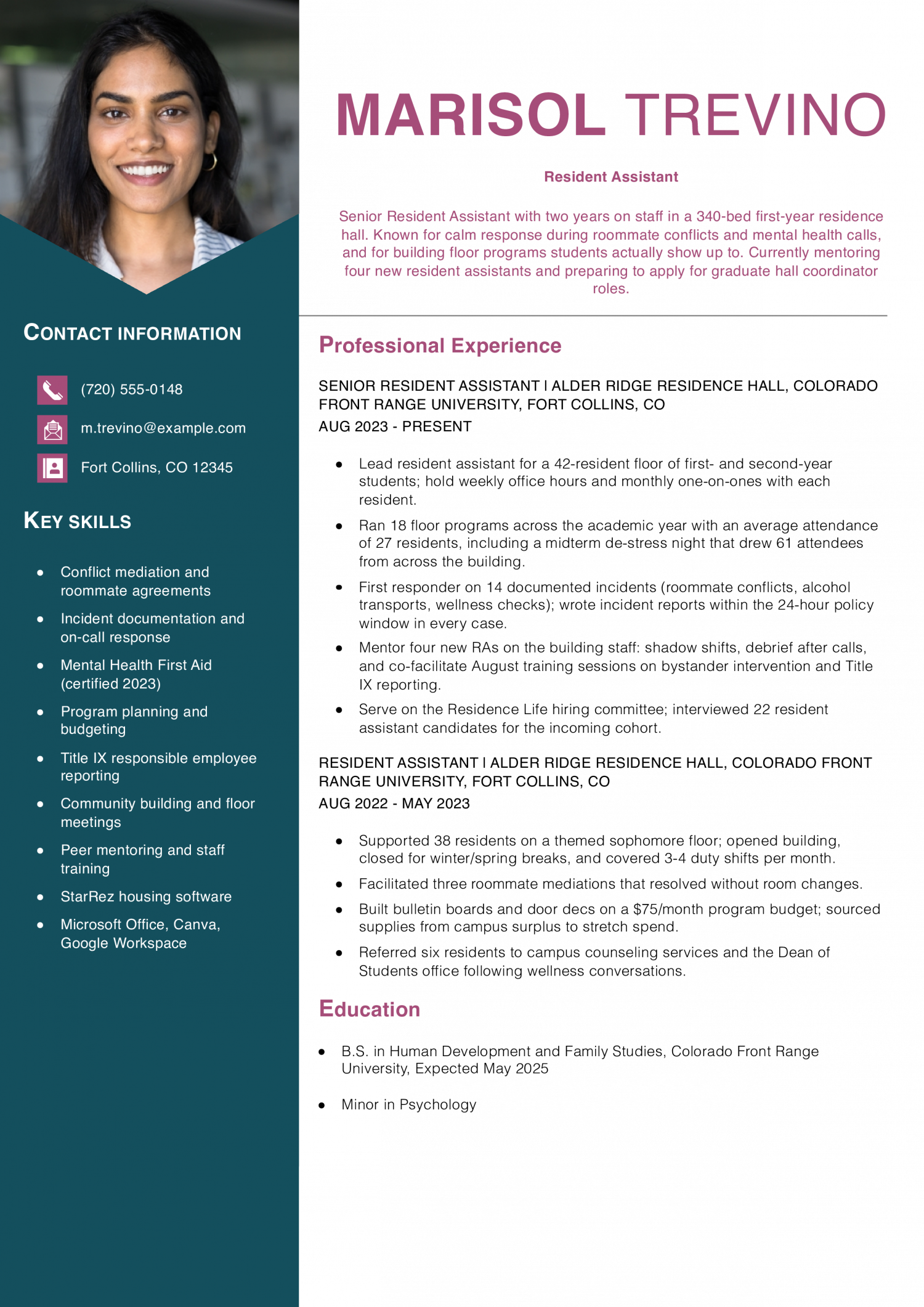
Featured Example

Why this resume works
  • Real numbers on floor programs: Instead of saying she ‘planned events,’ she gives program count, average turnout, and one standout attendance figure so the reader can picture the scale.
  • Shows she handled hard calls: Names the categories of incidents (wellness checks, alcohol transports, roommate conflicts) and confirms she met the 24-hour report window without exaggerating her role.
  • Grew into more responsibility: The two-year arc from resident assistant to senior resident assistant with mentoring and hiring committee work signals she is ready for the next step into a coordinator role.

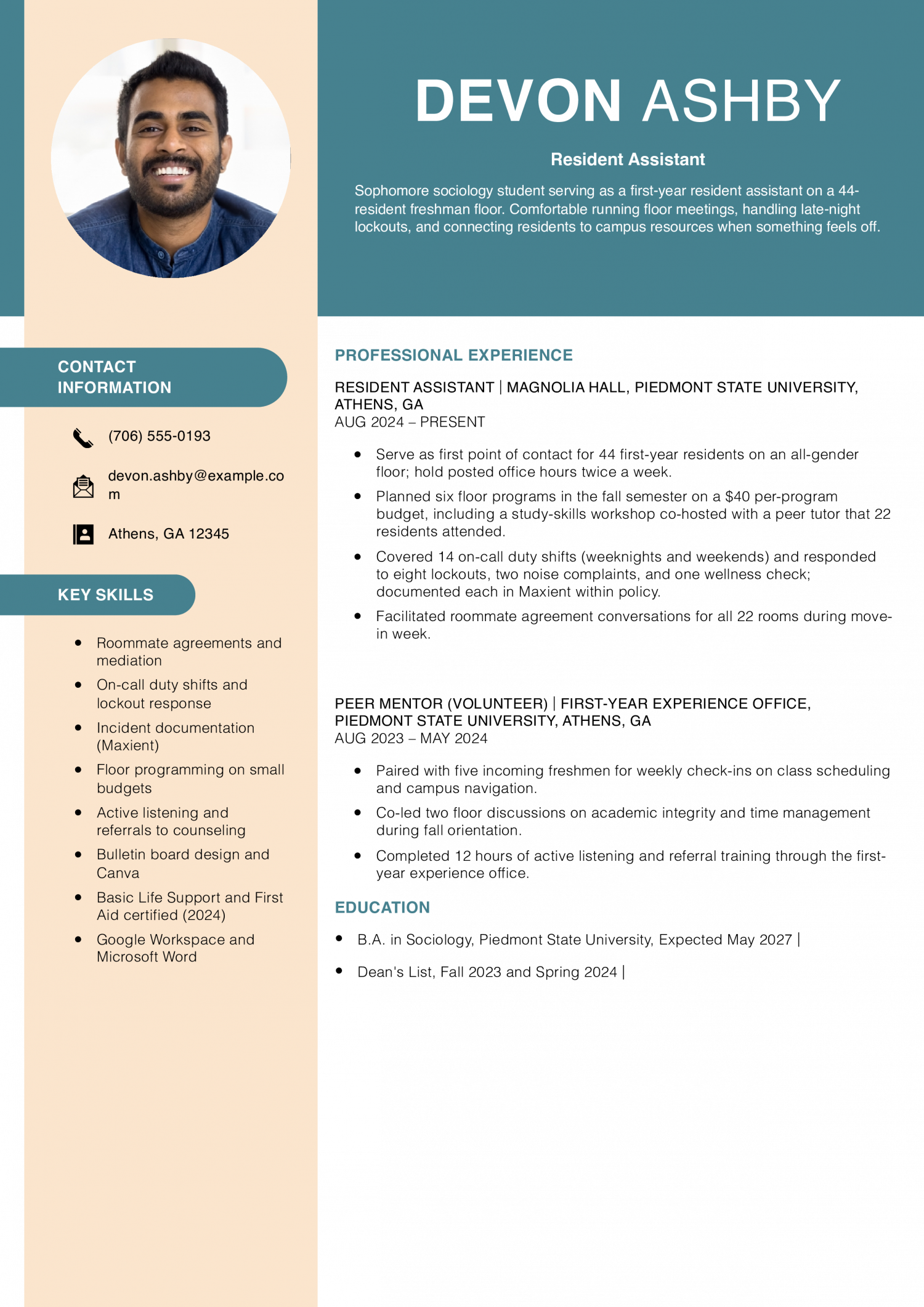
Resident Assistant Example

This resume fits a first-year Resident Assistant applying for a return term or a peer role on another campus. It has to show floor community building, incident response, and steady work under a residence hall director.

Why this resume works
  • Right-sized for a first-year resident assistant: One resident assistant role plus one peer-mentor volunteer role is honest for a sophomore; it does not pad the page with unrelated jobs.
  • Concrete duty-shift numbers: Naming 14 on-call shifts and the specific call types (lockouts, noise, wellness) shows the reader she has done the actual work, not just training.
  • Ties programs to a budget: The $40 per-program figure is small and believable and tells hiring committees she can plan within Residence Life spending limits.

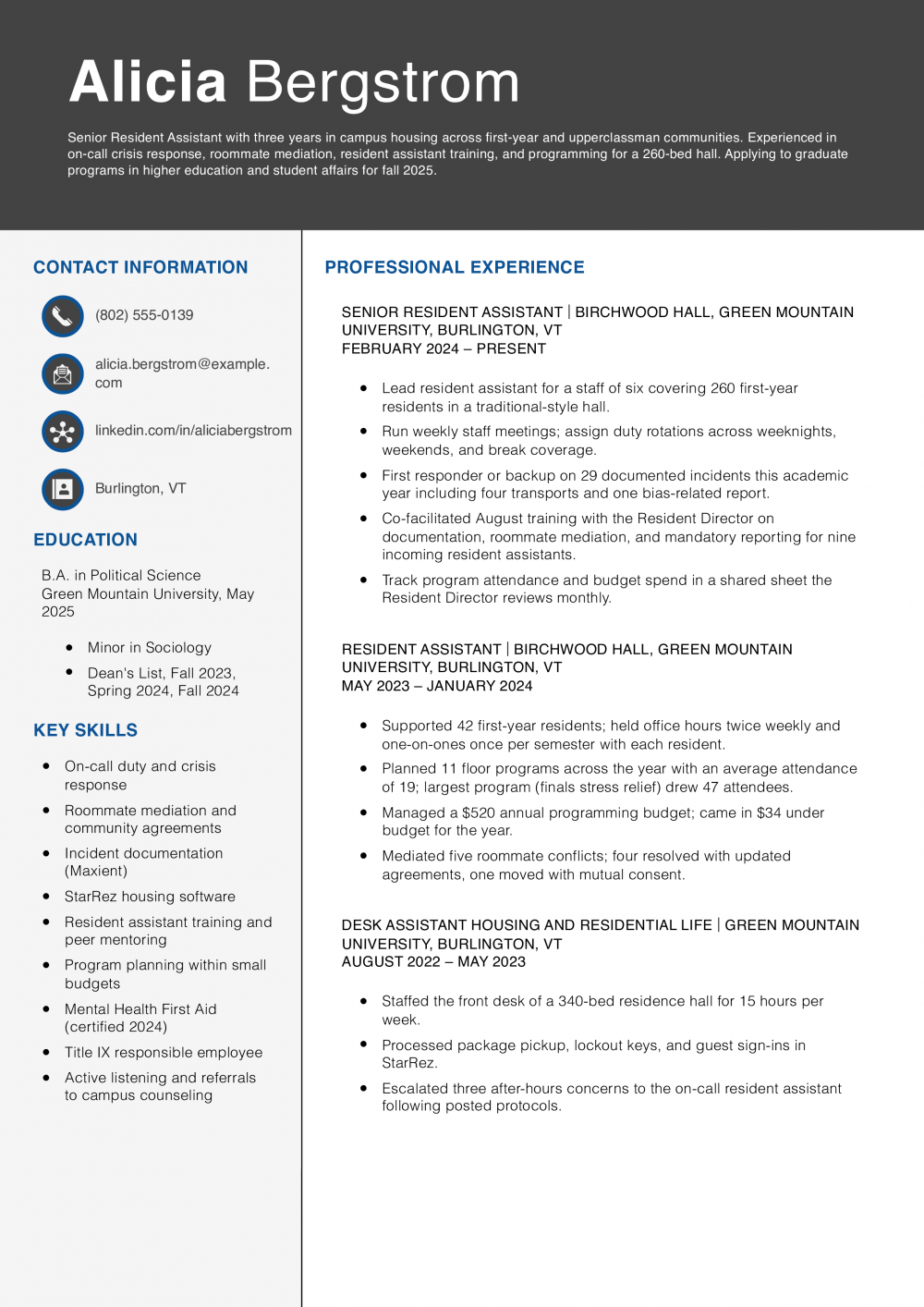
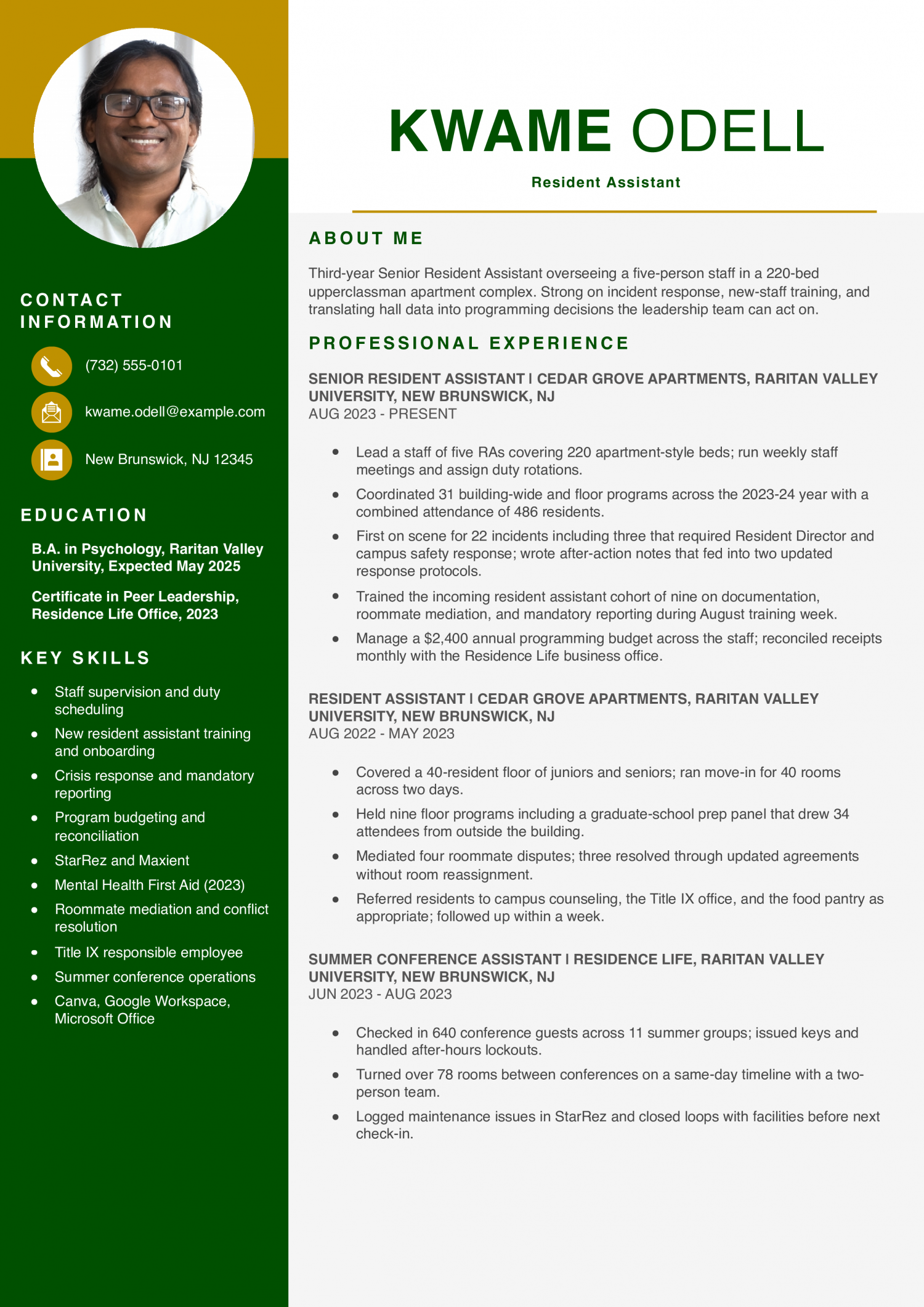
Senior Resident Assistant Example

This resume fits a Senior Resident Assistant who mentors newer staff and takes on duty rotations across a whole building. It has to prove training delivery, conduct follow-through, and sound judgment during on-call weekends.

Why this resume works
  • Shows supervision, not just service: Naming staff size (five resident assistants), training cohort (nine new hires), and a specific budget figure ($2,400) proves the step up from resident assistant to senior resident assistant is real.
  • Uses hall data as evidence: Program count with combined attendance, and after-action notes feeding into two updated protocols, connects his work to outcomes the Residence Life office cares about.
  • Full-year employment story: Adding the summer conference role fills the calendar honestly and demonstrates he can run building operations without a full-time supervisor on site.

Resident Director Example

This resume fits a Resident Director who runs a hall or complex and supervises a staff of Resident Assistants. It has to prove hiring and training of student staff, budget oversight, and partnership with area coordinators.

Why this resume works
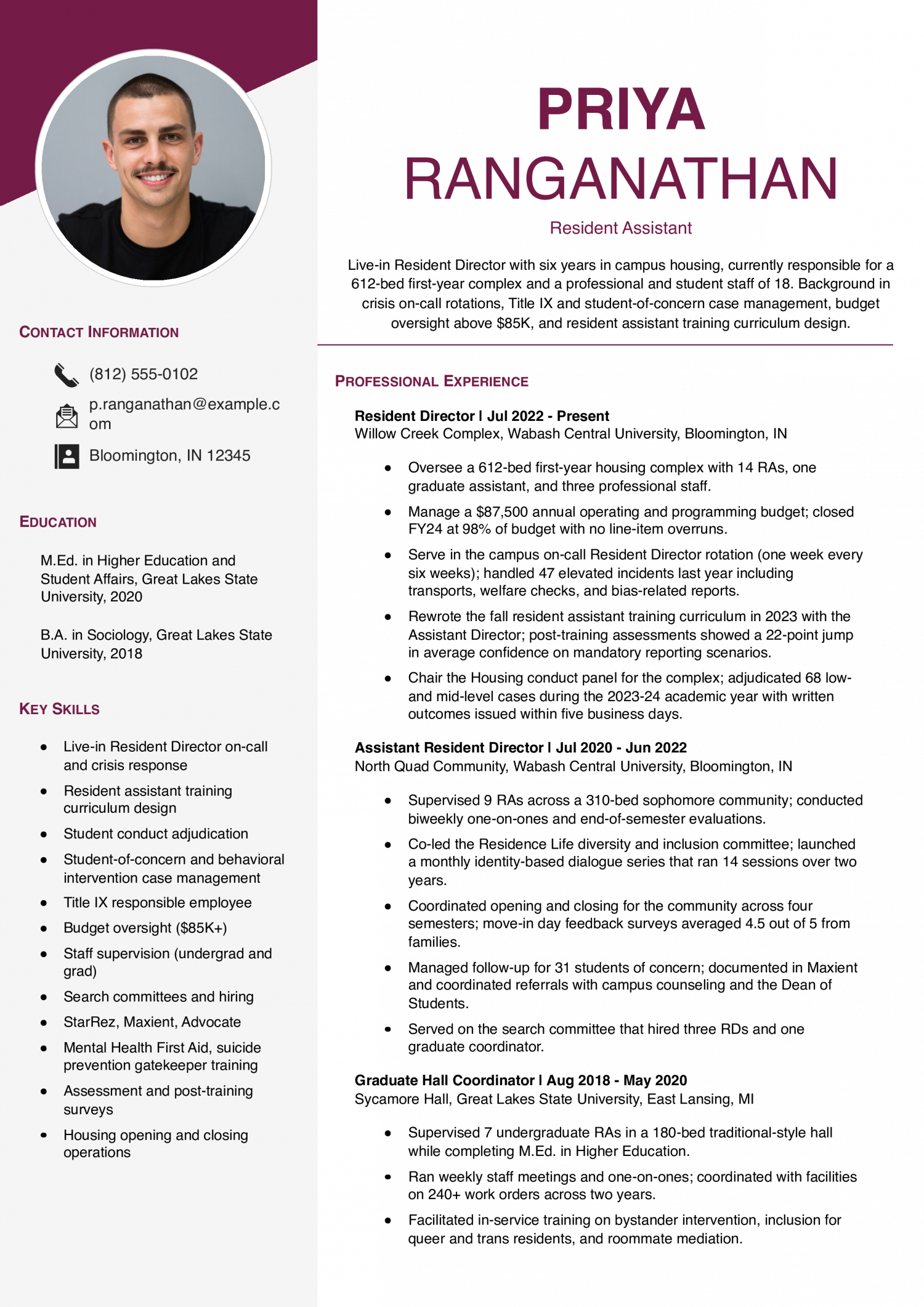
  • Scope matches a director role: 612 beds, 18 direct and indirect reports, and an $87,500 budget give recruiters the operating size in one glance.
  • Measured outcomes, not just duties: The 22-point jump in post-training confidence scores and closing FY24 at 98% of budget show she tracks results the way senior Housing leadership expects.
  • Clean promotion path: Senior Resident Assistant to Graduate Coordinator to Assistant Resident Director to Resident Director across six years reads as a real student-affairs career, which is what search committees want to see.

How to Write a Resident Assistant Resume

01 Open with a metric a hall director would use

Lead your summary with the size of the community you covered, not a broad service line. Name the resident count on your floor or wing, the building type, and the school year span. Residence hall directors and area coordinators read that first line as proof you can hold a real community.

A line like “Resident assistant for 42 first-year students in a 300-bed traditional hall” tells them more than “passionate student leader.” If you covered a themed floor, a substance-free wing, or living-learning housing, put that in the opener too. Follow with one clause on programming volume or duty coverage. Save personality lines for the cover letter, not the summary.

02 Put numbers on programs, duty, and response

Most strong resident assistant bullets carry a number, since the work is countable. Give the programs you planned per semester, the average attendance, and the duty shifts you covered per month. Add the residents you conducted one-on-ones with during move-in and mid-year check-ins.

For incident response, name the count of noise complaints, roommate mediations, or wellness checks you logged. Bullets without a number tend to read as duties a job description already lists. You do not need exact figures for every line.

Ranges like “8 to 10 programs a semester” or “duty coverage two weekends a month” read as honest. Area coordinators scan for volume first, then look at what kind of program or call it was.

03 Group your work into four clear categories

Sort your bullets so a reader sees the shape of the job fast. Use four buckets: community building, duty and incident response, administrative work, and peer support. Under community building, list floor programs, bulletin boards, and roommate agreements.

Under duty, list rounds, lockouts, and after-hours calls you escalated to the pro staff on call. Under administrative work, put room condition reports, occupancy audits, health and safety checks, and work order submissions. Under peer support, list referrals to counseling, the dean of students, or Title IX contacts.

Name the housing software you used for reports and incident logs. Keep each bullet to one action and one result, not a paragraph of context.

04 Place training and clearances near the top

Housing offices hire on training as much as coursework, so surface it early. Under your education block, add a short “resident assistant training and clearances” line on page one. List the pre-service training week, mid-year in-service hours, and any Title IX, mandated reporter, or bystander intervention modules your school ran.

Add Mental Health First Aid or suicide prevention training if you hold current cards. Residence hall directors and area coordinators need to see this without scrolling, since it tells them what they will not have to retrain. If you served on a hall council, judicial board, or diversity committee, put that here too.

Requirements vary by campus, so match the language on the posting to yours.

05 Close with education and campus involvement

Most resident assistants are undergraduates, so the education section carries real weight. List your school, degree, major, and expected graduation month and year. Add your grade average if it is 3.3 or higher, since many housing offices set a floor there.

Below that, add a short involvement block for clubs, Greek life, orientation leader roles, tutoring, or campus jobs. These lines show the pro staff you can balance the workload with coursework. Keep the block to four or five lines so the resume stays to one page.

If you are applying for a returning or senior resident assistant spot, move a short leadership line above education. Skip high school unless you are a first-year applicant with no college activities yet.

Five years ago, a Resident Assistant resume read like a duty list of rounds, lockouts and door decs. The mix has shifted toward crisis response, mental health referrals and measurable community programming. Bullets now show what changed on the floor, not what you were assigned to cover.

Residence hall directors and area coordinators read hard skills first to confirm you can staff a duty rotation. They then read soft skills as proof that residents will actually come to you. Conflict mediation carries more weight than any single software tool on this list.

The two tables below show terms that clear most applicant tracking system scans for the role. Match each one against the exact wording in your target job posting before you paste it in. Keep hard skills in your skills block and your bullets.

Move soft skills into bullets that name the resident situation and the outcome. That pairing gives a reviewer evidence, not adjectives. Skip any term you cannot speak to in an interview.

Soft Skills AI-estimated %
Peer conflict mediation 78%
Empathy under pressure 62%
Approachability 48%
Boundary setting 37%
Cross-cultural communication 26%

And here are the top hard skills showing up most often.

Hard Skills AI-estimated %
Residential programming 65%
Crisis intervention 51%
Policy enforcement 40%
Incident report writing 37%
Community building 29%

Skill names and rankings come from an AI model grounded in U.S. Department of Labor occupation data for resident assistants, not from a count of resident assistants’ resumes built on ResumeTemplates.com.

Latest BLS Statistics for Resident Assistants

The top-paying states for this role cluster in regions with large public campuses. They are not the coastal metros most students picture. Employment sits at a steady level across the country.

The spread from the low end to the high end is wide for a role often filed as entry level. That gap tells you time on the job, campus size, and hall type shape pay more than the title. If you can move for a role, name the campus types you have worked.

List any housing conferences you have been to.

$42,240 National median annual
$43,990 National mean annual
$29,870 10th percentile
$61,060 90th percentile
84,760 Resident Assistants in the U.S.
Where you stand

Below median

$29,870 to $42,240 Show the hall type you staffed and the resident count you covered on duty.

Above median

$42,240 to $61,060 List the conduct cases you closed and the program budget you ran each term.

Top 10%

$61,060+ Name the RA teams you trained and the crisis plans you wrote for hall directors.

Top-paying states

# State Median Annual
1 New Hampshire $49,010
2 Minnesota $48,770
3 Washington $48,640
4 North Dakota $48,590
5 New York $48,380
6 Massachusetts $48,190
7 Montana $47,230
8 Oregon $47,160
9 Maryland $46,950
10 California $46,650

Highest-employment states

# State Workers Median
1 California 8,120 $46,650
2 New York 6,150 $48,380
3 Massachusetts 5,120 $48,190
4 Pennsylvania 4,380 $40,010
5 Texas 3,630 $37,630
3.5% projected growthJob outlook, 2025-2035

Source: U.S. Bureau of Labor Statistics, Employment Projections, 2025-2035. View on bls.gov
Source: U.S. Bureau of Labor Statistics, OEWS May 2025 release (SOC 15-1255). View on bls.gov
Written by professional resume writers and loved by hiring managers

Resume Templates offers HR approved resume templates to help you create a professional resume in minutes. Choose from several template options and even pre-populate a resume from your profile.

Frequently Asked Questions

How should you describe a resident assistant role on a resume?

Lead with the size of the community you covered, the number of residents on your floor and the building you staffed.

Then name the recurring duties a residence hall director would recognize: duty rounds, programs, lockouts, and incident reports. Save one line for the outcome, such as retention on your floor or a drop in policy violations.

Should you put a resident assistant job on your resume?

Yes, list it under work experience with the title Resident Assistant, the university name, and your dates on staff.

The role shows paid responsibility for people, money handling for programs, and crisis response, which most student jobs do not. Employers outside housing read it as staff work, not as a campus activity.

What bullet points work best for a resident assistant resume?

Write bullets that put a number on the recurring parts of the job so an area coordinator can compare you to other applicants.

Cover the size of your floor, the count of programs you ran per semester, and duty shifts per month. Add one bullet on incident response, naming the type of incident and the office you escalated to.

How do you list a resident assistant role on a medical school resume?

Frame the role around the competencies admissions committees read for, which are service, leadership, and response under pressure.

Keep the housing jargon out and name the transferable work: welfare checks, mental health referrals, and mandatory reporting. One line on the community you served, one on a program you built, and one on a crisis you managed reads cleanly.

Where should the resident assistant job go on your resume?

Put it in work experience, not in activities, because it is a paid staff position with a supervisor and a schedule.

Rank it by relevance to the job you are applying to, above unrelated retail or food service roles. If you have held the role for more than one year, promotions to senior staff belong on their own line.

Does being a resident assistant look good on a resume?

Yes, because the role covers work most student jobs never touch, including conflict mediation, referrals to counseling, and after-hours crisis response.

Recruiters in education, healthcare, and human resources read it as early evidence you can hold a caseload of people. The value shows only if your bullets name the numbers behind the work.

How do you handle a resident assistant role you left mid-year?

List your real end date and leave the reason off the resume unless a residence hall director asks in the interview.

If you finished the training and worked at least one semester, the role still counts as staff experience worth showing. A short mid-year stint of a few weeks reads better under campus involvement than under work experience.

Which resume template works best for a resident assistant?

For a resident assistant, an ATS-friendly template is the safest pick, because it puts your certifications and experience where a hiring manager scans first. A basic template is a solid alternative. Whichever you choose, keep the formatting clean and easy to parse: clear section headings, a standard font, and no graphics a parser can choke on.

Rate this article

Resident Assistant Resume

Average Rating

4.8/5 stars with 238 reviews

You have given 0 Star(s)
4.8/5 stars with 238 reviews
Andrew Stoner

Executive Resume Writer and Career Coach

Andrew Stoner is an executive career coach and resume writer with 17 years of experience as a hiring manager and operations leader at two Fortune 500 Financial Services companies, and as the career services director at two major university business schools.