Tip !

Salesforce architects decide whether to forward a resume by the top third of page one; if Apex, LWC, and a current PD1 or PD2 aren't visible by then, the file gets passed over for one that names them up front.

Andrew Stoner , Executive Resume Writer and Career Coach

Why this resume works

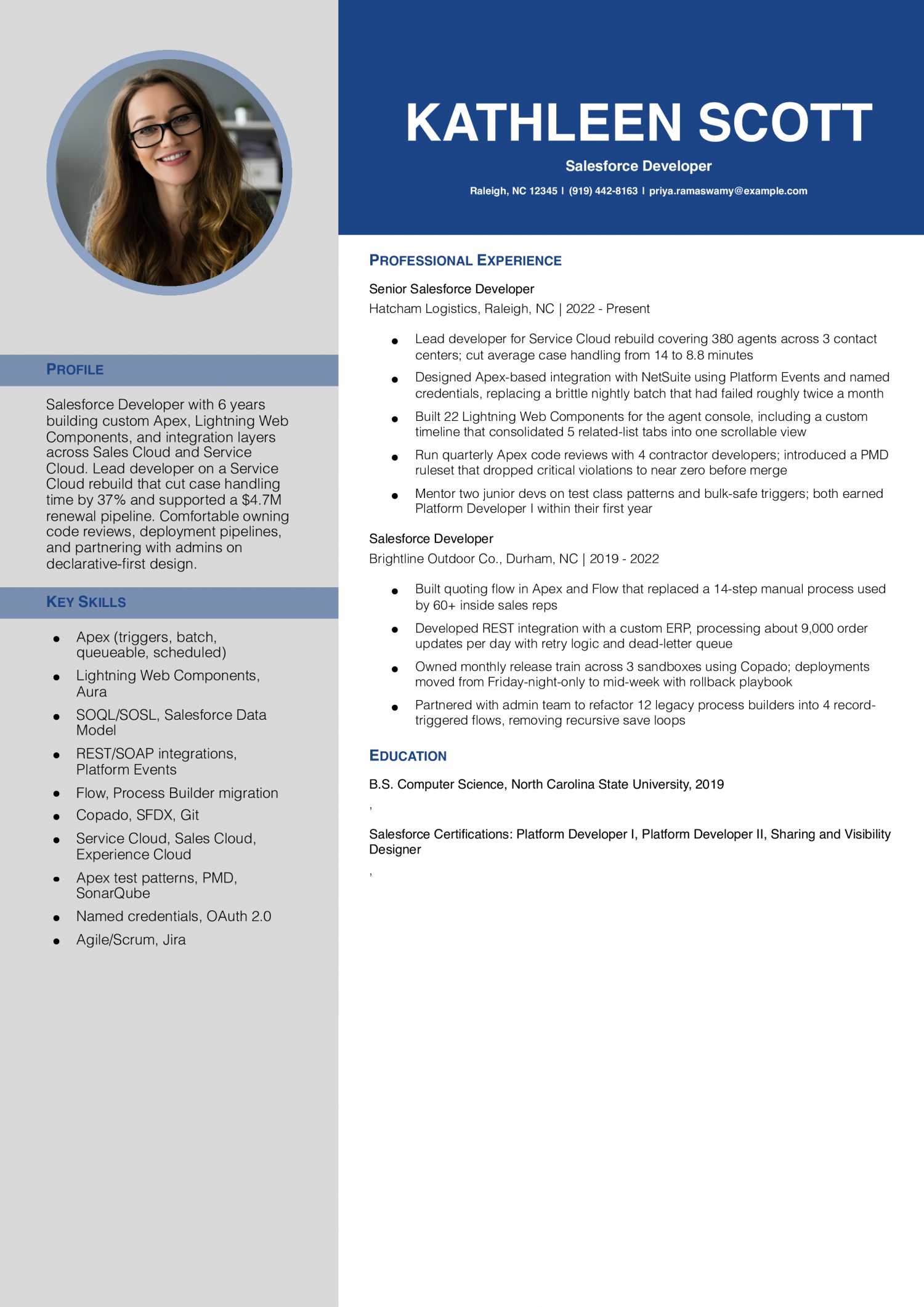
  • Numbers tied to real work: Bullets show case time dropping from 14 to 8.8 minutes and 9,000 daily order updates, so the impact is concrete instead of vague.
  • Mix of code and teamwork: Apex, LWC, and integration depth sit alongside code reviews and mentoring, which matches what senior dev hiring managers actually want.
  • Tools match the job posting: Copado, SFDX, PMD, and Platform Events are named directly, so keyword scanners and reviewers both find what they expect.

Junior Example

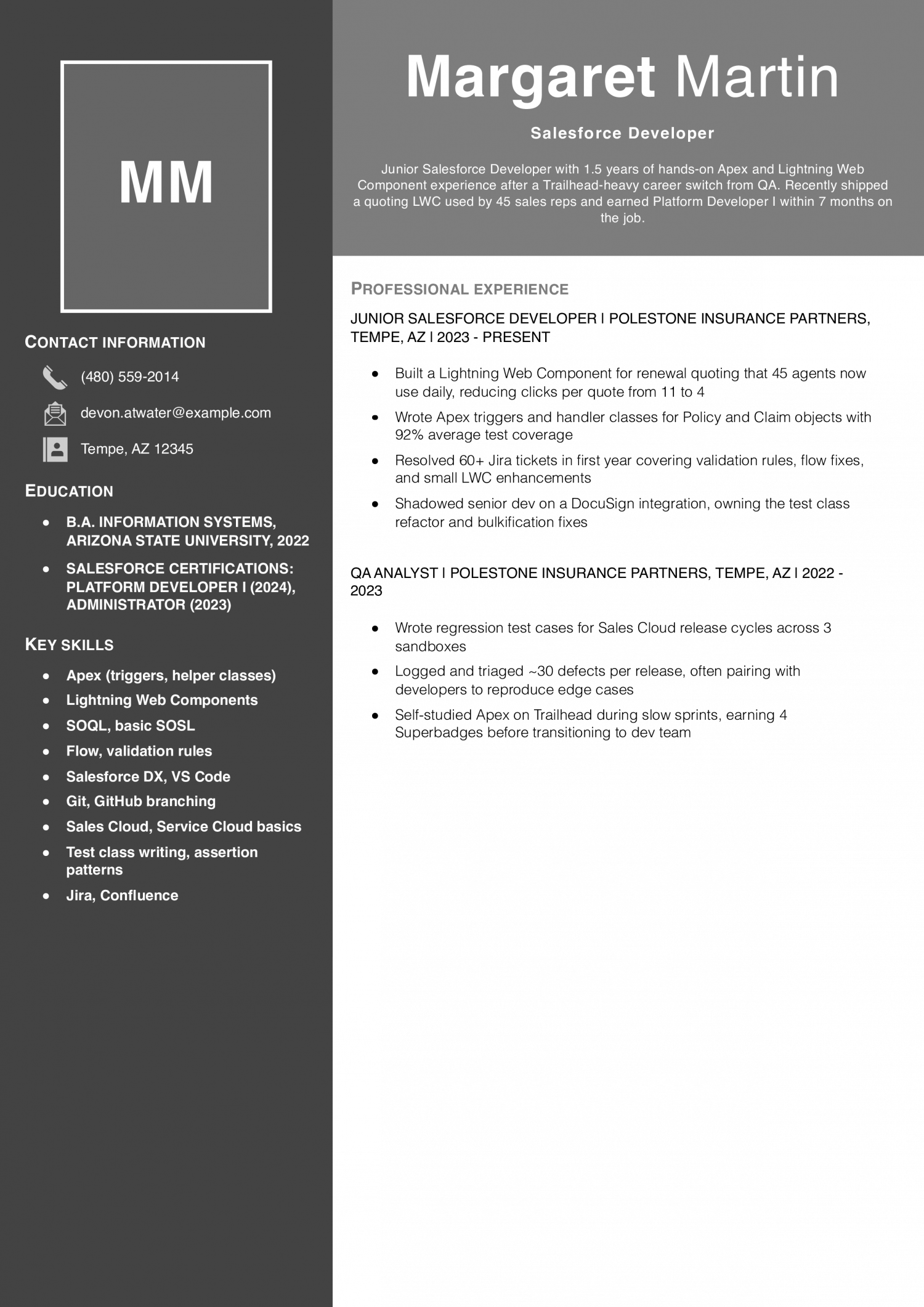
The junior salesforce developer profile has one or two years on the platform, usually one PD1 plus admin certification, and shipped Apex or LWC under a senior's review. This resume needs to prove you write governor-limit-safe code, understand SOQL, and have closed real tickets.

Why this resume works

  • Shows the career switch clearly: Going from QA to dev at the same company explains the resume jump and proves the candidate already knew the codebase.
  • One bullet has a real number: Clicks per quote dropped from 11 to 4, which is a small, believable win that a junior dev can honestly own.
  • Certifications are dated: Listing Platform Developer I (2024) and Admin (2023) shows steady learning rather than a stale resume keyword.

Senior Example

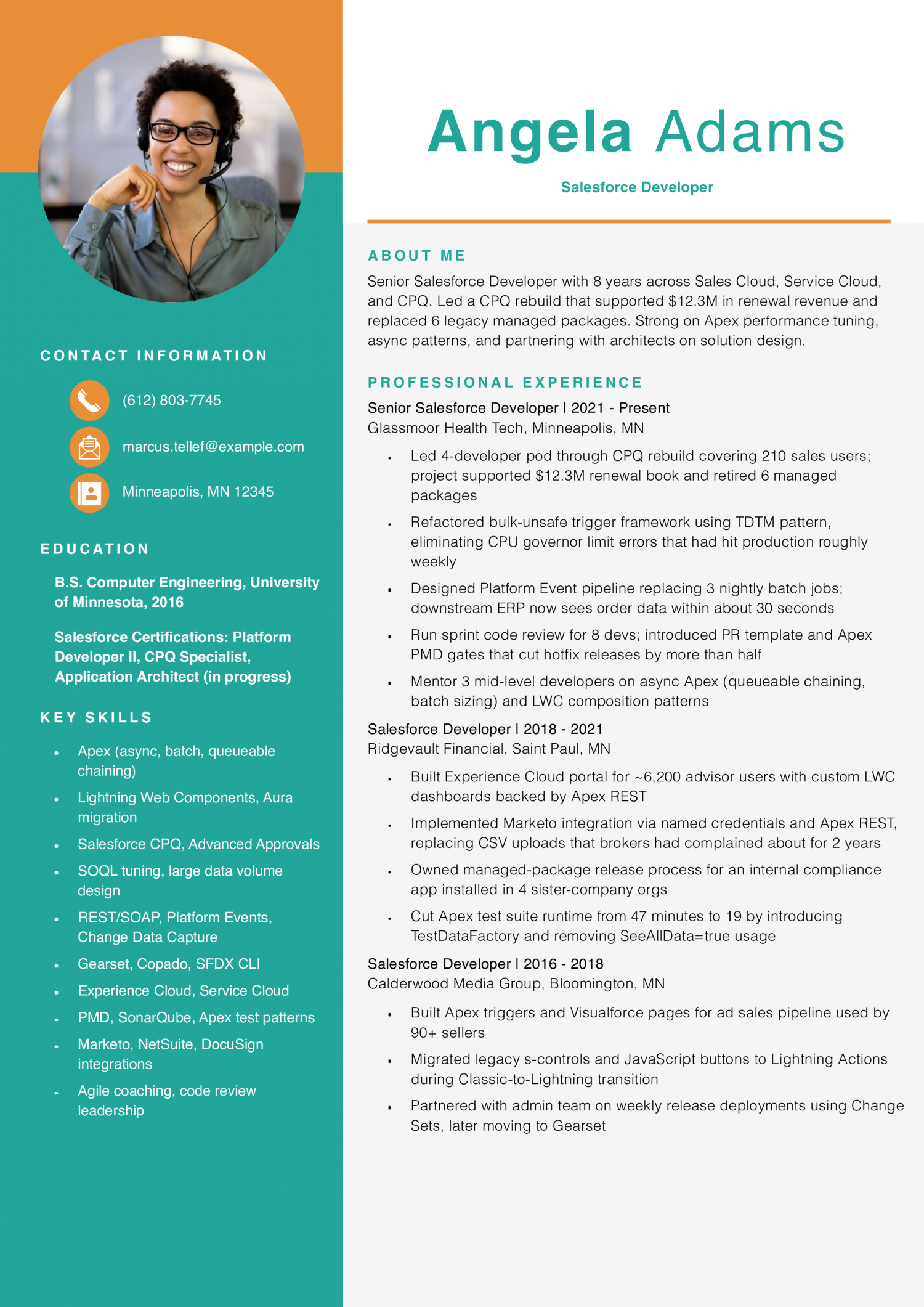
The senior salesforce developer profile owns features end-to-end across Apex, LWC, and integrations, mentors juniors, and runs code review. This resume needs to prove scope: the orgs you've worked in, the integrations you've designed, and the deployment process you run through SFDX and CI.

Why this resume works

  • Senior scope is obvious: Leading a 4-developer pod on a $12.3M CPQ rebuild signals the candidate runs projects, not just tickets.
  • Shows performance work: Cutting test runtime from 47 to 19 minutes and fixing CPU limit errors are exactly the problems senior Salesforce devs are paid to solve.
  • Career arc tells a story: Three roles in chronological order show growth from trigger writer to CPQ pod lead without gaps or job hopping.

Architect Example

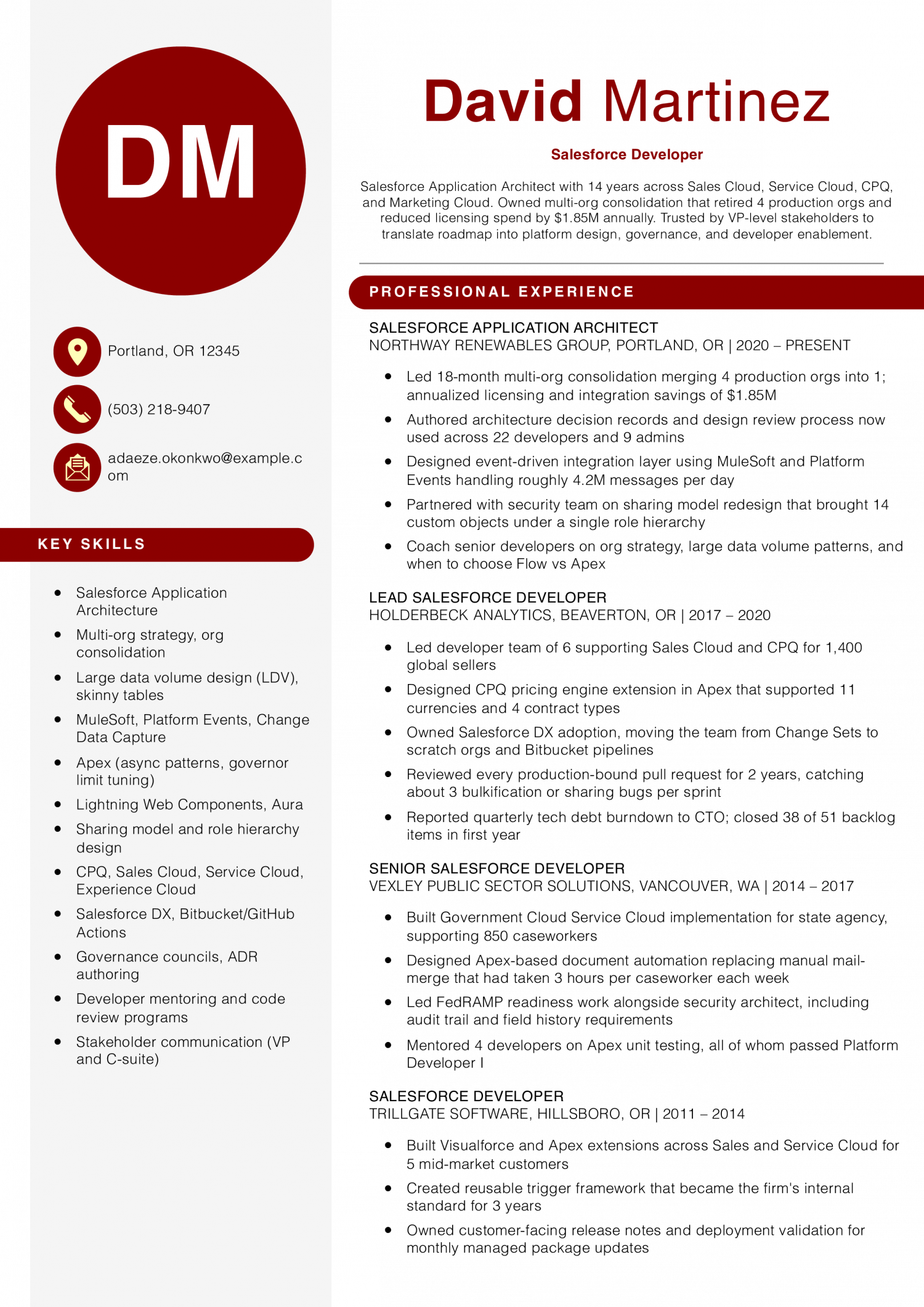
The architect profile sets data model and integration patterns across multiple orgs, owns governor strategy at scale, and signs off on technical design. This resume needs to prove platform breadth, certifications past PD2, and architectural decisions you've made on real implementations.

Why this resume works

  • Architect-level money on the page: A $1.85M annual licensing reduction from org consolidation shows the resume belongs at the architect tier, not senior dev.
  • Five certifications relevant to the role: Application Architect, Data Architect, and Integration Architect together signal someone who can actually pass the CTA-track gates.
  • Mix of design and people work: ADR authoring, design review process, and developer coaching show this is an architect who builds the team, not just diagrams.

How to Write a Salesforce Developer Resume

01 Open with the one thing a cert lookup won't show

A Trailhead profile and a PD1 badge tell Salesforce architects you’re certified. They don’t tell them what you’ve shipped.

Add one line at the top of your summary that names a specific build: a managed package you authored, a CPQ implementation you led, an integration you designed between Salesforce and NetSuite, or a custom LWC library your team reuses. Pick the artifact a comparable PD1-holder is unlikely to have.

If you’ve worked in regulated orgs, name the industry: financial services cloud, health cloud, public sector. That single line moves you out of the generic Apex developer stack.

02 Quantify scope, not effort

Salesforce architects scan for numbers that show platform scale. Bullets without a number tend to read as duties, not impact.

Most strong resumes name two or three of these: number of users in the org, record volume on the objects you worked with, integration throughput, deployment frequency, or test coverage above the 75 percent floor.

Write ‘rebuilt the lead-conversion flow for a 4,200-user org, cutting Apex CPU time 38 percent’ instead of ‘optimized lead conversion.’ Recruiters scan for the org size and the percent first.

03 Group your work by platform category

Wall-of-jargon bullets blur together. Group your bullets by category so a tech screener can find what they need.

Use four buckets: Apex and triggers, Lightning Web Components and Aura, integrations and APIs, and declarative work in Flow and process automation. Add a fifth for CPQ, FSL, or Marketing Cloud if you’ve shipped there.

Inside each bucket, lead with the strongest artifact. Name the object, the use case, and the result: ‘Built a batch Apex job to reconcile 2.1M Opportunity records nightly against an external ERP, with chained job recovery on failure.’

04 Put certs and tools in a page-one block

Salesforce architects and CRM platform leads filter on certifications first. Bury them on page two and your resume gets skipped.

Put a credentials block under your summary listing your active Salesforce certifications by name (Platform Developer I, Platform Developer II, Administrator, Application Architect), the Trailhead ranger or expeditioner level if it applies, and your tooling: SFDX, VS Code, Git, Copado or Gearset, Jenkins or GitHub Actions.

Skip badge numbers and login emails. Listing the certifications by name is the standard; the verification record lives on Trailhead.

05 Cut the duties that read as admin-only work

At the senior and architect level, lines about ‘creating users,’ ‘managing profiles,’ or ‘running reports’ pull the resume toward an admin read.

Cut them unless they’re tied to a development outcome (a permission-set framework you designed, a sharing-rule rebuild you scoped). Trim long Salesforce admin work from earlier roles to one or two summary bullets so the development arc reads cleanly.

Also cut generic phrases like ‘worked on Salesforce projects.’ Replace with the cloud, the object, and the deliverable: ‘shipped a Service Cloud case-routing engine in Apex and Flow for a 900-agent contact center.’

The skills below come from salesforce developer resumes our users built on ResumeTemplates.com. Salesforce architects and CRM platform leads scan hundreds of resumes a quarter, and these are the skills that show up most often. Hard skills like Apex and LWC carry the keyword match.

Soft skills only help when they back a bullet, like a stakeholder workshop that produced a real spec. Match this list against your target posting, and keep soft skills tied to evidence in your bullets.

Soft Skills % of resumes with this skill
Communication 71%
Problem-solving 60%
Collaboration 50%
Analytical thinking 37%
Attention to detail 25%

And here are the top hard skills showing up most often.

Hard Skills % of resumes with this skill
Apex programming 71%
Visualforce pages 55%
SOQL 45%
Lightning Components 39%
REST/SOAP APIs 26%

Based on data from thousands of Salesforce developers’ resumes built on ResumeTemplates.com, May 2026.

Must Have on a Salesforce Developer Resume

These are the must-haves hiring teams look for when scanning a salesforce developer resume.

Niche Keywords for ATS Checkers

Salesforce architects and CRM platform leads expect to see niche keywords that match the cloud and tooling on the job posting. Group them by sub-niche so an ATS keyword parse picks up the cluster, not just the headline term.

Niche Keywords ATS scans for
Apex and backend apex triggers, batch apex, governor limits, test classes
Lightning and front-end lightning web components, lwc, aura, slds
Integrations rest api, soap api, named credentials, platform events
DevOps and release sfdx, copado, gearset, github actions
Cloud and product specialty service cloud, sales cloud, cpq, experience cloud

AI Skills to Add

Salesforce shops are split between teams that want AI-assisted Apex and LWC scaffolding inside the dev loop and teams that restrict it for IP or compliance reasons. Name the tools you use, describe the workflow honestly, and avoid claims you ‘built with AI’ when your actual practice is generating boilerplate and reviewing every line.

What AI is actually changing for this role
Apex scaffolding

Copilot and Cursor draft trigger handlers and test classes, but governor-limit-safe rewrites and bulkification still come from you.

LWC component generation

AI tools draft HTML, JS, and CSS skeletons. Wiring to Apex controllers and SLDS conformance still need a developer's review.

SOQL and data work

AI suggests selective queries from a schema prompt. You still validate against actual record volume and selectivity rules.

Documentation and PRs

AI drafts release notes, PR descriptions, and ApexDoc comments. Faster turnaround on code review and handoff to admins.

AI tools to name
  • GitHub Copilot: Used inside VS Code with the Salesforce extension pack for Apex, LWC, and test-class drafting.
  • Cursor: Used for repo-aware refactors across Apex classes and LWC components when working in larger SFDX projects.
How to phrase AI on your resume
Do
  • Used GitHub Copilot in VS Code to draft Apex test scaffolds, cutting time to 80 percent coverage on new triggers by roughly a third.
  • Reviewed and rewrote AI-generated SOQL to remove non-selective filters before queries hit a 2.3M-record Opportunity object.
Skip
  • AI-powered Salesforce development expert
  • Leveraged generative AI to revolutionize the Apex codebase

Portfolio Strategy

Salesforce developer portfolios live across three surfaces: a public Trailhead profile, a GitHub account with SFDX repos, and a short writeup of one or two real builds. Salesforce architects will look at all three before a technical screen.

#1 Credentials proof Trailhead public profile

Shows active certifications, Superbadges, and Ranger status without a login.

#2 Code proof GitHub (SFDX project format)

Hosts Apex classes, LWC components, and CI workflows in a standard SFDX source tree.

#3 Build proof Personal Developer Edition org or writeup

Hosts a live demo or a short README explaining the data model, the trigger logic, and the deployment path.

Link the Trailhead profile directly in your resume header. Salesforce architects use it as the verification layer for the certifications you list. A missing or stale profile reads as a warning sign.

Keep one repo current. A single SFDX repo with a clean README, real tests, and a working CI workflow beats five abandoned repos. Pin it on your GitHub profile.

Tech Stack to List on a Salesforce Developer Resume

Salesforce architects expect a tech-stack line that goes beyond ‘Salesforce.’ Name the languages, the tooling, and the deployment chain so the keyword parse and the human reader both find what they need.

  • Languages: Apex, JavaScript (ES6+), SOQL, SOSL, HTML, CSS
  • Frameworks and UI: Lightning Web Components, Aura, Visualforce, SLDS
  • Platform tools: Flow, Process Builder, Approval Processes, Platform Events, Change Data Capture
  • Integration: REST API, SOAP API, Named Credentials, MuleSoft, Platform Events, Streaming API
  • DevOps: SFDX, VS Code, Git, Copado, Gearset, GitHub Actions, Jenkins
  • Clouds and products: Sales Cloud, Service Cloud, Experience Cloud, CPQ, Field Service, Marketing Cloud

Salesforce Development Credentials That Get You the Job

A Platform Developer I and an active Trailhead profile keep you eligible. The certifications below are what move a salesforce developer resume from the qualified-but-typical stack into a Salesforce architect’s shortlist. List each one by full name with the year earned.

  • Salesforce Platform Developer II (PD2): Signals you can pass the programming assignment and multiple-choice exam, which most senior and lead postings want to see.
  • Salesforce Application Architect: A pillar credential covering Data, Sharing, Integration, and Identity. Signals you can scope a build, not just write the code.
  • Salesforce JavaScript Developer I: Marks you as an LWC-strong developer rather than an Apex-only one, which matters for front-end and component-library work.
  • Salesforce Certified Integration Architect: Reads as architect-track. Signal that you can design API patterns between Salesforce and ERP, billing, or data-warehouse systems.

Latest BLS Statistics for Salesforce Developers

Salesforce developer is a narrow occupation inside the broader software developer SOC, which means the BLS numbers below pull in a wide range of application work. Supply matters here, and the specific Salesforce certifications and clouds you’ve shipped in read as differentiation against general application developers.

To position above the median, lead the resume with the orgs you’ve shipped to production and the certifications past PD1, not the languages you know in general.

$133,080 National median annual
$144,570 National mean annual
$79,850 Entry-tier floor (10th percentile)
$211,450 Top-decile ceiling (90th percentile)
1,654,440 Salesforce Developers in the U.S.
Where you stand

Entry tier

$79,850 to $133,080 At the entry tier, lead with PD1, an Admin cert, and the Apex and LWC tickets you closed under senior review.

Mid band

$133,080 to $211,450 At the mid band, your resume needs to show end-to-end features you own across Apex, LWC, and integrations, plus the org size.

Top decile

$211,450+ At the top decile, lead with Application Architect or Integration Architect credentials, multi-org work, and the design decisions you've signed off on.

Top-paying states

# State Avg. Annual
1 California $170,910
2 Washington $166,910
3 Virgin Islands $162,820
4 New York $161,260
5 Massachusetts $150,520
6 Maryland $137,890
7 District of Columbia $136,040
8 Oregon $135,260
9 Delaware $135,160
10 Colorado $134,540

Highest-employment states

# State Workers Median
1 California 292,630 $170,910
2 Texas 151,460 $130,500
3 New York 104,130 $161,260
4 Washington 91,470 $166,910
5 Virginia 83,290 $134,470
Source: U.S. Bureau of Labor Statistics, OEWS 2024 release (SOC 15-1252).
Written by professional resume writers and loved by hiring managers

Resume Templates offers HR approved resume templates to help you create a professional resume in minutes. Choose from several template options and even pre-populate a resume from your profile.

Frequently Asked Questions

What format works best for a Salesforce developer resume?

Use a reverse-chronological format with a credentials block under the summary. Salesforce architects scan for active certifications before they read bullets.

Keep PD1, PD2, and Admin visible on page one. Save functional or skills-first formats for career-changer cases.

How do I write a Salesforce developer resume with 1 to 2 years of experience?

Lead with your certifications and Trailhead level. Then group bullets by category (Apex, LWC, Flow) and name the org size you worked in.

Include side builds from Trailhead Superbadges or a personal Developer Edition org if your paid work is thin. Name the object, the use case, and the result for each.

Should I list Salesforce admin work on a developer resume?

Yes, briefly, if it's recent or relevant to the role. Summarize admin work in one or two bullets so the development arc reads cleanly.

Cut user-management and report-building lines at the senior level unless they're tied to a development outcome like a permission-set framework you designed.

How do I get a Salesforce developer role without a traditional coding background?

Build a public Trailhead profile to Ranger or higher and earn PD1 plus the JavaScript Developer I credential.

Ship two or three projects in a personal Developer Edition org. Write them on your resume the same way you'd write paid work: object, use case, code pattern, result.

Most career-changers start in admin or junior developer roles at consulting partners before moving to senior IC work.

What resume template should a Salesforce developer use?

For a Salesforce developer, a tech template is the safest pick, because it keeps your stack, tools, and impact easy to scan. An ATS-friendly template is a solid alternative. Whichever you choose, keep the formatting clean and easy to parse: clear section headings, a standard font, and no graphics a parser can choke on.

Rate this article

Salesforce Developer Resume

Average Rating

4.8/5 stars with 110 reviews

You have given 0 Star(s)
4.8/5 stars with 110 reviews
Andrew Stoner

Executive Resume Writer and Career Coach

Andrew Stoner is an executive career coach and resume writer with 17 years of experience as a hiring manager and operations leader at two Fortune 500 Financial Services companies, and as the career services director at two major university business schools.