Physical Therapist Resume Examples
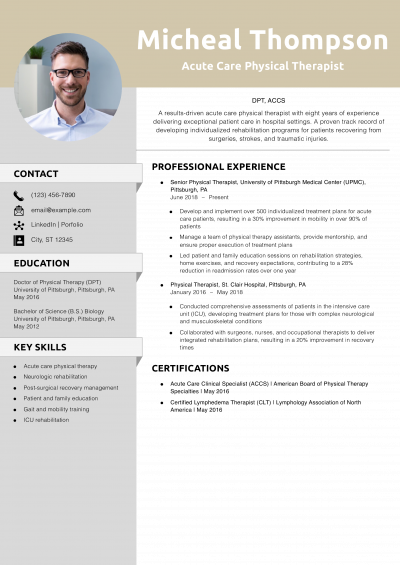
Lead with the one signal a PT clinic director cannot pull from your state board record. That could be your OCS or NCS specialty board, a vestibular or LSVT BIG certification, or a manual therapy…
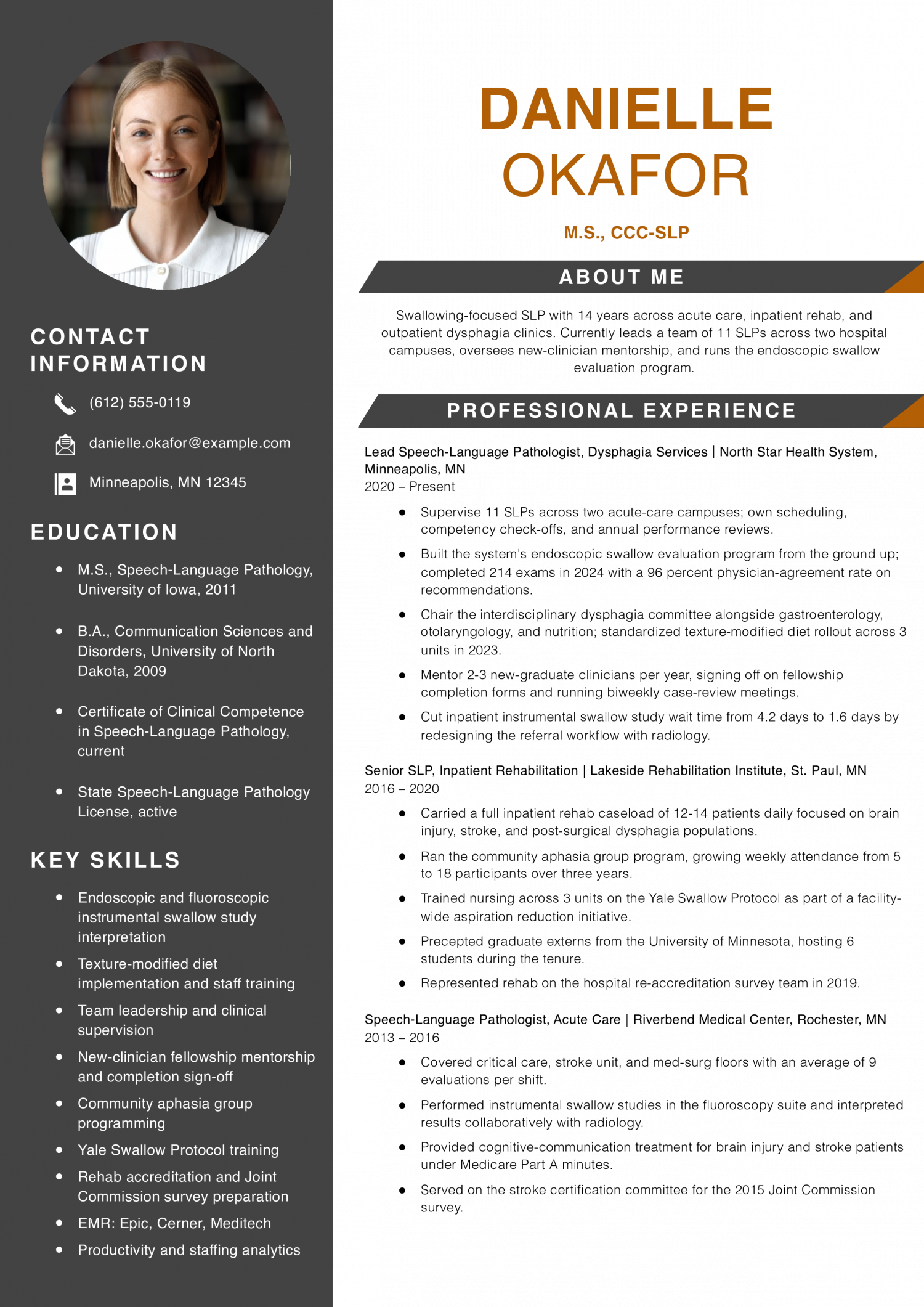
Clinical directors and rehab services managers scan the first page of a Speech Language Pathologist resume for caseload size, setting, and disorder mix, because that combination shows whether the clinician can carry a full productivity target.
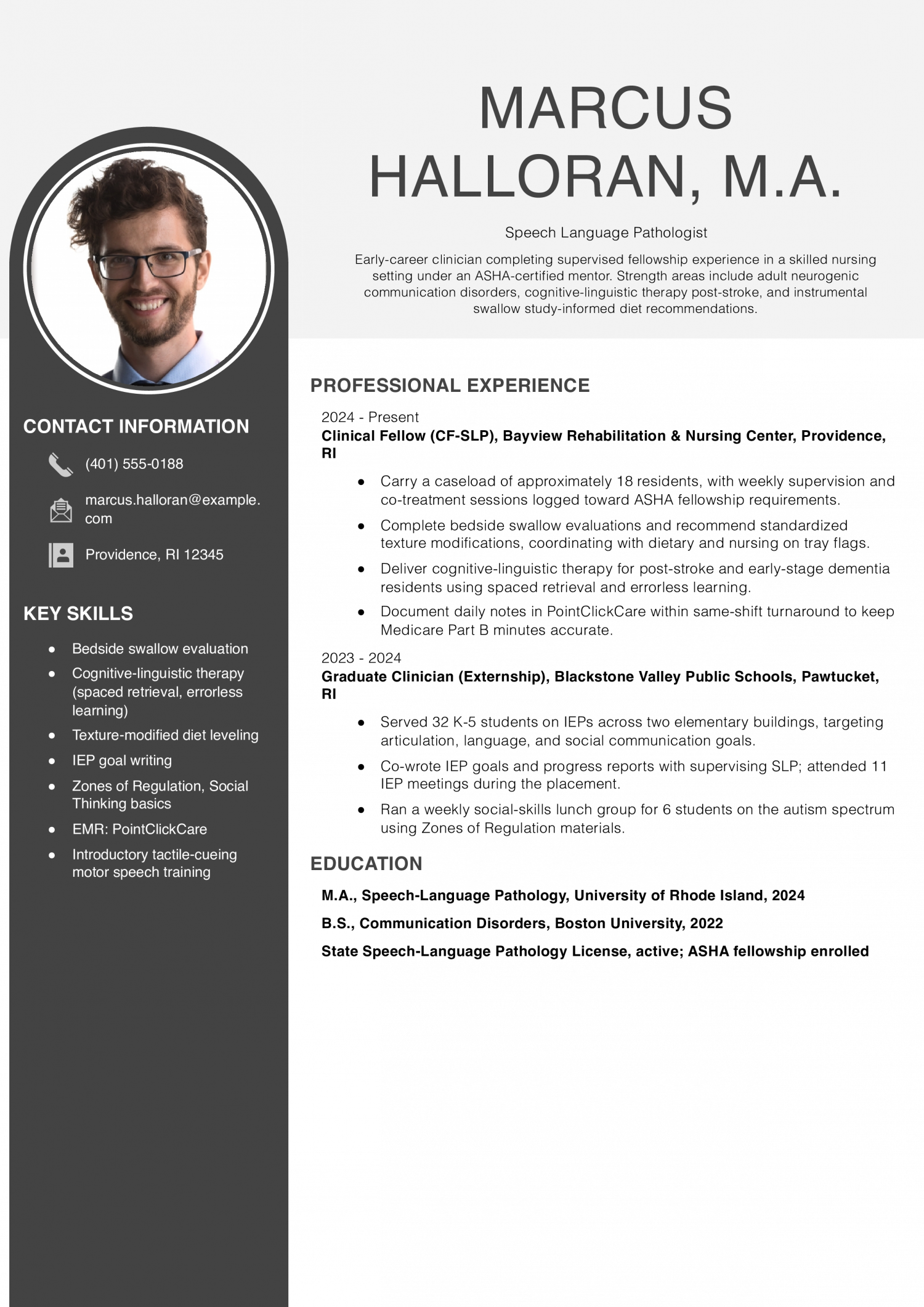
A Clinical Fellow resume has to prove your graduate training, supervised hours and state license paperwork are ready. Show your caseload settings, evaluation tools you used in placements, and the ASHA CCC-SLP timeline you are on.
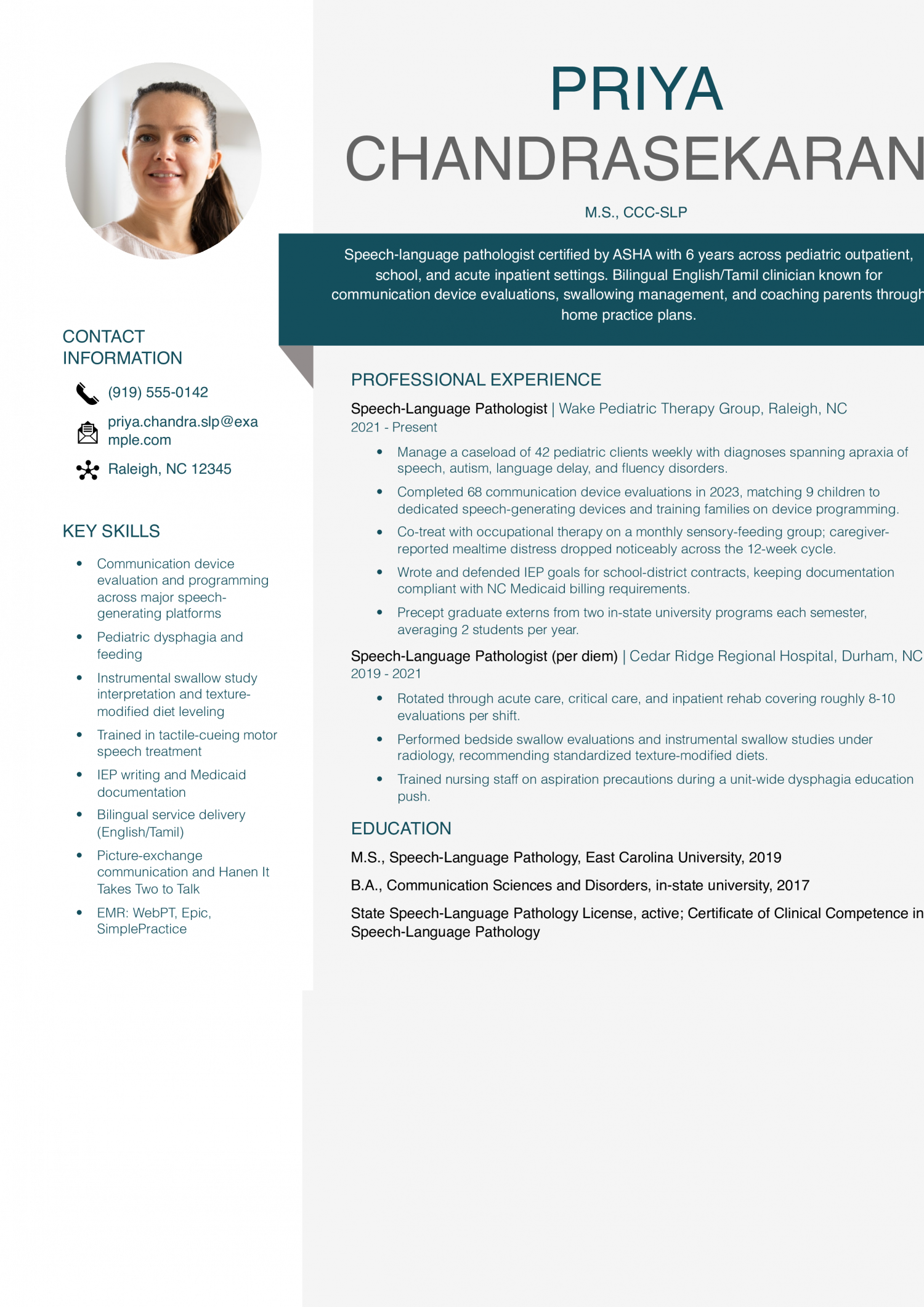
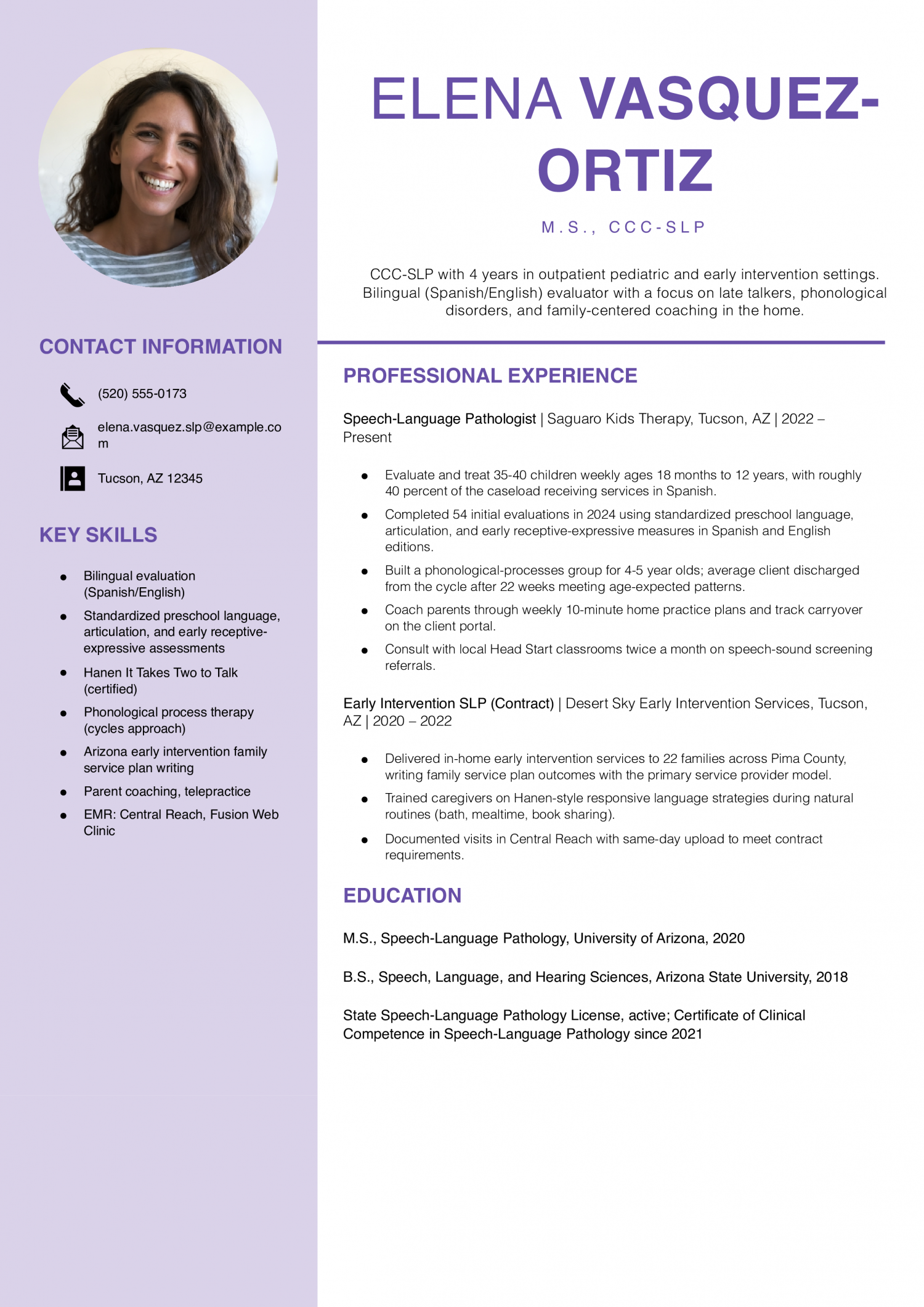
A CCC-SLP resume has to show independent caseload management across the ages and disorders you treat. Name your assessment batteries, treatment approaches, documentation systems and productivity numbers so clinical directors can picture you in their setting.
A Lead SLP resume has to prove you supervise clinicians and clinical fellows while carrying your own caseload. Show mentoring, program development, compliance with state and payer rules, and the outcomes data you report to rehab services managers.
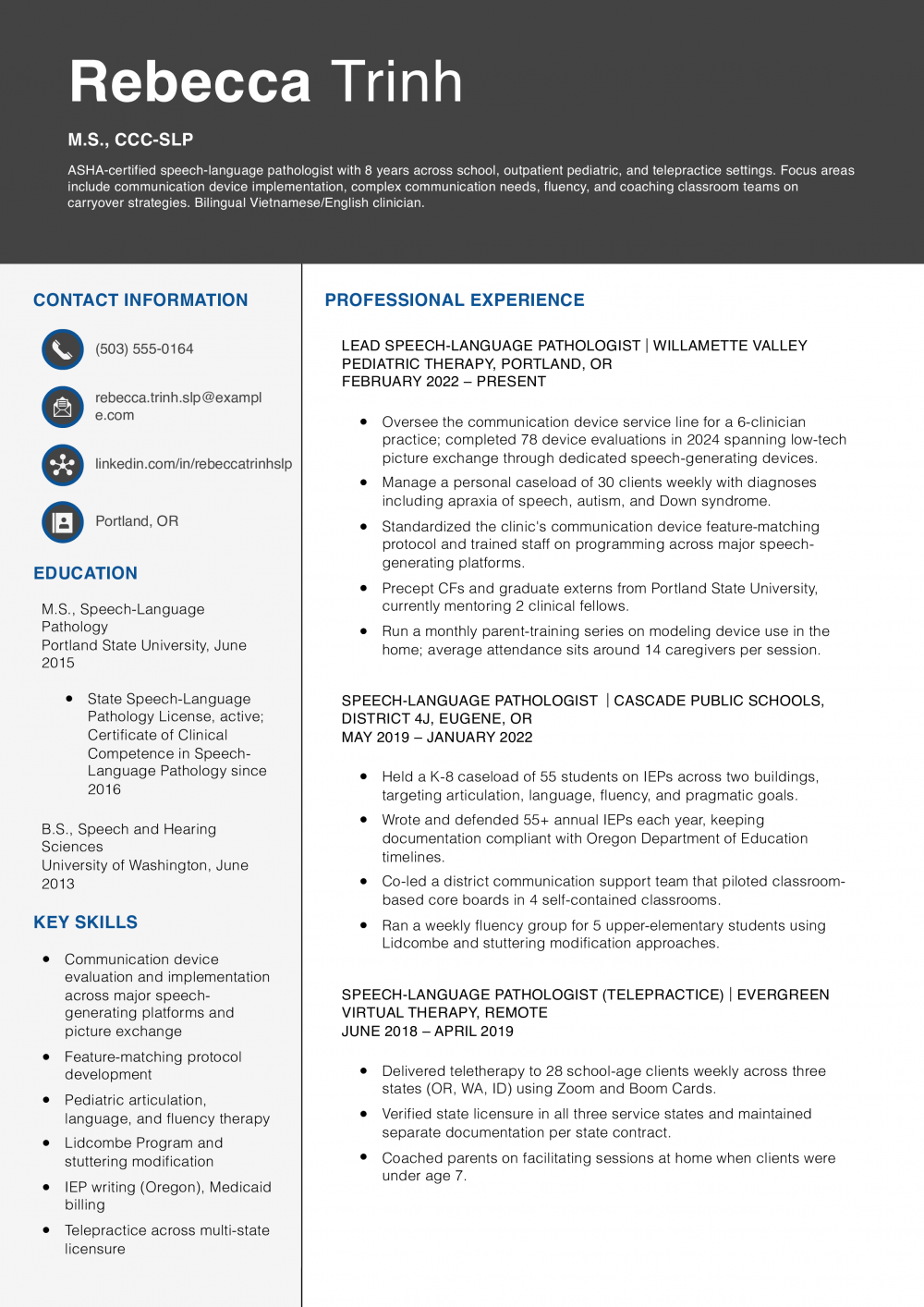
Rebecca Trinh, M.S., CCC-SLP
Portland, OR | (503) 555-0164 | [email protected] | linkedin.com/in/rebeccatrinhslp
ASHA-certified speech-language pathologist with 8 years across school, outpatient pediatric, and telepractice settings. Focus areas include communication device implementation, complex communication needs, fluency, and coaching classroom teams on carryover strategies. Bilingual Vietnamese/English clinician.
Lead Speech-Language Pathologist
Willamette Valley Pediatric Therapy | Portland, OR | 2022-Present
Speech-Language Pathologist
Cascade Public Schools, District 4J | Eugene, OR | 2019-2022
Speech-Language Pathologist (Telepractice)
Evergreen Virtual Therapy | Remote | 2018-2019
Staff Speech-Language Pathologist
Mount Tabor Children’s Clinic | Salem, OR | 2016-2018
Clinical Fellow (CF-SLP)
Rosewood Elementary, Beaverton School District | Beaverton, OR | 2015-2016
Your profile belongs at the top of page one, and it should state your years of clinical experience. Name the setting you work in, such as acute care, skilled nursing, outpatient rehab, schools or early intervention. Name the age band you treat, whether that is pediatric, adult or geriatric caseloads.
Name two or three disorder areas you carry weekly, such as dysphagia, aphasia or pediatric language delay. Clinical directors and rehab services managers read this profile as a scope statement. They are matching you to an open caseload, not a job title.
A profile that says only passionate SLP tells them nothing. A profile that names setting, ages and disorders tells them where you fit on day one.
A caseload bullet with no number attached reads like a duty list, not a clinical result. Clinical directors scan for caseload size, productivity and outcomes first. Name your weekly caseload, such as 45 students on an IEP roster or 12 to 14 inpatients a day.
Name your productivity rate if your setting tracks it, such as 85 percent billable. Name outcomes where you can, such as dysphagia patients advanced to a less restrictive diet, or students met 80 percent of annual IEP goals. If a number is not tracked in your setting, use scope language: number of schools covered, groups run per week or evaluations completed per month.
Two or three real metrics per role read stronger than five vague ones.
A wall of tasks is hard to scan, so group your bullets into three or four clear areas. Evaluation and diagnostics covers standardized testing, clinical bedside swallow exams and instrumental swallow studies you assist with. Treatment planning covers goal writing, plan of care, IEPs and progress notes.
Direct therapy covers the disorder areas you treat, such as dysphagia, aphasia, cognitive-communication, articulation, fluency or augmentative communication. Team and family work covers co-treatment with other therapies, teacher consults, parent training and discharge planning. Naming the categories helps a reader see the full clinician, not a list of chores.
It also lets a director match you to a specific caseload gap.
Put your credentials in a short block on page one, under your profile. List your Certificate of Clinical Competence in Speech-Language Pathology, or CCC-SLP, issued by ASHA. List your State Speech-Language Pathology License by state, and note in good standing.
Do not publish the license number itself. If you are a Clinical Fellow, say so and give your fellowship start date and supervisor setting. Clinical directors and rehab services managers need these visible early because they gate billing, school hiring and Medicare documentation.
Below the credentials, add a short tools line: the EMR systems you chart in, such as Epic or PointClickCare, plus therapy devices and assessment batteries you use. This saves the reader from digging.
Education sits near the end for a licensed clinician, since your CCC-SLP already signals the degree. List your master’s in speech-language pathology, the university and the year. Add your clinical fellowship placement if it is recent, with setting and population.
Under a short continuing education heading, name two or three courses that match the jobs you want, such as a dysphagia course or a voice therapy course. If you supervise fellows or graduate students, add a line for that. If you speak a second language used with clients, name it and your proficiency.
Skip high school, unrelated jobs from a decade back and personal interests. Every line on page two should still support the caseload you want next.
Five years ago, a speech language pathologist resume read like a caseload roster and a list of settings. The mix has shifted toward measurable outcomes, billing accuracy, and named protocols like dysphagia screening. Reviewers now scan for tools and results, not just years of service.
Clinical directors and rehab services managers weight hard skills first to confirm you can bill, chart, and treat on day one. Soft skills like family counseling then decide who they call back for an interview. Use the two tables below as a checklist against the actual job posting.
Mirror the exact wording it uses, and let soft skills back up the bullets in your experience section.
| Soft Skills | AI-estimated % |
|---|---|
| Patient family education | 65% |
| Clinical adaptability | 61% |
| Empathetic patient rapport | 43% |
| Interdisciplinary collaboration | 36% |
| Progress monitoring judgment | 28% |
And here are the top hard skills showing up most often.
| Hard Skills | AI-estimated % |
|---|---|
| Speech-language evaluation | 65% |
| Swallowing disorder treatment | 59% |
| IEP report writing | 42% |
| Treatment plan development | 37% |
| Caseload documentation | 35% |
Skill names and rankings come from an AI model grounded in U.S. Department of Labor occupation data for speech-language pathologists, not from a count of speech-language pathologists’ resumes built on ResumeTemplates.com.
Beyond your state license and the CCC-SLP, few extra credentials are truly standard in this field. The list below covers the two that clinical directors and rehab services managers scan for first. They read them as proof you can bill independently and take a full caseload on day one. Setting expectations matters here. Requirements shift by state, by employer and by setting, so a school role and a hospital role often ask for different things. List each credential on its own line. Give the full name, the issuing body and the current expiration or renewal date. Put this block near the top of the resume so it is easy to find.
For Speech Language Pathologists, the low end of pay sits well under the middle. The high end lands more than a third above it. That spread is wider than the pay gap in many clinical fields at a like training level.
Jobs are spread across the country. The top-paying states are not always the ones with the most SLP jobs. Clinical directors and rehab managers read the resume for setting, caseload and specialty.
They read years of work after that. Put your CCC-SLP status, state license, setting (schools, SNF, acute, outpatient, early intervention) and caseload size in the first third of the page.
| # | State | Median Annual |
|---|---|---|
| 1 | California | $118,970 |
| 2 | Colorado | $110,750 |
| 3 | District of Columbia | $109,380 |
| 4 | Washington | $105,550 |
| 5 | Nevada | $104,510 |
| 6 | Rhode Island | $104,000 |
| 7 | Delaware | $102,760 |
| 8 | Alaska | $102,670 |
| 9 | Oregon | $102,660 |
| 10 | New Jersey | $101,560 |
| # | State | Workers | Median |
|---|---|---|---|
| 1 | Texas | 19,120 | $99,910 |
| 2 | California | 16,930 | $118,970 |
| 3 | New York | 15,310 | $100,610 |
| 4 | Florida | 10,080 | $99,990 |
| 5 | Illinois | 9,040 | $95,080 |
Resume Templates offers HR approved resume templates to help you create a professional resume in minutes. Choose from several template options and even pre-populate a resume from your profile.
One page works for your clinical fellowship year and the first few years after it. Move to two pages once you have five or more years of caseload work across settings.
Clinical directors and rehab services managers read for setting, population, and outcomes, so use the space to name those clearly.
Yes, send one for every posting, and tailor it to the setting and age group in the job description. Name the population you have treated, the assessments you use, and one measurable gain from a recent caseload.
Close by tying your clinical fellowship or years of practice to the opening on the team.
List it as your first job entry with the title Clinical Fellow and the mentor's name in the line beneath. Give the setting, the caseload size, and the age range you carried during the nine months.
Clinical directors read the fellowship line to gauge how independent you were by the end.
Lead with your graduate externships and name the setting, the supervisor's credential, and the hours logged at each site. Add the disorders you treated and the standardized assessments you scored during those placements.
A short section for research, thesis work, or a graduate clinic role rounds out the page.
Name the state that holds your current license and add "license in good standing" after it, with no license number. If you have applied for the new state's license, add "pending" and the month you expect it.
Rules vary by state board, so read the posting for any temporary or provisional permit the employer accepts.
No, pick the ones the posting names and the ones that fit the setting you are applying to. A school posting wants the language and articulation measures you scored with students in that age range. A rehab posting wants the swallowing and cognitive-linguistic protocols you ran with adult patients.
Group them under a tools or clinical skills header near the top, so a reader finds them in one glance.
Group short assignments under one employer line for the agency and list each facility beneath as a sub-entry with dates. Note the setting, the caseload, and the length of each contract in a single line.
That format shows range across settings without turning the work history into a wall of one-month jobs.
An ATS-friendly template works best for a speech-language pathologist resume, since it keeps your CCC-SLP status and caseload experience where a clinical director looks first. A basic template is a solid alternative. Whichever you choose, keep the formatting clean and easy to parse: clear section headings, a standard font, and no graphics a parser can choke on.