Patient Care Technician Resume Examples

Add a single line a nurse manager cannot pull from a CNA registry lookup. Name your unit type, your typical patient ratio, and one procedure you own. Examples that land: telemetry PCT carrying six patients…
Every resume example is written and reviewed by our team of Certified Professional Resume Writers to ensure top-quality content and formatting.
Surgical services directors and SPD managers hire on proof you can keep instrument turnaround tight. Your resume should show real volume, like trays processed per shift and sterilization error rates. A CRCST or CSPDT credential signals you meet the baseline, but numbers from your daily output set you apart.
List the decontamination methods and tracking systems you have used. Autoclaves, Censitrac, and Instrument Manager all belong on the page. The examples below show how to frame that work so your resume reads the way these hiring teams expect. To compare layouts before you start, browse our resume templates.
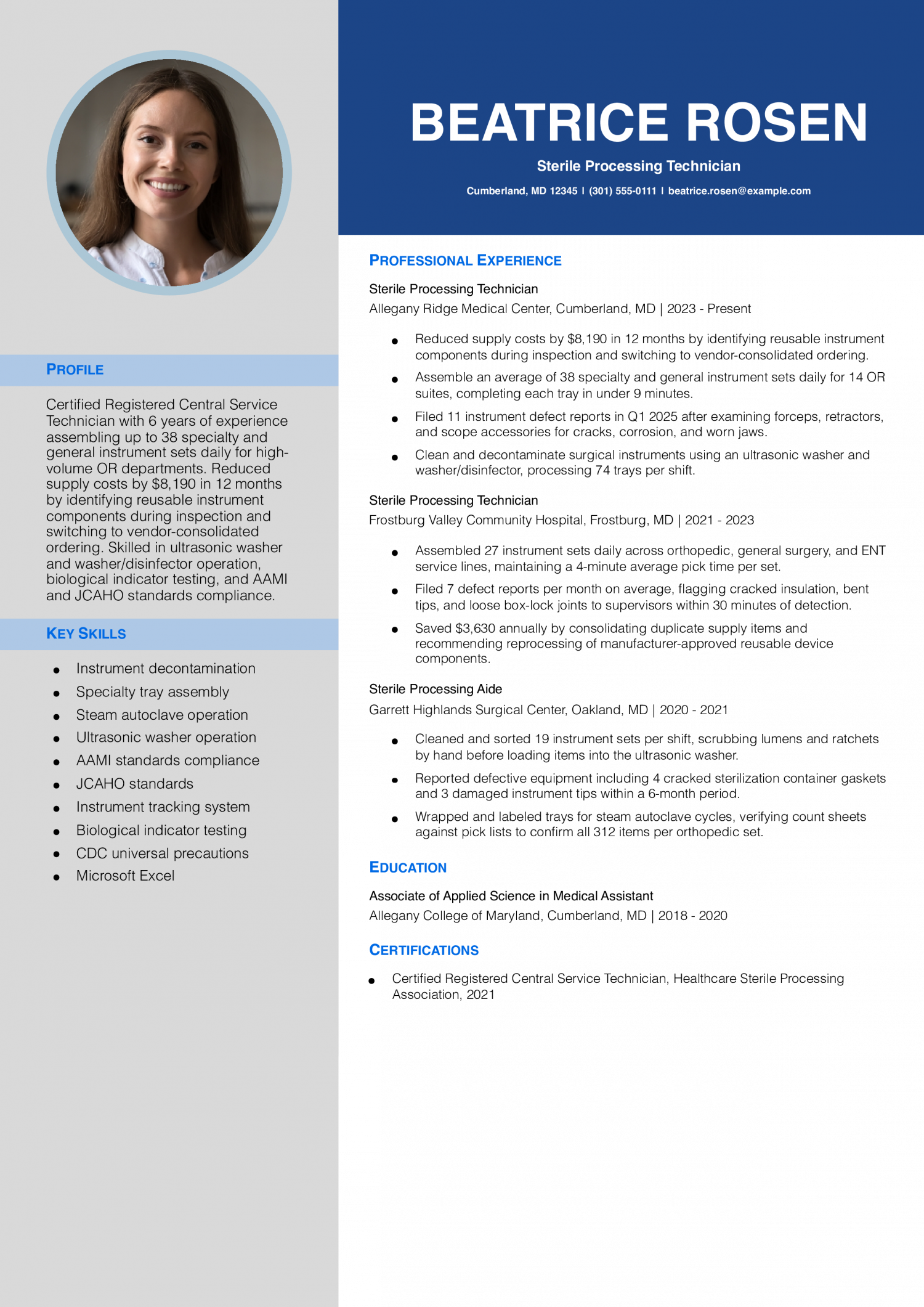
Pick this resume if you are a mid-level sterile processing technician with several years across multiple facilities and a CRCST credential. Lead your cost-saving bullets with exact dollar figures tied to the sourcing or reprocessing method you used.
Defect reports list the instruments checked and the specific flaws looked for. The surgery team knows which tools passed inspection and which ones were flagged. Say what instruments you examined and name the types of damage you checked for.
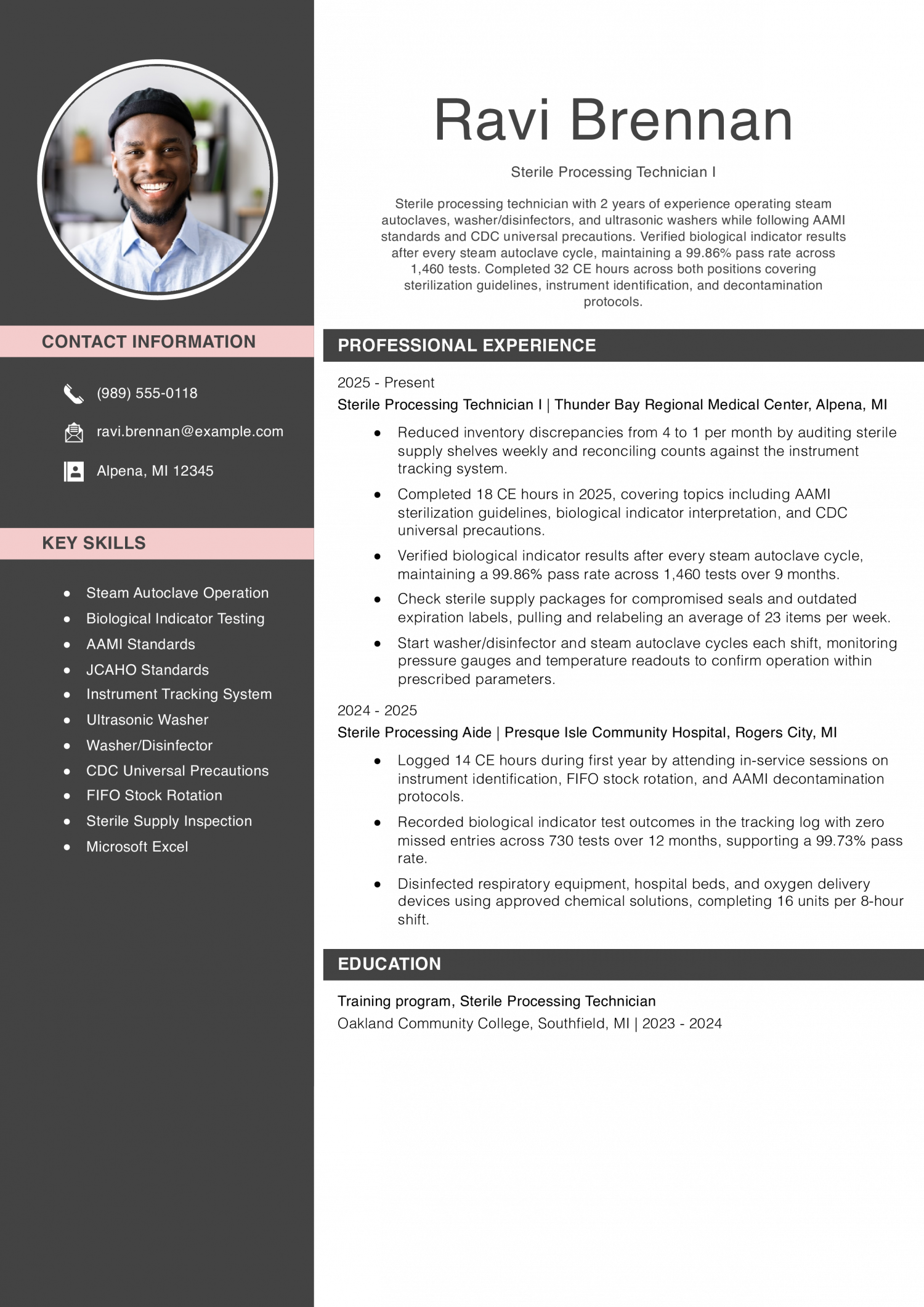
Start with this resume if you are an entry-level sterile processing technician building a career from a vocational certificate and early hospital roles. Lead your quality-control bullets with test volumes and pass rates rather than generic duty descriptions.
Inventory errors went down after weekly shelf audits started. Department supervisors see a real improvement tied to a routine, not a vague duty. Show the error count before your change and after for any check you do regularly.
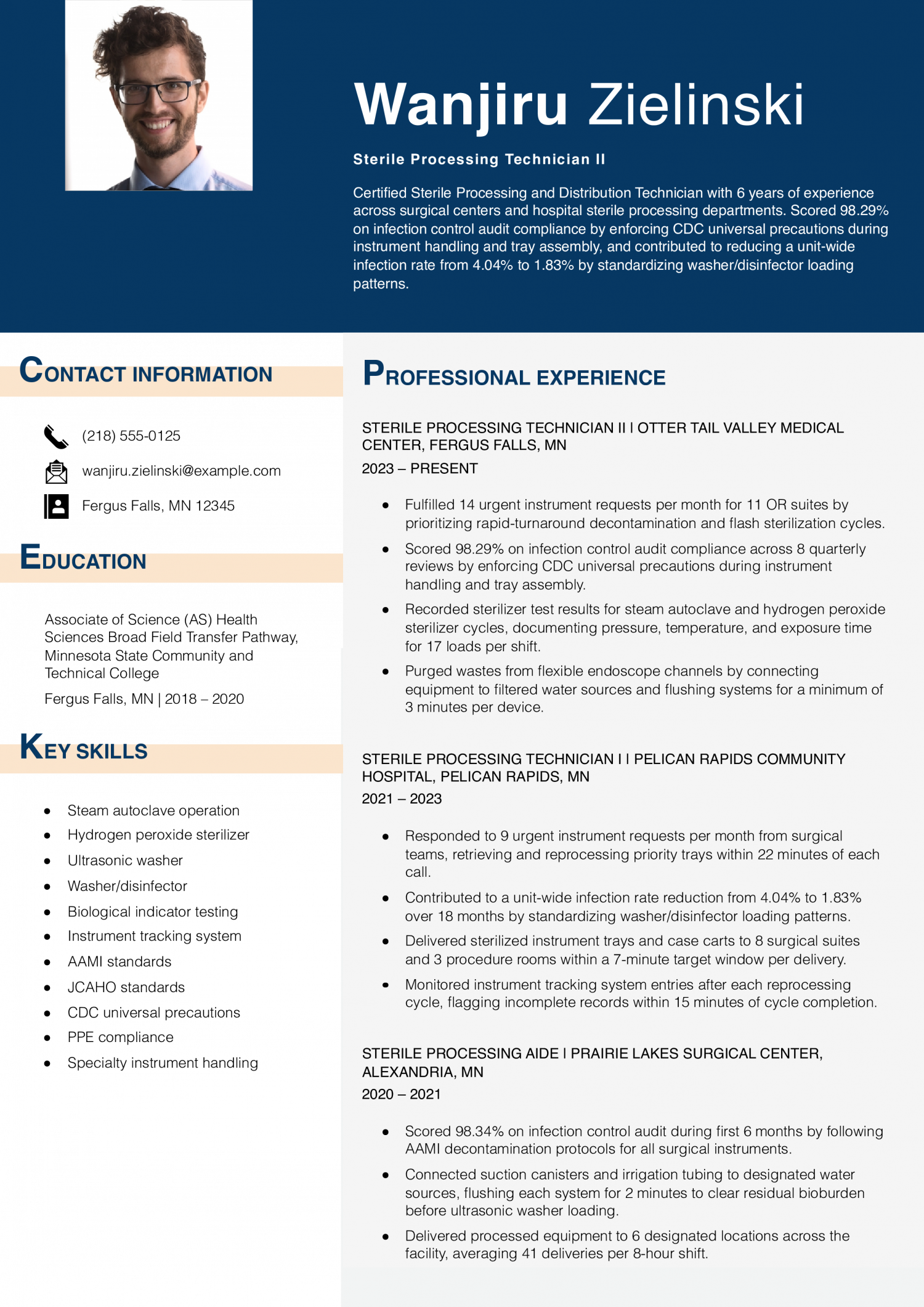
Try this resume if you are a mid-level sterile processing technician with a few years of progressive hospital experience and a current CSPDT credential. Lead your urgent request bullets with monthly volume and turnaround windows rather than listing reprocessing duties alone.
Sterilizer records name every parameter tracked and the number of loads per shift. Compliance reviewers see both the volume and the detail at a glance. State the readings you record for each cycle and how many cycles you run.
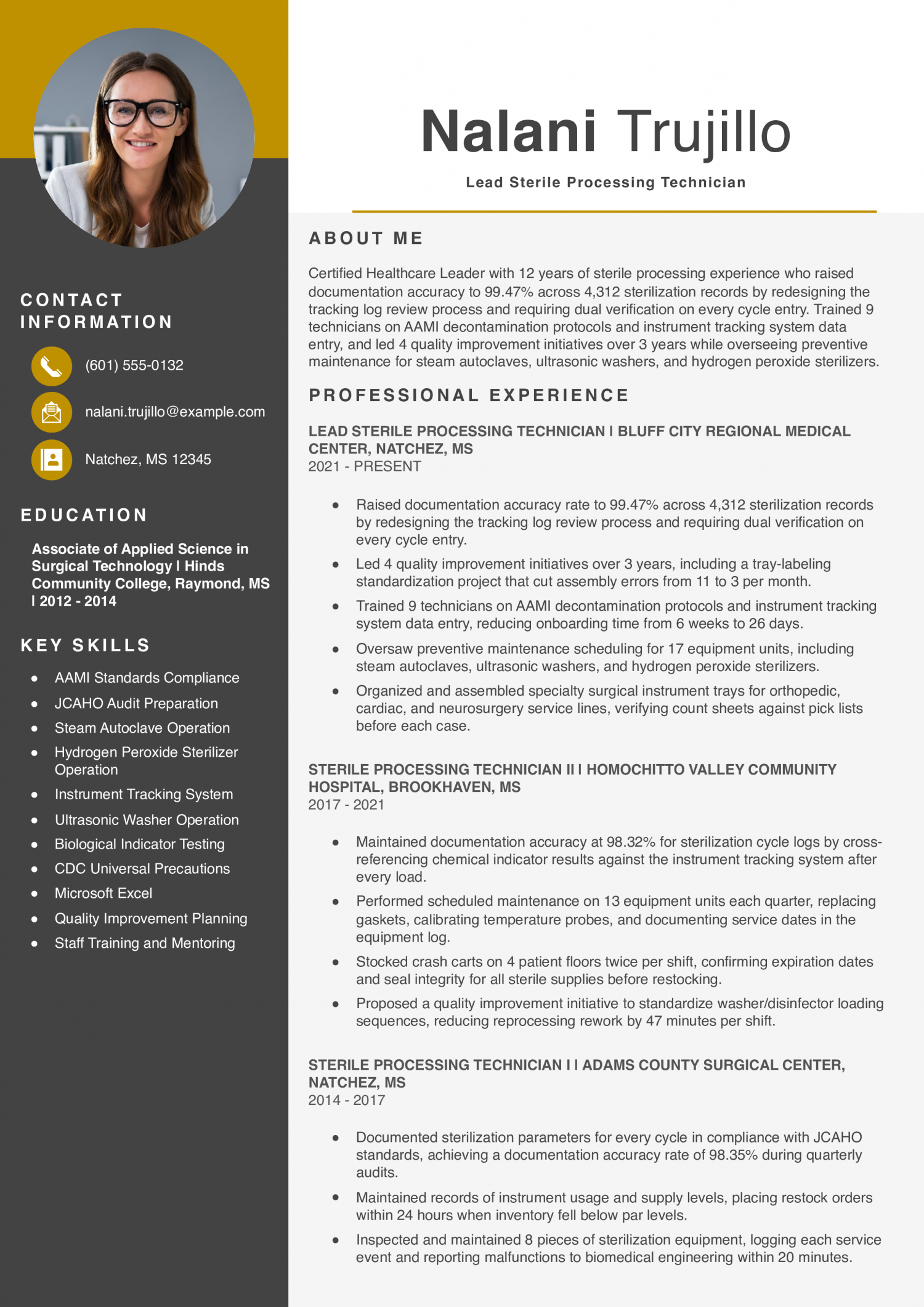
Lean on this resume if you are a senior sterile processing technician with leadership duties and a Certified Healthcare Leader credential moving toward a formal supervisory role. Lead your quality improvement bullets with project counts tied to specific measurable outcomes, as shown here across all three positions.
Onboarding time shrank because the training followed specific protocols in a set order. That tells a manager the program gives new hires structure rather than leaving them to watch and learn. Describe the topics you covered and the order you taught them.
Sterile processing technician with 6 years of experience operating steam autoclaves, hydrogen peroxide sterilizers, and washer/disinfectors across hospital and surgical center settings. Completes 19 sterilizer loads per shift while pulling 34 case carts per day for 12 OR suites, verifying tray contents against surgeon preference cards and delivering each cart within 8 minutes of the posted pickup time.
Your CRCST or CSPDT credential is easy to verify online. SPD managers and surgical services directors want to see what sits behind it. Lead your resume with one line that sets you apart from other certified techs.
That line might name a specialty tray set you build, like open heart or neuro spine. It could highlight your skill with a specific washer-disinfector or low-temperature sterilizer. A bilingual ability or experience in a Level I trauma center works too.
Pick the detail that is hardest to find in your local hiring pool. Place it in a summary line at the top of the page. This single fact gives a reviewer a reason to keep reading past the header.
Strong sterile processing resumes pair each duty with a volume or outcome. State how many trays you assemble and wrap per shift. Note the number of OR suites your department turns over daily.
If you cut instrument turnaround time, give the percentage drop. Biological indicator pass rates above a certain threshold show your attention to quality. You can also note how many loaner trays you processed for vendor sets each month.
Without a number, your bullets tend to read as duties rather than results. Even a round estimate is better than no figure at all. Most SPD managers and surgical services directors scan for speed and accuracy first, so lead each bullet with the metric.
Break your experience into three or four skill areas so the page scans fast. Decontamination is one group, covering manual cleaning and ultrasonic or automated washing. Assembly and inspection is a second group, where you list tray builds and instrument checks.
A third group covers sterilization, including steam autoclaves and low-temperature methods like Sterrad or EtO. You can add a fourth group for inventory and distribution if you track case carts or pull supplies for the OR schedule. Sorting your bullets this way helps SPD managers and surgical services directors match your background to their open needs.
It also keeps the resume from reading as one long task list.
Create a credentials block on page one, right below your contact information. List your CRCST from HSPA or CSPDT from CBSPD here. If you hold the Certified Healthcare Leader from HSPA, add it on the same line.
SPD managers and surgical services directors often filter applicants by certification before reading further. Below that block, name the tracking systems you have used, such as Censitrac or SPM. Include any sterilizer brands you can operate without retraining.
Compliance knowledge matters too, so note your familiarity with AAMI standards and Joint Commission readiness. Keeping these details near the top saves a reviewer from hunting through your bullet points for them. A clean layout here also signals the care you bring to your daily work.
Close the resume with your education section. List your sterile processing certificate or diploma program first. If you hold an associate or bachelor’s degree, add it below the certificate.
Include any clinical rotation hours your program required. You can also add continuing education courses tied to infection prevention or endoscope reprocessing. A short line about CPR or BLS certification fits here as well.
If you are new to the field, move your education section higher on the page. Place it right after the credentials block to show your training early. For techs with two or more years of hands-on work, education stays at the bottom so experience leads.
Sterile processing is not a tight hiring market in 2026. Demand for trained techs keeps growing as surgical volumes rise. Managers and surgical services directors still screen resumes with care, though.
They look for hard skills that prove you can run decontamination cycles safely. Instrument tracking and sterilizer operation top most postings. Load documentation matters too.
Soft skills matter here because errors carry patient risk. Attention to detail shows up in almost every job listing for this role. Managers also weigh teamwork, since techs hand off trays on strict timelines.
List soft skills as proof inside your bullet points. Do not group them in a standalone block. Check the two tables below against the posting you are targeting.
Add any terms the posting names that your resume still lacks. Drop terms that do not appear in the posting or your real experience.
| Soft Skills | AI-estimated % |
|---|---|
| Infection control vigilance | 68% |
| Detail-oriented processing | 61% |
| Cross-department coordination | 40% |
| Time management under pressure | 37% |
| Protocol compliance mindset | 30% |
And here are the top hard skills showing up most often.
| Hard Skills | AI-estimated % |
|---|---|
| Instrument decontamination | 79% |
| Sterilization cycle operation | 68% |
| Surgical tray assembly | 49% |
| Biological indicator testing | 37% |
| Sterility assurance documentation | 29% |
Skill names and rankings come from an AI model grounded in U.S. Department of Labor occupation data for sterile processing technicians, not from a count of sterile processing technicians’ resumes built on ResumeTemplates.com.
The credentials and training items below set a sterile processing technician resume apart.
Both the CRCST and CSPDT require renewal through continuing education. Listing recent CE hours shows you stay current on infection control. Managers and surgical services directors value this ongoing learning. It separates active technicians from lapsed credential holders.
HSPA requires CE credits on a renewal cycle for the CRCST. CBSPD sets its own hour requirements for the CSPDT. Check each body’s current cycle and log your hours early.
Add a short CE section below your certifications on the resume.
Focus on courses tied to daily sterile processing work. Topics like high-level disinfection and flexible endoscope reprocessing stand out. Biological indicator testing and sterilizer validation are also strong picks.
Beyond any state or employer training you have finished, the credentials below tell managers and surgical services directors how well you know instrument care and sterile workflow. They signal your skill tier when a department sorts its applicants. Many job posts ask for one of these by name.
Some treat them as a condition of hire. Others count them as a strong plus. List the issuing body and your current expiration date for each one.
If you have renewed the credential, note the year. Place these items in a short section near the top of your resume so they are easy to spot.
Managers and surgical services directors look for valid credentials first. A certification proves you passed a proctored exam. It confirms you know instrument assembly and sterilization standards. Most postings ask for at least one entry-level credential.
Sterile processing technician falls within the broader BLS category of Medical Equipment Preparers. It is a moderate-size occupation, so the median reflects a wide mix of facility types and credential levels.
Workers near the low end sit about a quarter below the median. Those near the top earn close to half again as much. That gap shows the field has room to grow.
Where you work and what credentials you hold both matter. On your resume, lead with your current certification and the instrument volume you process per shift.
| # | State | Median Annual |
|---|---|---|
| 1 | California | $61,370 |
| 2 | Washington | $58,830 |
| 3 | Massachusetts | $58,580 |
| 4 | New York | $57,320 |
| 5 | Delaware | $53,300 |
| 6 | Hawaii | $51,630 |
| 7 | Rhode Island | $51,460 |
| 8 | New Jersey | $50,280 |
| 9 | Minnesota | $50,070 |
| 10 | Alaska | $49,920 |
| # | State | Workers | Median |
|---|---|---|---|
| 1 | California | 8,720 | $61,370 |
| 2 | Florida | 5,250 | $45,890 |
| 3 | New York | 5,190 | $57,320 |
| 4 | Texas | 4,520 | $46,970 |
| 5 | Pennsylvania | 3,450 | $45,820 |
Resume Templates offers HR approved resume templates to help you create a professional resume in minutes. Choose from several template options and even pre-populate a resume from your profile.
Hospitals tend to want high case volume and complex tray counts, so lead with those numbers. Outpatient surgery centers often value speed and same-day turnaround, so stress cycle times. Match the tone of each posting to show you fit that setting.
Mention tasks where you guided others, such as training new hires on tray assembly or leading a recall drill. Note any time you stepped in as shift lead or ran an audit on your own. These details prove you can lead, even without a formal title.
Start each bullet with an action verb and attach a number that shows volume or accuracy. For example, change "responsible for decontaminating instruments" to "decontaminated 200-plus trays per shift with a 99.8% sterility pass rate." Numbers give surgical services directors a clear way to compare your output.
Use verbs tied to core SPD tasks, such as decontaminated, sterilized, assembled, and inspected. Verbs like reduced, tracked, and trained show you did more than the basics. Pick a different verb for each bullet so the list stays fresh.
No, list only the sets that match the job posting or the facility type. A short, focused list tells SPD managers you read the posting with care. If you know many sets, group them by specialty, such as ortho, general, or cardiac.
List any continuing education or volunteer work you completed during the gap period. If you kept your certification current, note the renewal date to show you stayed engaged. A brief line in your cover letter explaining the gap is usually enough for SPD managers.
Update it every time you earn a new credential or learn a new sterilizer model. Review it at least once a year, even if you are not job hunting. Fresh numbers and current tools keep your resume ready when a good role opens up.
Go with an ATS-friendly template that puts your credentials and work history under their own headings. A basic template is a good choice too.
Sterile Processing Technician Resume
4.5/5 stars with 125 reviews

Executive Resume Writer and Career Coach
Andrew Stoner is an executive career coach and resume writer with 17 years of experience as a hiring manager and operations leader at two Fortune 500 Financial Services companies, and as the career services director at two major university business schools.
© 2026 Resumetemplates.com All rights reserved.