Accountant Resume Examples
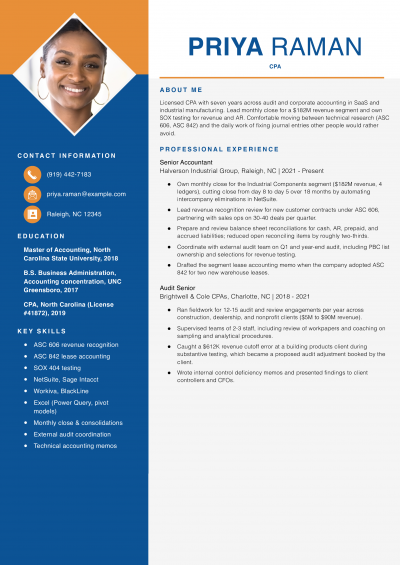
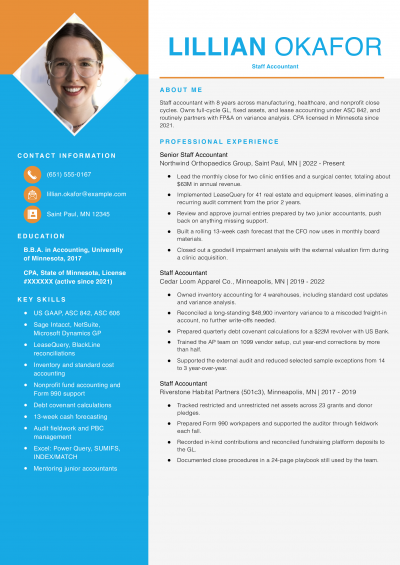
Lead the summary with one line stating the close outcome and the conditions that produced it. A pattern that works: ‘Closed a four-entity consolidation in six business days on NetSuite, $180M in annual revenue, clean…
A current PTIN and any EA or CPA credential listed up top is what gets tax preparer resumes past the credentialing screen at CPA firms; return volume and software fluency are what make them readable enough to advance.
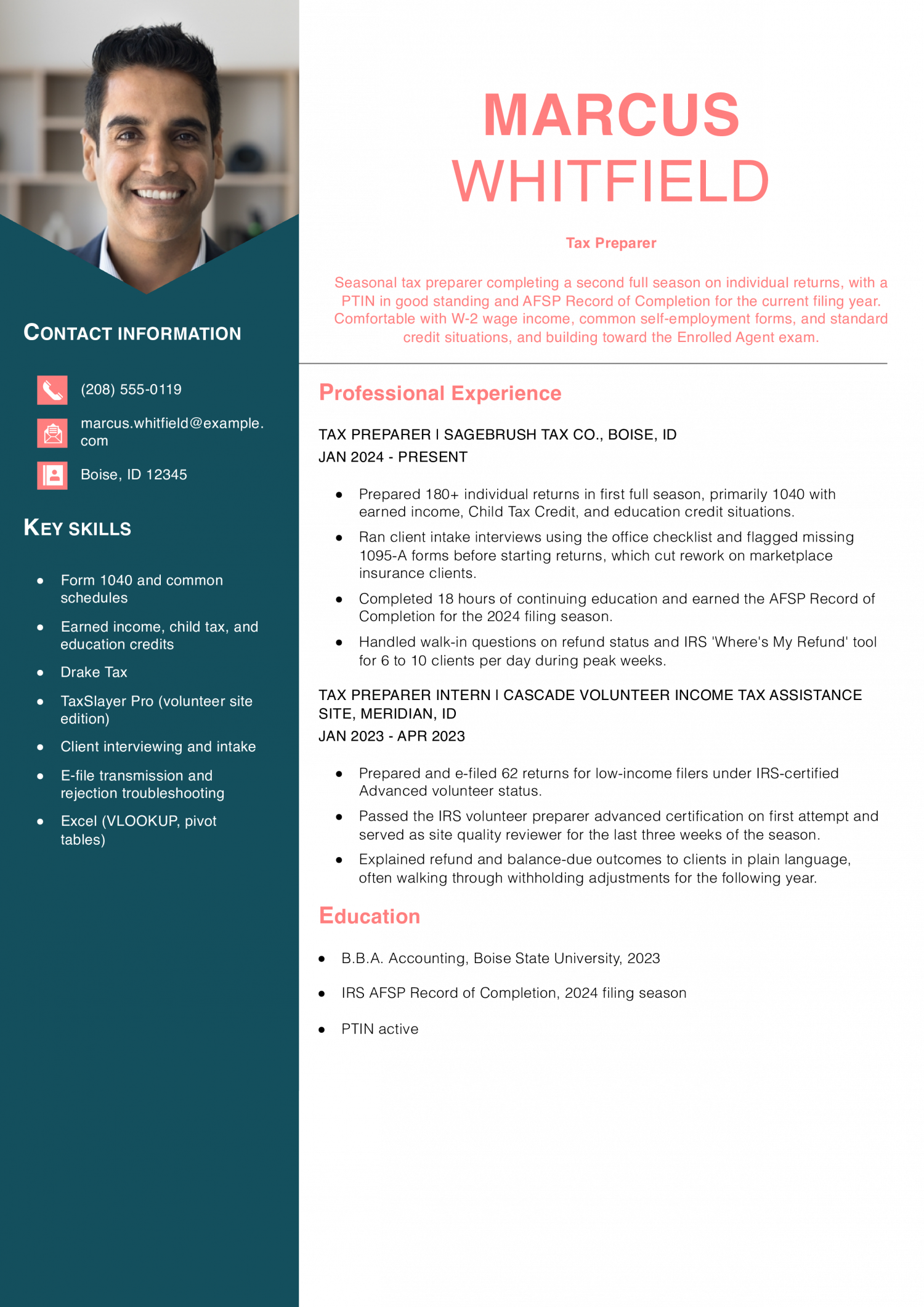
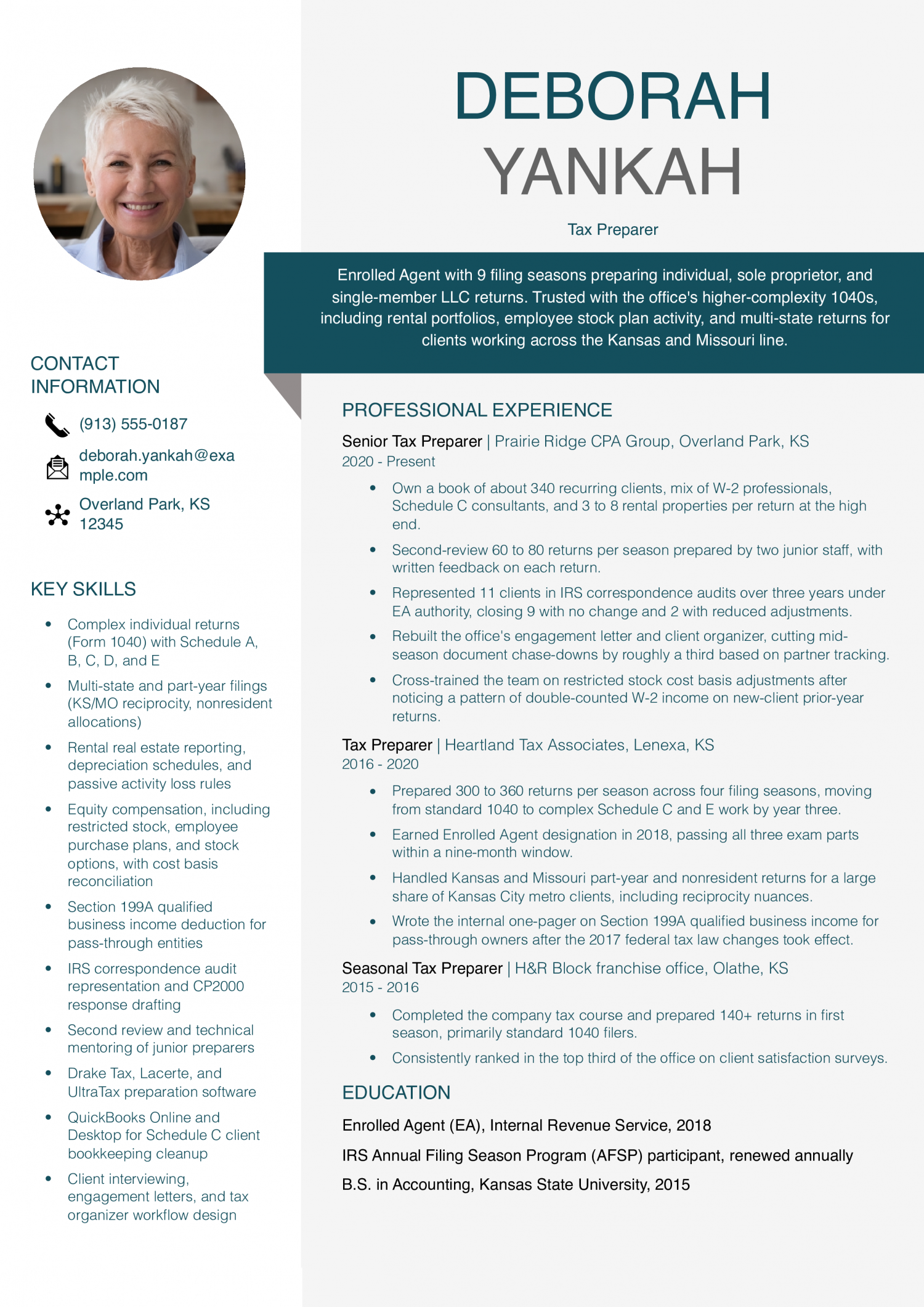
This resume is for a Tax Preparer building a first or second season book of returns. It should show your PTIN, the return volume you handled, and the software you used at a CPA firm.
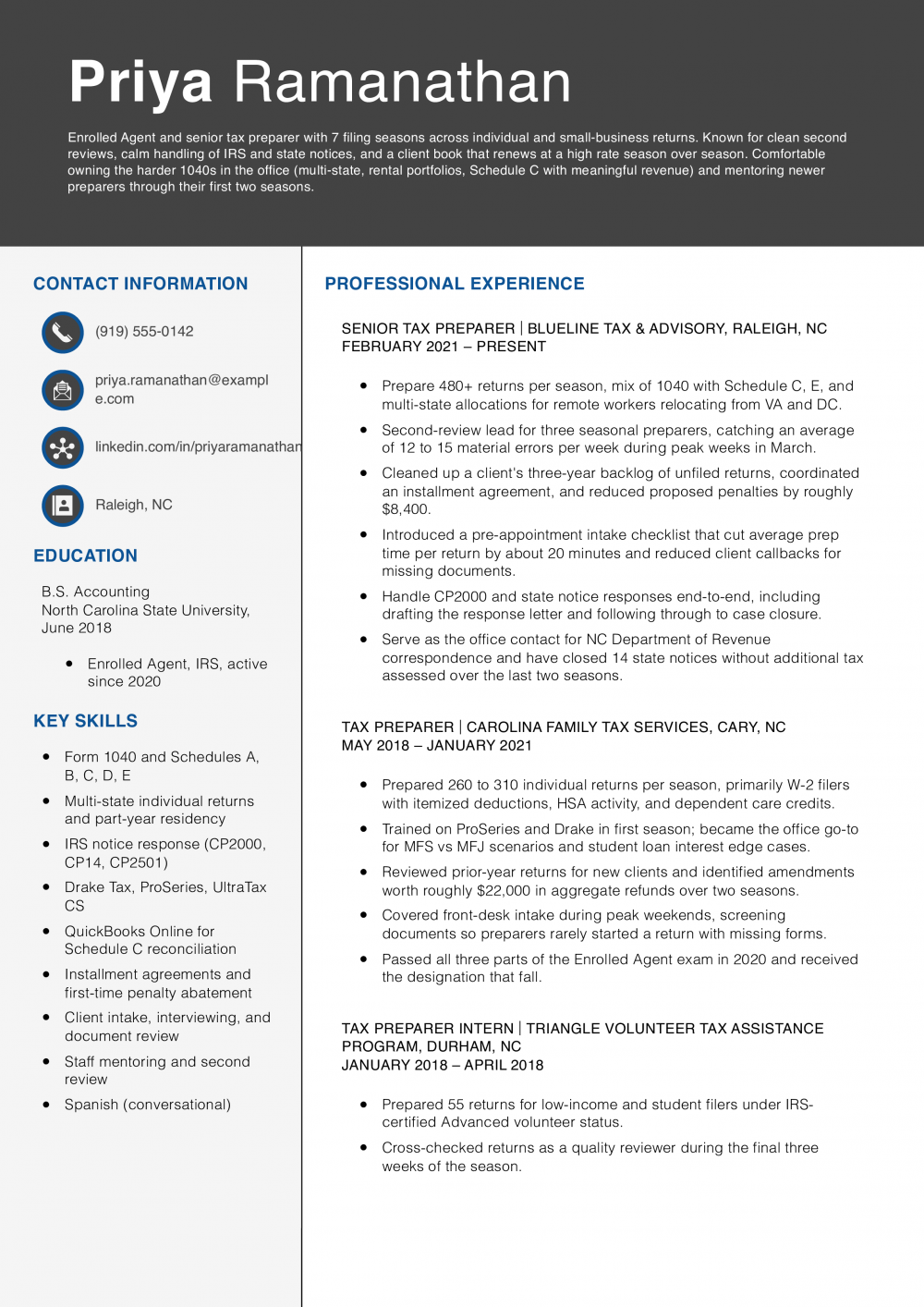
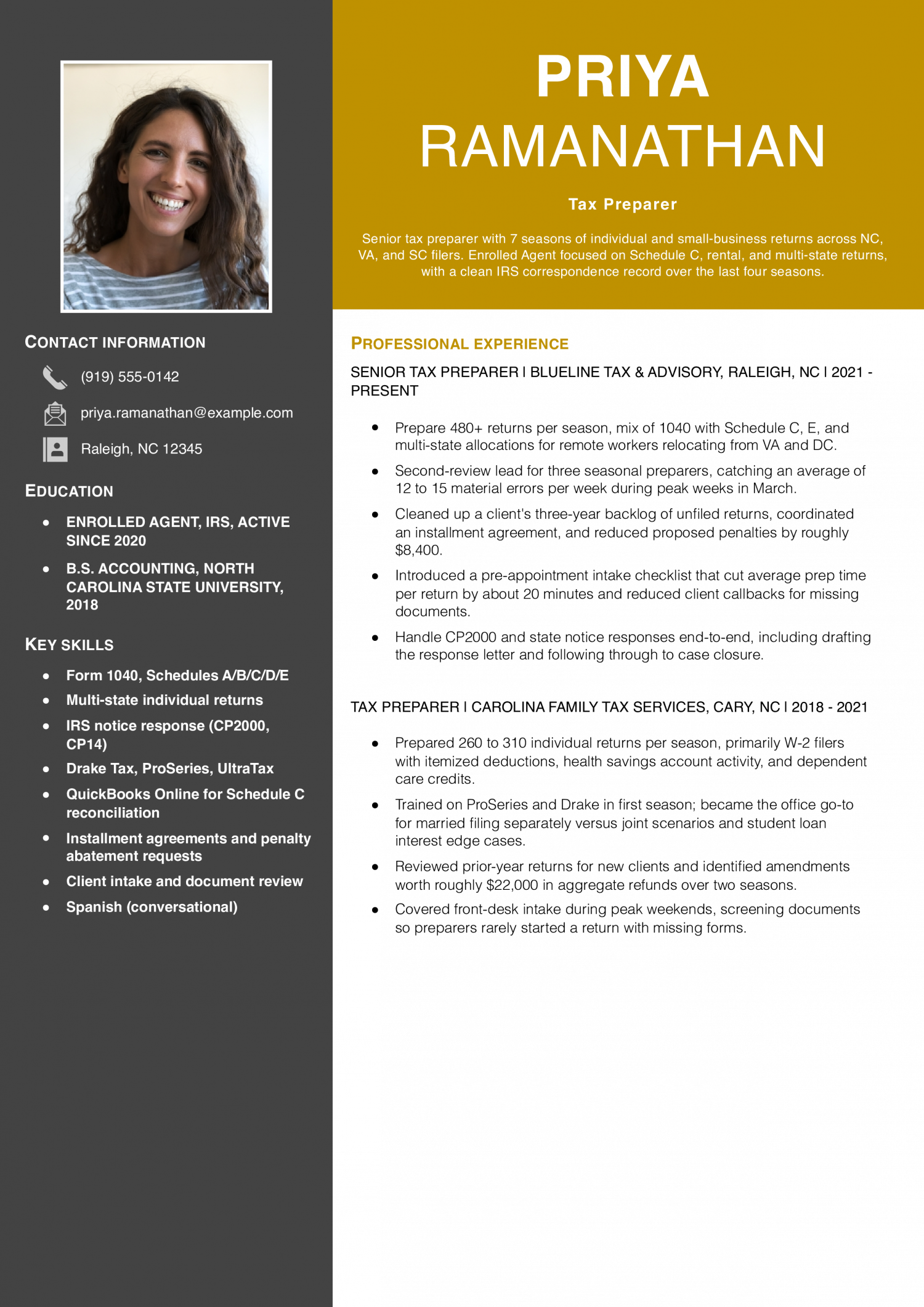
A Senior Tax Preparer resume covers four or more seasons of individual and small business returns. It should show your EA or CPA credential, the complex schedules you own, and the junior preparers whose work you review.
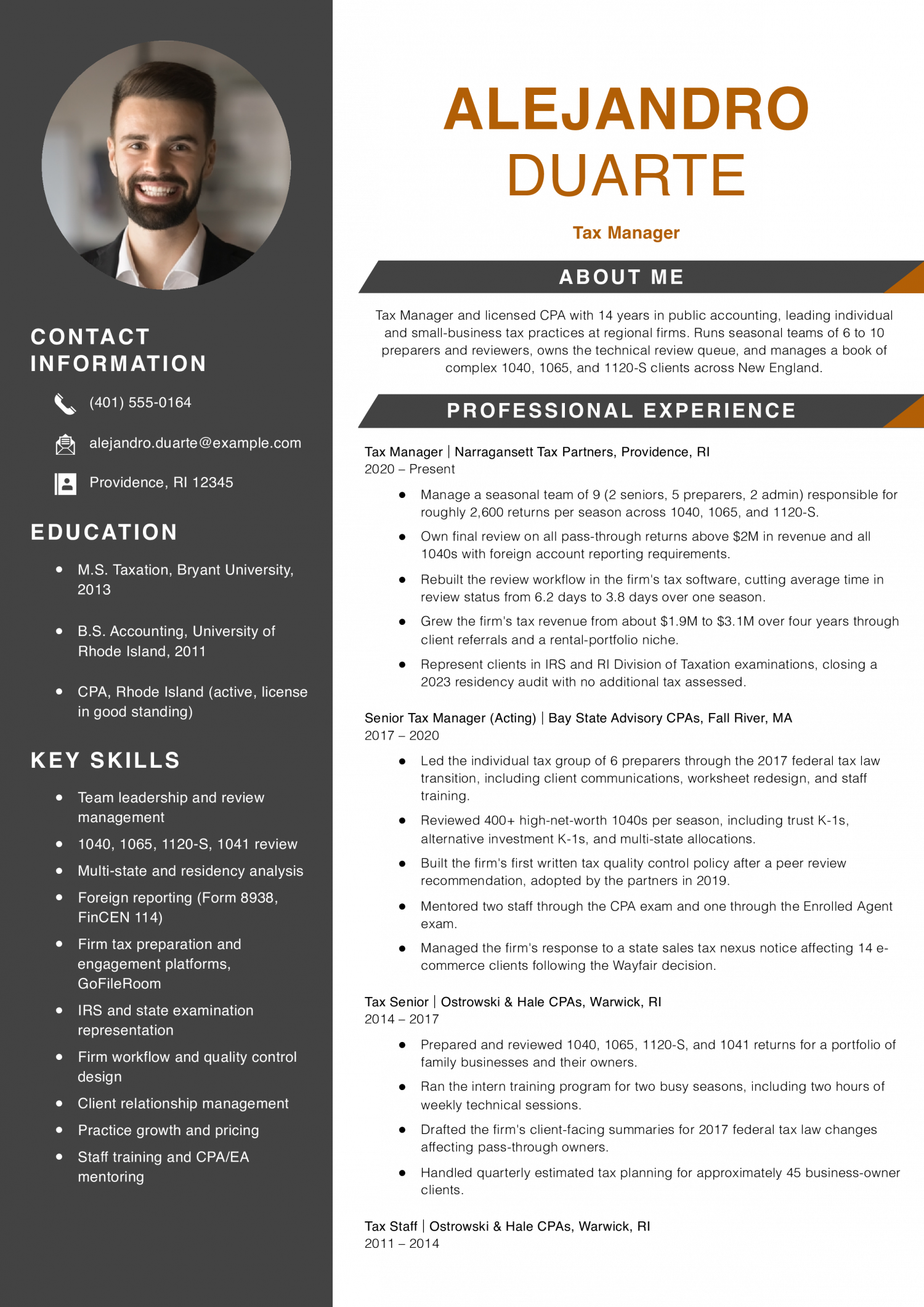
A Tax Manager resume is read by CPA firm partners staffing a compliance practice. It should show the size of your client book, the seniors you supervise, and your role in IRS notices and audit response.
Priya Ramanathan
Raleigh, NC | (919) 555-0142 | [email protected] | linkedin.com/in/priyaramanathan
Enrolled Agent and senior tax preparer with 7 filing seasons across individual and small-business returns. Known for clean second reviews, calm handling of IRS and state notices, and a client book that renews at a high rate season over season. Comfortable owning the harder 1040s in the office (multi-state, rental portfolios, Schedule C with meaningful revenue) and mentoring newer preparers through their first two seasons.
Senior Tax Preparer
Blueline Tax & Advisory | Raleigh, NC | 2021-Present
Tax Preparer
Carolina Family Tax Services | Cary, NC | 2018-2021
Tax Preparer Intern
Triangle Volunteer Tax Assistance Program | Durham, NC | Jan 2018-Apr 2018
Accounting Assistant
Peakwood Property Management | Raleigh, NC | 2016-2018
Your profile belongs at the top of page one. It should state your years preparing returns, the setting you have worked in, and the return types you handle each season. Setting means a national storefront, a regional CPA firm, a solo practice, or an in-house tax group.
Return types means the mix you actually touch: individual 1040s, Schedule C sole proprietors, rental Schedule E, partnership 1065s, S-corp 1120-S, or multi-state filings. Tax office managers and CPA firm partners read this to route your resume to the right desk. A preparer who runs 400 individual returns a season is not the same hire as one who owns 40 small-business books.
Skip the number and a bullet reads like a task list instead of a season’s work. Pull metrics from your last two seasons. Most strong preparer resumes name return volume, average turnaround, and error or amendment rate.
Write it plainly: prepared 380 individual and 45 small-business returns in a 12-week season with a 2 percent amendment rate. Add refund or tax dollars handled if you know the figure. Add IRS or state notice responses closed.
If you led a review queue, name how many preparers you signed off behind. Name the software you used to hit those numbers, such as Lacerte or Drake. Recruiters scan for volume first, then accuracy, then complexity.
A bullet that names all three tends to advance further than one that lists software you opened.
Sort your bullets so a reader can find each part of the job in one pass, and four groups cover most preparer resumes. Return prep covers intake, source document review, data entry, and final sign-off. Client work covers the interview, missing-document follow-up, and delivery of the finished return.
Research and notices cover code and reg lookups, IRS and state letters, and audit support. Review and training covers signing behind junior preparers and running kickoff sessions before the season starts. Put the group the job posting leans on first.
A small-business heavy role wants bookkeeping cleanup and entity returns near the top, not a long list of 1040 intake steps to open the page.
Tax office managers and CPA firm partners need to see your PTIN status and any IRS or state credential first. They check this before they read a single bullet. Put a credentials block on page one under your profile.
List the Preparer Tax Identification Number as current, then any Annual Filing Season Program record of completion, Enrolled Agent, or Certified Public Accountant license with the state and status. Do not print the PTIN itself. Under that, list the tax software you have run a full season: Lacerte, ProSeries, UltraTax, Drake, CCH Axcess, or ProConnect.
Add QuickBooks Online or Desktop if you handle small-business books. This placement lets a firm partner confirm you can sign returns before scheduling a call.
End the resume with a short school section and a training line. List your degree, the school, and the year if it is within the last 10 years. Accounting, finance, and business degrees carry the most weight for firm roles.
A preparer route does not require one. Under school, add a training line that names your recent hours and the topics covered. IRS credential holders and Annual Filing Season Program preparers renew each year.
Two or three topic tags are enough: for example, 15 hours on 2023 individual updates, IRS ethics, and rental real estate. This closing block tells a reviewer your credential is active and your knowledge is current.
Five years ago, a Tax Preparer resume read like a list of form numbers and software logos. The mix has shifted toward client volume, review accuracy, and advisory work beyond filing season. Bookkeeping fluency now sits next to soft skills like client communication on strong resumes.
Tax office managers and CPA firm partners scan hard skills first to confirm you can handle the return types they file. Soft skills carry weight in the interview, but the resume has to prove them with a bullet, not a label. Pull the exact phrases from the job posting and match them against the tables below.
Keep the hard skills clustered near the top of your skills block for the ATS parser. Push soft skills into your bullets as evidence, tied to a client count or a review pass rate. Drop any keyword the posting does not use, since a padded list dilutes the match score.
| Soft Skills | AI-estimated % |
|---|---|
| Client interviewing | 65% |
| Attention to detail | 62% |
| Deadline management | 49% |
| Clear financial explanation | 36% |
| Discretion with data | 35% |
And here are the top hard skills showing up most often.
| Hard Skills | AI-estimated % |
|---|---|
| Tax return preparation | 71% |
| Deduction identification | 66% |
| Tax law compliance | 44% |
| Financial record review | 40% |
| E-filing procedures | 27% |
Skill names and rankings come from an AI model grounded in U.S. Department of Labor occupation data for tax preparers, not from a count of tax preparers’ resumes built on ResumeTemplates.com.
These are the must-haves hiring teams look for when scanning a tax preparer resume.
Tax office managers and CPA firm partners scan for the work you actually do. The rows below sort keywords by the kind of return you handle. Individual work covers Form 1040, Schedule A, and Schedule C filers. Small business work covers pass-through returns for partnerships and S corporations. Multi-state work covers apportionment, nexus review, and part-year residency. Representation work covers IRS notices, audits, and payment plans. Software and workflow covers the tools a firm uses each season. Pick the rows that match your desk. Drop in the software your firm licenses. Name the credentials you hold, such as PTIN, EA, or AFSP. Keep the capitals the IRS uses on each form and program.
| Niche | Keywords ATS scans for |
|---|---|
| Individual returns | Form 1040, Schedule A, Schedule C |
| Small business returns | Form 1065, Form 1120-S, K-1 preparation |
| Multi-state filings | state apportionment, nexus review, part-year residency |
| IRS representation | IRS notices, audit response, installment agreements |
| Tax software | Drake, Lacerte, UltraTax |
What tax office managers and CPA firm partners expect on a Tax Preparer resume has shifted. A blanket claim that you never touch AI now reads as thin at a busy firm. A short workflow line reads as current and honest. Name the tool, name what you use it for, and name the human review step. Say who signs off on the return before it goes to the client. Say how you handle client data inside the tool. Firms want to see that you use software to draft, and that a preparer checks every figure. Use the list that follows to decide what earns a line on your resume and what stays off it.
AI features inside tax software now pre-fill returns from prior year data and uploaded source documents.
AI extraction tools pull figures from W-2s, 1099s and K-1s straight into the return.
AI research assistants inside tax platforms surface code sections and IRS guidance for a preparer to verify.
Chat tools draft plain-language answers on filing status, deductions and payment options for you to review and send.
A current PTIN keeps you eligible to prepare returns for pay. The credentials below are what move a tax preparer resume from the qualified-but-typical stack into the shortlist that tax office managers and CPA firm partners actually call. They signal your billing scope, your representation rights before the IRS, and the return complexity a firm can hand you. List each one on its own line. Give the full name, the issuing body, and the year you earned or last renewed it. Put your active credentials near the top of the section. Keep expired items off the resume unless a posting asks for history.
The top-paying states for Tax Preparers cluster in low-density and high-cost markets, not the big coastal metros most readers expect. The states with the largest headcounts sit elsewhere, in places with dense small-business bases and heavy seasonal filing volume. That split matters when you write the resume.
The spread from the tenth percentile to the ninetieth is wide for this role, so where you sit inside it shapes what to lead with. If you can work across state lines or take on remote clients, name the states you are cleared to prepare in near the top of the resume. Pair that with the client mix you handle, so a reader placing you against a pay band has the facts up front.
| # | State | Median Annual |
|---|---|---|
| 1 | New York | $71,850 |
| 2 | California | $70,030 |
| 3 | Utah | $66,720 |
| 4 | Montana | $63,080 |
| 5 | Missouri | $62,780 |
| 6 | Colorado | $62,620 |
| 7 | Alaska | $62,360 |
| 8 | New Hampshire | $61,370 |
| 9 | Oregon | $61,370 |
| 10 | Pennsylvania | $61,270 |
| # | State | Workers | Median |
|---|---|---|---|
| 1 | California | 10,270 | $70,030 |
| 2 | New York | 7,620 | $71,850 |
| 3 | Texas | 6,010 | $47,460 |
| 4 | New Jersey | 3,220 | $43,420 |
| 5 | North Carolina | 2,710 | $48,130 |
Resume Templates offers HR approved resume templates to help you create a professional resume in minutes. Choose from several template options and even pre-populate a resume from your profile.
Lead each bullet with the return type and the volume you handled in a season. Name the software you filed through, such as Drake, Lacerte, or ProSeries.
Tax office managers and CPA firm partners read for scope first, then for the tools you already know.
Put the season dates in the role line, such as January to April 2024, so the gap is not read as unemployment. Add the firm name, the office location, and whether you worked onsite or remote.
A short note about return count and complexity tells a reader what that season actually held.
No, keep the actual number off the resume and out of the header. Write that you hold an active PTIN in good standing with the IRS, and give the year it was first issued.
A firm will verify the number itself once you reach the offer stage.
Describe the return type, the entity, and the schedules attached, not the taxpayer. Write something like "prepared 60 Form 1040 returns with Schedule C and Schedule E attachments."
That tells a reviewer the work was past a simple W-2 return without breaking client confidentiality.
Put unpaid preparation under a heading like Volunteer Tax Experience rather than under paid work. Free community filing sites are the strongest unpaid line, since the return counts are real and the training is documented.
Name the site, the tax years worked, and any certification level you reached.
Yes, list your annual continuing education hours if you hold an EA, a CPA, or an AFSP Record of Completion. Give the hour count, the topics covered, and the provider name on one short line.
That line shows a firm you are current on the code changes for the coming filing season.
Rewrite your bookkeeping bullets to lead with the tax-adjacent work, such as year-end closes, 1099 filings, and sales tax returns. Put your AFSP Record of Completion or any volunteer tax certification near the top of the credentials block.
A short summary line that names the return types you can already prepare closes the gap for a reviewer.
For a tax preparer, an ATS-friendly template is the safest pick, because it puts your certifications and experience where a hiring manager scans first. A basic template is a solid alternative. Whichever you choose, keep the formatting clean and easy to parse: clear section headings, a standard font, and no graphics a parser can choke on.