Computer Science Resume Examples and Templates for 2026



The technical writer resumes that advance past the portfolio screen share three things: a live sample link in the header, a docs-as-code toolchain named by version, and one bullet per role tied to a measured user or support outcome.
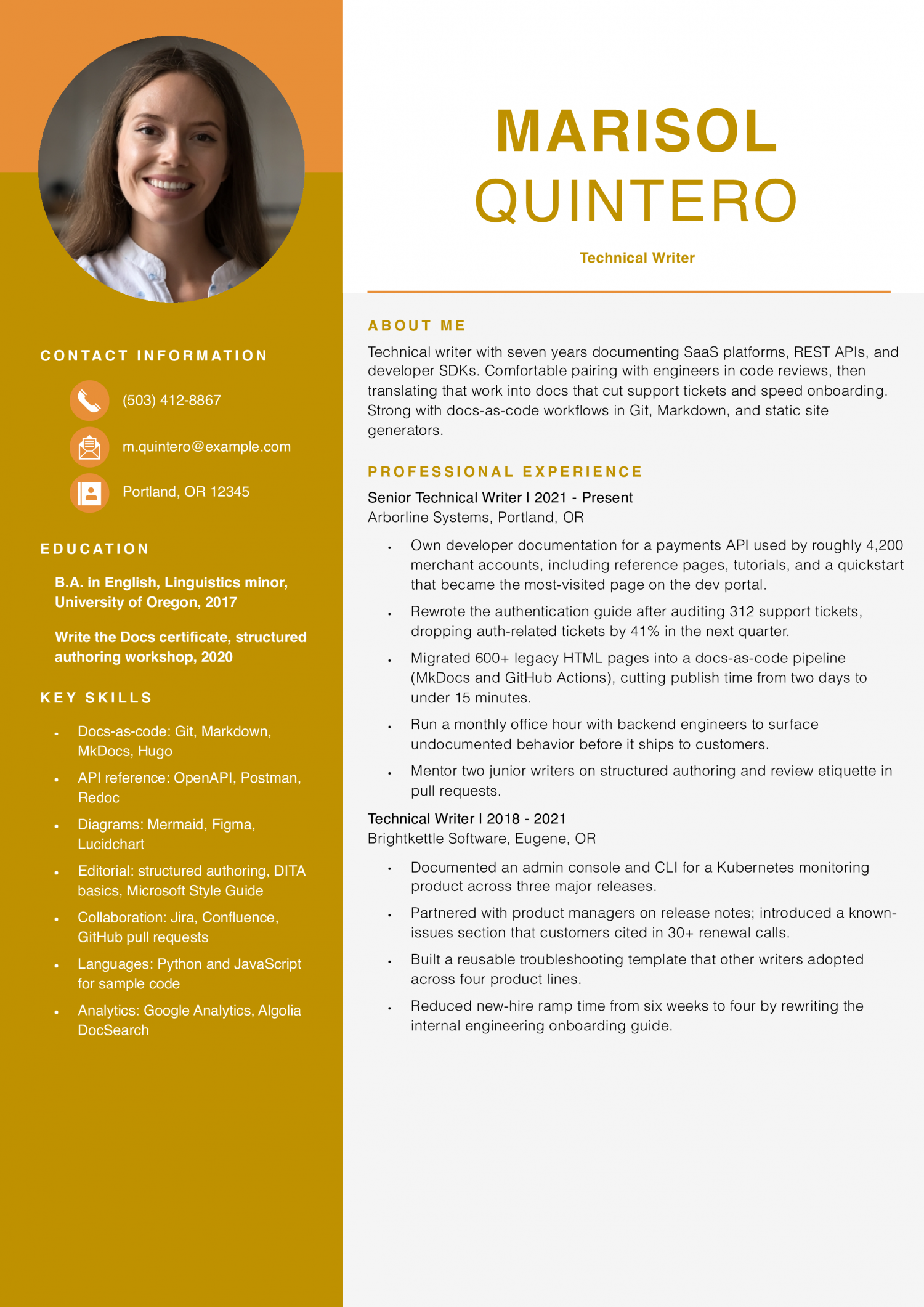
The junior technical writer is one to three years in, often a former support engineer or English major with a strong sample set. The resume needs to prove writing clarity, basic Git and Markdown fluency, and one published doc set you can link.
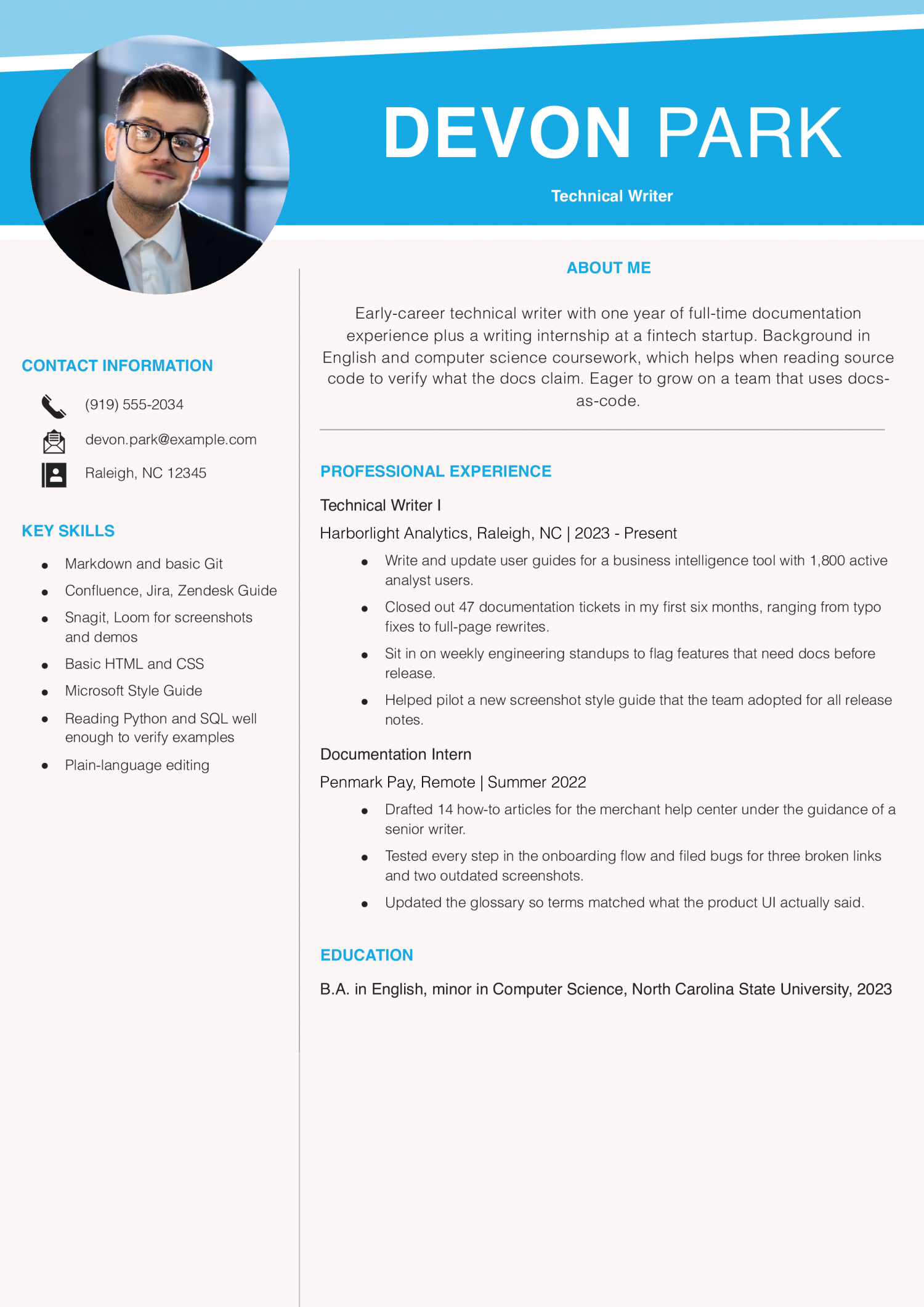
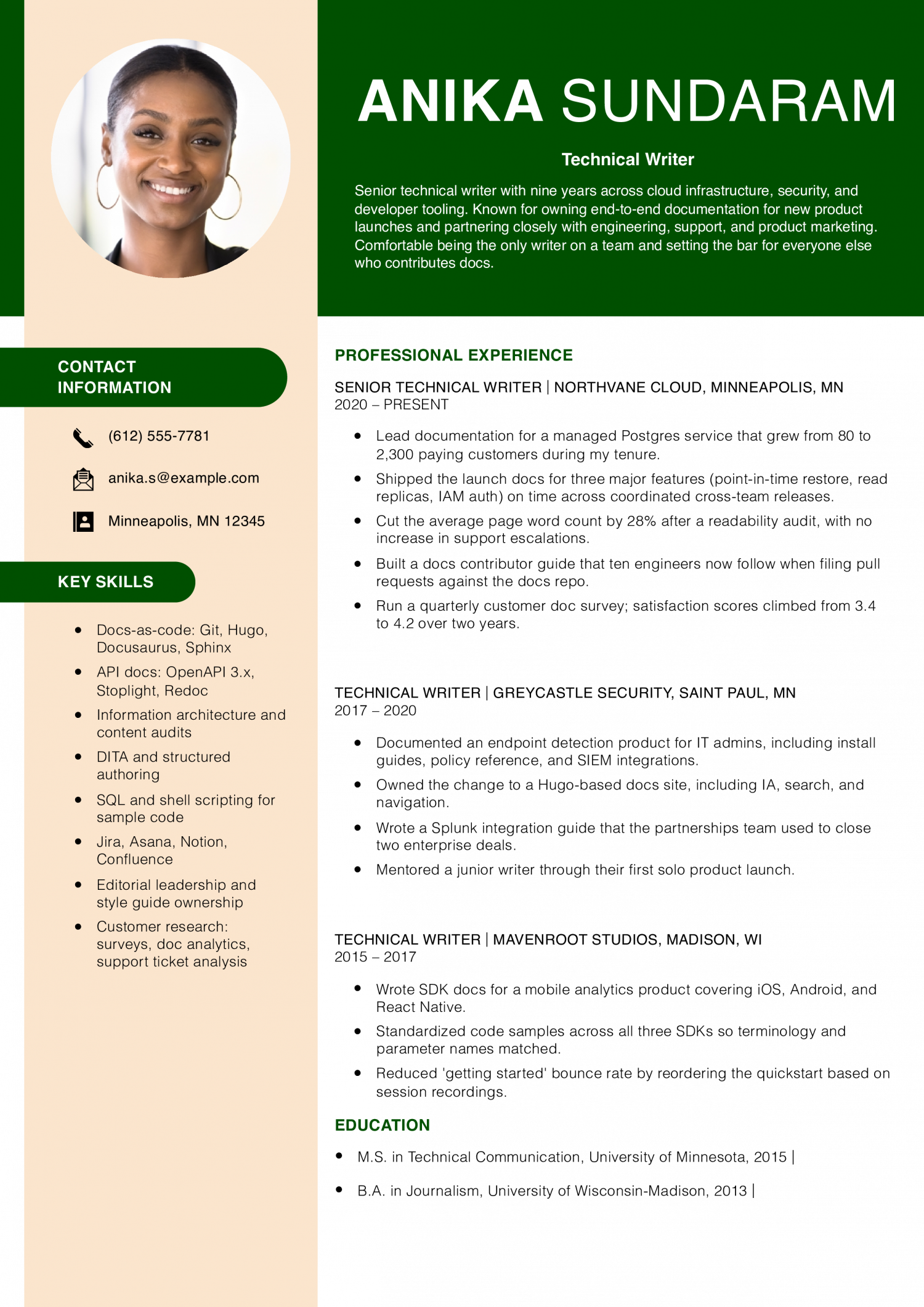
The senior technical writer owns a product area's documentation end to end and partners with engineering on release cycles. The resume needs to prove docs-as-code ownership, SME collaboration, and metrics like ticket deflection or onboarding-time reduction.
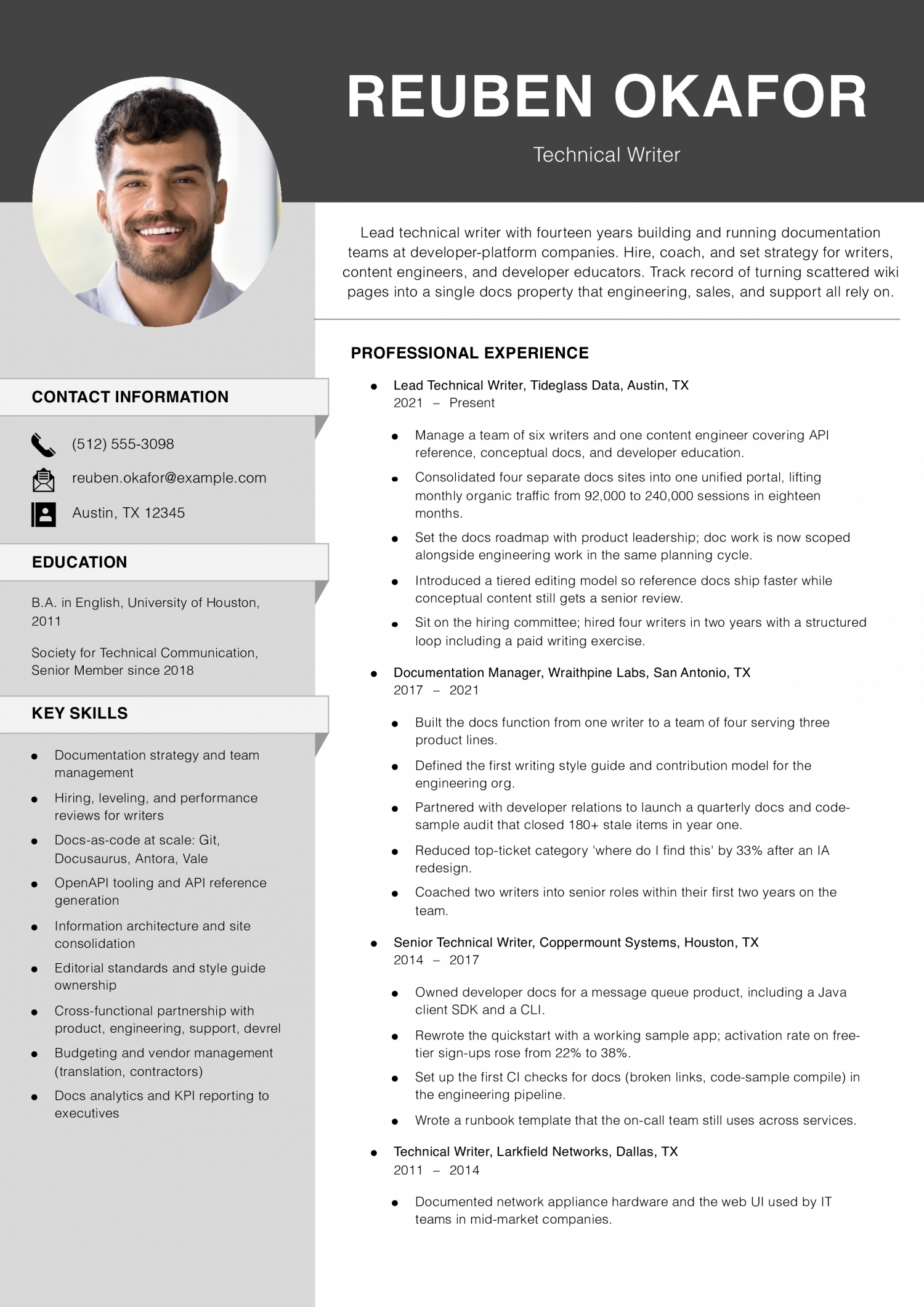
The lead or staff technical writer sets the information architecture, tooling stack, and style standards for the whole docs function. The resume needs to prove platform migrations, hiring or mentoring writers, and business outcomes tied to documentation quality.
Helena Brandt
Pittsburgh, PA | (412) 555-6620 | [email protected] | linkedin.com/in/helenabrandt
Technical writer with eleven years documenting developer platforms, data products, and enterprise software. Comfortable reading source code, interviewing engineers, and shaping a doc set around what users actually try to do. Built and run docs-as-code workflows, owned API reference programs, and partnered with support to turn ticket patterns into doc fixes.
Senior Technical Writer
Foundryline Data | Pittsburgh, PA | 2020-Present
Technical Writer
Quillstone Health Tech | Cleveland, OH | 2017-2020
Technical Writer
Ashbrook Robotics | Akron, OH | 2015-2017
Documentation Specialist
Verdantfox Software | Columbus, OH | 2013-2015
Junior Technical Writer
Stonemill Logistics Software | Toledo, OH | 2012-2013
Add a single line a documentation manager cannot infer from your samples alone. Examples: OpenAPI spec authoring, DITA migration experience, a developer audience you’ve written for at scale, or fluency in a regulated domain like medical devices or fintech.
Put this above your experience block, next to your portfolio URL. A reviewer who opens your samples already sees that you can write. What they cannot see is whether you’ve shipped reference docs against a Swagger file, or run a Flare-to-Markdown conversion.
Name that signal early so the rest of the resume confirms it instead of introducing it.
Most strong technical writer bullets carry a number tied to user behavior or support load. Recruiters scan for ticket deflection, time-to-first-API-call, onboarding hours saved, or page-view growth on key articles.
Three metrics tend to land: support-ticket reduction after a doc launch, reduction in onboarding time for new engineers, and search-success rate on the help center. If your team didn’t track these, name scope instead: number of API endpoints documented, release notes shipped per quarter, or SMEs you partnered with across teams. Bullets without a number or a scope figure read as duties, not outcomes.
Documentation managers read for the deliverable mix, not a chronology of tasks. Split your bullets into four buckets: API and developer reference, end-user guides and help center, release notes and changelogs, and internal or process documentation.
Under each role, lead the bullet with the artifact: “Authored REST API reference for 47 endpoints using OpenAPI 3.1 and Redocly.” Then add the outcome. This shape lets a reviewer skim for the exact deliverable the open role calls for, whether that’s SDK docs, knowledge-base articles, or compliance procedures. A wall of mixed bullets makes them guess.
Documentation managers and engineering leads want to confirm the stack on page one. Build a short tools block under your summary listing MadCap Flare, Oxygen XML, Git, Markdown, DITA, Confluence, Swagger or OpenAPI, and any static site generator like Docusaurus, MkDocs, or Hugo.
If you hold a Society for Technical Communication certification, the Google Technical Writing course completion, or a vendor cert like MadCap Flare Advanced, list it in a credentials line directly below. Engineering hires also look for any developer-adjacent signal: a CS minor, a coding bootcamp, or contributions to open-source documentation. Surface these before the experience section.
Senior and lead technical writers waste lines on “strong written and verbal communication” or “attention to detail.” Both are assumed at this level and signal a junior resume.
Cut generic editing bullets, copyediting hours, and Microsoft Word as a listed skill. Replace them with platform decisions you owned: a docs-as-code migration, an information architecture rebuild, a style guide you authored, or writers you hired and mentored. At lead level, name the business outcome of the documentation function, not your individual deliverables.
ATS filters catch more technical writer resumes than ever in 2026. The skills below come from our user-built technical writer resumes. Tooling names like MadCap Flare and Git clear the first cut, and SME-collaboration language decides whether the resume advances.
Documentation managers weigh hard skills first because the toolchain is non-negotiable. Soft skills like SME interviewing and audience analysis carry weight only when paired with a deliverable bullet. Match the table below against the target posting, and treat each soft skill as evidence to back a specific bullet rather than a standalone claim.
| Soft Skills | % of resumes with this skill |
|---|---|
| Communication | 67% |
| Collaboration | 61% |
| Attention to detail | 48% |
| Problem-solving | 35% |
| Adaptability | 28% |
And here are the top hard skills showing up most often.
| Hard Skills | % of resumes with this skill |
|---|---|
| Technical documentation | 72% |
| MadCap Flare | 53% |
| HTML/CSS/XML markup | 42% |
| Markdown | 36% |
| Git/GitHub version control | 32% |
Based on data from thousands of technical writers’ resumes built on ResumeTemplates.com, May 2026.
Before a technical writer resume gets a closer read, hiring teams check for a short list of essentials.
Group these terms by the sub-niche of technical writing the posting describes, then mirror the exact phrasing the job uses. Documentation managers and engineering leads scan for the niche signal first.
| Niche | Keywords ATS scans for |
|---|---|
| API and developer documentation | api documentation, openapi, swagger, developer docs, sdk reference |
| Docs-as-code workflow | docs-as-code, git, markdown, static site generator, docusaurus |
| Structured authoring | dita, oxygen xml, structured authoring, single-source publishing, s1000d |
| End-user help and knowledge base | madcap flare, confluence, knowledge base, help center, user guide |
| Regulated industry documentation | fda documentation, iso 9001, medical device docs, sop authoring, compliance writing |
What documentation managers expect on a technical writer resume has shifted: a “no AI” stance now reads as evasive on most SaaS and developer-tools briefs; an honest workflow naming the model, the draft step, and the SME-verification step reads as current and credible. The list below names what to add.
First drafts of how-to articles and release notes increasingly start from an LLM prompt, with the writer editing for accuracy and voice.
Tools that parse OpenAPI specs into draft reference pages mean the writer's job moves toward examples, edge cases, and narrative.
Help centers now ship with semantic search and chat overlays, so writers tag content for retrieval rather than only for navigation.
Writers use LLMs to generate question lists from engineering tickets and PRs, cutting interview time with senior engineers.
The portfolio is the real gate for a technical writer role. A documentation manager opens it before they finish your summary, so the first sample they hit decides whether they keep reading.
Free, version-controlled, signals docs-as-code fluency without a separate hosting story.
Hosts mixed deliverables (guides, release notes, API reference) under one URL with clean navigation.
Useful for career-changers with three to five samples; weaker signal at senior level.
Hosts Sphinx or MkDocs projects and reads as native to the developer-docs community.
Lead the portfolio with one API reference page, one how-to guide, and one release-notes set. Those three artifacts cover the full deliverable mix most teams hire for.
Each sample needs a short context note: the product, the audience, the toolchain, and what you owned versus what was already there. A sample without context reads as found work.
Documentation managers read your tools block to confirm you can land in the existing pipeline without a six-week ramp. Name versions where you have them.
Beyond a writing degree or English background, the certifications below tell documentation managers which toolchain you’ve trained on and which content standards you can apply on day one. List the certifying body and the year completed for each item.
The top-paying states for technical writers cluster around defense, aerospace, and biotech corridors, not the assumed big tech metros. Those employers pay a premium because the documentation is part of a regulated deliverable, not a marketing artifact. If you’re geographically flexible, the resume should foreground regulated-industry experience, structured authoring in DITA or S1000D, and any security clearance or compliance domain you’ve written into.
That positioning shifts which percentile of the band a documentation manager mentally places you in.
| # | State | Avg. Annual |
|---|---|---|
| 1 | Connecticut | $109,400 |
| 2 | Colorado | $103,960 |
| 3 | Massachusetts | $102,640 |
| 4 | Rhode Island | $100,580 |
| 5 | California | $100,440 |
| 6 | Maryland | $98,350 |
| 7 | Washington | $93,230 |
| 8 | New Hampshire | $91,710 |
| 9 | District of Columbia | $89,180 |
| 10 | North Carolina | $87,330 |
| # | State | Workers | Median |
|---|---|---|---|
| 1 | California | 13,210 | $100,440 |
| 2 | Texas | 3,670 | $79,060 |
| 3 | Florida | 2,590 | $80,840 |
| 4 | Virginia | 2,520 | $84,000 |
| 5 | New York | 2,030 | $82,980 |
Resume Templates offers HR approved resume templates to help you create a professional resume in minutes. Choose from several template options and even pre-populate a resume from your profile.
Build a public portfolio first. Pick an open-source project with weak docs, contribute a README rewrite, an install guide, and one API reference page.
Push the work to GitHub and link it from your resume header. Pair the portfolio with a credential like the Google Technical Writing courses or an STC membership.
Position adjacent experience (support engineer, QA, teacher, journalist) as evidence of SME interviewing and audience analysis. The portfolio is the gate, not the degree.
Use a reverse-chronological format with a tools block and portfolio URL directly under your name. Functional or skills-first formats hide the toolchain and read as thin experience.
Keep the resume to one page through mid-career and two pages at senior or lead. Use a single column so ATS parsers read it cleanly.
Spell out your portfolio URL in plain text since most parsers strip hyperlinks.
Yes, and frame it as workflow integration rather than authorship. Documentation managers in 2026 assume you use ChatGPT or Claude for draft scaffolding and Grammarly for editing.
What they want to see is the human-edit step: SME verification, code-example testing, and style-guide enforcement.
A one-line workflow note in your summary ("AI-assisted drafts, human-verified against SME interviews and code samples") reads as honest and current.
Pull keywords directly from the target posting, then layer in role-standard terms the ATS expects. The reliable set: docs-as-code, structured authoring, DITA, Markdown, Git, OpenAPI, MadCap Flare, Oxygen XML, Confluence, information architecture, and API documentation.
Add domain terms if the role names them (SaaS, fintech, medical devices, developer tools).
Avoid generic writing terms like "strong communicator" or "detail-oriented," which add no ATS weight and crowd out the signals that matter.
For a technical writer, a professional template is the safest pick, because it signals the polish hiring managers in this field expect. An ATS-friendly template is a solid alternative. Whichever you choose, keep the formatting clean and easy to parse: clear section headings, a standard font, and no graphics a parser can choke on.
Executive Resume Writer and Career Coach
Andrew Stoner is an executive career coach and resume writer with 17 years of experience as a hiring manager and operations leader at two Fortune 500 Financial Services companies, and as the career services director at two major university business schools.
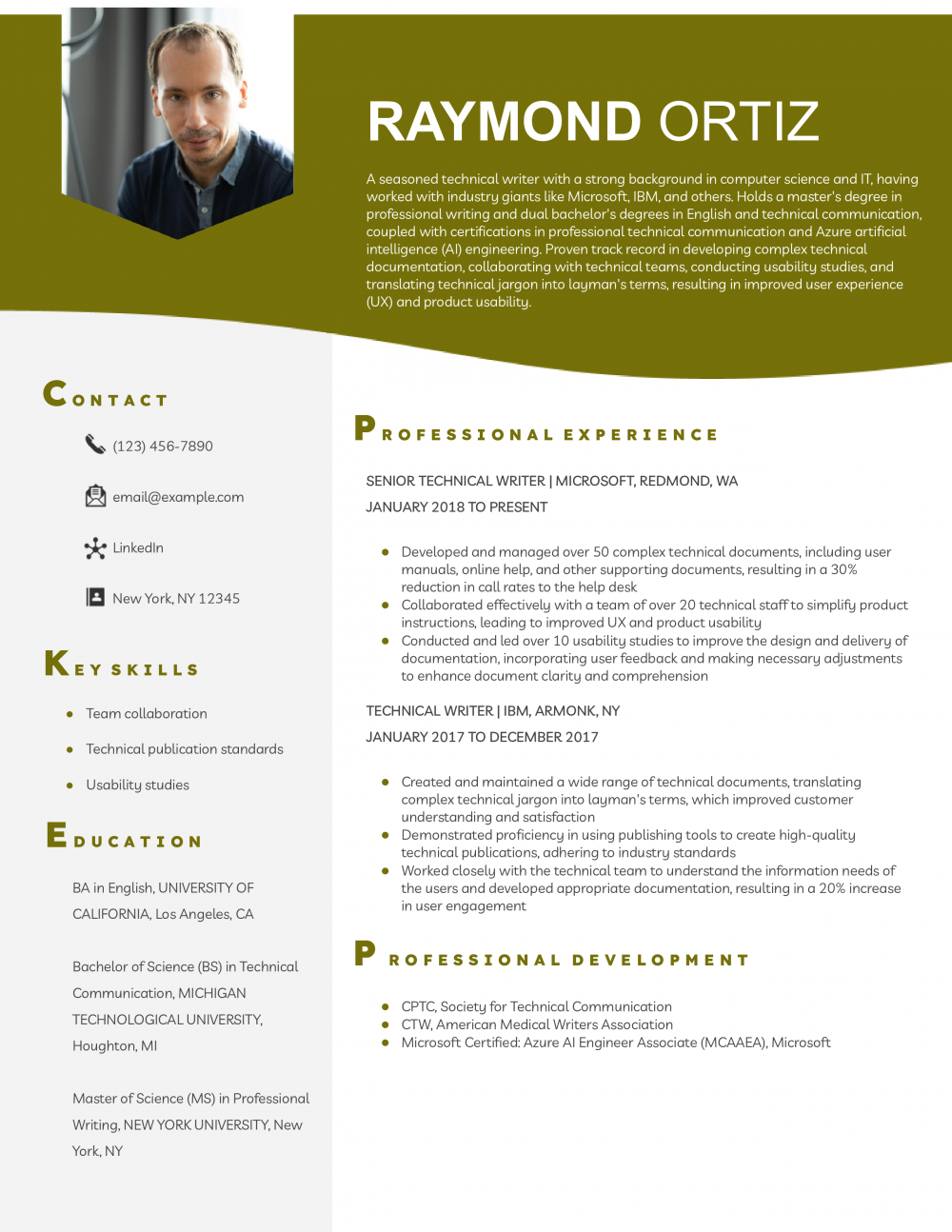
Customize this template in our builder in under 10 minutes.