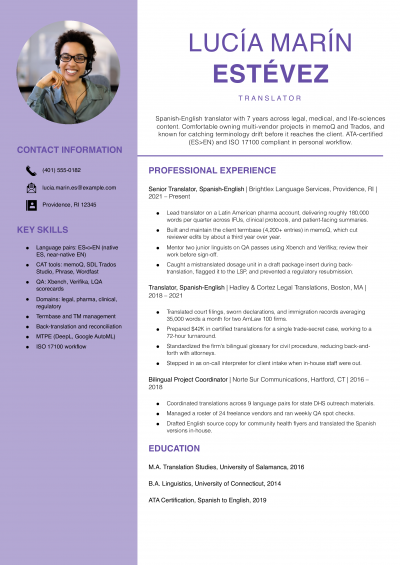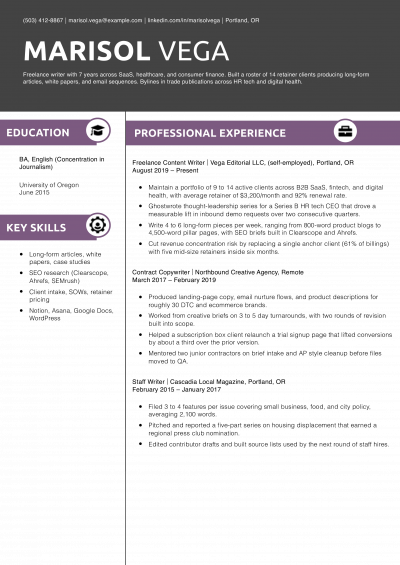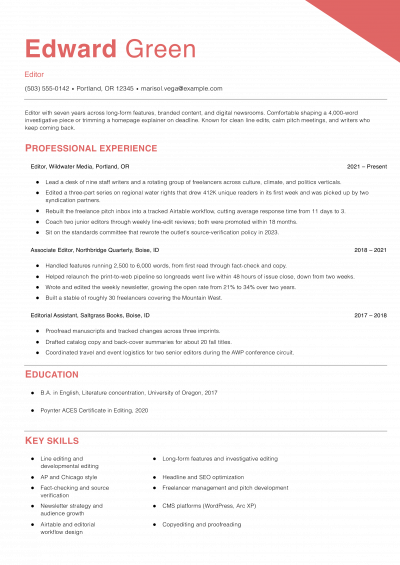
Editor Resume Examples and Templates for 2026



A portfolio of clicked-on bylines is what gets writer resumes past the editor's first read; specific traffic and retention numbers next to each clip are what make them readable enough to move to a writing test.
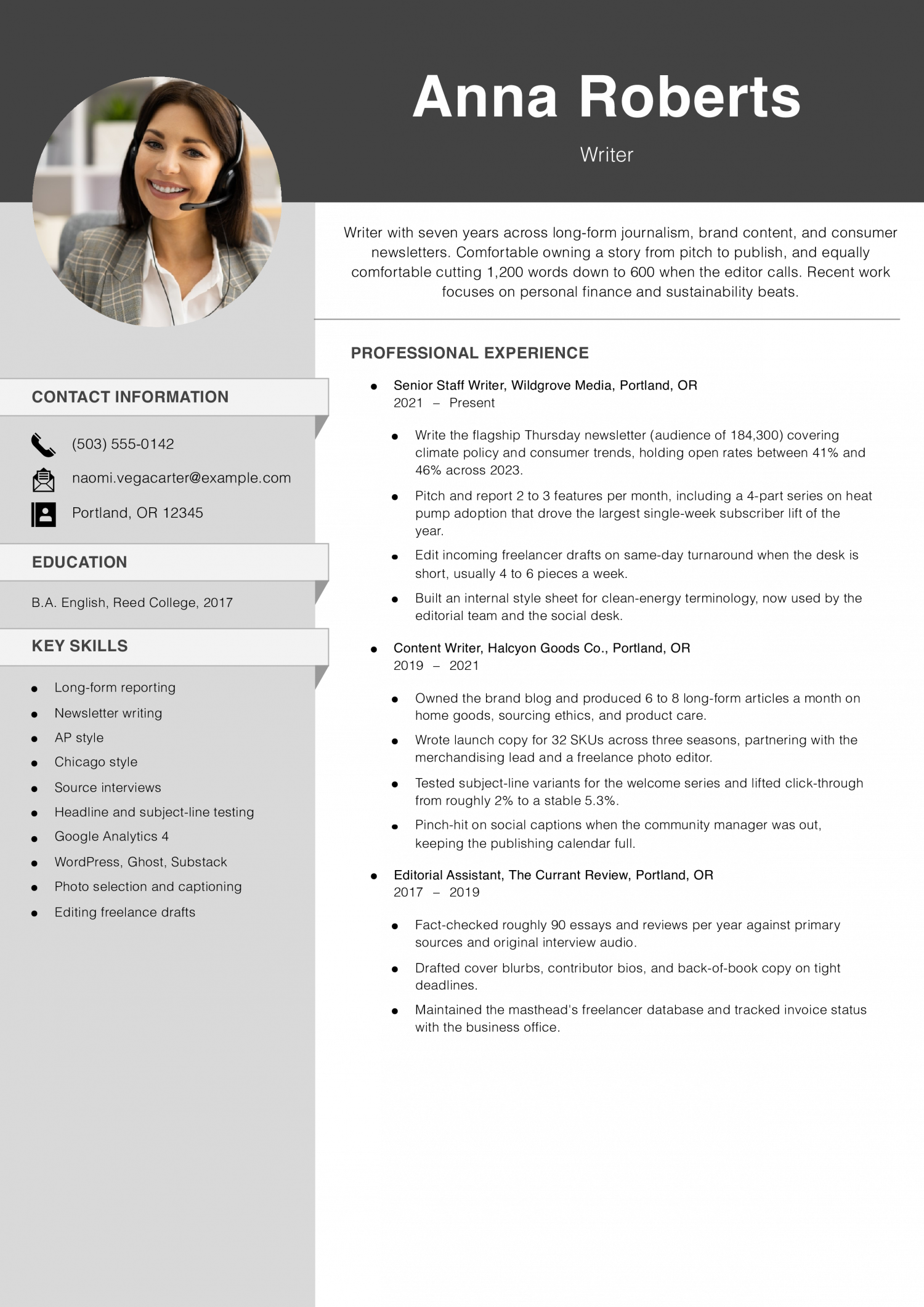
The emerging writer has a handful of published clips, maybe a student paper or a content internship, and is targeting junior staff or associate editor roles. This resume needs to prove range across formats and a working grasp of CMS and house style.
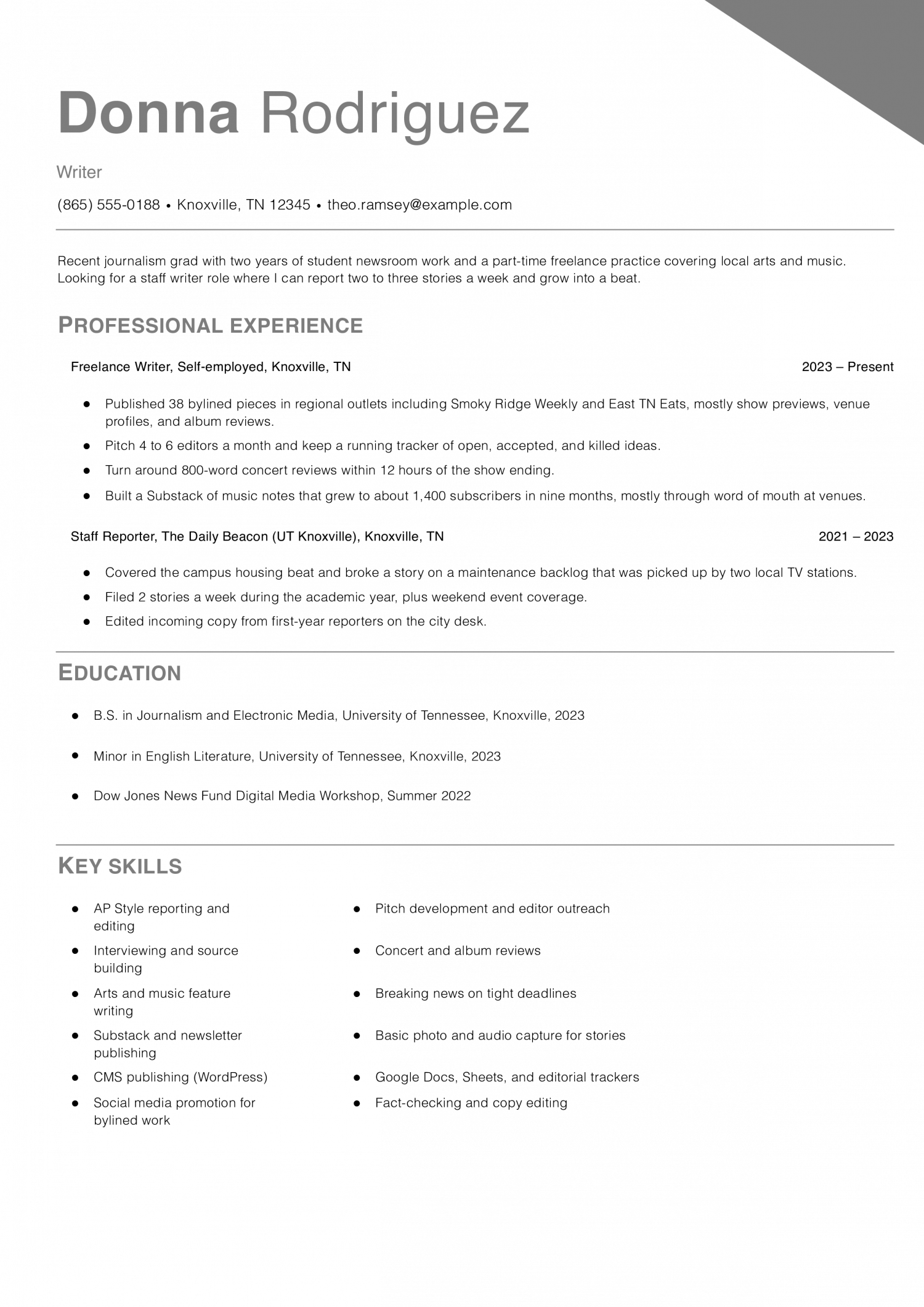
The established writer has 3 to 7 years of bylines, owns a beat or content vertical, and writes to traffic or engagement targets. This resume needs to show repeatable reach metrics, source networks, and fluency with SEO briefs and editorial calendars.
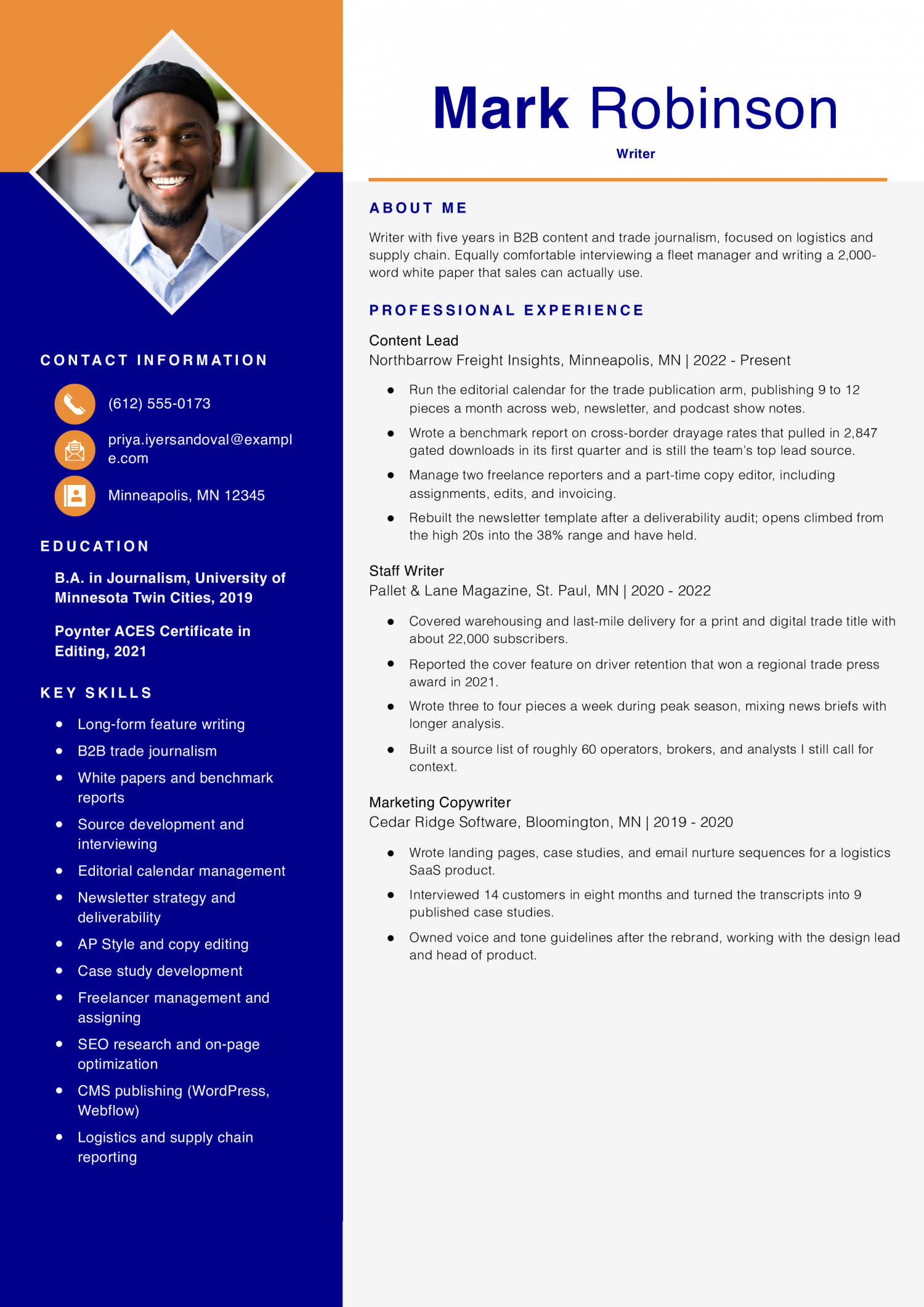
The senior writer leads features, edits junior staff, or runs a content franchise across channels. This resume needs to show franchise growth, the writers and freelancers managed, and the audience or revenue numbers tied to the work.
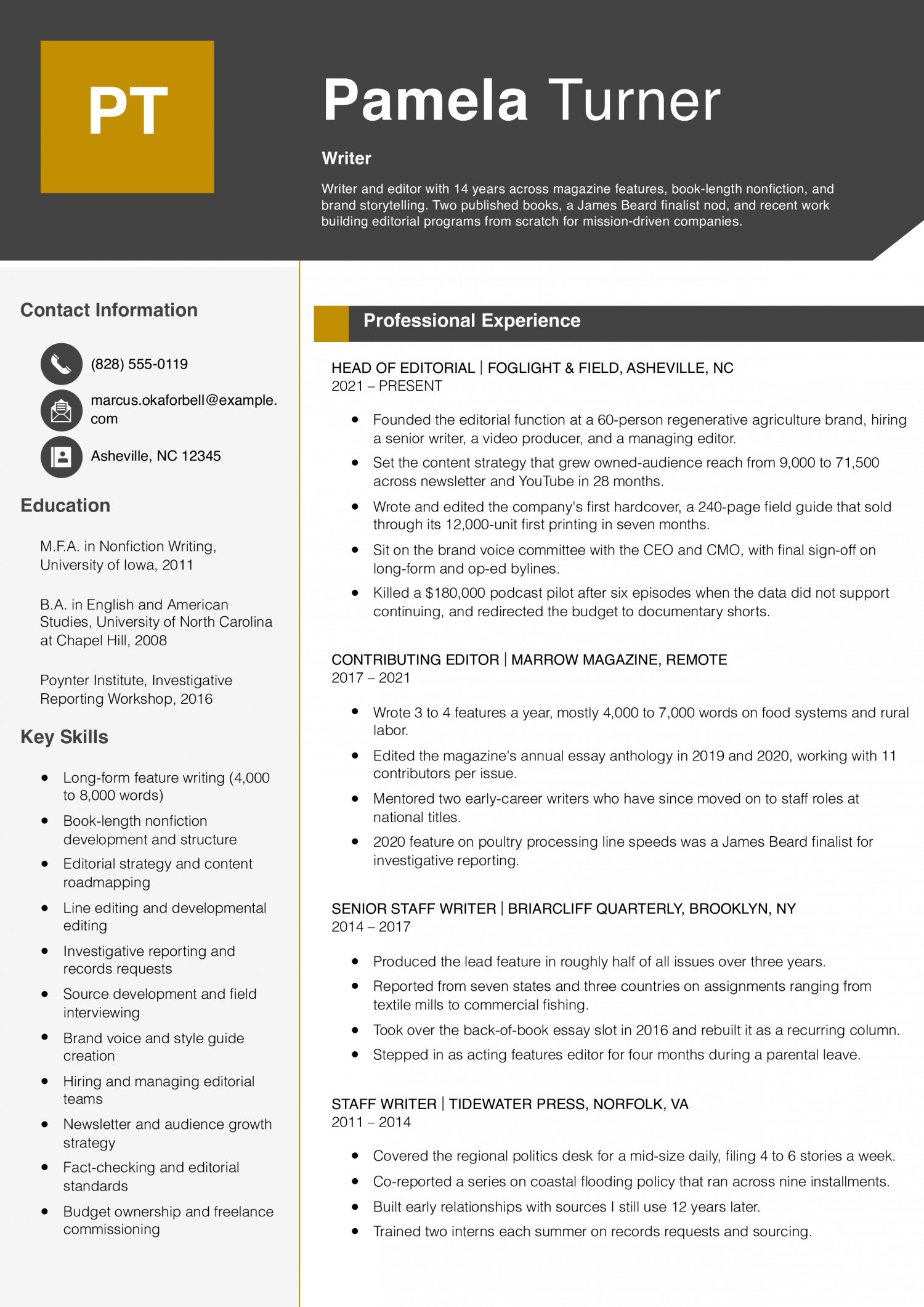
Yuki Brennan-Ortiz
Providence, RI | (401) 555-0166 | [email protected] | linkedin.com/in/yukibrennanortiz
Writer with nine years across science journalism, technical documentation, and consumer health content. Most comfortable in the space between researchers and general readers, translating studies and product updates into copy that does not lose the nuance.
Senior Science Writer
Halberd Health Media | Providence, RI | 2022-Present
Technical Writer
Cobalt Helix Bio | Cambridge, MA | 2020-2022
Staff Reporter
Narragansett Sun | Providence, RI | 2018-2020
Freelance Writer
Self-employed | Providence, RI | 2016-2018
Editorial Intern
Pawtucket Public Radio | Pawtucket, RI | 2015-2016
Lead with the signal another writer is unlikely to have. That might be a beat with built-in source access, like municipal courts or vertical SaaS.
It might be a format mix a generalist cannot fake, such as longform features plus SEO service pages plus scripts. Or a publication tier, like a top-50 trade title or a national consumer brand.
Put that line at the top of your summary, name the publication or beat by its real name, and pair it with one engagement or reach figure. Editors and content directors decide in seconds whether to click your portfolio link.
Writer bullets without numbers read like duties. Strong bullets carry a reach figure, a volume figure, or a deadline record.
Name 2 or 3 metrics per role: pageviews or sessions for a flagship piece, average words per week, articles shipped per month, or read-through rate from your analytics dashboard.
Use the units the publication uses. If your CMS reports unique visitors, write unique visitors. Vague phrases like ‘high-performing content’ tend to get cut on the editor’s second pass.
Editors scan for the formats they hire for. Cluster your bullets so they can find them fast: longform features, news and reported pieces, SEO and evergreen content, brand and B2B work, scripts and audio, newsletters.
Within each cluster, name the publication or client, the CMS, and the style guide (AP or Chicago). Add the editor relationship if you owned the pitch-to-publish cycle.
Three to five clusters per role is enough. More fragments the read.
Editors and content directors want to confirm fit in the first scan. Put a credentials line on page one with CMS systems (WordPress, Contentful, Sanity), SEO tools (Ahrefs, Semrush, Clearscope), AP or Chicago fluency, and any specialist software like Adobe InCopy.
Add a ‘Selected Bylines’ block with 4 to 6 links to live pieces. Pick the clips that match the target job, not your personal favorites.
Bylines on page one cut the time between scan and portfolio click.
If you are moving into writing from another field, the resume has to lead with published work, not intent. Open with a portfolio link and 4 to 6 clips above the work history.
Translate prior roles into writing-adjacent signals: research, interviewing, editing internal docs, running a Substack with subscriber numbers.
Name any freelance bylines, even small trade titles, by publication. Editors trust a small clip on a real masthead more than a long pitch about transferable skills.
The skills below come from writer resumes our users built on ResumeTemplates.com. Editors and content directors scan dozens of resumes a week, and these are the terms that show up most often. Hard skills carry most of the ATS weight for writer roles: CMS names, SEO tools, and style guides parse cleanly.
Soft skills like source development matter, but only when a bullet backs them. Match the hard-skill list to the job posting verbatim, and treat the soft skills as labels for the proof in your bullets.
| Soft Skills | % of resumes with this skill |
|---|---|
| Written Communication | 67% |
| Creativity | 59% |
| Attention to Detail | 49% |
| Time management | 37% |
| Adaptability | 31% |
And here are the top hard skills showing up most often.
| Hard Skills | % of resumes with this skill |
|---|---|
| Copyediting and Proofreading | 65% |
| SEO Writing | 61% |
| Content Management Systems | 46% |
| Research and Fact-Checking | 38% |
| AP Style | 26% |
Based on data from thousands of writers’ resumes built on ResumeTemplates.com, May 2026.
These are the must-haves hiring teams look for when scanning a writer resume.
Editors and content directors expect the niche line to read like the postings they write. Cluster your keywords by sub-specialty so the ATS picks up the format match and the human reader sees focus.
| Niche | Keywords ATS scans for |
|---|---|
| Staff and editorial writer | writer resume, writer resume sample, writer resume example, staff writer |
| Resume and career writing | resume writer resume, resume writer, professional resume writer, resume writing |
| Content and SEO writer | content writer, SEO writer, content marketing writer, blog writer |
| Copywriter and brand | copywriter, brand copywriter, B2B copywriter, conversion copywriter |
| Author and longform | author resume, freelance writer, longform feature writer, ghostwriter |
Editors are split between newsrooms and brand teams that want AI-assisted research and draft speed, and outlets that explicitly forbid generative tools in published copy. Name the tools you use, describe the workflow in plain terms, and avoid claiming you ‘write with AI’ when your real practice is editing and verifying.
Writers use ChatGPT and Claude to summarize source documents, build outlines, and pressure-test angles before drafting.
Clearscope and Semrush AI features now generate brief skeletons, leaving the writer to verify search intent and add reporting.
Editors expect tighter verification because generative drafts introduce confident errors that pass a casual read.
Content teams have raised throughput targets, and writers are expected to show a defensible verification step in their process.
A writer’s portfolio is the actual gate. Editors click before they read, so the link in your header has to land on a clean page with your strongest 6 to 10 clips, organized by format or beat, with a one-line context note next to each piece.
Full control over layout, custom domain, and the order clips appear in.
Pulls bylines automatically and is widely recognized by content recruiters.
Auto-archives bylines and pulls live engagement metrics next to each piece.
Clean reading layout that lets editors scan a long piece without ads or navigation noise.
Open with your three strongest pieces. Editors rarely scroll past the top of the page. Pick clips that match the target job’s beat and format, not a chronological feed of everything you have published.
Add one line of context next to each clip. Publication, year, format, and one reach or engagement number. A line like ‘12,000 unique visitors in the first month’ carries more weight than the headline alone.
Keep the portfolio URL in the resume header. A header link, a summary link, and a ‘Selected Bylines’ block in the body give editors three paths to the work.
Awards and notable credits give editors a quick read on the tier of work you have shipped. Keep this section focused on bylines and recognition that a hiring editor would know by name.
Writers are not licensed, so certifications signal specialty depth rather than legal minimums. The credentials below tell editors and content directors which formats and tools you have trained in beyond your bylines. List the issuing body and the year you earned each one.
For writers, the 10th-percentile floor and the top-decile ceiling sit far apart, and the spread reflects publication tier, format mix, and whether the work carries a byline or sits inside a brand team. Senior content roles at tech and finance employers tend to cluster at the top. Geography matters less than vertical: a B2B SaaS writer in a midsize market can outpace a generalist in a top city.
Lead your resume with the verticals, tools, and reach numbers that map to the ceiling.
| # | State | Avg. Annual |
|---|---|---|
| 1 | District of Columbia | $121,160 |
| 2 | Maryland | $107,540 |
| 3 | Washington | $86,170 |
| 4 | Vermont | $86,040 |
| 5 | Virginia | $80,990 |
| 6 | Connecticut | $80,950 |
| 7 | California | $80,470 |
| 8 | Massachusetts | $78,440 |
| 9 | Oregon | $77,830 |
| 10 | New Jersey | $75,640 |
| # | State | Workers | Median |
|---|---|---|---|
| 1 | California | 8,950 | $80,470 |
| 2 | New York | 5,980 | N/A |
| 3 | Florida | 2,440 | $65,830 |
| 4 | North Carolina | 2,170 | $63,720 |
| 5 | Texas | 2,100 | $71,650 |
Resume Templates offers HR approved resume templates to help you create a professional resume in minutes. Choose from several template options and even pre-populate a resume from your profile.
Treat each repeat client or publication as a role. List the publication name, the dates, and 2 or 3 bullets covering format, beat, and reach.
Group one-off pieces under a single 'Selected Freelance Clients' heading with logos or publication names. Add a 'Selected Bylines' block with 4 to 6 live links above the work history.
Editors care about the masthead and the clip more than the contract type.
Yes. A 'Selected Bylines' block with 4 to 6 hyperlinked titles, publication, and year sits well between the summary and the work history.
Pick clips that match the target job's format and beat, not your personal favorites. Always include a single portfolio URL in the header as a backup.
Name the tools and describe the workflow honestly. Frame AI as a draft, research, or outline aid that you verify and rewrite.
Skip phrases like 'AI-powered writing' or 'wrote with AI.' Editors read those as a signal you ship unedited generative copy.
If the employer has banned generative tools in postings, leave AI off the resume and lean on reporting and source bullets.
Build a small clip pack first, then write the resume around it. Three to five pieces on a Substack, Medium, or a personal site count as published work if traffic or subscriber numbers back them.
Pitch trade publications and local outlets for 2 or 3 real bylines. A small masthead carries more weight than a long summary about your writing voice.
For a writer, a professional template is the safest pick, because it signals the polish hiring managers in this field expect. An ATS-friendly template is a solid alternative. Whichever you choose, keep the formatting clean and easy to parse: clear section headings, a standard font, and no graphics a parser can choke on.
Executive Resume Writer and Career Coach
Andrew Stoner is an executive career coach and resume writer with 17 years of experience as a hiring manager and operations leader at two Fortune 500 Financial Services companies, and as the career services director at two major university business schools.
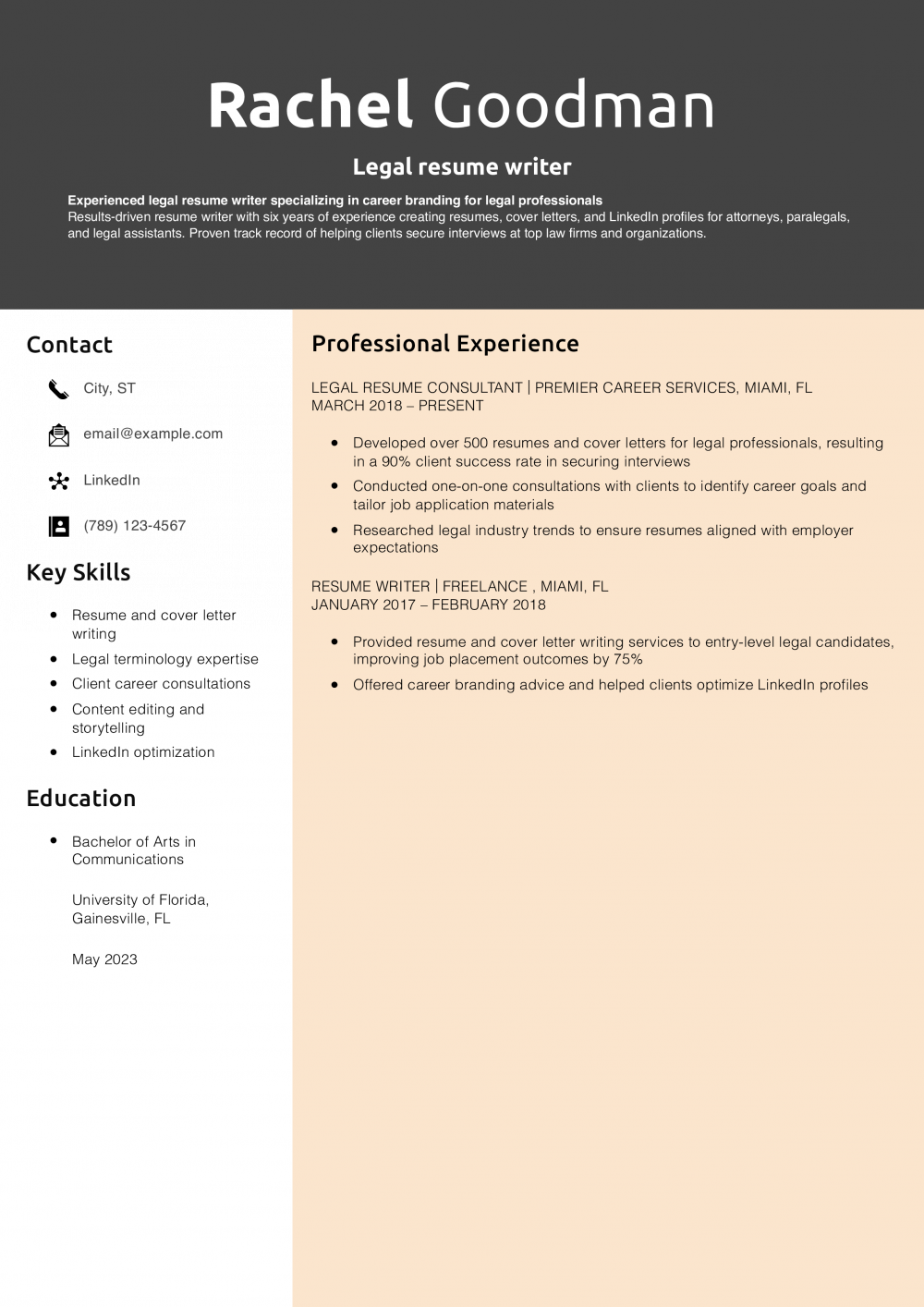
Customize this template in our builder in under 10 minutes.