20 Best Teacher Resume Examples and Templates for 2025



Search committees decide whether to keep reading by the top third of page one; if the terminal degree, field, and peer-reviewed output aren't visible by then, the CV gets sorted into the maybe pile and rarely comes back out.
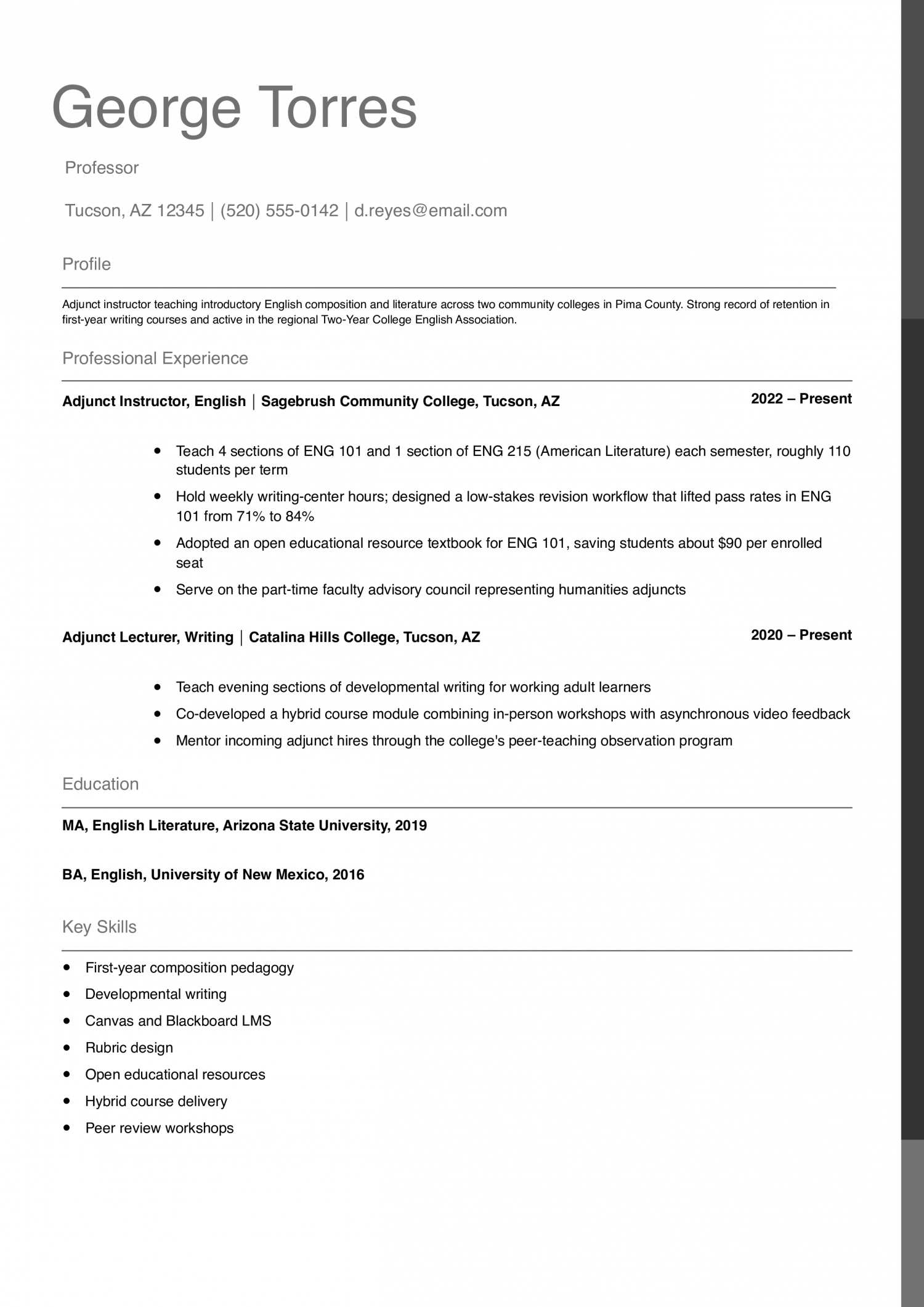
The adjunct profile teaches one to four sections per term across one or more campuses, often while finishing a doctorate or working in industry. This resume needs to prove course coverage, syllabus ownership, and consistent student evaluations.
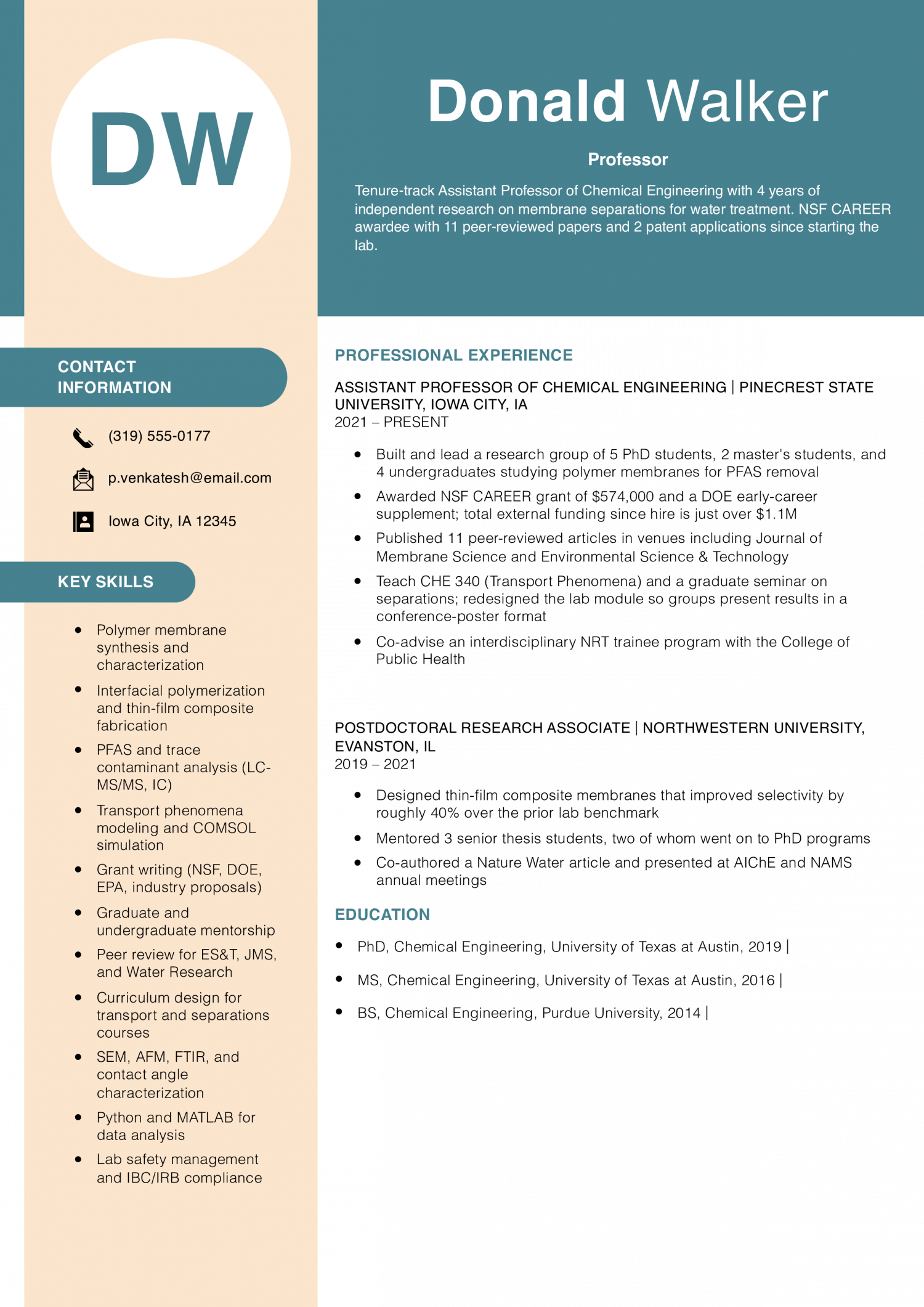
The assistant professor profile is tenure-track, three to six years past the PhD, with an emerging research agenda. This resume needs to prove peer-reviewed output, funded or pending grants, and graduate advising in the dossier-ready format committees expect.
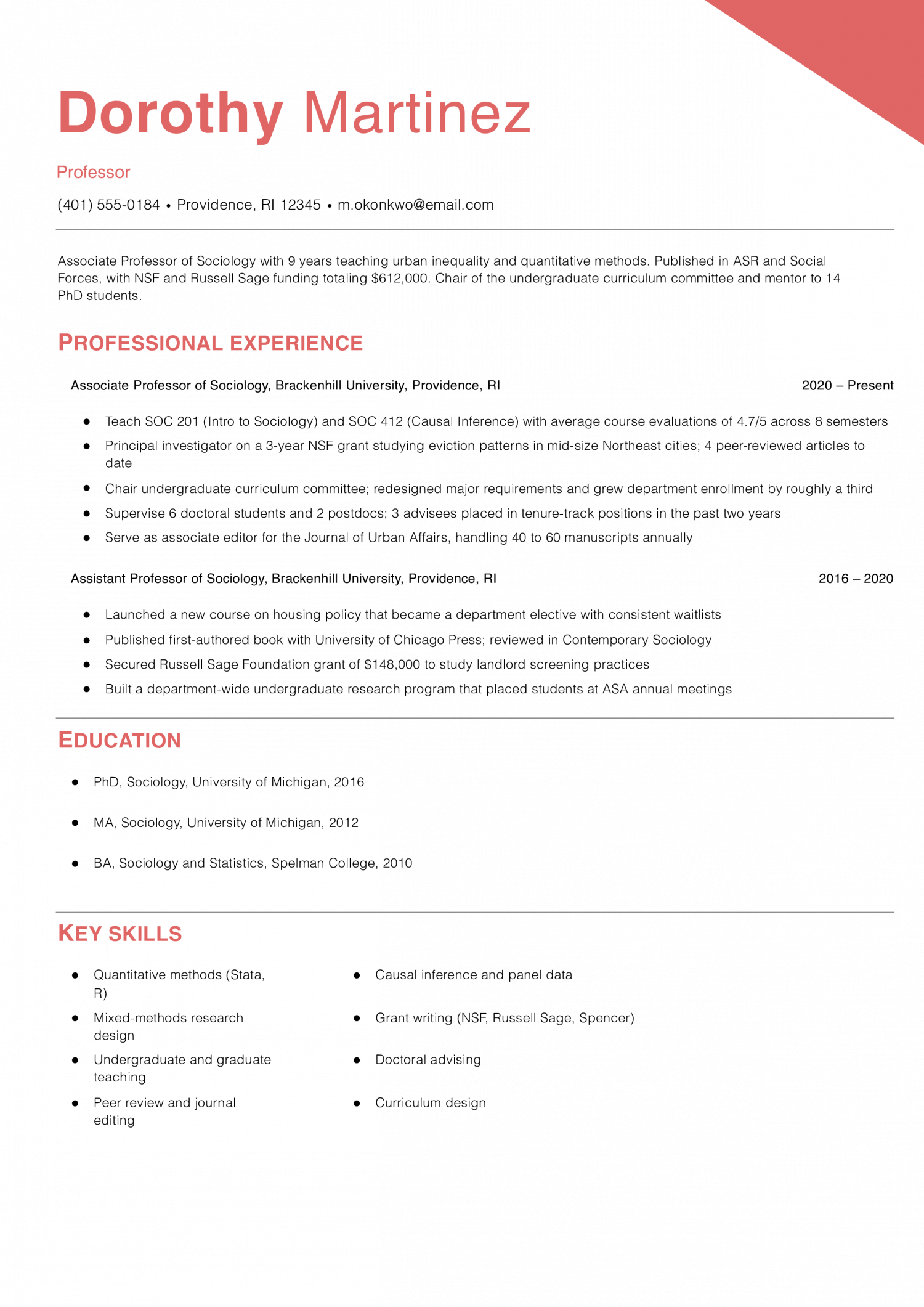
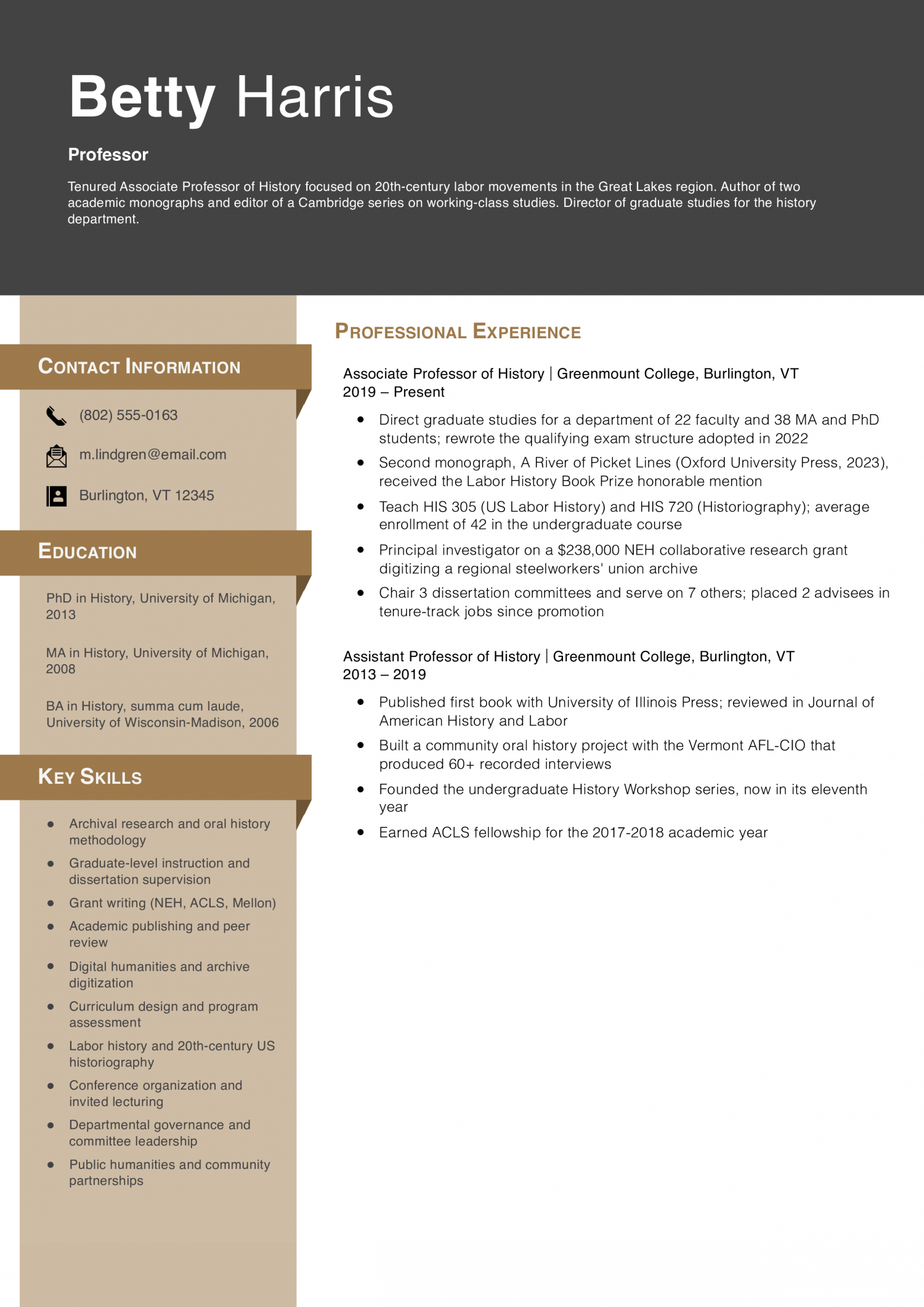
The associate professor profile has cleared tenure and runs a funded research line with national visibility. This resume needs to prove sustained publication, external grants, doctoral committee work, and editorial or society service that signals field leadership.
The full professor profile carries a senior chair, named lab, or program directorship with international reach. This resume needs to prove field-defining scholarship, large-grant PI history, doctoral mentees placed, and institutional leadership across hiring, curriculum, and accreditation.
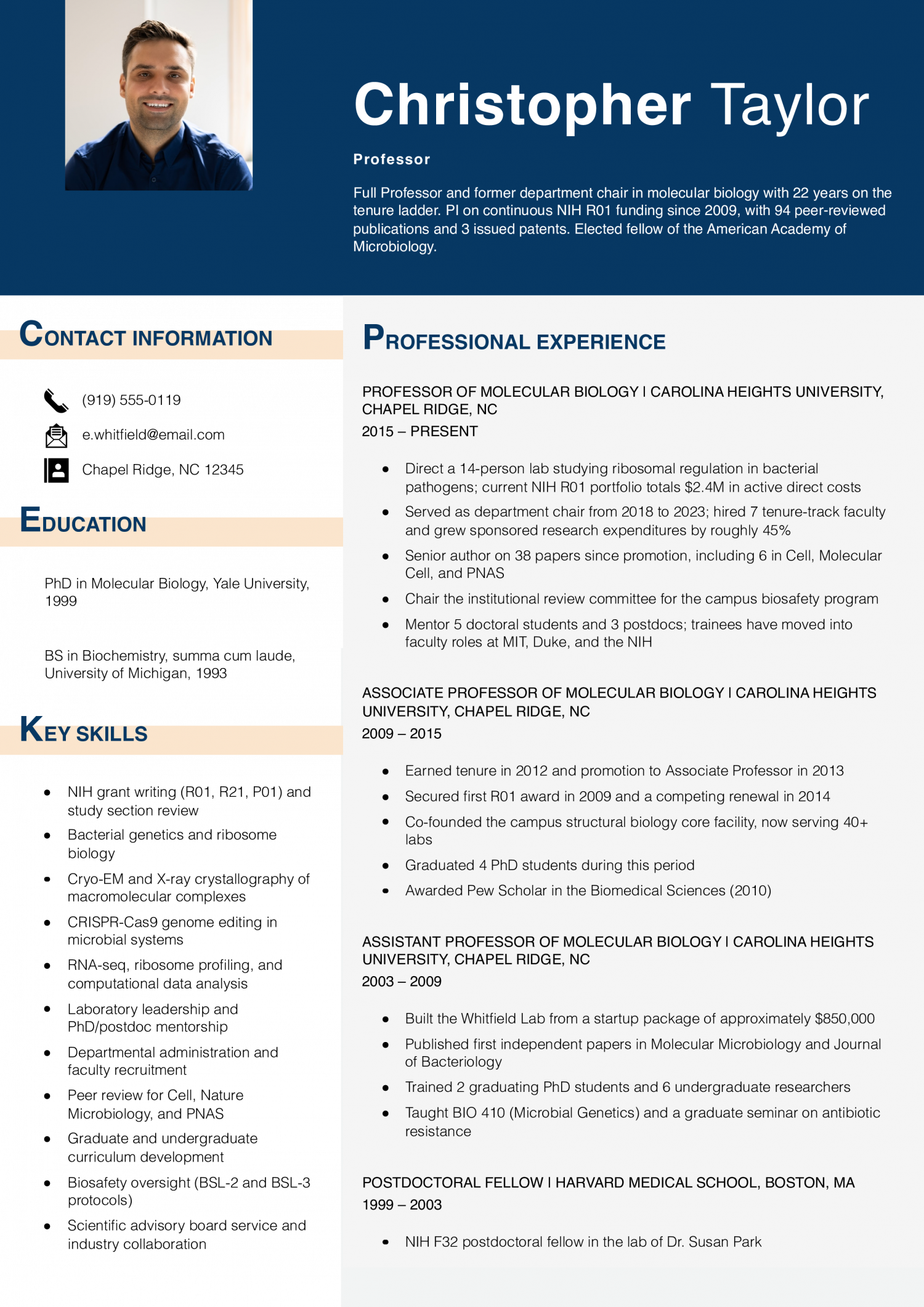
Full Professor of Economics and former associate dean for research at a public R1 institution. 18 years of teaching econometrics and labor economics, with 47 peer-reviewed publications, $3.2M in lifetime external funding, and editorial roles at two leading journals.
Your profile belongs at the top of page one. State your terminal degree, primary field and subfield, and the institution type you teach in.
Name the courses you regularly teach at undergraduate and graduate levels. Add your active research line in one phrase and your record at a glance, such as peer-reviewed articles, book chapters, or grant dollars secured.
Search committees read this block to confirm field fit before they reach your publication list. A vague summary about a love of teaching pushes the read off the page.
Move duties into evidence the committee can weigh. Name course enrollments, section counts per term, advising loads, and median student evaluation scores when they support you.
For scholarship, list peer-reviewed article counts, citation totals where strong, and grant amounts with funder names. A bullet that reads taught large lectures lands flat next to taught Intro to Sociology, three sections, 240 students per term.
Bullets without a number tend to read as a duty list. Strong faculty resumes pair a teaching, research, or service action with one concrete dimension.
Use the same buckets the dossier uses: teaching, scholarship, service, and grants. Inside teaching, list courses developed, courses taught, and any pedagogy work such as redesigned syllabi or program-level assessment.
Under scholarship, separate peer-reviewed articles, book chapters, edited volumes, and conference presentations. Under service, name department, university, and disciplinary society roles, including editorial boards and review work.
Grants get their own block with role (PI, co-PI), funder, award number context if relevant, and total awarded. This structure mirrors what tenure and promotion committees already read.
Your PhD or terminal degree, field, granting institution, and year sit at the top of the education block on page one. Add postdoc affiliations directly below.
Teaching credentials such as ACUE certification, CITI training for human-subjects research, and discipline-specific licensure for clinical or applied fields go in a short credentials block.
Name the tools you actually use: R, Python, Stata, NVivo, MATLAB, Qualtrics, REDCap, learning platforms like Canvas or Blackboard, and LLM tools you incorporate into course design. Search committees scan early pages for these before reading bullets.
Close with sections committees expect to find. List doctoral and masters students advised with placement outcomes, invited talks, and editorial or peer-review activity.
Add a selected presentations section if your conference record is substantial, and a press or public scholarship block if it supports your case. Languages, fieldwork sites, and lab equipment go in a short final block.
Keep the CV honest about length. Tenure-track and senior faculty CVs run long by design; adjunct and teaching-track resumes stay two to three pages.
The professor resumes that get callbacks share a specific skill mix. The lists below come from our user-built faculty resumes. Department chairs and search committees scan for these patterns first, not generic teaching-passion language.
Hard skills here name the courses, methods, and tools you actually use. Soft skills only register when a bullet underneath shows the behavior in action, with a course, committee, or grant attached. Match the lists against your target job posting and the department’s research clusters.
Treat soft skills as headers your bullets have to earn.
| Soft Skills | % of resumes with this skill |
|---|---|
| Communication | 67% |
| Student mentorship | 51% |
| Public speaking | 41% |
| Critical thinking | 39% |
| Time management | 26% |
And here are the top hard skills showing up most often.
| Hard Skills | % of resumes with this skill |
|---|---|
| Curriculum development | 68% |
| Research methodology | 64% |
| Academic publishing | 45% |
| Grant writing | 37% |
| Learning management systems | 27% |
Based on data from thousands of professors’ resumes built on ResumeTemplates.com, May 2026.
Before a professor resume gets a closer read, hiring teams check for a short list of essentials.
Search committees and HR portals tag professor resumes by discipline, rank, and teaching modality. Group the terms below by the sub-area that matches your target posting.
| Niche | Keywords ATS scans for |
|---|---|
| Rank and appointment type | adjunct professor, assistant professor, associate professor, visiting professor |
| Institution type | college professor, university professor, community college instructor, liberal arts faculty |
| Teaching modality | online professor, hybrid instruction, asynchronous teaching, distance learning faculty |
| Research and scholarship | principal investigator, peer-reviewed publications, external grants, doctoral advising |
| Service and leadership | department chair, program director, curriculum committee, accreditation review |
What search committees expect on a professor resume has shifted: silence on AI in teaching now reads as out of touch on most undergraduate-facing searches; an honest description of how you use LLMs in course design, assessment, and feedback reads as current pedagogy. The list below names what to add.
Faculty use ChatGPT and Claude to draft case prompts, rubric language, and scaffolded problem sets, then revise against learning outcomes.
Syllabi now spell out permitted AI use per assignment, and committees look for evidence that you wrote that policy.
Literature review, code drafting in R or Python, and figure captioning move faster when paired with human verification of every citation.
Some faculty use Khanmigo or course-embedded tutors to extend feedback between sessions while keeping grading human-only.
ChatGPT: Drafting assignment prompts, rubric language, and discussion questions; never used for grading student work.
MagicSchool AI: Generating differentiated readings, scaffolded problem variants, and accessibility-focused course materials with human review.
A terminal degree in field and current CITI human-subjects training keep you eligible. The certifications below are what move a professor resume from the qualified-but-typical stack into a search committee shortlist. List the issuing body, completion year, and renewal date next to each.
ACUE Certificate in Effective College Instruction: Signals formal pedagogy training beyond the dissertation, valued at teaching-intensive institutions and community colleges.
CITI Program Human Subjects Research: Required for IRB-approved studies; list the modules and renewal date so research-active departments see compliance at a glance.
Quality Matters (QM) Online Course Design: Carries weight for online and hybrid teaching loads, and for course redesign work at institutions expanding distance programs.
Discipline-specific licensure or board certification: For clinical, counseling, accounting, engineering, and nursing faculty, list active state license status and continuing education hours required by the board.
The 90th-percentile professor out-earns the median by a wide band, which tells you the academic market rewards funded research, discipline, and institution type more than years in rank. Medical, law, business, and engineering faculty sit at the top; humanities and community-college faculty sit closer to the median.
Lead the resume with the discipline, grant record, and institution type the high-percentile band hires for, not years of teaching alone.
| # | State | Avg. Annual |
|---|---|---|
| 1 | Hawaii | $135,380 |
| 2 | Nebraska | $134,170 |
| 3 | California | $104,310 |
| 4 | Missouri | $102,810 |
| 5 | New Jersey | $99,790 |
| 6 | New York | $98,220 |
| 7 | Massachusetts | $96,410 |
| 8 | Idaho | $84,750 |
| 9 | Virginia | $83,600 |
| 10 | Minnesota | $82,300 |
| # | State | Workers | Median |
|---|---|---|---|
| 1 | California | 48,460 | $104,310 |
| 2 | Florida | 9,210 | $64,250 |
| 3 | Louisiana | 7,020 | $79,190 |
| 4 | Ohio | 6,710 | $56,210 |
| 5 | Georgia | 5,930 | $62,310 |
Resume Templates offers HR approved resume templates to help you create a professional resume in minutes. Choose from several template options and even pre-populate a resume from your profile.
List adjunct work the same way you list any teaching appointment. Include the title, institution, department, and dates.
Add the courses you taught as instructor of record, section count per term, and total student enrollment. Name multiple campuses if you taught across them in the same term.
Adjunct titles do not weaken a resume when the teaching evidence underneath is concrete and quantified.
Yes, name the principal investigator when you list the research position. The PI's name signals lab affiliation and is searchable in your field.
Format the entry as Research Assistant, Smith Lab, Department of Psychology, followed by bullets on methods you ran and any co-authored output.
Do not list the professor as a reference inside the resume body. References belong on a separate sheet provided when requested.
Email the professor with a specific ask, not a vague review request. Attach the resume and name the position type you are targeting.
Ask for feedback on one or two areas, such as research framing or publication formatting. Give at least two weeks of lead time.
Faculty who write your letters expect to see a recent CV. Make the ask part of an ongoing exchange, not a one-off.
A faculty CV is comprehensive. Every publication, presentation, grant, course, and service role goes on it, and length grows with career stage.
A professor resume is a shorter, targeted document for non-academic, administrative, or teaching-only roles. It stays two to three pages and leads with work that maps to the posting.
Tenure-track and research-faculty searches expect the full CV. Industry, government, and policy roles expect the resume.
For a professor, a professional template is the safest pick, because it signals the polish hiring managers in this field expect. An ATS-friendly template is a solid alternative. Whichever you choose, keep the formatting clean and easy to parse: clear section headings, a standard font, and no graphics a parser can choke on.
Executive Resume Writer and Career Coach
Andrew Stoner is an executive career coach and resume writer with 17 years of experience as a hiring manager and operations leader at two Fortune 500 Financial Services companies, and as the career services director at two major university business schools.
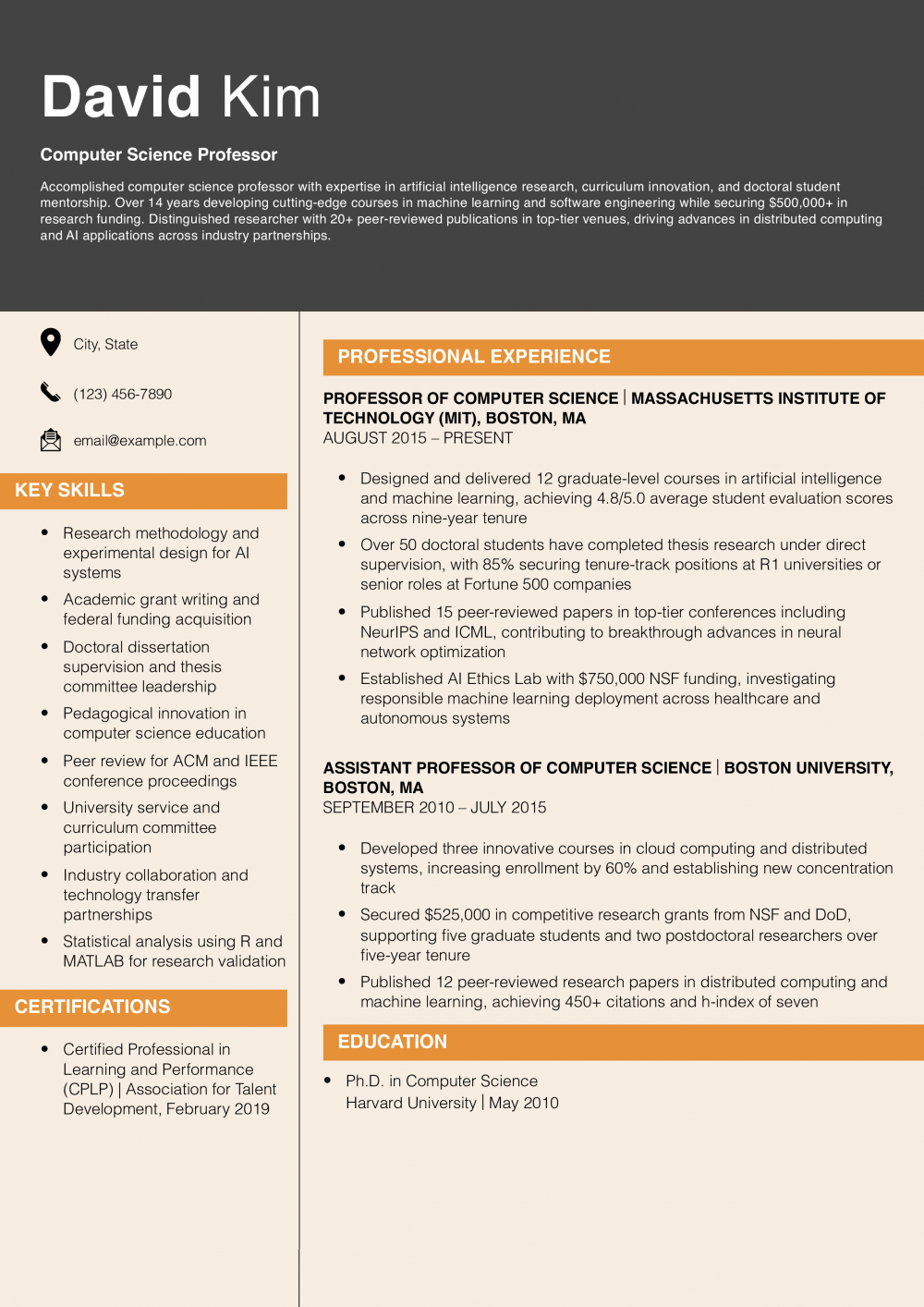
Customize this template in our builder in under 10 minutes.