College Resume Examples
Your profile should sit at the top of page one. Name your school, your major or intended major, and your expected graduation month and year. Add your GPA if it is 3.3 or higher. State…
Early-career recruiters decide whether to keep reading by the top third of page one; if a degree, graduation date, and one concrete project or internship aren't clear by then, the resume moves to the reject pile.
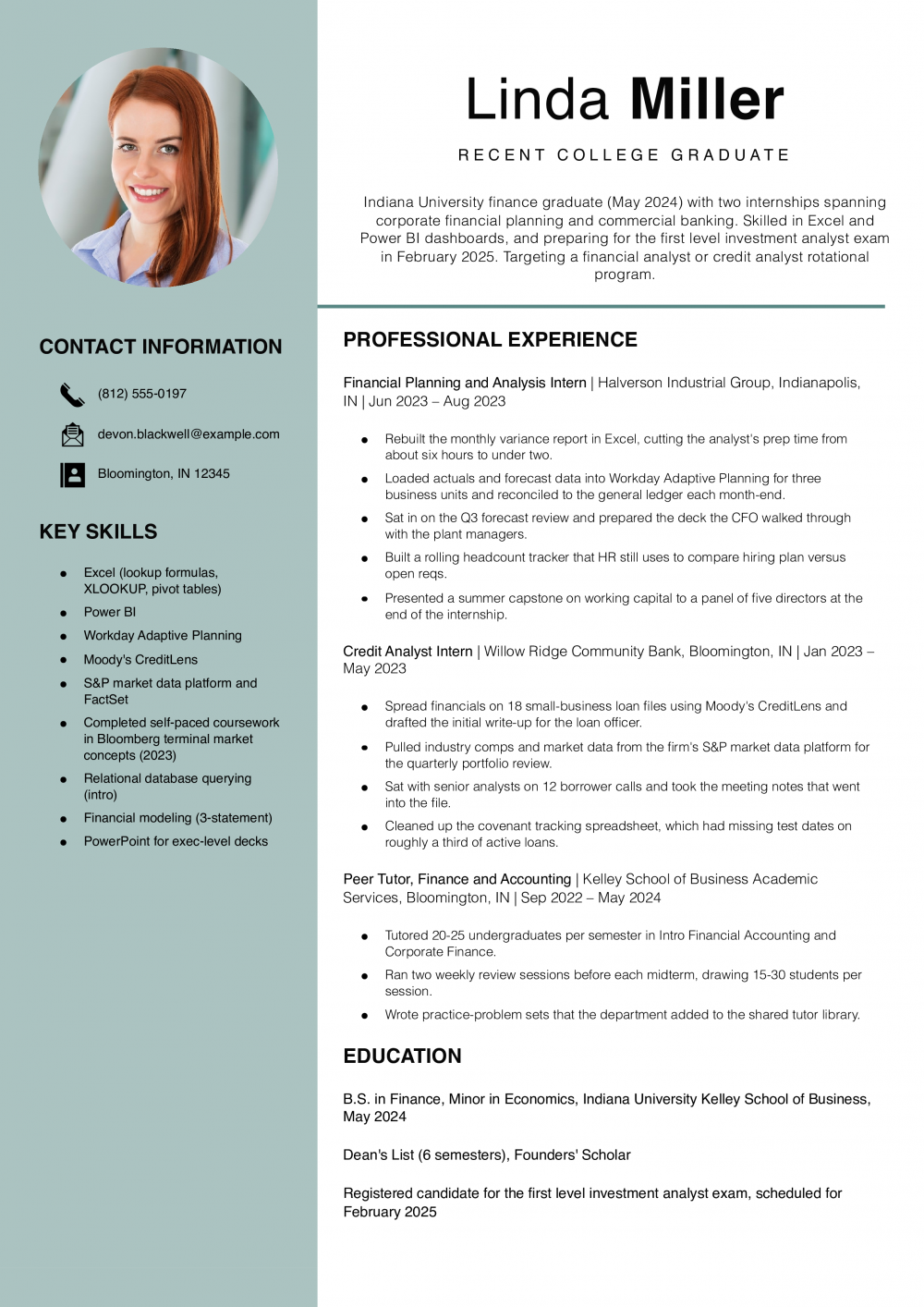
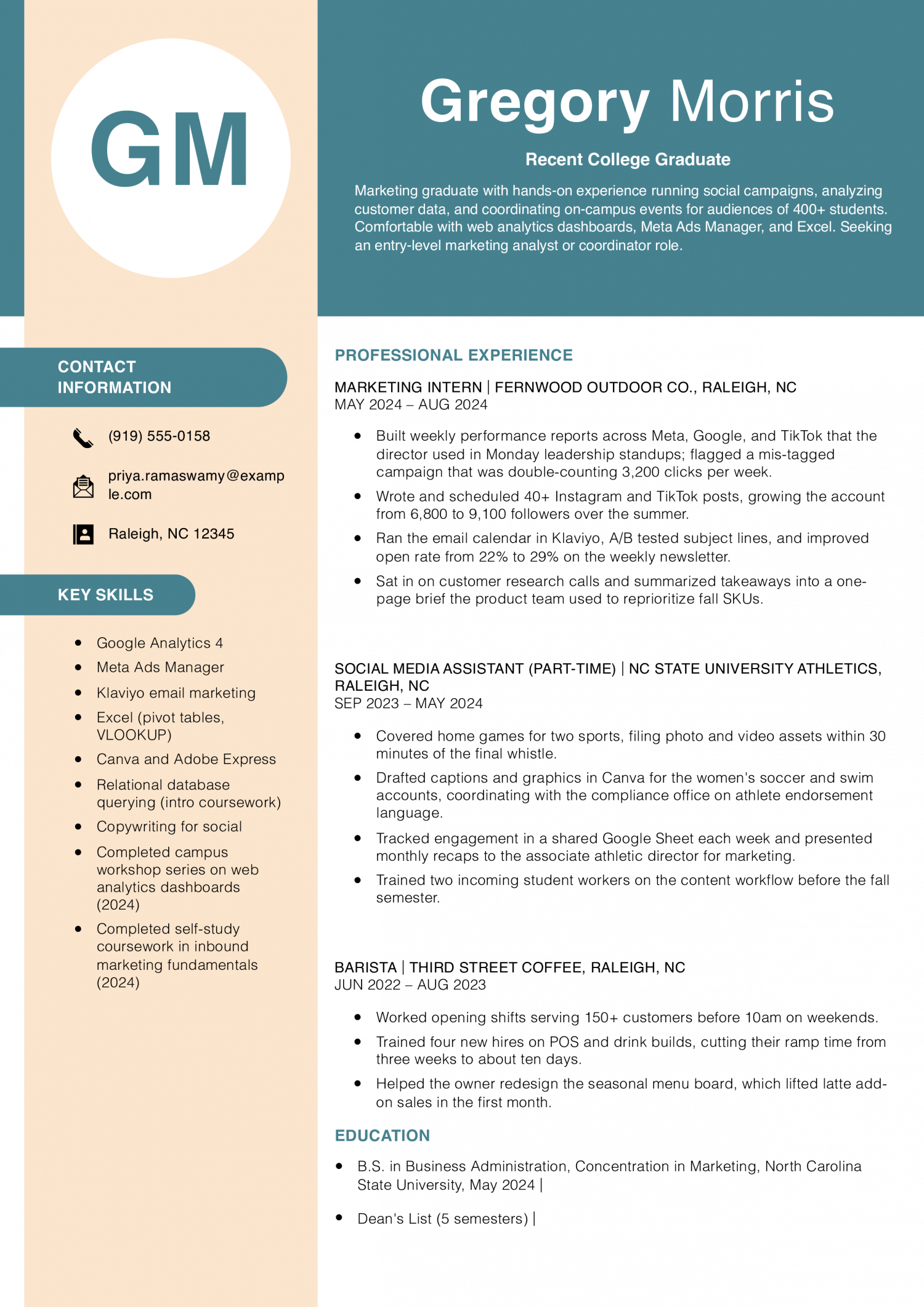
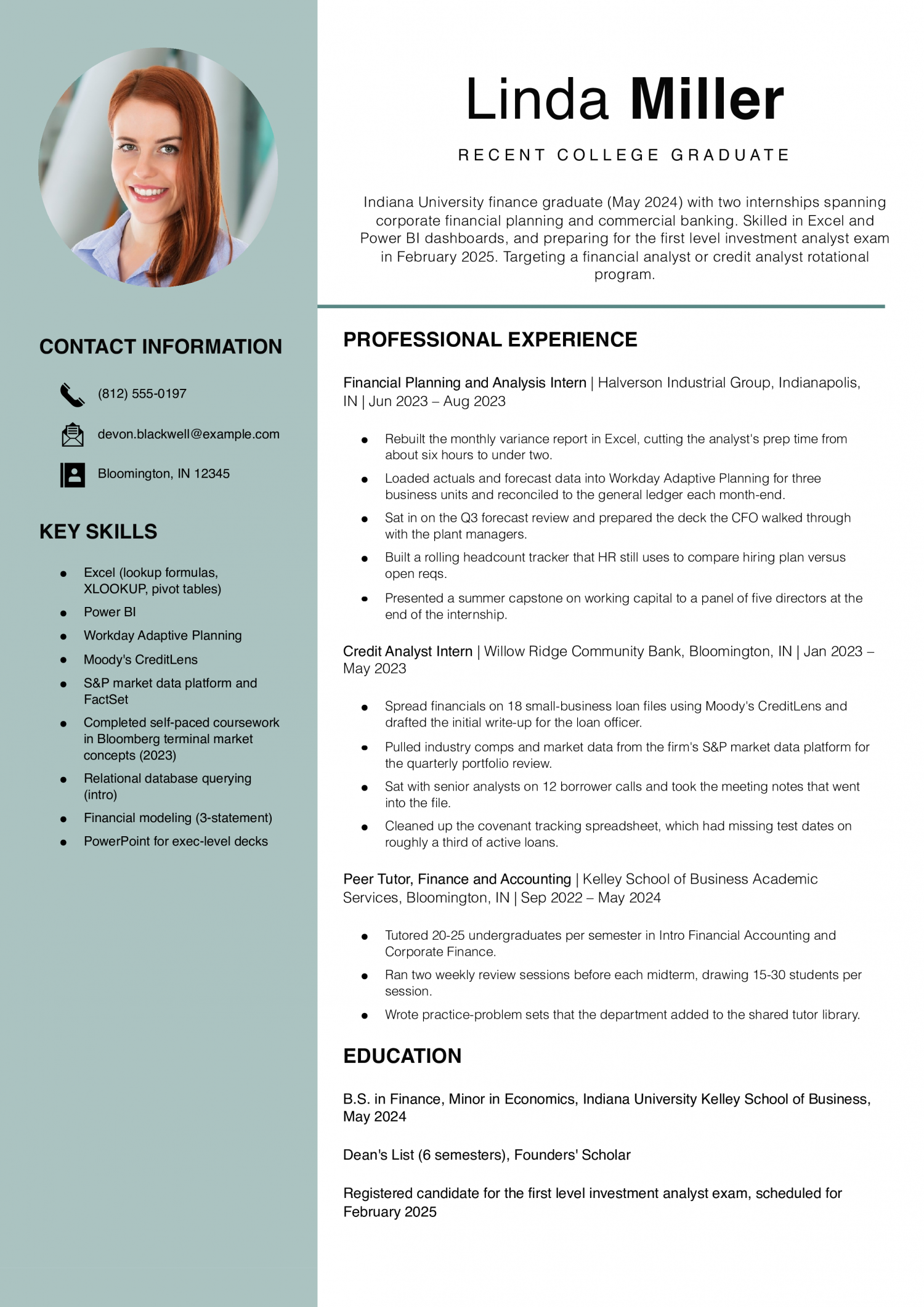
You are a recent graduate with little paid work history. Early-career recruiters want proof of your degree, class projects, and internships that show you can learn fast and contribute early.
May 2024 computer science graduate from Arizona State with a software engineering internship at a Series B startup and two years of part-time work as an undergraduate research assistant. Comfortable in Python, JavaScript, and relational database querying; targeting entry-level software engineer and data engineer roles.
The first line of your summary should carry a number, not a wish. Early-career recruiters and entry-level hiring managers scan for scale before they read intent. Lead with the size of a project you shipped or the scope of a role you held.
You can also open with the credit hours you carried while working part time. A strong first line reads like: honors graduate in finance who staffed a 40-hour internship each week. That gives the reader something to weigh in the first four seconds.
Save the objective language for later. A number up top signals that the rest of the resume will be specific too.
Bullets without a number tend to read as duties, and duties read as filler on a new-graduate resume. Push each bullet to name a figure the reader can picture. For an internship, name the team size you supported, the number of clients or files you touched, and the hours per week you worked.
For campus jobs, name the shift volume, the register total, or the event headcount. For coursework, name the length of the capstone and the size of the group. Two or three real numbers per role beat a paragraph of adjectives.
If a project has no clean metric, describe scope in plain terms: a semester long study of 30 survey responses.
Sort what you have done into three buckets so the page reads in one pass. The first bucket is academic work: your degree and one or two projects tied to the job. The second bucket is applied experience: internships, co-ops, research assistant roles, and freelance work.
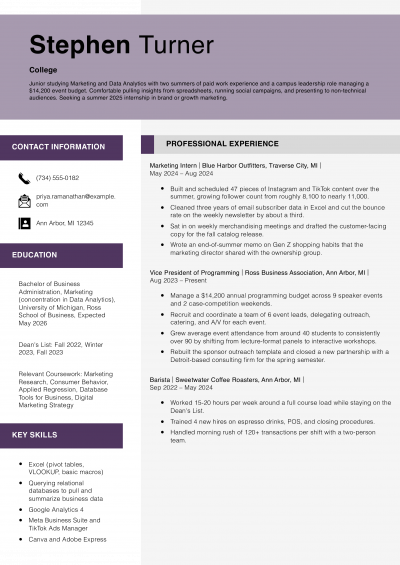
The third bucket is paid work and campus leadership: retail shifts, food service, tutoring, resident advisor roles, and club officer roles. Each bucket should carry bullets in the same voice. Lead with an action verb, name what you did, and close with a number or a named output.
This structure gives the reader a map. It also lets you show range without repeating yourself.
Put a short skills and tools block near the top of page one, under the summary. List the software you used in class and at work, or the tools named in the posting. Add languages if you speak them at a working level.
If you hold a certificate from a course provider or a school program, name it and the year. Early-career recruiters and entry-level hiring managers use this block as a filter before they read your bullets. Keep the list to items you can defend in an interview.
A tool you touched once does not belong there. Save deeper coursework for the education section further down the page.
End the resume with a full education block and one closing section that adds proof. The education block should carry your school, your degree, and your graduation month and year. Add honors, a minor, and a study abroad term if you have them.
Below that, pick one closing section that fits the role. Options include relevant coursework, senior project, publications, leadership, volunteer work, or awards. Six lines is enough.
A new graduate does not need a hobbies line or a references line. Cut anything from high school unless you are applying within a year of starting college. The last inch of the page should still be earning its space.
Five years ago, a recent college graduate resume read like a course catalog and a list of campus clubs. The mix has shifted toward tools you used and measurable output from internships or class projects. Employers now scan for named software and quantified results before they read your major.
Early-career recruiters and entry-level hiring managers weight hard skills first, since those match the keywords in the job description. Soft skills carry weight only when a bullet proves them with a project, a role, or a number. A line reading Excel or data analysis means little without the file, the team, and the result behind it.
Treat the two tables below as a checklist against the posting you plan to apply for. Copy any term that matches your real experience, then rewrite a bullet to prove it. Drop items you cannot back with a class, internship, part-time job, or volunteer role.
Save one master resume with every honest skill listed, then trim per posting.
| Soft Skills | AI-estimated % |
|---|---|
| Communication | 68% |
| Teamwork | 54% |
| Problem-solving | 44% |
| Adaptability | 40% |
| Time Management | 26% |
And here are the top hard skills showing up most often.
| Hard Skills | AI-estimated % |
|---|---|
| Microsoft Office | 67% |
| Data Analysis | 59% |
| Project Management | 44% |
| Python Programming | 39% |
| Adobe Creative Suite | 33% |
Skill names and rankings come from an AI model grounded in U.S. Department of Labor occupation data for recent college graduates, not from a count of recent college graduates’ resumes built on ResumeTemplates.com.
Resume Templates offers HR approved resume templates to help you create a professional resume in minutes. Choose from several template options and even pre-populate a resume from your profile.
Lead with a short summary, then education, then experience grouped into internships, projects, and campus roles.
Keep it to one page and put your degree, school, and graduation month near the top. Early-career recruiters scan for a real major and a real graduation date before anything else.
Yes, write a two or three line summary that names your degree, your field, and the type of role you want.
Skip the objective statement, which reads as generic and takes space you need for proof. A summary works when it points at a specific job posting, not at every job you might take.
Put internships, class projects with real deliverables, campus jobs, and volunteer roles that ran on a schedule.
Treat each one as a job entry with a title, a date range, and two or three bullets of what you did. Early-career recruiters know your first job will be your first job, so they read for evidence you showed up and finished things.
List honors that a reader outside your school can recognize, such as Dean's List, departmental honors, or a named scholarship.
Put them under your degree in one line, not as a separate section. Skip awards from high school and skip anything you have to explain in a second sentence.
Put numbers on the work you did in school: audience size for an event, hours per week at a campus job, or users on a class project.
A resume with two real figures reads as more credible than one with ten polished bullets and none. Name the tools you actually used by name, so an early-career recruiter can match you to the posting.
One page, every time. You do not yet have the volume of paid work that earns a second page, and stretching to fill one reads as padding.
Cut the high school section, cut generic soft skills, and cut coursework that does not connect to the posting.
List coursework when it maps to the job posting and names a skill the recruiter is scanning for.
Pick four or five courses and put them under your degree as a single line, not as a long block. Drop the course numbers, since a hiring manager outside your school cannot read them.
An ATS-friendly template suits a recent graduate resume well, putting your degree and internship history right where a hiring manager starts reading. A basic template is a solid alternative. Whichever you choose, keep the formatting clean and easy to parse: clear section headings, a standard font, and no graphics a parser can choke on.