Office Manager Resume Examples and Templates for 2026

Your profile should state your years in the seat, the headcount you support, and the office type you have run. Name the setting in the same words a posting would use: law firm, dental practice,…
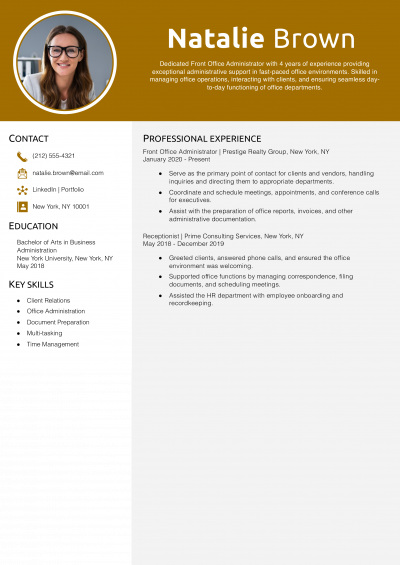
Every resume example is written and reviewed by our team of Certified Professional Resume Writers to ensure top-quality content and formatting.
The office coordinator role has shifted from front-desk gatekeeper to hybrid-office hub. You now run vendor logistics, expense workflows in tools like Concur, and calendar traffic across Outlook or Google Workspace. A strong resume shows that range in specific verbs, not soft traits.
Office managers and operations directors screen for proof you can own a process end to end. Lead with the systems you run, the events you staff, and the budgets you track.
Name the tools by brand, and tie each bullet to a scope figure like headcount or square footage. The examples below show how to frame that work at coordinator, senior, and lead levels.
Office managers and operations directors look for calendar ownership, vendor coordination, and headcount supported on the first page of an Office Coordinator resume, because it shows whether the workload of a full site can rest on one desk.
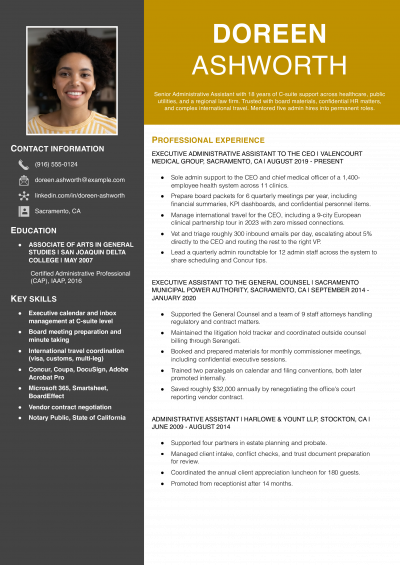
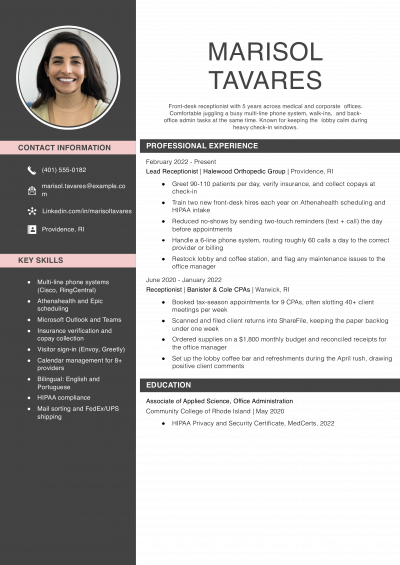
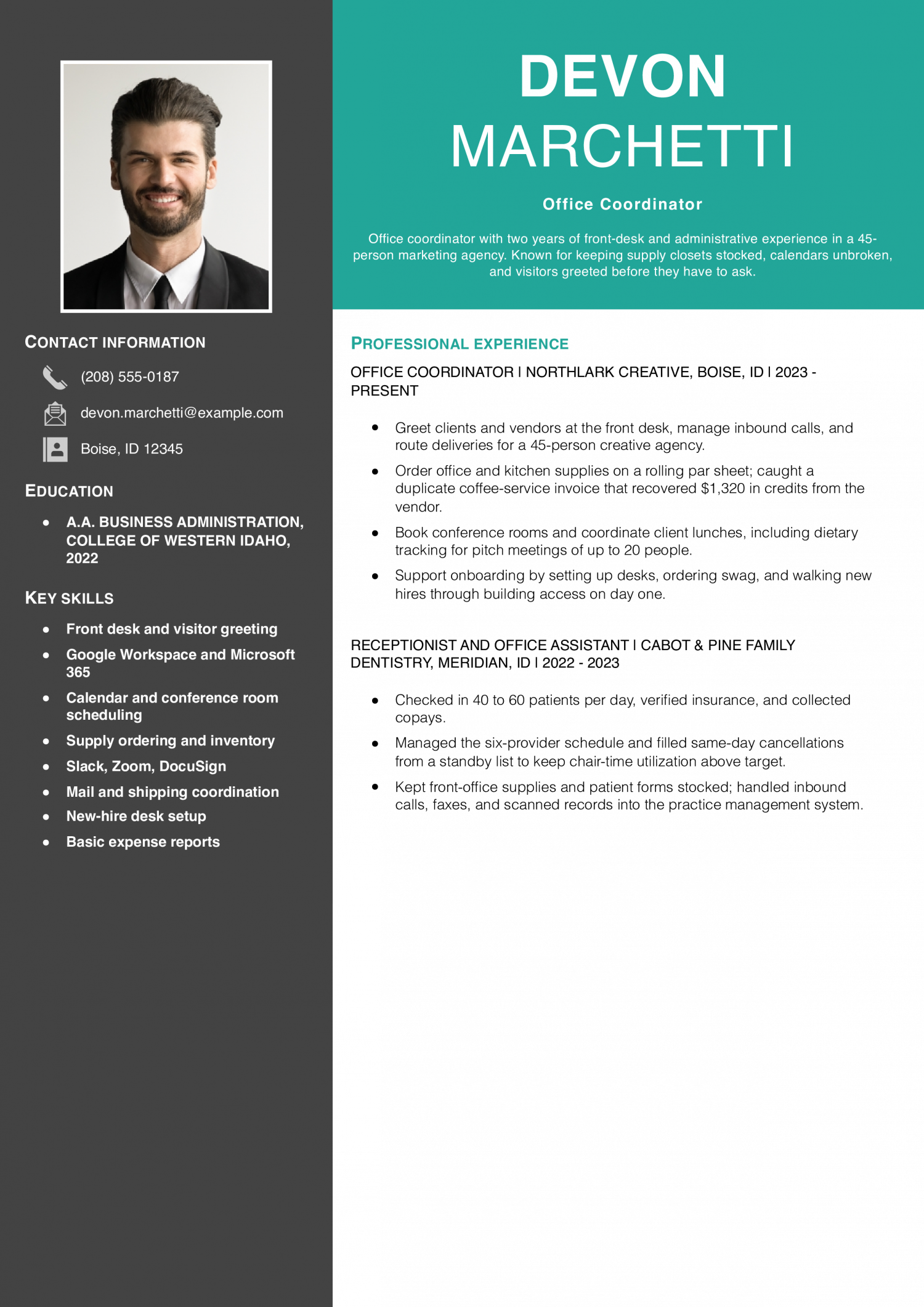
This resume fits someone new to the role who runs front-desk flow, supply orders, and calendar support for a small team. Show that you keep the office running without daily direction from office managers and operations directors.
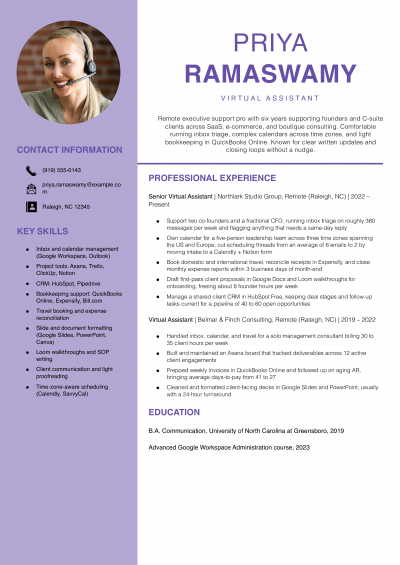
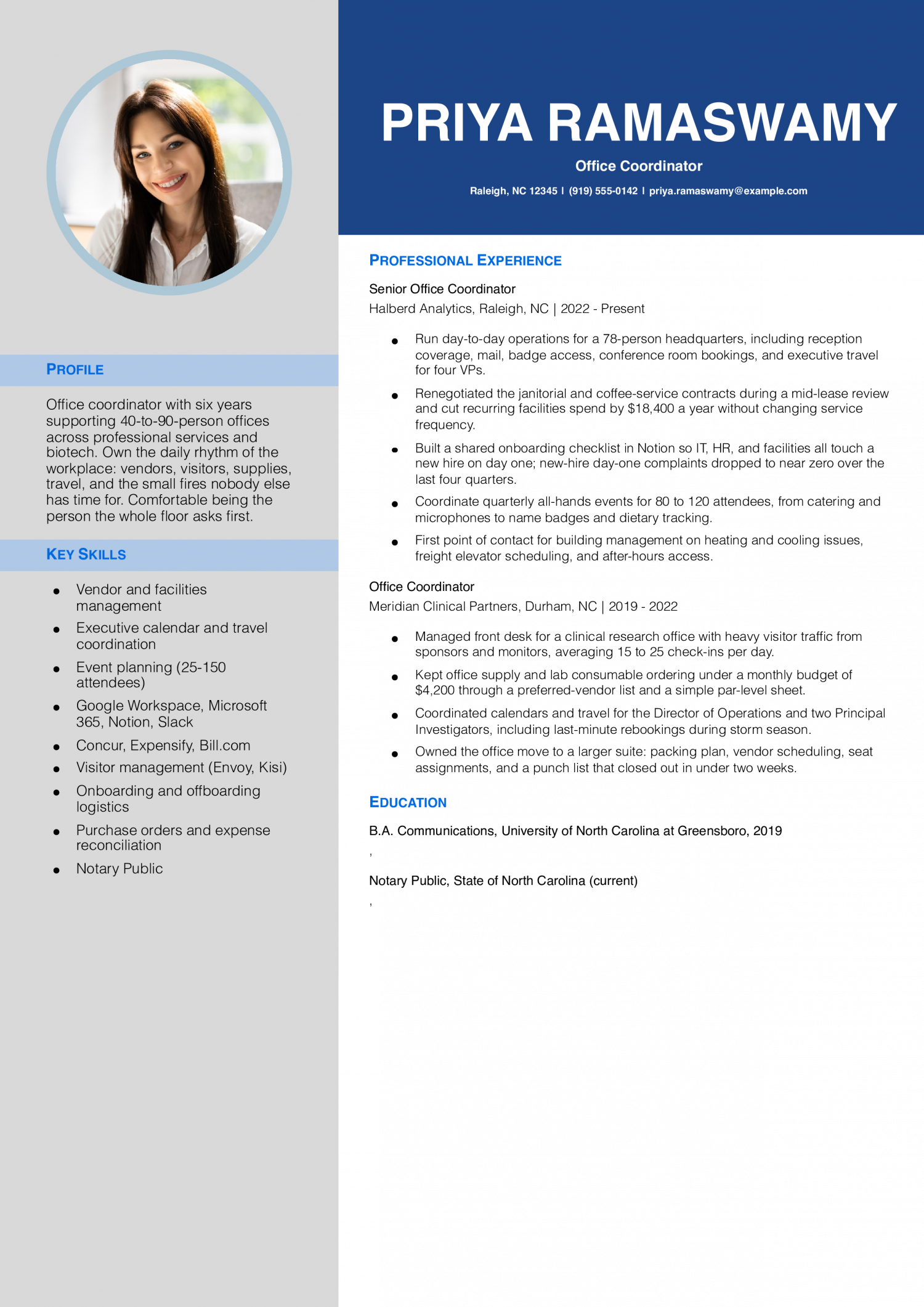
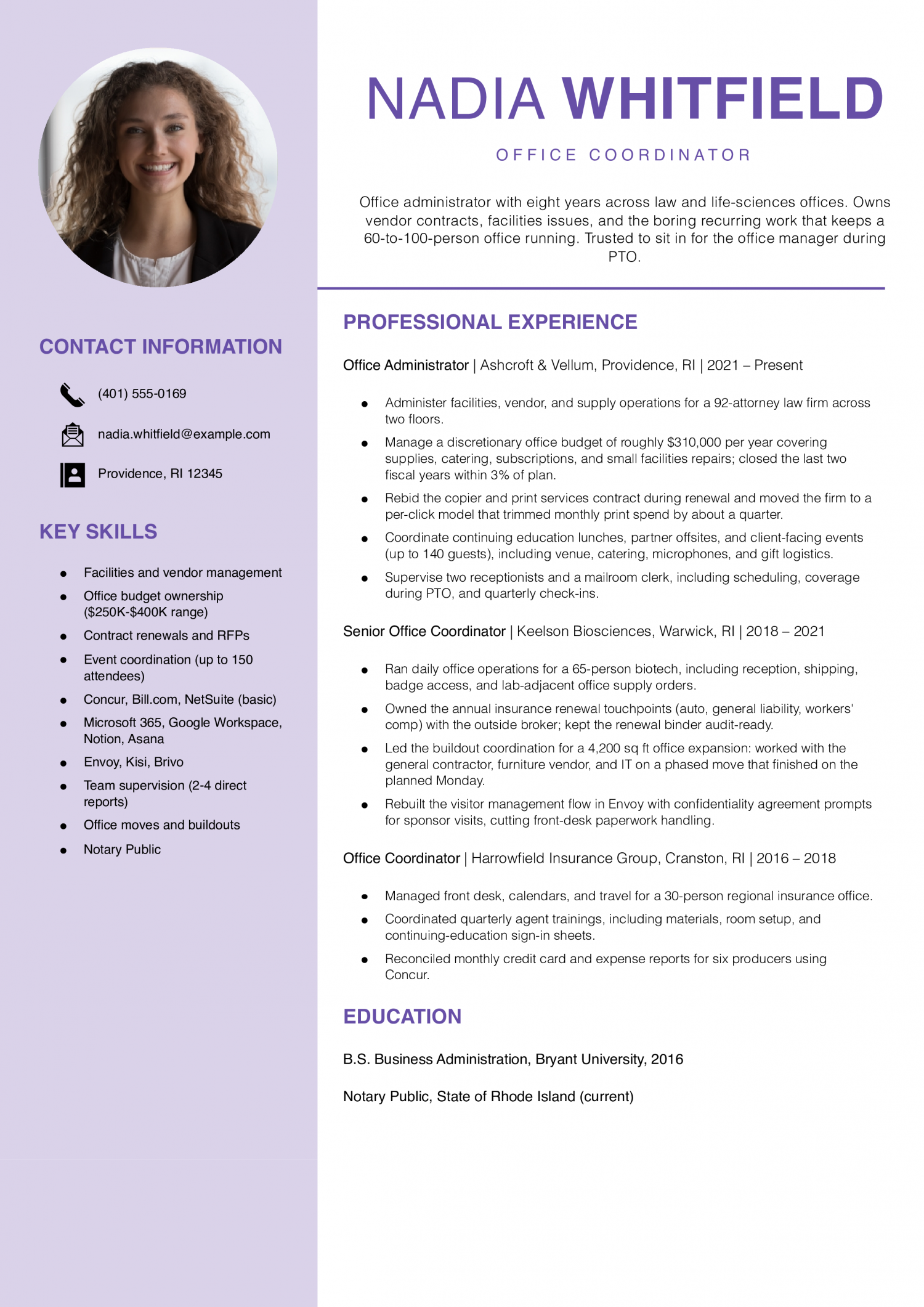
This resume fits a coordinator who owns vendor contracts, onboarding, and office budgets across one or more sites. Prove to hiring leads that you set the process rather than follow one written for you.
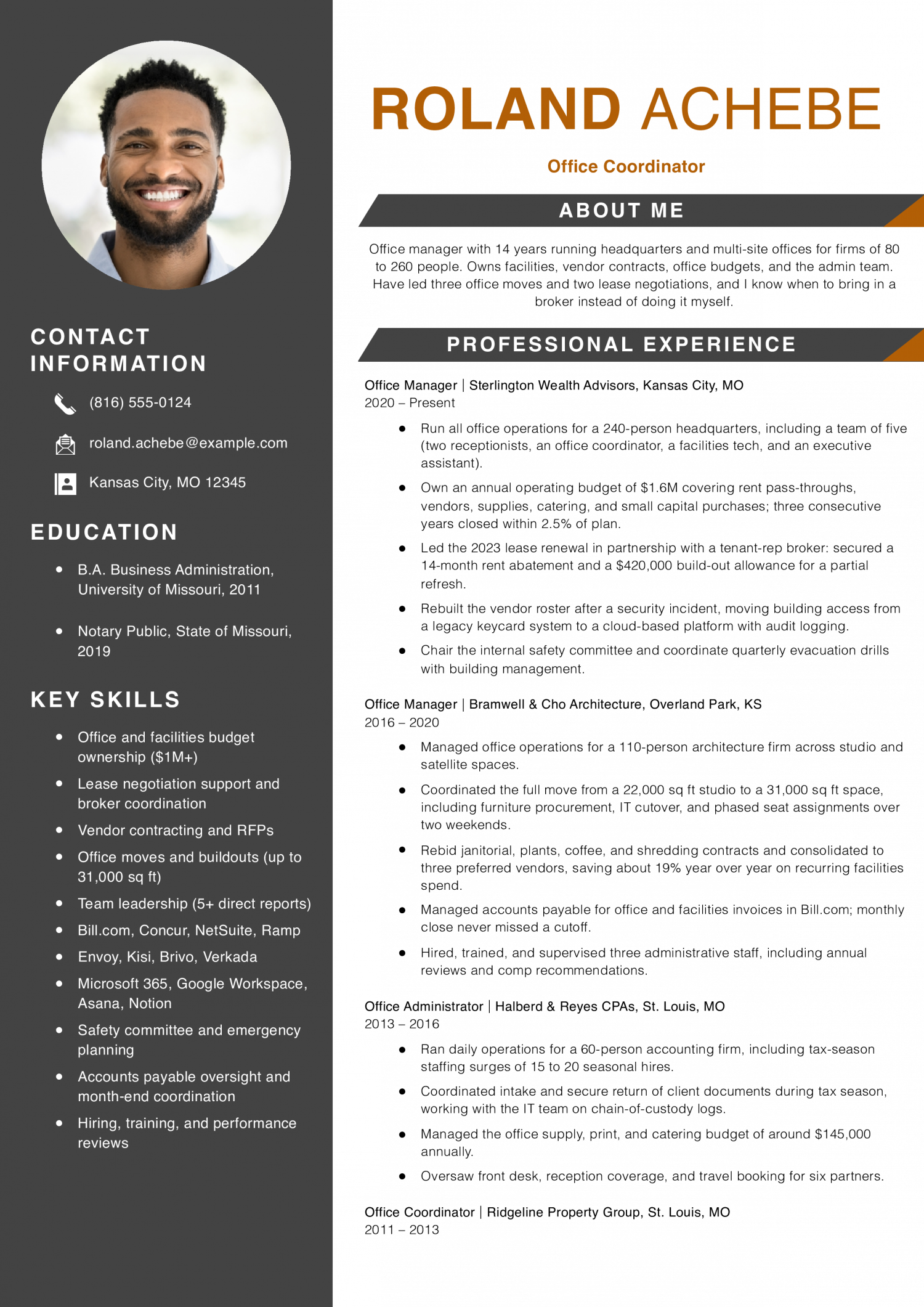
This resume fits a full office manager who leads staff, controls facility spend, and reports to directors on space and safety. Show scope of budget, headcount, and the systems you put in place.
Margaret Solheim
Minneapolis, MN | (612) 555-0198 | [email protected] | linkedin.com/in/margaret-solheim
Office coordinator turned office manager with 11 years running the daily operations of professional-services and tech offices sized 50 to 180 people. Own vendors, facilities, budgets, and the admin team. Comfortable being the person who negotiates the copier lease and also plans the holiday party.
Office Manager
Larkspur & Vane Consulting | Minneapolis, MN | 2022-Present
Office Administrator
Kestrel Health Analytics | St. Paul, MN | 2019-2022
Senior Office Coordinator
Thornbrook Legal Group | Bloomington, MN | 2016-2019
Office Coordinator
Merrick & Halston Insurance | Edina, MN | 2014-2016
Receptionist
Willow Creek Family Medicine | Eden Prairie, MN | 2013-2014
Your summary should lead with a number that shows the office’s scale. Name the headcount you support, the number of sites you coordinate, or the vendor accounts you manage. Office managers and operations directors read that first line to gauge whether you can hold their office together.
A line like “coordinator supporting a 60-person office across two floors” works far better than “detail-oriented professional.” Add the systems you run daily, such as Outlook, Concur, or a ticketing tool. Close the summary with one operational win, like a supply spend cut or an onboarding turnaround time. Three short lines.
That is the whole summary, and it sets the tone for every bullet under it.
A bullet with no number attached reads as a duty, not a result. A strong bullet names the volume, the frequency, and the outcome in plain terms. Say you booked 40 travel itineraries a month, or processed 120 expense reports a quarter.
Name the headcount you onboarded, the meeting rooms you managed, or the invoices you coded weekly. If a metric is fuzzy, use scope words like “office-wide” or “across three departments” instead. Most strong resumes pair one volume metric with one outcome metric per bullet.
For example: reconciled 200 monthly invoices with a 98 percent match rate. Recruiters scan for those pairings first. Two clean numbers per bullet tend to advance further than five vague verbs.
Cluster your bullets so the reader can scan the shape of your day. Four categories tend to cover the role well. First, front-of-house and visitor flow: reception, badging, and mail.
Second, calendar and travel: executive scheduling, booking, and itinerary building. Third, vendor and facilities: janitorial contracts, supply ordering, and building tickets. Fourth, finance and records: expense reports, invoice coding, and purchase orders.
Under each cluster, lead with the highest-volume task and the tool you used. Mixing all of this into one long list buries your best work. A grouped layout also mirrors how office managers and operations directors write their own job descriptions, which makes the match obvious at a glance. If records and data entry make up most of your work, see our office clerk resume examples for ways to present that work.
Put a short skills block in the top third of page one. List the systems you use daily, such as Microsoft 365, Google Workspace, Concur, SAP Concur, NetSuite, Slack, Zoom, and Asana. Add any building systems like Envoy or Kastle if you have run them.
If you hold a notary commission, add it here with the state and expiration year. Office managers and operations directors scan this block first to confirm you can start without a long ramp. Any office administration credential belongs in a short certifications line under skills.
Keep license numbers off the resume. State plus “in good standing” is the standard, and it protects you from posting identifying data online.
End the resume with a tight education block and one short extras line. List your highest degree or diploma, the school, and the year if it is within the last ten years. Older grads can drop the year.
If you took coursework in accounting, HR, or business writing, name two courses under the degree. Add a one-line “additional” section for languages, volunteer coordination, or event planning work. Skip hobbies that do not signal office skills.
Keep the resume to one page for under seven years of experience, and two pages beyond that. Save the file as FirstName-LastName-Office-Coordinator.pdf. That naming makes the file easy to find in an applicant tracking system inbox.
Five years ago, an Office Coordinator resume read like a duties list under each employer. The mix has shifted toward tools, systems and cross-team coordination the reader can verify. Vendor management and calendar systems now appear beside the older lines about greeting guests and sorting mail.
Office managers and operations directors read the hard skills first to confirm you can run the software they already own. They read the soft skills to see who keeps the office calm when three requests land at once. Communication and problem solving mean little on their own, so pair each one with a bullet that proves it.
Open the target job posting and mark every tool, system and duty the ad names by hand. Mirror that exact wording in your skills section when the skill is one you have used. Move any skill the ad stresses into your top five so the scan catches it early.
Treat the soft skills as headers for the stories your work history already tells.
| Soft Skills | AI-estimated % |
|---|---|
| Visitor relations | 79% |
| Organized multitasking | 55% |
| Cross-team communication | 48% |
| Detail orientation | 35% |
| Calm under pressure | 30% |
And here are the top hard skills showing up most often.
| Hard Skills | AI-estimated % |
|---|---|
| Appointment scheduling | 65% |
| Database management | 63% |
| Records filing systems | 49% |
| Office correspondence coordination | 38% |
| Multi-line phone handling | 29% |
Skill names and rankings come from an AI model grounded in U.S. Department of Labor occupation data for office coordinators, not from a count of office coordinators’ resumes built on ResumeTemplates.com.
These are the must-haves hiring teams look for when scanning an office coordinator resume.
What office managers and operations directors expect on an Office Coordinator resume has shifted. A line that lists only Microsoft Office and calendar tools now reads as thin. A short workflow note that names an AI assistant and the human check reads as current. Say which tasks the tool drafts, and say who signs off before it leaves the office. Meeting notes, first-draft policies, and vendor emails are the usual places. Keep the framing honest and the review step visible. The rundown below sorts what belongs on the page from what should stay off it.
Coordinators run AI transcription on internal meetings, then edit action items before sending to the team.
First drafts of vendor and tenant replies come from an AI assistant, with your review before send.
Office policies and desk manuals start as AI outlines that you fact-check against current company practice.
AI helpers sort inbox requests and propose meeting times, and you confirm the final calendar holds.
The Bureau of Labor Statistics does not publish a wage code for Office Coordinator specifically. BLS has no separate wage code for Office Coordinator. The nearest published stand-in is Secretaries and Administrative Assistants, Except Legal, Medical, and Executive (SOC 43-6014); treat the figures below as a directional estimate, not a precise figure for this exact title.
For Office Coordinators, the 10th-percentile floor sits well below the median, and the top-decile ceiling runs about 40 percent above it. That spread is wide for a support role. It tells you the ceiling belongs to coordinators who run larger offices, carry vendor and budget scope, and know an ERP or procurement system in depth.
National employment is large, so postings turn over often and pay varies by industry and metro. Read the state tables as two different questions. The top-paying list shows where the ceiling is highest.
The employment list shows where openings are most common. Position your resume for the band you sit in, and lead with the scope, systems, and vendor work that map to the next one up.
| # | State | Median Annual |
|---|---|---|
| 1 | District of Columbia | $59,910 |
| 2 | Massachusetts | $57,940 |
| 3 | Washington | $57,330 |
| 4 | Connecticut | $57,210 |
| 5 | California | $55,400 |
| 6 | Rhode Island | $52,140 |
| 7 | Oregon | $51,740 |
| 8 | Minnesota | $51,400 |
| 9 | Hawaii | $50,830 |
| 10 | New Jersey | $50,260 |
| # | State | Workers | Median |
|---|---|---|---|
| 1 | California | 158,630 | $55,400 |
| 2 | Texas | 149,650 | $45,140 |
| 3 | New York | 122,490 | $49,600 |
| 4 | Florida | 104,000 | $45,900 |
| 5 | Illinois | 74,280 | $48,310 |
Resume Templates offers HR approved resume templates to help you create a professional resume in minutes. Choose from several template options and even pre-populate a resume from your profile.
Use the title on the job posting you are applying to, since office managers screen for an exact match.
If your prior title was administrative assistant but the work was coordination, keep the real title and let the bullets show the scope. You can add a short line under the title, like scope of eighteen staff and three vendors.
Keep receptionist as the real title, then use bullets to name the coordinator work you actually owned. Lead with vendor scheduling, onboarding logistics, or supply budgets, whichever you ran end to end. An operations director cares that you owned the process, not that the title on payroll said so.
Name the calendar, expense and communication tools the posting calls out, in the exact form the posting uses. Common picks are Outlook or Google Workspace, Concur or Expensify, Slack or Teams, and a ticketing tool like Jira.
Put version or edition only when the posting names one, since older or newer builds get filtered.
Rebuild the numbers from your calendar, your inbox and the vendor invoices you still have access to. Count the staff you supported, the meetings you set each week, and the supply spend you approved in a quarter.
A rough count with the source named beats a vague claim, and office managers read it that way.
Most postings ask for a high school diploma or an associate degree, and a four-year degree is a plus rather than a rule. If you have coursework toward a degree you did not finish, list the school, the field and the credits earned.
Requirements vary by employer, so read the posting before you decide what to leave off.
Name the gap on the resume in one short line, using the months and a plain reason like caregiving or a return to school. Keep any freelance or volunteer coordination you did in that window as its own dated entry.
Office managers worry more about a hidden gap than a named one, so short and factual works.
Write a three-line summary if you have a year or more of coordinator or admin work behind you. Use an objective only if you are moving in from a different field and need to name the target role directly.
Either way, put the office size, the tools and the scope in that block so an operations director sees fit in seconds.
For an office coordinator, an ATS-friendly template is the safest pick, because it puts your certifications and experience where a hiring manager scans first. A basic template is a solid alternative. Whichever you choose, keep the formatting clean and easy to parse: clear section headings, a standard font, and no graphics a parser can choke on.
Office Coordinator Resume
4.8/5 stars with 238 reviews

Executive Resume Writer and Career Coach
Andrew Stoner is an executive career coach and resume writer with 17 years of experience as a hiring manager and operations leader at two Fortune 500 Financial Services companies, and as the career services director at two major university business schools.
© 2026 Resumetemplates.com All rights reserved.