

Cybersecurity Resume Examples and Templates for 2026

Lead the summary with a number that sizes your detection work. Name your alert volume per shift, the MTTR you carry, or the percentage of false positives you cut. SOC managers and CISOs read that…
Every resume example is written and reviewed by our team of Certified Professional Resume Writers to ensure top-quality content and formatting.
Cyber security hiring now runs on proof of hands-on work in tools like Splunk or Sentinel, not a list of what you have opened once. Your resume should lead with real detection and response work: alerts triaged, phishing cases closed, endpoints contained, playbooks you wrote in the SOC.
Security managers and directors of information security scan for the attack tactics you cover and the log sources you tune. They also look for credentials like Security+, CEH, or CISSP that match the level of the role. Map each bullet to a real incident, control, or audit you supported.
The examples below show how analysts at every level frame detections, audits, and risk work so your resume reads like a case file, not a course transcript.
A tight certifications block with CISSP, CISM, or Security+ up top is what gets Cybersecurity Analyst resumes past the credentialing screen security managers run first; concrete incident numbers are what make them readable enough to advance.
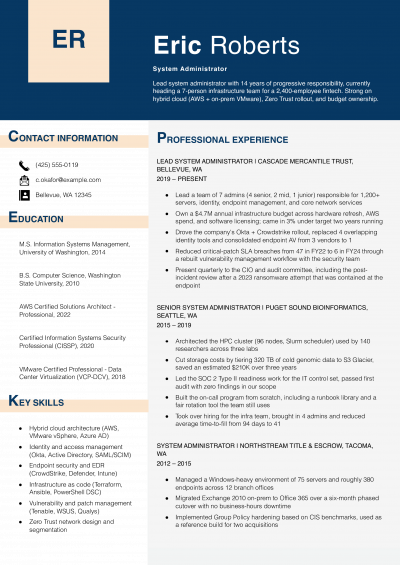
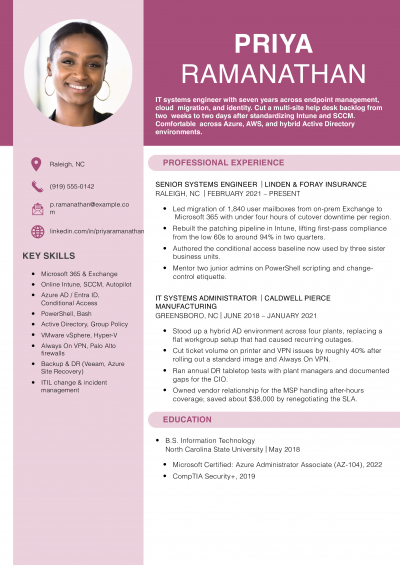
A Tier 1 SOC Analyst resume opens the security career and works triage on alerts from the SIEM queue. Yours has to prove you can escalate the real threats and close the noise with clear notes.
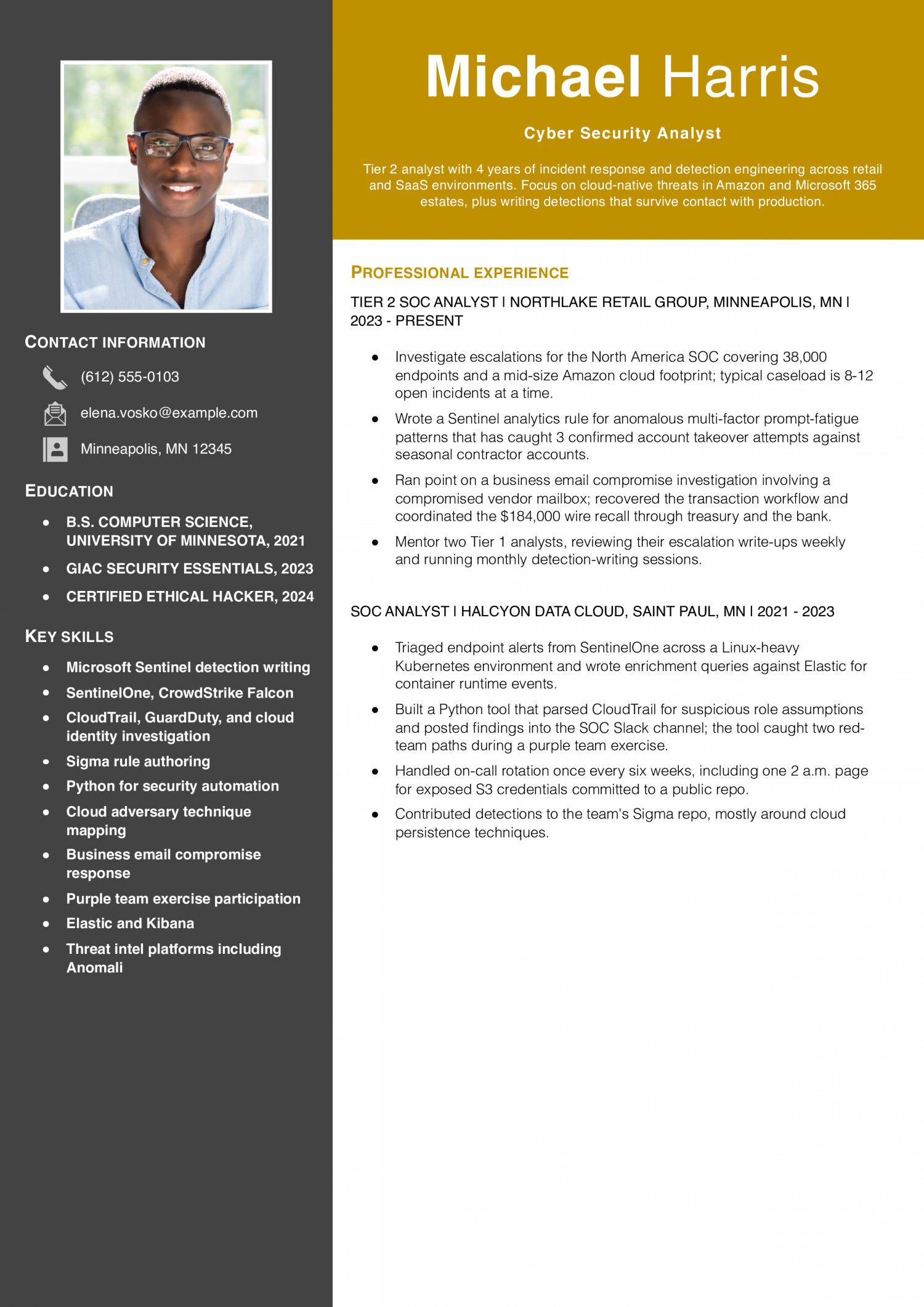
A Tier 2 SOC Analyst resume shows you own the deeper investigations that Tier 1 hands up. Yours has to prove you can scope an incident, pull host and network evidence, and drive containment to a root cause.
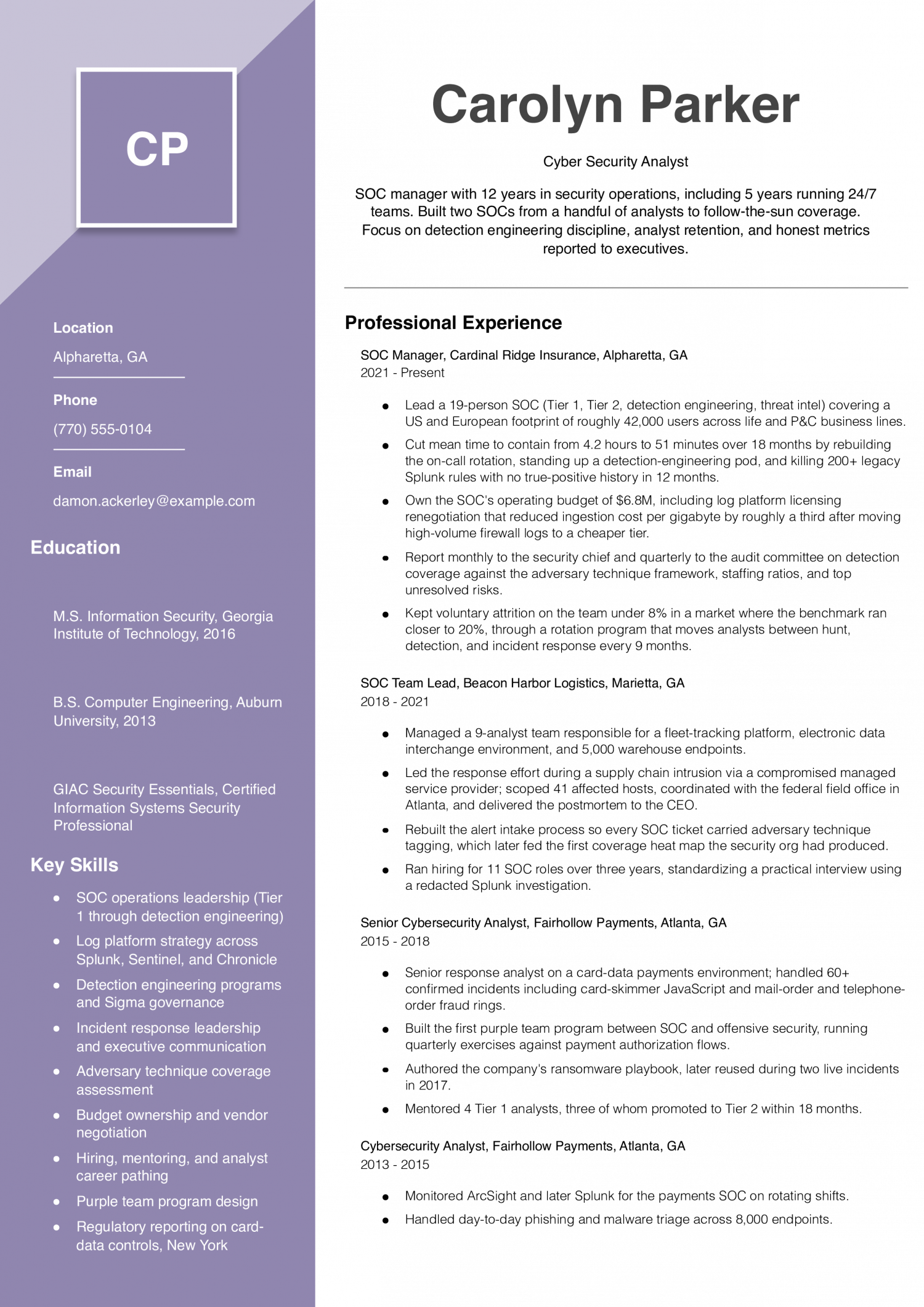
A SOC Manager resume runs the analyst roster, the on-call rotation, and the metrics that security directors read each week. Yours has to prove you can hire, coach, and hold response times against a defined service level.
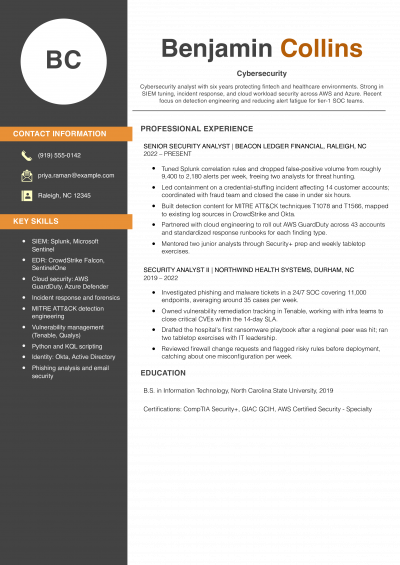
Jordan Halvorsen
Portland, OR | (503) 555-0105 | [email protected] | linkedin.com/in/jordan-halvorsen
Cybersecurity analyst with 7 years across managed security services, higher education, and biotech. Strong in log platform detection engineering, cloud incident response across Amazon and Azure, and threat hunting. Known for writing detections that stay useful and postmortems that name the real root cause.
Senior Cybersecurity Analyst
Cascadia Biosciences | Portland, OR | 2022-Present
Cybersecurity Analyst II
Pacific Crest University | Salem, OR | 2020-2022
SOC Analyst
Willamette Managed Defense | Beaverton, OR | 2018-2020
Tier 1 SOC Analyst
Willamette Managed Defense | Beaverton, OR | 2017-2018
Your profile belongs at the top of page one. State your years in security work, the environment you defend, and the domain you own. Security managers and directors of information security read this block first to place you.
Name the setting in plain terms: enterprise SOC, managed security provider, cloud-native product team, or federal contractor. Name the domain you cover most weeks: incident response, vulnerability management, threat detection engineering, or governance and risk. Name the stack scale you have worked at, such as endpoint counts, log volume per day, or business units supported.
Three plain sentences beat a wall of adjectives. A reader should know your scope in ten seconds.
Security work reads as duties without numbers behind it. Most strong resumes carry two or three metrics per role, drawn from real dashboards you owned. Useful figures include alerts triaged per shift, mean time to detect, mean time to respond, and incidents closed per quarter.
Coverage metrics also land well: endpoints under managed detection, log sources onboarded to your monitoring platform, and assets scanned each cycle. Reduction figures tell a stronger story than raw counts. Cut false positives by a percentage, shrink patch backlog by a share, or lower repeat findings across audits.
Recruiters scan for a number in the first line of each bullet. Bullets without a number tend to read as job description copy.
Split your bullets so a reader sees range at a glance. Four categories cover most analyst roles. Detection and response covers alert tuning, triage, threat hunting, and incident handling from containment through lessons learned.
Vulnerability and exposure work covers scanning, prioritization, patch coordination, and closing findings with system owners. Identity and access covers account reviews, privileged access controls, and joiner-mover-leaver process work. Governance and risk covers policy drafting, control mapping, audit support, and third-party reviews.
Name the tools inside each category rather than in a wall list. Splunk, Sentinel, CrowdStrike, Tenable, Qualys, and Okta all land better next to the work they supported. Avoid a jargon block that a reader will skim past.
Security managers and directors of information security filter for certifications before they read bullets. Put a short credentials block near the top, under the profile or beside it. List CompTIA Security+ from CompTIA and GIAC Security Essentials from GIAC for early-career roles.
List Certified Ethical Hacker from EC-Council for offensive-leaning work. List CISSP from ISC2, CISM from ISACA, CISA from ISACA, and OSCP from Offensive Security for senior roles. Show issuer and year earned so a reviewer can confirm currency.
Keep a tools line on page one that names your monitoring stack, endpoint platform, ticketing, and cloud provider. This lets a reader confirm fit before scrolling. State licensure by name, not by number.
Education sits at the end for most analyst resumes with two or more years of work. List the degree, the institution, and the graduation year on one line. A computer science, information systems, or cybersecurity degree is common, but many strong analysts hold degrees in other fields.
If your degree is unrelated, lean harder on certifications and hands-on projects earlier on the page. A short continued learning block helps here. Name recent courses, cloud provider training, or hands-on lab platforms such as Hack The Box and TryHackMe.
Keep bullets to one line each with the platform and the year. Skip high school once you have shipped real security work in production for a full year.
Cybersecurity analyst resumes that land interviews tend to share the same skill set. Weigh the two tables below against the specific posting in front of you. Security managers and directors of information security scan for these patterns first, not vague talk about protecting the business.
Hard skills prove you can triage alerts and run scans on day one. Soft skills like incident communication show you can brief leaders when a breach lands at 2 a.m. Both carry weight, in different parts of the review.
Pull the exact hard skill terms from the target job posting and mirror them word for word. Then pair each soft skill with a resume bullet that proves it in action.
| Soft Skills | AI-estimated % |
|---|---|
| Analytical thinking | 70% |
| Cross-team communication | 65% |
| Attention to detail | 41% |
| Calm under pressure | 37% |
| Stakeholder advisory | 25% |
And here are the top hard skills showing up most often.
| Hard Skills | AI-estimated % |
|---|---|
| Threat and vulnerability assessment | 65% |
| Network traffic monitoring | 55% |
| Security incident response | 46% |
| Data encryption implementation | 40% |
| Risk assessment reporting | 34% |
Skill names and rankings come from an AI model grounded in U.S. Department of Labor occupation data for cybersecurity analysts, not from a count of cybersecurity analysts’ resumes built on ResumeTemplates.com.
These are the must-haves hiring teams look for when scanning a cybersecurity analyst resume.
Security managers and directors of information security scan for proof of the work you have done. A resume that names the tools, frameworks and controls you touched reads as credible. Group your keywords by the kind of work each one covers. One group can show your SOC and monitoring shifts. Another can show incident response and forensics work. A third can cover vulnerability scans and patch cycles. A fourth can name the frameworks and audits you support. A fifth can cover identity and access work. Write each term the way the trade writes it. Keep the capitals on a tool, a control or a regulation. That signals you have used the thing, not read about it.
| Niche | Keywords ATS scans for |
|---|---|
| SOC monitoring | Splunk queries, alert triage, log correlation |
| Incident response | response playbooks, forensic imaging, containment actions |
| Vulnerability management | Nessus scans, risk scoring, patch cycles |
| Compliance and audit | SOC 2, PCI DSS, HIPAA |
| Identity and access | access reviews, multifactor rollout, privileged accounts |
Security managers and directors of information security are split on AI in the SOC. Some want analysts who can triage faster with copilots and assisted detection tuning. Others restrict generative tools because prompts can leak alert data, source code, or client names. Name the exact tools you use and the data you keep out of them. Describe the review step that catches hallucinated indicators or bad regex. Do not say you run AI-driven detection if your practice is triaging alerts and checking model output against logs. Framing your workflow honestly is what these managers read for.
Copilots draft the first-pass summary of an alert, and you verify the indicators against raw log evidence.
AI assistants suggest Sigma rule variants, and you test them in a lab before promoting to production.
Models parse headers and body text at scale, and you confirm intent before you push a block or takedown.
AI drafts incident timelines and executive summaries, and you own the facts, the scope, and the remediation call.
Microsoft Security Copilot: Summarize incidents in Sentinel or Defender and draft queries you review before running.
ChatGPT or Claude for scripting: Draft PowerShell, Python, or regex for log parsing, then test on sanitized data.
Beyond the baseline security clearances or role prerequisites your employer sets, the certifications below tell security managers and directors of information security where you sit on the skill curve. Some prove you can run a control audit. Others prove you can break into a system on purpose and write up how you did it. The tier you hold shapes the work you get handed on day one. It also shapes the pay band your resume is read against. List each one with its issuing body and the month and year it expires. Put active credentials first. Move any lapsed or in-progress ones to the end of the line.
CompTIA Security+: Issued by CompTIA and often asked for on entry-level analyst postings and federal contractor roles under DoD 8570.
Certified Information Systems Security Professional: Issued by ISC2 and often listed as required or preferred on senior analyst and security architect postings.
Certified Information Security Manager: Issued by ISACA and often required on senior analyst and lead postings that carry program or policy ownership.
The top-paying states for Cybersecurity Analysts sit in smaller markets with federal, defense, or finance buyers. They are not the coastal tech hubs most people picture. Pay tracks the cleared-work premium and the cost of running a security operations center in a thin labor market.
The states with the most jobs tell a different story. They lean toward large company headquarters and government contract corridors. That split matters because the same title pays very differently depending on which map you land on.
If you are open on where to work, put your clearance status, remote history, and multi-state incident response work near the top of the resume. That framing helps a recruiter place you against either map.
| # | State | Median Annual |
|---|---|---|
| 1 | Washington | $154,940 |
| 2 | Maryland | $139,640 |
| 3 | California | $138,570 |
| 4 | Delaware | $137,030 |
| 5 | Massachusetts | $136,550 |
| 6 | Colorado | $135,220 |
| 7 | District of Columbia | $135,090 |
| 8 | Virginia | $134,900 |
| 9 | New Jersey | $134,820 |
| 10 | New York | $134,660 |
| # | State | Workers | Median |
|---|---|---|---|
| 1 | Virginia | 19,120 | $134,900 |
| 2 | Texas | 16,130 | $129,890 |
| 3 | California | 15,570 | $138,570 |
| 4 | Florida | 14,220 | $124,860 |
| 5 | New York | 10,060 | $134,660 |
Resume Templates offers HR approved resume templates to help you create a professional resume in minutes. Choose from several template options and even pre-populate a resume from your profile.
Lead with a home lab, capture-the-flag results, or a security course project that shows hands-on work. List Security+ or a course in progress under certifications, with the expected date.
Pull help desk, network, or systems roles into a technical experience section that names the tools you touched.
Pick two or three projects that mirror analyst tasks: a Splunk or Elastic lab, or a phishing triage exercise. A vulnerability scan with Nessus works as a third.
Write each one as a short bullet block with the tool, the goal, and what you found. Link a GitHub repo or a writeup so a reviewer can verify the work.
Match the exact terms the posting uses for tools, frameworks, and tasks. Common ones include incident response, vulnerability management, threat intelligence, and log analysis.
Put them where you actually used them, in bullets and the skills block, not in a hidden keyword list.
Center a SOC analyst resume on alert volume, triage speed, and the tier you worked at. Name the detection platform, the ticketing system, and the runbooks you followed or wrote.
Include escalation counts and true-positive rates so the reader can gauge your judgment on the queue.
No, list the tools you can defend in an interview and drop the ones you touched once in a lab. Security managers and directors of information security expect you to speak fluently about anything on the page.
Group tools by category, such as detection platforms, endpoint agents, and vulnerability scanners, so the range is clear without inflating the list.
Rewrite prior bullets to surface the security-adjacent work: access reviews, patching, log review, or incident support. Add a short summary that names the pivot and the certifications you are earning, such as Security+ or CEH.
Put a projects or lab section directly under the summary so a reviewer sees hands-on evidence early.
One page holds up through about seven years of experience if you cut older duties to a single line each. Move to two pages once you have led incidents, run programs, or hold senior certifications like CISSP, CISM, or OSCP.
Keep certifications, tools, and current role on page one so a reviewer sees them without scrolling.
An ATS-friendly template works best here, since it puts your certifications and SOC experience exactly where a security manager looks first. A basic template is a solid alternative. Whichever you choose, keep the formatting clean and easy to parse: clear section headings, a standard font, and no graphics a parser can choke on.
Cyber Security Analyst Resume
4.8/5 stars with 211 reviews

Executive Resume Writer and Career Coach
Andrew Stoner is an executive career coach and resume writer with 17 years of experience as a hiring manager and operations leader at two Fortune 500 Financial Services companies, and as the career services director at two major university business schools.
© 2026 Resumetemplates.com All rights reserved.