Business Analyst Resume Examples
Lead with the one signal another BA cannot copy from a LinkedIn search. That might be a domain (claims, payments, supply chain), a system (Salesforce, SAP S/4HANA, Workday), or a methodology depth like SAFe RTE…
Every resume example is written and reviewed by our team of Certified Professional Resume Writers to ensure top-quality content and formatting.
Program managers and agency division directors hire program analysts who can prove they improved a process or cut costs. With over 898,000 management analysts in the U.S., your resume has to show real outcomes. Tie each role to a metric like cycle time, budget variance, or compliance rate.
List the tools you used to get those results, such as SQL or Tableau. A PMP credential can set you apart for senior roles. The examples below show how to pair your analysis skills with clear, measurable wins. To compare layouts before you start, browse our resume templates.
Quantified cost savings and efficiency gains are what get program analyst resumes past the initial ATS screening; a clear link between analysis methods and mission outcomes is what makes them readable enough for division directors to advance.
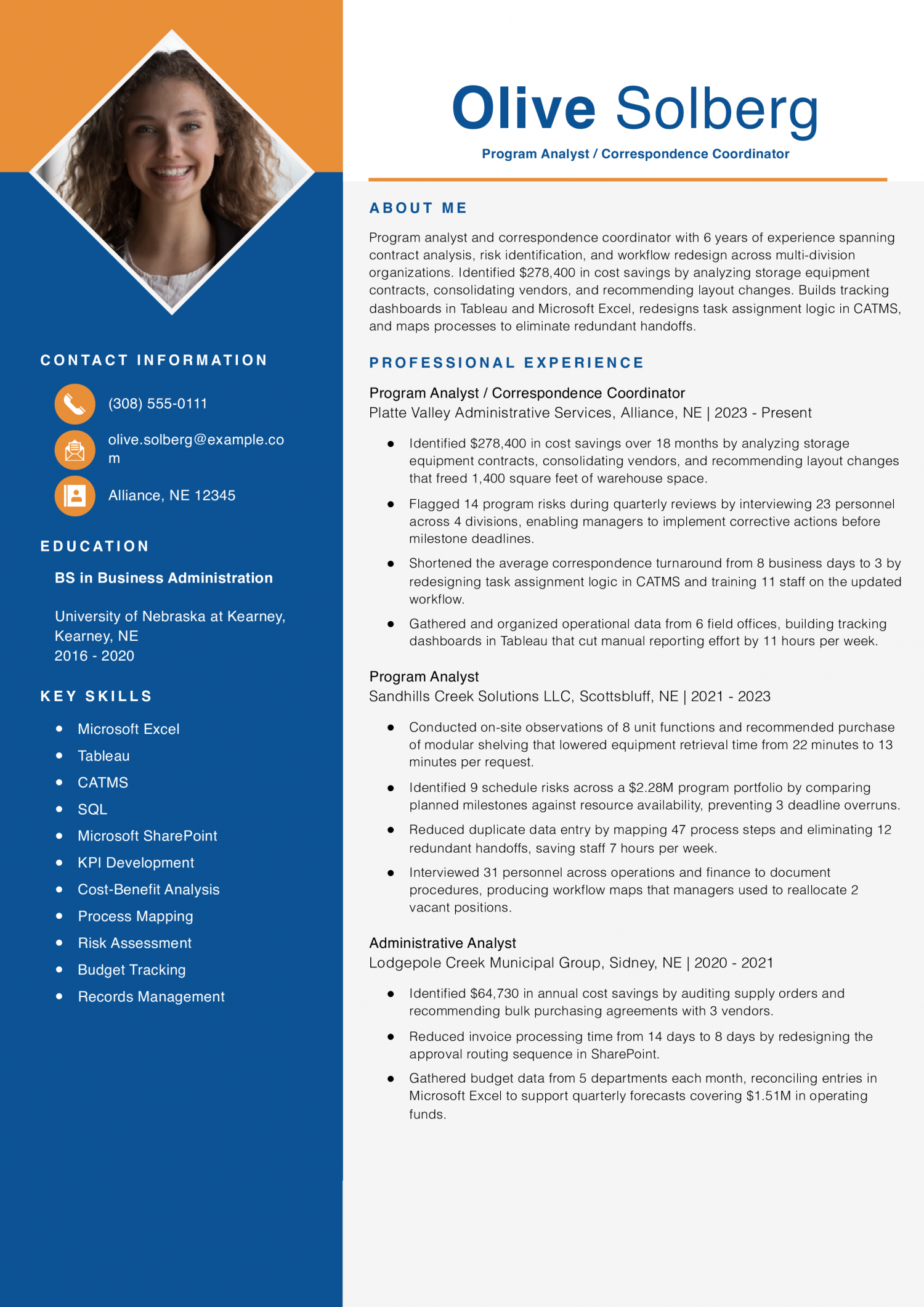
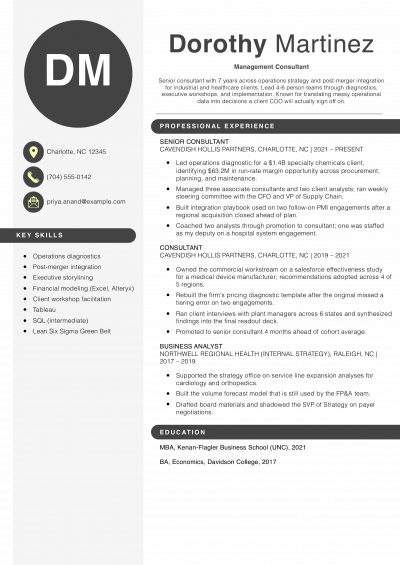
Consider this resume if you are a mid-level program analyst balancing correspondence coordination duties with cost and risk analysis work. Lead with the before-and-after turnaround windows this candidate pairs with every workflow redesign.
The Tableau dashboard bullet names the tool and the manual hours it replaced. A program director can see both the technology choice and its payoff in one line. When you build a reporting tool, name it and the manual step it replaced so the value is clear.
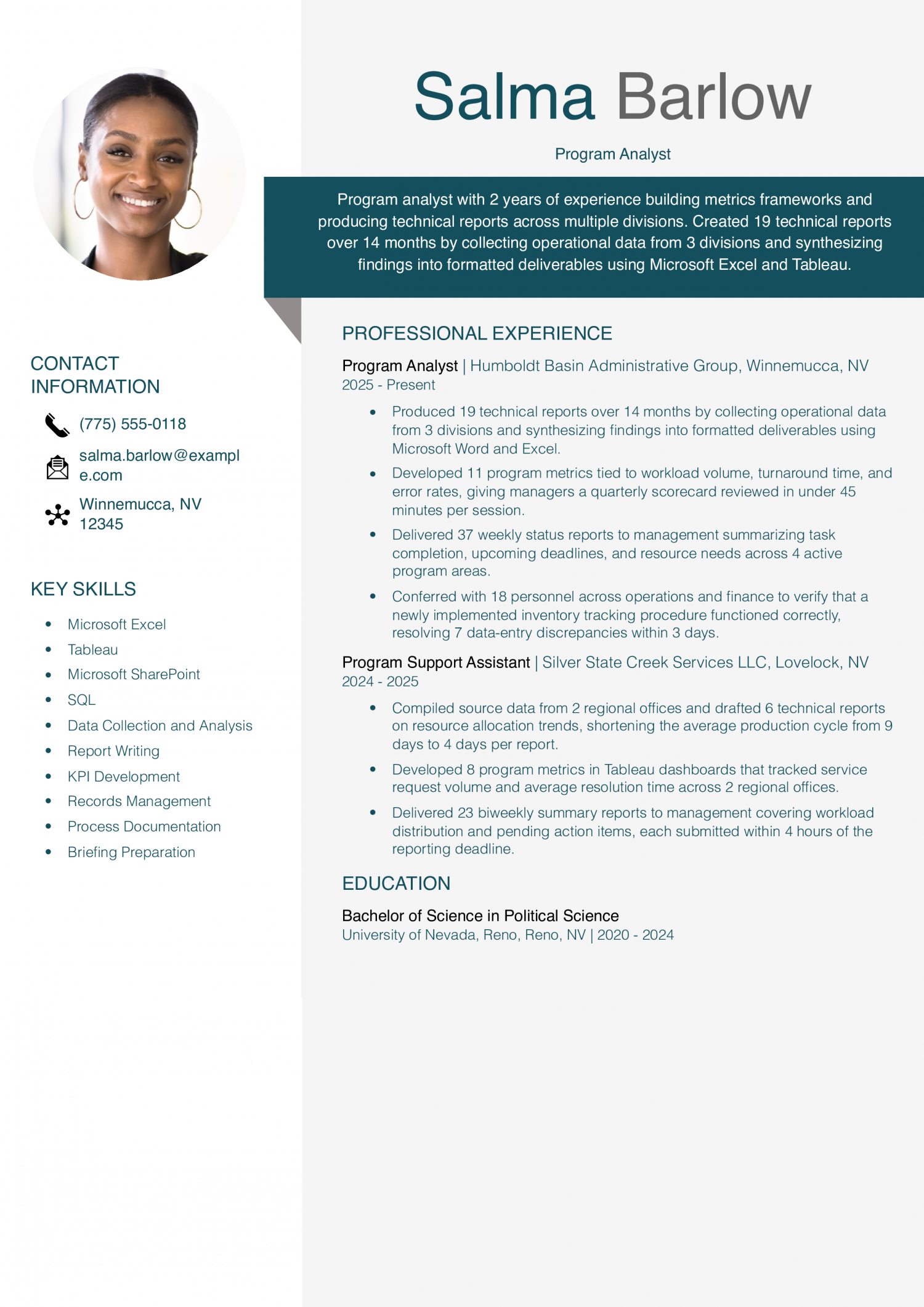
Start with this resume if you are an entry-level program analyst moving from a support role into full analyst responsibilities. Lead with the number of reports produced and the metric sets you built so each bullet shows analytical output, not clerical tasks.
Report production time before and after tells a manager whether the process actually got faster. The new process got reports to managers sooner. Put the old turnaround beside the new one so a hiring manager can measure the change.
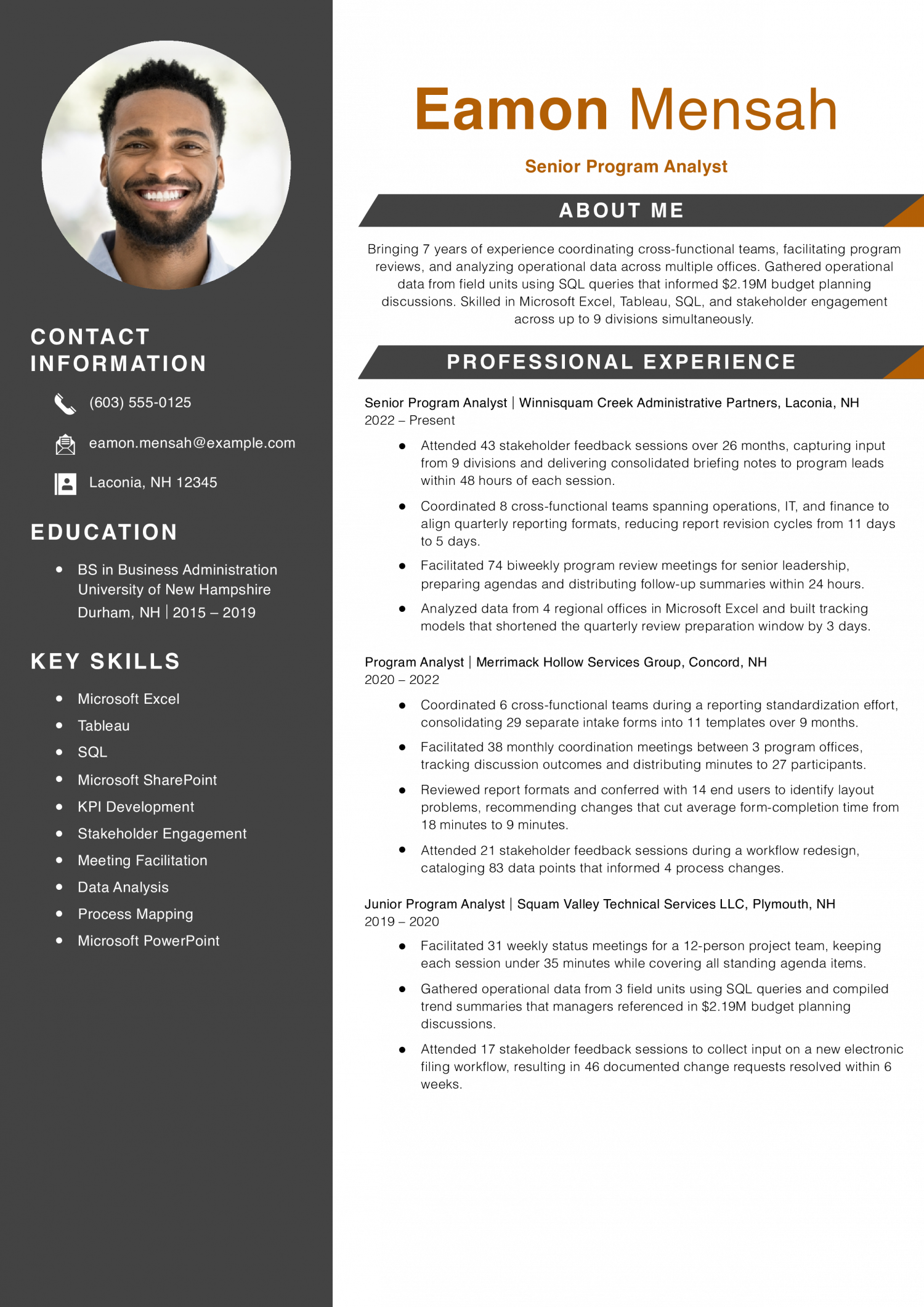
Try this resume if you are a mid-level senior program analyst who has run recurring review meetings while managing cross-divisional stakeholder input. Lead with session counts and turnaround windows the way this candidate does to prove consistent delivery speed.
Distributing meeting summaries within a set window shows the analyst keeps the work moving after the room clears. A division chief sees someone who follows through on schedule. Add a delivery time to your own meeting-support bullets so the hiring team knows how fast the follow-up reaches stakeholders.
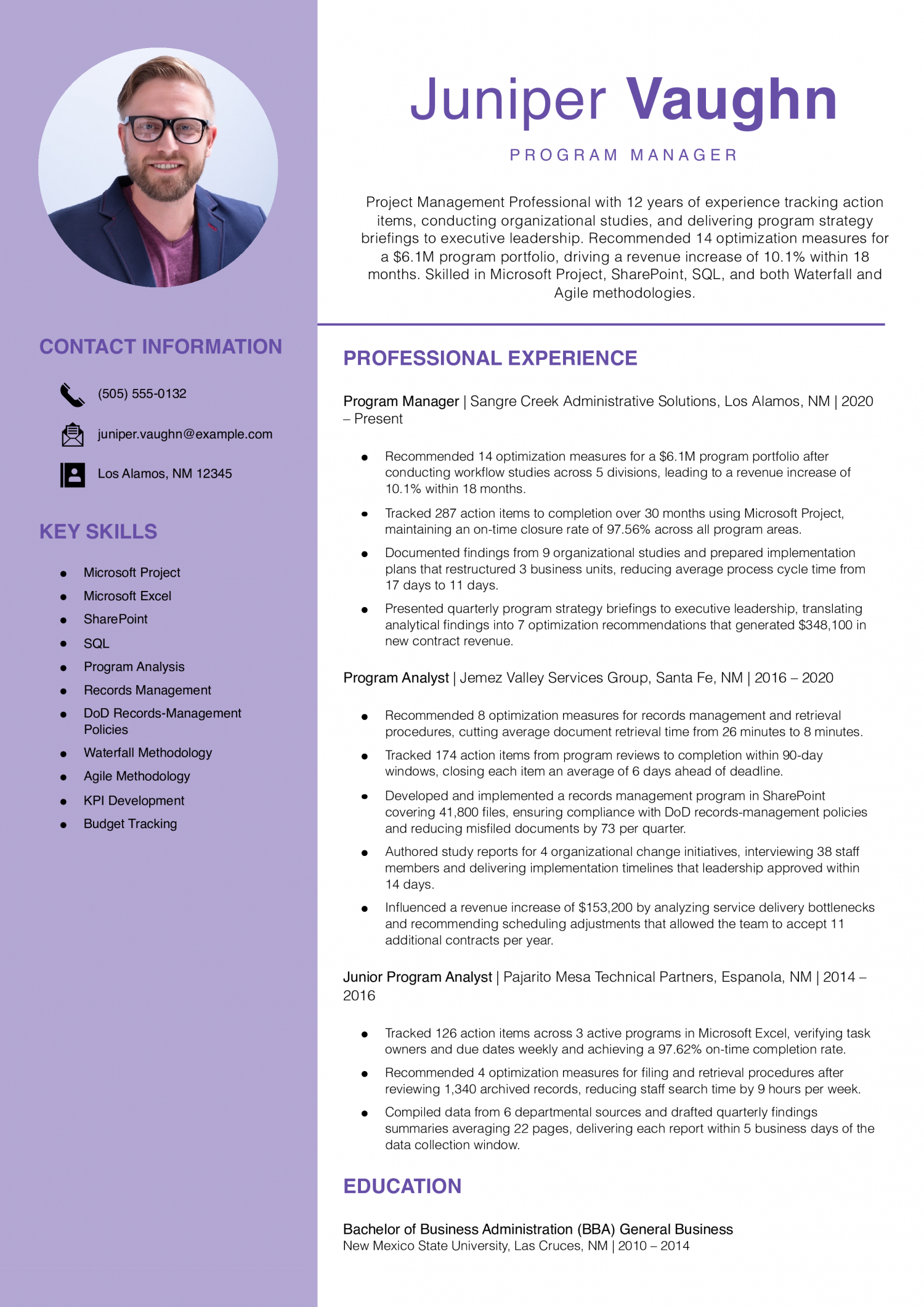
Lean on this resume if you are a senior program manager with about a decade of portfolio oversight and organizational analysis experience. Lead with exact closure rates and cycle-time reductions the way this candidate does across all three roles.
An on-time closure rate held steady over a long stretch tells a senior leader this person finishes what they start. The time span makes the number believable. Pull your own completion records and pair the rate with the months or years you maintained it.
Administrative analyst with 6 years of experience in suspense tracking, compliance auditing, and program support across government and consulting settings. Built a tracking calendar in Microsoft Excel and followed up with task owners 72 hours before each deadline, achieving a 96.2% on-time resolution rate across 314 suspense items. Completed 14 compliance reviews of administrative and inventory control procedures, drafted corrective memos within 5 business days, and reconciled expenditure logs for a $2.83M grant program.
Your profile sits at the top of page one. It should state your years of federal or private-sector experience. Name the program area you support, such as budget execution or IT modernization.
List the agency tier or contract size you have handled. Program managers and agency division directors scan this block first. A profile that reads “six years analyzing workforce programs across three DoD agencies” sets your scope fast.
One that reads “experienced analyst seeking new opportunities” does not. State whether you work at the division, bureau, or enterprise level. Mention if you hold a PMP from the Project Management Institute.
Two sentences of clear scope beat a five-line block of vague claims.
Most strong program analyst resumes carry real metrics. Start each bullet with what changed, not what you did. Write the dollar value of budgets you tracked or reallocated.
Note the percentage by which you cut cycle time on a review. Include the number of stakeholders you briefed each quarter. Bullets without a number tend to read as duties rather than results.
A good metric pair is funds managed and time saved. You can also cite report volumes or error-rate drops. If your agency restricts data, use approved ranges or round figures.
Program managers and agency division directors look for scale. They want to know whether you handled a $2M program or a $200M one. Even rough figures give your bullets weight.
Sort your bullets so readers find relevant skills fast. Use three to five categories drawn from your actual duties. Budget analysis and cost estimation form one natural group.
Program evaluation and performance measurement form another. A third category covers policy review and compliance reporting. If you build dashboards or run data queries, add a tools-based group.
You might also separate stakeholder coordination from written deliverables. Each group should hold two to four bullets. This structure helps program managers and agency division directors match your experience to their vacancy.
A wall of fifteen unsorted bullets slows every reader down. Label each group with a short heading when the list grows past ten items.
Create a credentials block on page one, right below your profile. List your Project Management Professional certification from PMI here if you hold it. Program managers and agency division directors want to see it before they read your bullets.
Add the software you use in a single line. Name tools like Excel, SQL, and Tableau. Follow those with any agency-specific platforms you have used.
If you hold a federal security clearance, state the level. Do not list the clearance number or investigation date. Keep this block to four or five short lines.
Placing credentials high saves reviewers from scanning to page two. It also helps automated filters catch your license and tool keywords early in the document.
List your degree, school name, and graduation year. Public administration and public policy degrees are common in this field. Business, economics, or information systems degrees also appear often.
Place relevant coursework only when your work history is short. Below education, add a section for training or professional development. Include agency-sponsored courses in areas like earned value management.
You can also note federal performance-reporting or budget-process training here. Do not repeat items already in your credentials block. Close the resume without an objective statement or references line.
Program managers and agency division directors consider both outdated on a modern resume.
Program managers and agency division directors review dozens of program analyst resumes each quarter. The ones they shortlist name clear methods and measurable results. Hard skills tell them you can run the work.
Think data analysis, budget tracking, and policy review. Soft skills tell them you can work with the team. Collaboration matters because analysts brief leaders across divisions.
Written communication matters because you draft findings for review. Program managers and agency division directors weigh hard skills first during screening. They check soft skills later in panel interviews.
A strong mix of both keeps your resume in the stack. Match each skill below to the target job posting. Treat soft skills as proof points that back your bullet results.
| Soft Skills | AI-estimated % |
|---|---|
| Executive-level communication | 67% |
| Cross-functional collaboration | 61% |
| Analytical problem-solving | 47% |
| Deadline management | 40% |
| Persuasive presentation | 35% |
And here are the top hard skills showing up most often.
| Hard Skills | AI-estimated % |
|---|---|
| Business process analysis | 71% |
| Program performance evaluation | 61% |
| Data-driven recommendations | 48% |
| Stakeholder needs assessment | 40% |
| Operational efficiency planning | 27% |
Skill names and rankings come from an AI model grounded in U.S. Department of Labor occupation data for program analysts, not from a count of program analysts’ resumes built on ResumeTemplates.com.
These are the must-haves hiring teams look for when scanning a program analyst resume.
AI use on a program analyst resume can go three ways. You could lead with vague claims like ‘AI-driven analyst.’ You could leave it off and wait for the interview. Or you could describe the workflow as it actually runs.
The third is what program managers and agency division directors can validate. Name the tool you used and the output it produced. Tie each mention to a real task, such as forecasting or data cleaning.
State what you checked before the result went forward. That framing shows judgment, not buzzwords. It also gives a reviewer something concrete to ask about.
What AI is actually changing for this role
Data cleaning: AI scripts now flag duplicate records and missing fields, cutting hours from quarterly data validation cycles.
Report drafting: Large language models generate first drafts of program status reports that analysts then verify against source data.
Trend forecasting: Machine learning models surface spending patterns across fiscal years, giving analysts faster starting points for variance analysis.
Stakeholder briefs: AI summarization tools condense long policy documents into two-page briefs that analysts review for accuracy before distribution.
AI tools to name
How to phrase AI on your resume
Do
Skip
Program analysts manage schedules, budgets, and cross-team work. Listing your PM methods shows real project control. Program managers and agency division directors scan for these frameworks.
Program managers and agency division directors read this list as a map of where your work is heading. The items below tell them which planning or oversight track you have put time into. A strong credential can set you apart from other analysts in a review.
It shows you chose to build skills on your own. Not every posting asks for the same ones. Federal roles may weigh them differently than state or private sector ones.
List each credential on its own line with the issuing body and the year you earned it. Keep the format the same for every entry so the list is easy to scan.
Program analyst falls inside the BLS group of management analysts. The headcount is large, so the median pulls in a long tail of entry-tier and general roles. The spread between the bottom and top of the pay range is wide.
Workers at the 90th percentile out-earn the median by roughly 69 percent. The 10th percentile sits about 40 percent below it. Roles cluster by region and agency type, so check the state tables for your market.
Lead your resume with the programs you managed end to end and the evaluation frameworks you used to measure outcomes.
| # | State | Median Annual |
|---|---|---|
| 1 | Massachusetts | $134,720 |
| 2 | District of Columbia | $126,140 |
| 3 | Maryland | $121,680 |
| 4 | Virginia | $117,580 |
| 5 | New York | $112,250 |
| 6 | Washington | $109,170 |
| 7 | Alabama | $108,040 |
| 8 | Vermont | $107,520 |
| 9 | New Jersey | $105,820 |
| 10 | Connecticut | $104,960 |
| # | State | Workers | Median |
|---|---|---|---|
| 1 | California | 137,280 | $101,460 |
| 2 | Florida | 71,060 | $88,610 |
| 3 | New York | 69,150 | $112,250 |
| 4 | Virginia | 59,620 | $117,580 |
| 5 | Texas | 50,990 | $101,400 |
Resume Templates offers HR approved resume templates to help you create a professional resume in minutes. Choose from several template options and even pre-populate a resume from your profile.
A reverse-chronological format works best for most program analyst resumes. It lets program managers and agency division directors scan your most recent assignments first. If you are changing careers, a hybrid format lets you lead with transferable skills.
Yes, many program analyst roles focus on policy review, budget tracking, and stakeholder coordination rather than coding. Highlight your experience with data tools such as Excel or Tableau instead. If a posting lists SQL or Python, note any coursework or projects where you used them.
One page is standard if you have fewer than ten years of relevant experience. A second page is reasonable when you need space for multiple federal or contract assignments. Keep every bullet tied to a measurable outcome so nothing reads as filler.
Name the staffing firm as the employer and the client agency in parentheses on the same line. This format tells division directors where you actually performed the work. Treat each contract as its own entry with its own bullet points and date range.
A summary works better once you have at least two years of analyst experience. Use two to three lines to name the program types you have supported and the largest budget you tracked. An objective suits entry-level candidates who want to state the role and agency they are targeting.
List the gap period with a brief label such as "Professional Development" or "Family Leave." If you completed any training or volunteer analysis work during that time, add one bullet describing it. Program managers care more about what you learned than about the gap itself.
A programmer analyst resume leads with coding languages, development frameworks, and software release cycles. A program analyst resume focuses on program performance metrics, stakeholder reporting, and process improvement. Read the posting title carefully so you match the right skill set to the role.
For a program analyst, an ATS-friendly template is the safest pick, because it puts your certifications and experience where a hiring manager scans first. A basic template is a solid alternative. Whichever you choose, keep the formatting clean and easy to parse: clear section headings, a standard font, and no graphics a parser can choke on.
Program Analyst Resume
4.5/5 stars with 222 reviews

Executive Resume Writer and Career Coach
Andrew Stoner is an executive career coach and resume writer with 17 years of experience as a hiring manager and operations leader at two Fortune 500 Financial Services companies, and as the career services director at two major university business schools.
© 2026 Resumetemplates.com All rights reserved.