X-Ray Technician Resume Examples
A state license and ARRT registry tell radiology directors what you are cleared to do. They do not show what you actually run. Put that in your opening line. Name the modality mix you own…
Every resume example is written and reviewed by our team of Certified Professional Resume Writers to ensure top-quality content and formatting.
Your scan quality and patient throughput set you apart, not your years on the job. Imaging managers and hospital recruiters look for proof you can produce diagnostic-grade images across abdominal, OB/GYN, or vascular studies. They want to see your RDMS credential and the modalities you operate daily.
List the ultrasound systems you know, such as GE Logiq or Philips EPIQ. Show volume, like the number of exams you complete per shift, and pair that with any specialty credentials like an RVT. The examples below show how strong ultrasound technician resumes put these details to work. To compare layouts before you start, browse our resume templates.
Imaging managers decide whether to keep reading by the credentials block at the top of page one; if the RDMS credential and modality specialties are not visible there, the resume moves to the reject pile.
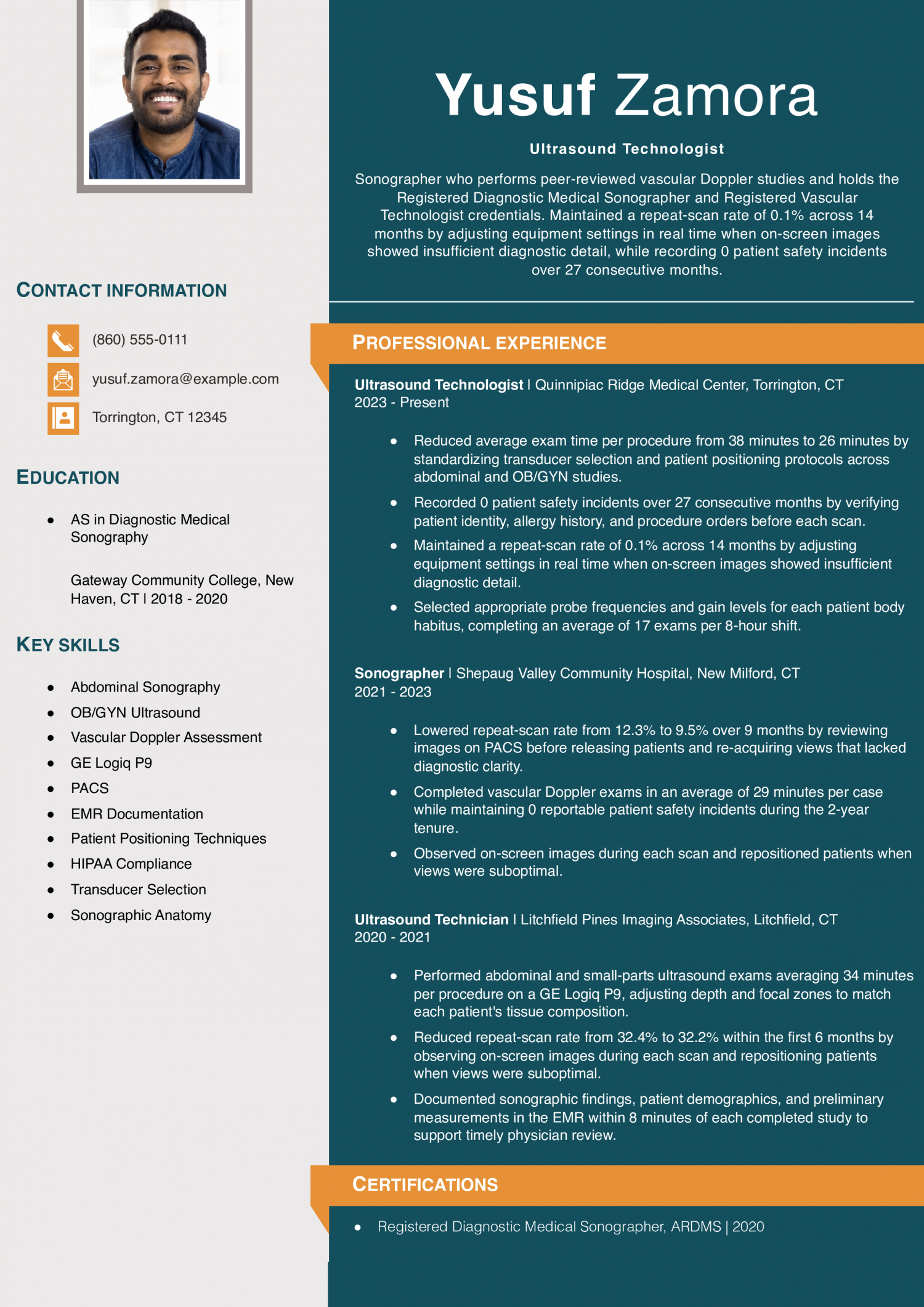
Pick this resume if you are a mid-level ultrasound technologist with about six years of clinical scanning and ARDMS credentials in both general and vascular sonography. Lead with repeat-scan rate reductions and safety streaks tied to specific protocol changes you introduced.
Standardized protocols for transducer choice and patient positioning are the method behind the lower repeat-scan rate. When you reduce retakes, name the protocol you put in place so your reviewer understands what drove the improvement.
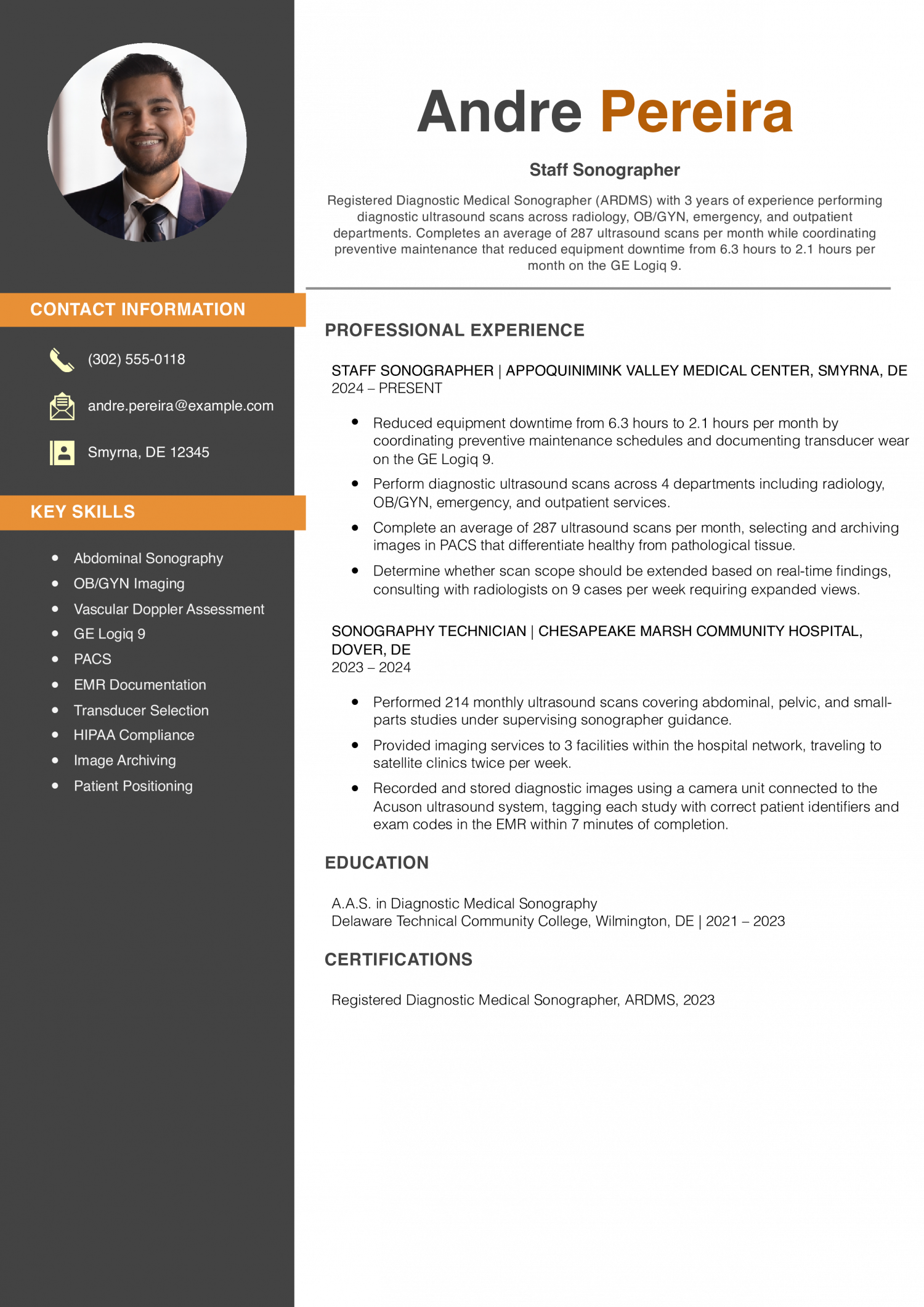
Use this resume if you are an entry-level staff sonographer with about three years of clinical scanning and an ARDMS credential. Lead with equipment uptime improvements and monthly scan volume rather than listing modalities alone.
Regular consultations with radiologists on cases needing expanded views show clinical judgment happening on a schedule. A department lead sees a sonographer who knows when to ask for help. Note how often you consulted and on which types of cases so the pattern is visible.
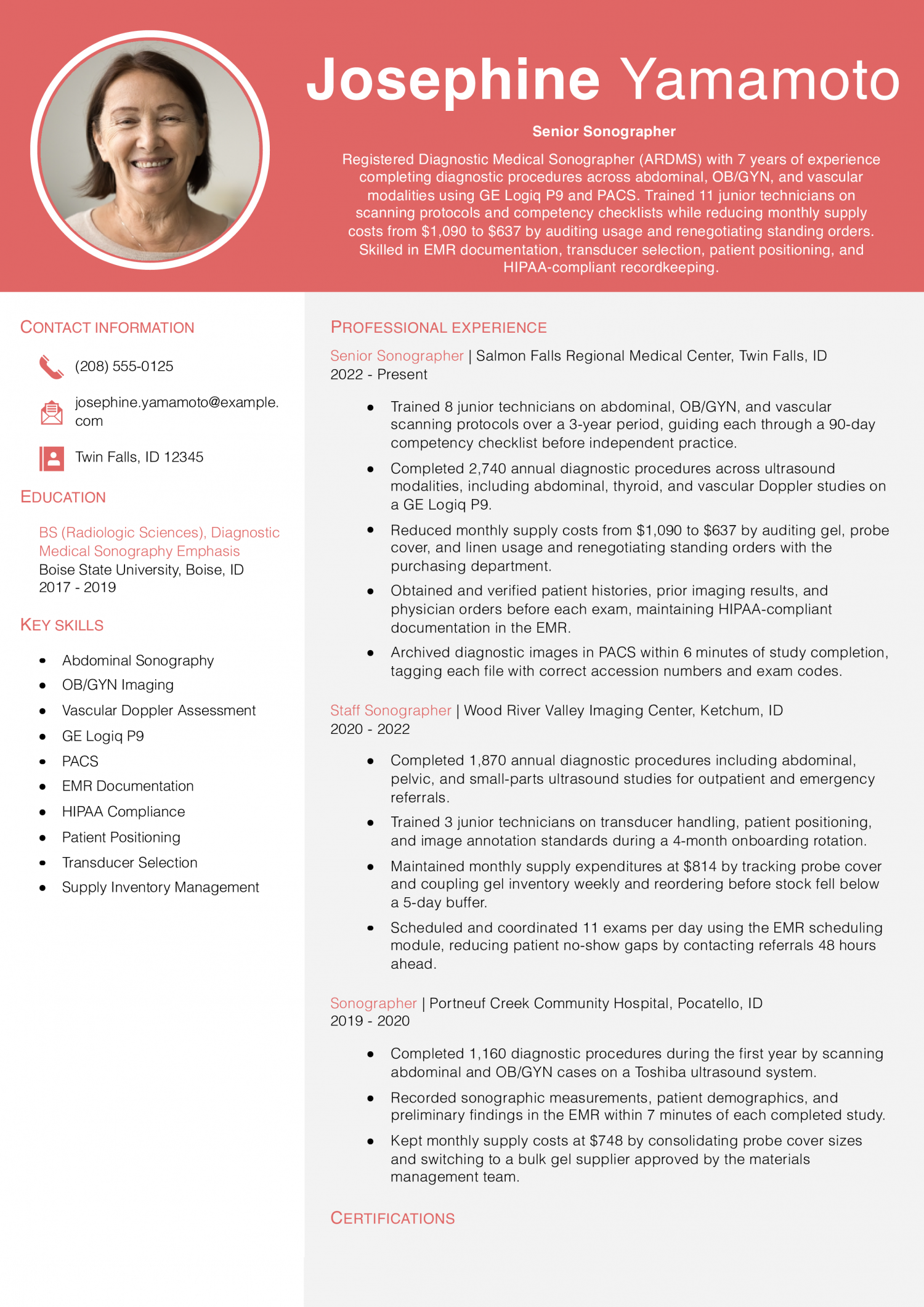
Try this resume if you are a mid-level senior sonographer with around seven years of clinical experience and a growing role training newer staff. Lead with supply cost reductions and technician mentoring counts to separate your resume from duty-only formats.
A structured onboarding checklist with a set timeline for each new hire is what separates this training bullet from a vague “trained new staff” line. A lab director knows the program has a beginning, milestones, and an endpoint. Name the structure of your own training and how long it runs.
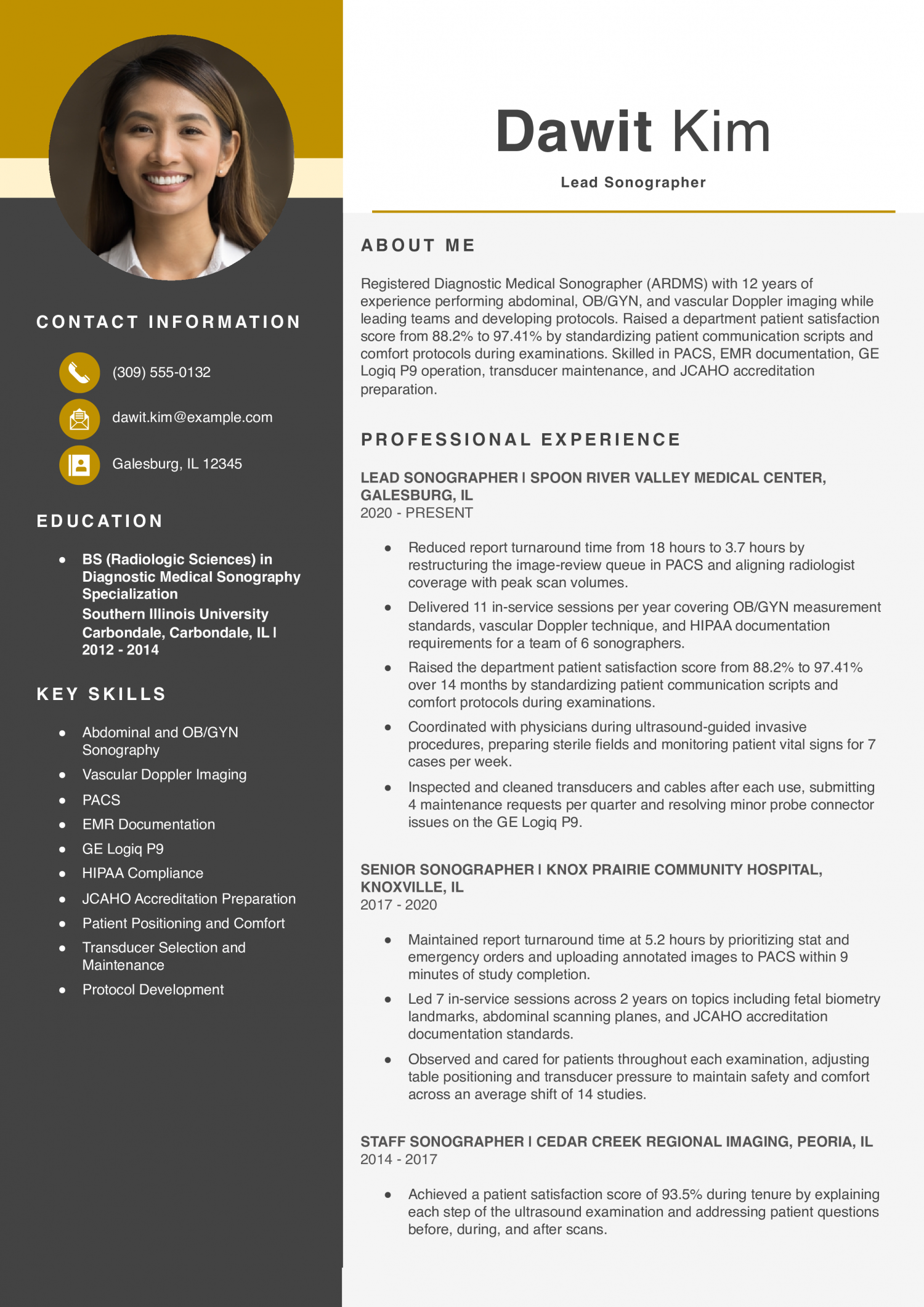
Lean on this resume if you are a senior sonographer with over a decade of clinical scanning and a move into a lead or supervisory role. Lead your bullets with turnaround-time reductions and satisfaction-score gains rather than listing scan types alone.
Report turnaround dropped sharply after the image-review queue in PACS was restructured. A radiology director can trace the speed gain back to a specific workflow fix. When you cut a turnaround time, name the system you changed and show both the old and new speeds.
Registered Diagnostic Medical Sonographer (ARDMS) with 6 years of experience across abdominal, OB/GYN, and vascular Doppler imaging, having passed 16 consecutive quality-assurance audits by maintaining protocol documentation and HIPAA-compliant records. Improved scan efficiency by 32.6% by restructuring daily scheduling sequences and batching similar exam types, while supervising clinical sonography students through competency milestones.
Name how many exams you complete per shift. Imaging managers and hospital recruiters use this figure to gauge your speed.
A line like “sonographer averaging 14 diagnostic exams per eight-hour shift” tells them what you produce.
Follow that number with the modalities you scan most often. Name your two strongest, such as abdominal and OB/GYN. Then add a third if it sets you apart.
Pair the volume figure with a patient population detail, like pediatric or bariatric. That context helps recruiters match you to their open requisition fast.
Most strong ultrasound technician resumes tie each bullet to a metric. Without a number, those lines tend to read as duties. Start with daily exam counts or weekly patient volume.
You can also note your repeat-scan rate if it is low.
A rate below five percent signals image quality. Turnaround time matters too, so state how fast you deliver preliminary findings. Equipment uptime is another metric imaging managers track.
If you trained new hires, state how many you onboarded. Place the strongest number at the start of the bullet.
Organize your experience into clear categories so reviewers can scan fast. Abdominal and small parts work is one common group. OB/GYN imaging is another.
Vascular studies, including carotid and lower-extremity venous exams, form a third.
If you perform musculoskeletal or cardiac scans, list those in their own section. Keep each group to two or three bullet points. Name the specific exams you run most often within each group.
This structure shows range without creating a wall of terms. It also helps imaging managers spot the subspecialty match they need.
List your RDMS credential from ARDMS right below your name. If you also hold the RVT from ARDMS, place it on the same line. Imaging managers and hospital recruiters look for these letters before they read further.
A credentials block near the top of your resume keeps them visible.
Include your state license status, such as “state license in good standing.” Do not print a license number on the resume itself. Below credentials, add the equipment and software you use. Name your primary ultrasound machine brand and your PACS platform.
These details confirm you can step in with less orientation time.
List your degree in diagnostic medical sonography or a related field. Include the program name, school, and graduation year. Clinical rotation hours strengthen an entry-level resume.
State the total hours and the facility types where you trained.
Name two settings, such as hospital inpatient floors and outpatient imaging centers. Relevant coursework in physics or cross-sectional anatomy can fill gaps. Place this education section after your experience unless you are a new graduate.
New graduates should lead with education and clinical rotations.
Five years ago, an ultrasound technician resume read like a list of body parts scanned. The mix has shifted toward imaging protocols and patient throughput metrics. Workflow speed now matters as much as anatomy knowledge.
Imaging managers and hospital recruiters weigh technical ability first. They then look for soft skills like patient care. Communication and teamwork fill gaps that scanners alone cannot cover.
A strong resume balances both columns. Match each table against your target job posting. Turn soft skills into proof by weaving them into your bullet points.
For example, pair patient care with a wait-time or satisfaction score. Use the hard skills as exact keyword matches. Leave off anything the posting does not mention.
| Soft Skills | AI-estimated % |
|---|---|
| Patient reassurance | 79% |
| Physician collaboration | 68% |
| Attention to detail | 40% |
| Procedure adaptability | 36% |
| Time management | 26% |
And here are the top hard skills showing up most often.
| Hard Skills | AI-estimated % |
|---|---|
| Ultrasound image acquisition | 73% |
| Sonographic anatomy identification | 68% |
| Patient scan preparation | 46% |
| Doppler flow assessment | 39% |
| Diagnostic image documentation | 34% |
Skill names and rankings come from an AI model grounded in U.S. Department of Labor occupation data for ultrasound technicians, not from a count of ultrasound technicians’ resumes built on ResumeTemplates.com.
Here is what to cover on your ultrasound technician resume, from credentials to the software and training you use on the job.
ARDMS requires continuing education to keep your RDMS active. Logging these credits shows you stay current in sonography. A short education section adds weight to your resume.
List recent courses that match the target job posting. Focus on topics like fetal echo or musculoskeletal scanning. Omit older courses that no longer reflect your skill set.
Most imaging departments run a PACS and an EMR daily. Naming the systems you have used saves recruiters time. It also helps your resume pass keyword filters.
Patient privacy rules shape every scan you perform. HIPAA training is expected at most imaging employers. Calling it out shows you take compliance seriously.
Keep Your HIPAA Training Date Current
Add your most recent HIPAA training date and provider. Mention any role where you managed patient data securely. This detail reassures imaging managers during screening.
Imaging managers and hospital recruiters read this list as a map of where your clinical work is heading. The items below tell them which body systems you have trained to scan. They also show which exam specialties you have trained in.
A strong list helps set you apart from other techs with the same degree. Add each credential on its own line. Add the organization that issued it and when you earned it.
If you hold more than one, list the most recent first. This format lets a recruiter confirm your status in seconds. Keep each entry short and clear so it is easy to scan on screen or in print.
Imaging managers and hospital recruiters look for current credentials first. The RDMS from ARDMS is the most common entry credential. An RVT from ARDMS signals vascular scanning ability.
For ultrasound technicians, the 10th-percentile floor and the top-decile ceiling sit far apart. The gap between them runs about 64 percentage points. BLS groups all diagnostic medical sonographers into one category, so these figures cover a broader pool than ultrasound technicians alone.
Credential type, specialty area, and work setting all vary across that range. Geography shapes pay too, with wide differences from state to state. Your resume should name the specific modalities you scan and the credential you hold.
List your RDMS or RVT status near the top of the page so imaging managers spot it right away.
| # | State | Median Annual |
|---|---|---|
| 1 | California | $128,530 |
| 2 | Hawaii | $124,430 |
| 3 | Washington | $121,340 |
| 4 | Oregon | $120,220 |
| 5 | District of Columbia | $112,020 |
| 6 | Colorado | $108,410 |
| 7 | Massachusetts | $107,480 |
| 8 | Alaska | $105,670 |
| 9 | Vermont | $104,100 |
| 10 | New York | $103,920 |
| # | State | Workers | Median |
|---|---|---|---|
| 1 | California | 10,110 | $128,530 |
| 2 | Texas | 6,960 | $92,580 |
| 3 | New York | 6,880 | $103,920 |
| 4 | Florida | 6,670 | $82,940 |
| 5 | New Jersey | 3,370 | $103,150 |
Resume Templates offers HR approved resume templates to help you create a professional resume in minutes. Choose from several template options and even pre-populate a resume from your profile.
Open your summary with the number of years you have scanned patients. Name the setting you worked in, such as a hospital or outpatient clinic.
List your RDMS or RVT credential in the first line so imaging managers spot it fast. Close with one measurable result, like the number of exams you perform each week.
One page works for most ultrasound technicians with fewer than ten years of experience. If you hold credentials in multiple specialties and have worked in several clinical settings, a second page is reasonable.
Keep each page focused on results rather than listing every duty you have ever performed.
A tested template gives you a clean layout that applicant tracking systems can parse without errors. Building your own format risks missing standard sections that imaging managers and hospital recruiters expect.
Choose a template with a clear header, a credentials line, and room for bullet points under each role.
Lead with your clinical externship hours and the types of exams you performed during training. List the facility name, the rotation dates, and the average number of scans you completed per shift.
Imaging managers treat supervised clinical hours as real experience when you pair them with patient counts.
No, the two titles describe the same role in most hospitals and clinics. Use the exact title from the job posting so your resume matches the applicant tracking system keyword.
If the posting says sonographer, use that term in your headline and summary instead.
Note any continuing education credits or volunteer scanning you completed during the gap. A brief line under the gap period showing that you maintained your ARDMS credentials keeps the timeline honest.
Imaging managers care more about current competency than a perfect work history.
Start each bullet with a verb that shows what you did for the patient or the department. Strong choices include scanned, assessed, identified, and documented.
Weak verbs like assisted or helped hide your direct contribution to patient care.
An ATS-friendly template with labeled sections makes your credentials and work history easy to follow. A basic template works too.
Ultrasound Technician Resume
4.1/5 stars with 172 reviews

Executive Resume Writer and Career Coach
Andrew Stoner is an executive career coach and resume writer with 17 years of experience as a hiring manager and operations leader at two Fortune 500 Financial Services companies, and as the career services director at two major university business schools.
© 2026 Resumetemplates.com All rights reserved.