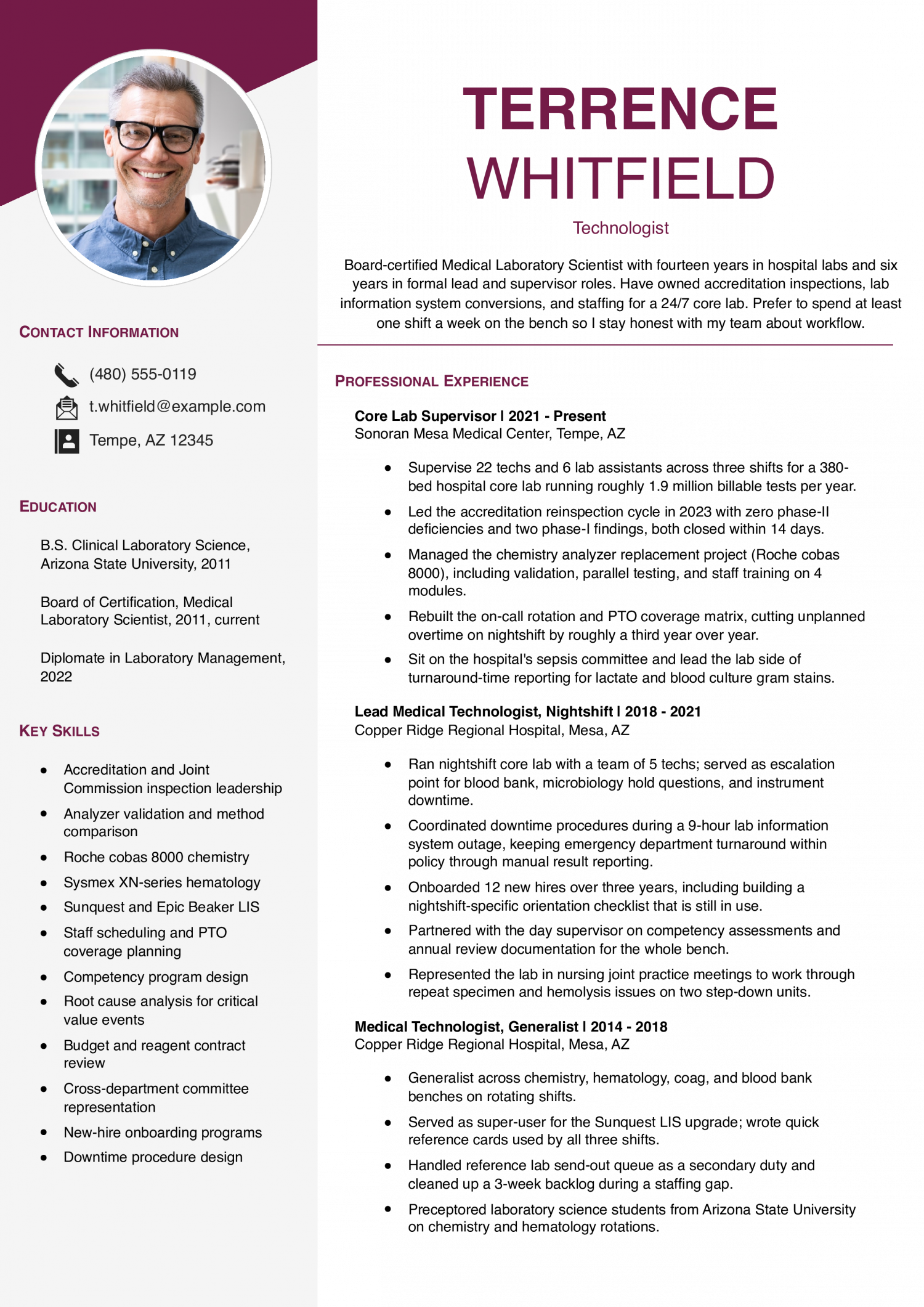
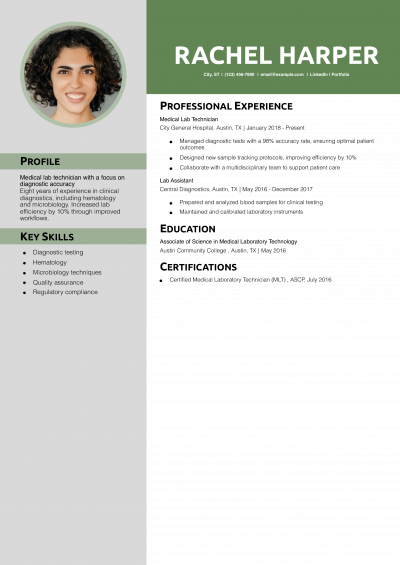
Lab Technician Resume Examples
Lead the summary with daily specimen volume and the complexity tier you handled. Lab managers read that line as your readiness to cover a bench from day one. Name your certification, the CLIA complexity (waived,…

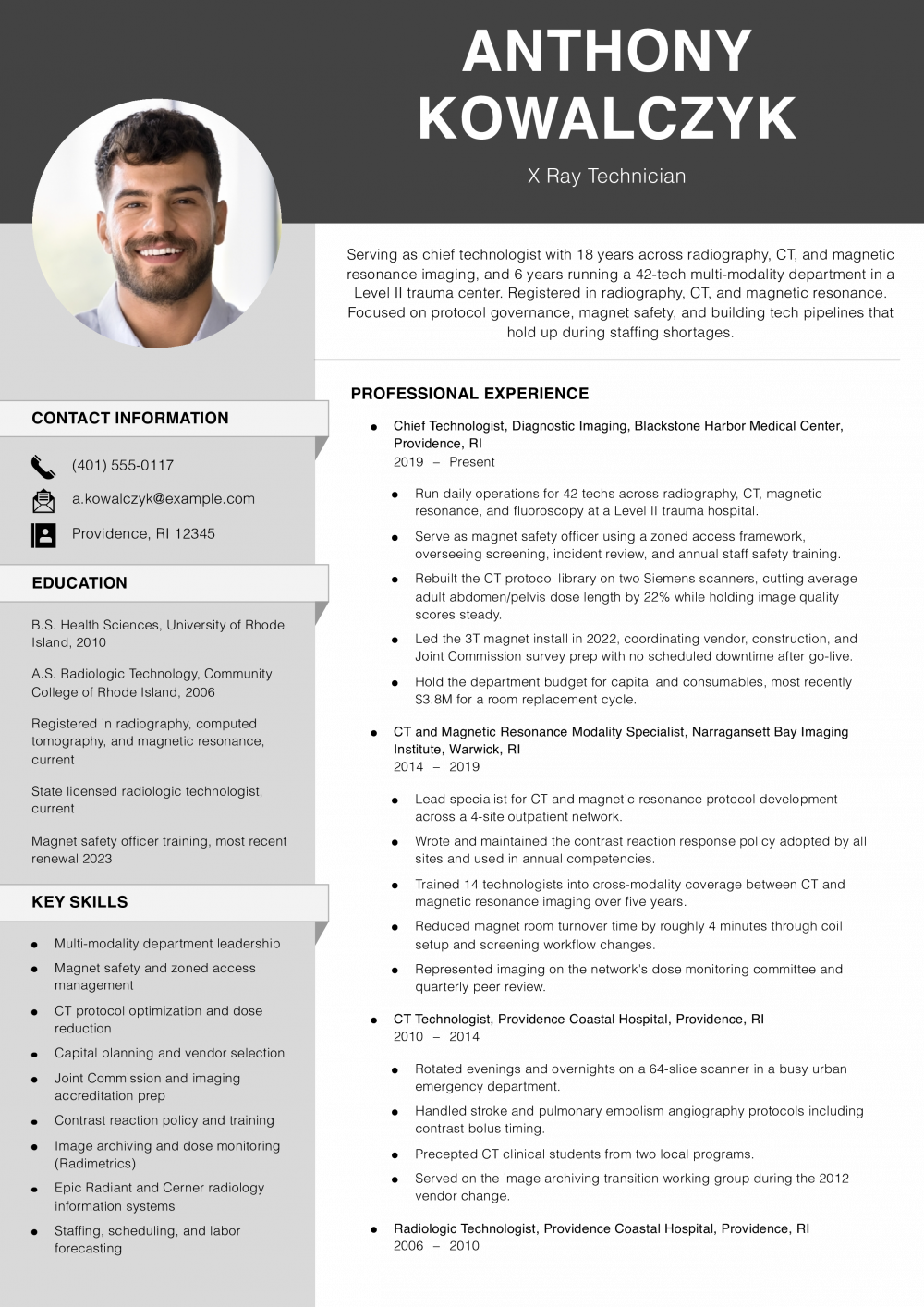
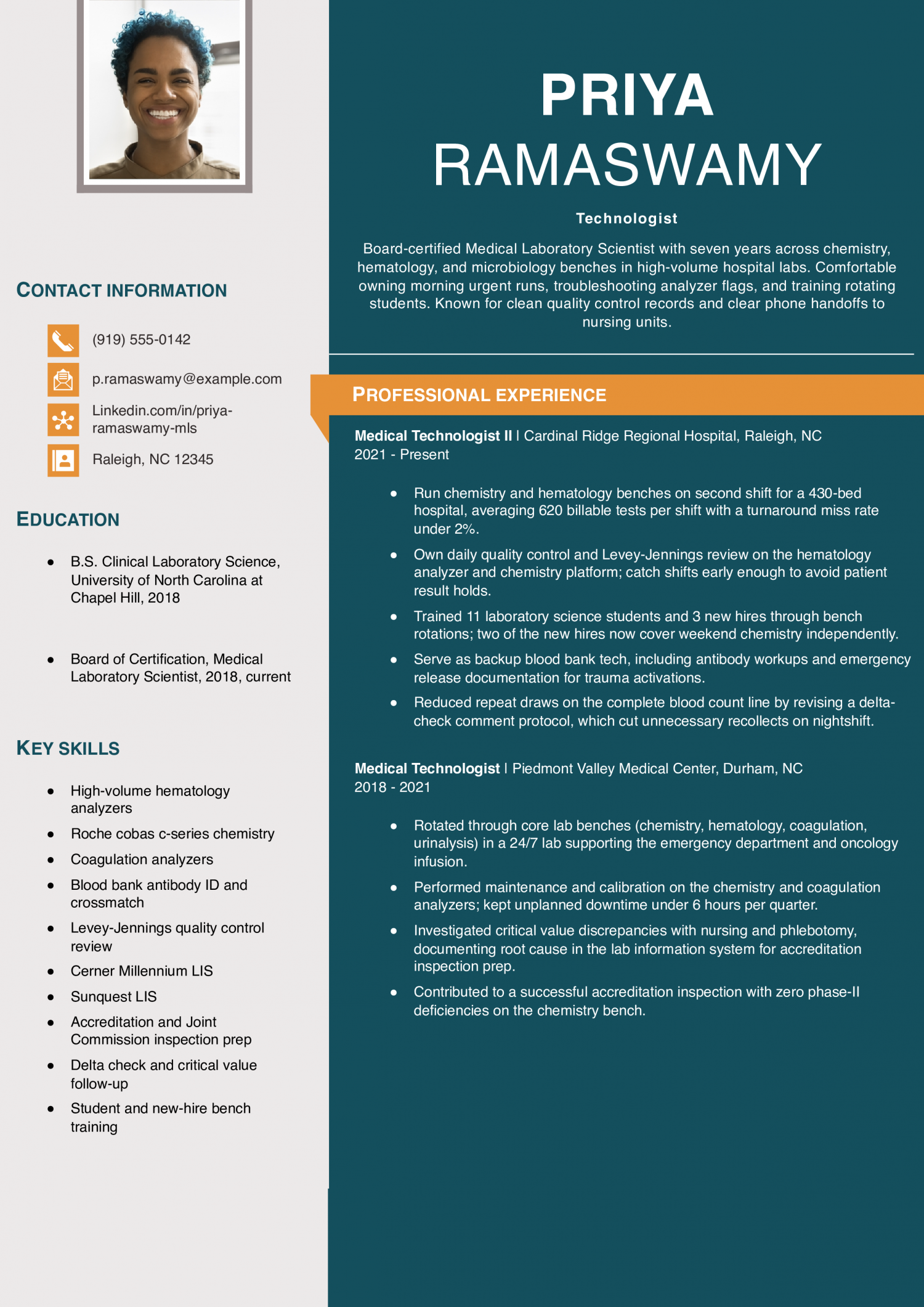
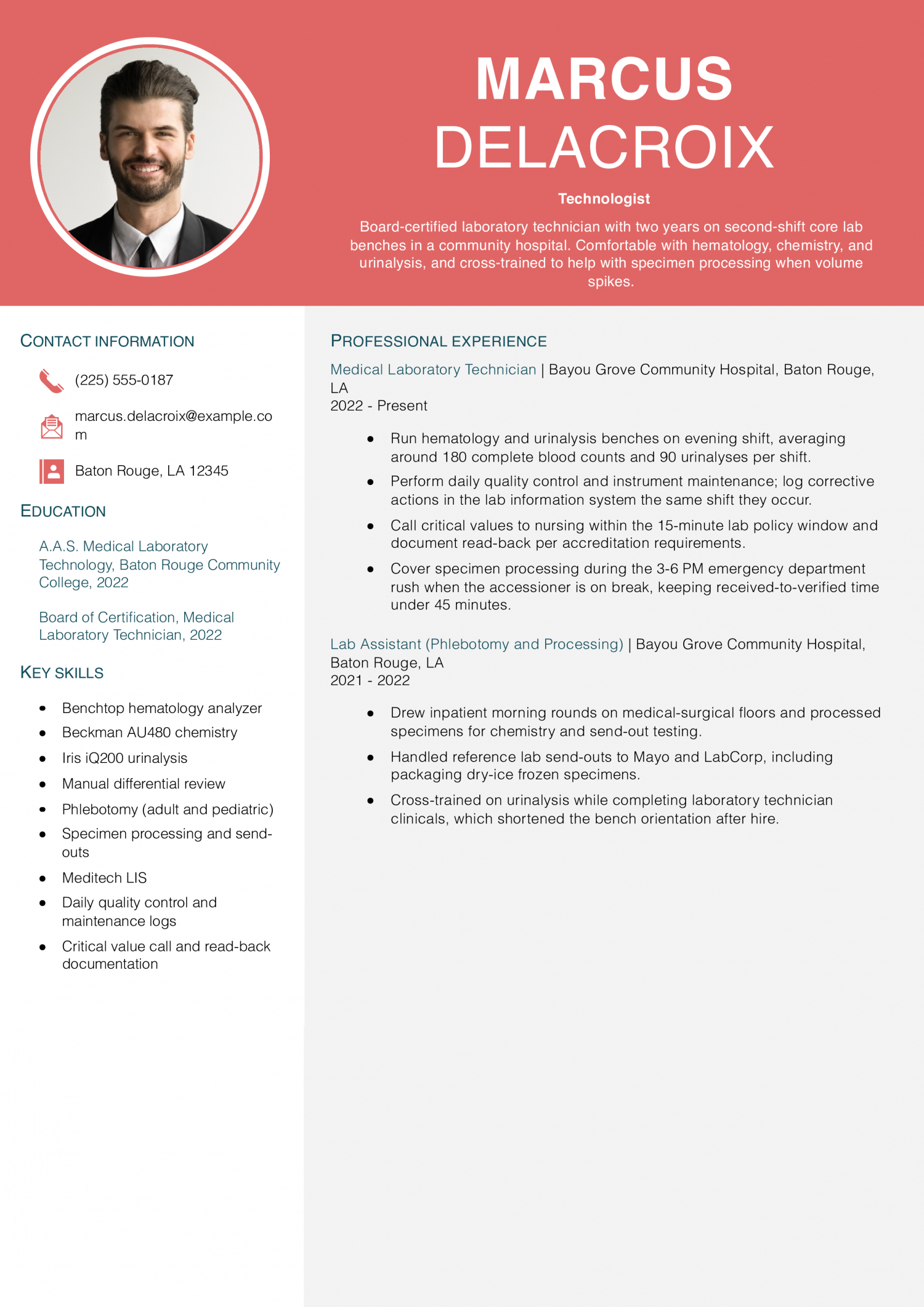
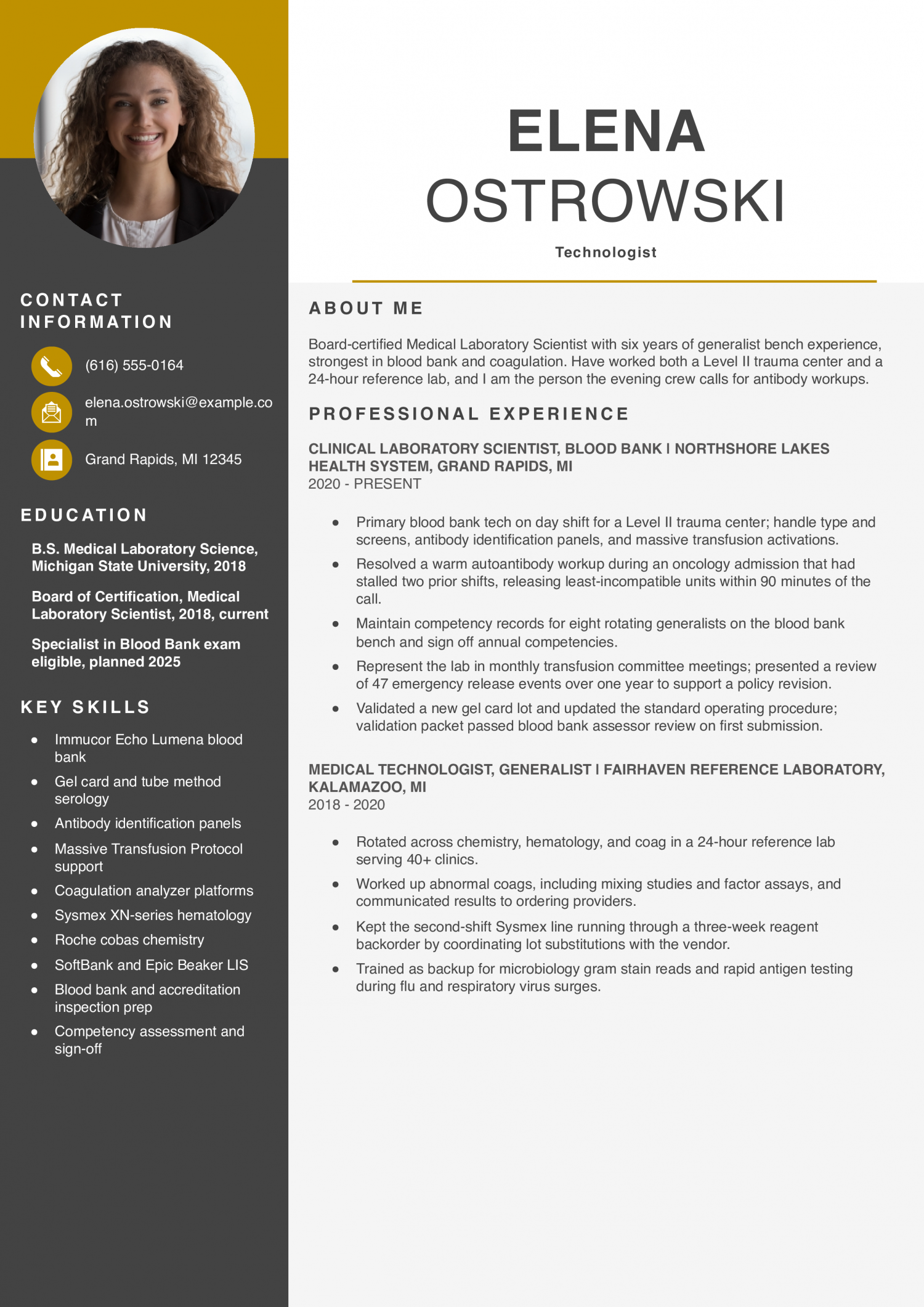
Instrument proficiencies listed by platform, proficiency-testing metrics tied to real assays, and a state license line at the top are what lab managers and clinical laboratory directors screen for before any Technologist resume advances.
At the MLT stage, your resume should show you can run routine blood, chemistry, and urine tests with a lead tech nearby. Lab leads want to see careful sample handling, daily quality checks, and clean machine logs.
As a Med Tech or Clinical Lab Scientist, your resume must show solo bench work across units and sound calls on odd results. Show method checks, skill records, and clear talks with the doctors who order the tests.
As a Lead Tech or Lab Supervisor, your resume needs to show you run a shift, coach staff, and own audit prep. Lab leads want skills test oversight, shift coverage, and fix up follow through.
Yuki Andersen-Reyes
Portland, OR | (503) 555-0176 | [email protected] | linkedin.com/in/yuki-andersen-reyes-mls
MLS(ASCP) with nine years of hospital and reference lab experience across chemistry, hematology, coagulation, and molecular microbiology. Comfortable owning bench workflow, training new hires, and representing the lab in nursing and infection control meetings. Currently the day-shift lead for a hospital core lab supporting ED, oncology, and a 12-bed ICU.
Lead Medical Laboratory Scientist, Day ShiftCascade Bluff Regional Hospital | Portland, OR | 2022-Present
Medical Laboratory Scientist II
Cascade Bluff Regional Hospital | Portland, OR | 2019-2022
Medical Laboratory Scientist
Willamette Crossing Reference Laboratory | Beaverton, OR | 2017-2019
Medical Laboratory Scientist, Nightshift
Harbor Point Community Hospital | Astoria, OR | 2015-2017
The first line of your summary should name the daily test volume you carry and the instrument platforms you run. Lab managers and clinical laboratory directors read this as your readiness to cover a bench from day one. Say the sections you work, the shift type you hold, and your accuracy or turnaround record.
A line like 250 chemistry and hematology samples per shift with a 98 percent first-pass rate lands harder than years of experience. Name the accreditation your lab reports under so the reader places your work fast. Keep the sentence short and factual.
Save soft traits for later. The metric earns you the second read, and the second read is where the rest of the resume gets its chance.
Most strong technologist bullets carry a number, since bench work is countable by nature. Recruiters scan for daily sample volume, turnaround time, quality control pass rate, and instrument uptime first. Pick two or three metrics per role and hold them steady across bullets so the reader can compare.
Write 180 blood counts per shift with a 30-minute urgent turnaround, not high-volume hematology experience. Drop the volume or turnaround number and a bullet blurs into the next one on the page. If you led a validation or method transfer, name the assay, the sample count, and the go-live date.
When exact figures are not yours to share, give an honest range or a scope word like batch size or run frequency.
Sort your bullets so a reader sees your range in one pass. Four categories cover most technologist roles well. First, testing and result reporting by department, such as chemistry, hematology, coagulation, urinalysis, microbiology, or blood bank.
Second, quality control and proficiency testing, including Levey-Jennings review, corrective action, and survey handling. Third, instrument work, meaning daily maintenance, calibration, troubleshooting, and vendor service coordination. Fourth, method validation, lab information system builds, and training of new staff or students.
Under each category, lead with the assays and analyzers you own, then the volume, then the outcome. This structure lets a lab manager confirm bench fit in under a minute and see where you can grow into lead or supervisory work.
Lab managers screen for license and certification status before they read a single bullet. Put a short credentials block under your name with your state license status, your certification, and your categorical or generalist scope. List the analyzers and lab information system you run right below, since platform fit often decides the interview.
Name the vendor and model of your hematology, chemistry, and other analyzers, along with the lab information system you use. Add the accrediting body your lab reports to. Keep this block scannable and factual, not prose.
Do not print your license number on the resume. State plus license in good standing is the standard the field expects.
End with a tight education section and a skills list that mirrors the posting. Name your degree, your accredited program if that applies, and your clinical rotation sites with dates. New graduates should list rotation hours by department so a lab manager can see bench exposure.
If you sat for a categorical certification, note the scope, such as hematology, chemistry, or microbiology. Skip high school and unrelated coursework. Your skills list should hold assays, instruments, lab system names, and quality tools, not soft traits.
Keep it to one column and no more than 15 items so the reader takes it in at a glance. A short, honest closing block reads stronger than a padded one.
Five years ago, a technologist resume read like a bench duties list. The mix has shifted toward instrument platforms, QC ownership, and LIS fluency. Recruiters now scan for named systems before they read a single bullet.
Lab managers and clinical laboratory directors weight hard skills first for screening. They read soft skills after as proof that the hard skills hold up. They want quality control paired with clear communication across shifts and disciplines.
Soft skills only count when your bullets show them at work on a bench. Pull the two tables against your target job posting side by side. Mirror the exact wording the posting uses, down to the analyzer name.
If the ad says Sysmex, do not write hematology analyzer instead. Move any term you can prove into your summary or a bullet. Leave terms you cannot prove off the resume, because a screen will surface them.
Treat the tables as a checklist, not a menu to pick from.
| Soft Skills | AI-estimated % |
|---|---|
| Analytical precision | 72% |
| Detail orientation | 52% |
| Cross-department collaboration | 50% |
| Results interpretation judgment | 39% |
| Time management | 29% |
And here are the top hard skills showing up most often.
| Hard Skills | AI-estimated % |
|---|---|
| Body fluid analysis | 78% |
| Blood cell morphology | 59% |
| Laboratory equipment calibration | 44% |
| Quality assurance monitoring | 39% |
| Quality assurance monitoring | 30% |
Skill names and rankings come from an AI model grounded in U.S. Department of Labor occupation data for technologists, not from a count of technologists’ resumes built on ResumeTemplates.com.
The items below are what separate a technologist resume from one that gets put back in the pile.
Technologist work spans several bench areas, and each one has its own vocabulary. Lab managers and clinical laboratory directors scan for the terms their department runs on. A histology lead reads for stains and microtomy. A blood bank lead reads for antibody work and crossmatches. Molecular teams read for assay validation and library prep. Pick the rows that match your bench. Then match your resume to how your lab writes those terms. Keep instrument names in their trade capitals. Group the terms near the work you did. That gives the ATS and the reader the same signal.
| Niche | Keywords ATS scans for |
|---|---|
| Clinical chemistry | Beckman DxC, electrolyte panels, quality control review |
| Hematology and coag | Sysmex analyzer, peripheral smear, coagulation testing |
| Blood bank | antibody screen, crossmatch, transfusion standards |
| Molecular diagnostics | assay validation, library prep, inspection readiness |
| Histology | H and E staining, microtomy, immunohistochemistry |
BLS does not publish separate figures for SOC 29-2011 in this release. The numbers below are for the closest published match, SOC 29-2010, which BLS reports together with related occupations.
Technologist pay spreads wide across the country. The 90th percentile earns roughly 60 percent above the median, while the 10th percentile sits about 38 percent below it. That gap is much larger than a normal seniority curve.
It points to modality, setting, and specialty mix as the levers that separate top pay from floor pay. National employment in the field is large, so the sample is stable and the spread is real. Two people with the same title can sit in very different pay bands based on what they run and where.
Frame your resume around the modalities, instruments, and case types you own by name, not around years on the job.
| # | State | Avg. Annual |
|---|---|---|
| 1 | New York | $83,010 |
| 2 | Oregon | $83,010 |
| 3 | New Hampshire | $81,020 |
| 4 | Massachusetts | $79,120 |
| 5 | Vermont | $78,680 |
| 6 | District of Columbia | $76,560 |
| 7 | California | $76,010 |
| 8 | Rhode Island | $75,780 |
| 9 | Minnesota | $74,440 |
| 10 | Minnesota | $72,760 |
| # | State | Workers | Median |
|---|---|---|---|
| 1 | Texas | 29,530 | $59,290 |
| 2 | California | 29,210 | $76,010 |
| 3 | Florida | 25,790 | $60,510 |
| 4 | New York | 16,460 | $97,280 |
| 5 | North Carolina | 13,710 | $60,650 |
Resume Templates offers HR approved resume templates to help you create a professional resume in minutes. Choose from several template options and even pre-populate a resume from your profile.
Use the exact title your employer put on your paycheck or badge, and match it in the header line.
If your registry credential is more specific, like registered radiologic technologist, put that in the credentials line and keep the plain title in the work history.
Put the credential on its own line under your name, and add your state license line under it.
Repeat the credential in a short certifications section near the top of page one, with the issue year.
It needs the analyzer platforms you have run, the complexity level of your bench, and the specimen volume per shift.
Lab managers read those three lines to place you on a chemistry, hematology, or microbiology bench before anything else.
Lead with a two-line summary naming the platforms and languages you build in, then link a portfolio in the header.
Under each job, name the product you shipped, the team you sat with, and one measurable result the work drove.
Name the degree, the registry exam status, and the rotations you completed by hour count.
A clinical laboratory director reads a new-grad summary for eligibility and rotation coverage, so those items belong in the first two lines.
No. List the analyzers you ran unsupervised on a scheduled shift, and group them under the bench they belong to.
A long list of platforms you only cross-trained on reads as padding and pushes the real bench work off page one.
Show the license with its state, the status as inactive, and the year you last renewed it.
Under the license line, add one sentence naming the reinstatement steps you have started, such as continuing education hours completed toward renewal.
For a technologist, an ATS-friendly template is the safest pick, because it puts your certifications and experience where a hiring manager scans first. A basic template is a solid alternative. Whichever you choose, keep the formatting clean and easy to parse: clear section headings, a standard font, and no graphics a parser can choke on.