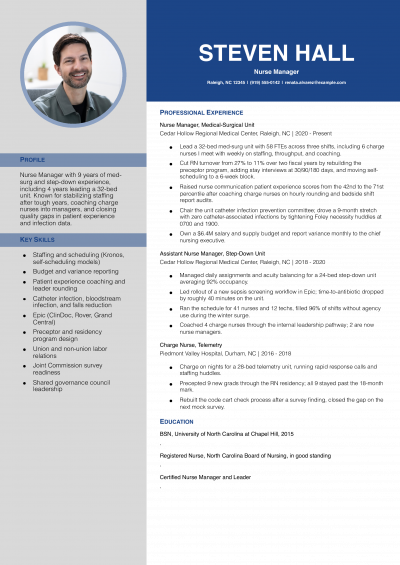
Nurse Manager Resume Examples
Your profile should sit at the top of page one and name the scope you manage. State your years in nursing leadership, the setting you run, and the size of your team. Setting means med-surg,…
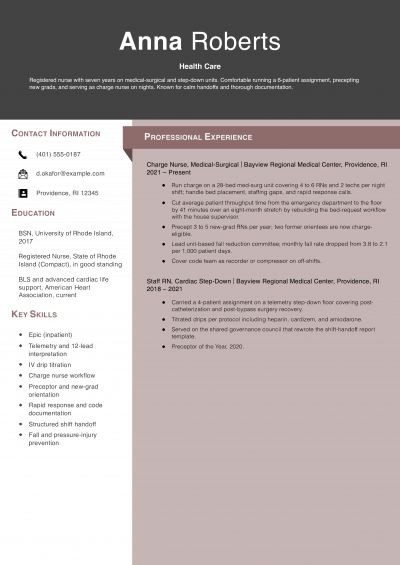
Every resume example is written and reviewed by our team of Certified Professional Resume Writers to ensure top-quality content and formatting.
Your resume has to prove you can run a facility, not only work in one. Hospital COOs and health system executives look for gains in patient throughput, cost per case, and staff retention. They want to see FACHE credentials or CPHQ standing next to real operating results.
Quantify what you controlled: beds managed, budget size, and quality scores you moved. Roles at the 90th percentile now pay above $224,000, so competition for those seats is steep. The healthcare management resume examples below show how to present that proof clearly. To compare layouts before you start, browse our resume templates.
A verified FACHE credential or state licensure line is what gets healthcare management resumes past the credentialing screen; quantified operational metrics like margin improvement or patient volume growth are what make them readable enough for hospital COOs to advance.
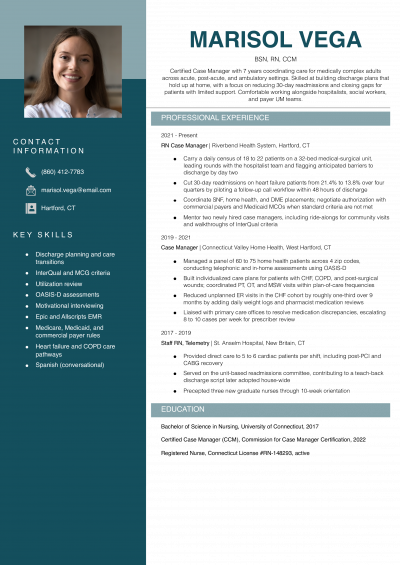
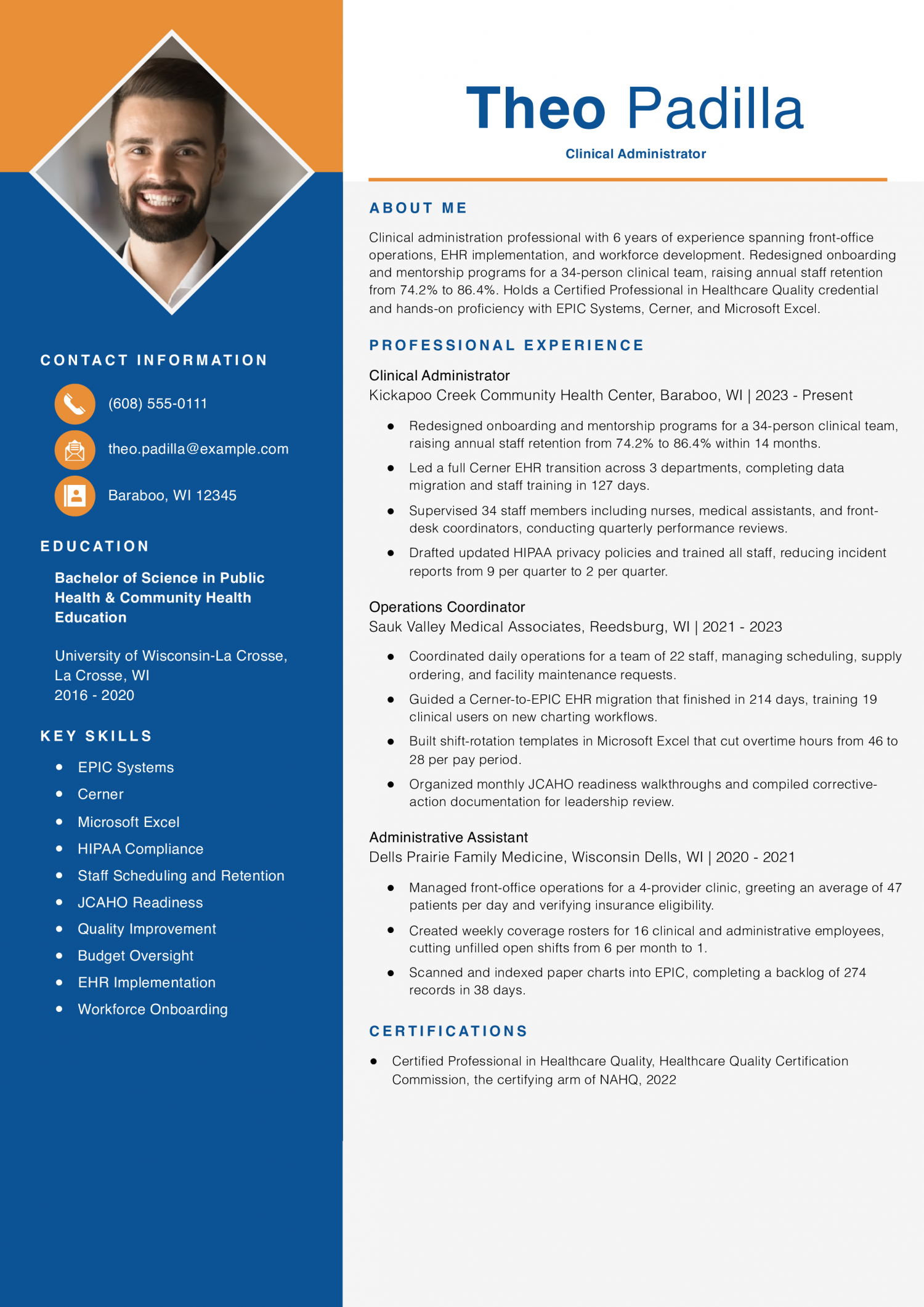
Pick this resume if you are a mid-level clinical administrator who has moved from front-office coordination into full team oversight. Lead with retention improvements that cite both the before and after rates, as this resume does.
The EHR migration bullet names the systems involved, the timeline, and how many clinical users were trained on the switch. A hospital executive can judge the project size in one read. When you describe a technology rollout, name the old and new platforms, the duration, and the training reach.
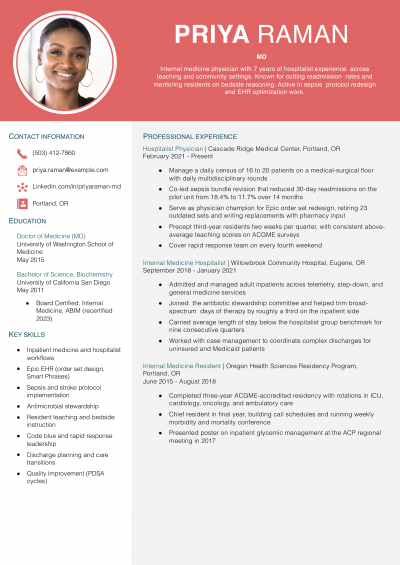
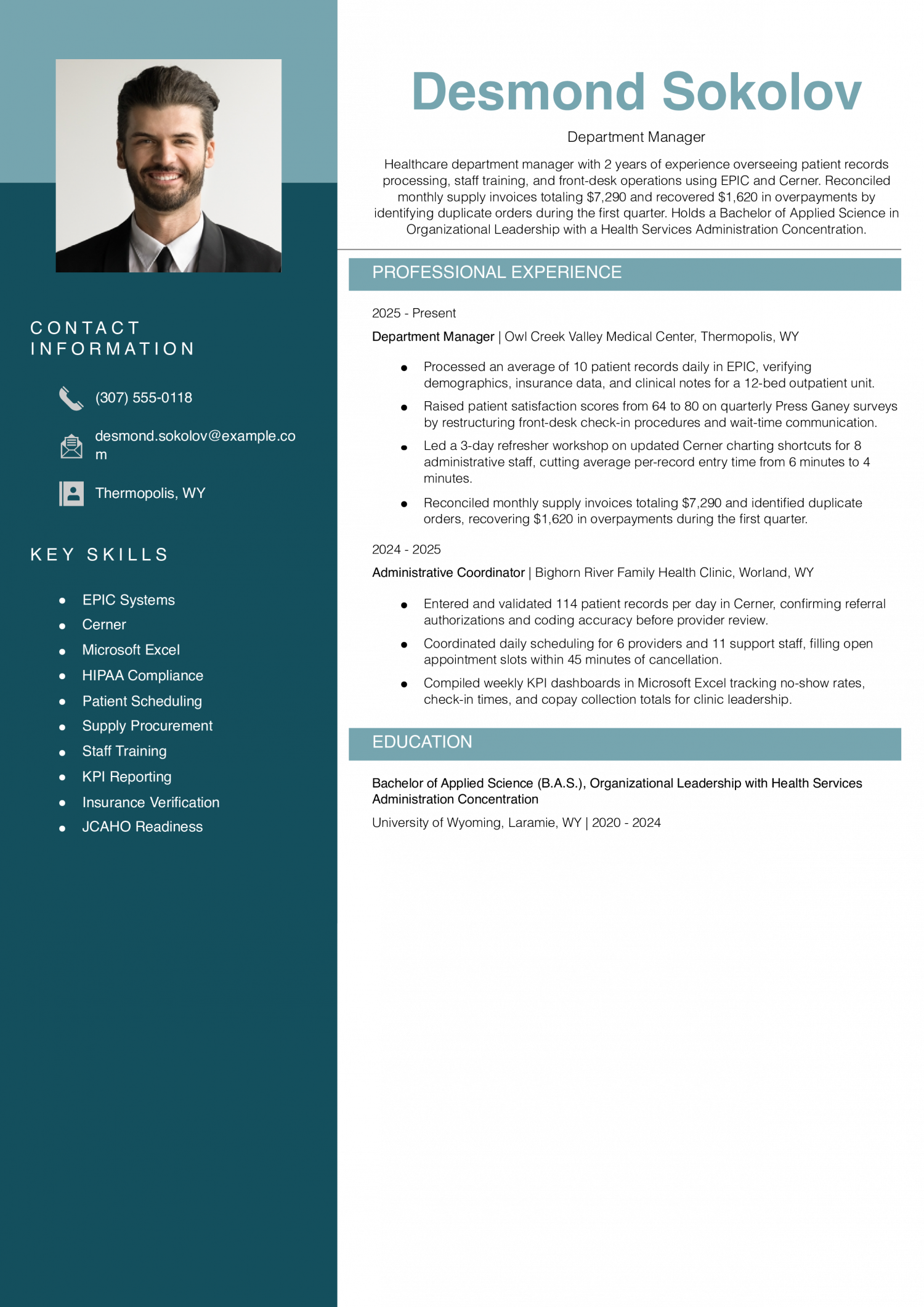
Start with this resume if you are an entry-level department manager stepping into your first supervisory role in a clinical setting. Lead with supply cost recoveries and patient satisfaction gains rather than listing routine administrative duties.
Per-record entry time dropped after a training session, shown as a before-and-after comparison. A clinic director knows the workshop had a measurable result on daily work. When you lead training, measure one task before and after so a reviewer can see what the class actually changed.
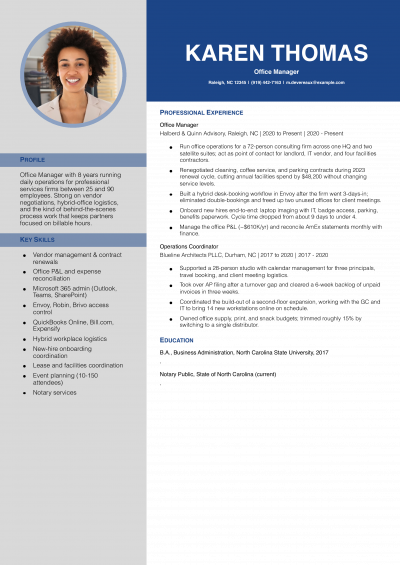
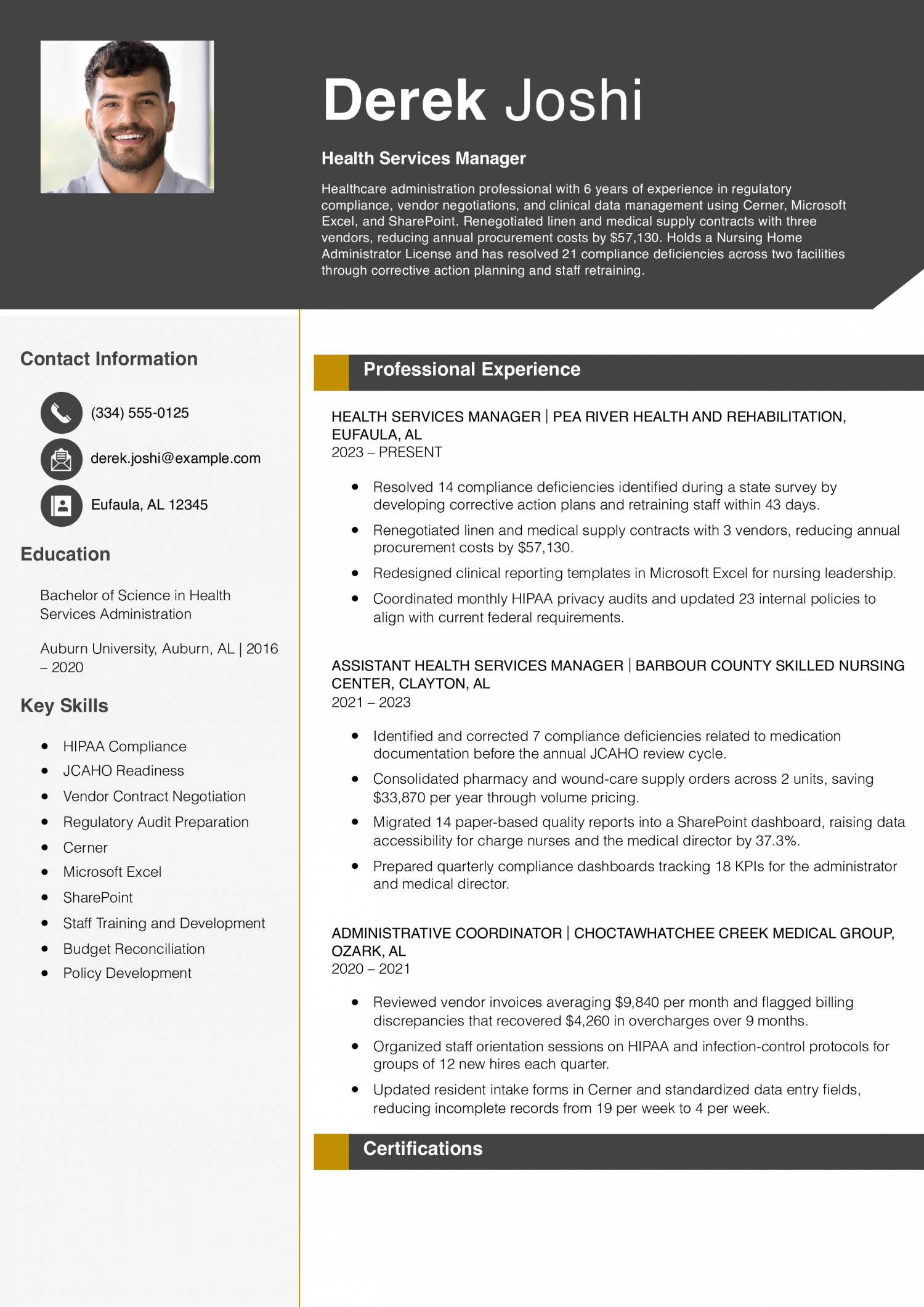
Try this resume if you are a mid-level health services manager who has moved from coordination into facility-wide compliance and budget ownership. Lead with vendor savings figures tied to the contract terms you personally renegotiated.
Compliance findings from a state survey were fixed with corrective action plans and staff retraining, all within a deadline. A hospital hiring manager can see the survey findings were closed on time. State the number of issues, the actions you took, and the time you needed to close them.
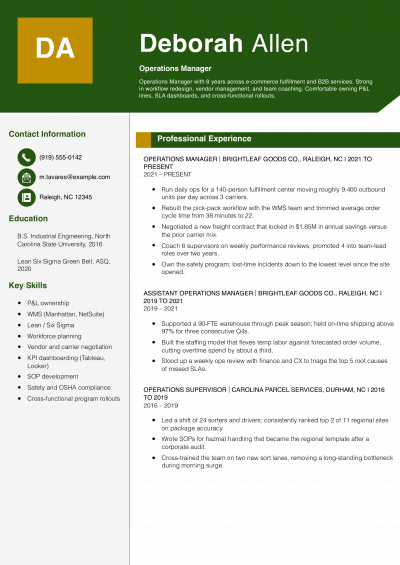
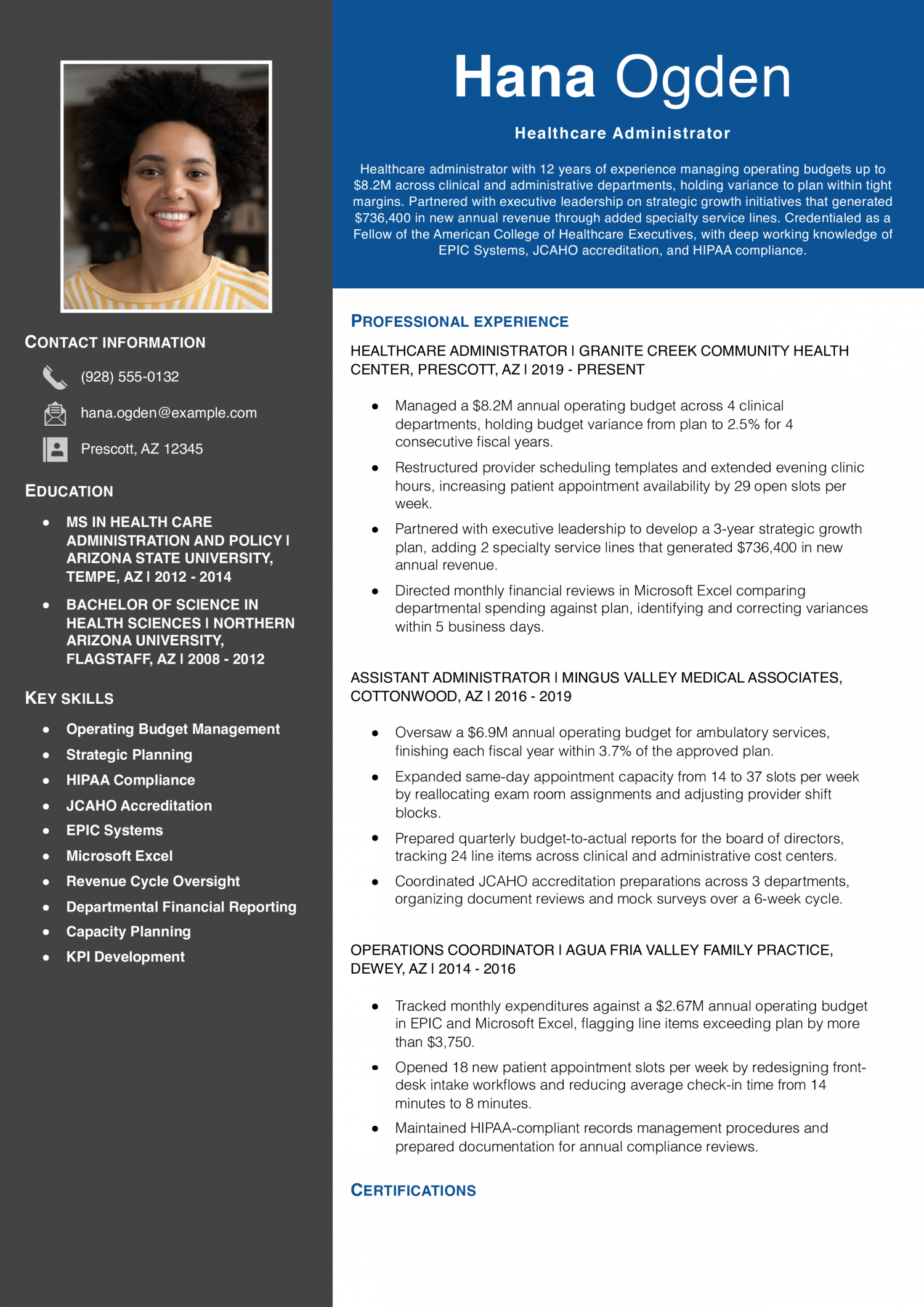
Lean on this resume if you are a senior healthcare administrator overseeing multi-department budgets and long-range growth planning. Lead with the dollar size of the budget you controlled and the variance percentage you maintained against plan.
The schedule change opened more appointment slots each week, showing a steady improvement. A department head can picture the extra patients seen because of that change. If you improved scheduling, say how many slots opened and how often the gain repeated.
Healthcare coordinator with 6 years of experience in multi-provider clinic operations, referral coordination, and records management using EPIC Systems and Microsoft Excel. Closed fiscal year 2025 with a $68,470 budget surplus by renegotiating service contracts and monitoring monthly departmental spending. Skilled in HIPAA compliance, staff scheduling, supply procurement, and KPI reporting.
Your state license confirms you can run a facility. It does not reveal your edge. Add a single line near your name that sets you apart.
That line might be a FACHE credential or fluency in Mandarin. It could be deep experience in behavioral health turnarounds. Pick the one detail a competing candidate is unlikely to share.
Hospital COOs and health system executives review dozens of resumes per search. Most list the same master’s degree and the same broad title. A differentiator line forces a pause on your page.
Place it right below your contact information. Keep it to one sentence or a short phrase. This small move frames every bullet that follows.
Strong healthcare management resumes lean on hard data. Start each bullet with a metric the C-suite tracks. Annual operating budget is a clear one.
Patient satisfaction percentile is another. Staff retention rate belongs in its own bullet. Readmission reduction works well for quality-focused roles.
A phrase like “oversaw daily operations” tells a COO nothing new. Swap it for “cut ER wait times 18% across a 220-bed facility.” Most strong resumes carry at least five numbered bullets.
Spread them across your last two or three positions. If exact figures are confidential, use ranges or percentages instead. Even a rough number beats a vague claim, so estimate when you must.
Healthcare management covers a wide scope of tasks. Sorting your bullets into categories helps readers scan fast. Use three to five groupings based on the role.
Operations bullets cover staffing models, bed capacity, and throughput. Financial bullets address budget oversight and revenue cycle results. Quality and compliance bullets show audit outcomes and accreditation results.
Patient experience bullets highlight survey scores and service redesigns. Strategic growth bullets cite new service lines or partnerships. Label each group with a bold subheading if the posting is senior.
This structure mirrors how health system executives think about performance. It also keeps your resume from reading like one long task list.
List your top credential on page one, near your name. The FACHE from the American College of Healthcare Executives signals senior readiness. The CPHQ from the Healthcare Quality Certification Commission signals quality focus.
A Nursing Home Administrator License, required in many states, confirms regulatory standing. Do not bury these in a footer or a second page. Hospital COOs and health system executives often skim the top third only.
Add a short credentials block right after your summary. Include your state license status without printing the license number. Below that block, list software you use daily.
Epic, Cerner, and Workday are common in this field. Separate tools from credentials so each line stays clean.
Senior healthcare management resumes grow long over time. Trim roles that predate the current regulatory landscape. A position from 2007 rarely reflects today’s value-based care models.
Keep your resume to two pages at most. Remove outdated software, expired certifications, and early-career task lists. If an old role held a notable achievement, fold it into your summary.
Hospital COOs and health system executives want recent proof of impact. They care less about where you started. Drop references to software that your target system no longer uses.
Cut committee memberships that did not produce a measurable result. Every line should answer one question: does this show current readiness?
Five years ago, a healthcare management resume read like a list of compliance terms. The mix has shifted toward operational metrics and patient outcomes. Financial modeling now appears alongside quality improvement on strong resumes.
Hospital COOs and health system executives weigh hard skills to gauge your command of daily operations. They also look for soft skills that prove you can lead diverse clinical teams. A skill like strategic planning signals you can set direction for a unit or facility.
Conflict resolution shows you can hold teams together under pressure. Cross-reference both tables against the job posting you are targeting. Mirror the exact phrasing the posting uses for each skill.
Treat soft skills as evidence you should back up with numbered bullets in your experience section.
| Soft Skills | AI-estimated % |
|---|---|
| Cross-functional leadership | 70% |
| Stakeholder communication | 58% |
| Decision-making under pressure | 40% |
| Team development | 37% |
| Adaptability to change | 35% |
And here are the top hard skills showing up most often.
| Hard Skills | AI-estimated % |
|---|---|
| Healthcare budget management | 68% |
| Staff scheduling coordination | 50% |
| Regulatory compliance oversight | 46% |
| Clinical operations planning | 38% |
| Health records management | 25% |
Skill names and rankings come from an AI model grounded in U.S. Department of Labor occupation data for health services managers, not from a count of health services managers’ resumes built on ResumeTemplates.com.
Start with your continuing education.
Hospital COOs review your learning history closely. Ongoing training signals that you stay current. It also shows readiness for larger operational scope.
FACHE status from ACHE requires continuing education credits. CPHQ holders must also renew through approved learning. List each course with its date and provider.
Group them under a clear heading on your resume.
HIPAA expertise matters for every healthcare manager role. Health system executives expect proof of compliance work. Show results, not general awareness.
HIPAA Results Belong in Your Experience Section
Name the specific HIPAA rules you enforced. Cite audit outcomes or breach reduction rates. Keep each bullet tied to a measurable result.
You could overstate it by calling yourself an AI-driven leader. You could leave it off and address it only in the interview.
Or you could describe the real process you follow. That option is what Hospital COOs and health system executives can validate. They will ask how you used the tool.
They will ask what data you fed it. They will want to know what you checked before acting. Describe the actual step, the tool, and the result.
Keep each claim tied to a decision you made.
What AI is actually changing for this role
Patient flow: Predictive models now flag likely admission surges so managers can adjust staffing hours in advance.
Quality reporting: Automated text tools scan clinical notes to code quality indicators, cutting manual chart review time.
Budget forecasting: Machine learning models project supply costs and volume trends with fewer manual spreadsheet assumptions.
Staff scheduling: AI scheduling platforms balance shift coverage against overtime limits and credential requirements automatically.
AI tools to name
How to phrase AI on your resume
Do
Skip
Hospital COOs and health system executives read this list as a map of where your work is heading. The items below tell them which side of care you have put time into. A quality credential points one way.
A senior fellowship points another. Each one helps them see your next role. They also check how current you are in the field.
List the issuing body, the year you earned it, and any renewal date on one line per credential. Place the most relevant credential first so readers see it before they scan down. If you hold a state license, note the state but do not print your license number on the resume.
Keep each entry to one line so the section stays clean and easy to read at a glance. A short, clear list shows that you invest in growing your career on purpose.
About These Numbers
The Bureau of Labor Statistics does not publish a wage code for Healthcare Management specifically. The numbers below are a proxy: the closest published match is Medical and Health Services Managers (SOC 11-9111), so use them as an estimate for this role, not an exact figure.
Healthcare management is one of the larger occupations tracked by BLS, which means the median pulls in a long tail of entry-tier and smaller-facility variants. The spread between the 10th and 90th percentiles is wide. Workers near the top out-earn those near the bottom by a large margin.
That gap reflects how broad the BLS category is. It covers clinic supervisors, nursing home administrators, and hospital vice presidents alike. Geographic concentration matters too, with pay varying sharply across states.
On your resume, lead with the size and type of facility you have managed, stated in bed count or annual operating budget.
| # | State | Median Annual |
|---|---|---|
| 1 | New York | $164,120 |
| 2 | District of Columbia | $155,140 |
| 3 | Hawaii | $147,630 |
| 4 | New Jersey | $145,650 |
| 5 | Washington | $145,290 |
| 6 | Oregon | $141,690 |
| 7 | California | $141,480 |
| 8 | Colorado | $134,910 |
| 9 | Delaware | $134,820 |
| 10 | Massachusetts | $134,360 |
| # | State | Workers | Median |
|---|---|---|---|
| 1 | California | 75,090 | $141,480 |
| 2 | Texas | 58,420 | $114,150 |
| 3 | Florida | 42,700 | $120,360 |
| 4 | New York | 33,200 | $164,120 |
| 5 | Pennsylvania | 30,480 | $103,670 |
Resume Templates offers HR approved resume templates to help you create a professional resume in minutes. Choose from several template options and even pre-populate a resume from your profile.
A strong healthcare management resume opens with a summary naming your setting and scope. Include details like bed count or annual revenue so executives see scale at a glance.
Follow with reverse-chronological roles that pair each duty with a measurable outcome. Metrics like patient satisfaction scores and cost reductions give Hospital COOs concrete evidence.
Mirror the language in the job posting, whether it says skilled nursing or ambulatory surgery center. Swap in the metrics that matter to that setting, such as length of stay for hospitals.
This alignment helps your resume pass both ATS filters and executive review.
Yes, budget figures give Hospital COOs a fast read on the scale you have managed. State the operating budget you oversaw and any savings you achieved.
Round to the nearest million or hundred thousand so the number is easy to scan.
Focus on the teams, projects, and committees you led rather than your job title alone. Write lines like 'Directed a 40-member team through a Joint Commission survey with zero deficiencies.'
Hospital COOs read scope and outcome, not whether your title said director or manager.
Yes, a two-page resume is common when you have ten or more years of progressive leadership. Keep the first page focused on your summary, credentials, and most recent two roles.
Move earlier positions and committee work to the second page so executives find strong content first.
Lead with a summary naming transferable skills, such as operational budgeting or regulatory compliance from another industry. Rewrite each prior role's bullets to stress outcomes that translate, like process improvement.
Add any healthcare coursework or relevant certifications to bridge the gap for reviewing executives.
Verbs like 'reduced,' 'launched,' and 'negotiated' signal decision-making authority to Hospital COOs. Pair each verb with a specific result, such as 'Negotiated contracts that cut supply costs by $1.2 million.'
Avoid vague verbs like 'assisted' or 'helped' that hide your level of ownership over the outcome.
An ATS-friendly template organizes your credentials and experience under clear headings. A basic template also works.
Healthcare Management Resume
4.9/5 stars with 238 reviews

Executive Resume Writer and Career Coach
Andrew Stoner is an executive career coach and resume writer with 17 years of experience as a hiring manager and operations leader at two Fortune 500 Financial Services companies, and as the career services director at two major university business schools.
© 2026 Resumetemplates.com All rights reserved.