Dog Walker Resume Examples
Lead your summary with how many dogs you handle per day and per week. Pet care company owners read that figure first, and it shapes their hiring decision. It tells them whether you can manage…
Every resume example is written and reviewed by our team of Certified Professional Resume Writers to ensure top-quality content and formatting.
Pet care company owners and pet owners hire based on trust. Your resume has to prove you can keep animals safe on your own. Show repeat clients, clean safety records, and the types of animals you have handled.
List concrete details like daily visit counts and medication schedules you managed. A Cat and Dog First Aid credential from the American Red Cross adds weight at any level. The pet sitter resume examples below show you how to put these details on the page. To compare layouts before you start, browse our resume templates.
Verified pet care certifications, specific animal handling experience and documented client retention rates are what separate the pet sitter resumes that pet care company owners schedule for interviews from the rest.
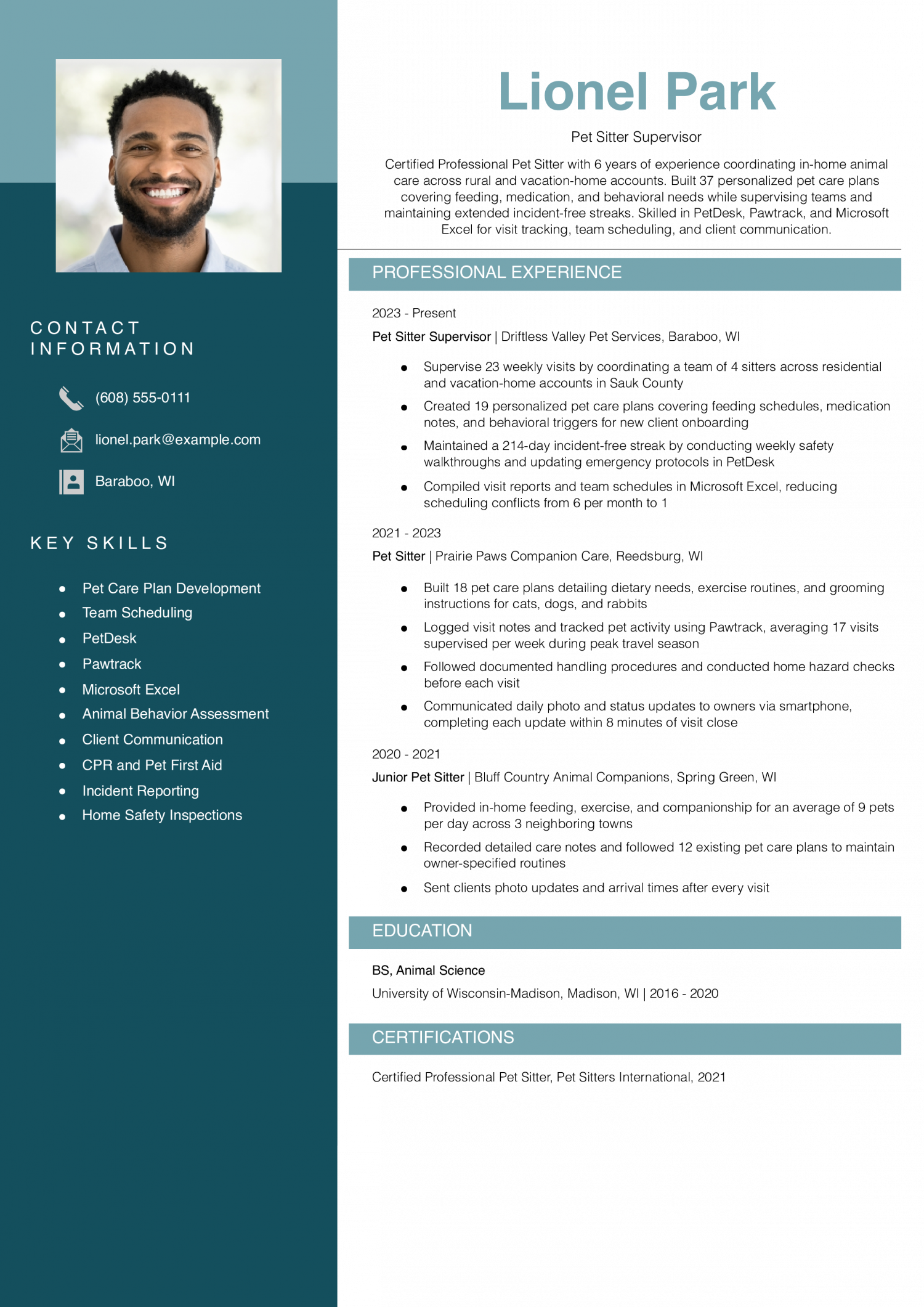
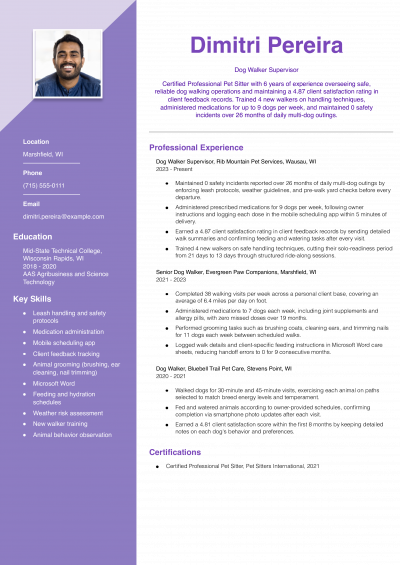
Pick this resume if you are a mid-level pet sitter supervisor who has moved from solo visits into leading a small care team. Lead with your scheduling improvements by pairing a before-and-after conflict count the way this resume does.
Safety walkthroughs logged in PetDesk tie an incident-free record to a routine a pet owner can verify. Naming the tool shows the work is tracked, not remembered. If you keep safety logs, say which app or system you use and how often you update it.
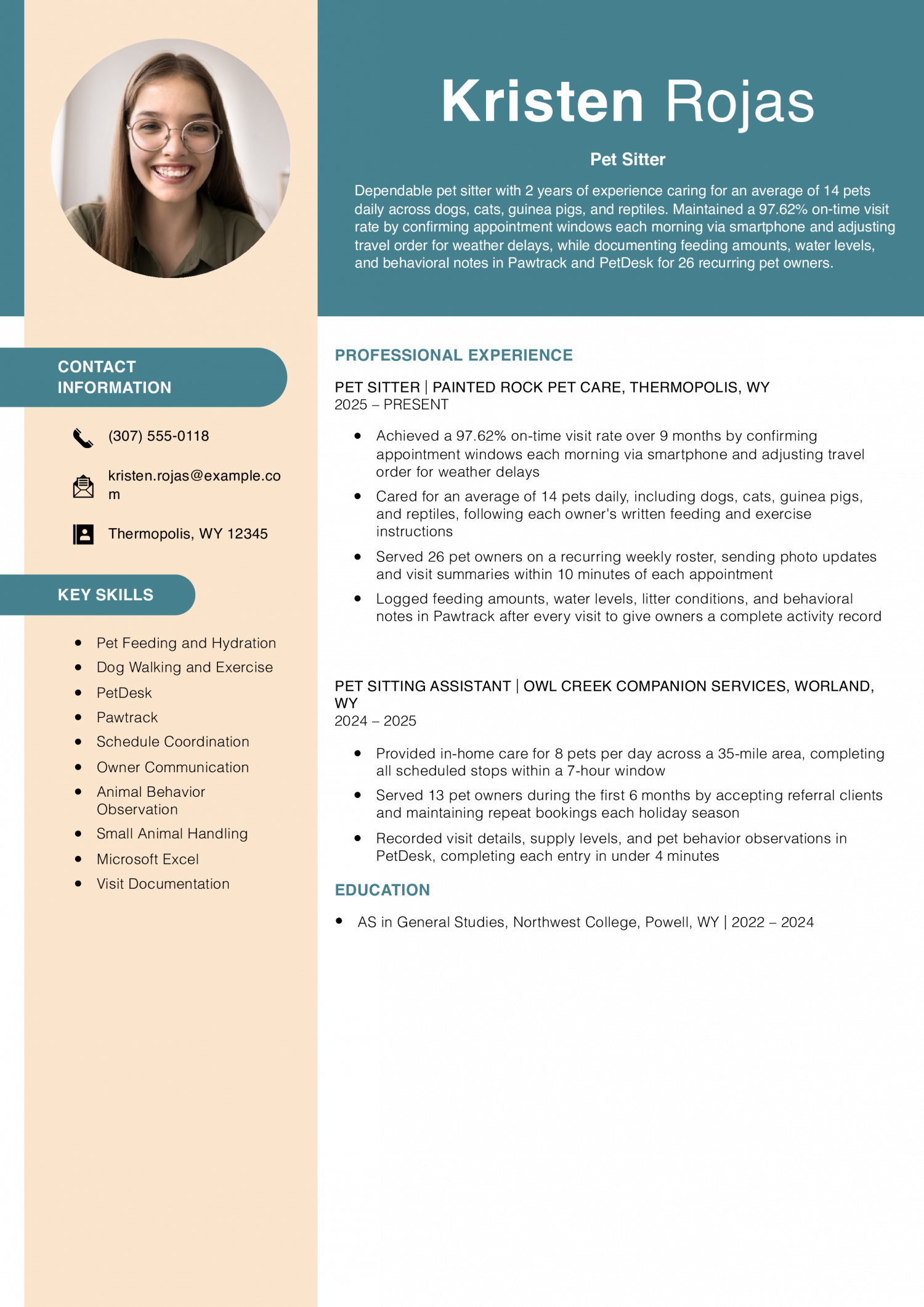
Use this resume if you are an entry-level pet sitter building a client roster from scratch. Lead with your on-time visit percentage and daily pet count to prove reliability before listing care duties.
Photo updates sent within minutes of each visit give a pet owner peace of mind while they are away. That fast follow-up is what builds trust. If you send visit reports, say how soon after each appointment they go out and what you include.
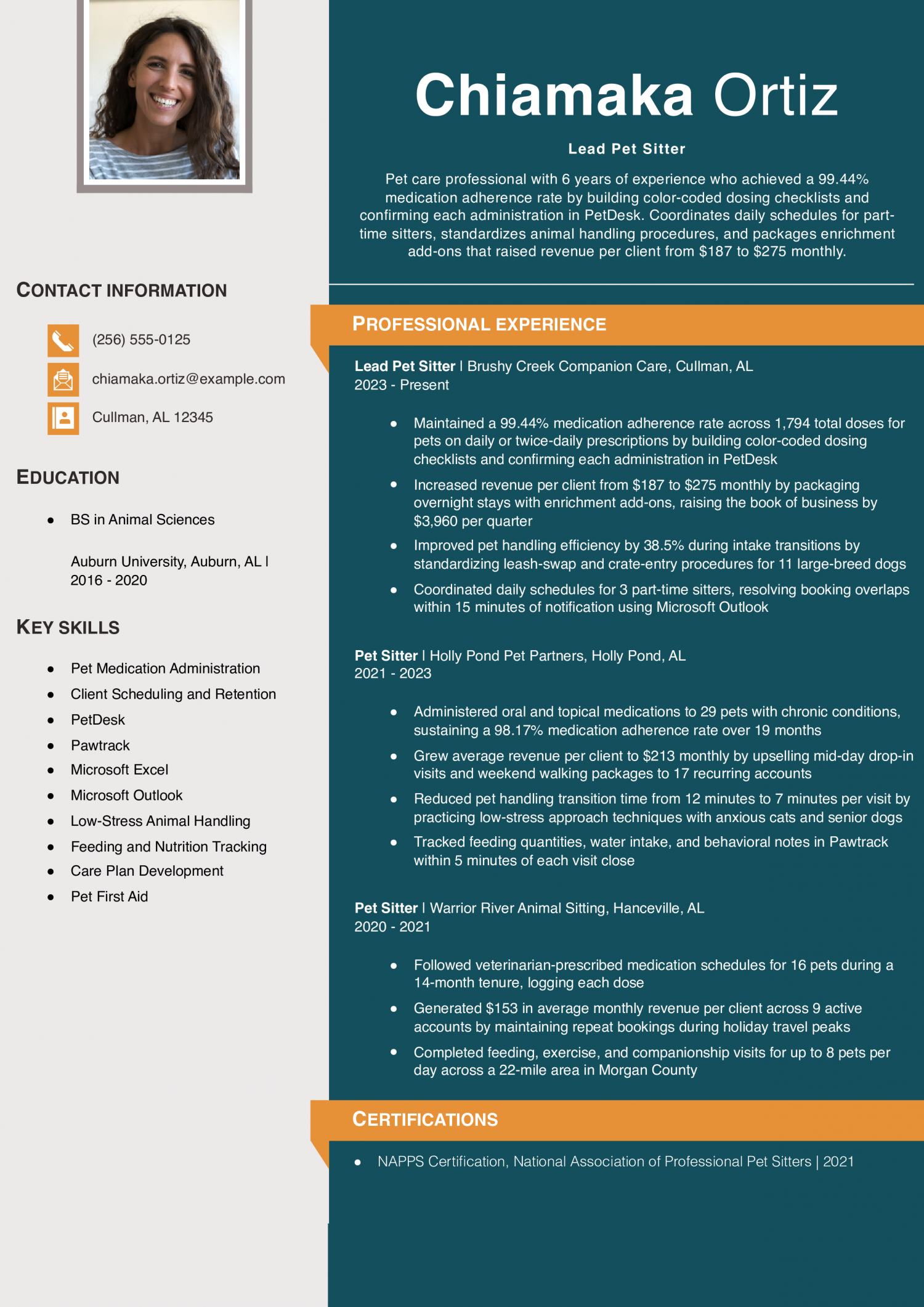
Try this resume if you are a mid-level pet sitter stepping into a lead role where you coordinate schedules and oversee medication protocols. Lead with adherence rates tracked across multiple positions the way this candidate threads that metric through three jobs.
Medication adherence over a long stretch shows a pet owner the care was steady, not hit or miss. Putting the rate next to the number of months proves the routine held. If you handle medicine for animals, track your adherence and state both the rate and the time span.
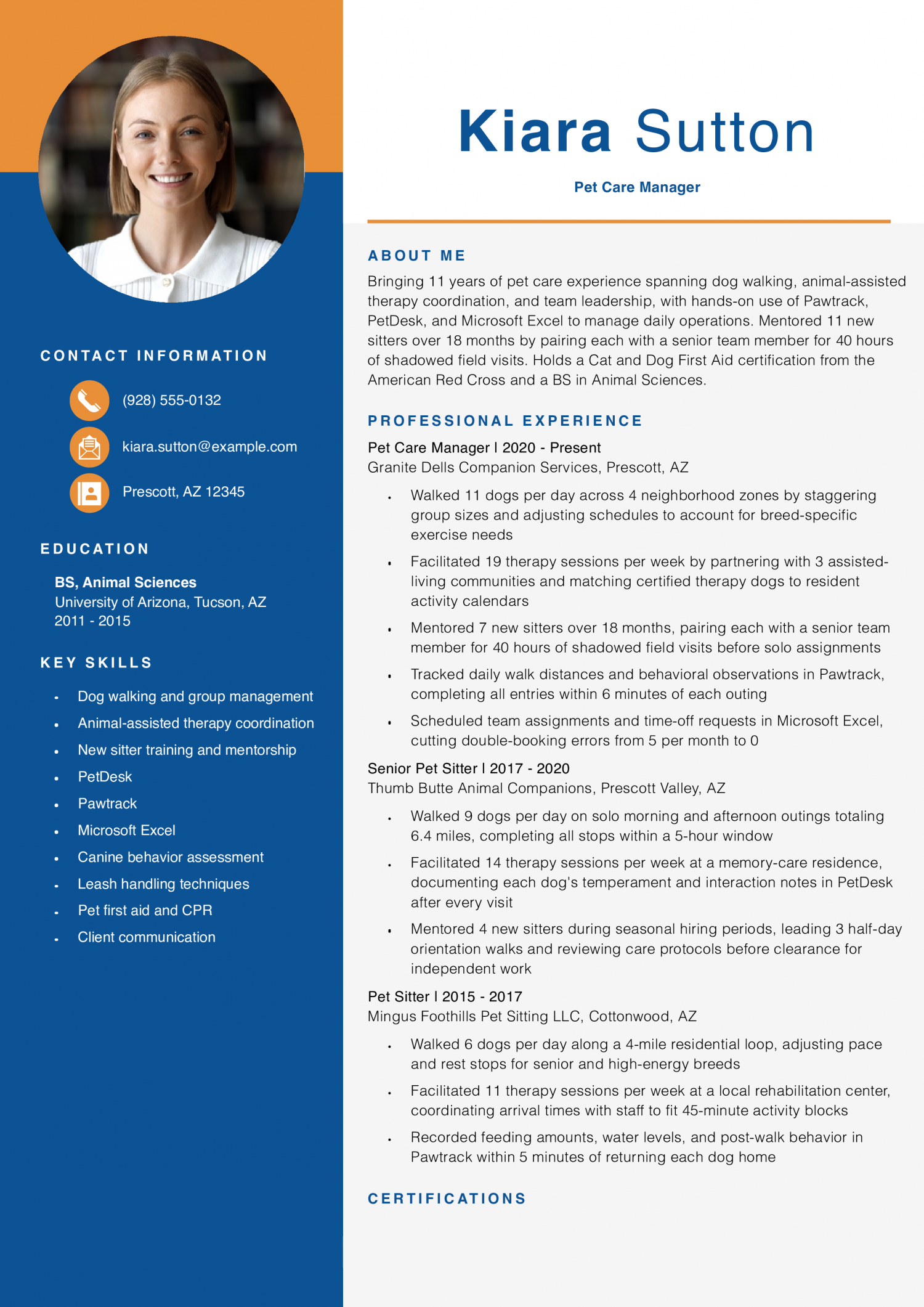
Lean on this resume if you are a senior pet care manager with a decade of experience scaling therapy programs and training staff. Lead with your mentorship structure and session volume growth across roles to show hiring managers you build teams, not only walk dogs.
Pairing each new hire with a senior team member for shadowed visits before solo work shows a real training program, not a quick handoff. A pet care company can see how the team was built. Describe your training structure by saying how many hours and what steps came before someone worked alone.
Dedicated to delivering reliable in-home pet care across 6 years of solo and coordinated visit work, maintaining a 97.69% client satisfaction rate by sending photo updates, feeding logs, and behavioral summaries within 5 minutes of each visit. Skilled in PetDesk and Pawtrack scheduling for up to 28 active accounts, with route planning that cut fuel costs by $1,130 per quarter through optimized mileage planning.
Your summary should start with a count. State how many pets you care for in a typical week. Pet care company owners and individual pet owners who are hiring read that figure first.
It tells them your capacity and pace. A line like “care for 15 dogs and cats weekly across 10 households” establishes the operational scale right away. Follow it with the types of animals you handle.
Then note how long your average client has stayed with you. Retention signals trust, which matters when someone hands over a house key. Keep the summary to three or four lines total.
Every line should carry a fact, not a trait. Words like “passionate” or “reliable” add nothing without proof behind them.
Most strong pet sitter resumes pair a task with a number. State how many visits you complete per day. Note the number of overnight stays you book each month.
Bullets without a quantifiable number tend to read as routine duties rather than measurable results. You can also mention the size of territory you cover in miles. Client retention rate works well if you track repeat bookings.
Revenue growth matters too, especially for solo operators. If you grew your client list from eight to 20 households, say so. Pet care company owners scan for proof you can handle a full schedule.
Even a small figure like “administered medications to four pets daily” shows real scope and care.
Break your bullet points into clear clusters of work. Start with daily animal care, such as feeding schedules and walks. Then cover health and safety tasks like administering medications or monitoring behavioral changes.
Add a section for client communication, including status updates and photos. A fourth group can cover home care duties like watering plants and collecting mail. You might add a fifth for administrative business tasks like scheduling and invoicing.
This categorical grouping helps pet owners see your full range of professional skills at a glance. It also keeps your resume from looking like one long undifferentiated list. Use three to five bullets under each group.
Each bullet should name one task and its result. Avoid stacking six duties into a single line.
List certifications in a dedicated block on page one, right below your summary. The Certified Professional Pet Sitter (CPPS) from Pet Sitters International carries weight with company owners. Cat and Dog First Aid from the American Red Cross shows you can handle emergencies.
NAPPS Certification from the National Association of Professional Pet Sitters adds further professional credibility. Pet owners frequently verify first aid certification before they book. Spell out each credential and the issuing body on its own line.
If you hold a valid state business license, note it in that same block. Do not bury these items at the bottom of page two. Pet care company owners and pet owners want proof of training early in the document.
A degree is not required for most pet sitting roles. Still, coursework in animal science or veterinary technology is worth listing. Place your education section after your work history and credentials block.
Include any workshops on animal behavior or nutrition you have taken. Pet care company owners value ongoing professional development and continuing education in this field. If you have volunteer hours at a shelter, add those under a separate heading.
Volunteer work shows hands-on animal handling beyond paid jobs. One or two lines per entry is enough. Include the name and the date. Do not list high school if you hold a postsecondary college degree.
Close the resume here so the final impression communicates professional growth and demonstrated competency.
Pet care company owners and pet owners look for specific skill terms first. Generic phrases like animal lover do not pass ATS filters. You need exact words from each job posting on your resume.
Hard skills prove you can handle daily care tasks alone. These cover hands-on duties like dosing medicine or giving pet first aid. Soft skills show you are someone a pet owner can trust. They signal that you will treat a client’s home and pet with care.
Review both tables below before you write your bullets. Match each term against the posting you want. Add the ones that fit into your work history section. Place them near real results or duties you performed. Drop any term that does not match your true experience. This keeps your resume honest and targeted at the same time.
When a posting lists a skill in its own words, copy that phrasing. Small wording differences can stop ATS software from finding a match.
| Soft Skills | AI-estimated % |
|---|---|
| Owner communication | 65% |
| Reliability and punctuality | 53% |
| Calm under pressure | 50% |
| Trustworthiness with pets | 38% |
| Observational awareness | 34% |
And here are the top hard skills showing up most often.
| Hard Skills | AI-estimated % |
|---|---|
| Pet feeding routines | 79% |
| Animal health monitoring | 70% |
| Medication administration | 41% |
| Pet exercise coordination | 40% |
| Care record keeping | 29% |
Skill names and rankings come from an AI model grounded in U.S. Department of Labor occupation data for pet sitters, not from a count of pet sitters’ resumes built on ResumeTemplates.com.
Pet care company owners and pet owners read this list as a map of where your work is heading. The items below tell them which care skills you have put time into. These go past the basic trust a client needs.
They show you chose to learn more on your own. Not every client or company will ask for the same ones. Some care most about safety training.
Others want proof of broad pet care knowledge. For each one, say what you earned, who granted it, and the year. Keep the most recent one at the top of the list.
That way a reader sees your latest training first. Short, clear entries work best here.
About These Numbers
The Bureau of Labor Statistics does not publish a wage code for Pet Sitter specifically. The numbers below are a proxy: the closest published match is Animal Caretakers (SOC 39-2021), so use them as an estimate for this role, not an exact figure.
BLS groups pet sitters under the broader Animal Caretakers category. Keep that in mind when you read the figures below. The 90th percentile out-earns the median by about 42 percent.
That wide gap tells you the field pays more as your client base and service scope grow. The 10th percentile sits roughly 23 percent below the median, so the floor is not far from the middle. National employment is large, which means openings exist in most regions.
On your resume, lead with the number of pets you manage per week and the types of animals you handle. Pair that count with any repeat client rate you can measure.
| # | State | Median Annual |
|---|---|---|
| 1 | District of Columbia | $44,210 |
| 2 | Washington | $40,570 |
| 3 | Hawaii | $40,130 |
| 4 | Massachusetts | $39,650 |
| 5 | California | $38,700 |
| 6 | Arizona | $38,180 |
| 7 | New York | $37,840 |
| 8 | Colorado | $37,430 |
| 9 | Connecticut | $37,310 |
| 10 | Maine | $37,230 |
| # | State | Workers | Median |
|---|---|---|---|
| 1 | California | 25,710 | $38,700 |
| 2 | Texas | 20,450 | $32,730 |
| 3 | Florida | 17,210 | $34,150 |
| 4 | New York | 12,470 | $37,840 |
| 5 | Illinois | 11,070 | $35,570 |
Resume Templates offers HR approved resume templates to help you create a professional resume in minutes. Choose from several template options and even pre-populate a resume from your profile.
Start by volunteering at a local shelter or caring for pets owned by friends and family. List those hours on your resume under a volunteer or related experience heading. Even unpaid work shows pet care company owners you can handle feeding, walks, and basic safety.
Give the role a clear title such as Pet Sitter or Independent Pet Sitter. Below that, add the dates and the city where you worked. Write two to four bullets that name the animals you cared for and the number of clients you served.
Yes, if the pet sitting work shows transferable skills the retail role requires. Bullet points about scheduling visits, handling payments, or managing client requests show reliability and customer service. Frame each bullet around the skill the retail position asks for.
A reverse chronological format works well when you have steady pet sitting history. If your work is scattered across short-term clients, a combination format lets you lead with a skills summary. Either way, keep your resume to one page unless you have more than 10 years of related work.
List the business name you used or write Self-Employed Pet Sitter as the employer line. Include the full date range and the area you served. Add bullets with numbers, such as the count of weekly visits or the number of repeat clients you kept.
A summary works better when you already have pet care experience to highlight. An objective suits you if you are entering the field and want to state your goal. Keep either one to two or three lines that name specific animal types and your strongest relevant skill.
Focus on skills pet owners look for when trusting you with their animals. Medication administration and animal behavior awareness carry weight. Time management and clear client communication also matter, because owners want to know their pets stayed on schedule.
An ATS-friendly template sets up clear sections for your pet care credentials and work history. A basic template is a good option here.
Pet Sitter Resume
4.2/5 stars with 197 reviews

Executive Resume Writer and Career Coach
Andrew Stoner is an executive career coach and resume writer with 17 years of experience as a hiring manager and operations leader at two Fortune 500 Financial Services companies, and as the career services director at two major university business schools.
© 2026 Resumetemplates.com All rights reserved.