Lab Technician Resume Examples and Templates for 2026



A credentialed status line and species scope are what get veterinary technician resumes past the medical director's first cut; named caseload and software fluency are what make them readable enough to advance to a working interview.

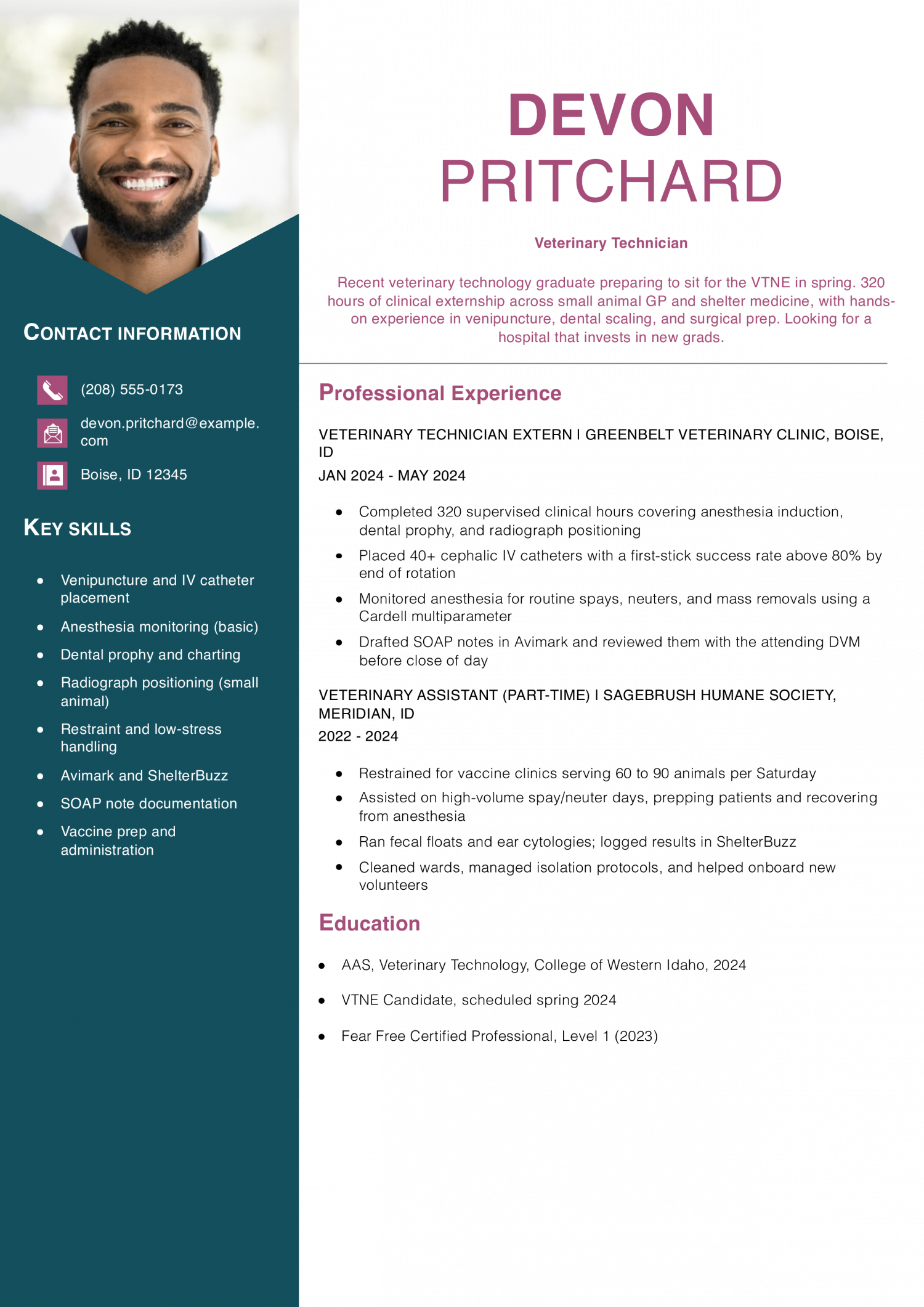
Entry-level vet techs are recent AVMA-CVTEA program graduates or assistants stepping into a credentialed seat. This resume needs to prove clinical rotations, species exposure, and VTNE-eligible or newly credentialed status.
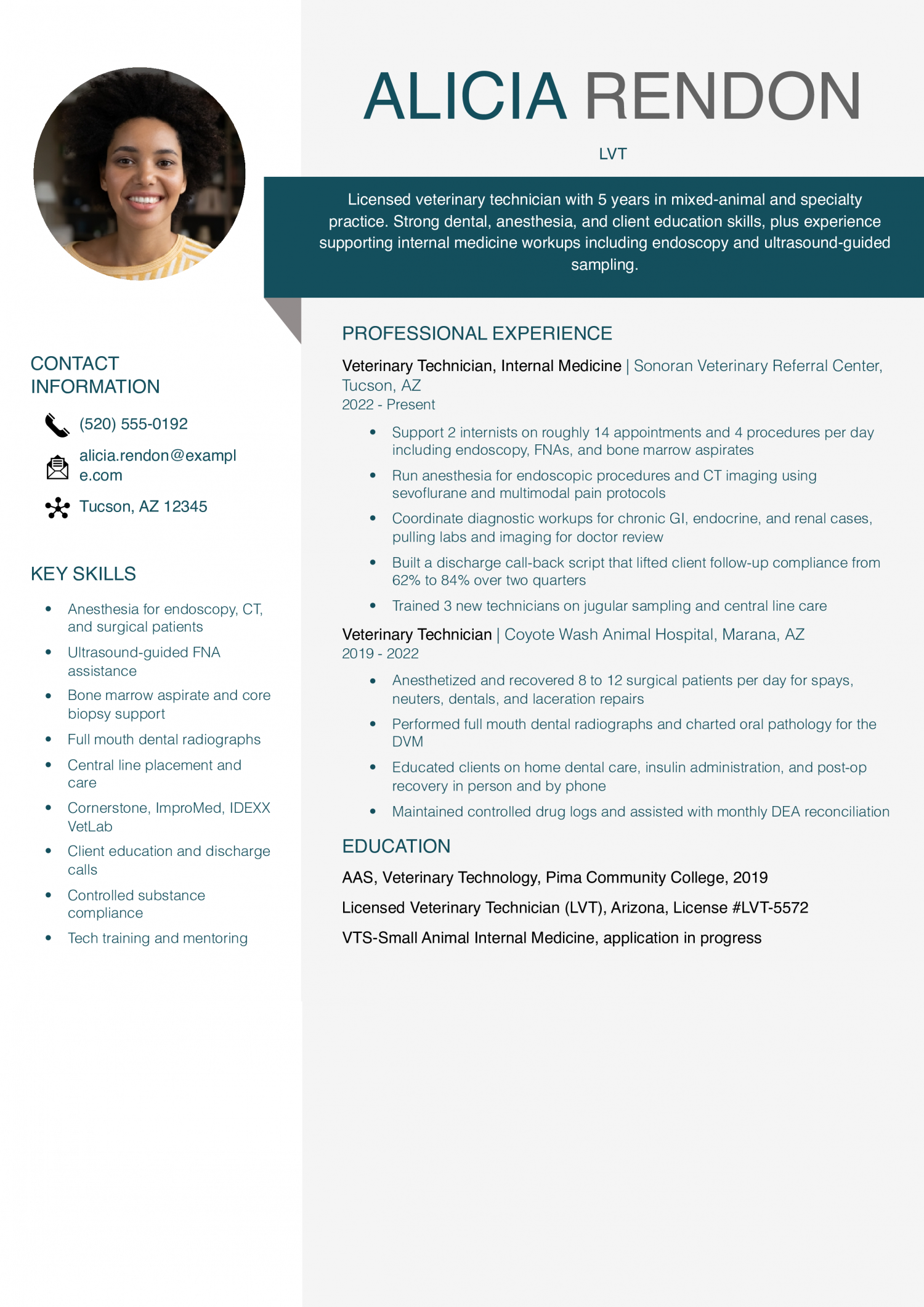
Experienced vet techs run their own patient load, handle anesthesia inductions, and train assistants. This resume needs to prove daily caseload, procedure scope, and fluency in Cornerstone, AVImark, or ezyVet.
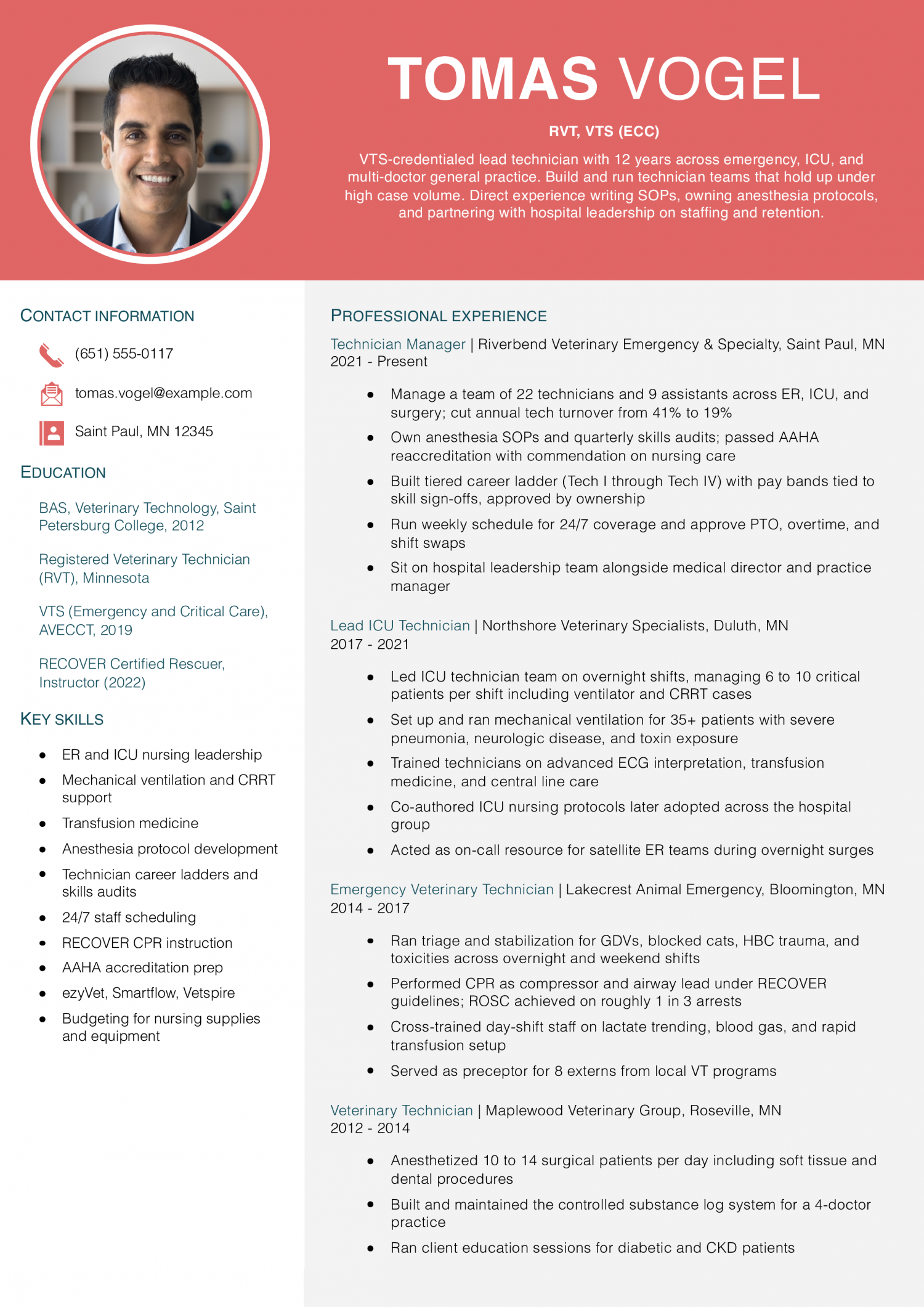
Lead vet techs run the treatment floor, schedule the technician team, and own protocols for triage, anesthesia, and inventory. This resume needs to prove team size managed, VTS specialty work, and measurable practice improvements.
Priya Whitlock, CVT
Asheville, NC | (828) 555-0164 | [email protected] | linkedin.com/in/priyawhitlock
Credentialed veterinary technician with 9 years across general practice, ER, and exotic/avian medicine. Anesthesia lead on complex cases, dental radiograph trainer, and the tech doctors trust with new client education. Looking to step into a senior or lead role at a progressive hospital.
Senior Veterinary Technician
Foothills Veterinary Hospital | Asheville, NC | 2022-Present
Veterinary Technician, Avian & Exotics
BlueRidge Exotic Animal Clinic | Hendersonville, NC | 2019-2022
Emergency Veterinary Technician
Pisgah Animal Emergency Hospital | Arden, NC | 2017-2019
Veterinary Technician
Stonebrook Animal Clinic | Black Mountain, NC | 2015-2017
Veterinary Assistant
Sunrise Pet Care | Weaverville, NC | 2014-2015
Your profile sits at the top of page one and tells the medical director three things in five lines. State your years of credentialed experience and your title (CVT, RVT, or LVT) with the state of credential.
Name the practice setting, whether GP, ER, specialty, mixed animal, university teaching, or corporate group. Then name the procedure scope you run daily: anesthesia monitoring, dental prophy, venipuncture, radiography, or surgical assisting.
Close the profile with species mix and caseload context. A clinic manager reading 50 resumes wants to know in six lines whether you fit the floor.
Bullets without numbers read as duty lists. Strong vet tech resumes name patients per shift, anesthesia cases per week, or dental prophies per month.
Pull two or three metrics from your real day: average daily appointments supported, IV catheter placements per shift, or radiographs processed weekly. Add outcome signals like reduced anesthetic recovery times or dental compliance rates.
Volume language works when exact counts are not available. “Supported a four-doctor GP at 60-plus appointments daily” tells the reader more than “assisted veterinarians with appointments.”
Wall-of-text bullets blur together. Group your hands-on work into four buckets so a reviewer scans them in seconds.
Use anesthesia and pain management (induction, monitoring, recovery), diagnostics (venipuncture, IDEXX bench, digital radiography, ultrasound prep), dentistry (prophy, charting, dental rads, extractions assist), and nursing care (triage, fluid therapy, wound care, client education).
Under each bucket, put two or three bullets with the species, equipment, and protocols you used. This structure lets a reviewer match your scope to the opening fast.
Veterinarians and clinic managers check credential status before reading further. Put your CVT, RVT, or LVT line with the state and “in good standing” directly under your profile, plus Fear Free, low-stress handling, or VTS specialty work.
Do not list your credential number on the resume. State boards advise providing it on the application form when requested.
Add a tools line near the top: Cornerstone, AVImark, ezyVet, IDEXX VetLab, Sound digital rads, or anesthesia machines like Matrx or Midmark. These keywords clear automated filters and tell the reader you can walk in and work.
Your education section names the AVMA-CVTEA accredited program, the credential earned, and the graduation year. Add clinical rotation hours if you graduated within the last two years.
List CE hours by year for the most recent renewal cycle, per your state board’s requirements. Name CE topics that match the target role: dental radiology, emergency triage, or anesthesia for high-risk patients.
If you are pursuing a VTS through an AVMA-recognized academy, list it as “VTS candidate” with the specialty and expected credential date.
ATS filters catch more veterinary technician resumes than ever in 2026. The skills below come from our user-built veterinary technician resumes. Procedure names and software fluency clear the first cut, and client-handling language decides whether the resume advances.
Veterinarians and clinic managers weigh hard skills heavier on entry resumes and soft skills heavier at the lead level, where team training and protocol ownership matter. Match the lists against your target posting, then back each soft skill with a bullet that names the situation, the species, and the outcome.
| Soft Skills | % of resumes with this skill |
|---|---|
| Communication skills | 78% |
| Empathy and compassion | 53% |
| Attention to detail | 49% |
| Teamwork and collaboration | 35% |
| Problem-solving | 26% |
And here are the top hard skills showing up most often.
| Hard Skills | % of resumes with this skill |
|---|---|
| Diagnostic imaging and testing | 72% |
| Animal restraint and handling | 57% |
| Medication administration | 45% |
| Surgical assistance | 35% |
| Medical records management | 25% |
Based on data from thousands of veterinary technicians’ resumes built on ResumeTemplates.com, May 2026.
The items below are what separate a veterinary technician resume from one that gets put back in the pile.
Most state boards require CE hours each renewal cycle. List your most recent cycle’s hours and the topics that match your target role.
Cite CE by year and provider. Strong providers include VetMedTeam, VetBloom, VIN, IVECCS, and the AVMA Convention.
Match CE topics to the role you want. Apply to an ER opening with RECOVER CPR, ECC nursing, and triage CE listed near the top.
HIPAA does not cover veterinary records, but client privacy and DEA controlled-substance handling do. Do not name clients, patients, or case details on your resume.
Reference controlled substance handling as a skill without naming the DEA registration number of the practice. Frame the experience as “logged and reconciled controlled substances per DEA and state board protocols.”
If you handled medical records or practice management, name the software (Cornerstone, AVImark, ezyVet) and the workflow, not specific client or patient identifiers.
Your state credential and VTNE pass keep you eligible. The certifications below are what move a veterinary technician resume from the qualified-but-typical stack into the medical director’s shortlist. List the issuing body, credential level, and expiration date for each.
Veterinary technician credentialing varies by state. Most use CVT, RVT, or LVT after a VTNE pass and graduation from an AVMA-CVTEA accredited program.
The 90th-percentile veterinary technician out-earns the median by a wide margin, which tells you the market rewards specialty credentialing, ER and surgical acuity, and team-lead scope more than years on a GP floor.
Geographic concentration also shifts pay, with metro specialty and university hospitals paying above rural mixed-animal practice. Lead the resume with the specialty work, anesthesia complexity, and team leadership the high-percentile band actually charges for, not years in scrubs.
| # | State | Avg. Annual |
|---|---|---|
| 1 | Washington | $59,080 |
| 2 | New York | $58,830 |
| 3 | District of Columbia | $55,900 |
| 4 | Virginia | $55,790 |
| 5 | California | $55,080 |
| 6 | Minnesota | $49,480 |
| 7 | Minnesota | $49,460 |
| 8 | Oregon | $48,950 |
| 9 | Connecticut | $48,880 |
| 10 | New Jersey | $48,630 |
| # | State | Workers | Median |
|---|---|---|---|
| 1 | Texas | 16,170 | $37,250 |
| 2 | California | 11,380 | $55,080 |
| 3 | Florida | 10,130 | $40,380 |
| 4 | Pennsylvania | 5,840 | $41,910 |
| 5 | New York | 5,480 | $58,830 |
Resume Templates offers HR approved resume templates to help you create a professional resume in minutes. Choose from several template options and even pre-populate a resume from your profile.
Put credentials in a block directly under your profile on page one. Lead with your CVT, RVT, or LVT status and state, then VTS specialty, Fear Free, and RECOVER CPR.
List the issuing body and expiration date for each. Do not include your credential number on the resume itself.
Group duties into four clinical buckets: anesthesia and pain management, diagnostics, dentistry, and nursing care. Under each, name the species, equipment, and protocols you used.
Quantify where you can. "Monitored anesthesia for 12 to 15 surgical cases weekly" beats "assisted with surgeries."
Yes, when you are within two years of passing or applying to your first credentialed role. List it under credentials with the month and year.
After that, drop the pass date and keep only your active state credential line. Reviewers care about current standing more than when you first tested.
List your current credential as "CVT (Ohio, in good standing)" and add a line noting credentialing in progress for the target state. Most state boards offer credential transfer for VTNE-passed technicians.
Name the AAVSB VTNE score transfer if you have submitted it. This tells the medical director you understand the path and have started it.
For a veterinary technician, an ATS-friendly template is the safest pick, because it puts your certifications and experience where a hiring manager scans first. A basic template is a solid alternative. Whichever you choose, keep the formatting clean and easy to parse: clear section headings, a standard font, and no graphics a parser can choke on.
Executive Resume Writer and Career Coach
Andrew Stoner is an executive career coach and resume writer with 17 years of experience as a hiring manager and operations leader at two Fortune 500 Financial Services companies, and as the career services director at two major university business schools.

Customize this template in our builder in under 10 minutes.