Audio Engineer Resume Examples
Studio managers and audio production directors can pull a discography or a room credit in seconds. Lead with the one signal that lookup will not surface. That might be a Pro Tools room you run…
Every resume example is written and reviewed by our team of Certified Professional Resume Writers to ensure top-quality content and formatting.
AV managers and event production directors hire based on proof you can run live signal chains without a hitch. Your resume should show the systems you have worked on, such as Crestron or Extron control processors. Include the CTS credential from AVIXA if you hold it.
List the spaces you have built or supported, from boardrooms to large venue installs. Name the protocols you troubleshoot, like Dante audio networking or HDBaseT. The examples below show how to present these details so your resume speaks to the role. To compare layouts before you start, browse our resume templates.
Signal flow documentation, system-specific brand names and a current CTS credential are what separate the Audio Video Technician resumes that AV managers and event production directors schedule for interviews from the rest.
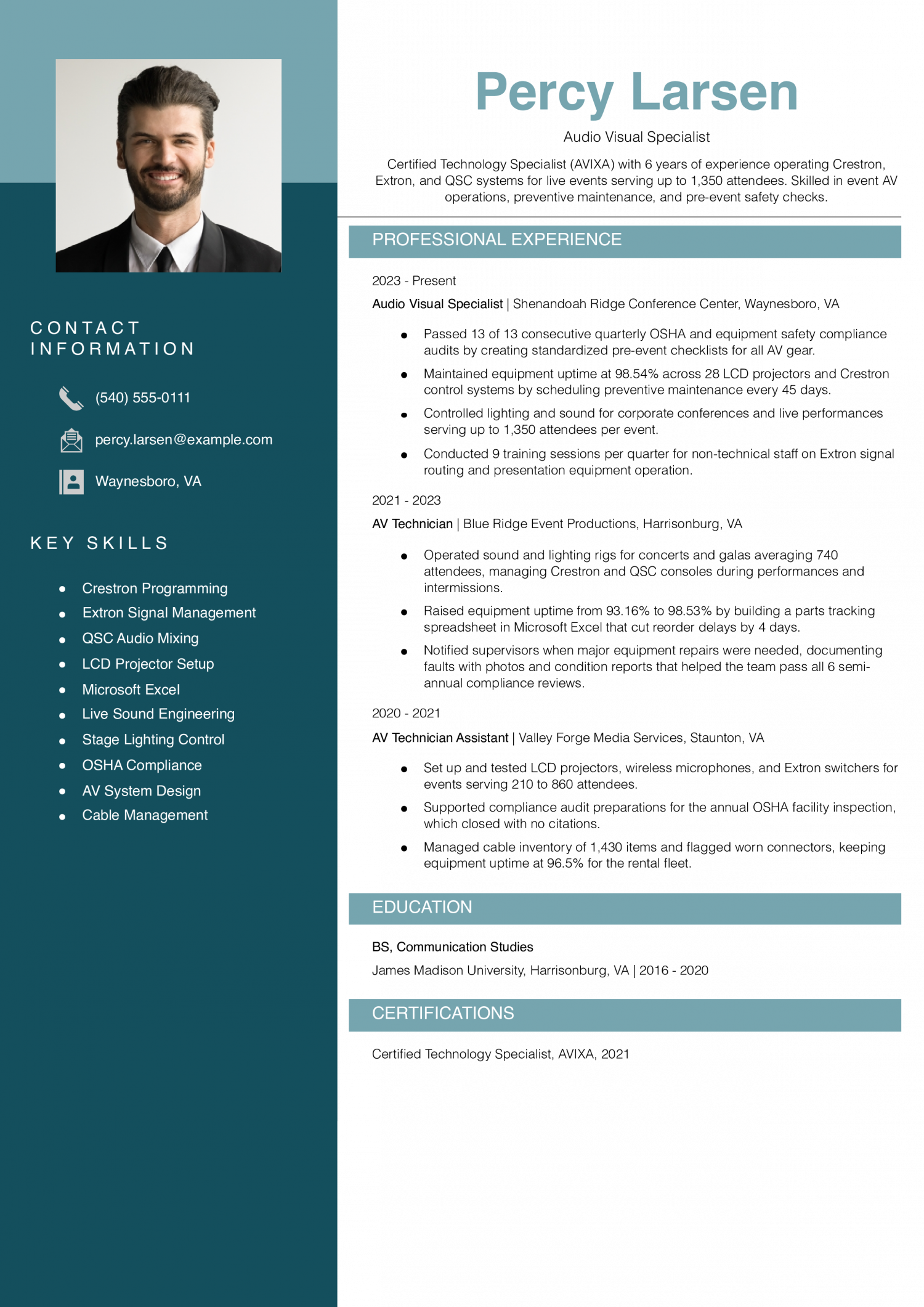
Consider this resume if you are a mid-level audio visual specialist with about 6 years of conference and event production experience and a growing compliance record. Lead each maintenance bullet with a specific uptime percentage tied to the preventive method you used.
A parts-tracking spreadsheet cut reorder delays and helped keep equipment ready for each event. That connects a simple tool to a real uptime improvement. If you build a tracking tool, say what it monitors and how turnaround or uptime changed because of it.
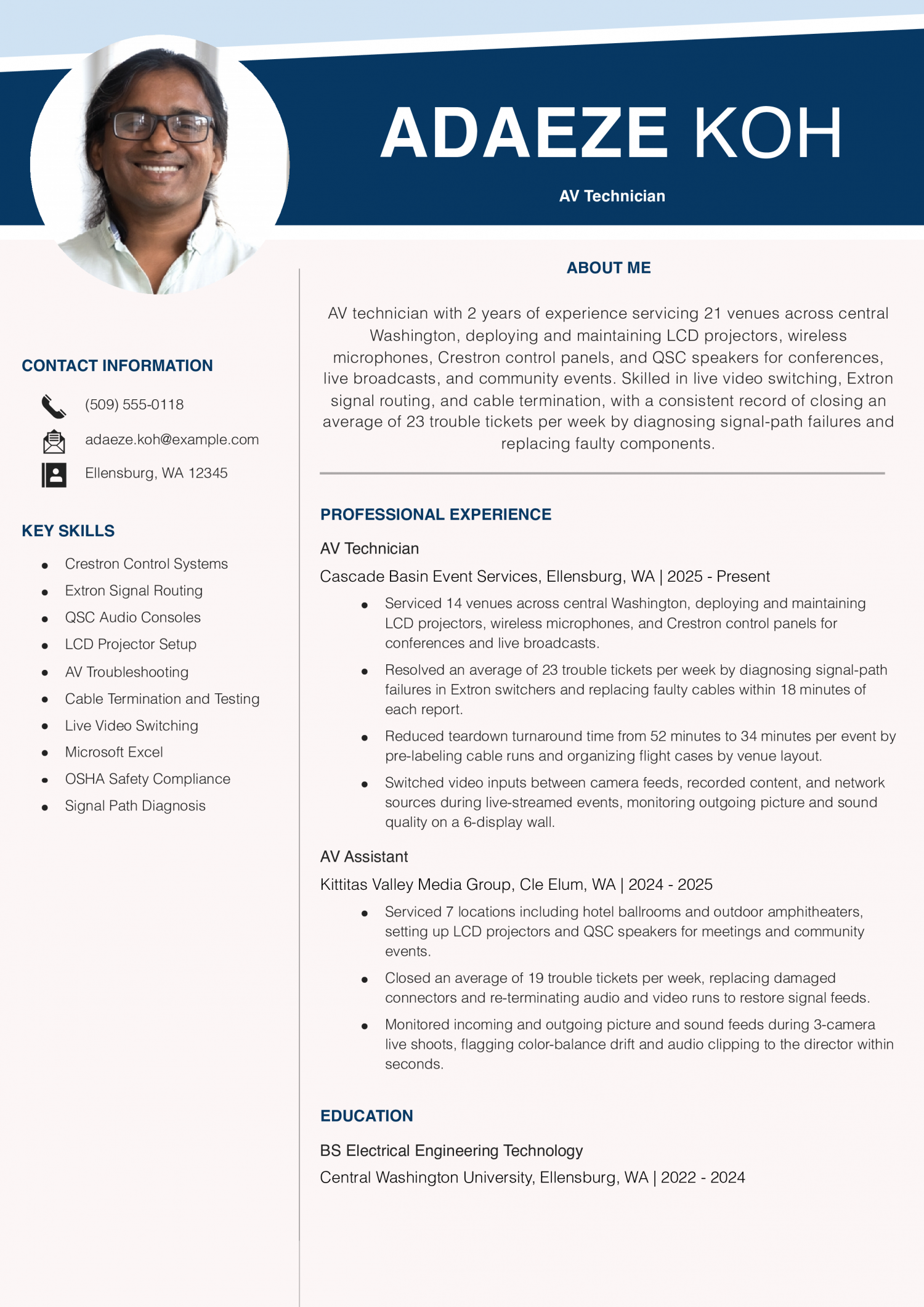
Use this resume if you are an entry-level AV technician with about 2 years of event support and troubleshooting experience. Lead each bullet with the number of venues or tickets you handled so reviewers can measure your workload at a glance.
Teardown time dropped because cables were pre-labeled and flight cases reorganized, not because the crew rushed. Event managers see the process behind the speed. Describe the organization step you added and the time difference it made.
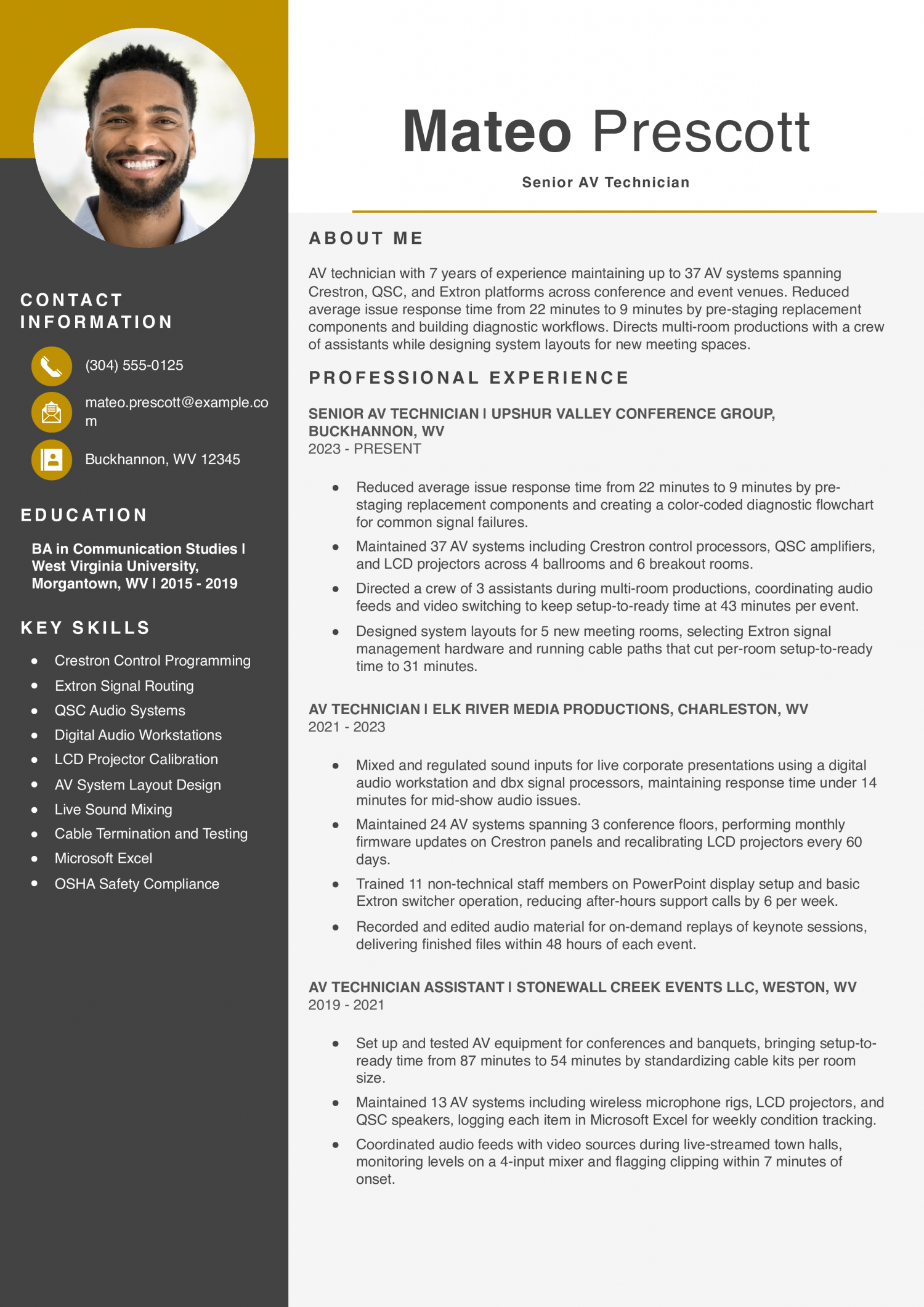
Try this resume if you are a senior AV technician with about seven years of conference venue and live event support work. Lead your response-time improvements with before-and-after minute counts, as every role here does.
Setup time dropped after cable kits were sorted by room size so the crew prepared the right gear each time. Venue directors can see the improvement. For any recurring setup, show both durations and name what you changed.
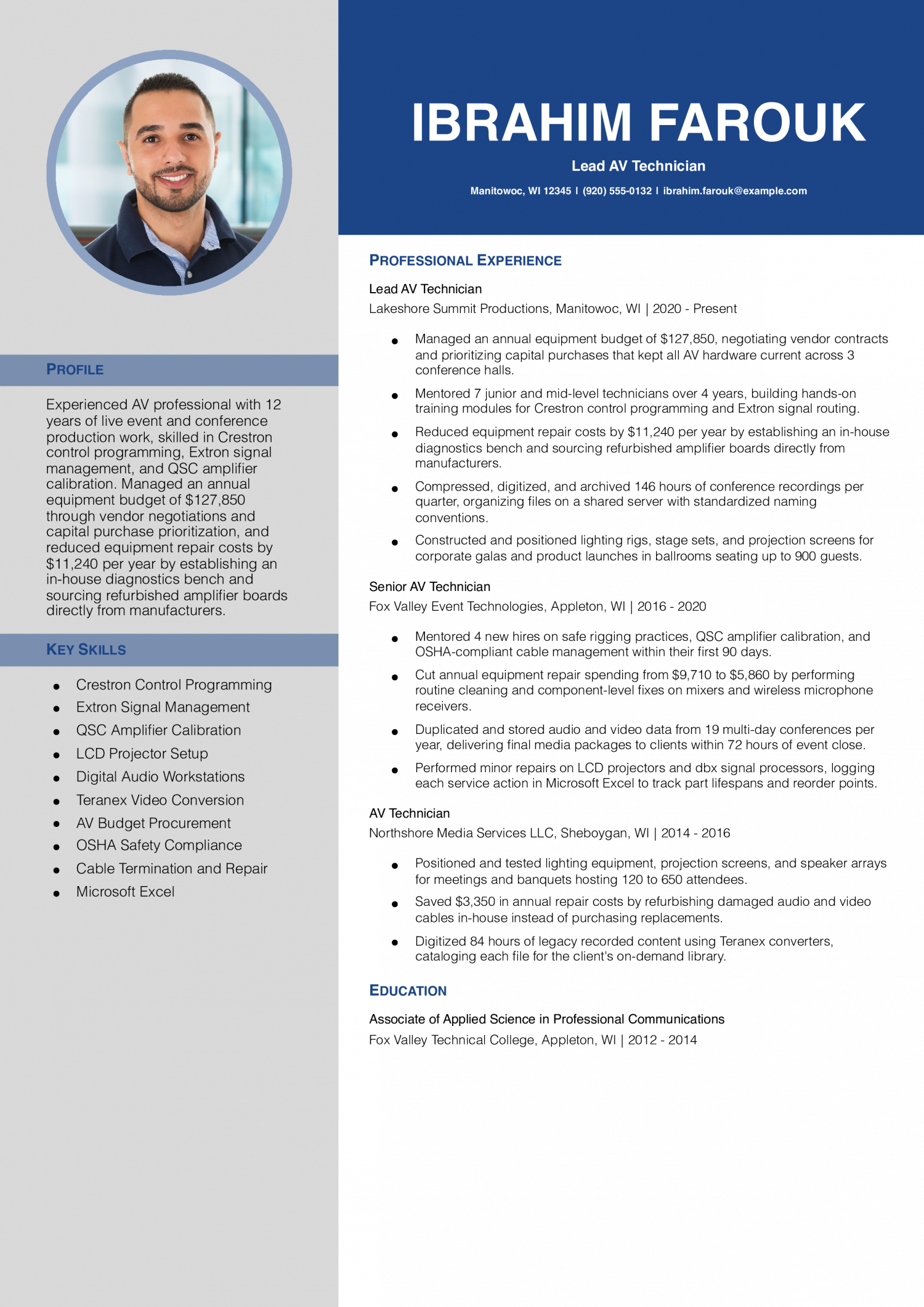
Lean on this resume if you are a senior AV technician with over a decade of conference and event production experience moving into lead roles. Lead each cost-reduction bullet with the dollar gap between old spending and new spending so reviewers see the savings at a glance.
The mentoring bullet names the exact systems taught and the format used for instruction. Technical directors can judge whether the training covered the gear that matters. List the platforms you teach and the way you deliver the instruction.
Experienced in coordinating AV setup, operation, and breakdown for an average of 22 events per month across corporate meetings, video conferences, and live performances. Earned a 4.83 out of 5.0 client satisfaction score across 187 post-event surveys through pre-show walkthroughs and real-time audio-level monitoring. Skilled in Crestron Control Programming, Extron Signal Management, QSC Amplifier Calibration, Polycom Video Conferencing, and Microsoft Excel across 6 years of conference and event production work.
State your years of hands-on AV work in the first line. Name the settings where you have built systems.
Corporate boardrooms and live event venues carry different weight. Spell out which type of space you know best. Include the signal types you handle most, such as digital video distribution or networked audio.
Mention the size of installs you manage. A 200-seat lecture hall differs from a 5,000-seat arena. AV managers and event production directors scan profiles first.
They want to see your niche in 10 seconds. A clear scope line helps them sort your resume fast.
Most strong AV technician resumes lean on volume and scope language. State how many rooms or systems you maintained per week. Note the channel count on mixing consoles you operated.
You might list the number of displays in a video wall you built.
Lines that leave out a number tend to look like duties rather than results. Try framing your work around scale. Write that you pulled cable for a 40-room hotel AV refresh.
Or note that you troubleshot signal issues across 12 conference rooms daily. You can also cite uptime for a full event season. Even rough counts give AV managers proof you handled real workloads.
Pair each number with the outcome it produced.
Break your bullet points into clusters that match daily AV work. Start with installation, covering rack builds and cable pulls. Follow with signal flow and routing for audio and video paths.
Add a cluster for live event support, such as mixing and switching. Include a maintenance group for preventive checks and firmware updates. End with client-facing tasks like site surveys and user training.
Each cluster shows a different part of your skill set. AV managers and event production directors want to see range. Three to five clusters keep the section tight without losing key details.
List the Certified Technology Specialist credential from AVIXA in a credentials block on page one. Set it right below your profile so reviewers see it before your work history. If you hold a CTS, spell out the full name and the abbreviation.
AV managers and event production directors often filter resumes by this line.
Below credentials, add a tools section. Name the AV systems and software you use daily. Match your list to the posting when you can.
Keep each tool listing to two or three words. A clean tools block signals that you can step onto a job site and work.
List any degree or certificate program in electronics, AV technology, or a related field. Community college programs and trade school diplomas both count here. Put the school name, credential earned, and graduation year on one line.
If you are early in your career, place education near the top.
Move it lower once you have three or more years of field work. In a closing section, add any vendor training courses you have finished. Note relevant safety training if you hold it.
You can also list language skills or a valid driver’s license. Both matter for on-site AV roles that require travel. Keep this section to five or six lines so it stays scannable.
Your resume needs both the technical and the personal skills listed below.
Soft-skill language like teamwork decides whether the resume advances. AV managers and event production directors weigh hard skills first. They check for gear you can run on day one.
Soft skills matter next. They show how you handle live events under pressure. Scan each table against the job posting you are targeting.
Mirror exact phrasing where it fits. Back each soft skill with a bullet that proves it in action. Add the skill phrase, then pair it with a short result from your work.
One or two numbers per bullet make the proof stronger.
| Soft Skills | AI-estimated % |
|---|---|
| Grace under pressure | 67% |
| Crew coordination | 58% |
| Client communication | 46% |
| On-site troubleshooting | 36% |
| Attention to detail | 32% |
And here are the top hard skills showing up most often.
| Hard Skills | AI-estimated % |
|---|---|
| AV equipment setup | 74% |
| Live sound mixing | 54% |
| Video signal routing | 42% |
| Cable management | 38% |
| Broadcast system operation | 26% |
Skill names and rankings come from an AI model grounded in U.S. Department of Labor occupation data for audio video technicians, not from a count of audio video technicians’ resumes built on ResumeTemplates.com.
Begin with your AI tools.
What AV managers and event production directors expect has shifted. Listing only analog signal-flow skills now reads as incomplete. Naming the AI tools you use for room tuning reads as current.
Automated mixing tools also belong on your resume. You should note which outputs you verify by ear. The list below names what to add.
It covers changes in the role and tools worth naming. It also flags lines to skip. Each item ties to tasks checked during live events.
Keep your entries honest and specific to your workflow. Add only tools you have used on a real project.
What AI is actually changing for this role
Room tuning: AI acoustic analysis tools now suggest corrective curves, but techs still verify results with measurement mics on site.
Signal routing: Automated processor presets handle basic routing, while techs adjust gain structure and troubleshoot during live shows.
Camera tracking: AI camera systems auto-frame speakers, though techs set zones and override during complex stage moves.
Troubleshooting: Predictive diagnostics flag cable faults or firmware conflicts before a show, reducing the length of pre-event checks.
AI tools to name
How to phrase AI on your resume
Do
Skip
AV managers and event production directors scan for specific tools. They want proof you can run real systems. List the exact software versions you have used.
AV managers and event production directors read this list as a map of where your work is heading. The items you add tell them which signal paths and systems you have trained on. This section goes past the base skills most job posts ask for.
It shows where you chose to grow on your own time. Give each credential its own line with the issuer and the date. Placing the date next to the name lets a reviewer see how current your training is at a glance.
Many postings for mid-level install and support roles note a preference for at least one industry credential. Even when a posting does not require one, holding a recognized credential can set your resume apart from others with the same hands-on experience. Keep the format clean so this block is easy to scan in a stack of resumes.
Audio Video Technician is a moderate-size occupation in BLS data. That means the field is large enough to show a wide pay spread but small enough that specific skills read as real differentiation. The 90th percentile out-earns the median by a large margin.
The 10th percentile sits well below it. That gap tells you the range between entry-tier install work and senior live-event or integration roles is steep. Geographic concentration also shapes where the dollars land, so check the state tables for your market.
To stand out with AV managers and event production directors, lead your resume with the signal systems and venue types you have worked on, not a generic list of tools.
| # | State | Median Annual |
|---|---|---|
| 1 | District of Columbia | $78,770 |
| 2 | New Jersey | $71,040 |
| 3 | Maryland | $70,040 |
| 4 | Washington | $69,270 |
| 5 | New York | $67,600 |
| 6 | California | $64,620 |
| 7 | Rhode Island | $64,070 |
| 8 | Nevada | $62,770 |
| 9 | Connecticut | $62,120 |
| 10 | Alaska | $62,060 |
| # | State | Workers | Median |
|---|---|---|---|
| 1 | California | 9,280 | $64,620 |
| 2 | New York | 7,990 | $67,600 |
| 3 | Florida | 6,000 | $54,230 |
| 4 | Texas | 4,280 | $49,440 |
| 5 | Pennsylvania | 3,080 | $56,890 |
Resume Templates offers HR approved resume templates to help you create a professional resume in minutes. Choose from several template options and even pre-populate a resume from your profile.
Use a reverse chronological format that lists your most recent AV role first. Lead each entry with the venue type or system scale you worked on. AV managers and event production directors can then see your scope at a glance.
Keep the file to one page unless you have more than eight years of installation work.
List both hardware skills and software skills in separate groups on your resume. Hardware entries might include signal routing and cable termination. Pair each skill with a system brand or protocol name so the entry reads as specific.
Open with a profile that names the equipment you trained on during school or volunteer events. Replace a traditional work history with a projects section covering installations or live event setups you completed. Include any formal coursework in signal flow or live sound reinforcement.
Yes, because troubleshooting speed is one of the first things AV managers and event production directors evaluate. State the problem, the fix, and the outcome in each bullet. For example, note that you resolved a signal dropout across a 12-zone system within 15 minutes of curtain call.
Create one entry labeled with your freelance title and the full date range you were active. Underneath, list each client or venue as a sub-bullet with the system type and event size. This approach shows steady work without making the page look like a list of short-term jobs.
Yes, the two roles share networking basics but focus on different outputs. Your AV resume should highlight signal distribution and live event support. A computer support resume centers on operating systems, ticket queues, and endpoint hardware instead.
Note the gap honestly and fill it with any relevant activity you completed during that time. Freelance installs, online training courses, or personal studio builds all count as technical work. Place a brief one-line entry in your timeline so reviewers do not have to guess.
With an ATS-friendly template, your certifications and work history each get a clear heading. A basic template is a fine backup.
Audio Video Technician Resume
4.3/5 stars with 159 reviews

Executive Resume Writer and Career Coach
Andrew Stoner is an executive career coach and resume writer with 17 years of experience as a hiring manager and operations leader at two Fortune 500 Financial Services companies, and as the career services director at two major university business schools.
© 2026 Resumetemplates.com All rights reserved.