Tip !

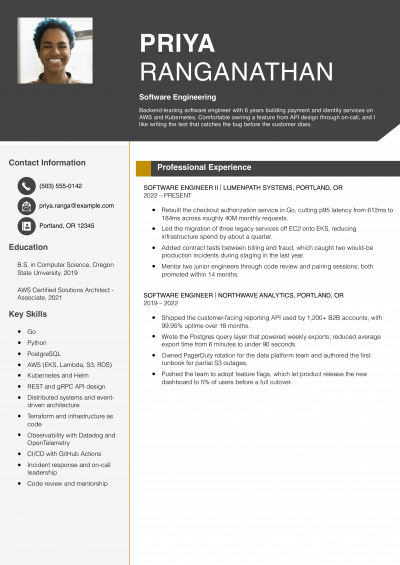
Hiring engineering directors look for the production system you own and the scale numbers behind it on the first page, because that signals whether you can carry on-call and own design reviews.

Andrew Stoner , Executive Resume Writer and Career Coach

Why this resume works

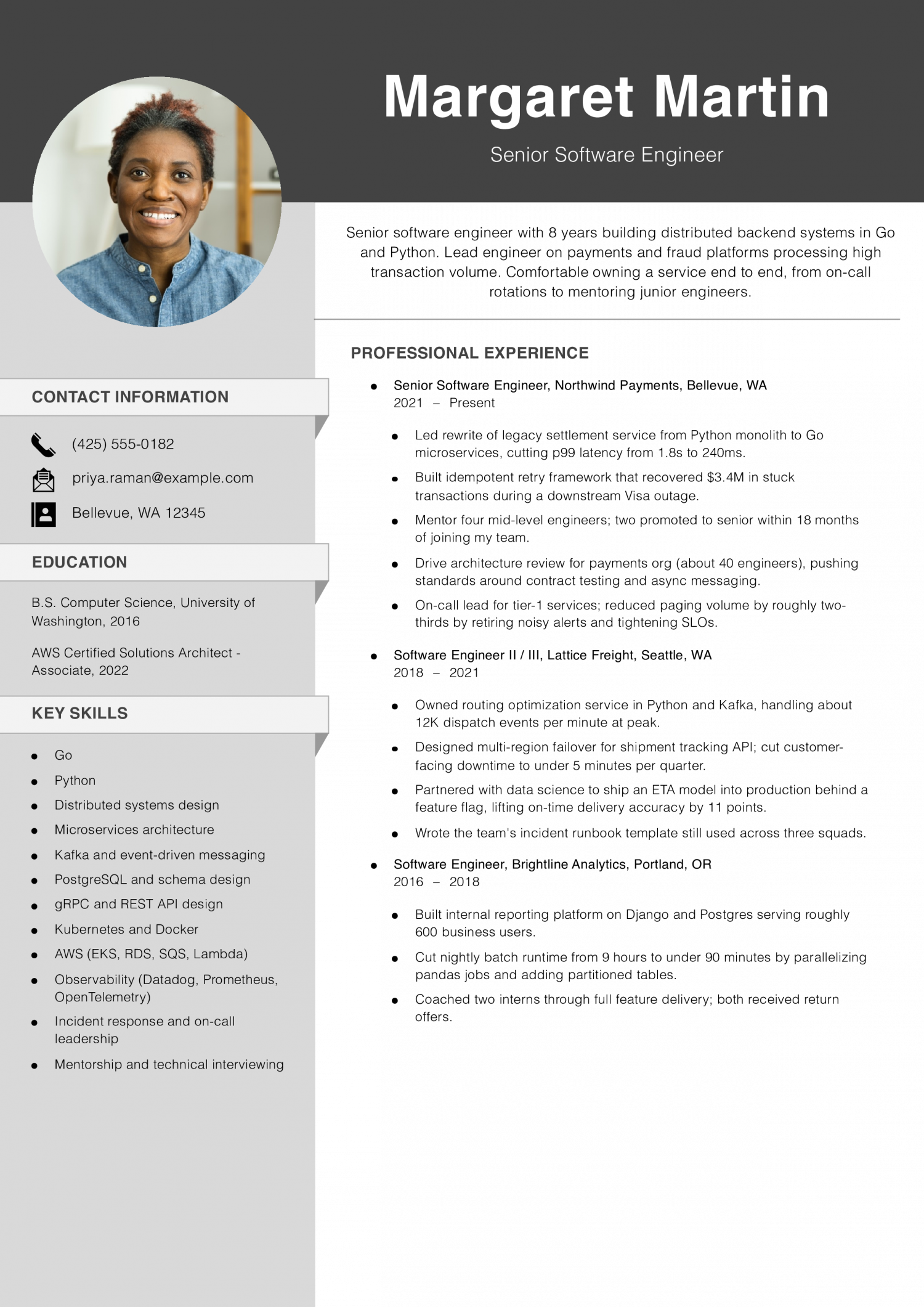
  • Recovered real money during an outage: The $3.4M idempotent retry bullet shows engineering work tied directly to business impact during a named external failure.
  • Mentorship with proof: Rather than claiming to mentor, the resume notes two direct reports promoted to senior, which is a concrete outcome.
  • Latency numbers a hiring manager trusts: Specific p99 figures (1.8s to 240ms) and paging reductions read like real on-call experience, not marketing copy.

Senior Software Engineer Example

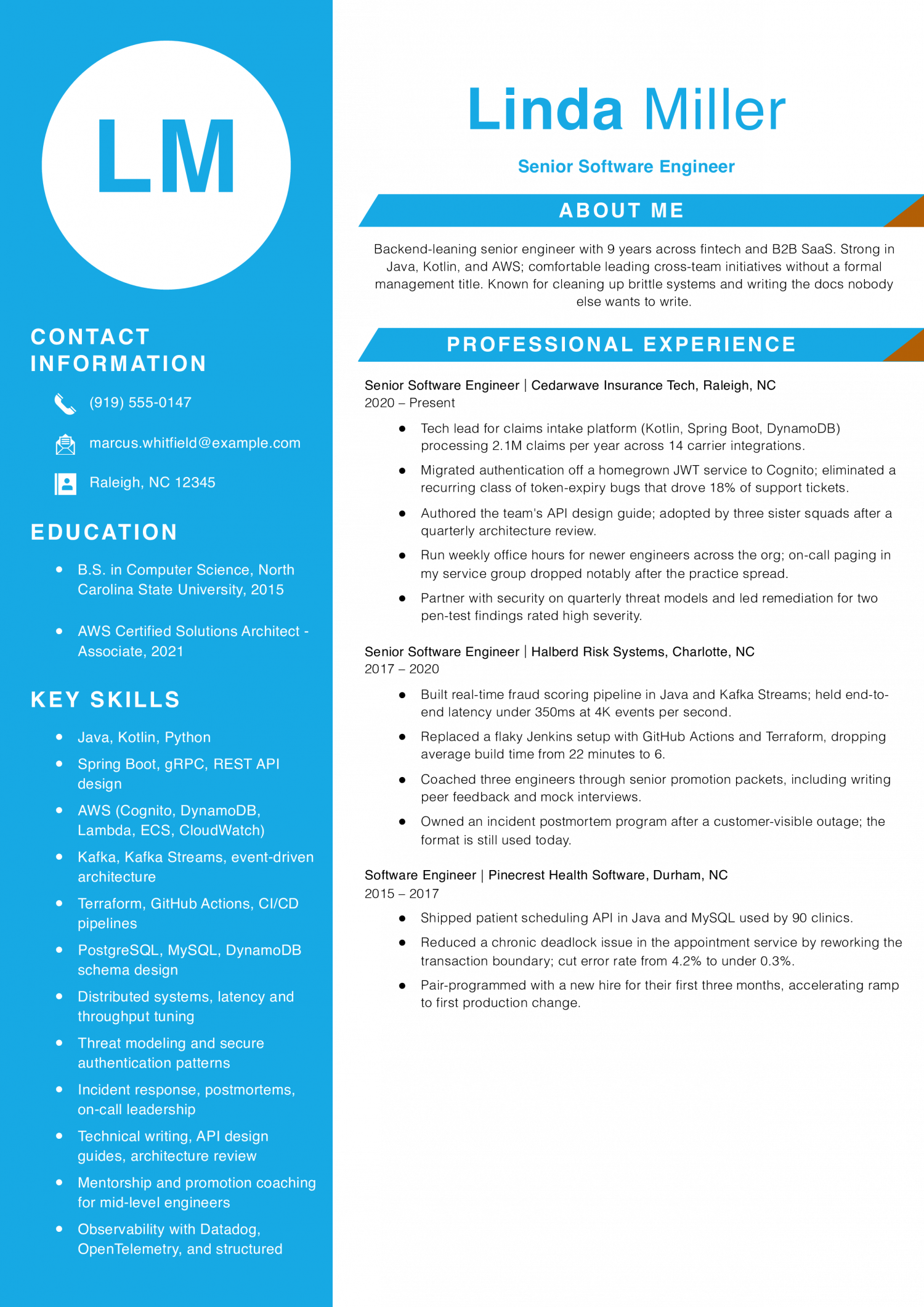
This is the IC who owns services in production and gets paged when they break. Your resume needs to prove system-design scope, measurable impact on latency, cost, or revenue, and the cross-team pull you carry.

Why this resume works

  • Owns work that crosses teams: Adoption of the API design guide by three sister squads shows influence beyond his immediate team, a key senior signal.
  • Concrete reliability numbers: Sub-350ms latency at 4K events per second and the error-rate drop from 4.2% to under 0.3% read as numbers the candidate actually measured.
  • Helps other engineers grow: Promotion coaching, office hours, and pair-programming for new hires give a hiring manager a clear picture of how he operates as a senior.

How to Write a Senior Software Engineer Resume

01 Open with the metric an engineering director would use to size you up

The first line of your summary should name the production scope you own, not your years coding. Lead with the system, the scale, and the language stack.

An engineering director reads “Senior backend engineer owning a Go payments service at 12K RPS with 99.99% availability” as ready for their on-call rotation. “Seasoned engineer with 8+ years” reads as filler.

Pair the scope line with one outcome: a latency cut, a cost reduction, or a revenue surface you shipped. That tells tech leads you operate at the staff-adjacent level before they reach your bullets.

02 Put numbers on every bullet

Strong senior software engineer bullets carry a metric. Without one, the bullet reads as a task description and gets skimmed past on the first pass.

Name 2 or 3 dimensions per bullet where you can: requests per second, p99 latency, monthly active users served, cost saved, deploy frequency, or revenue attached to the surface.

If a number is sensitive, use a range or a percentage. “Cut p99 latency from 1.2s to 280ms across the search path” beats “improved search performance.” Bullets without a number tend to read as duties, not impact.

03 Group your work into three or four scope buckets

Senior engineers do too many things for a flat bullet dump. Cluster the work so an engineering director can scan your shape in 20 seconds.

Useful buckets: systems you architected, services you own in production, cross-team initiatives you led, and mentoring or interviewing you carry. Pick three or four that match your actual scope.

Within each bucket, name the language, the runtime, the data store, and the scale. “Designed and shipped a Kafka-based event pipeline in Go handling 40K events/sec across six services” tells the reader your depth, stack, and reach in one line.

04 Place stack, on-call, and credentials on page one

Engineering directors and tech leads want the stack visible before they scroll. Put a tight technical skills block on page one: languages you ship in, primary cloud, datastores, orchestration, and observability.

Add an on-call line near the experience header for each role: “Primary on-call for billing platform, weekly rotation.” That signals operational ownership, which is the bar at senior.

If you hold AWS, GCP, or CKA-level certifications, list them in a four-line credentials block under the summary. Recruiter screens search for those exact strings, and burying them on page two costs you the keyword match.

05 What to cut from your senior software engineer resume

Cut bootcamp projects, intro coursework, and every bullet that describes a sprint ceremony. Daily stand-ups and Jira hygiene are table stakes at senior; listing them signals you don’t know what the bar is.

Cut the long tool list. Twelve languages and 40 frameworks reads as inflated. Keep the four or five you’d defend in a system-design loop.

Cut the objective statement. Trim your first job to two lines if it predates 2018. The page-one space belongs to the systems you own now and the impact attached to them.

Software hiring is tight in 2026. Engineering teams are running leaner, headcount is rationed, and the bar to clear a recruiter screen is higher than it was two years ago. The skills below come from our user-built senior software engineer resumes.

Engineering directors weigh hard skills first for the keyword parse, then read soft skills as evidence behind your bullets. Listing “system design” with no architecture bullet to back it reads as padding. Match the hard-skill list against the target job posting and prune to the stack that role actually uses.

Soft Skills % of resumes with this skill
Technical leadership 73%
Problem solving 56%
Communication 46%
Code quality focus 36%
Team collaboration 25%

And here are the top hard skills showing up most often.

Hard Skills % of resumes with this skill
System design 74%
Python 63%
Full-stack development 41%
Cloud platforms 39%
CI/CD pipelines 31%

Based on data from thousands of senior software engineers’ resumes built on ResumeTemplates.com, May 2026.

Must Have on a Senior Software Engineer Resume

Before a senior software engineer resume gets a closer read, hiring teams check for a short list of essentials.

Niche Keywords for ATS Checkers

Engineering directors expect a specialty signal on a senior resume. Cluster your keywords so the parser and the human both see which track you own.

Niche Keywords ATS scans for
Backend and distributed systems distributed systems, microservices architecture, event-driven systems, high-throughput APIs
Platform and infrastructure kubernetes, terraform, service mesh, internal developer platform
Site reliability and on-call sre, slo and sli, incident response, observability and tracing
Data and streaming kafka, snowflake, dbt, real-time data pipelines
Frontend and full-stack react, typescript, next.js, server components

AI Skills to Add

What engineering directors expect on a senior software engineer resume has shifted. A silent stance on AI tooling now reads as evasive at most product companies; an honest workflow naming Cursor or Claude Code with the human review steps reads as current. The list below names what to add.

What AI is actually changing for this role
Scaffolding and boilerplate

AI now writes the first draft of CRUD endpoints, test stubs, and migration scripts. Senior value is in review, design, and the parts that break at scale.

Code review and PR triage

Copilot reviews and CodeRabbit catch surface issues. Engineers who name how they tune those tools land design-judgment points faster on screens.

Incident response

AI-assisted log summarization and runbook synthesis cut mean time to detect. Show the tooling you've added to your on-call workflow.

Architecture documentation

ADRs and design docs are now AI-drafted then human-edited. Naming the prompt patterns you use for design reviews signals current practice.

AI tools to name
  • Cursor: Use for in-editor refactors, multi-file changes, and test scaffolding across services you own.
  • Claude Code: Use for design-doc drafting, ADR review, and codebase-wide refactors with explicit human review gates.
How to phrase AI on your resume
Do
  • Used Cursor and Claude Code to scaffold three new microservices, cutting initial development time from two weeks to four days with full test coverage and design-review sign-off.
  • Tuned Copilot review rules for the payments codebase, cutting reviewer time per PR by 35% while maintaining the team's defect rate.
Skip
  • AI-powered senior engineer driving 10x productivity gains through cutting-edge generative AI workflows.
  • Leveraged AI to revolutionize the engineering process and unlock unprecedented developer velocity.

Portfolio Strategy

A senior software engineer portfolio is a credibility signal, not a graduation project. Engineering directors check it after the resume to see how you think, not to find more bullets.

#1 GitHub

Pin three to five repos that show production-shaped code: a system, not a tutorial.

Best for writing Personal site or Substack

Host two or three deep technical posts on systems you've built or scaled.

Best for talks YouTube or conference recordings

Link any conference talks or internal tech-talk recordings you can share.

Pin the repos that match the role you want. If you’re targeting a platform job, pin Terraform modules and operator code, not a side-project todo app.

Include a short README on each pinned repo that names the scale, the design tradeoffs, and what you’d change. That README is what an engineering director actually reads.

Skip the contribution graph as a brag. Green squares without context tell a tech lead nothing about your judgment.

Tech Stack to Show on Your Resume

Engineering directors scan the stack block to confirm fit before they read bullets. Keep it tight, current, and matched to the posting.

  • Languages: Go, Python, TypeScript, Java
  • Runtime and orchestration: Kubernetes, Docker, AWS Lambda, ECS
  • Cloud platforms: AWS, GCP
  • Data and storage: PostgreSQL, DynamoDB, Redis, Kafka, Snowflake
  • Infrastructure as code: Terraform, Pulumi, Helm
  • CI/CD: GitHub Actions, ArgoCD, Buildkite
  • Observability: Datadog, Prometheus, Grafana, OpenTelemetry
  • AI development tools: Cursor, GitHub Copilot, Claude Code

Software Engineering Credentials That Get You the Job

Engineering directors read this list as a map of where your work is heading. The certifications below tell them which platform, infrastructure, or security track you’ve invested in beyond your day job. List each with the issuing body and the year earned, right under your summary.

  • AWS Certified Solutions Architect – Professional: Signals you can design multi-region, fault-tolerant systems on AWS, which is the stack at most senior roles.
  • Certified Kubernetes Administrator (CKA): Reads as proof you can run production workloads on Kubernetes, not just deploy a Helm chart and walk away.
  • Google Cloud Professional Cloud Architect: Useful when you're targeting GCP-heavy shops in fintech, retail, or AI infrastructure where Google Cloud is the primary platform.
  • HashiCorp Certified: Terraform Associate: Tells platform and infra hiring managers you write reusable IaC modules, not one-off scripts that drift over time.

Latest BLS Statistics for Senior Software Engineers

For senior software engineers, the 10th-percentile floor and the top-decile ceiling sit far apart, and that spread tells you most of the story. Stack specialization, employer tier, and geographic concentration in a few metro markets move you up the band more than tenure does. The work that pushes engineers toward the ceiling looks different: distributed systems at real scale, platform ownership, or AI infrastructure at a top-paying employer.

Lead the resume with the systems you own, the scale numbers attached, and the employer tier you’ve shipped at.

$133,080 National median annual
$144,570 National mean annual
$79,850 Entry-tier floor (10th percentile)
$211,450 Top-decile ceiling (90th percentile)
1,654,440 Senior Software Engineers in the U.S.
Where you stand

Entry tier

$79,850 to $133,080 At the entry tier, your resume needs to show services shipped to production, the language stack, and lead with on-call rotations you carry.

Mid band

$133,080 to $211,450 At the mid band, lead with the systems you own end-to-end, scale numbers in RPS or users served, and cross-team initiatives you led.

Top decile

$211,450+ At the top decile, your resume needs to show platforms you architected, staff-track artifacts like ADRs and design docs, and hiring you've done.

Top-paying states

# State Avg. Annual
1 California $170,910
2 Washington $166,910
3 Virgin Islands $162,820
4 New York $161,260
5 Massachusetts $150,520
6 Maryland $137,890
7 District of Columbia $136,040
8 Oregon $135,260
9 Delaware $135,160
10 Colorado $134,540

Highest-employment states

# State Workers Median
1 California 292,630 $170,910
2 Texas 151,460 $130,500
3 New York 104,130 $161,260
4 Washington 91,470 $166,910
5 Virginia 83,290 $134,470
Source: U.S. Bureau of Labor Statistics, OEWS 2024 release (SOC 15-1252).
Written by professional resume writers and loved by hiring managers

Resume Templates offers HR approved resume templates to help you create a professional resume in minutes. Choose from several template options and even pre-populate a resume from your profile.

Frequently Asked Questions

How many years of experience do you need to call yourself a senior software engineer?

Most companies title at senior between five and eight years of full-time engineering experience. The number matters less than scope.

If you own a production service end-to-end, carry on-call, and lead design reviews, the title fits. Some larger companies stretch the bar to ten years; some startups promote at three.

List the title you actually held, then let your bullets prove the scope.

Should I list every programming language I've touched?

No. Engineering directors read a 14-language list as inflated. Keep the four or five you'd defend in a system-design or coding loop.

Group them: primary stack, secondary, and exposure. "Go, Python, TypeScript" with the actual years of production use beats a wall of logos.

Languages you haven't shipped in for three years belong off the resume.

How do I show impact when the work was a team effort?

Name your specific contribution, then the team outcome.

"Designed the sharding scheme and led the data migration for a three-engineer effort that cut p99 latency from 800ms to 120ms" reads as ownership inside a team.

Avoid "helped the team improve performance." Tech leads parse that as participation, not leadership.

Do I need to disclose that I use AI coding tools on my resume?

You don't need a disclosure line, but you should name the tools in your skills block if you use them daily.

Cursor, GitHub Copilot, and Claude Code are now standard at most product companies. Hiding them reads as out of touch in 2026.

What hurts you is claiming AI-generated work as solo architectural decisions you didn't make.

What's the best resume template for a senior software engineer?

For a senior software engineer, a tech template is the safest pick, because it keeps your stack, tools, and impact easy to scan. An ATS-friendly template is a solid alternative. Whichever you choose, keep the formatting clean and easy to parse: clear section headings, a standard font, and no graphics a parser can choke on.

Rate this article

Senior Software Engineer Resume

Average Rating

4.1/5 stars with 221 reviews

You have given 0 Star(s)
4.1/5 stars with 221 reviews
Andrew Stoner

Executive Resume Writer and Career Coach

Andrew Stoner is an executive career coach and resume writer with 17 years of experience as a hiring manager and operations leader at two Fortune 500 Financial Services companies, and as the career services director at two major university business schools.