Electrician Resume Examples and Templates for 2026



Hiring principals look for licensure status, named project scope, and the BIM tools you actually drive on the first page, because that mix shows whether you can carry a job from schematic design through construction administration.
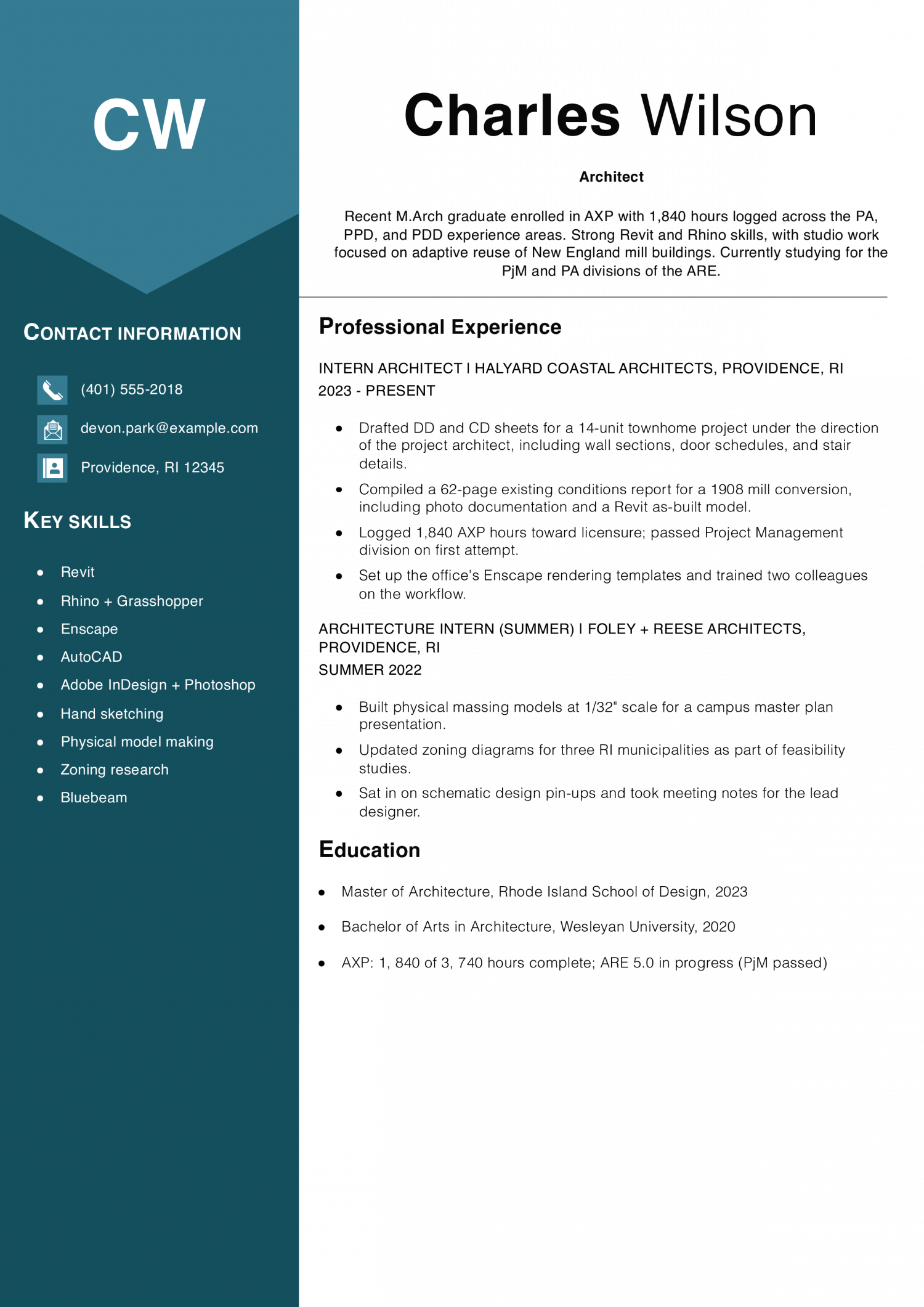
Intern architects are pre-licensure staff logging AXP hours while producing CDs under a licensed mentor. The resume needs to prove Revit fluency, ARE division progress, and ownership of real drawing-set tasks beyond rendering.
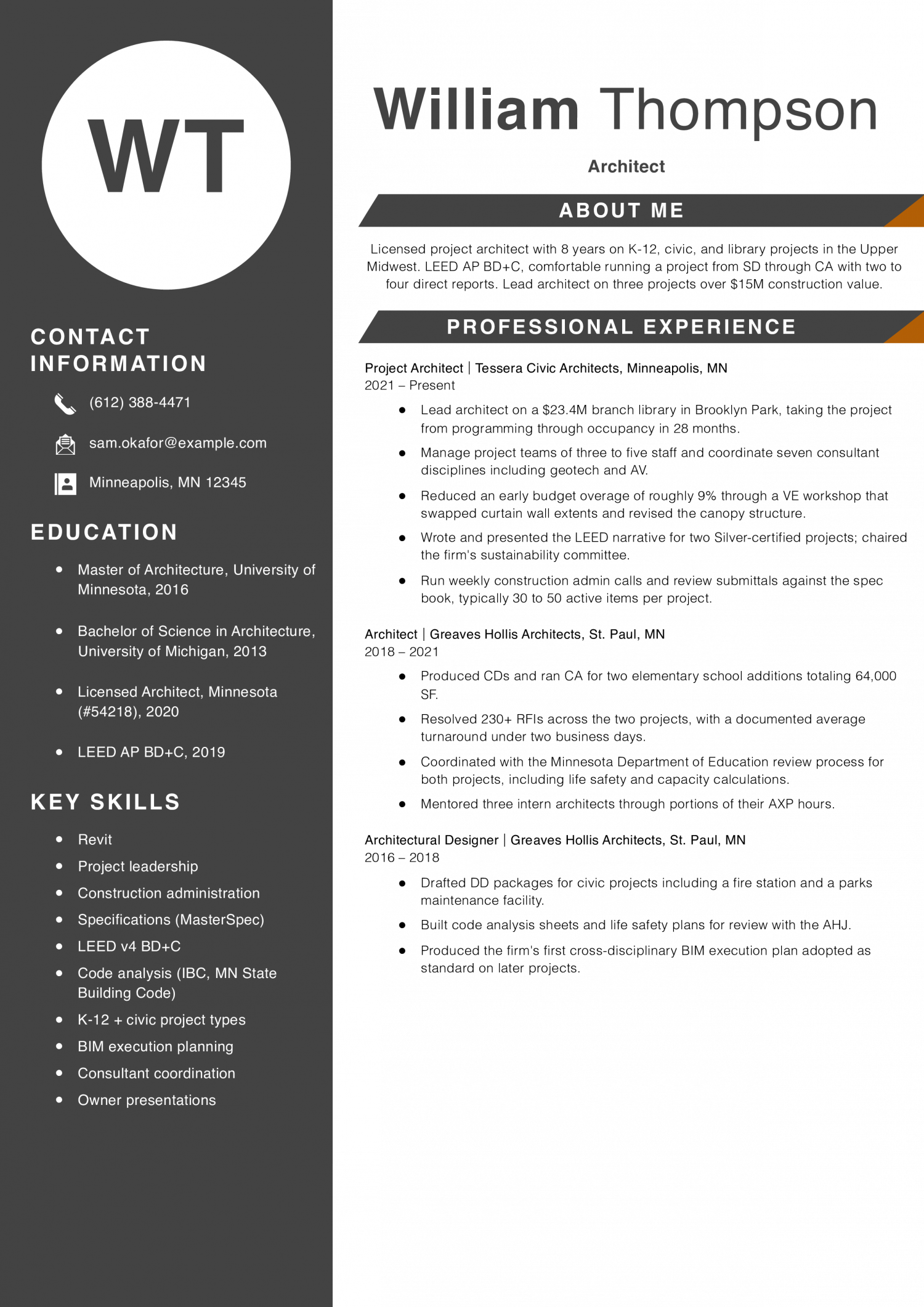
Project architects run jobs from SD through CA with stamped responsibility on at least one building type. The resume needs to prove phase coverage, consultant coordination, and code work on a named project with square footage and budget.
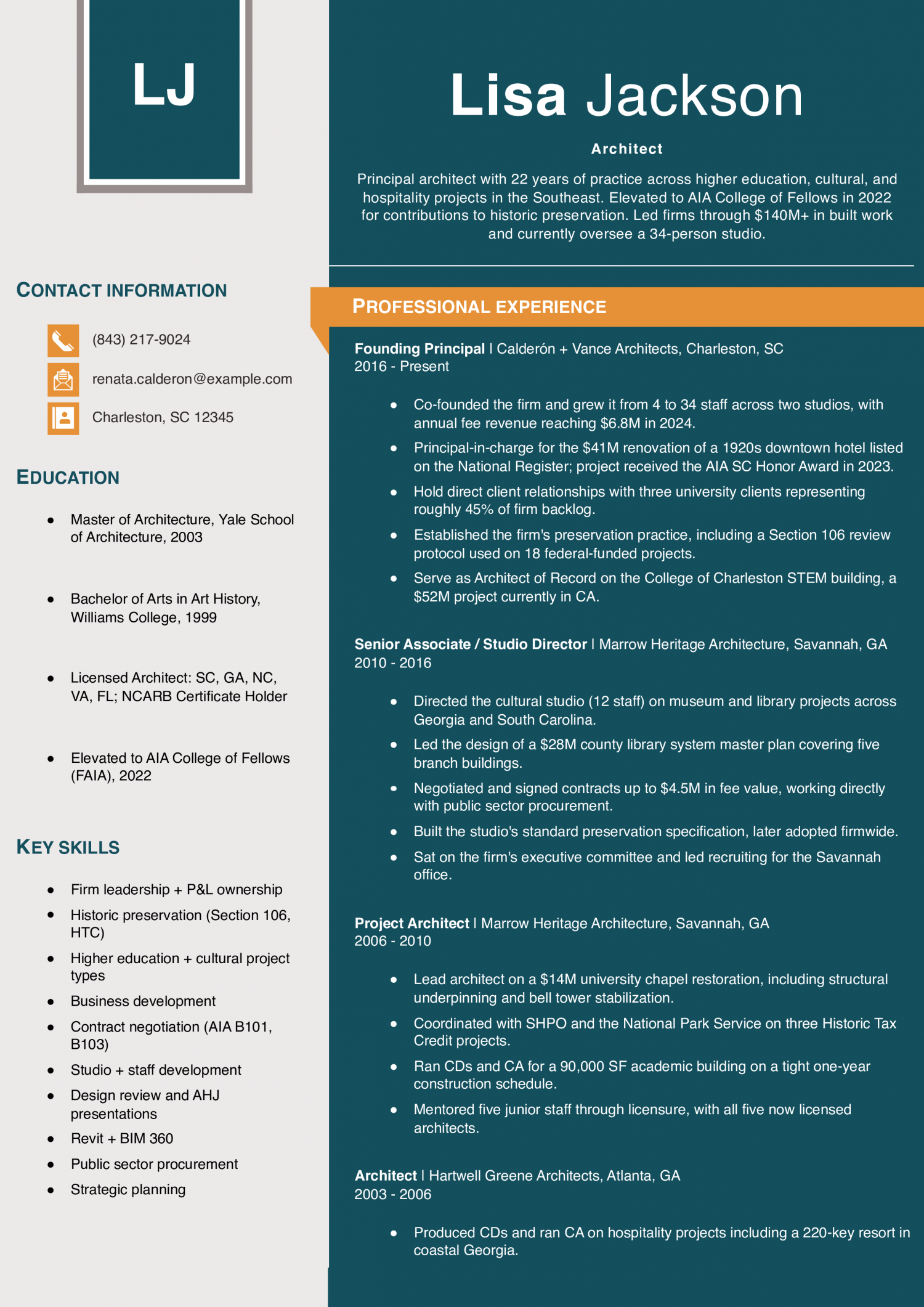
Principals and associate principals own studio output, client relationships, and firm-wide standards. The resume needs to prove signed work across multiple building types, business development numbers, and the staff or studio you lead.
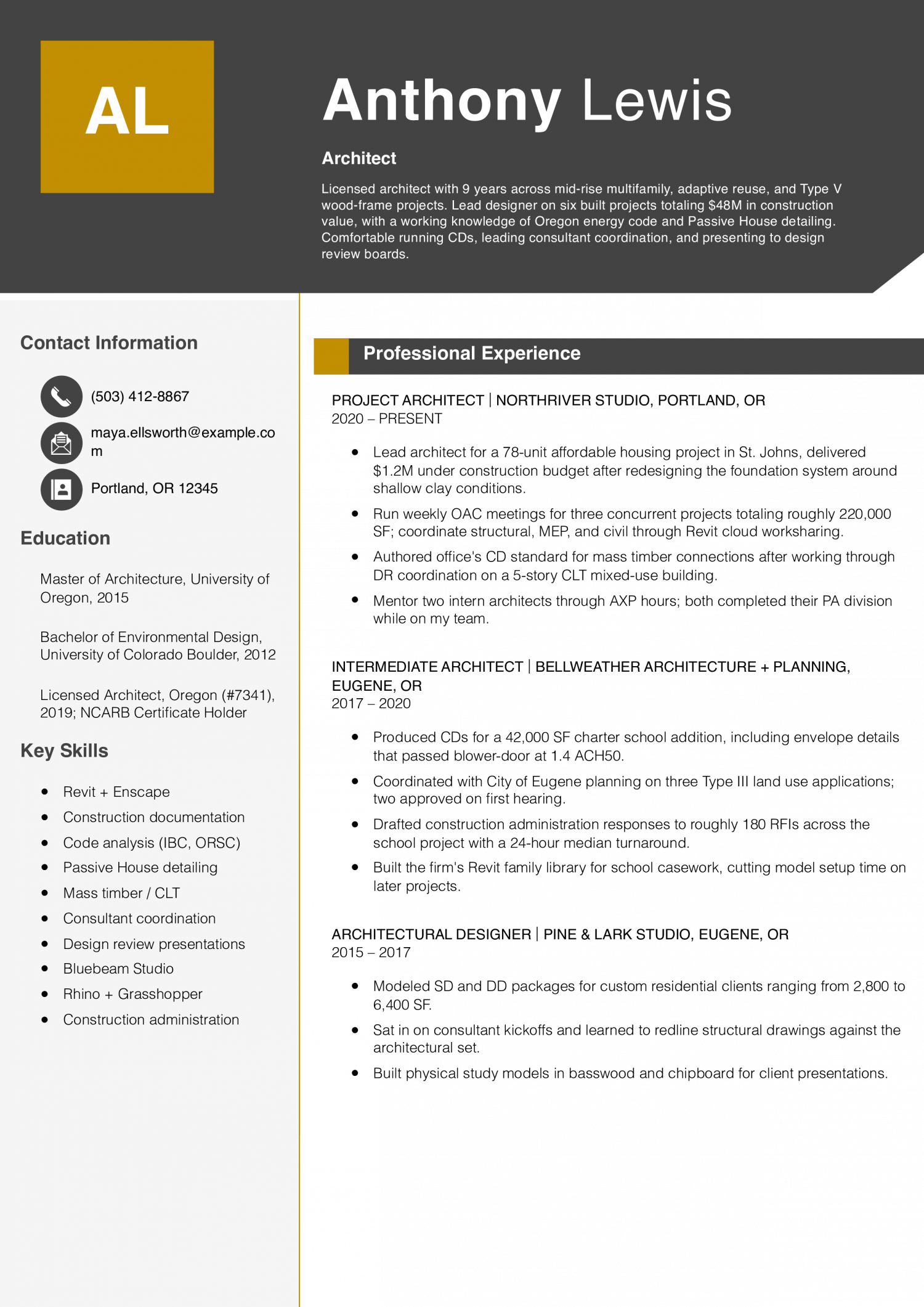
Licensed architect with 9 years across mid-rise multifamily, adaptive reuse, and Type V wood-frame projects. Lead designer on six built projects totaling $48M in construction value. Working knowledge of Oregon energy code, Passive House detailing, and CLT mass timber assemblies. Strengths include running CDs, leading consultant coordination, and presenting to design review boards in Portland and Eugene.
NCARB shows licensure and AXP hours. It does not show the work that sets you apart.
Add a single line a principal cannot find on a license lookup: LEED AP BD+C with two certified projects, healthcare CD experience under OSHPD review, Revit family-library ownership for a 40-person studio, or Passive House CPHC on a built multifamily job. Lead the summary with that signal, then follow with jurisdiction and ARE status.
Most strong architect bullets carry three numbers: square footage, budget, and a phase or schedule figure. Bullets without scope read as duty lists.
Name the building type, then the gross square footage, the construction cost, and the role you played. A bullet like “Led CDs for a 64,000 sq ft K-8 addition, $22M GMP, coordinated MEP and civil consultants through CA” outperforms three lines of soft framing every time.
Principals scan for phase coverage and building-type range. Cluster bullets under each role into four buckets: design (SD/DD), documentation (CD), construction administration, and code or zoning work.
Inside each bucket, name building types you’ve delivered: healthcare, K-12, higher ed, multifamily, mixed-use, adaptive reuse, civic, hospitality. A project architect resume that shows two CA jobs across two building types reads stronger than five SD-only renderings on one type.
Put a credentials block under your name: licensed jurisdictions and status (“Licensed Architect, NY and NJ; NCARB certified”), AXP completion if pre-license, ARE divisions passed, and LEED or WELL credentials. Do not publish your license number.
Add a tools line: Revit, AutoCAD, Rhino, Grasshopper, SketchUp, Enscape, Bluebeam, Newforma. Firm partners filter on the BIM stack before they read bullets, so this belongs above your experience section, not buried at the bottom.
Drop the rendered image on the resume itself. Link a portfolio URL in the header instead and let the work breathe at full resolution.
Cut software you have not used in three years (3ds Max if you live in Enscape now), studio competition entries from school if you have built work, and any line that names a course instead of a project. A principal-track resume should fit two pages with project scope on every line.
The architect resumes that get callbacks share a specific skill mix. The lists below come from our user-built architect resumes. Principal architects and firm partners scan for these patterns first, not design-philosophy language.
Hard skills carry the keyword parse: Revit, code knowledge, CA experience. Soft skills back the bullets where you ran a consultant team or held a client through value engineering. Match the hard-skill list against the job posting line by line, then use soft skills as evidence inside project bullets, not as a standalone block.
| Soft Skills | % of resumes with this skill |
|---|---|
| Design problem-solving | 77% |
| Cross-disciplinary collaboration | 50% |
| Client communication | 45% |
| Project coordination | 36% |
| Attention to detail | 34% |
And here are the top hard skills showing up most often.
| Hard Skills | % of resumes with this skill |
|---|---|
| Architectural design development | 74% |
| AutoCAD and Revit drafting | 64% |
| Building code compliance | 44% |
| Construction document preparation | 38% |
| 3D modeling and rendering | 25% |
Based on data from thousands of architects’ resumes built on ResumeTemplates.com, May 2026.
Before an architect resume gets a closer read, hiring teams check for a short list of essentials.
Principal architects and firm partners expect a niche section that mirrors their job posting language. Group keywords by the specialty the firm hires for, not by tool category.
| Niche | Keywords ATS scans for |
|---|---|
| Licensure and credentials | licensed architect, NCARB certified, ARE, AXP, LEED AP BD+C |
| Project phases | schematic design, design development, construction documents, construction administration |
| BIM and documentation | Revit, BIM coordination, Navisworks, Bluebeam, drawing-set production |
| Design and visualization | Rhino, Grasshopper, SketchUp, Enscape, parametric modeling |
| Building types and codes | healthcare, K-12, multifamily, adaptive reuse, IBC code analysis, ADA |
What principals expect on an architect resume has shifted: silence on AI tools now reads as out of touch on most production studios; an honest line naming where you use generative tools and where you do not reads as professional. The list below names what to add.
Generative tools produce massing and unit-mix options in hours, so principals expect more iterations reviewed per SD meeting.
AI assistants surface relevant IBC sections and local amendments faster, but verification against the adopted code is still your job.
Scripted and AI-assisted tools handle naming conventions, parameter audits, and family standardization that used to consume junior-staff hours.
Enscape and Diffusion-based rendering pipelines compress photoreal output, shifting the conversation from "can we render it" to design quality.
Stable Diffusion or Midjourney (concept imagery): Used for early massing and material studies in SD; always labeled as concept, not final.
ChatGPT or Claude (specifications and code lookup): Used to draft spec sections and surface code references that you then verify against the adopted edition.
An architect resume without a portfolio link gets a polite no. Place the URL in the header next to your email, and make the first three projects in the portfolio match the building types in the job posting.
Your own URL signals investment; loads fast on partner laptops during portfolio reviews.
Works when firms expect a downloadable book, common for European studios and academic-adjacent practice.
Strong for visualization-heavy submissions; weaker for technical drawing sets.
Lead with built or under-construction work if you have it. Schematic and competition entries belong later in the book.
Show drawings, not just renders. Principals want to see your CD pages, wall sections, and details, because that is what they will pay you to produce.
Keep a one-page PDF version at 5 to 8 MB for email submissions where a URL is blocked by firm IT.
Licensure is the single fastest filter a principal applies to your resume. Place it in a credentials block directly under your name, before the summary.
List each jurisdiction where you hold an active license, using the state name and “Licensed Architect in good standing.” Do not publish the registration number on the resume itself; provide it on the firm’s application when requested.
If you are pre-license, list ARE divisions passed by name and your AXP hour completion percentage. NCARB Record holders should add “NCARB certified” or “NCARB Record active,” which signals reciprocity readiness for multistate firms.
Principal architects read this list as a map of where your work is heading. The certifications below tell them which sustainability, building-type, or delivery-method track you’ve invested in. List the issuing body and the year earned, with project count where relevant.
LEED AP BD+C (USGBC): Signals you can lead a project through LEED certification, not just answer questions about it; pair with the number of certified projects.
WELL AP (IWBI): Reads as healthcare, workplace, or multifamily specialization where occupant-health scoring is part of the client brief.
Certified Passive House Consultant (PHIUS or PHI): Differentiates you on high-performance residential and multifamily work, especially in jurisdictions with stretch energy codes.
NCARB Certificate: Speeds reciprocity in additional jurisdictions and signals to multistate firms that you can stamp work outside your home state.
Architect is a narrow occupation in BLS terms, which means supply matters and a stamped licensure record reads as real differentiation against unlicensed designers in the same applicant pool. Pay also clusters around a handful of metro markets where institutional, healthcare, and high-rise work concentrate. The spread between the 10th and 90th percentile is wide because principal-track and developer-side roles sit far above staff salaries.
Position your resume against the band you’re targeting: lead with the credential or project scope that band actually pays for.
| # | State | Avg. Annual |
|---|---|---|
| 1 | District of Columbia | $114,480 |
| 2 | Wyoming | $107,040 |
| 3 | Rhode Island | $106,950 |
| 4 | California | $105,840 |
| 5 | Alaska | $105,340 |
| 6 | Connecticut | $105,200 |
| 7 | South Dakota | $102,420 |
| 8 | Massachusetts | $101,980 |
| 9 | Nevada | $101,720 |
| 10 | Georgia | $100,870 |
| # | State | Workers | Median |
|---|---|---|---|
| 1 | California | 13,880 | $105,840 |
| 2 | New York | 10,930 | $98,580 |
| 3 | Texas | 8,030 | $85,770 |
| 4 | Illinois | 5,580 | $79,320 |
| 5 | Florida | 5,500 | $83,720 |
Resume Templates offers HR approved resume templates to help you create a professional resume in minutes. Choose from several template options and even pre-populate a resume from your profile.
Use a reverse-chronological format on two pages with a credentials block under your name.
Group experience by employer, then cluster bullets by project phase: SD, DD, CD, CA.
Keep the resume itself text-only and link a portfolio URL in the header for the visual work.
Yes. List divisions passed by name (PcM, PjM, PA, PPD, PDD, CE) with the year each was completed.
Note your AXP hour completion percentage in the same block.
This tells a principal you are actively moving toward licensure, which affects how they assign project responsibility.
Use building type, square footage, construction cost, and your role. You do not need to name the client.
A bullet like "Mixed-use multifamily, 180 units, $48M GMP, ground-up" gives a principal what they need.
Save named references for the portfolio walk-through or interview, where context lets you frame the relationship.
No. List the state and "Licensed Architect in good standing" without the registration number.
You will provide the number on the firm's application form when requested.
NCARB certification can be listed as a line item without exposing the record number.
For an architect, a tech template is the safest pick, because it keeps your stack, tools, and impact easy to scan. An ATS-friendly template is a solid alternative. Whichever you choose, keep the formatting clean and easy to parse: clear section headings, a standard font, and no graphics a parser can choke on.
Executive Resume Writer and Career Coach
Andrew Stoner is an executive career coach and resume writer with 17 years of experience as a hiring manager and operations leader at two Fortune 500 Financial Services companies, and as the career services director at two major university business schools.
Customize this template in our builder in under 10 minutes.