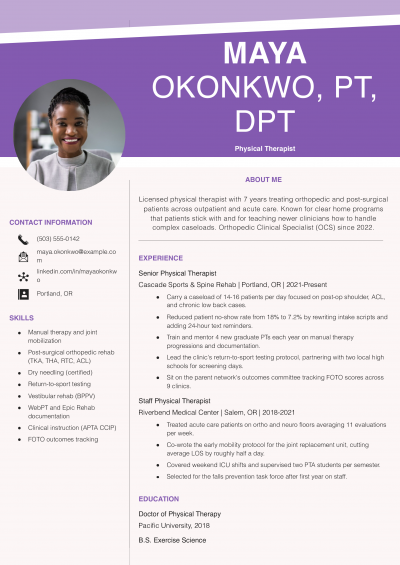
Physical Therapist Resume Examples
Lead with the one signal a PT clinic director cannot pull from your state board record. That could be your OCS or NCS specialty board, a vestibular or LSVT BIG certification, or a manual therapy…
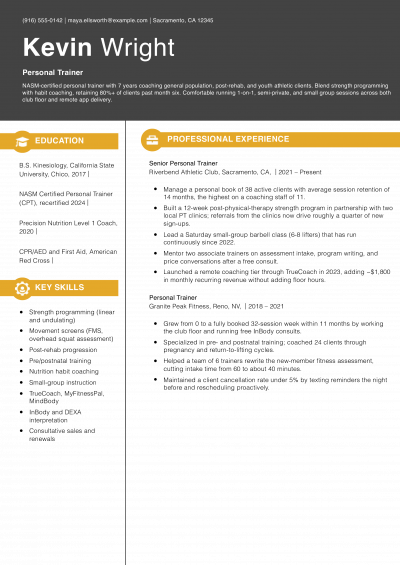
Every resume example is written and reviewed by our team of Certified Professional Resume Writers to ensure top-quality content and formatting.
Your ATC credential opens the door, but your resume decides which room you enter. Head athletic trainers, athletic directors and clinic managers scan for injury evaluation volume and return-to-play outcomes. They want to see the sports or patient populations you have covered.
List the modalities you use, like therapeutic ultrasound or electrical stimulation, and pair each one with a caseload size or recovery rate. Name the electronic medical record system you document in daily. To compare layouts before you start, browse our resume templates.
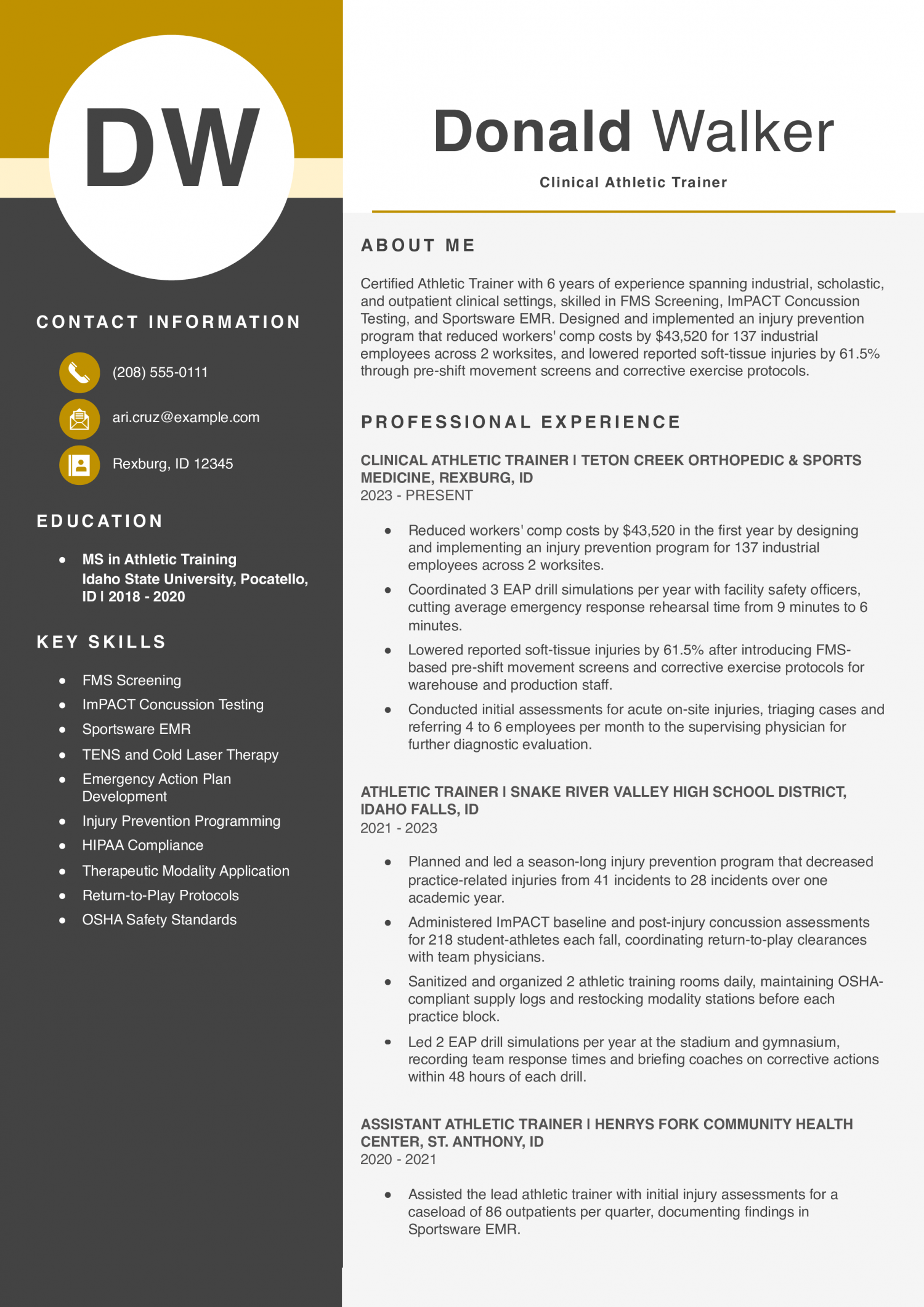
Consider this resume if you are a mid-level clinical athletic trainer bridging industrial occupational health and traditional sports medicine roles. Lead each bullet with a cost or injury-rate figure tied to a specific prevention program rather than listing modalities performed.
Employers hiring an athletic trainer for an industrial site want fewer injuries and lower claim costs. This resume ties a screening program to the drop in reported strains and the savings in workers’ comp. If you run prevention work, write down the program, the group it covered and the change in injuries and costs.
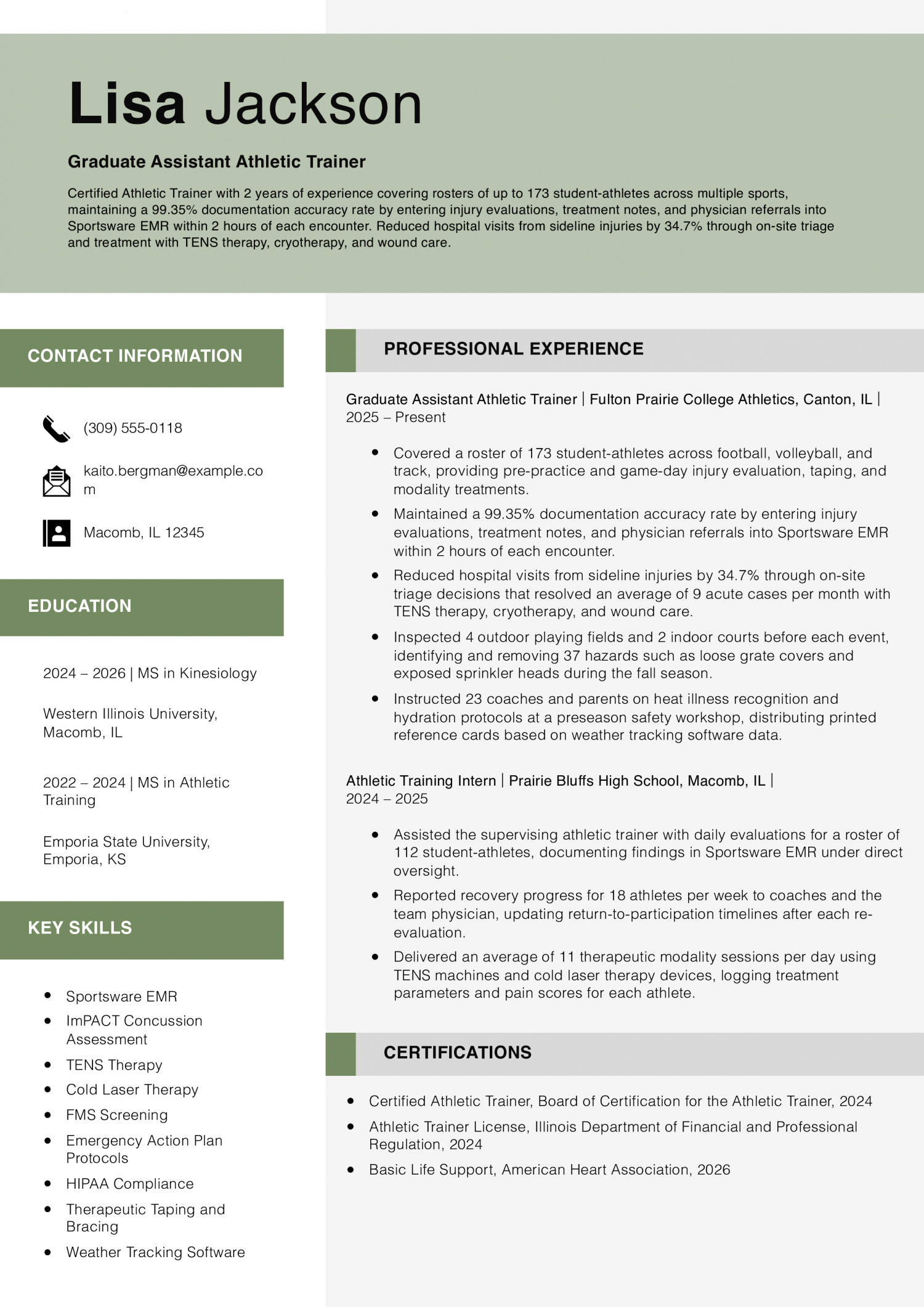
Start with this resume if you are an entry-level athletic trainer beginning a graduate assistantship or first clinical role. Lead with documentation accuracy rates and sideline triage outcomes rather than listing general rehabilitation duties.
A head athletic trainer hiring a graduate assistant looks for careful notes and calm judgment on the sideline. This resume shows how fast injury notes went into the records system and how on-site triage kept athletes out of the hospital. On your own resume, say how soon you finish documentation and what your sideline decisions led to.
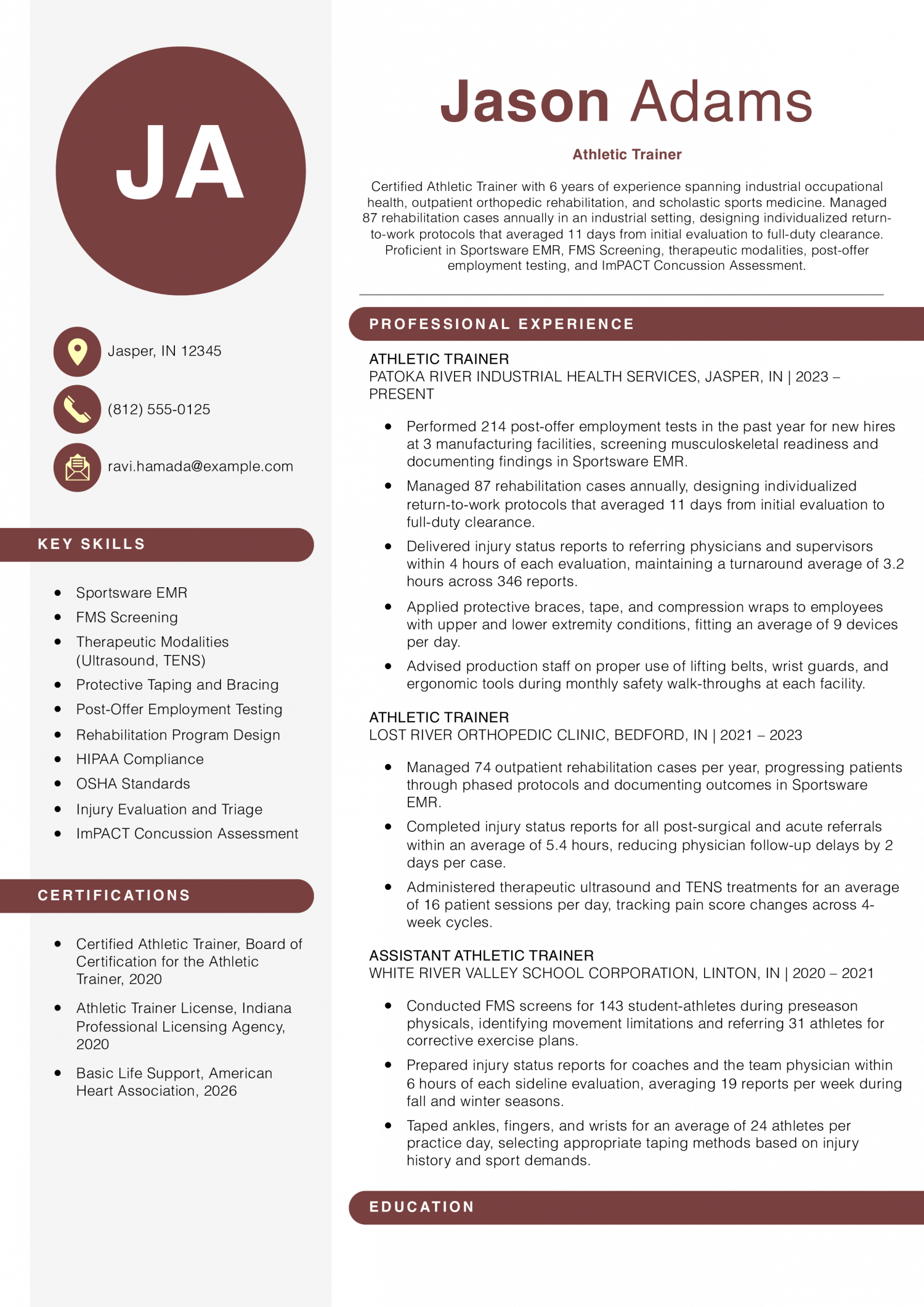
Try this layout if you are a mid-level athletic trainer moving between clinical, industrial, and school-based roles. Lead with report turnaround times and caseload counts to prove documentation speed alongside rehabilitation results.
Physicians and supervisors who refer workers want a clear report back fast. This resume shows how many tests and rehab cases the trainer handled and how soon each status report went out. When you list your caseload on your own resume, add the turnaround time and the number of days it took people to return to full duty.
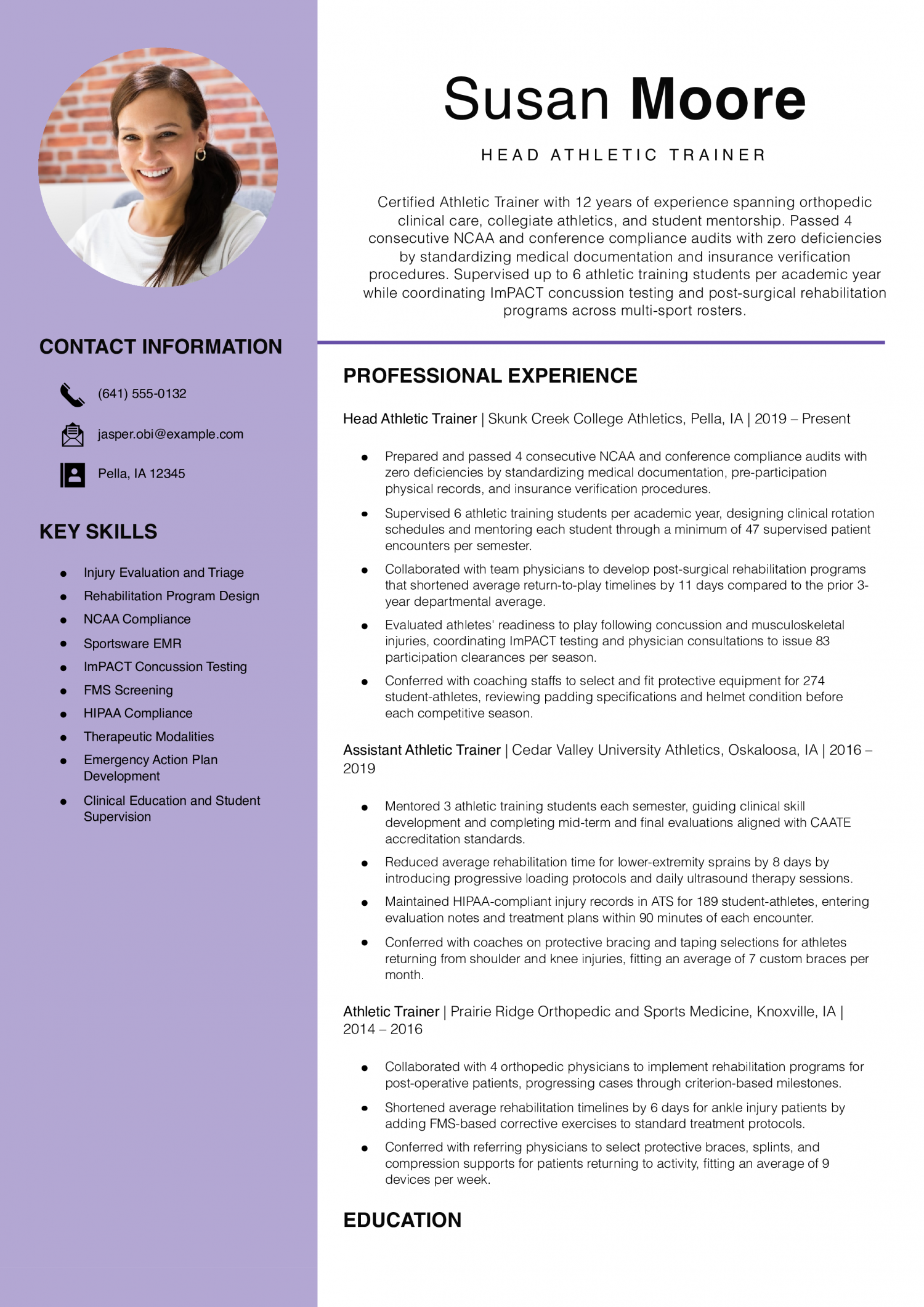
Lean on this resume if you are a senior-level head athletic trainer with a record of compliance oversight and student supervision. Lead your bullets with audit outcomes and return-to-play timelines rather than listing routine treatment duties.
Athletic directors hiring a head athletic trainer look for clean audits and a staff that can run without you. This resume reports consecutive audits with no deficiencies and the number of students supervised each year. When you describe leadership on your own resume, name the records you kept and the audit results they led to.
Certified Athletic Trainer with 6 years of experience covering up to 11 sports programs across collegiate and high school settings, including emergency action plan development for multiple venues, travel coordination for away competitions, and injury documentation in Sportsware EMR. Managed supply inventories and restocked taping and bracing materials, submitting purchase orders totaling $4,415 per quarter while maintaining HIPAA-compliant records and completing ImPACT concussion testing protocols.
Head athletic trainers and athletic directors scan your summary for a number first. Lead with your daily athlete caseload or the roster size you cover. A line like “ATC covering 85 Division II athletes across four sports” gives reviewers a fast read on your volume.
Follow it with the setting you know best, such as a university or an outpatient clinic. Then name the population, like high school or professional athletes. This opening tells reviewers your capacity before they read a single bullet.
Skip vague phrases about passion or years of experience. A concrete count does more work in fewer words. Pair the caseload with one outcome, such as a return-to-play rate or injury reduction percentage.
Athletic directors want proof that your care changes results. Strong bullets include metrics like injury incidence rates and return-to-play timelines. For example, write that you cut ankle sprains by 30 percent over two seasons.
Or note that your rehab protocols shortened average recovery by five days. Track the number of evaluations you perform each week. Note the athlete-to-trainer ratio you manage on game days.
If you reduced referrals to outside providers, state the percentage drop. When you document insurance pre-authorizations, include the approval rate. Each bullet should pair one action verb with one measurable result.
Numbers let clinic managers compare you to other candidates on the same scale.
Sort your bullets into categories that match how the job runs. Start with injury evaluation and diagnosis, covering on-field assessments and clinical exams. Next, group therapeutic interventions such as rehab programs and manual therapy.
A third category should cover emergency care and game-day coverage. Add a section for prevention work, like screening protocols and corrective exercise plans. If you handle administrative tasks, group documentation and insurance coding together.
Pull category names from the posting when you can.
The grouping shows you understand how the role breaks down day to day.
List your Certified Athletic Trainer credential from the Board of Certification for the Athletic Trainer on its own line. Below it, add your state athletic trainer license with the state name.
Licensing rules differ by state. Include Basic Life Support from the American Heart Association on a separate line.
If any credential is pending, note the expected date. Below your credentials, list the tools and software you use, such as electronic medical record platforms or injury tracking systems. Keeping credentials visible on page one saves reviewers from searching later pages.
List your athletic training degree near the page bottom. Include the school name and your graduation year on one line. Name the CAATE-accredited program so reviewers can confirm your education path. List any related degree on its own line.
Clinical rotation hours matter for entry and mid-level roles. Note the total hours and the settings where you trained, such as a college or a physical therapy clinic. Add a second setting on its own line.
If you hold a master’s degree, place it above your bachelor’s entry. Head athletic trainers look at fieldwork depth to gauge hands-on readiness. Relevant coursework in biomechanics or therapeutic modalities can fill space when your work history is short.
Keep the education section to four or five lines total.
Check the injury assessment and rehabilitation terms below against each posting you read.
Head athletic trainers and athletic directors weigh hard skills like injury evaluation first. Soft skills such as communication come next. Both types shape which resumes move forward in the review.
Choose skills from the tables that match the requirements in your target posting. Work soft skills into your bullet points as proof of a real outcome. Drop any term the posting does not list.
Place hard skills near the top of each work entry. A clear verb plus a measurable result gives each skill context. Soft skills read best when tied to a specific event or team setting.
Review the two tables below before you draft your next version. Match the phrasing to what each job ad uses. Even small word swaps can cause a filter to skip your file.
| Soft Skills | AI-estimated % |
|---|---|
| Athlete communication | 79% |
| Composure under pressure | 55% |
| Sideline decision-making | 49% |
| Collaborative team care | 39% |
| Patient education | 26% |
And here are the top hard skills showing up most often.
| Hard Skills | AI-estimated % |
|---|---|
| Injury assessment | 74% |
| Rehabilitation planning | 52% |
| Taping and bracing | 50% |
| Emergency action planning | 37% |
| Return-to-play evaluation | 33% |
Skill names and rankings come from an AI model grounded in U.S. Department of Labor occupation data for athletic trainers, not from a count of athletic trainers’ resumes built on ResumeTemplates.com.
Head athletic trainers, athletic directors and clinic managers sort athletic trainer resumes by injury assessment and rehabilitation planning, which is why the items below put them where a reader finds them.
Many states require a license to practice athletic training. Rules differ in scope, title and renewal cycle. Check your state board before writing your resume.
List the state that issued your license. Write “license in good standing” with the state name.
The BOC requires continuing education units to keep your ATC. Head athletic trainers want to see that you stay current. A dedicated resume section signals ongoing growth.
Group your entries by topic when possible. Include the provider, date and unit count for each.
A concussion management course matters for a school sports role.
Clinics and athletic departments rely on electronic records. Listing the systems you know shortens onboarding. Athletic directors notice this detail.
HIPAA training proves you can safeguard athlete records. Clinic managers screen for this early in the process.
Mention any role where you managed record access. Describe how you kept data secure in a shared setting.
Your BOC credential and state license keep you eligible. Head athletic trainers, athletic directors and clinic managers scan this block to gauge your scope of practice.
They also look for proof that you can respond to field emergencies. A strong list signals you stay current with continuing education. It tells reviewers you take professional standards seriously.
Put the issuing body, the year you earned each card, and the renewal date on one line. That format lets a reviewer confirm your status in seconds. If a card renews on a cycle, note the next renewal year so nothing looks expired.
Your ATC credential is the first thing reviewers check. The Board of Certification for the Athletic Trainer issues it. BLS says athletic trainers must be licensed or certified in nearly all states.
BLS counts about 30,500 athletic trainers in the U.S. A specific credential or experience in a specialty setting helps reviewers see what sets you apart. At the 90th percentile, pay sits about 42 percent higher than the median.
Pay at the 10th percentile falls about 23 percent short of it. Use these figures to assess the pay offered in job postings. Geographic variation adds another layer, so check the state tables against any posting you target.
To stand out, lead your resume with the clinical setting you cover and the athlete caseload you manage each season.
| # | State | Median Annual |
|---|---|---|
| 1 | California | $78,490 |
| 2 | Hawaii | $76,320 |
| 3 | New Jersey | $76,210 |
| 4 | District of Columbia | $74,450 |
| 5 | New Mexico | $72,440 |
| 6 | Massachusetts | $70,010 |
| 7 | Connecticut | $69,960 |
| 8 | New York | $66,230 |
| 9 | Utah | $65,980 |
| 10 | Minnesota | $65,390 |
| # | State | Workers | Median |
|---|---|---|---|
| 1 | Texas | 3,130 | $64,150 |
| 2 | Ohio | 2,100 | $61,420 |
| 3 | Pennsylvania | 1,870 | $61,060 |
| 4 | California | 1,760 | $78,490 |
| 5 | Florida | 1,430 | $61,350 |
Resume Templates offers HR approved resume templates to help you create a professional resume in minutes. Choose from several template options and even pre-populate a resume from your profile.
Most athletic trainers with under 10 years of experience can fit their resume on one page. If you have published research or worked in multiple clinical settings, a second page is reasonable. Keep every line tied to the role you are targeting.
Yes, especially if you are early in your career. List each rotation site with the setting type and the hours you finished there. Head athletic trainers and clinic managers use this detail to gauge your hands-on training.
Lead your summary with the credential you earned and the clinical hours you completed. Reframe prior work around transferable skills like injury assessment and patient education. Athletic directors want to see that your past role built abilities you now apply in sports medicine.
Start each bullet with a verb that names a clinical action. Words like evaluated, rehabilitated, documented, and triaged tell reviewers what you did. Avoid vague verbs like helped or assisted unless a measurable result follows them.
Yes, if the topic relates to the position you want. Create a section called Publications or Presentations with the title, venue, and date. Clinic managers at academic medical centers or research hospitals value this work.
Be honest about the gap and name any relevant activity during it. Volunteer event coverage and continuing education courses both count. Athletic directors care more about current BOC certification status than a gap in paid work.
Yes, because many applicant tracking systems scan a dedicated skills section before parsing bullets. Keep it to eight to twelve terms that match the posting, such as concussion protocol and therapeutic modality. Your bullets then prove each skill with a specific outcome.
You have two good choices for an athletic trainer resume, an ATS-friendly template or a basic template to start from. Both work when the headings are plain, the font is standard, and the page has no graphics.
Athletic Trainer Resume
4.5/5 stars with 181 reviews

Executive Resume Writer and Career Coach
Andrew Stoner is an executive career coach and resume writer with 17 years of experience as a hiring manager and operations leader at two Fortune 500 Financial Services companies, and as the career services director at two major university business schools.
© 2026 Resumetemplates.com All rights reserved.